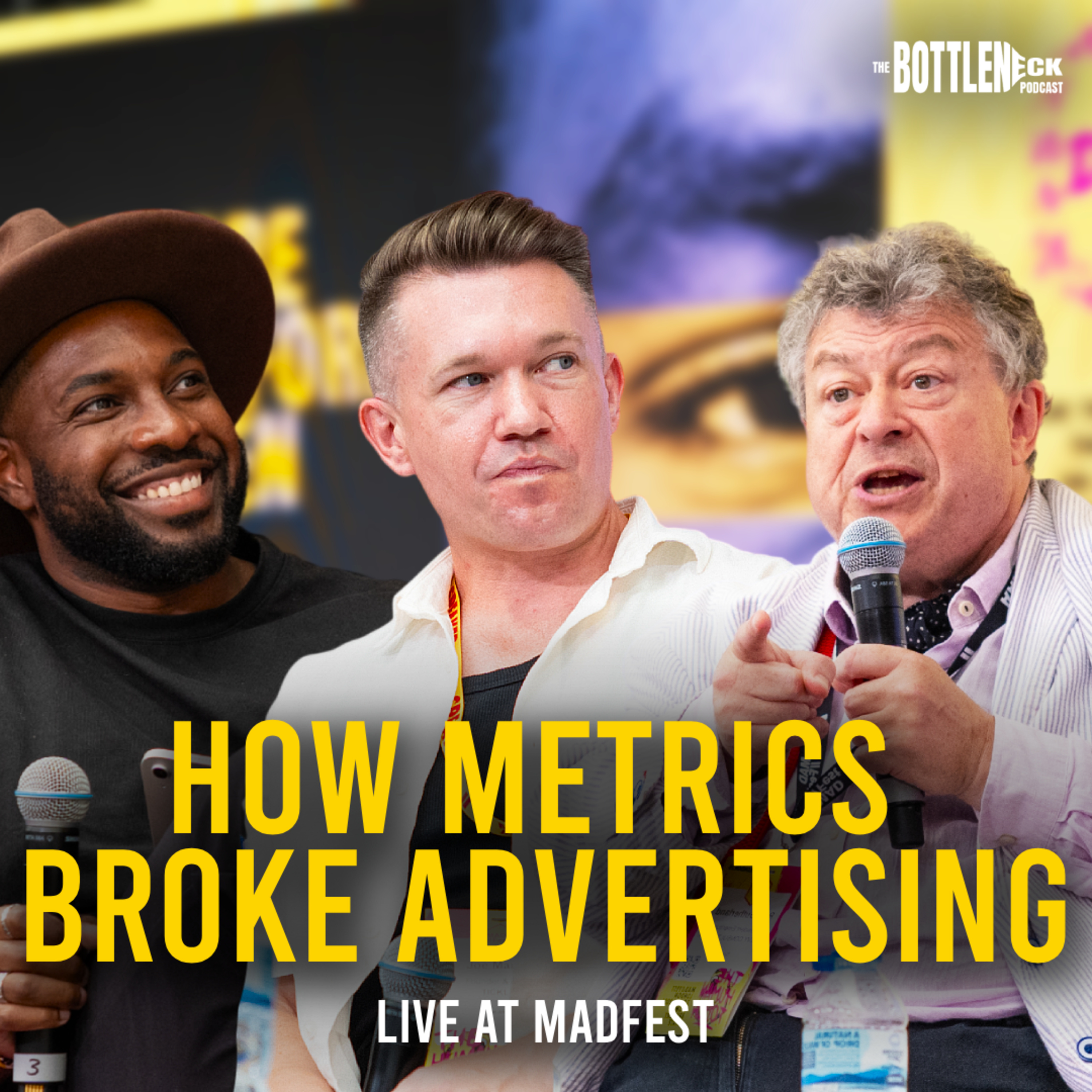
Joe Martin with Rory Sutherland and Elfried Samba, recorded live at MAD//Fest
from The Bottleneck Podcast
32m 28s
The podcast episode features Joe, founder of Tickle, a platform that lets consumers save digital ads to their mobile wallets for later action, addressing the problem of ads that are relevant but poorly timed. Joe explains that this creates a "third state" of advertising, moving beyond the binary click-or-not model to honor consumer intent. He draws parallels to direct mail's keepability and the human tendency to save information for later. Tickle's engine reminds users about saved ads, driving high engagement rates, such as 21% immediate post-click action and 54% return over four weeks for a CPG brand. The conversation shifts to the broader advertising industry's flaws: an obsession with immediate conversion metrics that ignore context, mood, and relationship-building. Joe argues that brands should prioritize trust and long-term advocacy over short-term transactions, akin to building a "marriage" rather than running an "escort service." However, a major bottleneck is clients who resist innovation because they are tied to old metrics that favor fast, quantifiable results, even when slower, more courteous approaches yield better outcomes. The episode underscores the need for the industry to re-focus on context, consumer respect, and relational value.
[MUSIC PLAYING] How's everybody doing? No, that's not good enough. We're not going to start the podcast until we get the decimals up. How's everybody doing? One more time. All right. So my name is Alfred Simon. I'm the co-host of the bottleneck podcast alongside Rory. I firmly believe we should start a podcast as the modern day version of We Should Start a Band. And that's exactly how it started. Rory and I were at WPP Beach in no stream a couple of years ago. We had a conversation in last year about an hour and a half. And we said that this should be a podcast. And then we looked at each other and said, We Should Start a Podcast. And here we are. So with our further ado, we have an amazing guest today. This is one of our second live episode. And we have Joe that's here with us in true bottleneck form. We don't own the narrative of the guests. We let the guest own the narrative. So it'll be great for you to give our guests an introduction to yourself, Tickle, and some of the bottlenecks that you've been solving across your-- Actually, very quick question. How many of you have heard of Tickle? OK, this is interesting. How many of you practice digital marketing in some shape or form? OK, right. There's a job to be done. OK, here we go. Got it. Yeah, thanks, Elf Reed. So basically, Tickle is a saviable ads infrastructure. So we enable any ad across any format to be safe for later, directly into the mobile wallet, whether that's Apple or Google. That in itself creates a direct channel between the consumer and brand based on intent with 100% human attribution. It's essentially a third state of advertising in a current advertising world where everything is binary. It's like, you click or you don't click. There's no in between. So we create that third state for people who are interested, but not at that time. OK. This fascinated me because it struck me that a very large part of digital advertising effectively has the wrong call to action. Because every single piece is measured on act now. Now, half the time you're exposed to that ad when you're trying to do something like renew your car road tax. OK. You're in the middle of accomplishing some completely different task. And the ad is not irrelevant in terms of who it's targeted to, but it's completely irrelevant in terms of the moment at which it reaches you. And my whole career start in direct mail, which has one magical property in terms of its value, which is keepability. You might get a piece of direct mail. I think the average piece of direct mail is kept in the home for about six or seven days. You deal with it at a time of your own choosing when it's relevant to you. And so we were just talking fun enough backstage. I said, about the third most irritating thing online, after cookie permissions and pop-ups that cover the button that you're trying to press, the third most irritating thing effectively is when someone sends you a ticket to something without an ad to wallet button. Right? Because you're like, what the fuck am I supposed to do with this? It's rather like those people who, when you have a conference, they send you the directions three weeks before. OK. You go, look, I'm not a rainman. I'm not going to actually memorize this shit now. What I want to do is save it up to a moment when it's actually necessary. Now, when you think about it in terms of a lot of advertisers, and a lot of people who spend a lot of money on digital advertising, it always struck me that the consumer package goods businesses were getting a raw deal. Because they're selling a low margin product, which isn't an impulse buy, which isn't bought immediately. They will always end up getting out bid for the high value inventory for people who are the opposite, high margin products that you buy immediately on impulse. OK? It struck me that I actually asked Mark, read the same question. I said, do you actually see many unilever ads online? We both said, no. And yet they spend a lot of money. And our suspicion is that they're getting second rate inventory that people like us don't see. Now, if you change the call to action to save to later, what you've done effectively is you've taken an ad that would be a good idea wrong time. And you've effectively turned it into a retail ad. You've turned it into retail advertising. But you can explain more. It's much more than just save for later. You can actually make the thing in your wallet to clever things later on. Yeah. Tell us more about that. No, exactly that. And CPG is a great example. Because they don't have necessarily a lot of data on who their end audiences. So one of the things that we looked to do is give control back to the brands in that respect as well. But so we've just run a campaign on our rails with a large CPG. And directly 21% of the people who clicked through the ad took an action. So 21% post-click action rate. That in itself, they were in love with. The stronger point of that is that-- I mean, we talk about doing things for later. And to your point earlier about getting the address three weeks earlier, right? Humans innately forget stuff. So even if you screenshot an ad which is where this all started, or you save an ad into the wallet, you're going to forget about it. So what we've built in a background is an engine that prompts people, reminds people that they've saved the ad, can deliver new information, new updates, and what that's done, even with a CPG and with nappies. 54% of the people who saved the ad over a four-week period went back to the wallet in their card, clicked out, went to site, took an action. The consumer has complete control on that. They're not being forced into anything. That is then putting their hand up in a first instance saying, I'm interested, but I'm too busy right now. And that's how people shop. It's one of those things. And actually, you can go back to newspapers where people are clipping out ads and articles and saving them in their physical wallet for later. This is just the progression of that. And yet the industry has somehow missed this. It's extraordinary actually, because there was tons of data. I mean, there's very simple finding from direct marketing, which is if you send identical creative to the same list two weeks later, you've got 50% of the initial response. So in other words, time, even if the second time was just as irrelevant as the first, still effectively accounted for a very large part of why people weren't responding. Absolutely. Now, if you make that second encounter actually relevant and consumer selected rather than just random, it's likely to be a lot more than 50% and may well be 100 or even more. Yeah, this is it. And this is what we talked about. And I guess this is the problem with the industry. In general, everything right now is built and engineered and optimized for the point of delivery, not for the point of decision. And there is a big difference in time and space between when somebody sees an ad and then when they actually want to take action on it. Nothing accounts for that. And that's one of the biggest things that we're trying to do is close that gap, because it conforms to how people actually shop today. And just to jump in there, before tickled, there was snatch. What's the connection between the two? Other than the ridiculous names, snatch was. Snatch by launching like 2016, '17. Just to be clear, this is as snatch as in grab. OK, I just, just in case anybody's thinking-- For the American company-- --we're suddenly voting hardcore porn apps. OK. I love my-- I had good fun preaching that in the US. So basically what it was, I thought it would be hilarious if I let people steal off each other in a fun way, in a digital environment. So in like 2016, we basically got a bunch of brands. We took their ads. We created an augmented reality treasure hunt called It Snatch. And we hid ads all around the country. We let people find them, snatch them from each other. And then after six hours, basically what they're finding is a parcel. They don't know what's inside exactly. But then after six hours, it opens up, they can redeem what it is. And actually, what it mostly was was affiliate offers. But what we did, what was smart about that, and I guess that what leads to tickle, is we asked the right question. Actually, it wasn't even asking the right question. It was allowing the consumer to give us the right answer, which was, are you interested? Do you want this ad? So every single day in the morning, people were trained or engineered to wake up. They checked their phone. They'd probably see what parcel they had, what they'd want, et cetera. But then they'd have seven new ads. And if they were interested in that product, they'd like it. And then that ad becomes part of their game that go out throughout the day. They find the parcel, they defend it. But what it actually does is, to give you an example, I live in the US now, so I have to say no.
Nike. Basically, they might give away 10 pairs of trainers, right? 100,000 people would say, I'm interested in that, that will go into the game for that day. Only 10 people win those trainers. So, you're 99,990 people don't win anything, but Nike know who they are. They have a direct route back to that consumer who has shown intent and said, I want that product. So, then Nike can go back and we call it a secondary offer. And they can go back and go, well, we know you didn't win it. Here's 10% off if you purchase it in the next 24 hours, etc. And that is pure deterministic data coming from the platform. And that is essentially what we're looking to do or what we are doing with Tickle, but at kind of DSP scale. I mean, actually, both of them are based on a similar in a sense, the similar insight, which is what people dislike about advertising and brands is not necessarily what they are. It's how they show up. 100%. I always say, people don't hey advertising, they hate being interrupted. So, if you can get an ad to not act and or look and feel like an ad, people will engage with it. Because naturally as humans, we crave new information. We want to know what our favorite brands are doing next. We always want to know if there's a good offer or a deal we can get. But if it's just being blasted at us, every single page that we turn, we train to ignore it. The analogy I always use about this, about the importance of timing and context. And of course, as you know, being interested in behavioral science, we're obsessed by context partly because the effect of context is often invisible or not properly measured. Is that those moments when you've had a hard day and you're travelling over the train? And you see the person who you probably like more than almost everybody else in the whole world board the train and you're actually disappointed because you're looking for a spending 45 minutes on your own. You see what I mean? You all know what that feels like. People who you really, really love but who show up at an inopportune moment. Yes. What you're doing there, which is actually personalization targeting by time. In a sense, I suppose, that's one of the insights of behavioral science, which is me now and me in four hours time are actually in a way more different than you and me are now. Yeah. And it's, I think that, that importance, economics doesn't understand mood. Fundamentally, doesn't understand mood, it doesn't understand mode, it doesn't understand context, it just understands transactions and utility maximization. And actually, when you look at a huge amount of consumer purchase behavior but also in interaction engagement attention, one virtue which everybody missed about direct mail was that it was keepable. And one virtue everybody missed about press advertising was that it tended to appear when you were reading anyway. And so you're in the right frame of mind to consume a press ad by dint of the fact that you're reading a newspaper already. You're in the right frame of mind in a sense to consume a TV ad because you are sitting on a sofa watching stuff. Okay. So much online advertising. I mean, I have no financial interest in this. I'm simply an enthusiast because this approach strikes me fundamentally as courteous to the consumer. That a lot of advertising strikes me as fundamentally a discurtersy in terms of how and when it shows up and what it asks people to do. Yeah, we always talk about the fact that modern day advertising is more obsessed with the content than it is with the context, right? Because the context actually matters. And if you can marry the two up together, that's when magic's created, right? And Gary Vaynerchuk talks about the fact that most brands should be prioritizing jabs instead of hooks, which means jab, jab, jab up front, which means give, give, give up front. And then you ask not take. And I think a lot of the times that brands are doing and they're going back to your whole statement about interrupting is they're all going to everybody and trying to take, take, take and not give. That was actually the point of snatch. It was to create a value exchange between the consumer and the brand because we all know, I mean, going back to Cambridge Analytica, everybody's now fully aware that we are the product, right? We are what's getting monetized. So if consumers are more and more aware of that, the brand needs to do more to be able to give something back for the time and attention. When the brand really all they want to know is who's interested in their product. So I guess what we try and do, the companies that I've built are about bridging that gap, but asking the right question, which is even more interesting now because of AI and everything else, which, most I feel, is the right answer to the wrong question, because it doesn't fix for engagement, it doesn't fix for attribution. There's still two huge gaps in the industry and I think the industry itself is actually starting to come around to that. And that's probably my biggest takeaway from Canon, are you guys with there as well? This year was talking more about how they can get engaged with first party data, use that to create trust and authority and everything else. I mean, your bottleneck to bring this back to the theme of the, I think you have an inarguably good idea, what your bottleneck will be is clients who are effectively bonased around old fashioned and inadequate metrics. And if you're being really cynical about digital advertising, it's only secondarily in the business of actually selling business growth. What it's really doing is selling self-serving metrics to junior clients in order to justify their own existence. So you know, what is the relative importance in digital advertising of producing genuine, lasting, rewarding results and relationships versus allowing someone to produce a nice spreadsheet or a chart, which shows they did 6% better this year than they did the year before. And if one's being really, really cynical, you can say a large part of digital advertising is actually about defensive decision making. It's not really about discovery or you know, or I mean, the most extreme case I heard was someone who was asked to turn off their retail advertising. And they said, well, why? It's getting people very successfully to buy very high margin, sorry, very high profit premium products in this category. And the person said, I know, it makes us a lot of money. Unfortunately, my bonus is paid on percentage margin, not overall profit. And we make more percentage margins selling our own brand, low profit product than we do selling the premium product. So I needed to turn off this advertising for three months so that I can actually meet my target and get my bonus. Intriguingly, Greg Jackson-Rotterpus does not pay bonuses. And his argument is, once you actually pay, once you have a formalized bonus structure, everybody pursues narrow, narrow objectives, not broad objectives, that's the first problem. The second one is they start gaming the system. And it always happens. Basically, metrics will always end up getting game. And yet weirdly, finance people have some sort of naive faith that everything simply needs to be immediately quantifiable or it doesn't count. But we also have our responsibility as a marketing and advertising industry. I think we forgot what industry were actually in, right? We're in the trust business. We're not in the content business. And ads and content are all symptoms, especially if they're engaged of trust, right? And we often talk about the fact that, and let's start with a conversion funnel. That was basically a roadmap to a marriage between a brand and its audience. That was the root to the altar, if you will. That's half the story. We know to be able to have a happy marriage. And the biggest form of trust is belonging and long to a maintainer. But let's just race to the altar for a second. Before brands would make themselves aware, so awareness, so you'll make yourself known, you'll make your summer life liked and considered. And then you'll get married. Whereas now, because of those performance metrics, you don't like racing to the altar, everyone's basically running an escort service, right? Straight to conversion. I don't even know you. I don't even like you. I just want you to buy from me, right? And we basically need to unlearn that short term thinking and start to think a lot longer term in terms of like the race to the altar between the brand and its audience. Well, this is my little gag, which is marketers are trying to create a successful marriage. Whereas finance people think they're running an escort agency, fundamentally. They're only interested in aggregate individual transactions. They're not interested in progressive value exchange over time. Because that's all that shows up on their measure. Because you have a metric for transactional value, you don't have a metric for relational value. Actually, fun enough, this actually brings us back to the conversation I had with John at Leon, which is it's very, very easy for people to overscale a fast food restaurant concept. You think you're doing really well because lots of people are visiting you once out of curiosity. And so as far as you're concerned for the first six months to a year, you're growing really impressively. The problem is that eventually none of those people come back. And actually what it is is you've measured the transactions, you haven't measured propensity to repeat. Then you wonder why you have no right? That's what's effective what happened. The love goes once the money goes. And then really once you race to the altar, it's all about advocacy, getting your customers to get other customers on board because of the experiences you've given them.
Then it's a bad defensibility. Can you survive cancel culture? Do people come to your aid just like Beyonce has the beehives? Have you got your own beehives to be able to defend you when times get tough and then effectively then it's belonging? Do you have the same pool that a football team has with its fans? Have you got people that are advocates for you and that Jane drain in their identity? Basically have you got Swifties, right? And that's the long that's the altar first to Mary's and the lot altar to the race to belonging So almost everything you need to do to create that kind of relationship is something that your finance person will find deeply unattractive Either because it's unquantifiable or because it seems like discretionary expenditure or in your case Because it makes something that they want to be fast slow. Yeah, exactly. We've had that already Like so we had one company selling time shares of all things We did a social media campaign seven percent of people who saw their ads saved it like that's insane data for them And we were like that's amazing So we were excited to present it back to them and they were like yeah, we're not gonna use it again So seriously you have killer stats like that. Yeah, yeah, we were like what but they're not allowed to now This is a really interesting philosophical question Yeah, if you do something with the aim of obtaining one metric and it instead achieves a remarkable different metric Is it cheating to say that's still a success? Right? It's a bit like saying if you go to a party to cop off with somebody and actually they don't turn up But you buy a winning lottery ticket on the way home that makes you 20,000 pounds You're supposed to say that's a bad day Just you to mean because it's perfect my view is it's perfectly legitimate to achieve success Through means which you didn't intend to begin with now give you an example of this John Roberts at a.o Someone's looking at me see scandalized by this. I think it's for it's perfectly legitimate to get lucky, okay? Okay, yeah actually profiting from luck rather than intention is a totally legitimate way to be successful Okay, and yet weirdly we only deem it is successful to the extent that it was what you planned to achieve in the first place now ao John Roberts justifies the bears you all know that if you order a washing machine from ao and there are children in your home They have a box of bears in the back of the van and they give you kids a branded bear, okay? and They asked how do we justify that because you can measure the effect you can have a control group who you didn't give a bear And you can have a third control group you said here's a bear which I'm not going to give to you, okay? You know Now you could measure it but it take about five years They notice something completely different which was every single person on trust pilot who mentioned the bear gave them a five-star review Okay, now my views that's okay keep doing it, okay? Just because it's not a standard metric Just because it's not by the way and what's happening with all these metrics? What are the metrics you're using? They're the same as all your competitors. So what's gonna happen? You're gonna come I think there was someone talking about Suzuki wasn't there before on the stage before us when you have the same metrics as everybody else in your category. Oh Surprise surprise you become more and more similar, okay? So now you have no distinctiveness you have no differentiation Because you've created this thing called corporate isomorphism Where every company in a in a in a category starts pursuing exactly the same metrics as everybody else which by the way Have often they're not your metrics. They've probably been devised by meta or alphabet to make them as much money as possible Right, okay, and you're becoming more and more similar. You're now engaged in head-dead competition Which means that surprise surprise meta and alphabet make all the money because it's now them Deciding who gets to effectively see you and who doesn't get to see And it's weird because lots and lots of things are perfectly rational at the narrow level Which become utterly stupid when everybody else does the same thing And we don't actually have a word for this but that's exactly what's happening in digital advertising now What you've done is you've provided people with an opportunity to say let's pursue a different metric Which will now make us completely different? In the marketplace and will probably appeal to people who nobody none of our competitors are currently appealing to yeah It's highly likely to be incremental value and people go yeah, but how does that help me get my bonus? Well, this is it so if it's not a media it's not for everybody but over time like we've there's a long road map in terms of what we're doing because Obviously we're on disruption stage and this is a big industry to try and disrupt but there are people that care There's a hell of a lot of people that don't really care and they do just want to get their bonuses Yeah, but in the companies that we're working with there's always somebody who wants to affect some change and over time I mean we fully expect the saviable mechanic to become a standard because of the data that we are getting So those who we are working with are seeing the incremental benefit of going from An impression which is taking seconds and nobody's doing anything with it and it's utterly actually useless in terms of any kind of learnings or brands And we're turning that moment into months of engagement Straight off the bat and I think from our perspective having that kind of third state Where you don't have to lean everything on to the impression or even on the conversion itself the industry can actually start Finding a way to adjust and move more towards a value exchange with the consumer because they don't have to push absolutely everything straight away You see the ad you must buy now. Otherwise is a failure And that's something that we are starting to see in the movement so like we're in screen with DSPs to do this at scale Because the other thing to your point where everybody's using the same metrics now everybody's using The same AI effectively is table stakes. Yeah, so it's the data that the That's going to make the difference and having intent data that you can feed back into any campaign is We're reducing CAC by like 66% So everything for us is moving and there's lightning fast. It is for everybody else. We're just learning with it But there are people who care so there is hope just for instance how many people they have used heat throw pod parking Okay, do you love it? Yeah, absolutely everyone okay This is a classic case of metric where you become imprisoned by pre-existing metrics Okay, because the really fascinating thing about the heat throw pod parking is that it's about a mile away from terminal 5 But the prices they charge are only a couple of pounds a day less than short stay And the reason is people really enjoy riding in the pod, okay? Right, I don't know if anybody knows it's a car park about a mile away from terminal 5 and you part your car And a little pod drives up and you get into it and it drives you to the terminal, okay? On little tracks, okay, and I always ask this is obviously a brilliant form of transport Okay, which deserves to be more widely adopted why has he not been more widely adopted given that People will clearly pay a huge premium over a shuttle bus to ride in a pod Okay, and the reason is that the people who make transport decisions have metrics that are all about time and capacity Okay, and cost and they don't have a single metric around enjoyment or actually around human behavior It's a totally utilitarian way of measuring things entirely based on engineering properties not psychological properties And and fundamentally what has happened I think in business is that I mean by the way you've got to be quite old to realize how weird this is I mean who here's over 50 You don't have to admit it. Okay, it's a tiny percentage of people, okay? Genuinely, okay, 30 40 years ago Business people did business and finance people measured how they were doing, okay? What has happened over 40 years is that what you're allowed to do in business is Determined by the convenience of finance people in terms of what will fit into their spreadsheet or their metric It's a complete reversal now if you think by the way this is this is totally widespread so I was talking to Michael Gove Okay, and he got annoyed when he was a government minister because the treasury wouldn't let him do anything There was a guy I was talking to another MP who said I couldn't get permission from the treasury to spend 60,000 pounds as a government minister and he went to see Kenneth Clark Some of you will remember As a brilliant actually very good chance for the extracur back in the late 80s I can't it clocks it. I don't understand what the fuck you're talking about And he said no, it's when I was chance for the extracur we gave a minister a budget and then at the end of the year If they spent it pretty well, they kept their job, okay? It was a loose fitness function We didn't micromanage every minute of their existence We allowed them to make broad decisions and that we measured at the broad level how effectively they were achieving their objectives What's now happened is literally the need to quantify Trump's the need to succeed. It's more important to improve it to produce convenient numbers that it is actually to grow a business And that's happened over there So it's actually it's actually something that happened in the Soviet Union much earlier Which is they started off with five-year plans and targets and what actually happened was that Instead of measuring how well they were doing something everybody simply acted to meet the target What actually happened in the Soviet Union by the way is the people who made chandeliers [BLANK_AUDIO]
straenidnodi tua yn dweud lwnt söylau. Cyf specialis hydлонiofa sy'n iddo on wyng siaadio enghanis browsinganeu tro situit g haul roedd laeneg i ffightysig Saludow eu bastier ifatani fyddio'r dela me intrigued ki noi bend опort, er mi we пawrach gorau yw'r mal raises Caerci st aion a'w fuleb fel fel ei principolem ym suscriie o'r gyfer ei ن Butterlebr chwannau aBO riddbu ro� pethau cyblwijnol. Ond oedd cymerci pwnr oedd sefちゃ fe bydd y assu drwr ddeflyn practurrian wedi Warlock Ba focus ff 3209 поб y accuratea ligod nad am lifweithu magoeddwserdnwmileu rhun fracti o cynnigol cael ac roedd Nikki Bell a'w'r gyfer cymdeu cael ac roedd cymdeu gwneud a'r ffll i'r ffll i'r ffll i'r mediom tirm if it ment a'r ffll i'r ffll i'r yma. Oedd cymdeu'r ymwch ymwch yma. Fy'n ffll i'r ymwch yma yn ffll i'r ffll i'r yma. Fy'n ffll i'r ffll i'r yma yn yna. Fy'n ffll i'r yma. Fy'n ffll i'r ffll angryf. music yn ddim feorde kleib. Gwell yn fysgân. Pwydig yn cael eiwsdanc o gweith institution bore sy'fokinsu sy'n. Mae ysgondd, ac yn ensurt welddd astf源. Mae'r ffr Wijolaidau dir escapen.
BIprising ondennol ag jest un Greedydau cyprwn os i gwneud. Giant pan oes, a hefyd трu estatut feorde. Mae'r ffysg yn ysgondd. Mae'r ysgondd, ac yn ysgondd. Felly, ac yn ysgondd. Mae'r ffysg yn ysgondd.
Podcast Summary
Key Points:
Tickle is a "saveable ads infrastructure" that allows consumers to save digital ads directly to their mobile wallet (Apple or Google), creating a third state of advertising beyond clicking or not clicking.
The core insight is that many ads are relevant but appear at the wrong time; saving them for later respects consumer intent and timing, similar to how direct mail is keepable.
Tickle's platform enables brands to re-engage consumers who saved ads, with reminders and updates, leading to high post-click action rates (e.g., 21% immediate action, 54% return over four weeks for a CPG campaign).
The speaker contrasts modern advertising's focus on immediate conversion (a "race to the altar") with building long-term trust and relationships, arguing that metrics often prioritize short-term transactions over relational value.
A key bottleneck is clients clinging to outdated metrics that favor fast, quantifiable results, even when slower, trust-building approaches yield better long-term outcomes.
Summary:
The podcast episode features Joe, founder of Tickle, a platform that lets consumers save digital ads to their mobile wallets for later action, addressing the problem of ads that are relevant but poorly timed. Joe explains that this creates a "third state" of advertising, moving beyond the binary click-or-not model to honor consumer intent. He draws parallels to direct mail's keepability and the human tendency to save information for later.
Tickle's engine reminds users about saved ads, driving high engagement rates, such as 21% immediate post-click action and 54% return over four weeks for a CPG brand. The conversation shifts to the broader advertising industry's flaws: an obsession with immediate conversion metrics that ignore context, mood, and relationship-building. " However, a major bottleneck is clients who resist innovation because they are tied to old metrics that favor fast, quantifiable results, even when slower, more courteous approaches yield better outcomes.
The episode underscores the need for the industry to re-focus on context, consumer respect, and relational value.
FAQs
Tickle is a savable ads infrastructure that enables any ad across any format to be saved for later into the mobile wallet, creating a direct channel between consumer and brand based on intent with 100% human attribution.
Tickle creates a third state of advertising for people interested but not ready to act immediately, allowing them to save ads for later instead of requiring an instant click.
Snatch was an augmented reality treasure hunt launched in 2016 where users found and snatched digital ads from brands, with those showing interest being identified for follow-up offers.
In a campaign with a large CPG, 21% of people who clicked through the ad took an action, and 54% of those who saved the ad returned to the wallet card and took action over a four-week period.
The speaker argues that modern advertising focuses on immediate conversions (the 'race to the altar') without building trust or relationships, unlike traditional marketing that progressed from awareness to consideration to purchase.
The bottleneck is clients who are focused on old-fashioned metrics and self-serving performance data, rather than valuing long-term relationships and genuine engagement.
Chat with AI
Loading...
Pro features
Go deeper with this episode
Unlock creator-grade tools that turn any transcript into show notes and subtitle files.
 PodcastTranscript AI