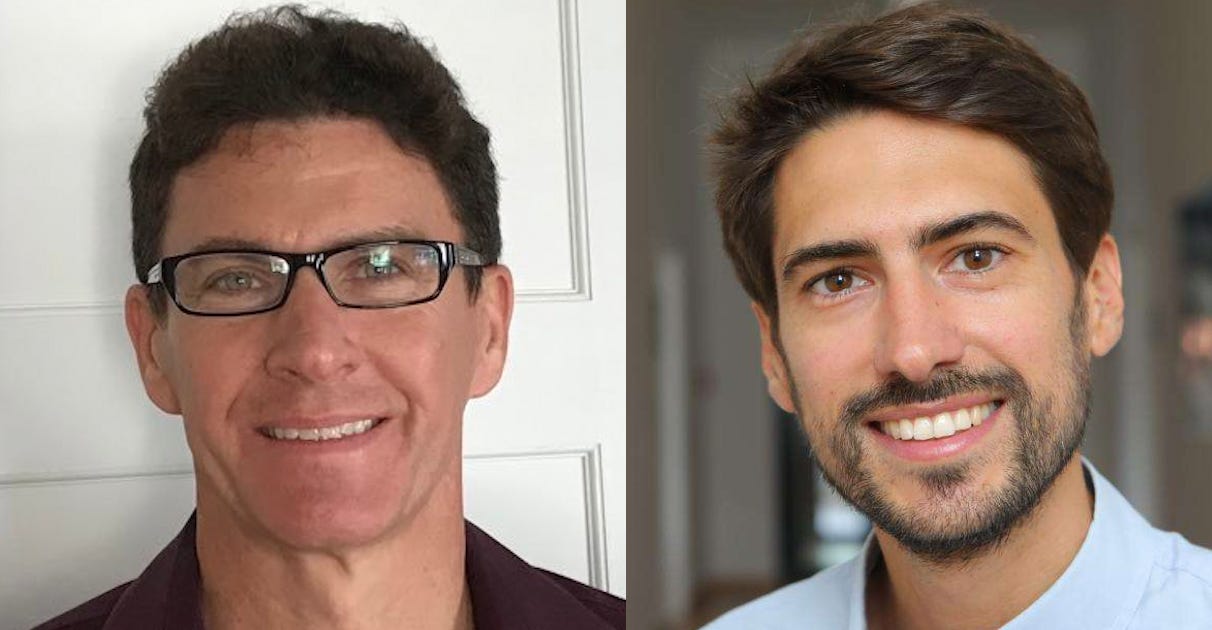
Joe Henrich and Cosimo Posth: the weirdest people in the world and the genetics of Ice Age Europe
94m 18s
This podcast episode features a discussion with Dr. Joe Henrich on cultural evolution and his book "The Weirdest People in the World." Cultural evolution is framed as an extension of evolutionary theory, where humans uniquely rely on learning from others to accumulate knowledge and practices over generations, leading to complex adaptations like manioc detoxification in South America. The term WEIRD is an acronym highlighting that Western, Educated, Industrialized, Rich, and Democratic populations are psychological outliers globally, differing in areas such as impersonal cooperation, individualism, and analytical thinking. Dr. Henrich explains that cultural evolution, rather than genetic modules alone, drives much of human psychology and societal development. He explores how intergroup competition and the rise of moralizing religions, like "big gods," have historically scaled up cooperation and social complexity. The conversation underscores that many cultural practices emerge without conscious design, challenging WEIRD assumptions about innovation and intentionality.
This podcast is brought to you by the Albany Public Library, remained branching the generosity of listeners like you Like a God daddy these people talk as much as you do Receive cons on supervised learning The Insight the Insight on podcasts genetics archaeology Denisovans Neanderthals metabolism and cistern where in the world did we come from I am unique DNA Jim from Austin Texas Hey everybody welcome to this week's episode of the Insight. I got a very special episode with Dr. Joe Hendrick at Harvard And he has a new book coming out with a very interesting title. Can you tell us about that Joe? Yeah, so the title of the new book is the weirdest people in the world and It actually is in 2010 I published a paper with some colleagues in the journal behavioral and brain sciences and that paper was called the weirdest people in the world We had a question mark. So the new book has it without a question mark. So I guess I'm sure now Yeah, it builds on the idea in that book which was that yeah, we so we had looked at the available psychological evidence at the time And we found that not only was there a lot more psychological variation than the behavioral sciences had been Assuming but that The populations most commonly used by researchers at the time were university undergraduates We're often anchoring the stream ends of the global distributions on a whole bunch of psychological outcomes So that's up on a kind of 10-year odyssey so the last decade. I've been really focused on this and Trying to explain why that's the case and so the weirdest people in the world is this is the best thing I've come up with to explain Certainly not all of the psychological variation we found by any means, but at least a substantial swap of it try to try to develop a theory for explaining that Yeah, and you know, I want to back up a little talk more broadly about cultural evolution because I would you call yourself a cultural evolutionist? Yeah, I'm happy with that. Yeah, so and what is what is cultural evolution for the listeners? How does it differ from evolution evolution if you want a biological evolution if you want to separate it? Can you can you walk us into that a little? Well, so in my Formation of it. It's a it's part of evolutionary theory And it flows directly out of thinking about genetic evolution So humans are a cultural species and unlike other species we involve to make use of the The information that's implicitly stored in the minds and behaviors of those around us And so we're geared up to be able to learn from those and so we call that cultural learning and I think there's good evidence to suggest that humans are really good at this at watching listening to and observing others interacting with them then being able to learn acquire ideas beliefs values practices and ways of thinking from other people's behavior And so that's cultural evolution so culture in this view is information that stored in people's brains They got there through some sort of learning process broadly defined and and this is really important for humans because other species Don't seem to be quite as good at this at this cultural learning as we are and so in our case It creates long processes that can go on over over millennia or centuries That altars are behavior and so a proper theory of human behaviors within a biological framework has to account for culture Yeah, and um, you know, just for the listener, I think one thing to emphasize here is uh, you know People often think about evolutionary psychology, you know human of universal's And um, this is this is a different way of thinking of evolution human behavior human history and the human paths right um in terms of like Just like cognitive modules in the brain you're more focusing on cultural variation And trying to think about how that variation might have been selected or not selected Just like we think of alleles in population judge right Yeah, uh, but I would I mean, I don't want to separate it off entirely from evolutionary psychology So there's lots of features of the human mind So for example our kin-based altruism where our virgin to sex with siblings Incess to version which I think are you know best explained as being the way evolutionary Psychologists proper think of them and in fact the way We might think of our capacities for cultural learning might be a specialized Pieces of cognition that evolved and reliably develop in young children that allow us to acquire ideas beliefs and values from others So it's just kind of a richer version of the more standard Chronicle views of evolutionary psychology It may be that maybe we think it is an extension rather than an overturning Yeah, it's an extension and and the biggest the biggest point of interest or the biggest point of Discussion would be just how much of our psychology is shaped by the cultural learning process So I mean the typical picture you might get from evolutionary psychologists would be it's mostly modules and whatnot And there's a little bit of learning that kind of fills in some slots That's kind of one extreme and the other extreme would be you know substantial rewiring whole new cognitive modules Mm-hmm So what would you say is the biggest non-obvious insight from cultural evolution? Well, I mean there's several of them. I mean one thing that comes out of the field that was predicted theoretically Which is kind of interesting because so in the 1980s Rob Boyd and Pete Richardson Along with Mark Feldman and and Cavali Sporzo Came up with this idea of gene culture co-evolution So a lot of people tend to think about human genetic evolution as there was a long period of genetic evolution And then depending on who you're reading that stops either 50,000 years ago 10,000 years ago 200,000 years ago and And then cultural evolution the rest is history and the social sciences But the gene culture of co-evolutionary perspective says that There was this long period of time. I think it was longer than a billion years Which genes and culture were co-evolving and culture was actually the primary driver of much of our genetic evolution So in my previous book the secret of our success I make the case that you can't understand the human colon the size of our stomachs the fact that we have Neucol ligaments without understanding how our physiology was shaped by culture Is this related to the social brain hypothesis? Well, so there's Couple different ideas out there about what drove the massive expansion in human brains that has occurred over about the last two million years and The cultural brain hypothesis argues that it was an accumulating body of cultural information That the reason why our brains got bigger is that we had to be getting better at acquiring all this information about how to make fires and find food and make tools and It was available in the minds of other members of our social group And as we got better that cumulative body of cultural information got bigger And we needed brains that were bigger for acquiring storing and organizing all that information The typical social brain hypothesis there's a couple different variants is quite different So there's no cultural information. There's this idea that we need to be able to track social relationships to live in large groups So in that there's no selection pressure there to to expand human brains You need to deposit some kind of external force that drives up the size of human groups And then then you could explain human brain expansion. So it's kind of an incomplete thought Okay, okay, so you know, I want to before we move on to your new book I want you to talk about Maniac preparation in Africa which is from the secret of our success I think that's a really great illustration of just non-obvious insights and what cultural evolution can You know do to help us understand how practices emerge can you talk about that a little Sure, so quick background to the one of the key ideas in the secret of our successes that humans are dependent on cumulative cultural evolution That over generations this ability to learn from each other produces Complex practices that are more complex than any individual could figure out on their own And one of the examples I use is Maniac process in erikasava processing and when Europeans arrive in the Americas They find that lots of populations in South America are using A kind of maniac called bitter maniac that is high levels of cyanide And if you eat it without processing it You can make you sick you can even kill you because it has cyanide in it But it grows really well in certain kinds of soils especially soils that are very fertile So people had moved into various parts of the Amazon and they had a complex Process for detoxifying for removing the cyanide from the cassava and it you know it involves scrubbing the cassava and leaching it And it takes several days and gradually you know researchers have done studies to show how the cyanide concentrations gradually decline Until you can eventually eat it Well the Europeans actually the portuguese immediately took this crop and shipped it to Africa in other places Because it grows really well But in Africa Long periods of time went by centuries and people there were still getting poisoned by the By the cyanide because they hadn't developed the full package of detoxification processes that had developed in South America probably over millennia So it's a case where it's hard to figure something out and it has real health and fitness consequences Yeah, and so I mean it just it shows also I think um, you know One of the things when I read cultural evolution literature is interesting is how a lot of
these practices that are useful or encapsulated where people don't have conscious understanding of the reason for the different interlocking parts. But you know, you are a researcher at Harvard, you're going to spend your time figuring it out and eventually you kind of figured it out. But most people don't have your resources, your leisure to do this, but it works and they're good at it. And they can probably do a better job than you in the preparation, even if you understand it. It's different from the kind of skill-based thought that I think maybe weird people think as the norm where it's like something you go and you learn in school and it's novel and you know exactly why you're doing this that, you know, each step, you know. Yeah, and so, yeah, you mentioned weird people. So we should probably say that weird is an acronym stands for Western Educated Industrialized Rich and Democratic. And one of the cultural models on weird people is that there's a lot of conscious, intentional thinking. So there's the myth of the heroic inventor. So fancy things are invented by big brain geniuses who kind of figured all out and put it together. But what we find a cultural evolution does, whether it's the grammar of languages or maniac processing, is that it can assemble complex phenomena, complex adaptations, non-genetically, without anybody consciously even acting on it or individuals themselves even understanding it. Yeah, yeah. And which is for weird people, I think that's a non-obvious insight, although maybe for other people, it's like, well, of course, you know, traditions have values just because we don't know all the details. And maybe we'll get back to that later. I want to ask about the backstory of weird just in the 2000s, why do you come to think about this problem? Because it's a bit of a problem in psychology. And like, I mean, what was the lead up to that? Yeah. So I had my first tenure track job was at Emory University and I was in cultural anthropology. So I was hired as a psychological anthropologist. And I did four years there and then I got an offer from the University of British Columbia. And the offer there came jointly from psychology and economics. So I actually changed disciplines. And I moved two thirds of my position in psychology in one third in economics. And when I arrived at UBC, I started hanging out with these two cultural psychologists, Steve Hiner and Arnor and Zyna. And over a period of lunches, Steve and I were kind of talking through the stuff we were working on. And we'd each realize in different separate areas of psychology that not only were the subject commonly studied by psychologists and others unusual, but they often, you know, they anchored the end of the distribution. So it wasn't, you know, whatever you had more than two populations, there was usually an odd one out. And so this lightest into this research project where we began putting together all the data we could find from the literature and writing the weird people paper. And the term weird actually came up. I was calling them like typical subjects or undergraduates or something like that, but it didn't seem very catchy because it didn't, you know, not every time it was an undergraduate, about 70% of them are American undergraduates. So we thought about using that for a while. But then we came over the acronym. So. Yeah. And I was against it because it's kind of a little bit too playful and maybe not quite serious enough for me at the time. Well, I mean, I think this relates to a little bit of a dance Berber's epidemiology of ideas where the selection of that word probably accelerated the acceptance of the idea. Yeah. Yeah. So I had all the wrong questions. You're intuitions, Rob. So can you, can you talk about how weird is different than non-weared in general in the worldwide scale? Like what are the big salient points? Yeah. So although the first thing I always like to start off with is the cautionary, you know, there's the weird term is meant as a consciousness raising the device to kind of, initially it was to focus researchers on the idea that the subjects they were using were the unusual ones. And then in fact, they themselves as researchers might be bringing particular intuitions like I was that turn out not to be right about human psychology. So, but really there's a distribution of psychological variation. There's no dichotomy between weird versus non-weared. And this is a multi-dimensional dichotomy. But some of the interesting features of psychology that I try to explain in the book, one is a big category called impersonal sociality or impersonal processality. And that's this things like trust and strangers cooperation with strangers, fairness towards anonymous others that we find various a lot across societies. And this is not to say that other societies are uncooperated. Just that your cooperation is based on the relationships you have or people within your ethnic group are kind of just enough to general generic person you might encounter, but some kind of relationship constrained social interaction. And so there's also another area called individualism, which is the tendency to focus on one's self, on cultivating certain attributes and thinking of oneself as a unitary whole rather than a nexus in the network of relationships. And analytic versus holistic thinking. So this tendency to look at backgrounds and contexts in a relationship when approaching a new problem versus trying to break things down and to discrete categories and assign properties to those categories, conformity, how much do you want to go along with peers versus acting independently. Another one is the use of intentions in judging others. So people in Western societies tend to place a lot of weight on whether a person meant to do something and relatively less weight on what actually happened compared to folks in other societies. And this I think this has to do with the focus on the individual. So if you're really focused on that person as an atom, then you care about the dispositions and the underlying intentions. If you're seeing that person as animated by a web of social relationships, and really it's as family and friends and cousins and stuff they're going to bring them into line, then the details of what's inside no matter as much as all the network of social relationships that he's or she is down by. Yeah. So before we get into the trajectory of the weird, which has a particular historical sequence, I think that listeners will be fascinated by it. Hopefully readers. Can you talk about intergroup competition and perhaps the rise of religion and big gods and how that might set the stage for the emergence of these weird peoples who obviously they had a history in a past before they were weird. They weren't born weird like Athena from the head of Zeus. Sure. So one of the lines in my research is thinking about the evolution of increasingly complex human societies. So trying to go back well back into human history and think how humans went from relatively less complex hunter-gatherers, mobile groups, no higher level political institutions to larger scale societies with increasingly complex political institutions, webbing together larger and larger networks of people. And one of the things that comes out of that repeatedly across the world ethnographically, historically, is the role of religion. So my collaborators and I made the case that one of the tools the cultural evolution deployed was rituals and beliefs in certain kinds of supernatural agents. So it looks like that supernatural agents became increasingly moralizing and is the circle of whose encounter as someone you should be nice to expands over time and gods begin to be concerned about behavior towards people inside that expanding circle. So you might just simplify things. Lots of groups have clans and those clans have a god and they're concerned about your behavior to fellow clan members. But then you can have a tribal group which is consistent many different clans and you might have a tribal god that's concerned about people who speak the same language or share your dress or other ethnic markers. And then you can go from there all the way up to the big gods that most people think of as religion are relatively late in human history and everyone gets put under the umbrella of the big gods. So we think that that helps scale up human sociology. And we have a bunch of experiments where we unconsciously remind people of God and see it believers behave more pro-social with strangers for example or co-religionists. We've done experiments around the world where we show that people who express more belief in a punishing God or God who's monitoring their behavior are kindred of co-religionists who live in a distant town or a city. So let me, let's talk about religion for a little while. I have actually followed this literature pretty closely. It's fascinating. I read big gods, you know, and a bunch of those books. The one quam that I recently started having about some of the psychology experiments, they kind of remind me of priming a little bit. Do you worry a bit? Like I will put out there. I'm broadly persuaded by the general outline of Rathesis. But in the specific contemporary experiment literature where you have eyes and it makes people behave more morally, do you worry a little bit about the replication bias type stuff? Yeah, yeah. So I'd be worried if everything hinge on the priming. So we do use priming as a tool. And there are good meta-analyses that put together all the available priming evidence. And it looks like a pretty well behaved literature. It doesn't always replicate, but there's reasons why I think it might not always replicate. You know, there's a little bit of a file drawer, but if you compensate for that, the effect still holds. The other thing that's tricky about the whole literature is researchers haven't always been careful that they're testing believers. And so you're going to get negative results if you have too many non-believers in there. So we get it on where effects were we were able to remove and focus only on the believers. But and then I mentioned we have all this correlation work showing even just comparing people within the same village.
with a couple of villages. People who believe more are more pro-social to these distant individuals. - I see. - I see. - Yeah, okay, that's what I thought. - And the ice stuff is interesting. So I would not lean very hard on the ice stuff. And that's always been a worry of mine because humans shouldn't be generally susceptible to eyes. I mean, our world is full of eyes that we don't worry about. So baby's eyes, dogs eyes, birds eyes, there's all these eyes around this. But we can't be monitoring for all those eyes. So it should be specific otherwise. And so that's why God's eyes, if you have a lot of religious iconography, you're actually odds. So I would expect God's eyes to work, you know, that kind of the symbol. - Oh my God, symbol. - And the original work done by Gaelian Fesla actually uses a kind of cultural symbol for a supernatural eye. - I see. - And that was true. - Well, so, you know, before we move to the weird, the big topic, I wanna ask you about a paper that came out last year. And, you know, there's kind of a controversy, you know, related to religion between two groups of cultural evolutionists. And I don't think it was as intense as say, selectionists versus neutralists and population genetics. But it got kind of intense, at least on social media. And, you know, I think I'm friendly with, you know, people in both groups. So I'm not taking sides here. Complex societies proceed more to rising God throughout world history, White House at all. And so this paper is claiming that, basically the big gods are an effect of big societies, rather than the reverse, I think. And, you know, there were some issues with data analysis. And, you know, honestly, I think this is a very big question and it's very important. And that's why I'm asking you. I'm assuming you guys are having a reaction or a follow-up soon. - Yeah, so, first I have a hugely positive opinion of the authors of that paper, Peter Turchin, Harvey White House, great guys. We do disagree on this topic. And so, a couple of notes here. So they have, you can think of there as having two possible findings in that paper. The first finding is, are bigger gods, do they precede the scaling up of societies? And then the second finding is, do big gods help the society stay big for longer? So both of those are in our paper and BBS, which is the place where we lay all this out. We actually make that prediction as, you know, cultural group selection will favor religion if it either helps scale up and/or if it helps keep it stable over time. So they show evidence for keeping stable over time. So that paper could have easily been rewritten as providing evidence for the big hypothesis. And the problem, but they emphasize the other side, which is the scaling upside. The problem is they made basically an error. And when they, the data had a bunch of data that was missing, and what they did is replace all that with absences. So they took an absence of evidence and turned it into evidence of absence. And that's the entire result. There's nothing left if you remove that. Yeah. We demonstrated. So we've written a reply. We sent it to nature. Nature had a review. The reviewers said, absolutely, you must publish this. This is devastating. And the nature then asked the authors to retract it. Several of the authors decided that, yes, they would retract it. Some authors refused and wanted to fight. And nature's been sitting on it for months. I see. I see. Well, I mean, for the geneticist, for a lot of like data scientists in the audience, missing data is a big deal. And there's always discussions on how to deal with missing data in various questions. So it sounds like a simple thing, but it's not trivially at all. It's always something that crops up because believe it or not, imperfect incomplete data is actually the norm in most things. And so that's not surprising. So let's talk about the origins of weird societies. The historical scope here, let's say the past 2,000 years, you start with Rome and you have the modern world, the Western world, the developed world. So you said you had a joint appointment in economics back at UBC. And this book actually overlaps with a literature, economic history that I'm quite familiar with, related to the great divergence, the origins of Western capitalism, et cetera, et cetera. And so it threads a lot of things together. And so there's going to be a lot of stages in moving parts that we're going through here. But first, can you start with the church, the family, Rome, and its fall, and that great hinge? Because I think that's where it starts. Sure. So the case the book makes is that a particular religion in what became the Roman Catholic Church, which was just one branch of Christianity at the time, adopted a particular package of norms related to marriage in the family that altered the structure of kinship and families in marriage in parts of Europe. And that these things were held in place for centuries. And that put that parts of Europe on a different cultural evolutionary trajectory, then we see in other places where people can build extended family networks, develop clans, and cultivate a different kind of cooperation, different approach to cooperation. So I make the case that that's a key event. And that that is really important. And then I kind of flow through the ramifications of that, both in terms of psychology. It's easy to show. I mean, we showed in our science paper last year that you can relate intensive kinship to these aspects of psychology that I call weird psychology. But then it also has implications for the kinds of formal institutions and social forms that we see developing by the high Middle Ages in Europe. And Rome is a nice case because part of the Western Roman Empire falls. And then the church is able to have substantial influence in what was previously the Roman Empire and then expanding out beyond that. Meanwhile, the Roman Empire continues for 1,000 years in Byzantine Empire. And so does the church. So does another version of Catholicism. And so we get this-- that's kind of a nice comparative case. So for example-- Yeah, so people would suggest it's Rome or Roman institutions. But we have a control case, which is Byzantine. Yeah, so I mean, I think the key point here is in your telling-- and it seems broadly correct to me-- the Roman Empire, Roman Culture, and Roman Society-- in many ways are much more intelligible to non-Western people than, say, medieval European society. And so the great break here is after the fall of the Roman Empire when the kindred kinship-related institutions collapsed. And we're kind of burned away by the church through these banning on cousin marriage and stuff like that, which-- can we talk about-- you kind of address it a little bit. What do you think? Is there an origin for this program? Or is it just kind of historical chance? I mean, was it inevitable? Yeah, so one of the kind of big tools of cultural evolutionary thinking is that we have a tendency to focus on the winner or on whatever the case is we're trying to explain. And I think an important kind of mental tool is to zoom out and think about what's happening more generally. So if you think about what happened in Rome is just, well, different religious groups are trying different things to ways to manipulate the family, different religious beliefs are coming into existence. So over in Iran, you have Zorra-Astridism, which is encouraging marriage to cousins and even incestuous marriages between brothers and sisters amongst the elite. Meanwhile, Lyslom comes along a bit later, but there there's a restriction of polygyny, just down to four wives. But there's an inheritance system which encourages parallel cousin marriage. So societies influenced by Islam are virtually unique in the anthropological record in marrying patholateral cousins. So father's brothers, children, married. If you're a woman, it's father's brothers, son, the marriage. And that's going to create a whole different set of network dynamics. So different groups are trying different things. And the Roman Catholic Church just happened to pick this peculiar set of taboos, extreme incest taboos, and regulations on monogamy, bilateral inheritance, other groups were doing different kinds of inheritance. Yeah. And if you look at the genetic data, you can see this difference pretty obviously. And I'm sure you know some of this work. Where it's like, you see in some of these Islamic societies in Middle East, they have like huge long runs of homozygosity all over the place. And when you look at the summary statistics on the SNP frequencies, well, you know, they look like other eurations, but then you look at the segments. There's just a lot of inbreeding in recent history. Whereas if you look at Europeans, it's not Western Europeans in particular, but Europeans in general. It's not like that at all. They're not actually genetically very diverse because of the ancient bottlenecks. But in terms of their recent marriage patterns, it is exactly as you describe. And so I think that's a great synthesis between just like looking at genetic level data and what you see in the history and the anthropology. So you know, you have this situation where you have like lack of familiarism, I don't know, like a society where the family isn't as important. And this relates obviously, I think to the listeners that's been paying attention to what you were saying earlier about weird, but can you make it explicit when you have a society where the family is not important? Like what happens then? Right. So I think that the country. you want to have in your mind is in a world where you inherit lots of relationships. When you're trying to find say someone to open a business with, the key thing is how they're connected to you. And you can guarantee that they're going to be trustworthy if they have dense connections for various ways. And that will keep them trustworthy. Once you're in a world with small families where you're interacting with strangers, you got to focus like, is this person an honest person? Is this someone I want to kind of bet on and I'm going to go into business with or I'm going to marry? Whereas in the complex kinship world, intensive kinship marriages are arranged. So you're building strategic links amongst families so everybody can be stronger through shared sources and shared alliances and whatnot. So you change the world into a more individualistic world where what you need to make your way in the world is to cultivate attributes. What do you have unique to give to others in order to build social relationship? Whether that's friends, spouses, partners, things like that. And this freaks people. In some sense, it's bad because people lost the security blanket. And if you get injured, you would have this big network to take care of you. If you have children or someone dies or a spouse dies, you have a big network to take care of you. And they were sort of thrust out into this world. And one of the things they did is they built voluntary associations. So these are groups of strangers that come together as a club. They take oaths, they're all Christians. They take oaths to take care of each other essentially. And this is the beginning of Gills. And then you get a whole proliferation of Gills. It eventually becomes occupational. You get things like universities and charter towns. So people even come together and they join towns like a club. And as with the club comes membership, you have responsibilities, but you also have privileges. And this is notions of citizenship you begin developing. But it's a voluntary thing you join. You don't join this member of a linear journey. Yeah, so I mean, this has been a very rich civil society, like a thick network of institutions and ties that are not family based. And obviously in other societies, there are non-family based institutions. So you know, you go Buddhist temple in China, but the history and the philosophy and just, you know, the way the Chinese think about the world is kindred family based. And they're not the strange ones there. I mean, most societies, right? It's like, you know, it's like the question in some societies. So, you know, like the question you asked new new people tells you about a society. So an American society, people are often asked, what do you do? So like your job is what's important. I mean, which it's actually offensive in a lot of cultures. Like, why are you, you know, whereas in other societies, you know, people will be like, who are your people? You know, which if you asked an American that, that would just not register. I think most Americans would actually just not understand what you were asking, which when I first heard that I actually didn't understand either, like, what are you even talking about? I mean, my neighbors, like, I actually, like, I think defaulted to weird because I was like, well, what people, like my coworkers, my neighbors, my family, like I didn't automatically think of the family. Yeah. So I want to ask you real quickly. I'll just come on that research and feed you. And for G and start looking for some kind of relationship link. Like they talk about possible people they could have in common. And they're just searching for some way in which they're linked to relationships. Yeah. My family's from Bangladesh. And I can tell you Bengali's, I've seen the same thing. And a lot of times it's pretty obviously made up or fake where it's like, oh, they know two people from some town that have the same name. They're like, let's just go with that. Like you can tell that you can tell they're both like, that's fake. But we're just going to pretend because we want to hang out or, you know, we want, we want to do this. I want to ask you a question. So, you know, this has, this is like a book to some extent of history and anthropology and evolution. Have you, have you given much thought to Walter Shidel's theories in Escape from Rome on the polycentrism and geographic diversity and how that relates to what you're talking about here? Yeah. Yeah. So I really like that book. And a lot of what I describe is, you know, this competition amongst cities, free cities, and then eventually it becomes competition amongst countries. And so I think polycentrism is really important. And the way it fits into cultural evolution is this, the importance of intergroup competition. So in Europe, you know, if you had a great invention or you wrote an important book, you know, it could be banned by your local ruler, but there was always somewhere else to head. You know, Galileo gets imprisoned, but his books gets printed like crazy in the Netherlands. And eventually makes its way back to Rome and then people read the Dutch copy. So, or the books printed in the Netherlands. So that's really important. The thing that I would, the place where I think are two ideas, me would be why this polycentrism maintains so long in Europe and these independent city states that persist for so long. So I think that it kind of, you know, you kind of put our two books together and get a more complete theory. I just not that I don't think that geography played some part. I mean, there is a way in which Europe is different, but you can find other places in the world which have similar patterns of geography, but they didn't have the same society. Okay. So as I was, again, complimentary. So let me ask you, so we're talking about inbreeding and relatives and family, but you know, obviously part of the weird package is monogamy, obligate monogamy. And your work on monogamy and polygamy and mostly polygamy in general. So it's like, you know, one man with with many wives. To be frank, it's kind of frightening in terms of polygamous societies or polygamous societies and how they're organized. I mean, I know that you're a scientist. You're not like presenting a normative thesis here, but can you talk about the differences between a polygamous society and a monogamous society in terms of competition and cooperation? Yeah. So the key thing I are interested in and point out is that most societies throughout human history have been polygamous. So one man being able to take multiple wives. And then what's interesting about monogamy is how it affects the competition among men. So if you have a society with any kind of status differentiation, I mean, you'll even see this operative in hunter-gatherer societies where the hunting is difficult. But anything that differentiates the men, the higher status, more productive males end up getting additional wives. And that creates an increasing pool of low status unmarried men that have few mating prospects. And they just end up permanently residing at the bottom of the status pool with no matings unless they can take a big risk and somehow fling themselves up the status hierarchy. And the more polygamous society, the steeper the climb, the further they have to fling themselves up. So they can't just kind of work hard and keep their head down. You know, climbing up the status by 10% often won't catch you into the mating and marriage market. You've got to go up 40% or some larger amount. So this leads to higher crime rates in some societies. It could lead to rating from other societies. It leads to minor marriages where families will promise brides at a young age because they're so few females. They've got to kind of get their bets in early. So all those kinds of consequences. And so I make the case that intergroup competition will favor monogamy, normative monogamy because it reduces male-male competition within the group and then makes that group more competitive with other groups. Did you see the, it was kind of a dumb Twitter debate about monogamy a couple of years ago, triggered by Jordan Peterson? Did you see that? I didn't see it. Okay, well good for you then. You didn't miss anything. It was very weird in a literal sense because I think people were trying to grasp some of the things that you're talking about but not in a very sophisticated way. I want to ask, do you think this theory you have? It's not necessarily Western exceptionalism, but it does feel like, okay, this is how the West is weird and it's the exception to the rule. And I know that there's no normative valence in what you're saying here. You're just describing, you're trying to see how the world is around you. But do you think some of the criticisms will be that this is Eurocentric? I mean, it kind of by definition is because you're talking about Western Europe. But I mean, do you understand what I'm getting at there in terms of the ethical, and normative framework and how this is going to be interpreted by some people? Well, yeah, I mean, so it's a sensible worry that people might misunderstand that way. I kind of think of it as the opposite of ethnocentric because I mean, at a scientific level, one of the things the book is doing is trying to raise concerns about the extreme bias in psychological sampling. So, you know, I'm calling for a more thorough kind of homo sapiens level of psychology where we canvas the species and we try to understand all the psychological variation. Right now, the psychological database is about 95 percent weird subjects. So we really have only a thin fraction of the total global variation. This way in which I think that that's that would be wrong, that concern or that criticism, I guess, would be that, I mean, the whole book is about how the things that at least some people take pride in from Western civilization, so democracy, science, individualized, individual centered law, so Western law, were in my telling of it, you know, myopic products that emerged through an unconscious cultural transmission that occurred over centuries, and it wasn't, you know, due to region or rationality, or some enlightenment thinkers suddenly giving birth to, you know, I invented democracy because I'm finally rational enough. Instead, those things are very much a side show and that it's this kind of success and facts about cultural evolution which would apply to any society and it traces
back these institutions to the to the strange sexual taboos of a group of religious zealots. So, in that sense, that wouldn't be what I think most people who want to put the West on a pedestal, that's not the story they would want to tell. Yeah, yeah. Without rationality and reasoning, not a bunch of religious guys who were obsessed with sex and not people not having it. Yeah. Do you think weirdness is spreading? Well, I mean, I think certainly in some ways and some dimensions. So, I mean, the diffusion of institutions that emerge from Europe. So, countries whether they succeed or not, you know, at least are superficially trying to be nation-states, they write constitutions, they have elections. These are things that are all spilling out of Europe. Monogamy spread. So, China adopts monogamy in the mid-20th century, Japan in the 1880s, Turkey in 1926. So, there's all these institutions that are spilling out around the world. There's new data suggesting that, you know, being close to missions in Africa makes, you know, you can find some variation in people's psychology that's consistent with the account I lay out in my book. So, Western missions spread all over the world, including in Africa, and seem to have had an impact on people's psychology by promoting all these institutions. So, you know, how much monogamy an African village has is actually predicted by its distance from the nearest historical mission. So, the missionaries will busy. Yeah, I mean, that's fascinating. I do have a question. With the demographic transition, there are fewer relatives out there. Do you think, like have you ever thought about like the fact that, you know, huge families relatively recently with, like, low infant mortality in some societies resulted in an increase of familialism temporarily that might just fade due to demographic structural forces? Yeah, so, I mean, if you get the demographic transition to spread, then that should reduce your ability to build those large families just as a kind of mechanical product, and the fact that people have fewer relatives. Yeah, and so things like Western education is one of the biggest spreaders of the demographic institution. So, when you go to school, means they get pregnant later, which means they have fewer like time fertility. But school is a Western, universally schooling is a Western institution. Yeah, yeah. So, this is, I mean, in some ways it's like, okay, is everyone going to become Western or not? I mean, that is, I guess, the question. Well, one thing that I think that, again, that my term, and this could be my fault, right, is just saying weird. It suggests that there's like one thing, but what I think we're going to see is a kind of, you know, there's a kind of homogenizing, and then I'm going to expect a wide range of different ways of thinking in, because you're going to get different forms of government, different ways of organizing people. They're going to be popping up as each of these, as the Western institutions are reinterpreted locally, people add some of their own cultural institutions, and then they have to interface. And so, I think cultural evolution will recreate a lot of psychological diversity. You'll just be different than we've been accustomed to in the past. I see. I don't think towards a one-sided list fits all. I see. So, I mean, in a way, this is actually kind of the argument or discussion I have with people who think, you know, people from different ethnic groups coming together is going to like create some like one homogenous whole, which is like, that's just how genetics works. Like, the variation is going to be there. You're just going to see new configurations that you didn't expect before. And so, you're saying the same thing with cultural evolution where weird might expand, but as part of the expansion, it's going to diversify and regionalize. Okay. So, that's kind of that feeling just based on how evolutionary processes go. Yeah. Yeah. Well, I mean, the past and the future often have some relationships. So, we'll see. So, one question. Let me just take one more point on the question you asked about ethnocentrious. And one of the other points I make is that, you know, innovation and economic growth are one of the things I take on at the end of the book. And there, the key is not in societies that are more innovative is are not because individuals are individual. People are individually smarter, but because there's a greater collective mind. So, these things are rooted in things like tolerance, trust and strangers, openness to new ideas. And then the more people you can have interacting, sharing ideas, you get faster innovation, faster cumulative culture. And that puts it, that emphasizes the importance of integration, bringing people together, tolerance, things like that. So, so, diversity of different kinds of cognition can really drive innovation in that case. I mean, this is, this is the kind of reason that economists would say that you want density in big cities, right? You interact with lots of different types of people. You get a lot of synthesis and everything just happens a lot faster. So, I think, you know, your book, your idea is actually like kind of dovetail with other disciplines, which is good, because reality is one thing. What are the big questions in cultural evolution that as the 2020s progress are going to, are making you excited or driving your research program right now? Yeah, so the big thing, one of the big things that I want to get to and the book is kind of my first pass at this is really taking cultural evolution into history and trying to get longitudinal data where we can track cultural changes through time. So, I have two postdocs starting the lab that we're going to be trying to look at kind of both century-time scale change using literary sources and newspapers and things like that and trying to track changes in psychology or other cultural traits through time. The book, I had a little bit of that, but mostly I'm trying to tack things that happen historically to contemporary psychological variation. Now I want to get the culture trajectory wherever I can. Want me to Howard historians feeling about this attempt at imperialism? Are they pretty chill about it or you know? Well, I will say there's at least a few historians who seem supportive and my guess is the vast majority will not like it. But I mean, you do have a lot of. Yeah, I'm a collaborator, right? So, I want to work with historians and learn from them and this is a, I think science is a team sport and so we have to, you know, bring as many people in as possible and take advantage of everyone's individual expertise. The problem is within at least part of history there's a kind of epistemology which is anti-scientific and still has the old goddess world away with those manuscripts, you know, writing his independent monographs. Well, yeah. It's just one fact after the other sometimes, you know, like in terms of. And I think in your, you know, for the listeners who don't know, you've been part of a group of researchers that have said theory is very important in science to avoid problems like the replication crisis. And that's, I think, something that's sellable to people who think of themselves as scientists, you know, psychologists. But when you go to historians, that's an order of magnitude, more difficult lift, you know, where it's like, you know, as Peter Turchin has found. But I mean, some historians are quite open, but the vast majority, it's just not their bias. Yeah. So, I've been involved with this database of religious history led by the historian and Chinese philosopher, Ted Slingerland. And, you know, they've done well at getting historians to participate and make entries into this historical database. But I remember I was speaking at a conference we put together invited a whole bunch of historians and there was a kind of general skepticism permeating the room and it was the rebels who were willing to kind of cooperate and collaborate and the rest of them didn't want to impart it. Awesome. Awesome. So, you know, that's your big project, I guess, for the next decade. I mean, that is a big thing to tackle. But I do have like one last question. A couple of years ago, was it a couple of years ago, Tyler Cowan said that some of your ideas were seemed quite conservative in a way. Like how do you feel about that impression, you know, thinking about it? And then conservative in the, I guess, in a classical sense or in the enlightenment sense or something like that. And I think the key idea that I think I should ask Tyler exactly what he meant because we never kind of debriefed on that. The way I now interpret his question is that it's about the idea that there can be institutions can have functional elements that we don't understand. And I take that to be one of the main messages about the new book, which is that take something like monogamy. So I was involved in this trial in British Columbia and we had months, months of long debate, scientists, I gave testimony to the court for three hours trying to understand whether they should be criminalized, the law against polygyny or the law that criminalized this polygyny. And, you know, so we're trying to understand what this, what the infosition of monogamy does to societies. And there's a huge debate about it. We clearly don't know. People have been imposing monogamy for centuries in your, you know, thousand years or longer. So this just as an example of an institution which we can't even agree in this courtroom on how it works with the kind of latest psychological evidence, there's no way people in the past had a chance of figuring out how other institutions work. And I think that's generally true of our institutions. They spread and we have them because they were successful in competition with other versions of institutions. So there's something functional about them. But the idea that we understand exactly what they do, I think is one of, is why Tyler make that point. I've made the same point in the book about in competition among
firms. So I think it affects people's trust and if you have competition among firms composed of individuals who can move around between firms, you actually increase the overall trust levels in the society. But that's not something anybody who's no economist who theorizes the firm has said it changes people's psychology. Yeah, yeah. I mean, I think you're exactly right, this whole idea that we don't rationally understand all the details of all these customs, traditions, and institutions. And that's why I was asking you about Kassava because I think that illustrates that really, clearly. Okay, so the book is the weirdest people in the world. How the West became psychologically peculiar and particularly prosperous. It is out September 8th, 2020, and it's been really great talking to you, Joe. All right, thanks to you with you. The Insight. The Insightome podcast genetics archaeology. Denisovans. Neanderthals metabolism. Where in the world did we come from? I am unique DNA from Austin Texas. This week, the genetic history of I say zero. Hey, everybody, this is Riseep Khan. I am director of scientific content at Insightome and I am here with Kassimo Post. Hello, everybody. I'm Kojima Post. I'm a postdoc researcher at the Max Blank Institute for the Science of Human History in Yana, Germany. Yeah, and we're going to talk about prehistory, a particular place to see it and place to see Europe. Can you talk about what the place to see it is and what it means for Europe in general? Yeah, sure. So, place to see it is, of course, a huge time period at this spanning between two billion years ago until 11,000 years ago. So, the time period of our interest is specifically the late place to see that is actually starting around 120,000 years ago and is finishing exactly around 12,000 years ago. And this period of the late place to see, actually largely overlap with what has been known as the last ice age, the last glaciation. And during this period was not all glaciated but it was, of course, a phase of warmer and colder phase, so-called glacial interglacial phases. But the coldest period of this last ice age was the so-called last glacial maximum. And this was around 22,000 years ago and this is a period where of course, modern humans were already in Europe and a strong impact on their living. So, the beginning part of this, the 120,000 years up until about like 45, like Europe is occupied by the other thoughts, correct? Correct, yes. They were really dominating this side of the world, West and West Eurasia. And they were living there and producing different, you know, different techno complexes, so-called, mostirian. And it's this period where Neanderthal were around in Europe is called the Middle Paleolithic. And around 45,000 there is the beginning of this upper Paleolithic, that is, techno complexes, so cultures associated with a rival of homo sapiens, so of modern humans into Europe. And about when did modern humans arrive in Europe? Yeah, exactly. So, the old estates are right now around 45,000 years ago. And they are coming from southern Europe, particularly Italy in in Puglia, but also center Europe like southwest Germany, all the way to the UK, all with dates that are ranging between 43 and 45,000. So, that means that modern humans may have been in eastern Eurasia and even Australia before they were occupied in Europe. Correct, there are a lot of theories and a lot of hypothesis that this was the case. It's really still hard to date precisely when modern humans left Africa, but there are more and more archaeological evidence, indeed, around the region of Australia, as well as Indonesia, and in general eastern Eurasia, with very, very old archaeological findings associated to modern humans. The question is, though, if those modern humans did live or did not live descendants in later period, so far the common ideas that there was a major out of Africa event that both spread towards east and towards west Eurasia, and this is the one that was successful and happened around 50,000 years ago. Yeah, yeah. And so in Europe, I want to talk about a paper that you were a second author on genetic history advice, say, "Europe." What is the major finding from this paper for a listener? So, yeah, in the ice age Europe paper, we found several population turnover throughout this 35,000 years of human history, spanning between 45,000 and around 15 or 10,000 years ago. So here we are talking about hunter-gatherers populations. Farming is not yet established, and this population were extremely mobile, but they were also producing different kind of culture throughout different time periods. And what we observed that in this time interval, there are a lot of genetic transformations. Some of them we could find a good link, a good match with archeological transition, so change in culture. Some other genetic transformation is that we could associate them to climatic changes. So there was not one to one correlation, but there are multiple situations and multiple parameters that played a role in these genetic transformation that you observed. So, yeah, can you talk about like the last-lacial maximum, like what areas of Europe were inhabited, and that was not a major turnover event? In the absolute, yes. So the last-lacial maximum is, as I said before, the coldest phase of the last ice age, and this spans at least in the coldest period between 25 and 19,000 years ago. And we have to imagine this phase in Europe where the ice sheet, a thick layer of ice sheet, was covering almost entirely all northern and central Europe, was reaching basically France and central France as well as central Germany. And this was not only the only ice that was present in Europe because of course, also all the mountainous regions like the Pyrenees, as well as the Alps and the Carpations, were of course much larger and the extension of the glaciation was much larger also in that respect. So we have to imagine this is a phase where there is a contraction of human population and resulting in genetic bottlenecks. And then only after the last-lacial maximum there is a re-expansion and of course during this time period there is a loss of genetic variation. Yeah, yeah. So I think one of the primary things is the extent of turnover. I actually, I had a bet with Chris Dinger that the first modern Europeans would not have left any descendants before you guys paper came out like years ago. It just seemed that with human turnover, especially in northern regions, the probability of continuity is low. So for the listeners, I think we should go over some of these cultures and what they mean and they probably heard some of the words. So the word "chromagnet" that's not a scientific term, right? No, not anymore. So chromonion man with a terminology was a type specimen to describe these early modern humans that arrived in Europe. However, it has been really replaced by this terminology early modern human because it is only related to a specific site and when we start referred to early modern humans, we refer to Europeans that spans from the first arrival. So modern humans that are spent from the first arrival all the way to
the event of agriculture. Yeah, yeah. And so we have these cultures, I think they're mostly defined by tools. So, like we have like the our nation, the gravision, the salutrian, the macdalenean, the epigraphidian, and the avi-gravision. And I'm kind of like labeling them by order of time. Can you just like give like a quick overview of these cultures? Yes. So, all these names of this culture come from archaeological sites where some specific tools, stone tools have been discovered. And they take the name after those sites. And those stone tools are spread and also of course, distributed in different geographical regions. So, starting with the our nation, it's really the first widespread technology that we find in Europe. And this has been associated with one of the first arrival of modern humans around Europe. And this culture starting around let's say 43,000 years ago, then gets replaced by a different culture, the gravetian, that starts a little bit later around 30,000 years ago, or 35,000 years ago, and depends on the geographical region. And this is also have a huge spread. It goes from Western Europe all the way to Eastern Europe. And it's still not clear if it is one single group or multiple groups involved. But the gravetian are the people that face this last glacial maximum. And are the people that kind of retreat in climatic refusures during this coldest phase of the last ice age. And then in this period, other culture emerge. One of those, for example, is the salutrian that is distributed mainly in one of these climatic refusures that is southwest Europe like Iberia as well as south and France. And from there, it's supposed to be supposed that people spread again after the last glacial maximum with this transformed culture that is called Maligaliniian from the southwest to the northeast, repepling Europe that was depopulated during the last glacial maximum. And what happens south of the Alps in Italy, it's a little bit different. So there is not this strong cut, strong transition between strong divide between the gravetian and the Maligaliniian, but there is more continuity archaeologically. So in southern Europe, for example, in the Balkans and in Italy, the period after the last glacial maximum is called epic gravetian to strengthen this connection with the previous, the pre-lac glacial maximum period called gravetian. Can you talk about the genetics and what you guys found out about the relatedness of these groups to modern populations in each other? Yes, so we were quite at the beginning of the point we started to work on this paper, we really decided to let the genetics speak without associating these ancient human remains to any archaeological culture. So we just really analyzed them independently and we saw that individuals from different locations from different time periods start to group together in different clusters. And we gave names to this cluster, not based on the culture of those people, but based on geographical location or the site where the oldest individuals belonging to this cluster came from. But then we realized that actually we could draw some association. For example, we found that many individuals associated to this gravetian time period indeed share a higher genetic affinity than people they were there even in the same geographical location before and after. So we could indeed see that the gravetian were not only sharing a similar culture but also sharing similar genes together. And for the origination unfortunately, to the previous period, we don't have many skeletons. So far we have only one individual that is associated to this techno complex. So it's really hard to extend this conclusion. But after the last glacial maximum, so during the period called Magdalena, again we find a strong correlation between genes and this techno complex called Magdalena. However, I have to stress also that this is not always the case because the phase after the Magdalena that start around 14,000 years ago, we see a genetic shift, we see what we call a population turnover from 14,000 years ago onwards. And this is not followed by any remarkable archaeological shift. So we think that in that case, it was not really the archaeological shift driving the genetic shift, but we think that actually climate played a major role in the expansion of a new population. And from the south, east, Europe, so from the Balkans that moved and migrated into central Europe, bringing this new genetic type. So do you think Europe is exceptional in the amount of turnover because of the Northern liposition? This is a really good question. I think that the geography of Europe indeed plays a major role in this climatic turnover, not only for the latitude, but also for the elevation of certain region like this Montenios region that are present in Europe. Indeed, this geomorphology facilitates the formation of a structure population. It means that population that are not in contact among each other during colder phases. And so if facilitate the formation of genetic cluster, and then eventually also the mixture or replacement between those groups. Yeah, so I mean, all of those like cave paintings, those people do not leave many descendants, right? I mean, for the listener, like that's one of the things that you guys discovered. I have to say actually that our paper found out that the initial people, the initial Europeans like data between 40 and 45,000 indeed did not leave descendants in a modern day Europeans. But actually all individuals in our time series starting from 37,000 onwards, they left descendants in later European. Maybe as more proportion, but indeed, there's some level of genetic continuity throughout 37,000 years. So also the people that were painting the caves in these famous caves in France, like Glasgow, they indeed left traces in the genome of modern day Europeans. All right, so one thing that I'm curious about, it doesn't look like there was much if any gene flow over Gibraltar, right? Correct, correct. So it's really highly debated. The contacts in the Paleolithic time between North and Africa and Iberian penicera through Gibraltar. One of the reason why people think that this was not a viable connection is because of the high current that is always in this trade. And there are not convincing evidence of early contacts. So most of the contacts between Africa and Europe happen through the Levant region where there are multiple evidence of alternation between Neanderthals and other humans throughout time. Yeah, so it seems like we're not going to be talking about the agriculturalists, but it's a recurrent pattern that the Middle East store the Balkans serves as a reservoir for modern humans during the ups and downs of the climatic cycle. Totally, yes. And the kind of genetic turnover that I was telling you about that happened around 14,000 years ago. So it's. indeed associated with a spread of people with a higher percentage, a higher proportion of Near East and Ancestry. So indeed that's a reason why we think that this population movement of hunter-gatherers happened also from the southeast towards the northwest towards Central Europe. Probably because this was again a climatic refusial during colder phases and it is interesting that 6,000 years after a gain similar movement happened around basically 8,000 years ago spreading that time a new kind of lifestyle so spreading the agriculture. So quick question about So Neanderthal ancestry in Oassi and then later like your paper found that it declined over time like what is the update on that result since that paper came out? Yeah we are still confirming this pattern The pattern is that despite Oassi that is clearly what has been defined as a hybrid because it carries in his family pedigree one ancestor that is Neanderthal so in the 4 to 6 generation before the individual lived and that's why it has an elevated percentage of Neanderthal proportion up to 10% All other individuals have a much lower percentage of Neanderthal contribution but what we observe is lining this individual through time from the oldest 45,000 to actually modern day individuals so today we could really find out the percentage of Neanderthal's decline over time and if we look specifically where there is this declition so this reduction of Neanderthal ancestry is in the proximity of genes so of coding regions and that's why we interpreted this as a negative selection towards Neanderthal in progressed blocks that are there were disadvantages for the population and so were depleted from the modern human genome through time. Yeah so natural basically natural selection was purifying the genome so I have a question about Neanderthal there's not a lot of stuff recently that's been coming out about Neanderthal's and Neanderthal are Neanderthal culture I don't know I mean if you have a strong opinion on it or not but what was the interaction of the modern first humans and Neanderthal's like I mean like do we do you have any intuition about why modern humans 45,000 years ago finally replaced Neanderthal's after you know hundreds of thousands of years of back and forth. Yes so I don't have a clear answer of course I think this is a huge question many scientists and many researchers are trying to answer this question but of course multiple hypothesis and probably multiple causes for this replacement. What I can say is like there was indeed a period of overlapping between Neanderthal's and modern humans and we all know the outcomes of this period of overlapping it was indeed genetic exchange and so I'd make sure between these two groups or homining groups but it's hard to tell the reason why Neanderthal got extinct one explanation and actually it is in line with this decline of Neanderthal ancestry through time is the fact that the population size the population size of Neanderthal was shrinking was reducing through time and this of course led them accumulating slightly the three years mutations. When this population had mixed the Neanderthal population and mixed with an expanding population of modern humans of course natural selection started to kick in and remove this slightly the late age mutation from from their genome so this is probably one reason so a population size probably was one reason why Neanderthal disappeared as soon as modern human arrived. Okay all right so you know we have we have like all of this data on Europe now from ancient DNA for various reasons how representative do you think Europe is of the dynamics we see around the world? I think it's not really representative because what is what's happening in in East Asia it's probably a completely different pattern and we still need to investigate much more so far there is only one upper Paleolithic genome from East Asia that is this Tianyuan is famous Chinese specimens but we cannot really yet assess if also Asia or other region of the world were also influenced by this massive genetic turnover that we see throughout time in Europe so definitely we need much more data from from that side of the world. And what do you what do you think about you know with like in terms of genetic homogeneity we see at the Neanderthals and then we see a lot of the hunter-gatherer populations as well later on modern human hunter-gatherer populations do you think the behavior ecology basically like the distribution density of humans during the place to see in base was qualitatively different in a way that would affect the parameters like gene flow and stuff like that population structure? Yes yes indeed I think the population size indeed is playing a huge role not only in the technological advancements but also in the in the possibility of those people to interact and to spread. I think though we have to imagine this is hunter-gatherer society in a different way than what we usually think about you know population in the past like sedentary population in the past from the advent of the agricultural onwards because this hunter-gatherer society were highly mobile and they were really moving a lot during different time of the years but also different years according to the climate how it was changing so this of course gave the possibility of this population to meet and to exchange genes in certain in certain period but of course isolation allowed them also to form some genetic structure and this is really good for us for archaeogeneticists because allows us to distinguish one group from the other and really observe much more clearly when two groups get into contact. Yeah so you know in this paper you guys didn't use the standard methods inference of structure and it was you said in there I think that it was because the populations were so different from modern populations do you think whole genome sequencing without the ascertainment bias of that snippet capture array will improve that sort of analysis. I think there is a big hope and the big hope is I think personally I'm really fascinated by the idea of generating high coverage genome of those individuals to see which regions and which variants are present in the genome of modern-day individuals and potentially identify regions that are under selection so they're positive or negative for for modern humans so this is something that of course we need to shock and genome to answer those questions however generally speaking I think the capture data that we have generated for those individuals allow us to really finally detect that mixture pattern between those groups and and also to relate them through time with a following population however when we want to study modern-day Europeans we cannot really compare them directly to people that lived 30,000 years ago because the variation that is present, genetic variation that is present in modern-day Europeans it's limited compared to what was present 35,000 years ago so we need to really analyze those genome slide by slide and create genetic map of Europe through time. Yeah that's pretty ambitious so there has been a fair amount of work since you guys as paper came out there's a recent paper out of Spain that talked about the different you know population structure or the groups that you guys identified and how they persisted in Spain and also there has been some work I think out of Mark's Plunk about maybe Martin Petter about Geneflow back in
into Africa from Europe. What are the biggest things that have happened? I'm pleased to see genetics and our understanding of these population structure and relatedness since the paper came out. - Yes, so indeed, there is a paper that was published last week about Iberian population. And we, I'm also part of this study and we could actually show in the study that there was a much earlier connection between South and Europe, like Italy and the Balkans with Spain. And this connection probably was during the last Asian maximum. So I think we should really stop thinking about this calamity with use as regions where there was not contact among them, but a much more dynamic condition. So what we figure out that the older genome, associated with this Elmiron Magdalena culture, so called Elmiron genome, is already at mixed between different gene pool. So we could identify much earlier contact than what we thought. On the other hand, on the eastern side of Europe, we recently published a paper on Anatolia, actually it was published two days ago. And it's quite interesting because we published the first hunter-gatherer genome from Anatolia. And what we see is that we could show that there is genetic continuity between the hunter-gatherer and the neolithic people. It means that the local population acquired agriculture and spread this agriculture few thousand years after into Europe. So I think this situation is actually quite a good example to show that not always there are population to know of Earth, but sometimes we also show that there are population in these population continuity in certain areas of the world. - Yeah, yeah, that was fascinating work. I mean, there's just so much ancient DNA stuff that's coming out. What are you excited about for the future of this particular project? I mean, the sample sizes that you guys have for Europe and Middle East are quite large. Obviously, there are other areas of the world that are not as well sampled. - Yes, there are, however, really also some complication that's working in the region of the world at that time, or rise in terms of time. Complication that are either political, where it's not possible to excavate or to actually do research with specimen from those countries. Other complication is preservation. Of course, Europe with its temperate climate is the ideal for preservation of ancient DNA, whereas if you go to more lower latitude, DNA preservation is much more harmed. I am personally still really interested in what's happening in Europe, because despite we see these big numbers that you're describing now, it's also 35 or 40,000 years of human history. So it's the larger, the largest period of modern humans outside of Africa. And so I think we are still, these are only the first picture of the complexity that is actually emerging between those different groups. So I am really hoping to fill some gaps in terms of time and space. And as I told you to reconstruct this genetic map that is indeed ambitious, but there are new specimens coming along. - So there has been some work on traits, phenotypes. What do you think are the possibilities of inferring genetic variants that are causing an outcome today and how that relates to genetic variants that are causing an outcome in the past? I know some people are pretty skeptical of it. Other people's less so. Where do you stand? - Yes, so far only the genetic snips that have been phenotypic snips that have been analyzed are like eye-color, skin color, lactose persistence is really like a limited set of snips. And I think finding, let's say correlation between those snips and modern day people is really hard. The problem, the point is, I give you an example. We have certain snips that are associated with the light skin color in modern day Europeans. And what we find out is that population like many underthals and as well as early modern humans, so these hunter-gatherer populations from Europe, they have the ancestral veil. So according to our knowledge, these people were had that dark skin. However, we don't know if there are other variants that in the past were responsible for a lighter skin, a color of the skin in order to survive at those latitudes. So we can of course test that variants that are known in modern day individuals, but discover new variants and know how these are affecting the phenotypes of modern day individuals is of course really complicated. - Yeah, yeah, for sure. So I wanna close out just like talking about the big picture, like about like 10, 15 years ago, we were talking about it out of Africa, like 50, 60,000 years ago, et cetera, et cetera. Now we have a lot of evidence that there's a lot of deep structure in Africa and that modern humans may have flourished for hundreds of thousands of years within Africa before they left Africa. I'm kind of confused at this point and like where we're going and what we're gonna discover. I mean, what are your thoughts on that? - Yes, Africa is of course placed with the highest, the genetic diversity in the entire world. So I think that ancient in a study from Africa would be really extremely revealing to understand this great population structure that existed, that exists today, but even higher that existed in the past. So I've seen that studies from Africa are really gonna be game changer in our understanding of the evolution of our own species. The biggest limitation is that this is a preservation of DNA from those regions. So far, the oldest genome published is from 15,000 years ago from a cave in Morocco, but it's gonna be extremely hard to obtain as old material as from Europe from Africa. But in terms of the big picture, I agree with you, we should indeed investigate much more different populations and different time period of this African diversity. - Yeah, so I guess like the two things that you're saying is there's political issues, but also just like the preservation, like there's a reason we have all these Siberian remains from Europe and we don't have them from Africa, it's just like DNA degrades, right? - Exactly, so it degrades over time, but generally speaking, but also climatic condition, for example, humidity or temperature, of course plays a major role in the preservation of those ancient genomes. So I think not only we need to increase the sample size, and of course also to increase the bioinformatic approaches, how we can study best those genomes, but at the same time, we also need to develop new method to efficiently extract DNA from these limited, extremely valuable human material. - All right, so I guess the last thing I want to highlight is just surprises. So I think the Goyette sample shared some drift with Tianyuan, the East Asian one that you're talking about. Do you think that that's an artifact, or do you think that there's basically gene flow and connected this in Northern Eurasia that we just don't know and understand very well right now? - I, we have investigated a lot the first possibility that is the possibility that there was some sort of artifacts so that this attraction between the oldest origination genome, so this Goyette Q1 and 6, and this is the oldest East Asian genome that is Tianyuan, was due to some sort of shared damage or processing. We could,
All the tests that we had done, we could exclude these artifacts. And so we really think that there is something real there. We really think that there was a contact between people with West Eurasian ancestry and the East Eurasian ancestry. However, we have so little data still from this early time period between before 40,000, we have only two individuals, one from Siberia and one from Romania that is a highly admixt with Neanderthas. So we really need to have more genome from this time period to understand the spread of those two ancestors. And maybe we will figure out why there is this genetic link. Well, I mean, could it be that as these groups were in the Near East and the Middle East, as they were moving, there was structure there that was preserved, you know, that sort of thing instead of like going from East Asia to Europe or vice versa? Yes, and understand what you are talking about, like some sort of incomplete lineage sorting between those groups splitting up in the Near East. I think in this case, these populations are already quite defined. So this is Station Branch and the West Eurasian Branch. So I see this affinity more as a really movement of people, or at least the existence of people with an East Asian branch. So we have to be a really high limit from the location where those genome were found. But of course those ancestors might have been once not only limited to Eastern Eurasia, but could have been much more westward. So I guess the last question is like, what surprised you the most from this paper as you guys were looking at the results? Hard, hard to question. And I think what surprised me most as is this genetic turnover that we see around 14,000 BP. Because I actually already described that the genetic turnover in a previous paper the same year based on Matricondal DNA. And we were not sure from where the source, the genetic source come from. And it was a big debate because as I told you before, this is not really associated with any major archaeological change. So some people were skeptical of this result. But then with the nuclear genome we could show this higher affinity of population after 14,000 with people from the Near East. This was indeed a major surprise and also led many, many research are both in the field of archaeology and genetics to really go back and investigate their material to see if there is any sign of a shift also in the material culture. All right, you know, it's been a great conversation. Definitely. I think the listeners have been keeping track of ancient DNA for the last couple of years. And it's a very exciting field. And I'm sure we're going to be hearing from you because Simo is great talking to you. Also for me is a great pleasure. This podcast is brought to you by the Albany Public Library, remained branch in the generosity of listeners like you. But it's a wonderful cast. God gave these people a target, my destiny. Received cons on supervised learning.
Podcast Summary
Key Points:
The podcast discusses cultural evolution, contrasting it with genetic evolution and emphasizing human reliance on cumulative cultural learning for complex adaptations.
It introduces the WEIRD acronym (Western, Educated, Industrialized, Rich, Democratic) to highlight psychological and behavioral outliers in global research, noting differences in sociality, individualism, and cognition.
Cultural evolution explains societal complexity through mechanisms like religion and rituals, which foster cooperation and scale up social structures over time.
Examples like manioc processing illustrate how cultural practices evolve without individual understanding, contrasting with WEIRD societies' emphasis on conscious innovation.
Summary:
This podcast episode features a discussion with Dr. " Cultural evolution is framed as an extension of evolutionary theory, where humans uniquely rely on learning from others to accumulate knowledge and practices over generations, leading to complex adaptations like manioc detoxification in South America. The term WEIRD is an acronym highlighting that Western, Educated, Industrialized, Rich, and Democratic populations are psychological outliers globally, differing in areas such as impersonal cooperation, individualism, and analytical thinking.
Dr. Henrich explains that cultural evolution, rather than genetic modules alone, drives much of human psychology and societal development. He explores how intergroup competition and the rise of moralizing religions, like "big gods," have historically scaled up cooperation and social complexity.
The conversation underscores that many cultural practices emerge without conscious design, challenging WEIRD assumptions about innovation and intentionality.
FAQs
WEIRD is an acronym that stands for Western, Educated, Industrialized, Rich, and Democratic. It describes populations often overrepresented in psychological studies, which may not represent global psychological diversity.
Cultural evolution is the process by which humans learn and transmit ideas, beliefs, and practices through social learning across generations. Unlike biological evolution, which involves genetic inheritance, cultural evolution relies on information stored in people's brains and passed on through interaction and observation.
The cultural brain hypothesis suggests that human brains expanded to acquire, store, and organize accumulating cultural information, such as tool-making and fire use, available in social groups. This contrasts with theories focusing solely on tracking social relationships in larger groups.
Manioc (cassava) processing in South America is an example, where complex detoxification methods to remove cyanide developed over generations. This knowledge wasn't fully replicated when manioc was introduced to Africa, showing how cultural practices can be more effective than individual understanding.
Religion, through rituals and moralizing supernatural agents, helped scale up societies by expanding circles of cooperation. Beliefs in gods that monitor behavior encouraged pro-social actions toward strangers or co-religionists, facilitating larger social networks.
Traits include individualism versus relational self-concepts, analytic versus holistic thinking, conformity levels, and the emphasis on intentions in moral judgments. WEIRD populations often show more individualism and focus on internal dispositions.
Chat with AI
Loading...
Pro features
Go deeper with this episode
Unlock creator-grade tools that turn any transcript into show notes and subtitle files.
 PodcastTranscript AI