Jill Lepore on why the artificial state is ‘doomed’
from Politics Weekly America
27m 58s
In this episode of *Politics Weekly America*, Jonathan Friedland interviews historian Jill LePore about her new book, *The Rise and Fall of the Artificial State*. LePore argues that the liberal nation-state is being replaced by an artificial state, where governance is increasingly mediated by machines, algorithms, and corporate-controlled platforms, rather than by democratic consent. She traces this shift to historical movements, such as the 1930s technocracy movement, which proposed rule by scientists and engineers during the Depression, and the 1980s Silicon Valley ideology that equated technology with democratization—a promise she says was never fulfilled. LePore draws a striking connection between technocrat Joshua Holderman and his grandson, Elon Musk, suggesting a philosophical lineage of techno-libertarianism. The discussion turns to data centers as a flashpoint for voter anger in the 2024 midterms, reflecting broader anxieties about AI, unregulated corporate power, and politicians’ complicity in secrecy. LePore contends that the artificial state is not inevitable; it can fall due to environmental limits, public frustration, and the resilience of democratic institutions. She also comments on the Democratic Party’s shift to South Carolina for the 2028 primary, seeing it as a strategic but somewhat desperate move. Overall, the conversation underscores the fragility of democracy amid technological upheaval and the need for active resistance.
This is the Guardian.
If we build more machines, we will only have a better and better and better
and more efficient society.
It's an idea.
It's not an eternal truth.
Less than three months to go until the mid-term elections.
And American voters are thinking about gas prices, the Iran War, and data centers.
Data centers are kind of a bucket where people are pouring in their anxieties
about this moment and about AI.
So how will this latest AI backlash affect the big vote in November?
And are we seeing the beginning of the end of the artificial state?
Yeah, I kind of think it's doomed.
I'm Jonathan Friedland, columnist for the Guardian, and this is Politics Weekly American.
And I'm delighted to say I'm joined by the historian and New Yorker writer, Jill LePore.
Jill, it's fantastic to have you with us on Politics Weekly America for the very first time.
Yeah, thanks so much for having me. What a treat.
It is a treat for us.
We need to talk about your new book, which is out next week.
It's called The Rise and Fall of the Artificial State.
So let's just define our terms right at the beginning and what you mean by the artificial state.
The artificial state is sort of the coming successor to the liberal nation state.
And in lieu of government by consent, we have government by machine.
It's a change that's been coming for quite a long time,
but I think we're really on the cusp of it right now.
So I wanted to give a name to what I think is going on.
And obviously people understand that in the information flow that we're in now,
what voters receive is massively dominated by algorithms and so on.
We understand that actually the bureaucracy of the government is so often online.
It's huge vats of data that are collected on all of us.
How does that turn from being just a tool used by the liberal democratic state
to actually being something sort of constitutively different from what we had before?
Yeah, that's a great question.
Well, I think the easiest place to see that is in how people get information
and how they participate politically.
And that's largely mediated now by social media.
And it's important to remember that there are more robots online than there are humans.
And so every single platform on which people are predominantly getting their news
and that think of TikTok or Facebook or Instagram,
especially where young people are getting their news.
We've kind of slowly become accustomed to the idea that,
well, democratic evolution maybe doesn't need to be face-to-face.
You know, maybe I could do maybe I could post things and I could read things.
I'm an elected official. Maybe I'll just sort of see what people are saying on Twitter
and that'll help me decide what my constituents want.
The sort of people kind of like casually fell into this dehumanizing notion
that the kind of virtual representation of public opinion
that is the weird skewed oddity that is social media.
Somehow is this adequate substitute for democratic deliberation?
I think that was largely accidental for a long time
and then it became quite deliberate, right?
Then some of these platforms began marketing themselves as the new town hall, right?
You don't need to talk to your constituents.
You don't need to hold a town hall.
You could just, you could just tweet at people and they'll tweet back at you
and then you're doing your duty.
But it's a new era when the majority of those posts are written by bots, right?
When our public discourse is almost entirely owned by private corporations
and the public is actually a bunch of robots talking to one another.
You are a historian and you go back quite far.
I think much further than people might expect, given the topic
that there is a deep history to this, early on in the book,
you say that humans at an earlier stage essentially turned their back on nature.
And I think that just sets the table for a lot of the arguments.
So just explain to us when that happened and why it happened.
You know, the great historian Keith Thomas wrote this book called Man in Nature Decades
and Decades ago about early modern England.
And kind of the rise of the idea that the artificial is inevitably an improvement
over the natural.
It's an idea we associate to some degree with the Enlightenment
but really more with the industrializing 19th century,
which is, you know, really where you get the idea
that technological change represents progress.
If we build more machines and they are better and faster
and we can fuel them by extracting energy from the natural world,
we will only have a better and better and better
and more efficient society.
It's an idea.
It's not an eternal truth, right?
I mean, this kind of key moment in the story I'm telling,
which is really the 1950s partly because that's
when the term artificial intelligence is coined in 1955.
And if you go back and look at the guys who coined it,
they're applying for money from the Rockefeller Foundation
to have a summer research institute.
And they decided to call it artificial intelligence
because by then it's the 1950s and people like in the US,
like people were remarketing artificial sweetener by calling like fake sugar,
by calling it artificial sweetener.
Like you would get air conditioning would be artificial weather.
Like you would, like everything that we wanted to sell,
you would sell it by saying it's artificial.
Like in a way that, you know, decades later,
we'd say, look, what's all natural?
But in the 50s to sell it, you had to say it was artificial.
Like it was the heyday of like plastics.
It's this period which actually is so fascinating in the book.
So the whole that the waves of technology come with these very idealistic hopes,
you talk about computeopia, this notion that things are only going to get better with technology.
And I want you to go to this group of people,
particularly who reveled in the notion of technocracy.
But just explain to us how,
because this word technocrat and technocrat is used differently now.
What was meant by it then, what this movement was and how it sort of played out?
So in the 1930s, when the world is driven by the crisis of democracy,
as democracies are falling all over or collapsing all over the world,
fascism and communism are on the rise.
In the United States, it's not really clear that liberal democracy is going to survive,
especially before FDR is elected.
It's a lot of kind of concerns of depression, kind of the depression sets in very, very quickly.
Okay, maybe actually democracy isn't up to the task of managing an economy
in a modern industrial state.
So there are merges in in North America, a movement called technocracy, incorporated.
And it's kind of a joint Canadian U.S. movement.
Hundreds of thousands of Americans join the technocracy movement, all of a sudden,
in desperation, in the throes of the depression.
And the idea of the technocracy movement is there should be no democracy.
Democracy isn't up to this task.
This is a complicated society that we have built.
The modern industrial economy is really run by machinery.
So who should run it?
Who should run our society scientists and engineers?
We'll be no more politicians.
We don't need any bankers.
Look what the bankers have done.
They've let us into this depression.
There'll be no money.
There'll be no banks.
There'll be no politicians.
There'll just be scientists and engineers.
And why don't we even need things like names?
We'll just call ourselves by numbers.
And everybody will be the same.
And we will distribute goods, kind of like a universal basic income,
through this measure called the ERG, which is kind of a unit of energy.
There'll be no prices, there'll be no capitalism.
And the movement just really gathers steam, like almost overnight.
And it seems, you know, by 1931-1932, as if technocracy might replace democracy in the United States.
There is one individual, a technocrat who has a number, instead of a name,
who you spend some time with telling us about Joshua Holderman,
fascinating individual figure who's a real true believer in this movement.
Tell us a little bit about him.
And as you do in the book, save to the end why we might find him particularly interesting.
Yeah, so, so Holderman's actually born in Minnesota.
And he moves to Canada as a young man.
And he is this kind of crazy, adventurous young life. He's a cowboy, he works in rodeos.
He's a fantastic aviator, amateur aviator, sort of like a stunt pilot.
He's also a chiropractor.
And he becomes a farmer in Saskatchewan, but he loses his farm at the very beginning of the depression.
And he joins the technocracy movement, and he's a very dynamic figure.
And he rises to the top of the movement, becomes the national chairman of the technocracy movement in Canada.
The technocrats at this point are dressing in like identical gray suits,
and they drive identical gray cars.
They have these big parades called the gray fleet.
Anyway, Holderman is the dynamic leader of technocracy in Canada.
Until he tries to come to the United States in 1940,
he's barred entry to the United States.
And Canada has at this point outlawed.
Technocracy is subversive to the government.
It's the start of the Second World War.
And Holderman is arrested and jailed for a couple of months.
He insists that he's part of a national patriotic movement.
He joins and then becomes the national leader of the Social Credit Party,
which is an anti-Semitic party, a kind of cult.
He becomes very attracted by South Africa, which in 1948 openly declares publicly announces a part died as the official policy.
And then Holderman moves his family, his young family, to South Africa.
And the reason why we're spending so much time talking about him is that young family in South Africa
will sire a grandchild of Joshua Holderman.
And the name of that grandchild is. Elon Musk.
I mean, that's the jaw dropper.
Elon Musk comes from this lineage.
And the parallels, even as you describe it, there's the. the passion for aviation and exploration.
There's the sort of charisma that takes him
to the top of this movement.
There's a kind of quasi fascist vibe going on
in the whole aesthetic of it.
To what extent do you think Elon Musk is walking
in the footsteps of his grandfather,
technocrat Joshua Holderman?
- You know, they look uncannily alike.
There's a kind of great photograph of Holderman dressed
as a cowboy doing his rodeo show.
When Musk was on Saturday Night Live in 2021,
he did a skit as a cowboy and really blew my mind
because on my computer I put the two pictures alongside.
He's just tremendous family likeness.
You know, there's a philosophical family like us.
I can't say, like, Holderman died in a plane crash.
When Musk was just a toddler,
I don't know what his actual influence on him was,
but I assume that his writings were around the house.
His manifestos read as though they could have been written
not only by Musk, but by a whole world of
Silicon Valley techno libertarians.
Who have inherited that set of beliefs
and the kind of technological millenarianism of it all?
- I mean, all this is by way of saying
that what we're dealing with now in the present moment
hasn't come out of a clear blue sky.
There is a history to it.
There are roots to it, which you chance to fascinatingly
in this book.
As you've just explained, a lot of the support
for technocracy as an idea came about from a period
around the Depression era,
when people wondered if democracy just was not up
to the job any longer.
To what extent do you think we are going through
and experiencing a similar moment right now?
- I do think we're experiencing a similar moment,
and that's why I think the history is really important
because one of the things that has cloaked these figures,
like all the merchant princes,
'cause they have a kind of feudalistic quality to them.
One of the things that has enhanced their authority
at every stage, really, since the 1980s,
is the idea that they have a special perception
of the future, and they can kind of guide humanity
to a future, and the rest of us lack that vision.
We don't have the acumen, we don't have the technological
expertise, we are not the musk-like genius,
but their political ideas are the worst,
and most failed and most discredited ideas
of the 20th century.
Like, ultimately, these men are figures of the past,
not of the future.
And the idea that they could carry us forward
into a future that is a return to the worst moments
of the 20th century, just leaves me kind of shattered
at the gullibility of the public.
The kind of deification of these men
is really attached to the notion
that they know what's coming next.
That we live in an age of tremendous uncertainty,
but we can rest assured that they know what's coming next.
That the world is in their hands.
Not in the world, it's not in the hands
of our elected officials, it's not in our hands.
It's in their hands.
- Our interest obviously is in the politics of all this,
you know, as it's unfolding right now.
Just tell us about what you think the danger is,
quite specifically in terms of the platforms
that people use.
And I'm very interested in the book,
you talk not just about what that's like for the users
in terms of getting their information,
obviously very siloed, you know, people in filter bubbles.
We know about that.
But even the effect on the sort of campaign professionals
and what they're doing and how they talk to voters,
you know, people are very excited by,
for example, Zoraan Mamdani in New York,
his kind of gift, his knack for social media,
quite excited here in the UK,
the Prime Minister Andy Burnham seems to be quite,
you know, adept at the vertical video game.
He's got it, he can do it.
What do you think is the danger posed
to democratic politics by these,
as it were, artificial techniques and forms?
- So I date the rise of this odd assertion
that computer technology will inevitably advance
this democracy to the 1980s.
People, I think some people, you're older listeners
and viewers and readers will remember,
in 1984 Apple released on the Super Bowl in the US,
this incredibly effective ad,
launching the first Macintosh computer,
which was the awesome ad, this is a great computer.
But the ad is a play on Orwell's 1984.
So it was released in January of 1984
and it's this whole kind of Orwellian scene
with these actually people who look like technocrats,
dressed in gray kind of marching and lockstep
to hear like big brother on this giant screen.
And then this woman comes in with a,
I don't know if it's a ham, giant ham or something,
and maybe it's an Olympic shot,
but anyway, she crashes the screen
and then the tagline is because of the Apple Macintosh 1984
will not be like 1984.
And so the whole ad campaign around the Macintosh,
which was like this incredibly elegant,
beautiful personal computer,
was that the personal computer will accelerate democratization,
will empower the people
by giving everybody their own personal computer
that you would have a new ability as a person,
as an individual, to be an active citizen,
like somehow.
No, wow.
And I think actually the ad was kind of just a joke.
It was like, it was 1984, so it's 1984.
But like, there was a kind of ideological commitment
behind that, really even early on,
Silicon Valley in the 1980s.
And so then the internet was like,
okay, the internet is gonna connect us all.
And then there'll be more democracy
'cause we can communicate with other instantly.
And there'll be able to communicate with electric officials
and we'll find everyone will know everything about everything.
And it is knowledge, knowledge is power.
All of it will be powerful.
People with democracy will be great.
And like that really didn't happen.
Like with the internet, it was like,
well it was great until it was terrible.
And then social media, Mark Zuckerberg's like,
social Facebook, we'll make the world one place,
we'll be wired together.
All there'll be no more war.
There'll be only peace.
We'll love one another.
You know, and now it's like, okay, we'll AI.
We'll have democratic AI.
And if we only have democratic,
we have to be China in the race
because we have democratic AI.
Well, then everything will be perfect.
Like it's just a marketing scheme.
All of the arguments that are being made about AI right now
were made about the personal computer.
They were made about the internet.
They were made about social media.
And there are a lot of wonderful things.
Like we're talking on a personal computer.
We're having this remote corner room together.
It's cool, we can have this conversation.
Like it's wonderful.
Marvel's like, I'm not opposed to these things,
but like in terms of the functioning
of a healthy democratic society,
those promises none of them were realized.
Like really, it's worse than the record
of all of your bad prime ministers put together.
- After the break, tech bros keep wanting
to build new, gigantic data centers across the United States.
But Americans are fighting back.
Why are politicians struggling with that backlash?
I'm back with Jill LaPore.
Jill, I want to look at the sort of sharp end
of all the misgivings and doubts in some ways
that people have about technology in general.
And about AI seemed to have come to a head
or been manifested in a particular issue,
which is the data centers that are popping up
all across the country.
As it happens, they're not actually that new,
but they have become a huge issue.
Indeed, they are looming as one of the major issues
of the midterm elections in November.
Why is it happened now, do you think?
- Well, I do think the data centers
are kind of a bucket where people are pouring
in their anxieties about this moment and about AI broadly.
I mean, not that there aren't real concerns
about data centers and especially electricity use
and the effect on the landscape and on wildlife.
- And water use as well.
- And water use.
But I think it's kind of just like a place
where people are saying, this is clear to me now.
I didn't say yes to this.
This is not something I ever agreed to.
And in the US, a lot of these data centers approval
was done before voters knew anything about them.
Elected officials signed NDAs with corporations.
So they swore that they would not tell the people
that elected them what they were doing
on their beautifully on their behalf.
So people are just outraged by that.
And one of the reasons, of course,
that people didn't know about who's going on
with data centers and then they're surprised here.
We're having this giant thing that's bigger than,
you know, the biggest city in our state
in your backyard and you're paying for it,
was because there's no local news.
And you know, there's no local news
because of social media.
So I think it's just kind of it's a swirl
of frustrations around powerlessness.
The rollout of these has been like,
it's like, how did this happen?
Like last week we didn't know about this.
And now it's here.
- No, it's absolutely exploded.
And I think even by 2024, Microsoft
was opening a new data center every three days.
So this has been very, very quick.
Even last year 2025, Donald Trump was talking about
eliminating what he called woke AI regulation.
And Congress in general, going right back
to the early days of this, of the technology you describe,
essentially sort of raised its hands and said,
we're gonna let you do what you want.
We don't really understand how all this works,
but we've been persuaded that an unregulated space
will be a profitable space.
That will be our big advantage.
over, you know, interfering, nannying Europe that we will let you do what you want to do
without meddling. Do you think, in a way, the voter backlash about data centers is in
part about not just people's misgivings about the technology, but particular anger at
the politicians for having failed to step in and regulate, for Congress essentially rolling
over?
Yeah, I do think it is about that, and I also think it's worth thinking about why Congress
rolled over. And the corporate argument is regulation stifles innovation. Regulation
stifles innovation is not an empirically demonstrable claim. I mean, sometimes it does, and sometimes
regulation accelerates innovation. And sometimes, some things shouldn't be innovative. And
some, you know, it's just, it's just not true, but it became the mantra of Silicon Valley
in the 1980s, whatever the early like telecommunications, electronics, industry, when Silicon Valley
really turned to libertarianism. And one of the big arguments about the internet was it
will be a holy libertarian place. Like the reason that we have this insane internet was
because Newt Gingrich and libertarians of the Progress and Freedom Foundation said,
"Oh, it's going to be better than our liberal nation states. This new space, this cyberspace
will be without laws. Not just without regulations. It will be lawless. It will be a
wild west, you know, the kind of declaration of the independence of cyberspace of founding
document in 1996. This is in, this is in the DNA of every tech company that happened
with the internet, that happened with social media. Now it's happening with AI. And I
do think people are saying, yeah, but now we're like, there's a loneliness epidemic. My
kid doesn't know how to read. My son seems to be married to a chatbot. Like, why, why
are all these things? Why have all these things been happening without any government intervention?
Yeah. I mean, on the data center point, it's fascinating in the polling that it crosses
partisan lines. That Republicans seem to be as worried by it as Democrats. It does seem
to be a test case for democracy itself. The title of your book does contain, given if we
take as read that people have great misgivings about this, does contain a grain of optimism
because it's called the rise and fall of the artificial state, which does signal that
you believe it will fall eventually, that this is not a lost cause. What gives you that,
if I'm reading that right, what gives you that confidence that this thing, which you
describe and whose origins you chart, and which will be so dispiriting to so many people,
is nevertheless not an invincible foe, but rather something that could be on its way
out already. And I mean, maybe it's just that I hope
it's doomed, but I think there are two places you could see evidence for it's being doomed.
One is somewhat fantastical and one is more practical. There are a lot of stories in science
fiction that are about the eventual rise of the robots, or they're not called robots until
the 1920s, but even in the 1860s, there are these stories. But a future where people are
the servants of machines. And the stories have a couple of different endings, but they're
unified by one fact, which is that the machines are powered by the natural world.
And the resources of the natural world are limited. If the machines rule over us and the
machines, they're more and more and more in machines, that will eventually end because
the natural world will become exhausted and will be unable to fuel them. And sometimes
it's too late. But in this case, why we might be optimistic
or can be optimistic that the fall could be coming.
Because we have strong democratic institutions. And because there are so many signs of
people's immense frustration with their growing dependence on machines that they somehow
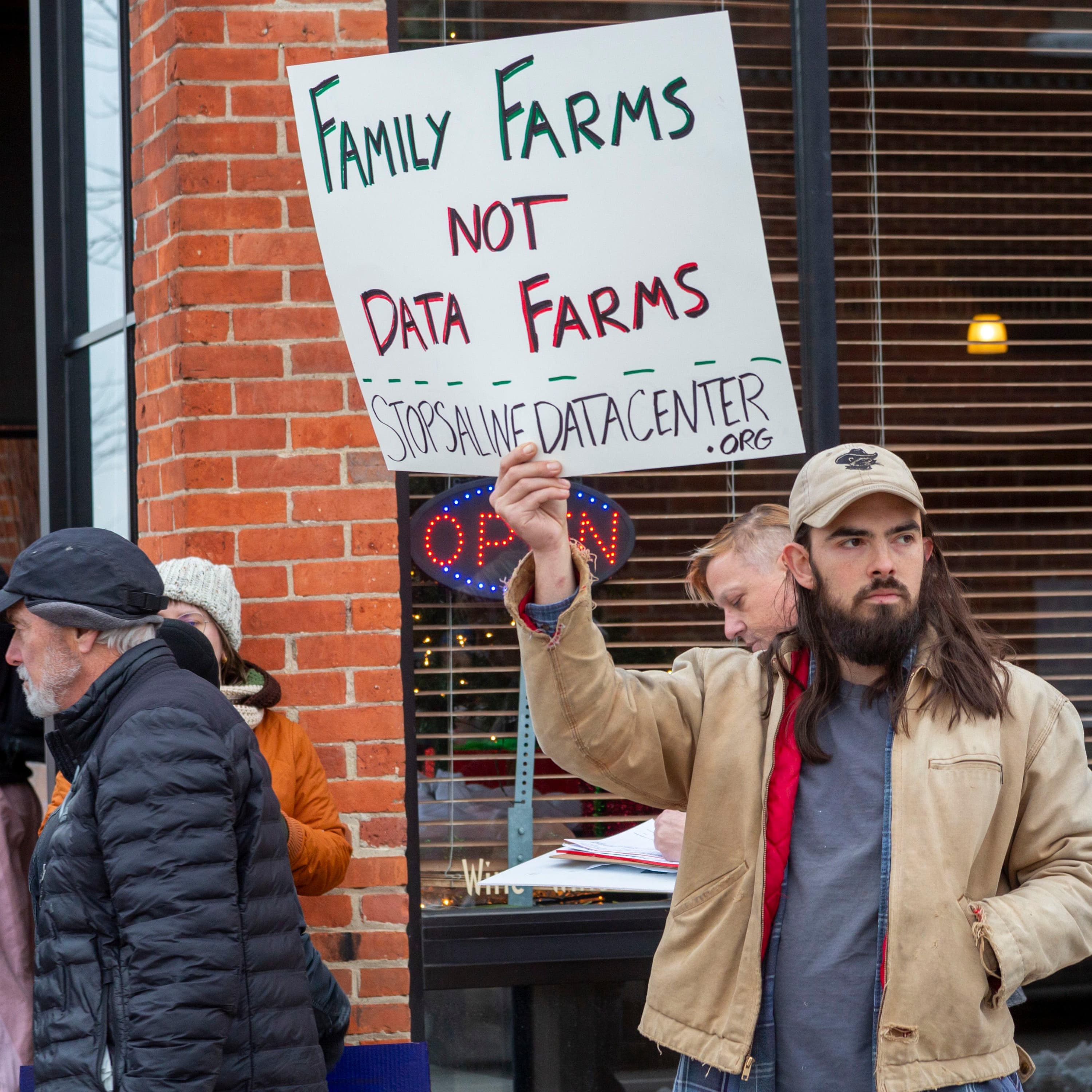
didn't choose. And that are often required of them. You know, there are these billboards
here that say grow tomatoes, not data centers. There's this touch grass movement in the
US. You really think about like in Japan, where people pay to go to spas, to forest bathing,
to just like look at trees. I think we're on the edge of a new environmental movement
that has. And maybe this long hot summer in Europe is part of that. If we were having
this kind of a conversation about social media in 2005, I don't think social media would
have gone the way it went. I was watching this interview with Elon Musk and it's all like,
well, the horse is out of the barn. And now we're the horse. You know, the toothpaste
is out of the tube. Like, it's inevitable. It's not. It's really not. It's really, really
not inevitable.
Jill, we do always like to ask a what else question. All summer, there have been primaries
across the United States results coming in. But looking ahead to 2028, the democratic
party have changed their calendar for the process whereby they select their nominee for the
presidential race that year. In the past, it was always the likes of Iowa or New Hampshire
that began. Now the first state to vote will be South Carolina. Now, you're a historian
of the country. Just give us some background on why they might have done this. And whether
you think it will work.
So the Democrats, I think this is a move that they've been considering making for a while
because the worry is that presidential candidates coax their message to appease the largely
white electorate in New Hampshire and Iowa, the two first states. And then they come up with
a campaign that's really targeting white voters when the strength of the democratic party
is non-white voters. And younger voters, not older voters, and New Hampshire and Iowa
have older populations. So they're like, well, if we start another in South Carolina,
which Biden wanted to do, that we'd have a more vital campaign. And we'd start out on
it. We'd start out on better footing.
I think there's a little bit of a whiff of desperation to it, to be honest. The head of
the DNC who announced this is coming off in terrible scandal. Really a series of scandals
where he really just seems to be one of the worst heads of the DNC ever, which as with
my remark about your prime minister is saying something.
So I think he's trying to like undertake a positive step to say, like, this is the thing
our party's been wanting to do for a while. I'm going to make it happen. He can't necessarily
even make it happen. Like he can't. These states can still hold their primers. I hold
the caucus whenever they whenever they want to. But it's an attempt to assert that the
democratic national committee has authority, has power and has a vision for how to win
the election. I think it's mostly that.
The book is the rise and fall of the artificial state. Jill LePore, it's been absolutely fascinating.
Thank you so much for talking to me for politics weekly America.
Thank you.
And that is all from me for this week. There'll be a link so you can pre-order Jill's
book in the episode show notes nearer to home. Make sure to listen to Wednesday's episode
of today in focus. Annie Kelly went to Brick Lane in London to hear from residents campaigning
against a massive data center. One of the capital's most iconic streets. Search for that
wherever you listen to your podcast. But for now, it's goodbye. The producers were Daniel
Stevens and Nada Smillionic. And the executive producer this week is Frankie Toby. I'm Jonathan
Friedland. Thanks as always for listening.
This is The Guardian.
Podcast Summary
Key Points:
Jill LePore’s new book, *The Rise and Fall of the Artificial State*, defines the artificial state as a successor to liberal democracy, replacing government by consent with government by machine.
The shift toward technocracy has deep historical roots, including the 1930s technocracy movement and the 1950s coining of “artificial intelligence,” tied to ideas that technological progress inherently improves society.
LePore highlights Elon Musk’s grandfather, Joshua Holderman, a Canadian technocrat leader, linking Musk’s worldview to a lineage of techno-libertarian and quasi-fascist ideas.
Data centers have become a focal point of voter anxiety ahead of the 2024 midterms, symbolizing broader frustrations with AI, lack of regulation, and corporate secrecy in approving projects.
LePore argues that promises of democratization through personal computers, the internet, and social media were never realized, and AI follows the same marketing-driven pattern.
She sees hope for the artificial state’s fall due to limited natural resources, strong democratic institutions, and growing public backlash, such as movements like “touch grass” and local opposition to data centers.
The Democratic Party’s decision to start its 2028 primary calendar in South Carolina is framed as an attempt to better appeal to its diverse base, though LePore views it as partly a response to internal crises.
Summary:
In this episode of *Politics Weekly America*, Jonathan Friedland interviews historian Jill LePore about her new book, *The Rise and Fall of the Artificial State*. LePore argues that the liberal nation-state is being replaced by an artificial state, where governance is increasingly mediated by machines, algorithms, and corporate-controlled platforms, rather than by democratic consent. She traces this shift to historical movements, such as the 1930s technocracy movement, which proposed rule by scientists and engineers during the Depression, and the 1980s Silicon Valley ideology that equated technology with democratization—a promise she says was never fulfilled.
LePore draws a striking connection between technocrat Joshua Holderman and his grandson, Elon Musk, suggesting a philosophical lineage of techno-libertarianism. The discussion turns to data centers as a flashpoint for voter anger in the 2024 midterms, reflecting broader anxieties about AI, unregulated corporate power, and politicians’ complicity in secrecy. LePore contends that the artificial state is not inevitable; it can fall due to environmental limits, public frustration, and the resilience of democratic institutions.
She also comments on the Democratic Party’s shift to South Carolina for the 2028 primary, seeing it as a strategic but somewhat desperate move. Overall, the conversation underscores the fragility of democracy amid technological upheaval and the need for active resistance.
FAQs
The artificial state is the proposed successor to the liberal nation state, where government by consent is replaced by government by machine. It involves governance heavily mediated by algorithms, data collection, and social media platforms.
It emerged during the industrializing 19th century, influenced by thinkers like Keith Thomas, and was popularized in the 1950s when 'artificial' became a selling point. This idea is not an eternal truth but a historical construct.
Holderman was a leader of the technocracy movement in Canada in the 1930s, which advocated rule by scientists and engineers over democracy. He later moved to South Africa, and his grandson is Elon Musk, showing a lineage of techno-libertarian beliefs.
Concerns include high electricity and water use, environmental impact, and lack of public consent, as officials often signed NDAs with corporations. This has become a major issue in the midterm elections, reflecting broader anxieties about AI.
Congress was persuaded by the mantra that 'regulation stifles innovation,' a claim not empirically supported. This libertarian ideology, rooted in the 1980s Silicon Valley, led to a hands-off approach that allowed rapid, unregulated growth.
She points to strong democratic institutions and growing public frustration with unconsented machine dependence, like the 'grow tomatoes, not data centers' movement. She argues that technological inevitability is a myth, and change is possible.
Chat with AI
Loading...
Pro features
Go deeper with this episode
Unlock creator-grade tools that turn any transcript into show notes and subtitle files.
 PodcastTranscript AI