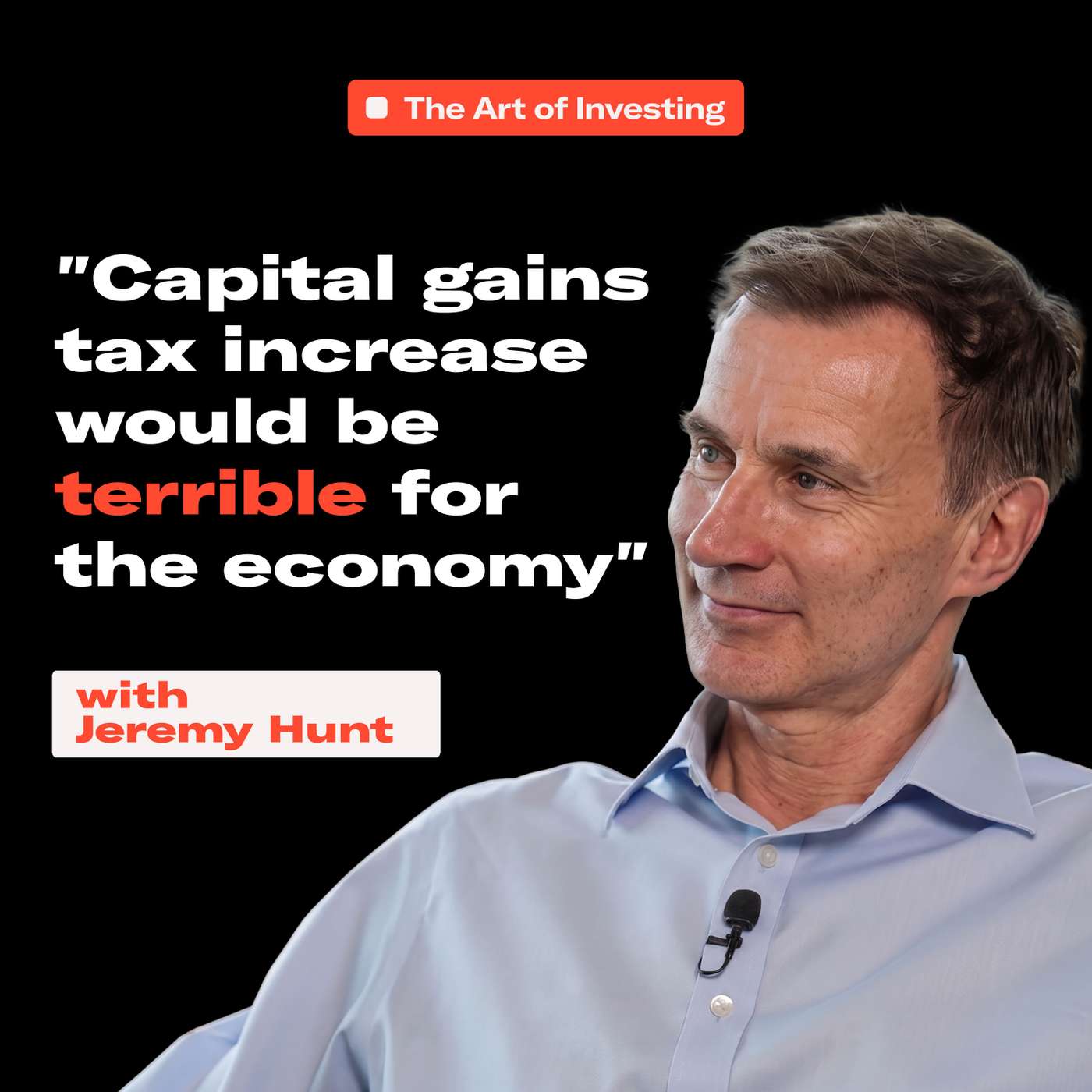
Jeremy Hunt on UK Investing, CGT, and the £100k Cliff Edge
from The Art of Investing
42m 11s
Jeremy Hunt recounts his unexpected appointment as Chancellor during the 2022 fiscal crisis following Liz Truss’s budget, describing the chaotic yet pivotal moment when he had to stabilize a nation teetering on recession, with inflation at 11% and a £72 billion fiscal hole. Despite lacking an economics background, Hunt focused on restoring market confidence by emphasizing fiscal credibility, transparency, and long-term sustainability. He highlights how investor behavior is driven by trust in a country’s ability to repay debt, not political whims. A central theme is the need for reform in the UK’s fragmented pension system, where he advocates adopting Australia’s single, portable pension model to boost competition, transparency, and returns for savers. He also stresses the underinvestment in UK equities and domestic tech, arguing that stronger domestic capital access would benefit both investors and the economy. Hunt firmly opposes policies like capital gains tax hikes, warning they disincentivize investment and harm growth. He champions tax cuts as a proven engine of economic expansion, provided balanced by fiscal responsibility. Key reforms such as the Mansion House reforms and pension consolidation were initiated during his tenure, though time and financial constraints limited full implementation. He believes the UK has significant growth potential—projected to overtake Japan by 2030—due to its world-class universities, tech ecosystem, and strong foundations in life sciences and AI. While acknowledging global risks like debt and geopolitical conflict, Hunt remains optimistic about the transformative potential of technological innovation, urging a balanced, forward-looking approach to investing and economic policy.
Hello, and welcome to this special episode of the award-winning R2 Investing podcast brought to you by
IG the global investment platform. It's a great privilege for me to date
interview someone who has been an MP for 21 years as
occupied a number of cabinet posts
including two of the great offices of state and
Was there at the most important time in my view for the UK in the past 20 years?
When we lost our fiscal credibility after the Liz Truss and quasi-quattang budget
He had to come in and save the day. I am, of course, talking about the ex-Chancellor ex-Jekker
Jeremy Hunt. Jeremy, how wonderful to see you. Hello, Chris. Pleasure to be here. Before we start on
Some of our other topics. I'd like to go back to that period. That was a really, really tricky period
I'm sure you found it so but it was even more tricky for you because you weren't expecting to be Chancellor
Can you tell us the story of how you became Chancellor the ex-Jekker? Yes, I mean, I was a backbencher
I had not been chosen by Boris Johnson to carry on as foreign secretary
So I happily went to the backbenches and was enjoying
spending time with my family and I was actually on a long weekend in Brussels
with my wife Lucille. It was a Friday morning
woke up and
There was a message on my phone saying Liz Truss here. Please call
And I thought it's got to be a hoax
I didn't support Liz Truss in the leadership campaign
So I ignored it and I in fact I shouted out to my wife who was brushing her teeth. I said
I can't believe these silly journalists. They think I'm such a sucker. I'm going to fall for this
And I thought it was maybe a presenter from a radio show who was going to do a Liz Pruss
No, but I thought they were going to do a Liz Pruss in personation and
And get me to say stuff. I captioned say and
Anyway, so I ignored it the phone rang
But it was an unrecognized number so I zap the call
And then we went down for breakfast and had a very nice breakfast and then a friend of mine
Called Lucille and said I think number 10 are actually trying to get in touch with Jeremy
So very gingerly I call the number 10 switchboard and I said look I'm sure this is a hoax
But I got a message that the prime minister wanted to call me
And they said absolutely she does and um my five o'clock that afternoon I was Chancellor
Well, that is an amazing story. So you had to rush back from your holiday. I rushed back on the euro star
You know, and it was uh, you know, I remember having to talk to the civil service
propriety people on the train who wanted to check. I didn't hold
Have share holdings that were not appropriate for a chance in the ex-check and all that sort of stuff
And we're having these rushed conversations on the euro star
Which I couldn't do in my seat because they could be overheard. So I had to go in that very sort of noisy
place between the carriages
Back home
Get myself changed and do a suit. You know, I've got my car was waiting and I came and by five o'clock that afternoon
And it was a bit surreal because I mean if you could imagine I
I've got no background in
Economics. I've got a business background. Yeah, except around my own business
But I'd never run any of the departments with an economics or
business
Focus that was a moment where markets were crashing around our ears
inflation was 11% bank of England saying we're heading into the longest recession for a hundred years
A huge
72 billion pound black hole in the public finances. I know you're going to talk about my book
But in a way that book is the book I wish I'd been given
At that moment because it's everything. I've learned since then
About what chances need to do. So if we go back to that period as you say markets all over the place
You're a businessman. You're not an economist and you now find that
Your beholden to some anonymous people called city fund manager
I have to I have to raise my hand up here to say I have been one of those many years
I have been that person buying something else
You're now absolutely beholden to them. What did that feel like?
Well, they felt like we're in a hole and we've got to get out of it. I didn't stop to say
This is wrong
These you know teenage scribblers are being completely unreasonable
I thought there's a perfectly sensible reason for this which is that the government has just announced a budget
Which is a massive increase in borrowing without explaining to people where the money is going to come from and
the markets
Took fright and so what I needed to do
Was to reassure people that
Britain was good for the money it borrowed that we were a country that would
Be able to repay our debt and that we would be sensible fiscally and that was my
primary job and even though I didn't have that background in economics. It was pretty clear to me
That was the root of the issue and you know just one more on that subject
You know, I listened to a number of financial podcasts um the rested money being one of them shout out for Robert Pestin and Steph
I live listening to them the other day and they were sort of claiming it was democratically wrong for the bond market to dictate
To a government when it came in how much it could or could not borrow
Because the people voted for it and I regard that as an interesting place to come from what's your reaction?
You know, how do you see that? I'm surprised if they said that because I don't agree with that at all. I mean
You know, you can only borrow money if someone is willing to lend it to you
And uh, so that's that's how the world works
And if people think that you are not a good bet they're going to charge you a higher interest rate
And that is what's been happening to the UK
Now, I think there are some structural
Things that we have to recognize it is true on the one hand that
UK governments have been borrowing more and more and the root cause of that
Is that we've been increasing public spending faster than the economy's growth and that's why over the last 25 years debt's gone out from
About a third of GDP to just under a hundred percent of GDP. That is
perfectly sustainable
As long as you can continue to pay the interest on that debt and there's no reason why the UK can't
It is also true that because people worry that we will continue to borrow more
They're charging us higher interest rates than they charge other countries
And there probably are some structural issues which
You know the government should look at which is you know, for example quite a large chunk of our debt is held by foreigners
And it's held by hedge funds who are
Generally a little bit more short term in their thinking
Compared to say pension funds particularly domestic pension funds who tend to be more stable
Long-term holders of debt. So that may be one of the reasons why we
Pay a premium for our debt
That's nothing the government couldn't sort out over time if it had an active plan to
Change the the holders of debt or to reduce the proportions held by different
Categories of lenders and that's something that a you know a government should certainly think about but that's you know as a bond investor myself
That the you know the key point is a credible
fiscal policy an incredible growth policy
I've always been in the views that we can borrow more money to on market will lend you more money if it's clear
It's going to get it back
It's when it starts to doubt is going to get it back that you get your problems and so
Growth that's built around the the proper fundamental ways of driving growth with a bit more spending
is fine
What you can't do is have the spending first and not the growth and that's what we're unfortunately
Seeing in the economic climate today. Well, I couldn't agree with you more as a whole chapter my book that the base there is
Two on debt. We will be referring to that in a moment
Makes the argument, but I would say that um lifting the bonnet on that problem
Is it's it's that when British governments have tended to spend more
It tends to be on day-to-day expenditure
For example, welfare, which is something people are talking about at the moment
Rather than on the kind of capital expenditure that would increase the growth potential of the economy
For example nuclear power stations which will give us cheaper energy
Or new rail networks or new road networks that those kinds of things that increase the productive potential of the economy
I think if investors
People lending money to the UK can see that you're spending money on things that are going to increase your long-term growth rate
They will take a different view
Absolutely, if they think it's
Jam today absolute right okay, so we created
This podcast series the art of investing with IG
to help encourage people
To take more interest in financial markets to understand how investing in financial markets can transform their wealth
Help with their retirement hopes their aspirations for their final for fort for their own financial journey and take responsibility for it
It's a subject matter which people tend to ignore when they ever they can
And it's too important to ignore and it's something therefore that we wanted to try to help with this series
So my first question to you would be what advice would you give to the young and old of today regarding investing and saving
For me it is an absolutely core part of my philosophy
I'm not a really part of political obviously I am a conservative
And I think that
human beings are happier when they are able to stand on their own two feet.
Part of that means having the capacity to deal with a rainy day, which means savings in
the bank that mean you can cope with the horrible things that life throws at all of us from
time to time.
So I think it's really important.
I think there's a particular reason why it matters now, which is that we're all living
longer.
The first time in human history, I'm going to be 60 this year.
And I think I've got at least 20 years of active life in front of me.
That will be a period in which I'll be hoping to spend money, travel the world, do some
fun things as well.
And we're not saving enough to allow us all to do that kind of thing because our parents
and grandparents might not have lived for quite so long.
So we all need to be saving more, and therefore we need a culture that encourages people
to save.
And I actually think that British people in our DNA are brilliant savers and brilliant
investors, but we have not created the structures that encourage people to save as much as
they could and should.
What can we do about that?
What do you think, if you were sending out, if you were made minister of savings, if they
were such a thing, what would you set out as your sort of one or two things to try to convince
people of why this is something they should be doing?
Well, how about if I was a chance at the Exchequer because, you know, that might happen.
Yes, well, I did actually say when I was a chance at the Exchequer exactly what I wanted
to do.
And unfortunately, I wasn't in post for long enough to do it, but I think the single reform
that would make the biggest difference is to go Australian in the way that we save for
our pensions and get rid of this crazy system where you have a different pension pot for
each employer that you work for.
So most people have no idea of the total value of their pension pot.
In Australia, you have one pension pot.
You take it with you from employer to employer.
You can look on your phone any time and see the value of your pension pot and how much
that will mean for you when you retire.
And what that does, that simplicity does two things.
First of all, it creates fierce competition in the Australian superannuation market as
they call it because the returns that the pension pot investors get are published.
And everyone can see that this company gets 0.7% higher returns than either this company
and then they switch their pension pots.
And that fierce competition has led Australian pension funds to invest much more in equity
and in private companies and in high-growth companies rather than what British pension
funds have done, which is much more cautiously stick their money into bonds.
When Australian pension funds get about 1.6% higher returns than British pension funds,
over 40 years of saving.
That's a lot.
That's about double.
That compounds do about double.
Having a simple system, one pension pot you take with you creates more competition.
It also encourages people to save more if they get an inheritance, if they get a bonus,
there is their pension pot.
So to me, there are a number of different parts of that which are important.
But let's sort of break them down into separate bits.
First of all, savings.
How do we encourage people to save more and how do we encourage them to take more risk
with their savings?
Because there was a great bit of work done started last year by JP Morgan and they looked
at the UK savings market and found that since the crisis, since the Covid crisis, we'd
actually save more than almost every other country when you looked at our savings rate.
But we put 50% of that in cash.
What's making people be so cautious about what they do with those investments?
And just to put it in perspective, if they had invested that money in equities since
Covid to today, they would in real terms, real terms over and above inflation have beaten
inflation by 39% and in cash, they would be down 9% to go.
So people have saved what's going to make them put that money in more risky assets?
I wouldn't phrase it quite like that, it's probably why you're a politician.
Yeah, I mean, obviously, it sounds a bit scary to say we should be encouraging people
to invest in more risky assets.
I would say we should be encouraging people to have a smarter investment strategy and
a smarter investment strategy, typically, when you're an investor not me, but typically
as I understand it, you would say, well, let's take the amount of money I've got available
to invest and let's put a small proportion of it in the high risk, high return elements
and there may be a big chunk in something that's a bit more steady and solid.
So that I'm not risking all my money, but I am going to get some of the upside from
some of the more potentially exciting investments.
And the way to get people to do that is just to make it simpler for them.
Now, I think the Australian system is one way of doing that.
But I could also point to the complexity of the ISO system, which again is in a way has
been a great success, it's a huge market, but it's also really complex.
I think sometimes, if you're not a professional investor, it's hard to get your head around
it.
And that is why a lot of people, when they came out of COVID, they had their furlough
money.
They hadn't been able to spend it because they couldn't go on holiday.
They had those extra savings.
They just left it in the bank and that's why it ended up as cash.
And I couldn't agree with you more.
We need to change the culture.
And I'd say one final thing about looking at pension pots as the best vehicle for this,
in Australia, everyone with a pension pot has been turned into a retail investor.
They care about what's happening on the stock market.
They're really interested in investment strategies because it's their pension.
And I think that would be a brilliant thing to do in the UK, because we've got a long
tradition of retail investing.
It's kind of withered on the vine since the privatisation of the 1980s and 90s.
It's what the London stock market really needs and we need to get it back.
You make some great points there.
I mean, one of the things about the Australian system is they give massive tax benefits to
Australians investing in their own stock market.
One of the things we've been incredibly terrible at is destroying what was the best pension
market in the world and big holdings in UK equities into what is now far worse and a bias
to not actually invest in UK equities but to invest elsewhere.
Should we provide tax incentives just to invest in UK equities?
It's not completely straightforward because London is arguably the world's greatest
financial centre, certainly one of the world's top two alongside New York.
And compared to New York, one of the great strengths of London is that it is more international.
And that is partly because we don't put any restrictions on where people invest.
We allow people to just follow wherever they think the best returns are anywhere in the
world.
And people come to London and transact in London because they can get that advice from
stock brokers based in London.
So I wouldn't want to lose that international edge that London has.
But on the other hand, the reason I worry about the way pension funds invest in the UK
is because I think they get an inferior returns for British pension savers.
And you can compare the investment strategies of British pension funds and the returns
they get and it is lower than in Australia or Canada or the United States.
And that is because we're not taking advantage of some of these high growth companies.
I've thought about this.
Would I mandate British pension funds to invest in the UK?
Probably not.
What I think I would do is go for a system where there's a default that they invest a certain
amount in the UK.
But that we give individuals the full freedom to opt out of that if they choose so that
we're not forcing anyone to invest anywhere.
But I think most brits actually expect a decent proportion of their pension funds to be
invested at home.
Would you take away the tax efficiency?
Because where I'm with you is I would never man that anybody to do anything.
I'll hold my hands up now.
I'm a conservative.
If I believe taking responsibility.
So as far as I'm concerned, if you want to go invest in America, fine.
But I don't know why I'm paying you.
I'm letting you take 200% out of Nvidia tax-free when British taxpayers pay in that or losing
that benefit.
When I could be saying to you, invest in the UK and we will give you tax benefits in the
UK for as much as you like overseas, but you don't get the tax benefit.
I can't argue against the logic in that.
I hope it wouldn't get to that point.
I hope the government will be able to say to pension funds, look, smell the coffee guys.
We are giving you huge tax benefits,
benefit your industry.
Now you need to modernize and start getting
the better returns that pension funds
in other countries are getting
by investing sufficiently in equities
and infrastructure and private companies
as happens in other countries.
By consolidating, got 30,000 of these pension funds
as it's way too many.
And yes, as part of that,
we'd like to see a healthy domestic allocation
because Britain is the, you know,
the third largest tech ecosystem in the world.
We've got brilliant start-ups happening
up and down the UK,
but British tech start-ups are more likely
to get money from Australian and Canadian pension funds
than British pension funds.
And that's absolutely mad.
- And so before we go any further,
because there are people throwing things
at their phone or wherever they're listening
to the podcast at the moment,
because they will be saying,
I want to be able to invest wherever I want to go.
Why would I invest in the UK stock market?
UK stock market is done terribly compared to the US stock market.
You're just giving me worse returns.
Now my argument would be
if we had more money going into the UK stock market,
UK stock market valuations A would be higher,
so you would have better returns.
But B, we would be having a lot more scale up finance.
We'd have a lot more of those secondary financing.
Third financing is done here.
People would not have to move to the States
as they are having to at the moment.
Is that where you're coming from here?
Is that what you're thinking?
- Exactly where I'm coming from.
And then, let's ask whether we need to address the issue
that despite having the third largest tech sector in the world,
we have no globally significant British tech giants.
They get to certain size,
and then they go across the pond and they float in Nasdaq
and they raise their money in other countries.
And the reality is that the UK stock market
would benefit massively if some of our homegrown companies
were able to raise their capital here.
But in Australia, about 50% of funds are invested in equities.
In America, I think it's about 40%.
Whereas in the UK, our pension funds
are around 4% of their portfolios in British equities.
So actually everyone is a winner
if the UK stock market starts to outperform in the way
that it has every reason to,
'cause we've got the brilliant companies here.
If you were saying to me, Chris,
the reason we're not investing in Britain
is 'cause you haven't got great companies here.
I would say, okay, we'll game over a fair point
because you've got to be able to invest
where the best company is up, but that's not the case.
We've got the most amazing companies here.
And by the way, it's not just tech, it's like life sciences.
Medicine Discovery, Cambridge is the European center.
600 companies based in Cambridge
doing the most amazing research.
So I think we've got to be a little bit
more long-term in our thinking here.
A healthy stock market is good for everyone.
But above all, it's good for people
saving for their pensions.
- So can I ask you a slightly more sensitive question then?
You were chance liver two years.
You obviously believe firmly in what you're saying here.
Why didn't you do more to drive that part
of the mandate forward that many things you did do?
But why not really grasp that nettle and say,
I'm gonna go down flames because let's face it,
you knew you only had three years probably maximum,
two and a half years probably maximum.
Why don't we just really make something count here?
- Well, actually I did.
And I'm proud of my record.
I mean, remember when I became chancellor,
you have to do a lot of things.
I had inflation at 11%.
I had a country going into a very, very long recession.
I had a huge black hole in the public finances.
All of those things I sorted out.
And with the Bank of England, we got inflation
down to 2%.
We got out of the recession.
Actually, when I left, we had one of the fastest
growth rates of any major economy.
We sorted out public finances with some very painful
tax rises and spending cuts.
And at the same time, looking further ahead,
I did the mansion house reforms,
the Edinburgh reforms that were designed to,
so for example, on the stock market,
I changed all the listing rules
to make them completely competitive
with the Nasdaq listing rules.
So that tech founders used to say,
well, look, if I list on Nasdaq,
I can float my shares and still keep control of the company,
but the London stock market rules
weren't allowed me to do that.
We changed that.
With the mansion house reforms,
I introduced the mansion house compact,
but also big reforms designed to consolidate
the pension industry.
And actually, to Labour's credit, Rachel Reeves
and Torsten Bell completely accepted that
was the right agenda.
And they have just passed into Laura Bill
based on those reforms, which will consolidate
the pension industry.
So I think this process is happening.
It doesn't happen overnight.
I did say in my final budget speech,
I want to have the Australian pension system.
I want to have a single pension part
that follows people from job to job.
And that is my vision for the pension industry.
Unfortunately, a couple of months later,
we have a general election.
So I wasn't able to do it.
So look, there's always more you can do as chancellor,
but I think I gave a pretty good shove.
Yeah, I'm not disputing the fact that you didn't do a lot.
You did do a lot.
And as we'll talk about Munchenhouse compacts in a moment.
But I'm far more of a, and I suppose
that's what I want to get.
I'm a pollcaster of fund managers and a politician.
I'm a far more of a just get it done.
Now to me, you believe, I'm reading your book,
that if you give incentive, things tend to follow.
Incentives are a great driver for what you're trying to do.
To me, if you want to change that attitude,
you can push a little bit to the side,
and you can push a little bit to the side.
But that's not going to push it.
You need to really drive it forward.
And I think we missed a trick.
If we wanted to go down this route clearly,
if you don't want to go this route, it's not important.
But to go down this route with that UK ISO
that you suggested in your last budget,
but actually actually just doing it.
And rather than consulting on it, just saying,
we're going to do this.
I'm making the difference.
Now, please, that's a matter of judgment.
And you know, you've got a lot more skin in the game
as to what's going on as a chancellor.
But to me, if you really wanted to drive that behavior,
that's what you really needed to do.
Sure, but to make those changes,
you have to do one of two things.
You either have to find money to create the incentive.
So a British ISO costs several hundred million,
maybe half a billion pounds a year.
Because you're giving an incentive to people for a new ISO.
And that incentive is tax that you would have received
that you're not receiving.
So you've got to find the money.
And that means you've got to be growing sufficiently
for the tax receipts to be able to fund it.
Or you've got to change the law because a lot of the consolidation
of the pension industry, actually, it's legal changes.
Changing the law takes time.
You've got to get parliamentary time.
It's got to go through the legal processes.
It's months or years to change laws.
And remember, when I became chancellor,
we had a huge black hole in the public finances.
I made big cuts.
But it's not possible to do all the things
that you want to do straight away.
So I think I pushed it as far as I possibly could
in the time that I had.
But unfortunately, yes, there were financial constraints.
Yes, we didn't have time to change all the laws.
We wanted to change.
I mean, I would have loved to have done that.
But I would have also-- there's also things
I wanted to do even more.
Yeah.
I wanted to do more.
That's what you said.
I wanted to do--
I've given you one of the things I want to do even more.
That's welfare reform.
But that is a big change in the law.
That would have released a lot of money
because the welfare bill is exploding out of control.
But we didn't have time to pass that law, unfortunately.
And it looks like that our success
isn't interesting being it either, sadly.
Can we go back to the private individual just for a moment?
Because the research that we've done at IG
suggests that the 100,000 pounds tax cliff edge
is discouraging many high earners
from investing and building wealth.
Can you explain what that is to people who are listing?
And do you think it's a problem that he's
going to need to be addressed?
Yes.
And yes.
So first of all, we have this cliff edge in the tax system
that when your salary reaches 100,000 pounds,
the treasury starts to claw back your personal allowance,
the 12,500 pounds.
It does it progressively between 100 and 125,000 pounds.
And so your marginal rate of tax goes up from 45% to 62%.
At the same time, because you're not
entitled to free childcare over 100,000 pounds,
if you happen to have young kids,
there's 6,000 to 7,000 pounds worth of childcare
that you suddenly won't get.
And so we've got this crazy situation
where some people tell their bosses,
I don't want to earn 100,000 pounds,
lead my salary on 99,000 pounds, because I'm better off
be able to claim my free childcare and not deal with this.
tax cliff edge. We need to be a society in which we're encouraging everyone to do the extra
work that's going to make the economy dynamic and competitive. We need to be on the side
of people who are working hard. And these kind of kings in the tax system absolutely need
to be ironed out. Now, from a politician's point of view, now I'm going to speak like
a professional politician if you like. There are sensitivities because you're talking about
tax changes that will benefit the very wealthiest because obviously very few people in society,
the median take-home pay is 39,000 pounds. So 100,000 pounds is very high. So it's a very
sensitive thing to introduce tax breaks for people on very high salaries. And my judgment
is that's something that you do at the start of a parliament when you allow time for
changes to work their way through the system. It's very difficult to do that kind of change
in the run-up to an election which is the situation I was in but absolutely needs to be addressed.
And a final full toss for you in this section of what we want to talk about. And you know,
you'll understand when I ask the question, I think. We've seen lots of speculation about
capital gains tax, capital gains tax increasing to the income tax levels and wealth taxes under
a suggested U. Prime Minister. Do you think that would be good or bad for the investment
environment and for the economy? It would be terrible. And it doesn't matter if you're
left or right, don't do it. And the reason is because if you increase capital gains tax
above 24%, you will get less revenue not more because investors will change their behaviour
and they won't sell their assets. They'll move their assets abroad, they'll move
abroad themselves and you will get less money not more. So if you're a left-wing government
that wants to raise more money to redistribute it to poorer areas or to put into public services,
don't do this because you'll get less money for the things that you care about. If you're
a centre-right government that wants to encourage enterprise and wealth creation, obviously
don't do it because you're going to discourage precisely the thing that will make the economy
dynamic and successful. Essentially the point I think you're making, I totally agree, is
if you're doing it for financial reasons, don't do it. If it's class politics or class
envy, then you shouldn't but you can see why people might do it. When I was asked to do
this interview, I decided that I needed to read your latest book and we have a copy of
it here which we are. Thank you. We will have it as a prize to one of the competitions
that we have on the podcast. Can we be rich again, the surprising potential of the British
economy? That sounds like a very catchy title, if I ever heard one. Don't see your keeping
yourself busy in opposition because clearly you've got some time on your hands so you
can write a good book. I liked it and I thought it had a lot of good ideas but the obvious
question and you tackled in your book but I wanted you to just be able to answer it here.
Did some of it but you didn't do it all and why was that? Was that for a not understanding
some of these issues until you got in the job or just so many other priorities? It's a mixture
but I was chancellor for just under two years and I inherited an economy in total crisis
as we talked about. My primary focus was to get the economy through that very, very
challenging period and I think working with the Bank of England and others, I succeeded
in that but then obviously what you want to do is to lay the foundations for long-term
growth and I did as many of those as I could but obviously in that time period, dealing
with those other pressures, it's not possible to do everything but frankly as you rightly say
Chris, you don't know it all when you arrive so there are things you learn on the job, there
are things you learn after you finish the job and so this book basically contains everything.
It contains the things that I did, the things I wished I'd done more often, the things
I learned after I finished the job and I think that overall it's a positive book because
I think we are a bit too gloomy about our prospects. I give you one example, according
to the Centre for Economics and Business Research by 2030, we will overtake Japan and become
the fifth biggest economy in the world. Now I would never underestimate the Japanese
I think they're an amazing economy in all sorts of ways but I think very few people watching
your podcast would be aware of that and I think that's because we've tended to be very
glass half empty when it comes to the British economy and we've actually got more going
for us than we often realise. Your first chapter in the book is about
growth and tax cuts and I just wanted to make sure that everybody listening here understood
your views on tax cuts because there seems to be a lot of thoughts around these days that
tax cuts aren't good for growth are good for growth blah blah blah blah blah I'm very
much a believer that the tax cuts are very good for growth. How do you think about that?
I am too and I think you can look around the world and in fact in the book I give you
the evidence that countries with lower tax grow faster and significantly faster but you
also have to go back to our very opening discussion you also have to balance the books and you
have to persuade people who lend you money that you're going to be able to pay it back.
So balancing the books living within sensible fiscal rules is the starting point and there's
no shortcut to reducing taxes it's hard work it is you know being restrained on public spending
and it is as your economy grows using a proportion of the extra tax receipts from that growth
to bring down the tax burden that is a a disciplined path that you take over many years it's not
something you can do overnight but absolutely it's one we should go on. And then also within
there you we've talked about a little bit already but just let's get a bit a bit of flesh on
the bones the mansion house compact you talked about what were you trying to achieve by that?
I wanted to do two things first of all I very strongly believe that the economies that are growing
the fastest around the world are the ones that are investing more and to invest more you have to
save more because you know they're two sides of the same coin so we need a much stronger savings
culture and that means a more modern and effective pensions industry and we have got a very fragmented
pensions industry which for various reasons relating really back to the Maxwell scandal of
of a couple of decades ago I remember it well I was trading Gilt's yeah well they have they have
been very cautious in their investment strategies and that's meant a lower returns for
British pensions savers then as we talked about them their counterparts in places like Australia
and Canada so we need a stronger savings culture and the second thing we need to do is we need to back
great British companies particularly in the industries of the future AI life sciences all those
really brilliant areas we've got three of the world's top 10 universities in this country they've
all got big business parks and science parks where you're getting really exciting companies
getting off the ground and we should be making sure they can access the capital they need at home
and that means taking advantage of the fact that we have one of the largest pension pools capital
pools in the world. Jeremy in your book about growth you talk about a number of options one of
the that I've often wondered about is the mandate of the Bank of England now the Bank of England has
a mandate to keep inflation low and people assume that they mean two two and a quarter percent
whatever that rate is but that is their only target whereas in the US they have the target of
keeping inflation low but also full employment so there's a sort of growth and inflation
piece there and I think there is speculation that maybe that would be a way of getting more growth
if you had both of those in the Bank of England's decision what did you ever think about changing
that which do you think that's a good idea what were the risks around that sort of thing?
I didn't ever think about changing it and I wouldn't want to change it and it's a very simple
reason which is that I don't think there is a trade-off between inflation and growth I think
low inflation is absolutely essential for growth and it's the building block it's the foundation
and if you're an investor and you're having to worry that the value of your assets is going to be
eaten away by inflation that is a destabilizing factor and so I think keep things simple give
the Bank of England a very straightforward job which is to keep inflation stable and low
and then you've got the treasury and you know politicians who can think about all the other things
but all those other things become so much easier if you've got low inflation and I know that because
I inherited an economy which had 11% inflation I know what it's like you know your bills are going
through the roof on everything from the NHS to benefits to all your capital projects it's an
absolute nightmare and it's not conducive to long-term decision making which is what you need
if you're going to have a healthy economy. It's great to talk to you because you're
clearly very optimistic and so in my industry you'd be an equity investor as my friend
Spice I hope you're listening Spice would be cheering if we look at that global
stock market now which is at all time highs very strong on AI, very great returns being achieved.
Where do you see the risks? Let's take away the optimistic bit for a moment. Let's look at
the global picture. Where are the risks? There's a debt risk as people at Ray Dalio write about that
countries have become more and more indebted over the last two or three decades and there's a
geopolitical risk of war. Now we've seen how entrenched conflicts can become in places like Ukraine
where the conflict has now lasted for longer than the First World War. We also need to be very
aware of the risks of unintended consequences and unintended conflict because great powers don't
talk to each other. I mean the First World War is a very salutary example of a war that neither
Britain or Germany actually wanted to get into it in the first place and they both found themselves
sucked in. There are real risks but what's interesting at the moment is that you have to balance those
risks against the extraordinary opportunities of AI and the entire tech revolution which I still
believe is in its early phases and so it's not an environment where you can say that you know all
the risks are on the downside. There are some big upside opportunities as well and you know
I'm not an investor and I'm not qualified to give investment advice but I do think it's a very
very interesting time. It is amazing and that's the the joy of the investing world and what we've
tried to get through in our podcast is how there's always something to look forward to. There's always
things to worry about but if you can balance them right you can have fun in their markets. You can
enjoy those markets and get great returns as well. Jeremy Hunt thank you so much and all the best.
It's been a pleasure. Thank you.
Podcast Summary
Key Points:
Jeremy Hunt became Chancellor unexpectedly after being called by Prime Minister Boris Johnson during a holiday, highlighting the sudden and urgent nature of the fiscal crisis following Liz Truss’s budget.
During his time as Chancellor, Hunt prioritized restoring fiscal credibility by stabilizing inflation, exiting recession, and reducing public debt, despite lacking formal economics training.
He emphasized that credible fiscal policy and long-term growth are essential, noting that investors lend money based on trust in a country’s ability to repay debt, not political ideology.
Hunt criticized the UK’s fragmented pension system, advocating for a single, portable pension pot—like Australia’s—driven by competition, transparency, and better returns for savers.
He argued that UK pension funds underinvest in domestic equities and infrastructure, missing opportunities in British tech and life sciences, which could boost market performance and national growth.
Hunt warned against tax increases on capital gains or wealth, stating they discourage investment, reduce market activity, and ultimately harm economic growth.
He supported tax cuts as drivers of growth, citing global evidence that lower taxation correlates with faster economic expansion, provided fiscal discipline is maintained.
He stressed the need for structural reforms—like pension consolidation and improving investment in UK tech—to build a more resilient, long-term economy despite time and financial constraints.
Summary:
Jeremy Hunt recounts his unexpected appointment as Chancellor during the 2022 fiscal crisis following Liz Truss’s budget, describing the chaotic yet pivotal moment when he had to stabilize a nation teetering on recession, with inflation at 11% and a £72 billion fiscal hole. Despite lacking an economics background, Hunt focused on restoring market confidence by emphasizing fiscal credibility, transparency, and long-term sustainability. He highlights how investor behavior is driven by trust in a country’s ability to repay debt, not political whims.
A central theme is the need for reform in the UK’s fragmented pension system, where he advocates adopting Australia’s single, portable pension model to boost competition, transparency, and returns for savers. He also stresses the underinvestment in UK equities and domestic tech, arguing that stronger domestic capital access would benefit both investors and the economy. Hunt firmly opposes policies like capital gains tax hikes, warning they disincentivize investment and harm growth.
He champions tax cuts as a proven engine of economic expansion, provided balanced by fiscal responsibility. Key reforms such as the Mansion House reforms and pension consolidation were initiated during his tenure, though time and financial constraints limited full implementation. He believes the UK has significant growth potential—projected to overtake Japan by 2030—due to its world-class universities, tech ecosystem, and strong foundations in life sciences and AI.
While acknowledging global risks like debt and geopolitical conflict, Hunt remains optimistic about the transformative potential of technological innovation, urging a balanced, forward-looking approach to investing and economic policy.
FAQs
Jeremy Hunt was unexpectedly called by Prime Minister Boris Johnson after a phone message during a holiday in Brussels. He initially dismissed it as a hoax, but after a friend confirmed the call, he accepted the request and rushed back to London, becoming Chancellor by 5 p.m. that day.
Hunt inherited a crisis with 11% inflation, a recession, a £72 billion public finance deficit, and a loss of fiscal credibility. Markets were crashing, and the government needed to restore confidence in the UK's ability to repay its debt.
He focused on reassuring markets that the UK was fiscally responsible and would repay its debt, emphasizing a credible and sustainable fiscal policy despite lacking formal economics training.
He believes it is a fundamental and correct market mechanism — if people don’t trust a government, they charge higher interest rates. He sees this as a reflection of market judgment, not democratic overreach.
He advocates for a single, portable pension pot system like Australia’s, which would increase competition, encourage long-term investment, and improve returns by promoting equity and private company investments.
He attributes this to low domestic investment in UK equities, especially in high-growth areas like tech and life sciences, and a pension system that invests heavily abroad, missing opportunities for homegrown companies to grow.
Chat with AI
Loading...
Pro features
Go deeper with this episode
Unlock creator-grade tools that turn any transcript into show notes and subtitle files.
 PodcastTranscript AI