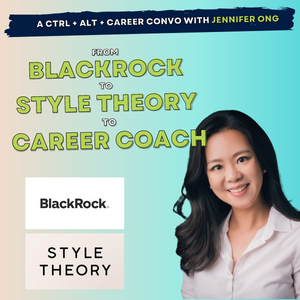
In this podcast episode, host Jen Ahn shares her career journey, beginning with a childhood in Hong Kong where her artistic interests were discouraged in favor of academics. She studied economics at Columbia University, influenced by parental advice on financial stability. After graduation, she entered a technical finance role at BlackRock in New York due to campus recruitment and peer pressure, but found it emotionally draining due to a mismatch with her skills. Seeking change, she moved to a sales-oriented position at BlackRock in Hong Kong, which was a better fit and improved her happiness. However, she still lacked passion for finance and engaged in various creative side projects, including fashion blogging and a clothing rental idea. These ventures, along with her podcast "Control All Career," which interviews people with unconventional career paths in Asia, ultimately led her to leave finance and pursue entrepreneurship, emphasizing the importance of self-reflection and aligning work with personal strengths and interests.
Hey guys, welcome back to another episode of Control All Career. In this podcast, I interview people who have taken a leap of faith and pursued an alternative career path in Asia. Today, I'm doing something a little bit different and actually flipping the mic to myself. A lot of you have mentioned that you wanted an episode to learn more about me and my own journey. And so, as I'm about to turn 32 tomorrow, I thought it'd be a really fun opportunity for me to share my story and spend a little bit of time reflecting on my own career and what I've learned throughout these years. And so, I asked my friend Kevin, who is actually also a podcast host, to help interview me. So without further ado, here's a conversation with me. Today, I'm hosting Control All Career and I'm joined by the creator Jen Ahn. It's so weird being on the other side of the mic, honestly. Well, the thing is, you've had just as interesting and funny of a path as a lot of the folks who have been on the podcast as guests, right? So, obviously, it's good for the folks who are listening to actually get a little bit of insight into your own path. So, just to kind of kick things off, right? Could you tell me a little bit about your childhood, where you grew up, how you grew up? What are the basic facts? Sure, sure. Yeah, so I was born and raised in Hong Kong and I remember I actually had a very young age that I was already very interested in art, drawing, et cetera. But my parents were always like, oh, you should focus more on your academics and less on like drawing and painting and coloring, et cetera. And so, yeah, I guess in my childhood, I was just very much focused on academics, studying. My parents had a lot of influence in my life. So, it was very much like my parents said, I should do this and so I would do that. Yeah, and so I guess growing up, I never really thought about what it is that I really liked. And so that kind of then trickled into even my college years where that was really the first time I was like, oh, wow, I have to choose a major. I don't know what I'm interested in because my whole life, it was like, oh, yeah, I'm interested in art, but my parents said that that's not what I should be interested in. So I would kind of sway away from that and just focus more on like math and science. And so getting to college was really the first time where I was like, okay, I've got all the freedom of the world to kind of figure out what it is that I want to do. And I was just so lost, like I had no idea. So, what major did you end up picking based on your interests, the influence of your parents and ultimately the fact that, okay, I'm in a new country and I get a little bit of freedom to make the choice now. Yeah, so I guess going off to college, I ended up going to Columbia University in New York. So it was really exciting. You know, I got a lot of freedom. And so I explored a whole bunch of different classes, different topics, different majors. And actually, again, I was very drawn towards art, right? So art history was actually one of the majors that I was exploring back then. And so I remember I was talking to my parents about it and I was telling them, oh, hey, potentially I'm thinking about majoring in art history. And they were like, wait, what, what do you mean you're going to major in art history, right? They were like, that's one of those majors where you don't make money afterwards or like, what would you do after with an art history major? And I thought, you know, that's a good point. Financial security is important. And so, yeah, I mean, just chatting with them, they were like, you know, why don't you explore economics, you know, with like a business degree, you can actually go into a lot of different roles. So if you really do want to go into like the art space later on, you know, you could always do something in like the art space with regards to a business, I mean, I thought that made a lot of sense. And as someone who was relatively indecisive, it was good because economics was one of those majors where you could apply to a lot of different industries after you graduate. So I was like, okay, let me major in economics. Got it. So when you finish your major, I think there's a good amount of folks at Columbia who major in economics, they're living in New York City, they're influenced by a ton of different business field, right? So what sort of field did you end up going into? Yeah. So when you major in economics at Columbia, your junior and senior year, you've got a ton of companies just coming onto your campus, trying to recruit you. And a lot of these companies would be your investment banks, your consulting jobs. And so I kind of just got sucked into all of that, right? Again, you didn't really need to think or for me, there was no conscious decision that I was like, Oh, I'm interested in finance, I'm going to go into finance. It was very much like reacting to all these recruiters coming to our campus. And you know, when all of your friends are recruiting and landing interviews, it almost felt weird that I wasn't also doing that. And so definitely peer pressure led me down this path where I was like, okay, everyone's like going to these like info sessions, I should go to, I should go find out what these different roles are, I should apply for these roles. And so yeah, so I ended up applying to a whole bunch of finance roles, eventually landed a job with BlackRock. But it was very interesting now looking back, you know, how when you're a college interview for a job, you're very much like, I got to get this job. That was your ultimate goal. It was never, at least for me, I never really had the mindset where it was like, is this job the right fit for me? It was very like one sided. Like I wanted that job, hopefully the job wants me back, rather than, is this job the right role for me? And I think I'd also spoke to my insecurity back then, right? Because if you were more confident in your abilities, you'd be like, okay, I believe in myself and in my skills, I need to interview the job, not get interviewed by the job, right? Like I need to see if the job is the right fit for my life. And I never really did that, and that's how I got sucked into a role in finance, you know, as a young graduate who wasn't sure what she wanted to do, it was great, you know, like it's got the brand name, it's a job that a lot of people wanted, it's got the prestige, kind of all the things that I have been taught growing up to want, like get good grades, go into a prestigious school, you know, this was like the new thing, the new shiny thing to aim for was, you know, to land this prestigious job, and I got it, and so I was like, okay, great. Yeah, I think like knowing your abilities and being confident enough to pick a field to go into it, most college kids probably wouldn't be able to do that or have that awareness. So when you think about it, right, like whether it's Columbia or another grade school, a lot of kids go into maybe three or four different jobs, but I can't imagine like 10, 20 years down the line, thousands and thousands of Columbia graduates are still in only those three or four fields. That's a little too concentrated, right? There are leaders in other industries where Columbia is represented, so I imagine that this first job wasn't your second job, right? Yeah, yeah, and so for this first job, I guess, I guess back to the point where I never interviewed the job, I also didn't know what I was getting myself into, and so the job ended up being such an analytical, technical job, and was such a bad fit for me, right? So I was part of the Liberal Arts program at Columbia, I never really took coding classes or any computer science have a classes, and so lining a job where it was very much like the first day they were like, oh, you got a query databases, I had no idea what a database was when I first started. They were like, you got to write like simple code in PerlScript, and I was like, what do you mean? I have no idea how to code. And so it was just like a very, very terrible fit, and it was just, I had no one to blame but myself, right, for not properly doing my homework and not fully understanding what role it was that I was getting into. I was just attracted by the shiny brand name and got sucked into the job. And so, so yeah, that job was really honestly quite a terrible fit, but yet I stayed on, right? I guess I was very persistent, I'm a very persistent and gritty person, which is, you know, my strength but also my weakness, so I ended up staying way longer than I needed to, even though I knew pretty early on, I needed to quit this job, so I stayed, when I set all these arbitrary goals for myself, again, which is going to be a consistent theme in my career later on as well. I was like, okay, you know what, I got to stick this out until I'm an associate, life will probably get better when I'm an associate, let's just see, it's just two years. And then two years later, you know, I got the promotion, became an associate, and I was like, life is definitely not better, you know? And throughout this whole period of time, it actually took a very emotional toll on me because the job was just such a bad fit for who I am and my strengths, so every day going to work, I would be pretty defeated, to be honest. I would go into work. Everything that I had to do at work was things that I was really bad at. And so, over time, it just started taking a really strong emotional toll on me and I was like, you know what, this is not the right place to be. And so, once I got my associate promotion, I was like, okay, I really need to get out of this job. And so, at that point in time, I, again, did not do a lot of self-reflection. I was, again, attracted by the next shiny new object that everyone was trying to go into, which was tech. So, then I was like, okay, you know what, everyone's trying to get into tech, let me try as well. And so, I then went and applied to a whole bunch of different jobs like in Facebook, Google, etc. But at the same time, I was also thinking, okay, maybe I'll apply to roles internally as well. Let's just explore what else BlackRock has to offer. One of the jobs happened to be one in Hong Kong that was in a much more investment-focused role, which I thought was pretty interesting. And I also had a friend who was doing a very similar job. I had previously worked with him. So, he's quite familiar with what is a good fit for me and what my strengths and weaknesses are. And so, he was like, you know what? Like, why don't you try this role? I think it will be a much better fit for you. And so, I was like, yeah, sure. And that's how I kind of happened into the second role at BlackRock. You know, I did have interviews with different tech jobs, but at the end of the day, the BlackRock one just gave me an offer so much faster, and I was honestly at this point in my life where I was just like, so over my first job that I was like, I just got to get out of here. I just got to have a change. And so, that's how I ended up in my second role. I think an interesting thing in my thought is that you were in the financial services sector with an economics degree, but you were still fielding interest from the technology sector, right? And so, for a lot of folks who might be interested in switching locations, switching sectors, the fact that you still feel that interest when you're in a totally different sector is pretty, what was kind of the case that you made and how did you make that case? Was it based on your experience? Was it based on pure networking? What was your approach there? We can kind of delve in. Yeah, so I mean, at the end of the day, my parents were right with an economics degree. You can apply it to a lot of different fields that maybe if you majored in art history, you may not be so easy for you to apply to a tech job, but you know, with a business degree, it's kind of, you can apply to like different business roles within the tech space. And also it's about how to market your skills, I guess. At the end of the day, companies really just want to hire people who are smart, can think on their feet, have some sort of an analytical mindset. So I think that's one key thing that I do tell people that actually a lot of the times what you need, they will gladly teach you on the job. And when they're interviewing you, a lot of the times is how quickly do they think you can learn and adapt to the new environment, how passionate are you about this new rule? And also whether or not they see you as someone who they would love to work with. And so don't discount those things, I would say. Yeah, I think one point of advice from my end as well as that, especially if you're someone fresh from undergrad or freshman MBA program, who doesn't have relevant experience in, let's say, banking or any other sort of specific field, right? A lot of times you don't have a skill set that is valuable to these firms, but they want to see that one, you have a somewhat relevant background that shows, okay, I'm at least comfortable the terms that are being used when economics major would know some business terms. And second, you have a good disposition and a good kind of personality that makes it easy to teach because they know all these technical things. Nobody walks into the role knowing them, right? And I think you're an example of that as you went through all of these interviews. So I think that's a good example here. Now that we've talked about, okay, there is some kind of flexibility in terms of how you can use your profile and your personality to transition to the second job. You've also transitioned geographies to Hong Kong back home. So how was that second job for you? Was it drastically different? What did it teach you? The second job was a much better fit because I was more in a sales role. So it was a much better fit in terms of my personality traits and like my strengths versus a code role, which is much more internal focused and you're more about just creating something by yourself. For me, I do like working with other people and, you know, my strengths is in selling, I would say. And so that was a much better fit and I was much happier because, you know, I felt like, okay, it's not like I'm just terrible at working, you know, it was just because that previous job was a terrible fit. So yeah, I started finding my footing. It was also much closer to an investment-oriented role and specifically it was equity focused. So I was always very interested in learning about how businesses are run. And so that for me was quite exciting to get exposure to studying different types of companies in Asia and then also being able to use my strengths and my skills to try to sell mutual funds to customers. So you know, it was good. It was good. Honestly, it was like a much better fit. I was much happier. I was back home. So it was also nice in terms of my social life. I also felt like culturally I fit in a lot better into the role at BlackRock and Hong Kong because it's a lot more diverse compared to in New York where people were very US-centric and I never really felt like I could really climb the ladder there. So yeah, definitely making the move to Hong Kong was one that made a lot of sense at that time. I was much happier. It was like a significant upgrade. So I was happy for quite a few years. But then again, the bug hit and I was like, okay, do I really see myself progressing into becoming my boss? And I really that passionate about what I'm doing. And I really started noticing this difference, I guess, or divergence in passion between myself and some of the other people at work. For people who are passionate about their jobs, they really do spend all this extra time on the weekend reading up on what it is that they do. And I myself, I'm like, okay, I'm out of here. I'm not going to spend my nights like reading up on like research reports, et cetera. And so during that period of low, I again went as it goes for myself to keep myself going. One was I wanted to have international exposure. So I had to tick off the New York bucket, I ticked off the Hong Kong bucket, and I really wanted to be in London for a period of time. So like one of my goals was like, okay, how can I see if I can get some exposure working out of London? And so I managed to convince my boss to send me to London for three months, which was really great because then I got to try working in London, living in London. Everything was paid for, which was amazing. And so that kind of kept me going, right? Like I created all these things for myself to look forward to so that I would keep staying at that job basically. But I think all of these things are like band-aids to like cover up my underlying unhappiness. And I think also throughout the seven years I spent at Blockup, I always had the side projects. So because I wasn't fulfilled at work, I had to find an outlet for myself for the creative side to be unleashed, especially in finance where you use the left side of your brain a lot. I needed an outlet for the right side of my brain. So throughout my entire career, I've always had things on the side. So for example, I had like a fashion blog for a period of time when I was in New York. And then when I was back in Hong Kong, I was also exploring creating my own fashion brown. So making pencil skirts that were like work appropriate, but also like a bit more fun. Because I really love colors. And I felt like a lot of like the work where it was always like black, navy, gray, etc. And I always wanted like a pencil skirt that was like more fun. So that was something that I explored for a period of time. I went to like trade shows and like met different factories and even did like samples and mockups and stuff. But I never took it to fruition. I never like took it to the next level where I was like, oh, I've built a company and I'm like now selling like pencil skirts. I think maybe it's almost like in the process of doing it, I satisfied the right brain of me. I think I was maybe even like self sabotage a little bit like I didn't want my side project to be so successful that I would have to choose between BlackRock and that side thing. So yeah, I remember while you were in Hong Kong, you had a very cool travel focused idea that's quite different from the world of investments. So we'd love to hear a little bit about that. And I think that does segue into how you ultimately made your next full on career step, that third step, right? Yes, exactly, exactly. So I was working on a project where I was doing clothing rental, but trying to partner with hotels. So imagine if you could travel and not pack a suitcase. So all the clothes that you would need would already be waiting for you at the hotels. So when I was working on this project, it was just an idea. And I called emails a bunch of hotels in Hong Kong with my idea and people actually replied, I was shocked. I emailed this guy from Overlow, he was a pretty senior. I think he was like sea level person with like my idea or nothing, but an idea. And actually now I think I'm back up like, who am I to like just randomly like email this guy with my idea? Anyway, yeah. I emailed this guy. I was like, hey, this is my idea. Like I was wondering if Overlow would be interested to find out more about this. He responded. He was like, sure. Would love to hear more about this. Do you want to start a meeting? And then I was like, what? What? It's like, unless you want to meet this guy, I was still working on BlackRock at the time. So I just took a really long coffee break. I like to sit here for like an hour and I met this guy at Overlow and it presented to him. My idea, like last minute, like put together like a presentation and I bought some clothes that I was like, oh, like these are potentially some of the clothes that we could like stock. And I like presented to him, oh, would you guys be interested in like partnering in this project? But it didn't work out in the end because we didn't agree on like the logistic cold side of things. And he was like, okay, maybe later on once we like figure out the logistic, we can reengage again. But like he was like very excited about the idea. So that was like kind of like my first like foray into like start up or like starting something from nothing. And I was like, wow, this is so exciting. Yeah. I think style theory from after I heard this story that you had just told and thinking about what you do now, it seems like it's a good combination in terms of you get to do something a little bit more entrepreneurial in a very different field that you've always been interested in, right? But it's a little bit of a nice leeway in that you don't have to run the entire ship and go eight is he from start to finish. You have a team that's in there and has a little bit of experience, but still has a role for you to play, right? So I'm curious, moving to Singapore and joining style theory, how did that come about and was there any kind of apprehension about leaving a very comfortable Hong Kong? Yeah. So I guess for me, I was in a long distance relationship for three years in New York to Hong Kong and that was really starting to take a toll on my personal life. My career has always been the thing that I focused on most. And I kind of accomplished all the goals that I had set up for myself at that point. One, I got my international exposure to, I wanted to make VP before I left. So that was a very calculated decision to make a vice president before I left because I didn't want to leave BlackRock without a safety net because I am someone who is actually very risk averse. I got to make sure I get to mid-level management at BlackRock. In case I ever want to come back, I do not want to be like a 35 year old associate. So I was like, you know what, the VPs could get stuck as a VP for a really long time. So if I make it to VP, at least hopefully I can come back as a VP. And so yeah, for me, that was like the goal that I had set up for myself. I accomplished it. And so I was like, you know what, I feel more confident and more comfortable leaving BlackRock at that point. But yeah, so at that point in time I was like, okay, I am moving to Singapore. So I was like, should I move with BlackRock to Singapore? I was like, one of my first decisions because I could probably move internally quite quickly. They would help me with my relocation. If I was like, oh, maybe I should do that. And actually on the day that I gave in my resignation letter, my boss also asked me, he was like, hey, would you consider moving to our Singapore office? You can just be based out of Singapore, still work up with the same team here. Like, we can make it work. So it was really nice of him to offer me that, but yeah, my mind was set at that point already. So yeah, that was one option, but I was like, okay, Jen, you know, you've spent your whole career talking about how you want to leave and you want to try something new. This is the chance. This is the universe telling you to leave and like try something new. And so I was like, yeah, you know what, like, let me like for real try to find jobs out there that are better suited to what I like. And so yeah, I was physically looking on LinkedIn again. I was like, okay, for like tech jobs, which honestly, I feel like tech was like the new finance. You know how like people really wanted to go to finance for a period of time. And then afterwards everyone would go to check. And so I was like, oh, I guess I'm just following this trend to like go into tech. But anyway, I did. So I was like on LinkedIn, like looking for jobs, I was like actually looking at types of Netflix because I was like, oh, maybe like I can work on Netflix. And yeah, I found style theory because they describe themselves as like the Netflix of fashion. So basically, style theory is like a bit like rent the runway in the US. So you pay a monthly membership and you get to rent the clothes from them. And I was like, wow, this is exactly what I'm looking for. Like, it's fashion, which is what I'm interested in, but it's not just pure commerce kind of fashion. It was like a really exciting, like new concept. So it has like elements of like the tech and like startup-y vibe that I was like kind of intrigued by. And I was like, wow, I think I may have found like a job that really takes a lot of the boxes that I'm looking for. And so I was like super excited, like reach out to the founders. I like stocked them. And when I was like, do we have mutual friends? And we did. And so I was like, I reached out to like our mutual friend being like, hey, could you like connect us? She was like happy to like make the introduction. And we set up a call, was just like chatting. He asked me a lot of questions about the business, like, how would I approach these problems? And as I was answering, I was like, this is so exciting. Like people can spend like their jobs just thinking about how to build a fashion company. And that was the first time in my life where I could feel so passionate just talking about it. So that sounds pretty interesting, right? Like the day-to-day sounds pretty awesome, right? Oh, I'm actually interested in my work. What a novel idea. But I'm curious, when you do this, you know, everyone wants to work in a job where they really love the day-to-day, but something holds them back. At BlackRock, you had good compensation, you had good vacation, you had a good reputation that let you switch cities, right? How hard was it to throw that out the door? Like, how are you thinking about it? Because a lot of us want to make that same jump, and we can't, right? So that's why it was so scary for me to like hand in my resignation letter, which is so weird, right? Because most people, when they hand in their resignation letters, like the happiest day of their life, they're like, yes, I'm out of here. For me, I was so nervous going in. Like I remember, I pushed off this conversation with a boss so many times, because I truly felt like, wow, am I really making the right decision? I'm really throwing away this seemingly perfect career for what, you know, like it just, it didn't make sense for anyone on the outside really, like my parents, especially, it made no sense to them. They were like, wait, what? You're going to give up your BlackRock career with like amazing benefits, pay, work life balance, all these things, for a startup that's paying literally a fraction of what you're making, and they're like literally the understand. So yeah, for me, that decision was really hard, but I knew that I had to do it because I was like, hey, if I don't do it now, I will regret it probably for the rest of my life. And two, the decision was slightly easier for me because at that point in time, I actually was working on a side project, another side project, which was very similar to style theory. So I was like, oh, men as well go learn from someone like the logistics and the operations, on the other side of things, and kind of learn on someone else's dime instead of putting all my eggs into like one basket and like trying to build my own company and not get paid and like make all the mistakes. And that's the advice that the founders of style theory gave on the earlier part, right? So it was great that they agreed with that. But yeah, I mean, honestly, it's been a really great experience at style theory. Like I've learned so much being there, like how to build a business from scratch, how to take up something from an idea and do an actual thing and see it come to fruition. Because like previously I would always get kind of stuck, like I would never really like push it all the way through. And so at style theory, I was like forced to obviously deliver on results. And so I had to push myself all the way through. So I think that that's also kind of given me a confidence that I am able to do it for myself in the future. But I will say, not everything is perfect. So I want to be also very honest here that like, yes, while it was probably the best decision and like no regrets ever, like leaving my job at BlackRock, there are some downsides to the job as well. One that still grinds at me is pay because I took a significant pay. I took like 80% pay from my job previously to this. I remember the day they gave me the offer on the phone, like a verbal offer on the phone. We talked about pay. And I was like, what? Are we missing like a zero in this? Okay, I mean, like I knew that obviously, like I would have to take a pay cut, right? Like so I was like, thinking, okay, maybe like a 50% pay cut, right? Like, okay, like that seems like more doable, like 80% make also what? So how do you wrap your head around that because there's a lot of folks who say, don't take a pay cut from your last job, always be going up, right? You're taking a big cut here. So what's kind of your thought process around doing that? That was really tough. And it's still tough. Like a year and a half later, I'm still like, this is still like one of the pain points in my life, right? And I was like, can people live out of the salary? And then she saw it, and I was like, even my first job at Blackrock was like so much higher than this. Like as like a fresh grad. But then I was like, okay, you know what, Jen, like you've made enough money. I've saved up enough money to like last myself for like a few years anyway. And then I was like, okay, I set myself a timeline of two years. I will see if I can live off of the salary. If I don't, then I will dip into my savings, but I'm going to treat this like my MBA. So instead of going to business school, I expect $200,000. Why don't I just learn from the startup experience? And then the money that I get paid here is almost like a subsidy. So I kind of re-friend my thinking to like, okay, I could be like negative dollars and making no money going to business school, or I could be getting a little bit of money to learn. So then when I frame it that way, then it was like, okay, okay, it's not about like comparing against like a Blackrock salary. Well, we was working in corporate helpful for your time at Style Theory. Are there any transferable skills? There are very different types of companies, right? Yeah. So that for me was actually quite difficult, like the transition from Blackrock to Style Theory. I was mentally preparing myself for working for a much smaller company and a much more local company, because here is like all Singaporeans. And also, I think it was like the first day at Style Theory, which I was like, wow, I am at a startup. Like this is not like a glamorous startup, right? Like we're like legit at a startup. Like my desk was like an IKEA desk. It wasn't even a coffee machine. And then also culturally, I was used to working for a good American company. So I then also paid up a lot of like very American traits that which I didn't realize were like American traits until I got to Singapore, yeah. So I'm very direct and up front, whereas at Style Theory, it was much more like read between the lines, like nuances. So it looks like Style Theory was a pretty big change in terms of industry, size of the company, again, city, you do it again, right? Your prior experience working in fashion, exercising that right part of your brain a little bit. I can see why Style Theory drew you in. Where did this podcast come in? Yeah, yeah. Yeah. So my brain works in mysterious ways. So for this podcast, I think for me, the impetus really started during COVID actually when we were in pretty strict lockdown here in Singapore for quite a period of time. And so during that period of time, I had a lot of time to think about my life. And I was like, you know what, I want to start something again, like again, the side project bug hit. But this time I was like, my day job is already in fashion. So my side project is probably not going to be in fashion. And so I was just started writing in my journal, which is something that I do a lot to give myself some clarity. I was actually like when I put pen to paper, that really helps me in terms of my thinking, I've been taking myself out of my head. So when I started drawing down ideas, I kept going back to this idea of like alternative careers. Because for me, I personally went through this whole experience of very nervous about leaving like a corporate cushy career. And I was like, I can't be the only one out there who feels this way. And I remember when I was in Black Rock, there were so many colleagues that I had this exact same conversation with where we were like, we need to quit our jobs, but no one left. Like it was like years later, they were still there and like fear to leave is real. Because like their whole life, they grew up thinking, okay, a job is supposed to be a job. It's not supposed to be fun, a job is supposed to make money. And I think seven years in, your job becomes a little bit of autopilot because you know all the stakeholders, you know exactly what to do to think about starting all over again in a totally different. And from what you've told me, I think the skillsets required are very different too. Why go down that path and take the 80% paid cut and just begin again, right? Yeah, I think that's honestly the scariest thing that I had to do. And also, I think it's a very scary thing that keeps a lot of people from following their dreams. I mean, that's why I wanted to start the podcast because I wanted to share with people, the stories of other people who have successfully done it. People who have been able to leave their corporate jobs, what their thinking was at that period of time, the things that they struggled with, how did they overcome them, and then hopefully give the listeners a blueprint or just some inspiration, right? You know, just hearing about other people's stories kind of brought in your own perspective. And actually, it's not so far fetched. It's not like an idea that like some random person out there who has no care in the world, like only they can be an artist or like, oh, you must be like a billionaire's son to be able to do this because then you don't have to care about money. I wanted to bring in like real people who were able to successfully do it. I wanted to bring in people who were high achievers as well, people who have kind of gone through their whole lives, ticking all the right boxes, and also people who grew up in Asia where like, there is a lot of stigma almost to following your dreams or at least like there's a lot of pressure for you to make money. And so I wanted to kind of bring those stories in to share with other people to hopefully give some of you guys out there listening to this, like some courage to be able to leave a corporate job. And that actually, it's not so scary. Like yes, you take a 80% pay card and you start your career all over again. And there was so many moments in my life where I have like, self-doubt. But at the end of the day, I have no regrets to making this decision. And I am much happier than I was like at BlackRock. Even through the podcast, you've got to meet a lot of cool people through it. And I'm sure as you do each podcast too, you're also thinking, okay, where is this going? So where is this going? That's something that I've been asking myself a lot is, you know, like the podcast has been honestly quite a surprise in the sense that it's really resonated with people. People are randomly sharing this with their friends, which is amazing. And also this is how I met Kevin because I guess some of our mutual friends shared with each other and then it reached to Kevin and like our mutual friend introduced us and then we met. So I've been thinking more and more about like, okay, this alternative career path, it seems like a lot of people do want to pursue this but are nervous to do it. And so what I'm thinking as my next step is to create an online course around this. Like how do you overcome the fears of leaving a very steady, corporate job to pursue something different? How do you figure out what your passion is? I think a lot of people, myself included, when I was at my corporate job, I never really thought about what my dream job was in what industry is it even. And how do you shift your mentality when your whole life you've been taught to follow certain rules and take certain boxes? So yeah, so these are some of the things I want to cover in this online course. That's something that I'm super excited to put together for you guys. Hopefully, it'll be helpful for you guys. And yeah, I think that's the next immediate step for the podcast. I will still keep going with the podcast, I'll still have a lot of guests coming on to share their stories, etc. But yeah, definitely the online course. And then I'm even thinking like, maybe further down the road, like how could I set up potential opportunities for people to shadow or work on almost a consulting type projects for industries that you're potentially interested in. So you don't have to take time off of your work, but you still get some exposure to this new field. And I have a really good friend of mine who's local here and he's a management consultant. But on the weekend, he'll take one day to actually work at a restaurant and try to flex that culinary side of him and think about it as a career, right? And thankfully enough, the restaurant was nice enough to do that. But if you could do that with more formal fields, that would be helpful because I want to try a different field and I probably have to quit my job. So I think there's definitely a demand there. And I think, yeah, if you can make a network like this where you connect people to shadow or maybe just intern a little bit on the side and remove a lot of that barrier to provide that exposure. And then on top of that, like what you mentioned before, give that framework for how to think about what I want to do. And that framework for, okay, what are the actions to actually test that out, which includes this little stash internship externship, that'll be really cool. So tying it together, I think the podcast gave a lot of us ideas, oh, this sounds cool. Oh, this person's in a corporate field and wow, they just really took a jump and made it happen. Now you're going to give the tools. So as someone who's in a corporate job himself and just sort of on the wheel, I think I would be okay with less frequent podcast releases if you'll get this at a little bit faster. And that was the perfect way of summarizing all of this. This is really great. I think I've heard enough episode summaries from you at the very end to pick up a little bit on the fly. I will say this on Spotify, my top podcast is this very podcast. But yeah, I think we've kind of talked about your career. We've kind of talked about the motivations and thoughts you've had as you've crossed through. And this really exciting thing that you're working on moving forward. Are there any sorts of last reflections or any thoughts that you would have for the listener as we close this up today? Yeah. Actually, that's a question I always ask my guests. And actually you asking me this is kind of making me think as well because I've actually never thought about it too much myself, like what advice almost would I give someone? I think for me, the biggest thing was really like mentality. Like how do you get yourself out of that space where it's like, okay, I must do this because like my parents told me to or because society tells me that I need to make money. How do you get the courage to leave that behind? I think that is something that I acknowledge is really, really difficult. I think for me, the way that I was able to get through that was reframing my decision. So as I talked about a bit earlier, I was able to reframe my financial decision by looking at it as like, okay, I'm comparing this against going to business school for two years. And so actually me making a small amount of money is better than making no money and actually having to spend money on business school. So I think reframing decisions is one way of approaching this. And that was like one way that really helped me with this. On the financial front, actually one more piece of advice that I wanted to share is for me, I started getting really into investing because I was like, I gotta make my money grow. Actually, before I decided to quit my job, I did a lot of financial planning. I was someone who was very bad with my own personal finances before this. And so actually before I decided to quit my job, I was like, do I even have enough money saved up? Where is my money? What is my money even doing? And so like I put together a spreadsheet, drawed it everything down, figured out how much I'm actually spending every month. And then I was like, I divided my savings by my monthly spending and I was like, okay, it's gonna last me like a bit of time. So I guess I'm okay to just leave for a while and take a massive pay cut. So yeah, so I think that's the other piece is like financial planning, like really thinking through, okay, do you have enough saved up to help you get through this period of time? And the other pieces make your money work for you. You know, like your job may not be paying you, but your money can still work for you. So investing, I think is the one takeaway I got out of BlackRock. The other big piece of advice that I want to give is just get started. It doesn't need to be perfect, but just start. Once you start, doors will start opening to you. Like whether it's like me just putting out one episode out there and getting to be all these cool people from it, or actually just me deciding to quit my job at BlackRock and starting at a fashion company. Now all of a sudden, I'm getting all these like fashion related opportunities or people sending me links about fashion that like previously they wouldn't send to me because they were like, oh, you work at BlackRock, probably not interested in fashion. So you know, just take that first step. Once you take that first step, the universe has a really funny way of just helping you out along the way. Like people around you will start helping you out. So it's not that scary, guys. It's okay. I know how scary it might feel at this moment in time where you're about to take that leap, but once you take that leap, you know, the universe really does have a funny way of making things work out for you. Thank you so much, Jen. Good to hear from the host herself. So I really appreciate it at the time and looking forward to the next season, as well as the release of the new projects that you mentioned as well. Yeah. And thank you so much, Kevin, for being my host at this time. It's so weird being on the other side. And you've been a great host, keeping me at ease, which I feel like you're honestly a better host than I am now. I've got a lot to learn, but Kevin is starting his own podcast. So you guys definitely go check it out. Do you want to tell them more about it? I am starting a podcast on December 17th called Almost Home Podcast. The general gist of it is basically sharing stories from Asian folks who are living in different parts of the world, whether it's in different parts of Asia, America, Africa even, or really anywhere else. And just talking about the different challenges they've had and the different thoughts that they might have as well, right? What is it like to have a face like this, but be speaking English or Spanish as my primary language, right? What will my children think of themselves as Chinese, as American, something in between? Right? So if you're interested in learning more about these stories, you're welcome to follow us on Instagram at Almost Home Podcast or on your favorite podcast app. You can just look up Almost Home Podcast and you'll find that right there. So thank you so much for having me on Jen and hope to see some of you guys on my own podcast as well. Yeah. Yeah. So guys, definitely go check it out. There's a lot of variations of being Asian and I think it's super interesting to see Kevin bring these stories to life. You could be an Asian who grows up in Mexico. I think that was one of the guests that you had or how do you define yourself? Do you define yourself with your Asian name or your more westernized name and the power of language, right? So if you spoke Spanish, but you look Asian, how do people look at you or do you relate more to your Spanish roots or do you relate more to your Asian roots? So I think a very interesting topic and I would highly encourage you guys to go check it out. I'm super excited to see it come out. So yeah, cool. Please Kevin. Thank you for interviewing me today. And there you have it, the season finale. Instead of recapping the conversation like I normally do with my other guests, I thought I'd spend a little bit of time instead going through the eight things I've learned in the past eight years of my career. So here goes number one, don't be shy. If you want something, just ask for it, whether it is getting a pay raise, a promotion, being able to work out of London, reaching out to Ovalo with nothing but an idea, or even landing my job at Style Theory, I wouldn't have gone any of it if I didn't ask for it. No one will care more about your career than yourself, and more often than not, you will get what you want. Two, people around you will always have an opinion, and many times they just want what's best for you. Try to find a balance between taking in people's advice without losing yourself. Learn when to stand up for yourself and stick with your gut, even if everyone else thinks or says differently, because at the end of the day, it really is too difficult to live your life for someone else. Three, there's no right or wrong decision, and not making a decision is a decision in and of itself. And once you decide, the universe often has a very funny way of making sure things work out for you. Four, have a plan. It's easy to let life pass you by. Spend some time setting goals and really figuring out what it is that you want, and where it is that you want to go. Five, recognize that you are often your biggest enemy, and more importantly, recognize when you are self-sabotaging and stop yourself from doing it. Six, what got you here isn't going to get you there. You cannot rest on your laurels. Always be learning. Seven, spend some time on your personal finances and learn how to invest your money, especially if you have to take a significant pay cut to pursue an alternative career. Making your money work for you is a great way to supplement your income. Eight, don't compare yourself against others, and most importantly, don't let this comparison stop you from pursuing something you love. I know just how easy it is to not want to start all over again for fear of lagging behind your peers. But remember this, life is long. Let this short term loss stop you from long term gains. And so that's it. Eight years of learnings in just a few minutes. And as I mentioned in my podcast, I have just started an online course to help you pursue an alternative career. If you are feeling stuck in your corporate job, and not sure what it is that you're passionate about, or just trying to figure out how to pursue an alternative career, then this course is for you. I've built this course to be very much action oriented. I'm a step by step guy to help you overcome the societal pressures in Asia and pursue a career you love to building a minimum viable product for you to test out different potential career paths. This course is everything I wish I knew before I spent seven years meandering in my own career. So I'm super, super excited about this course. And I really can't think of a better time for you to invest in yourself ahead of the new year. You can go check it out and find out more at www.onggenifor.com/controlyourcareer. That's www.oggenifor.com/controlctrl-your-career. Link is also in the show notes to today's episode. And for a limited time only, I'm offering a discounted pre-launch price at 50% off. So definitely head on over and check it out. Alright, that's all for season 1. Thanks so much guys for tuning in and for your support throughout this season. I hope you have a great holiday season ahead and I will see you guys back here in the new year for season 2.
Podcast Summary
Key Points:
Jen Ahn grew up in Hong Kong with a passion for art, but was steered by her parents toward academics and later chose economics in college for financial security.
She entered finance at BlackRock in New York due to campus recruitment and peer pressure, but the technical role was a poor fit, causing emotional strain.
She transferred to a sales-focused role at BlackRock in Hong Kong, which better matched her strengths, yet she still felt unfulfilled and pursued creative side projects.
Jen eventually left finance to pursue entrepreneurship, leveraging her side project experiences and podcasting to explore alternative careers in Asia.
Summary:
In this podcast episode, host Jen Ahn shares her career journey, beginning with a childhood in Hong Kong where her artistic interests were discouraged in favor of academics. She studied economics at Columbia University, influenced by parental advice on financial stability. After graduation, she entered a technical finance role at BlackRock in New York due to campus recruitment and peer pressure, but found it emotionally draining due to a mismatch with her skills.
Seeking change, she moved to a sales-oriented position at BlackRock in Hong Kong, which was a better fit and improved her happiness. However, she still lacked passion for finance and engaged in various creative side projects, including fashion blogging and a clothing rental idea. These ventures, along with her podcast "Control All Career," which interviews people with unconventional career paths in Asia, ultimately led her to leave finance and pursue entrepreneurship, emphasizing the importance of self-reflection and aligning work with personal strengths and interests.
FAQs
It interviews people who have taken a leap of faith to pursue alternative career paths in Asia, sharing their journeys and insights.
She was born and raised in Hong Kong and had a strong interest in art from a young age, though her parents encouraged her to focus more on academics.
She majored in economics at Columbia University because her parents suggested it offered financial security and versatility for various industries, unlike art history.
She was influenced by campus recruiters and peer pressure, applying for finance roles without deeply considering if the job was a good fit for her skills and interests.
It was highly analytical and technical, requiring skills like coding and database querying that she lacked, leading to emotional strain and dissatisfaction.
She sought a better fit, moving to a sales-oriented role that aligned with her strengths in working with people and selling, and she wanted to return home for cultural and social reasons.
Chat with AI
Loading...
Pro features
Go deeper with this episode
Unlock creator-grade tools that turn any transcript into show notes and subtitle files.
 PodcastTranscript AI