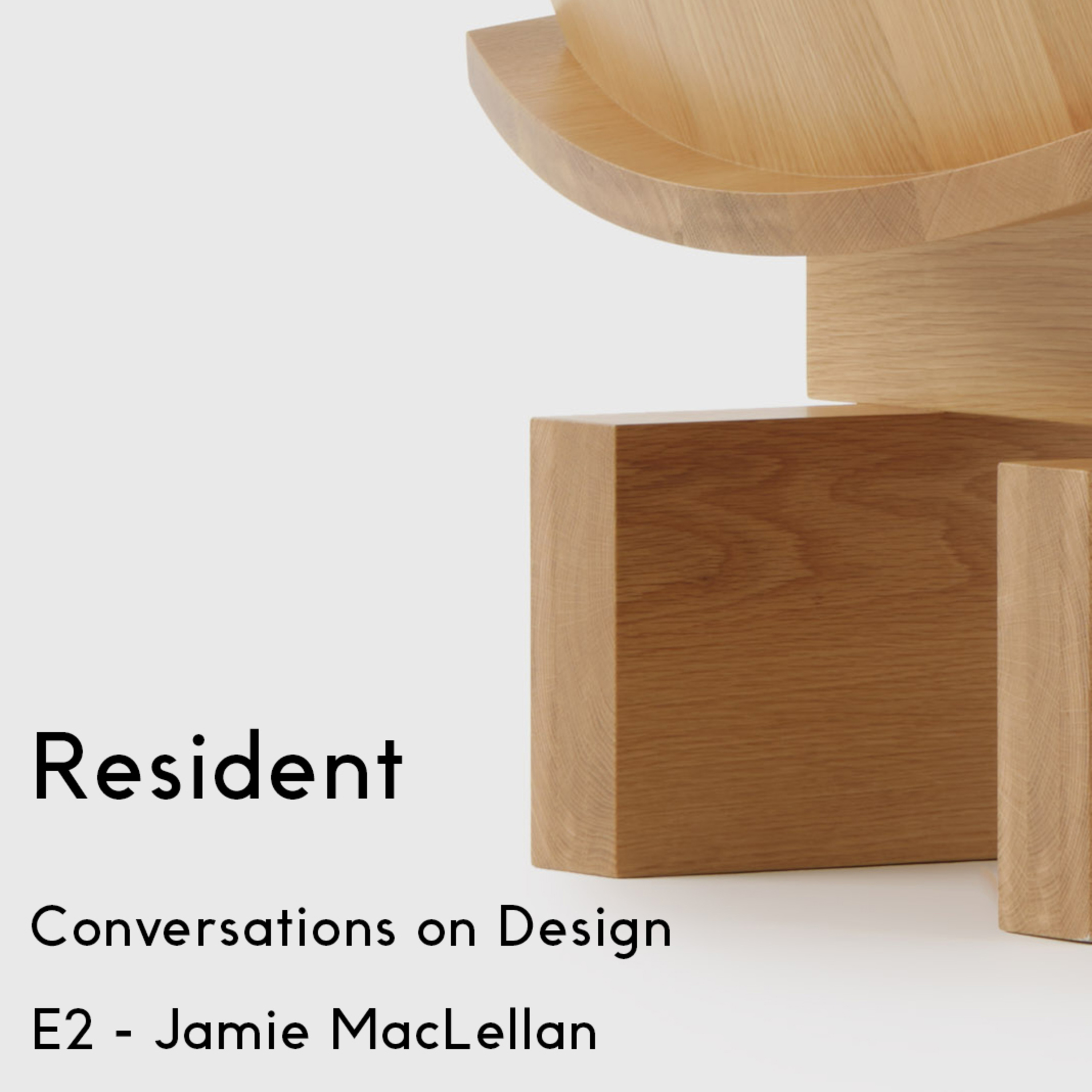
Jamie McClellan, a prominent designer, has a diverse body of work ranging from furniture to industrial design. His design philosophy focuses on expressing ideas beautifully and honestly. Influenced by figures like Tony Parker and Ross Stevens, McClellan worked for Tom Dixon in London before establishing his own design company in New Zealand. His designs for Resident, like the enduring Spotlight, are characterized by essentialness and an engineering quality. McClellan's design process is not based on traditional briefs but rather on resonant ideas or sketches. Additionally, he played a pivotal role in designing the famous tree runner for Allbirds, where he also served as the head of design.
Transcription
7638 Words, 40840 Characters
Hi everyone, I'm Phoebe Holden and today I'm joined by local legend and resident foundation designer Jamie McClellan.
We're here at Jamie's home on Waikia Island where he lives with his family after doing a lengthy
stunt in San Francisco. Jamie is an incredible designer and a key part of the resident family
but his work extends far beyond furniture. Over his 20-year career Jamie has designed everything from
high-performance track and mountain bike frames to a titanium shift knife and flight meal trays
for Cathay Pacific, a beer tap, an oil diffuser, a luxury kaya can stand up paddleboard.
He also designed Tom Dixon's iconic spin candelabra and was hit of design at all birds where he
now continues as principal creative advisor. Jamie to start us off in your own words, how would you
introduce yourself? An industrial designer, a product designer. I still, you know, 20 plus years
and I still don't quite know the differences between product and industrial but one of those or
both of those. With probably a deep passion for furniture and a kind of a furniture design approach
that's applied to anything, whether it's a piece of furniture or a shoe or a kayaq or whatever.
And for me, that's, I guess, about not packaging something but it's about trying to understand
the idea within an object and then trying to express there in a beautiful and honest
sometimes pragmatic way but hopefully something surprising and fresh. And like I said,
it's sort of the approach that has applied to anything. I'd like to touch on a few aspects of your
formative years. You grew up in Wellington and is this also where you studied? Yep, a Wellingtonian
through and through. I still love Wellington. I'm still trying to convince the family that maybe one
day we could have a chapter down there but I think the weather is the weather is the deciding factor.
I started studying at was a co-joint degree between Victoria University and Wellington Polytechnic
and then during the course of my degree, Messi University bought the polytechnic
and then they ended up splitting off into two schools. So by the time I graduated there were,
I was actually given a choice to decide whether I wanted to graduate with Victoria University or
Messi University. And then they since went on to succumb to separate schools. So half of my tutors
went to one and the other half went to the other. It was like my parents divorced. And having to choose
one was hard. And during this time, did you have any particularly influential figures or moments
that have shaped you as a designer? Yeah, definitely. All my lecturers were awesome. There was none
that I could fault. But certainly, there was my head of school at the time, Tony Parker, who I think,
you know, I think you did this for so many students. Like all educators, they're so passionate about
dear young people, they're empowering to go out into the world. But he certainly was responsible for
my first little piece of work, even before I graduated, my first client, my first commission,
which was this funny little rubber duck kind of sailing yacht for the 2000 America's Cup. And I got
to design a little miniature rubber duck stylized version of an America's Cup boat for this gigantic
rubber ducky race that they had in city centres to raise money for the campaign, for the Cup campaign.
And I'd say the other person that really was important to me was Ross Stevens. Ross had worked for
Philippe Stark. And I think in those years, a sort of opening your eyes to design Philippe Stark
was this fascinating character who was, you know, a bit of an art-spoken rock star of a designer,
but his work was, and it was very French, you know, but his work was really captivating for me.
And just the idea that he could actually design all these objects and create your own world
was always really appealing. I don't think I wanted to be a designer like Philippe Stark,
although probably I tried to emulate him during design school at certain times and probably
in really, you know, spectacularly bad ways, but I certainly like the idea, the notion that this
career path could mean that I got to design things that I wanted or believed in, or the diversity
was what was super appealing. But Ross had worked with Philippe Stark and Ross had a really,
you know, novel point of view on the creative process as well. And I always really enjoyed that.
Even if sometimes it sort of took me years to understand what he was trying to teach me. And I
just enjoyed his sort of irreverence and curiosity as well. So I'd say that those two were the
really important figures in my university years. But I'd say even going back to high school,
my graphics and design teacher, Andrew Kyrus, and I'm allowed to call him Andrew now, but it was
Mr. Kyrus and I actually just caught up with him a couple of months or so back. He was responsible
for actually showing me that industrial design was a course and a processing program that I could
pursue. And he, I mean, but it was probably fit for me. He took our whole class down to the
Vivian Street campus. So I went to Wellington College, so we just walked from Wellington College to
Vivian Street. And I remember walking into that building and it had just been refitted. It was the
old and New Zealand building for that. And I think it was clear for that moment that I wanted to,
that's where I wanted to go. You know, if I could like hack the system and that was going to be my
career path or my next stage of my education, then I felt like that was pretty clever. And so he was,
and he was a great teacher and, you know, I had him all through high school, I think, and I love that
course. And I would go sort of fast forward, you know, into more, you know, post-grad times. And I'd
say Tom was another really profound person in that sense that he taught me about furniture and
taught me about materiality and process and taught me about a bit, very pragmatic point of view on
what objects should look like. And I carried that with me to this day, you know. So, yeah, that was
almost like my postgraduate studies that I never undertook working with Tom. And this is Tom Dixit,
which was actually going to be my next question. Was it after graduating that you moved to London
and accepted your first major role working for Tom? Not quite. Now, I moved to, after graduating,
I worked for Fisher & Packals, which was also an amazing experience. And, and I would say I was
probably a little, um, was like you talking about Wahiki. You know, you only realized how good it is
once you've gone. I feel like the same thing with Fisher & Packals, I probably took it a little
for granted. And it was probably, you know, very naive, but it was an amazing environment. And I think,
again, Mark Elmore would be another one of those figures whose lead design there for so long. And
it's just, I mean, look at what that brand is to the stage. It's just phenomenal. And amazing to see,
you know, product go from, it was like, it was quintessentially creative the process. It was exactly
like an extension of this design school that I just stepped out of the way in which design was
brought to life. And to see that cherished and championed and taken all the way through to,
you know, to the model shop and to the engineering team. And then out, you could literally walk out
of the design studio at the time into the factory floor where you would see some of these things
being produced. It was, it was, it was also. And then, you know, and then after two years, it was,
I think at that time, it was clear that as an industrial designer in New Zealand, you had to look
abroad, either opportunities or for bigger opportunities. And so it was always a given that we'd
be travelling overseas. And it was only when I got overseas that people couldn't believe.
Firstly, that I was that young at that time, to have had a couple of years professional experience.
And then I was clear to me that all these places I was looking at, like, they didn't have the
resources or the facilities or the, or the rigour even that that Fisher and Pico had had. So it was,
it was, it was only in, you know, landing in Milan, which is where I went after Fisher and Pico
that, in looking around and starting to realise that, that I was really fortunate in lots of ways.
How long were you in Milan for? Only there for six months. So I thought I'd be there for longer,
but before I left Fisher and Pico, I had applied for a job at a windsurfing company. And hadn't
heard anything. And then when I was in Italy, I got an email, um, uh, expressing interest. And it seemed
so glamorous for me at the time they said, can you meet us in Paris for a, coming for a meeting in
Paris? And so the log Jamie with his flip-flops got to fly out and we had a meeting at like the
Hyatt and Charles de Gaulle, um, with Neil Pride, who was the owner of this windsurfing company.
He was also a Kiwi and a credible success story and built this brand when, when windsurfing was sort
of in its earliest days, sort of exploding and, um, and was sort of savvy enough to see that
the kind of scale that he needed to be producing stuff wasn't possible in a traditional sort of
sale, like, like, had been making sales up to that point and had seen that he could take methodologies
and infrastructure in the garment industry and Hong Kong at the time and use that to scale,
you know, a windsurfing business, making sales predominantly and, and also sort of have worked
and sold as well, but, but it was the sales, that was the big thing that needed scaling that happened
to that point, hadn't been sort of possible in traditional sale making. Anyway, so I met with Neil
and I met with the, um, the head of the European distribution at the time and had this interview
and they offered me a job and I took it and moved to Hong Kong side unseen and was such a, um,
culture shock, you know, from, you know, working in, in Italy and, yeah, yeah, to then this, the,
the company was based in the new territories of Hong Kong, so on sort of the mainland of China
and it was just, you know, just developing at breakneck speed, but, yeah, quite chaotic as a result,
and it's very different from the slow pace of life that I've been enjoying in Milan and, yeah,
it was quite confronting. Um, and I think, you know, just also then, you know, for the first time,
as a young designer, spending time in southern China, um, and just for the first time understanding
the scale of consumption, the scale of manufacturing to feed this sort of consuming masses of the West
was pretty, pretty shocking. I think up into that point, I just thought, well, this is also
I can just make cool stuff and this is, this is, you know, it's pretty, again, pretty naive and, um,
and for the first time, I was like, oh my gosh, this is, it was a bit confronting and a bit challenging
and, um, sort of forced me to question my role and it was definitely, um, you know, the beginning
of a like, oh gosh, what is my role in this and how do I, yeah, how can I find a more way of, um,
feeling better about, you know, what I'm doing, what I'm creating and it took a long time to sort of
keep my head around that and I, you know, and it's a journey and it's still not perfect by any means,
but, um, but certainly that, you know, that was, that was what sent me on a path that then moved
to back to Europe and that's when I moved to London and that's how I stumbled into Tom's office and
managed to find myself some work and by being in the right place at the right time.
That specific role then obviously wasn't why you relocated?
No, so I just, I, um, I spent a year in Hong Kong and decided that, um, that was enough and that I wanted
to go back to to London. Funnily enough, just towards the very end of my time, my last trip was, um,
to Hawaii to go and work in their development center. It's been a year in Hong Kong, not windsurfing,
surrounded by product, surrounded by, you know, all, uh, you know, all the temptations about nowhere to
go windsurfing. The only time you go windsurfing in Hong Kong was during a typhoon, but they wouldn't let
you go because the theories would all shut, you know, so it was just like, in other ways, it was just
no wind, it was just, um, it was torture and I finally got to go to Hawaii, but I'd already made,
I'd already had my, you know, my visa and my passport and I'd already plane tickets, book and stuff, but
went to Hawaii and then met a, uh, a fellow named Robert Stroy who was the person who was responsible for
all the product design and engineering, uh, finial pride and, um, and worked with him on our collection
of sales then. It, it was just, I think, very quickly we came friends and then it was clear that, um,
well, it just, it, it continued. So I went to London, but already still with like, um, moon lighting
as a, as a windsurfing designer, uh, and that continued even while I worked for Tom, I would take all my
annual leave, I would go to Hawaii and design windsurfing sales and I did that for probably 13 years,
maybe, for a long time. And how was working for Tom? Tell me about that experience. It was the best job
in the world. Yeah. Yeah. It was just, it was awesome. It was so good. I mean, it was, like I said,
before it was like a, like a post-grad, it was, I learned so much. And it was funny because I, you
know, I didn't know, I know I was very little, almost zero furniture experience and lighting experience.
So I had to learn a lot and, and it was terrifying, but it was exhilarating and, and it completely,
you know, it was almost like deprogramming so much of what I'd sort of learned or assumed and, uh,
and, well, maybe it wasn't there, but it was certainly like, I had to kind of, I mean, Tom would say,
you just need to read my mind, like you have to get into the practice of reading my mind, which we
really had to do because he was doing so much and stretched so thin and he was not micromanaging and
he was not sort of like over our shoulder all the time. It's interesting. Residents co-founder,
Scott Bridgins and some other significant employees have also cut their teeth at Tom Dixon,
Nina Hazelhurst, our head of sales and creative director Tim Rundle, for example. A lot of good
things seem to have stemmed from here. Why do you think that is? Does Tom just love Kiwis? Tom,
yeah, Tom loves New Zealand. I think he's got a sister who lives in New Zealand perhaps, and so he's
been out here lots of times and, um, he probably just likes the, I don't know, I don't think he likes
flip flops. I don't think he likes seeing people's toes. I remember he had always teased me about my
flip flops on my jambles, I should call them. Um, so it's definitely not that that's a turn off.
I think as designers, we're pretty pragmatic. We're not sort of bullshitness, we're good at solving
problems where you're more on that engineering end of the spectrum. Usually, yeah, we're not these sort
of like, more cliché stereotype kind of juggie designers, you know. So I think probably there's
something there. And then skipping forward a little bit from here, you return to New Zealand and
eventually started your own design company. Your spotlight was the first piece resident produced,
and it's still going strong today. What do you think it is about that particular design that has made
it so enduring? I don't know. I sometimes wonder if it's because we're like a, we're a patriotic bunch
of consumers here and it's like, it became a bit of a, you know, a bit of a bold icon and people know
it's a, it's a New Zealand piece and it fills the room nicely and it functions well, you know, to
project some light into the middle of the space. Maybe it's that. Maybe it's that it flakpets
really well and it's easy to ship. I don't know. Maybe it's price well. Maybe it's all those things.
I mean, it's definitely distinctive, you know, I think the, the shape is, you know, really memorable
and, you know, it is funny how you can spot one from a mile away or, you know, when you're flicking
through a magazine or a blog. And since then, you've released a number of products with resident.
What are some defining characteristics that tie those pieces together?
I don't know. I mean, if you think about the ones that have stood the test of time, it's like the
Sparland from their own chair and, you know, hopefully the plane tables. I think there's an essential
ness to all of them, which could be used to describe maybe a lot of my work. But I think certainly with
the resident stuff, there's a, there's an engineer quality, there's a, it's, I wouldn't say it's raw,
but it's very sort of pure brutal but not harsh, you know, it's, it's, it's, it's, this essential.
This is the best word I can think of, so it's like, and certainly that's the way I think of these,
these, these ideas as a, how do you, how do you find that essence of something, whether it's
projecting a light bulb into the middle of a space, you know, can delivering it or
making a bracket for a leg to, to, you know, to hold the most simplest wooden components together.
I mean, I think the tables and, and soon the chair are taking that sort of notion, but maybe having
a little bit of poetry somehow, you know, it's, it's like a little less, the funtory, it's not just,
you know, you could make a table, I guess, with four legs in a service, whereas this is stacking blocks
in a way that's, it's like the architectural or, but it's still sort of essential, you know, it's,
it's a center spine and then two skids for legs, you know, and balanced like a, you might balance
some children's blocks and, and, and, and maybe slightly counterinsured of in the way that you,
you, you would build it slightly differently if you were just concerned about the engineering,
so there's a little bit of magic there. So it's, it's a celebration of engineering unseen in some
ways, whereas sometimes maybe the, the spotlight is celebrating very, very overt form of engineering
and structure, and similarly the chair, I think is celebrating the process of making those engineering
components, but, but they all come from the same way of thinking about an object. And I understand
you don't design any of these pieces based on a brief. Yeah, yeah, yeah, I think so. I think there's
been a couple of times where I've tried to design an object to a brief and they've been
a little less spectacular or a little less successful, you know, sometimes, you try to, I don't know,
something like creative process. Yeah, something about the, the type of object, you know, it's,
you know, it's, the, the scope of its possibility is far broader than say, I don't know, if you're given
a fixed object like a piece of footwear where you have all these constraints, so you're working within
a much tighter set of constraints, I think furniture, it's like the blank sheet of paper, so maybe that's
part of the problem, there's like, if you try and brief that, how do you even, where do you even start?
Sometimes it can be a little brief of like, there's an opportunity for this thing and that's it,
but yeah, but often, more often than not, it's like a sketch of an idea or a little maca or a print or
something that resonates and it goes from there versus the other way. So yeah, I think it's fair to say.
And then another of your early New Zealand clients was Tim Brown, who later we're not found all birds.
You played a key role in designing the now famous tree runner and then served as the brand's
head of design. That's obviously an incredible story. Can you share with us how this collaboration
came about and a bit about where that journey led you? Yeah, well, the first shoe was the wall runner,
that was the first one that was that set things in motion. But yeah, Tim was making shoes, so he's
a professional footballer, Tim Brown, for Williamson Phoenix at the time, and he had been sort of
dabbling in the off season, making shoes, dabbling sounds condescending, he'd been literally making
shoes and producing them and selling them. He'd been making sort of, kind of, cupsol sneakers out of
first of all canvas and then leather. And then they'd made some felt shoes. And I think
somewhere on that felt journey, he came into sort of possession or contact with a really
highly engineered version of wall made by Ag Research that was had Kevlar woven into it, and he
stored this opportunity to make a more kind of sports leaning shoe, like a running sure or something,
a little more high performance. And then I think he realized he needed some help with that. And
funnily enough, the Tony Parker, my former head of school that I mentioned earlier, he had gone to
the Royal College with Tim's, so Tim studied design on a football scholarship in Cincinnati and his
head of school in Cincinnati had studied at the Royal College with Tony Parker, my head of school.
And when Tim came back to New Zealand, his head of school said, "How you got to get in touch with my
old mate Tony?" So Tim got in touch with Tony. Tony and Tim said, "I need some help with this
project. I've got this idea." And Tony said, "Oh, you got to get in touch with this guy." And so Tim
rang this guy up and he never answered the phone. And then so Tim went back and said, "Oh, I need
another designer. You got another one." And he said, "Oh, you got this, this is another guy Jamie,
he did a shoe, but his major project talked to him. He's kicking around and Tim rang me and I answered
the phone and the rest is history." But Tim loves to tell that story in front of as many people as
possible. And for the longest time, I just thought he was just having a wind up, but it turns out it's
true. When I left, when I left, I just go, "You showed me the emails." Yeah, so that's how we got
connected. Tim's a couple of years younger. We actually both had Mr. Karrison, Andrew Karrison,
his design teacher. We both went to Wellington College. And yeah, and it was interesting that
designing the shoes. I was like, "Well, you know, I've been doing all these other things, kayaks and
bear taps and whatever, you know, furniture and can't be that hard to design a shoe." And I tell you
why the shoe was kicked started in 2014, so that gives you an idea how long it takes just to make
a sample, that prototype for a video. It was really, really hard. We probably made it hard for ourselves
because we had this really strong point of view about how to make the shoe. And as time went on,
we became really dogmatic about ethos. And a lot of that was sort of underpinned by the same ethos
that I was just talking about with other objects. And it was that this shoe, it was going to
celebrate the engineering with a bone thing that was special out subject. We were going to celebrate
that and let the design stand out of the way, get out and knock it in the way. And that was the wall.
And so we wanted to, you know, we wanted a shoe that was just this maximal expression of wall.
And I think also at the time we started to realize it was an opportunity to make a shoe that was
unembellished and un-low-goed. And we were in a moment there of, like, max kind of sneaker hype,
and that doesn't seem to have gone away. It just seems to have like, celebrated me.
But so, yeah, so we, I think the other thing was we didn't really know how to make a shoe, and we're
paranoid about making a shoe uncomfortable. So we also figured, well, if we make a shoe with no
seams and no panels and, you know, as little details possible, it gives us our best chance of
making something uncomfortable on foot. And, and in doing so, I think we, probably intentionally,
unearthed a really different point of view on the way the shoe should look. But I would say we
unintentionally over-indexed on comfort and created this incredibly comfortable shoe, partly because
of the wall, partly because we had no structure on the upper and no panels, no seams. So this thing
was really compliant and pliable. And, and I think, you know, those two things set it up for
really kind of cutting through the noise, you know. And, yeah, it was, I mean, if you told me at the
time that this wall-in shoe project was going to be the thing that sent me off on this different
trajectory for, you know, me and my family, and for many, many years, and, you know, to to this day,
you know, I would never have believed it. But, uh, but it was super exciting. And I think as we, as Tim
went from Kickstarter, you know, there was, there was, there was, you know, there was certainly,
it was, you know, an even harder journey for him at times, you know, to try to, to try to figure out
where to go with this, this shoe project. And there's a, there's a really wonderful story if you
ever get a chance to listen to it on the how I built this podcast, where he goes into detail about
just how much sweet and tears and, you know, went into this, this journey for him. I was very much
just a supporting actor in this story, but, um, but, um, but, but really enjoying the opportunity to
learn and explore footwear and also the opportunity to sort of go again and to refine and could start
to see through the Kickstarter, just that this thing had real latent potential baked into it. And so,
you know, I felt like there was a period where my job was not my job, but I was, I was, I was more
interested in making sure Tim kept going, you know, um, the first time we made the shoes, we made
them in like a Portuguese factory that was making women's dress shoes completely uncertain to making,
you know, a sports shoe. So we had like, we couldn't use foam, so we made things out of rubber,
they were heavy and there was all sorts of, yeah, the wool wasn't, it wasn't as good as it could be,
but, um, but through the course of Tim pushing this thing along, he partnered, um, with an American
fellow and they raised some money together. Um, they connected with an incredible Italian
mill to make the wool properly, um, that was using New Zealand Marino and in the engineering,
and then this far higher performing way with a better quality of wool. They, um, were connected with
shoe manufacturing and career that could handle the processes and the knowledge and, you know, with
at least the unsung heroes that helped make this thing fit and comfortable and scalable out of the
gate. Um, but it was a, yeah, a super exciting time and, um, and I think for me, also coming back to
the sustainability thing, when Tim met Joey, his co-founder, the idea grew from being about novel
natural material, it wasn't comfort and a point of view on design to also being, uh, having, um,
a stronger sense of the opportunity to do things better in a sustainability, in a, with sustainability
at the sort of heart of it. Um, and, and that evolves over a couple of years from being about
using natural materials and using less oil to also, like, understanding a carbon footprint and, um,
and how we could, um, use that as a metric to design better and better and it's been a really rewarding
process starting to understand more deeply the molecules and the fibers that we use to build
products and objects and how you can use that to measure how good you are and how also that starts
to produce really unexpected, interesting results that aren't just sort of, you know, arbitrary
indulgences, but are actually can be traced back to, you know, reason and pragmatism and, and, and,
and, and, and it, want to create something better. So it's been really sort of rewarding and
validating and, and we're just scratching the surface, but suddenly it feels like we have tools
as designers to, to sort of launch into this sort of next phase of relevance versus just being
decorators, you know, um, and now more than ever, that's so important isn't it?
Yeah, yeah, I mean, I do think sustainability has, um, had a bit of a tough time recently,
you know, it's been, you know, that the word has been co-opted. I think that the consumers sort of
send them towards it, you know, there's, you know, there's a, it's, it's, it's still a bit of a luxury,
but it is important and, you know, I think, longer term, we should be on the right side of history
and should just keep on believing and pushing and learning and evolving and, um, yeah, it's, I mean,
yeah, an exciting time. Norboads have now sold millions of pairs of shoes. It must be incredibly
rewarding if not surreal seeing your work at, at that scale. Yeah, I think especially in San Francisco
it was like ground zero for all birds. It probably was like bread a mart or something. It took a long time
to get used to that, you know, and you're constantly wanting to be like go up to people and be like,
does it in a bit of shoe coming, you know, like, oh, you are, I'm sorry that the toes
stretch a little bit wrong, you know, like, it was, um, but no, it was cool. It was great. Especially when
you saw them worn well and, um, yeah, no, it was great. And I would often say, you know, I've never seen
anyone walking down the street with one of my cheers under their arm, right? So it took a bit of
getting used to seeing, you know, something you'd crafted and sweated over and, you know, let's every
objects infused with memories and stories and, um, and, and emotions and so, um, yeah, it's, it took
a long time for that to wear off that novelty. And fast forward to today, you and your family are
living in Waikia Island. We discussed this before we started recording, but I grew up here. So it's
really nice to connect with someone who's made at home. How are you finding it? Uh, yeah, we love it,
we love it. We came back during COVID for a period and, um, and then went back to the States when
things settled down, but couldn't get Waikia out of our mind and, you know, we would, and then
one day we were just like, what if we just go back? And I was like, because we, we had an
intended to live here where we thought this would be a, you know, a holiday home, but it became clear
that we could live here and we loved it. And, um, and it's just got better and better. It's, yeah,
it's crazy. Um, yeah, so it's a wonderful community. It's great for the, uh, the life stage we're
at with our kids. It's great for me, uh, because I'm a water baby and I just love anything in the water
and around the water. No, it's just, it's, it's great. And if it wasn't for my wife and her
curiosity and her constantly looking at sections and properties for sale, we, we, we wouldn't,
we wouldn't be here. I've heard a rumor that you take your youngest, I think it is, to school on
a paddle board. Can you confirm this? Do you guys do that, um, can the across the Bay, so we go on the
paddle board sometimes? So that's pretty cool. He loves it. He doesn't take his wicket off until he
gets to school so the kids can see. Yeah, yeah, well, just this week he was one up by his good little mate
and he went on a jet ski. And so now my son is like, okay, yeah, yeah, yeah, yeah, maybe a foil board,
we'll see. Yes, talk to us a little bit about foiling or maybe what that looks like here on the
island. So I wasn't a winter for a long time and kind of fell out of love with that probably and
just, you know, there were other priorities. Then through COVID, I became aware of this sort of
wing foiling sport that was evolving. It was very early and it became quite so fascinated with that
and sort of threw myself in it, managed to scrape against some gear through old contacts and through
a store and Christchurch that had had some equipment and and taught myself, you know, when other people
were baking sourdoughs and whatever, I was out in the water getting getting beaten up and, you know,
but just absolutely loving it and realized that for that hadn't learned anything new, you know,
for a long time, maybe, yeah, obviously we're always learning especially in your career,
but actually sort of other sort of extra curricular stuff, I hadn't really done much. So yeah,
so and it actually turns out where we are on the island is perfect because we can walk down to the
bottom of the bottom of the garden and I can just jump in the water, paddle out and get to the wind
and no matter what wind direction and out there, you know, I can go for a little 45 minutes sail
between meetings sometimes. So it's pretty dreamy. And I know there is a very special collection that
you've just recently worked on, a series of new products coming out in May for resident called
the Little Fellers. Can you talk a little bit about these? Well, they were, they were a little thumbnail,
one of these thumbnail sketches that I think, Scott had seen, I mean, like, oh, like that. And they came
pretty easily really. It's just, and it became a little family, so it started off as like a little,
it's a little bit related to the plain table, but maybe a little, a little or integrated in form,
but has some similar sort of elements, but a little more refined, maybe, which I think is,
is nice of something at that scale. And yeah, it's like, again, too little, I mean, again, if you look at
that very early in the resident catalogue, which is no longer produced as the flyover table,
which also have these two little fins for legs. So it's been, you know, almost feels like an evolution
of that. Yeah, like I said, it was this little thumbnail sketch, it was to this day quite a cute sketch.
And they came to life pretty easily, but then we kind of grew them into a family. So then there was a
there's a little round fellow and a little square fellow and then like a little double fellow and
then a tall fellow, but no, they're well suited to material solid timber that resident does so well
and has has really good understanding of. And yeah, there's that flat pack and they're quite honest,
you know, you can see the fixings of the feet and and I think we just thought it's not trying to be too
clear, but it's just yeah, but I'm really proud of them. I've got, and so as I talk here, I'm sort of
turning my neck and looking at the prototype and I love it sitting there next to my chair and
that's the spot to sit and pontificate or that's where I sit in the end of the night when everyone's
gone to bed and tap away my laptop. But yeah, you have also been working on plain lounge chair,
which is a new addition to the existing plain collection. What inspired this? Where can you see it
being used? I it's definitely a sort of a statement piece just because of its presence and its mass,
but it should be really comfortable and functional and I can kind of visualize it in a beautiful
beautiful fair and hay house, you know, as the, you know, and appear overlooking a beautiful view or
something. It's definitely got a heroic quality to it and and it she has a lot of those same,
I mean, it's literally made out of the same sort of elements as the plain tables are. So two kind
of blocks for legs kind of skids, if you like, and then a big cross member that's instead of being kind
of like connected in a sort of an overlapping way, it's sort of balanced on the top with a sort of
clever bit of engineering holding them together and then the the seating surface sits on top of that
in the center and again is kind of balanced in a slightly cantilever way and then the backrest is
kind of also plunged into the seat plane in a way that's very, very pure and there's no
there's engineering hidden within it, but there's no overt sort of engineering to resolve that
but the curvature of the two helps give a bit of triangulation, I guess, and it's, yeah,
it's very essential, I would say, like just the, it's, it's, it's, I mean, I've always thought that
that one especially reminded me of like a Richard Sarah sculpture, you know, the big planes of
Quarantine steel that use curvature to balance and just the the presence of those things,
that's another place where I think one would look great sitting at the foot of a mess of
we could, you know, maybe, um, what is it that gives farm, maybe they could get a couple.
Put them below the seara there, um, but, yeah, I'm really proud of it and I can't wait to see it in
in the real material, you know, and um, I think it's going to be, yeah, really striking and have
a real gravitas to it. Jamie, thank you so much for your time today. Before we finish,
I've just got two more questions for you, the first, which is something we like to ask everyone.
What is the essence of resident? The essence of resident, I think, I mean, I think it ties in
what some of those words I've used up my own work and I think the workable, the designer's tends to
share similar sorts of point of view. And I think the designer's that resident is attracted to and
vice versa, tend to have a sort of a similar spirit about them. I think there's a, there's a museum
in this, to the work, even if the designer is not a museum in there, I think it tends to attract
kindred spirits to this country, you know, and I, um, but I think there's definitely a, uh,
a purity, a slight rawness and a pragmatism. It's certainly a sophistication, but not like a
synthetic kind of sophistication you might see from other brands or from other parts of the world.
I think there's always a, a heft and a materiality and a, and a, a slight rawness, not always, but, um,
I mean, I, some of the work I love that, I think, really captures, captures this as like the
Cheshire lamp, the Foundry lamp, you know, and it just kind of, there's something so interesting
like that one. And for me, there's, you know, one of those pieces that's, that, that lands it
beautifully, you know, the unfinished piece of cast bronze and then the very minimal square
section and the almost like optical illusion, the, the way that line waved around, I, yeah, I think
what is it? It's so earnest and yet not so serious, you know, there's still a playfulness,
but it's not like a cheap laugh. It's, it's more sophisticated sort of humor, if I think about
like the circus lights or the geometric series, pendants, um, there's, um, you know, I think,
like the bloom lamps are super sophisticated, so there's, and yet quite sort of joyous, but not
again, like that kind of cheap laugh that all sort of quickly fade. So there's, there's enough to
make you sort of smile over a long period of time. I don't know, I'm sort of struggling to like,
put my finger on it exactly, but there's clearly a sort of a palette as well, color, material,
that'll key and feels very at home in this part of the world, you know, I think the silhouettes
are often very strong and I feel like even in New Zealand with our clarity of light, there's
things that are always like a, the silhouettes are always something really strong and in a
landscape which always feels like something I see sort of parallel and resident pieces, you know,
there's never any sort of decorative things or frilly things or there's no, you know,
there are lots of other brands I could think of that are, you know, and for
more neat executions or more unusual sort of textural stuff, and I think there's a,
there's a purity to the resident work that, um, doesn't need to sort of go there. And then,
similarly, there are, you know, other brands that are shiny and glackered and glossy and
pastels and colors and patterns and things that are, you know, kind of fun as well, but just a little
slightly more disposable, slightly less sort of, have less longevity, perhaps.
Jamie, thank you so much again for today. Just before I let you go, I'd love to ask
if you could give one piece of advice to a young designer, what would that be?
Um, get out of from behind your computer and go and knock on doors, you know,
and knocking on Scott's door was a great, a great thing to do, knocking on Tom's door was a great thing
to do. Too many people sit behind their computers and their phones. There's a whole world out there
to be seen with your, your own eyes and touched and, you know, the best thing I ever did in every
city and every country I've been to was walking around or biking around, trying to find my way around
and in, in trying to not force my way into people's studios, but suddenly knock on doors and see if
I can give them invite. And if they tell you to press awful in, they're probably decks anyway, but
there'll be people who appreciate the enthusiasm and invite you for a cup of tea and on your,
you'll be off in your adventure. And the initiative, right? When you say get out there at first,
I think you're going to say get out into the water. I would do that too, definitely. Yeah, do that too.
On the weekends, after work.
Podcast Summary
Key Points:
Jamie McClellan is a renowned designer with a diverse portfolio.
His design approach focuses on expressing ideas in a beautiful and honest way.
McClellan's formative years were influenced by key figures like Tony Parker and Ross Stevens.
He worked for Tom Dixon in London before returning to New Zealand to start his own design company.
McClellan's designs for Resident, such as the Spotlight, reflect essentialness and an engineering quality.
His approach to design does not rely on traditional briefs but rather starts from sketches or resonant ideas.
McClellan played a significant role in designing the iconic tree runner for Allbirds.
Summary:
Jamie McClellan, a prominent designer, has a diverse body of work ranging from furniture to industrial design. His design philosophy focuses on expressing ideas beautifully and honestly. Influenced by figures like Tony Parker and Ross Stevens, McClellan worked for Tom Dixon in London before establishing his own design company in New Zealand.
His designs for Resident, like the enduring Spotlight, are characterized by essentialness and an engineering quality. McClellan's design process is not based on traditional briefs but rather on resonant ideas or sketches. Additionally, he played a pivotal role in designing the famous tree runner for Allbirds, where he also served as the head of design.
FAQs
He has a deep passion for furniture and a design approach that applies to various objects.
He grew up in Wellington and studied at a co-joint degree between Victoria University and Wellington Polytechnic.
His head of school, Tony Parker, and designer Ross Stevens were important figures.
It was the best job in the world where he learned a lot and describes it as a post-grad experience.
His designs have an essential quality, an engineered aspect, and a touch of poetry.
He finds that designing without constraints in furniture allows for a broader scope of creative possibilities.
Chat with AI
Loading...
Pro features
Go deeper with this episode
Unlock creator-grade tools that turn any transcript into show notes and subtitle files.
 PodcastTranscript AI