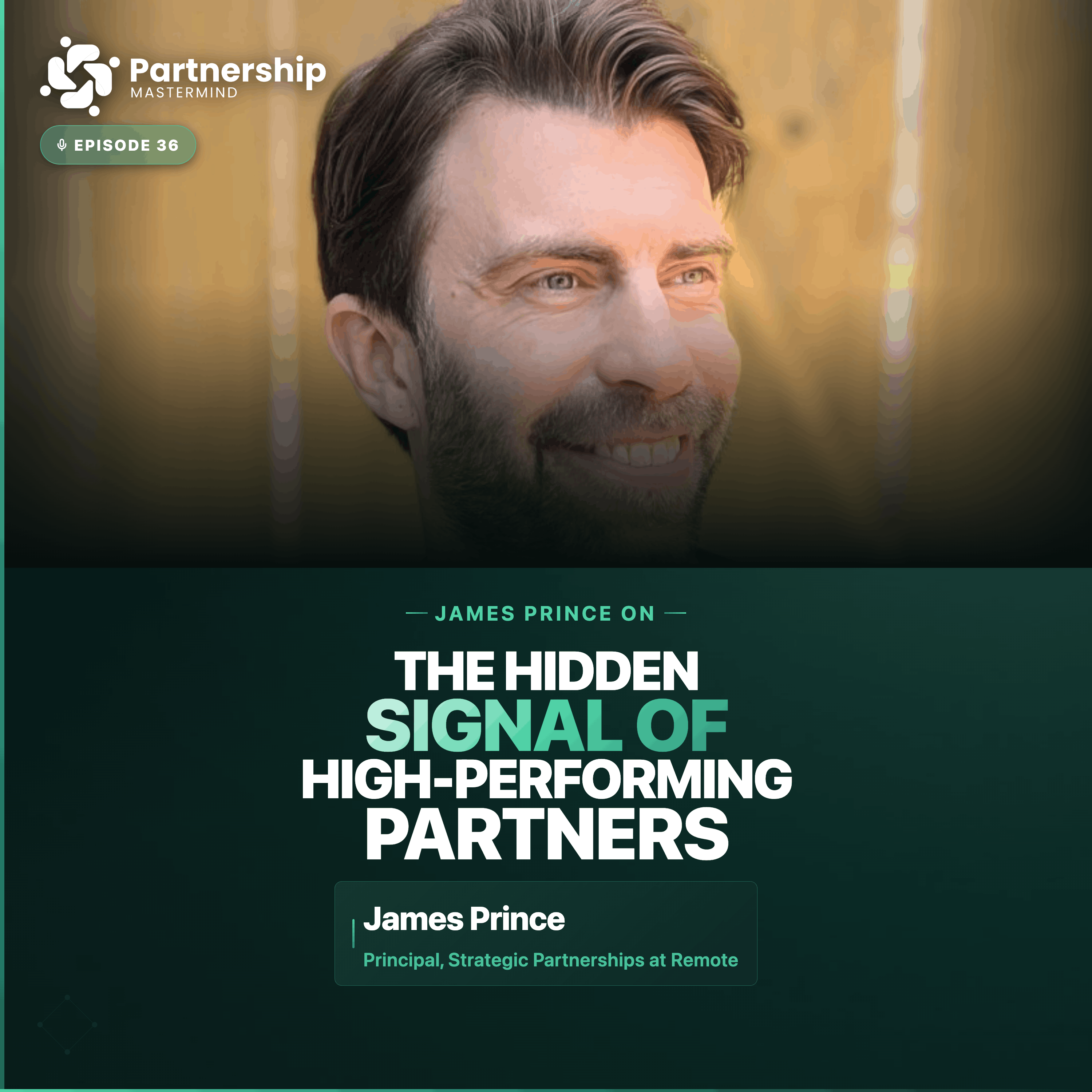
James Prince on Willingness to Work: The Hidden Metric That Actually Drives Partner Revenue
from Partnership Mastermind Podcast
55m 17s
In this podcast episode, host Crystal Voix interviews James Prins, a partnership operator who treats partnerships as a system rather than a program. James emphasizes that true partnership success hinges on a partner's "willingness to work," not on logos or partner counts. He shares that a quick disqualifier is when a partner misunderstands the product's value, and he criticizes the overused metric of total partner numbers, advocating for activating the right partners instead. James highlights that sales teams outperform partner managers in structured discovery and driving outcomes, suggesting partner managers adopt similar rigor. He respects partners who respond quickly and proactively bring in leaders or technical teams, signaling shared commitment. Reflecting on his early career, James learned the importance of in-person meetings and staying close to revenue from corporate trips and tech conferences. If partnerships vanished, he would pursue a career as a chef, drawn to tactile creativity and finite results. His systems-thinking approach, honed from a philosophy background, underpins his partnership philosophy.
All right, welcome back to the Partnership Mastermind podcast on your host, Crystal Voix. Absolutely thrilled to have James Prins on the show. And James is the kind of partnership operator who doesn't treat partnerships like a channel or a program or certainly not a slide deck. He treats them like a system, which is what we love in this group. He's built partnership programs at high growth startups, driven new lines of revenue at places like Boroughwell, and now he's working on an embedded distribution channel at Remote. And what I like about how James thinks is he cuts through a lot of the noise. He's not about logos or tame or how many sellers a partner has. But something most people completely overlook, which is willingness to work, which is something I really loved uncovering in our prep work. So today we're going to break down what actually separates partnerships that drive revenue from the ones that just look good on a deck. James Prins, welcome to the show. Thanks so much for having me, Chris. It's been, I was really excited to be on today as well as it's just been amazing watching the quality of guests that you go through. So I'm thrilled to be a part of it. Amazing. Well, James, I'm a huge fan of yours. You kind of came out of nowhere. I'd been aware of you. And we'll get into this later. But James was the first ever winner of our ecosystem master's pitch competition, which is an intense shark tank style pitch competition where he had to pitch a hypothetical company, although it felt like a real company that you had invented James because you knew it so damn well. The steam judges Rob Moore and Nelson Wang, Lauren Spence, very high stakes. James walked away as the winner of that. So you really impressed me then and just in our follow up conversations, you just are super sharp looking into your background. Your pedigrees really strong. So I'm personally very excited for this conversation. Well, thanks, Chris. I was humbled to actually even just get into the pitch competition, winning it was a big surprise. The person that I was up against Rachel was brilliant. She had a fantastic partner program. And then some of the judges were people that I actually genuinely respect and used their frameworks. Nelson Wang, one of them, I really appreciate the way that he thinks about partnerships and he has taught me a lot. So it was really kind of like nerve wracking to be in front of them. So I was very honored to win that. And I'm excited to see kind of the next set of those of those pitches. Exactly. I'm excited to work with you specifically on launching the next phase of competitions. But today we're going to learn more about you, your background and how you think. And we start every episode off with what we call the fast five segment, which is just five quick hitting bite size questions, get you a chance to warm up and get our audience a chance to get to know you better. You ready for that? Just the first thing that comes to your mind. Let's go. All right, cool. First question. You meet a new partner. And within five minutes, you already know this is going nowhere. What did they say that told you? You know what? This is just going to be a total waste of my time. I would say the thing that would stand out in the first five minutes is that they don't understand the value that our product is actually providing to their customers. They have they've misunderstood how we're how either we go to market, but predominantly it's about the product value. They're coming in. They know that I work for remote right now. It's like we're an HR tech company. So they're like, oh, we want to do staffing. And it's like, that's not what our platform does. So it's like within the first couple of minutes, you're less like you're you actually don't understand what we're doing. Yeah. We I mean, I cringe at that as well. I would always hate when I would get hit up. I'm sure you get this as well. Like LinkedIn DMs emails like, hey James, I want to get in a call. I think we can partner together and it's like, okay, sure. You finally get in a call. And then they like run you through this like generic pitch deck. That's like their company sales deck. It's not even a partnership deck. Let alone one tailored for you. Absolutely. Yeah, absolutely. You know, and it's like they are. It's one of those programs that is clearly like being set up to kind of measure activity. Like those partner managers or the BDRs or the BDMs are like out to do activity. And they're having to show that their sales leads or their revenue leads that they're they're doing something. I pitched 25 different partners this month. Yeah, exactly. But as we'll get into it's not necessarily about numbers. It's certainly not certainly not those type of numbers and incentives drive the behavior. And in that case, I totally agree with you. Okay, cool. That was a fun one. What's one partnership metric that looks impressive or perhaps is overused but is completely useless or not that useful in your opinion? From a program perspective, I would say from like an overarching program perspective, total number of partners is one that always kind of throws me. Whether we're talking about marketplaces or we're talking about the number of referral or affiliate partners. A company has sometimes they'll have that on their website. We've got 500 partners. Making a partner isn't the same as activating or driving value through a partnership. And over time, I've really realized that you don't necessarily need a lot of partners. You do you need the right to partners. So I've really felt that like seeing companies advertise the number of partners they have makes me feel that they're not really thinking about the actual outcomes. Now, that's not true of all companies. But it's just one of those metrics that I went when you see you're like, okay, like actually activating them is the program work. We don't know. We're centers and they're actually active or yielding. I totally agree. And to be honest, that took me a long time to really understand. I think early in your career, perhaps this is relatable. You almost have this like customer success or like account manager mindset where it's like, oh, I'm assigned to this partner. I have to take care of them like a like a child. Like I don't neglect you don't neglect your children. This is this is a customer. It's like no, no, no, not really. It's a it's a commercial relationship. And both sides have obligations to satisfy. If you don't, there are real consequences with that. So I found that when I was coming up the ranks, I felt like I had to make all of my, it was like whack them all like all of my partners had to be fed and be successful. And if they weren't, then I was failing. And then it took so long to realize like, you know what? What is the opportunity cost of me burning myself into the ground to make all of them successful which I wasn't able to do. And then I realized the power of obviously like Preddo's principle 8020 rule. Is that resonating with you, James? I only resonates with me. I remember when I was at my second partnership program that I was working on as a company, those pre-series A. I was hired a little bit too early. We had a wide variety of different types of partners at that time that the CEO was all managing. And then she handed them all to me. And because she had held those relationships, I had that mentality. I had this customer success mentality that like, oh, and the CEO, which had just handled all these like they must be important as opposed to kind of doing my own analysis. And realizing that like most of them were not important at all. And they were going to drive value. And in the end, I was spinning my tires and ended up getting laid off there because the partner program just wasn't valuable. And it took them years to actually restart the program. Yeah, no, thanks for sharing that person I liked doing. And I see that time and time again. I think it's like, you know, these rich celebrities, Bragg and how many cars they have, 10, 15 cars. Like how many cars do you need? You can only drive one at a time. Last time I checked. Yeah, less, less is definitely more. Cool. Definitely. Second last one or one of the third ones I have for you is, and this is a, this is kind of comparing sales and partnerships. What's one thing you think that A.E.s do better than partner managers that perhaps we don't like to admit because before you, while you think about it, I think we're supposed to have this really strong relationship with sales, but there's sometimes it's like competitive element. There's this lack of trust and respect element that I think is really pervasive and a negative thing. I think there's a lot of things that sales does that I think we could learn from an even mimic. So I'm curious, what's one thing you think sales teams and A.E.s do better that perhaps we should be adopting? This is a tough one. Two things come to mind if you don't mind. Sure. The top two are like from a specific thing in like a sales rep would do that I think is better than a lot of partner managers. It's structured discovery. Really thinking about A.E.s are incredibly good at it, kind of getting to customer pain, understanding whether or not the product is the right fit for them or for selling multiple products like which of the products are the right fit in which order. So I think that A.E.s do really good structured discovery and partner managers, myself included especially early on in my career, can try to round whole square peg of partnership. If they like the logo, if they like the size, if you think there's other reasons and you kind of get into this cycle of getting partners that are not the right fit for you. So I think that being able to do structured discovery which then disqualifies sales sometimes really well is really helpful. And then programmatically or like system wise, I think sales drives outcomes really well sometimes. Like if you know if the sales rep is trying to get something done, they will have fight tooth and nail to get it done. They will get the executives on the call. They will bring in, they will create a huge buying committee to make it happen. And sometimes partnerships because of the under investment or the satellite nature of how the teams are set up. You get harder for you to kind of build that buying committee and drive to completion in the same way. Yeah, those are two great answers. I totally co-sign on both of those. I love the way you frame like they do discovery well. And I actually coach discovery for partner managers in the sense that you should be aiming to disqualify. Like you're going in, I don't want to say pessimistically but kind of where it's like you're delighted that they like pass your rigorous test. So to speak, wow, they might actually be it because that puts a lot more value emphasis on the resources you have to give. Yes. And then on the programmatic side, driving outcomes yes. And I think it's because like look, eighties are on 50/50 commission splits. So they better deliver outcomes. And I also think they have better pipeline hygiene as well.
they have to whereas the average partner manager they have they have a pretty lazy sense if I may say of like understanding their pipeline whereas if I go to any partner manager and say hey what's your pipeline health like oh you know like 250k of active pipe probably gonna close 100k but if I go ask those AES working those deals that their names are on they're like no no no that 50k deal just got moved to lost so they're not as up to date so to speak a little bit lacks so those are just some of my general comments if that resonates yeah I think the understanding and you know to give partner managers that they do sometimes because you're in influencing the deals and you're not like owning the deal in the same way it's a little bit hard to have pipeline hygiene so I do want to do a shout out for for partnerships there but I agree with you of course sweet and no no no totally like look like you're not actually working the deal but at the same time your compensation in many cases is tied to that so you have to like really bring that rigor you should be just as close yeah exactly okay cool second last one here and it's about the question is what's one behavior from a partner that instantly earns your respect kind of in the early days the first question asked was what's like an instant turn off it gives you the IK so let's put a positive spin on it what's something that's a partner does early on you're like okay you know like you know what this one could be a really strong partner for me um this goes back to kind of like what you mentioned about me and I know we're gonna dig into it later but like the understanding kind of some of those early response metrics of like how could they get back to you whether or not they're willing to bring in a leader whether or not they're willing to do like a I'm working on like technical partnerships right now so how willing are they to kind of like bring in their technical team to have a technical conversation how quickly are they willing to do that so that's things I think all of those it's just it's about that really early activity where once you kind of get past the get to know you phase that they're helping to drive it and you're not it's not you it's not just you as a partner manager driving it it's really about kind of like a shared outcome driving and like you can see early on and like email response is the one that I think about this is like if they get back to be quickly it's like oh okay they're interested something's happening on the other side yeah I mean that opens up a whole other can of worms of like how much I like I think speed is an underrated skill and like look some things are just God given we're born with certain intangibles I think speed is something we can all commit to and I think it's an underrated superpower but to your point on the I love the phrasing of like willingness I haven't heard anyone kind of portray it that way but in our prep the way you explained it I think is fantastic and we're gonna dive into that in a whole segment but I totally grew with that okay cool let's get you out of the fast-fiving into the fun stuff all right and we always end the these segments with this question if partnerships as a profession disappeared tomorrow what would James Prince be doing with his career so there's no partnerships you're out you're out of the and we can even go beyond that like just get out of of go to market right yeah I would have to do exactly what are you doing I'm a chef oh wow so I would be a chef this is there's a a tactile nature to it and a creativity that I love and I also love the the finite outcomes or it's like you're getting to the end of a meal right or so you're getting to putting the meal on the on the table I do a lot of I do I'm from Toronto there's a really nice culinary school there called George Brown so I do classes there and like yeah I thoroughly enjoy if there's a different if I was a lot younger I might get it I might like switch careers yeah there's an element of like maybe one more like that's my last chapter I love that yeah my my wife has done a number of those exact same George Brown classes here probably probably around four all right well then I have to ask bonus question here real quick sure you're you're already done the ecosystem masters pitch competition let's just say you're in one of these fancy cooking show competitions which we love to watch here in our household yeah it's the finale meal for your life what are you cooking toughest question of the episode meal single dish single dish I would probably do a Italian-tive fusion kind of like a fetichine alfredo with a Thai twist on it so something like that with like a shrimp yeah something like that I love I've already given you one trophy before I'm ready to give you a speak in my love language I love fusion cooking like you're bringing together a couple different like flavor profiles is incredible yeah I love that cool well that was a fun warm up now let's get into the fun stuff the first segment is one we always start with which is origin stories and hard lessons on the early days okay so for you it really interesting background like a lot of folks in partnerships you start out hosting corporate trips tied to fundraising then you moved into partnerships at one of the biggest tech conferences in Toronto so the first question is like what were you actually learning in those early days that still shows up in how you operate now from those two the going back to the corporate trips I think one of the incredible things that I was around at that point was the two founders that I worked for were probably some of the best like pitch pitch pitch man pitch people that I've ever seen and watching them build relationships over the course of a long period of time having dinners making sure that they were in person having a little side conversations really continues to show up in an asynchronous work by making sure we're doing on-site to their partners today like I will fly out for a one hour meeting with somebody because like that meeting might actually get us significantly farther than multiple kind of virtual meetings so having and making sure I have that kind of one-on-one touch point in person is still incredibly valuable from running those corporate trips and then from the tech conference and I know we're going to get to do this a little bit from the hard lessons but it's like being close to revenue early on that's just like when I was in partnerships there's like there's so much to do in partnerships and you can as you know and I'll you can spend unlimited number of hours trying to like influence and drive partners you can work non-stop non-stop and I always work yeah but I was when I was running when I was at that tech conference I did I was working 12 15 hours a day like trying to get stuff across the line trying to build decks and going to pitch meetings and doing all this stuff but not being hyper focused on the activities that would actually get the revenue out the door totally so it's just like or revenue in the door I should say but it's yeah so that that was like the really big learning at the tech conference I love that yeah thanks for sharing I like I like the in the early part of your answer talking about like the value of in person which goes beyond just the obvious and I had totally agree I think the average in person meeting if executed correctly is worth like at least five zoom meetings if if that so I totally agree and that'll show up a little bit later and so then the next question is you know do you remember a moment when partnerships as you're starting to get into like partnership specific roles is there a moment where it really click for you as a career and we ask this for all guests where it's like it's like oh wow like I kind of got into this profession seemed interesting but now it's like I'm hooked and for me just as you think for me it was definitely you know I get bored sometimes like I'm not hyperactive but I do get bored right and I love diversity in my life and so for me I'm like wait I get to work at this company that I was hired by which is pretty cool company and then I get like deep exposure into like all of these other tech companies like Shopify and Clavio and Google and all this for me it was like wow it's like I get to work at a lot of other companies by proxy so what was that moment like for you to be honest Chris it sounds like you and I are very similar and in that exact in the way that you just described that I am a systems thinker my undergrad is in philosophy like I like to think kind of broadly around things when I was first getting into startups and trying to figure out the next chapter of my career I was leaving my MBA I was looking at a bunch of different options and when I got encouraged by a number of kind of like mentors of the time to look at startups and I looked at all the different functionaries of them to start up and none no specific functionality I interested in and then it's like oh partnerships work with all the function areas and not just at the company that you're at but also you help implement at another company and you understand their system and that's really come to roost at working at remote with our embedded partnerships where I work very deeply across a lot of different teams both internally and next and with our partners and I really it's really clicked here I would say I've loved partnerships but here at remote it's it's like really kind of just like the eyes open kind of it's like oh I can actually influence whole organizations and I'm working with organizations like Gusto and Personio that are like 2000 3000 people and it's like you're able to get influence across like multiple functionaries and regionally that's very cool I love that I love the way you describe that and just to add on like and I imagine you're similar I love to learn like I I feel like when I'm not learning I feel like I'm stuck in life so to speak I'm just not as happy when I am learning it's the opposite and for me it's like say you're in a you join a company let's just say you're in the specific ecosystem could be FinTech could be e-commerce could be housing whatever for me it's like I am I am learning so much faster about the industry that exists within like where I'm at in the universe because I'm exposed to all these different companies I'm talking to so many different stakeholders across different functions across different companies so my understanding of where my company and my product sits within the customer lifecycle of the industry that I exist within that journey has been rapidly accelerated versus other jobs that I've been in which we're not partnerships so I don't know if that resonates as well with you James yeah I would say
The way the largest point of leverage from learning was when I was at Vidyard, I managed to channel partner sales program for sales consultants. So I got to work directly with some of the largest sales organizations in the United States, which was just an unbelievable time. Sandler is one of the big sales organizations, Challenger Sales is another one, winning by design is another one. And I was working with them all directly to help sell our product, but because of that, I was getting inundated with all these different ways to build revenue and to sell and all these different sales methodologies and how to go to market and it dramatically changed the way that I thought about revenue because it's like I'm literally talking to the people who write the sales books, the teach, all the sales teams have to sell. And then I'm like, "Oh, see that?" And then trying to position our product within their methodology. It was like, "I love that." It was such a, yeah, I will hold that experience forever because it changed the way that I thought about revenue and how I thought about sales and those type of systems. I love that. We do a lot in the community. We're trying to do more of attracting people to get into the partnership profession. So this last little segment, I'm definitely going to emphasize on because I think it speaks to some of the real tangible benefits of the profession itself. So now let's wrap up this segment by talking about something you had mentioned in our prep, which is early lessons, early tough lessons, which we always cover on the show. Early on you said you were a big picture thinker, which can be great in some context but also dangerous because it can slow you down. Can you walk us through that experience and what did it look like in practice? Yeah. So the first two partner program and partnership roles that I had, one was the tech conference and the one after that was an early stage startup called Virtual Gurus, not a Calgary. And in both of those instances, I focused too much on kind of broadly how the partnerships were positioned inside our organization, how we positioned them externally and thinking about the program as a whole as opposed to getting getting specific to I need to work actually with this one partner because they have the highest likelihood to drive revenue for the organization. And that's the that's why I need to focus. It's not about program building. It's not about how do I communicate more effectively internally. It's actually being like laser focused early on on driving revenue. And then over time, once you kind of build some of the processes and you get give up and you start to kind of like ladder yourself up, but you start with that revenue goal and you hold on to that revenue as tight as you can because like that's how you show the value for your organization. And like I early on, yeah, I was like too much of like a partnerships. I'm strategic. I'm thinking of a big picture thinker. It's like, I don't know. Yeah. The lifeblood of the organization, you are here to help drive revenue. And ideally, if you're a partner manager, you have a unique opportunity to do like you can like, like you're you're a very significant lever. You can 10 X organizations with a good partnership. You can you can drive 10 times the sales that are in a e drives. So it's like, yeah, really being focused on that is like something that it took me a while to learn. And then it's like, and then you can kind of build on top of it and then become a bigger picture thinker. Totally. And I appreciate you showing that because I think a lot of people listening will will take a sigh of relief because it's like, okay, that sounds like exactly what I'm struggling with, which is something I certainly struggle with. And I think it's, it's like, look, incentives do drive the behavior. And a lot of us do have some quota hanging in our head. Maybe we have like 10, 20, 30, 40, 50% of our total compensation contingent on some commission. That being said, it's easy to just we're humans as humans, we crave to be busy and we can trick ourselves into thinking that just because we were like busy in a day or a week that we were productive. And activity is does not equal productivity. I think it's a key takeaway. Totally. Very cool. Totally agree with that. Okay. Cool. Well, now let's let's let's take a transition now because everything you're saying feels very execution, which is great. So now let's actually talk about how you elevate partners today. So this next segment is on willingness to work is greater than everything else, right? Yeah. Okay. So you said something that I think most people wouldn't necessarily agree with right away, but they will certainly have to hear you, which is that willingness work matters more than tam size or revenue. So break that down for me. What does willingness to work actually look like? Sure. This is a phrase I got from one of my leaders at some point. I can't remember which one. I think it was Ashley at Ashley Gray at Vidyard. She's the one that came up with this phrase. I also want to shout out Nelson Wang who we talked about earlier because he hit in one of his frameworks. He calls it commitment. And it's he has it is the number one out of the three that he has as well as his three season. I can't remember the other two. But I think the way that I think about willing this to work is that when a partner is willing to work with you, they are going to drive outsized outsized returns, which may not be you might not think are possible in their tam. You might be able to get to a significantly larger amount of their tam. Their sellers might be able to go above and beyond in a way that like you're not able to do it a larger organization. And they might be able to get you to some of their enterprise or larger customers if they're willing and they see the value of your product. You have them incentivized properly. And willingness to work is also a metric that kind of reflects the macro environment as well. And I want to say there's a willingness to work and why are they willing to work as the question, right? You can say you can take a look at them externally and say, wow, our ICPs seem to line up. The tam line like they have a huge tam. They've got a thousand sellers, 500 sellers, 50 sellers, whatever the size of program we're building. This should work. But if the macro environment isn't right for them to partner with you, if there's strategic rocks don't align with yours internally, they're not going to do anything with you. So willingness to work for me is also a metric where it's like right time, right place comes into that because they are going to be wanting to drive it. And I've seen this at every partner program I've worked at where it's sometimes there's a smaller partner that absolutely surprises you because they are really willing to work. They understand the value of the product. They understand the value of the customer value proposition. Maybe their product team is really poor. So they're like, okay, I need something else to help monetize my existing customer base. They're hungry and they're hungry. Right. So yeah, that's like that. And that hunger will mean that they might get their executives involved. If you have a partner manager that's hungry, their organization might be their board might get involved. All these things like you might be able to align a whole organization around your partnership. Exactly. In a way that doesn't matter the rest of the other metrics for me. So it's and then what you end up getting is like this crazy alignment that is in using a marketing term is they're pulling you. You're not pushing it right like they're pulling you along. I love that which is a gift and I know as a as all the partner managers listening, you've have water to these and you're like, it is amazing to work with a partner like that where you're not pushing the rock up the hill, the rocks roll and down the hill. Yeah, and that was a fantastic segment. I think that last point is important because it's like, look, I think we can all point to at least one partner and it's like, well, wouldn't it be better if you just spend way more time trying to find those partners? I know it's scary, right? But you do need they don't just magically happen overnight. So if you can index your time on that, obviously that's a huge outcome. But let me I agree with everything you just said and I love how you phrased. I'm going to play devil's advocate and challenges not on the not on the premise, but on a on a scenario. So let's just say I say to you, hey, James. Okay, I buy into this willingness to work thing. But let's just say I'm a VP of partnerships. We have several hundred partners in our program and only 20 to 25% of them are like truly active, right? Now, I trust that my fleet of partner managers validated that these partners were willing to work, right? But now just for six to 12 months, right? Only, you know, only 20 to 25% of them active. So are you saying, James, that my team wasn't good enough at detecting partners that were willing to work? Which is to say that maybe they're willing to work in the early days, but like things dynamically evolve. So how do we how do you reconcile? Oh, it's like, okay, we we let in a thousand partners. Are you telling me that we did a shitty job qualifying that they were all willing to work? Like what happened along the way? So how do you kind of walk through that mental model? Okay, that's a really good question. I think you kind of answered the question in the question, which I really appreciate, which is about like, it can change. Yeah, exactly. So no, there's a metrics. There are metrics and matrices, the decisions that you can get to looking at activity levels, understanding, oh, we have really great executive alignment. We had meetings with the CEO and he said that we're going to do this. We had like marching orders. We had the right technical people in the room. And then it all dried up. You're like, yeah, because some like going back to willing to work at the macro environment might have changed their funding. Yeah. You didn't there were pieces to it that you don't know. So it can change and that is in it. And as you know, as we all know as partner managers, you're sometimes the last to know about that. Well, yeah, well, but you should be the first. You should be the first. Ideally, you're the first. If you're there, if you're, you got a good first across the table, but sometimes it's just just. Yeah, it's changed. I am. That's what I was hoping you'd say. And so that's kind of why I was a little facetious there. But, but yeah, no, that's the point I wanted to get across. And look, we're running this huge report right now. It's March of 26. That would be 26. Yeah, exactly with HubSpot, PartnerSack, and Crossbeam. And hundreds of respondents. One of the questions is like, Hey, regardless of how many partners you have that are like active partners, what percentage of them are like actually active and yielding in the last like quarter? And the median is literally 27%.
right? So this is a huge problem and it's it's a lazy conclusion is oh well we just did a crappy job picking partners and it's like that that's not it that's the that's the tip of the iceberg you probably did you probably got like 70 to 80% hit rate on like picking the right partners give or take but as you said James things change and so the big takeaway is you need to have an instrument a mechanism from from measuring and and monitoring how partners are evolving were are like low performers and then all the sudden things change they get a new leader they go up market they go down market they expanded new geo and all the sudden they're good fit and then likewise you have a great fit partner who's crushing and your main point of contact leaves their industry gets hit Silicon Valley bank fails and all of a sudden they're they're going out of business so I think the big takeaway here is a do your best to pick the right partners up front obviously but you have to be aware in real time at least accordingly cadence of how are my partner portfolio changing and who's hot who's not and how can you reshift your capital deployment method to index on the highest leverage partners and then pull away resources respectfully from the ones that are performing you think that's a fair conclusion there James I would say it's a very fair conclusion I would yeah the the opportunity cost or the other that opportunity analysis and cost and cost benefit analysis on like where you're doing capital deployment resource saying if you're doing product updates like what's on like the engineering and product road maps all of that is needs to be adaptable you've like the partner programs are not especially in today's world with the with the advent of AI which so things are easier to change as well yes but it's really necessary that you're like highly adaptive to like what your partners need and which ones which ones are the right ones to work with at the right time so I agree with and finding that finding that analysis it's really interesting because I've never thought of like having that internal kind of analysis of like when and how to work with your partners like there's the I don't know if you know clay AI with like the release advent of kind of like signal analysis on like marketing yeah it's like I haven't heard the same for partners so I think it's a really interesting that's a really interesting about like area of opportunity I guess well it was really hard I appreciate you sharing that and it's it was it's really it was really difficult pre AI to reconcile so many data points multiply by so many partners now with AI it's it's totally unlocked and I just gave this webinar last month on like the AI stack for partner management and one of the 10 plays I showed was if you pull the right signals you can have automated in real-time updated reporting on like you're like you're literally stack ranking of all your partners per metric like momentum influence alignment you could put waiting models within each of those metrics that are automatically calculated and it's not subjective it's just like hey look how many what how much pipeline has this partner sourced us in the last 90 days or 30 days how many reps do we have aligned as evidence by like contributions in the last 90 days and then it's completely for me like and so I would run this report monthly or at least quarterly and it's like okay last quarter these partners were hot and these partners are cool now the picture it's like a it's like a stock index ticker yes right there's no there's no reason in the AI world that you can't have something like this especially for large report folios agreed and like you start to have the external like data enrichment tools like as I said like clay exactly hollow or zoom info or your macro environment around these partners you have the right scanners as well from a macro environment like are they hiring are they not hiring was they're like funding like a series like you can I didn't even add that that's smart I like that that's the external macro variables yeah because like they all of a sudden it could be like oh like this partner hasn't worked with us but they just raised a hundred million dollars they're trying to enter China they're trying to enter me and now can we help them or we have a huge amy base of course we could help them like maybe now's the time for us to kind of pick them up yeah they just they just acquired someone who now is probably gonna compete with us right that's a red flag that really exactly that happens at least once in the year with one of your partners oh I love that's like with with the type of partnerships and working in now it's one of the challenges with our like our commercial challenges it's like oh it's a working it's with our commercial agreements it's like exclusivity on whether or not they're allowed to work with other partners that are similar to us whether or not they're like acquisition yeah lead time is almost yeah no it's a serious risk I like that I like that big takeaway here's like look you can have real-time reporting and monitor your partner hopefully dynamically enriching with both inside information that you have on the data and then external macro information I think is great okay cool well look that was a super fun segment now that we filtered for the right partners now let's talk about what most teams completely get wrong after that and so this next segment is called why most partner programs are just theater right and these are some of your words so so look you said something in the prep that I think will might hit a nerve but in a good way which is that enablement is not the end of the journey yeah right and so we're gonna we're gonna dig a lot into this because I think you're totally right enablement is is a is a dangerous buzz word that gets thrown around and one of the context that you might hear this is like a boss might hammer their partner manager like look we're not hitting enough pipeline from this partner because you're not enabling them enough we're enabling them in the right way so the first point blank question for James is why is enablement so overvalued in partner programs and where does it actually break down in reality so what I'm gonna say here is one of the challenges with being able to measure everything is that it leads us to looking at the wrong metrics so enablement is an easy thing to look at number of sellers in the room did they complete the training did they go through all the training how many times did they looked at it again and we can look at those metrics it's easy for a boss especially as you look across an entire partner program to have those metrics ladder up to them and look at them from an activity perspective but those metrics aren't connected to are you incentivizing the sellers to sell well are even incentivizing the company to sell well is that company prepared to actually sell for you or are they selling three other to your point where you said earlier three other competing products and we're actually fighting like four three other referral programs at the exact same time so the sellers are enabled they know ours they just provide the options to the customer and the customer picks right so it's like there's there are different I think I think very top of yeah thinking that the partner doesn't know about us I think is a is a tough one it's like knowledge is an important and I don't get me wrong we have phenomenal enablement with with our partners we have huge enablement at remote we've done I've done enablement for lots of old women by partners but that needs to be coupled with incentives and it needs to be like that so I think that that's for me where enablement sometimes falls down is like where we're not enabling and incentivizing simultaneously and that and then even driving short-term behavior change after enablement with like elevated spiffs or elevated share agreements so like that's really and like I think obviously enablement is is incredibly important if you can getting into like the real-time systems of your partner of getting into their enablement programs so like you or referrals at part of their existing systems and all that kind of stuff is incredibly important and valuable but only if they're actually incentivized to act like just because someone knows something doesn't mean they're gonna do it yeah no absolutely and we're gonna we're gonna drill down here and I look I think of everything in the business world as like a funnel especially never any business everything's a funnel what you just described is effectively enablement is like this really powerful and important top of funnel vehicle but to be clear it is top of funnel and where where does our commissions and quote-a-com from bottom of funnel deals crossing the finish line so your quota lives at the bottom of funnel your enablement stops short of like the transition layer between top of funnel and middle funnel so you have to figure out how to bridge that top of funnel enable with middle of funnel pipeline generation which James is saying is incentives and before I ask you the next question I'll add a personal anecdote and building my own business at this stage we have pretty solid product market fit for like our core offering I would say our enablement and awareness in the market is good but that doesn't necessarily translate into like bonafide bookings and pipeline generation so I've had to learn a lot about attaching incentives like hey like I'll reach out to a VP of partnerships which I'll do from time to time and I'll look to book a meeting so I can understand their team's needs and perhaps get get something cooking whereas before you know maybe I was I thought my copy was so strong they would book and now it's like hey look I'll do I run a free diagnostic survey right like I'll give some some incentive to like get you to act and then I've got you hooked so now the next question for you is I know you said that incentives matter more than an annablin for this next phase so what does a properly incentivized partnership actually look like so you're enabling them well let's just say that you're doing a good job enabling them well what what's the next key step what does good incentive structures look like good incentive structures would be there has to be alignment between kind of three factors I would say one is are you are you are you helping to so first the sales organization and marketing organizations are they incentivized so like where how are you connected to either existing quota or specifically extra money on top of so if it's just a referral or a lead pass is there extra money that is attributed to your program specifically the organization needs to be incentivized in some capacity so like recurring revenue one-time shares profit sharing equity there's lots of different ways to incentivize the actual organization and lastly which we haven't talked we haven't talked about a lot but it kind of goes back to the willingness to work in macro environment is like is there product market fit for the customer right so it's like are you actually creating value for the endpoint customer because like a sales rep if they see even if they're not incentivized perfectly if they see the value for their customer and it increases like close rates on their
normal product. If they see kind of the synergy between your products, that might be enough value actually. Right? If they actually work really well together and the close rates go up like 10% by attaching your product to their product, they might do it on their own just because close rate goes up and their normal commission is enough of the structure. So I think it's really kind of you have to go back to being a system-sigger, you have to think about the system and understand that specific partner and a lot of partner programs that I've been a part of and ones you see in the market. They might have like a very quickie cutter approach to how they build incentives with organizations, which means they might be like, well, we offer that organization 20% and they're like, okay, but that might not be enough. They might be struggling with close rates. So we need to actually think about going back to structured discovery, figure out exactly what their pain is at the time. Are they trying to get into a Mia and like, that's what we're going to help them with? Are they trying to increase close rates? And that's how you can actually help them and get them across the line as a partner manager. So I think really understanding kind of like the structure of the business that you're going into, how their incentives work already and working within their system as much as you can. But that means that you have to have an adaptable partner program and you have to be very aligned with your own finance team and your own executive team to be able to like to be able to be like, hey, I'd like to actually change how we exactly like these and we can't be cast. Yeah, exactly. Yeah, no, fantastic breakdown. I think that was one of the more powerful segments and two additional points that I'll just add on. And beyond the one that you just had like building with your finance team, because I think that's such an underrated thing to do. If you build something and actually like start selling it to partners and it hasn't been vetted yet, you're going to be burned and you're going to burn your trust internally. So be careful there. But two other things I'd say, I love that you've e-frame to like personalized and tailored incentive structures on a per partner basis. I think that's key. You can have like a general foundational incentive structure because you can't can't reinvent the wheel for every single partner. But you need for the biggest ones, you need to know precisely what it is they would care about most. Are they trying to expand an EMEA? Are they trying to go out market or down market or or or or go horizontal? Like understanding the specific value that would be who the C suite with your partner company is critical. And then the other piece I'll say that I've always focused on the incentive side. Like incentives drive the behavior. I'm a big fan of like a tiered pyramid style incentive structure where it's like, look, the biggest outcomes you deliver obviously unlock the biggest incentives or or notes. So to speak, but like if I want if I'm trying to enable a partners customer facing teams, CS, account management, sales. Like what I really want is them to source me a deal that closes and they'll get rewarded for that. But what I really actually want them to just start is like take a meeting with me. Okay, great. You get a 15 to $20 Uber Eats voucher. Okay, great. Then I want you to send five emails to your clients with email copy that I will give you hand personalized, right? And you just got a BCC. Okay, great. Here's another $25 Uber Eats voucher. So like I'm a big fan of like this like tiered incentive program where they're getting warmed up. And then they're like, oh, wow, this is actually easier than I thought. And so I'm trying to like simplify things through micro incentives that will lead to those big macro payouts. Is that kind of aligned with some of the ways you operate James? Absolutely. I think like it's a try to try to test it in true method of like crawl walk around. Sure. I think like I like starting with small incentives, trying to get the behavior. If you're if you're working broadly across the sales team of let's I don't pick a number 10 even. And you do exactly what you said is like who's taking the meeting with you. Okay, it's those three people great. You're going to keep trying to get to the meeting with the other people, but these two people have a willingness to work with you. So so focus on them. And then it's like and so then you go up to the year and you're next set of behaviors that you're trying to encourage. And maybe eventually you only get to one rep that's actually working with you, but then you close two or three deals and that it that's usually a mouth of a good good news story that you can go back to the sales manager and be like, look, everyone should be doing this. And then you know, so some of that sometimes is super frustrating because things are a lot slower than you hope because you can't do it for them. However, that type of kind of like slow methodical activity that you're doing across multiple partners will yield results of it. 100% 100%. Okay, cool. So let's keep it moving here and flip into the next segment. So this is where your thinking starts to separate a bit. I think one of the things that makes you stand out. So you're not just running partnerships. You're structuring them. And I really you've already said how your systems think you're so now let's talk about your revenue architect mindset. Yeah, but you've built this version of the bow tie model into your QBRs as an example and call it a game changer. So walk us through that. What did you actually change and what does that actually look like in practice? Great. So I mentioned earlier about my working with winning by design. So I really want to call out that that organization. You said everything looks like a funnel. When I first saw this model, it kind of like everything clicked for me where it's like the revenue funnel turned on its side and it actually looks like a bow tie. We're on the side. You have awareness. You go through conversion in the middle and then your customer value grows on the other side. So it's just like this really kind of like elegant way to think about how you acquire customers, how you close them, how you activate them and then how you grow them. And so what we did is we were able to kind of get one of our biggest partners here at Remote On Board with reporting this way because what I the way that we partner at Remote right now is they work on embedded partnerships which mean between better service inside other platforms and they have to do the selling. It becomes their product almost like a white label but but a lot deeper. It's called embedded. And we but to do that, I have to work across every like almost every functionality at their organization that has a cross tie with every function area of our organization. So it's a lot of data and a lot of information and it's hard to kind of have like a dashboard and we have dashboards but they have like as you would imagine a ton of metrics on them. So it's like how do we boil this down into something that is digestible. Which we we hold all of the primary metrics. So like total like lead sources, how many leads, close rates of those leads that turn into opportunities, those opportunities into close one opportunities and just be able to see all the percentages over month over month and we just updated every month. And it became this really easy way for us to see kind of the health of the of the partnership where where we weren't being successful, whether that was like we weren't growing our customers effectively, we were closing effectively, churn as a lot higher this month than we expected what's going on there. And it allows you very easily when you're working with kind of executives for them to look at it all and be like, what's happening right there? I'm like, great, you're right. What is happening right there? Here are the activities below that thing that we need to talk about. Here's the here's the plan against why that's happening on whether it's macro, micro, you know, it's like internal extra and whatever it is. And then you kind of build plan against kind of the that. And what what that allowed me to do is really think about the whole structure. Like from a revenue architecture perspective, it's like, okay, where are those leads coming through? Okay, the leads are down. Why are they down? Okay, which of the lead sources are down? You kind of keep digging deeper and deeper, but you're able to see it in this very kind of like small slide that allows you to do that. And we just recently got to automation, which means they're automated on a monthly basis now. So it's a really great way to kind of just like take a look at and go, okay, that's interesting. Why are leads down from this the mid-market sales team? That's interesting. What happened this month? And you can then go talk to like that sales manager and see what's see what happened. So it's like you're able to have this like very kind of comprehensive picture. I love that. So yeah, so like revenue architecture. It's also under shadow. Well, we're talking about it. The CRO Gong, who's no longer the CRO Gong, he is now the chief revenue architect of Gong Shane Evans. So he's actually just titled to this title. So I think it's something that you're going to start seeing a lot more of us. We start talking about like systems and AI. I love that. That was a fantastic breakdown. And I can see the value certainly for your larger partnerships, but any mid to large size partnership that you mentioned, I think that's great. I think the automation piece is key. But I don't know how you can operate a successful partner program and successful partnerships. If you actually don't bring this type of model, so we'll link the the bow tie model in the once we publish this episode. But I think that's great. Okay, cool James. Look, we're going to get into the stretch run now just a couple one off questions to get us out on time. You ready for that? Yeah. Okay, cool. All right, so first question is and I mentioned it earlier, you want our ecosystem master's pitch competition. So the question isn't so much about that, but I'm curious. What did what did going through that process, you know, teach you or what did you learn going through that process? Just walk us through that whole experience. And why do you think it's so important to be able to defend proposals? Because that was really the heart of the competition is like, Hey, look, you're pitching for a budget. There's only so much budget to go around and resources around. And it could go to marketing, could go to sales, could go to partnership. So what was your experience like going through that? And then why do you think it's such an important skill to sharpen that being being able to pitch with confidence and then defend it to the to the leadership group? Yeah, I, what did I learn? I think the thing that I primarily learned was it was really about kind of thinking about my audience. And like, I think I spend a lot of time thinking about my audience is like, who's in the room? What are they going to be thinking about? Why are they making these decisions? And so that really helped me. And then why that's important. Both thinking about the audience and why pitching is important is because in a world where cognition and decision making becomes ubiquitous, in a world where data becomes easy to do to get.
Everybody can look at data, everybody can ask chat GPT to come up with something. You'll be able to look at people stand up in front of them and be able to articulate value and actually be able to defend why that is. >> Yeah. >> Is going to show that you're able to execute on them, I think. And I think that's going to be start to be a larger marker as we continue through this evolution of AI. Is the ability to convince somebody is going to become more valuable. Because anybody who wants chat GPT to come up with a pitch, but do you believe in it and do you understand it? And when you're asked to defend, that's when someone knows whether or not you understand it. >> I think that's one of the best articulations of why just communication skills, just to zoom out on what you just said, is going to be not just critical, but advantageous to develop and maintain in this AI rule. Because, look, AI is going to run all these workflows and it will make some decisions. But the other day, the highest leverage decisions, there will be one final stop gap, which is a human making a decision and a human on the other side persuading them to do so. So I totally love everything you said about that. So anyone listening, sharpening your communication skills is a cheat code in the old era for climbing the ladder. But it certainly is. Now I think it's a 10x advantage. >> I would agree 100% on that. I think it's becoming more and more valuable, which goes back to like even in-person meetings. And the value of in-person meetings, we able to sit down with somebody and understand what they're trying to do. And whether or not you can work with them. Like that is going to become to your point, like a cheat code and a 10x opportunity. >> I love that. Cool, James. We'll get you out of here on this. This is one of the last questions we always ask, which is just around staying sharp. So to speak, and look, partnerships is one of the most under-supported roles in GTM, I think compared to the other functions. I say that with confidence. So I'm curious, how does your super smart obviously, but that's not enough. So how do these James prints personally stay ahead and not plateau, not get, you know, rest on your laurels. So to speak, how do you personally stay sharp? What does that look like for you? This is zooming out. I don't know. One-year cadence. >> On a one-year cadence, every Christmas-ish, when I'm on break, I put together a list of somewhere between 10 and 20 business books that I want to read over the course of the year. I usually get three but half of them, maybe less. But like I have the list and I keep, and then I pick it up for the next year. Everything. I read product books. I read revenue books. I read marketing books across the board. Like I'm trying to understand what everybody's up to. And what are the new ways to do it. And secondarily, I continue to network. Like I think, I think that you learn a lot from other people and how they're thinking and the way that they're approaching the problems. And the best way to do that is by like adding them to LinkedIn and hopefully they're big posters and content people. And you just like learn through that as well. And then meeting really smart other people. And listening to what they're up to. Likewise, well, thanks for sharing that, James. I think reading is an underrated skill. Connecting with people as well and like look like it's maybe unrealistic that you're going to get all these people to be your official mentor and get in all these like monthly calls. But like, can you have back and forth async conversations? Can you just, I'm a big fan, anyone listening? If there's some big shot like James, who you would love to get FaceTime with. Don't ask like, hey, James, can you be my mentor? Right? So hey, James, I have, I'm facing this one very particular challenge that I think you're well suited to provide me advice on. Do you mind just commenting on this? Right? And I'm sure James will eventually get back to you. Now you've added an impression on James. It's like, oh, look, he didn't, this person didn't just ask me for like an hour of my time every month. They understood what I'm an expert in. They asked me a point blank question. And then voila, I got that. That's how I got Rob Moore as a mentor. That's why I've got a few other folks like Jamie McBain. So don't ask for them to be your mentor. That's not realistic. Ask them a point blank question. Skip the pleasantries. It's like, hey, James, you know, big fan of yours. Here's, here's a precise problem on FaceTime. Can you comment on this? Would really help me out on a jam? Is that kind of resonate with you, James? I think that is phenomenal advice. I would say the other piece that is really important if you're a big reader is read the book called, why am I blanking on it? It's called Weak Connections. It's about the network effect. And it's actually about how the weaker connections in your network are the ones that create generate the most value for you over time. So how do you connections like that where you have like, you've interacted that person a little bit. That's actually where you can eventually get value from. The people that know you the strongest connections you don't actually receive as much value from. So it's like that sort of net networking theory. Your spot on it works exactly. It's really good. I mean, look, like my whole business has been built on top of connections in LinkedIn. So I totally agree. Like seriously, like I think some of the biggest breakthroughs and lucky breaks, so to speak, they typically didn't come from like my like tier one cohort of connections. So you never know who's going to be able to help you down the line. Absolutely. Cool. Cool. Look, James, I could keep going all day long, but I know you've got a life to live in a job to run. So thank you so much. This was seriously tactical and invaluable. So I can't thank you enough and I can't wait to get this episode live. I appreciate it, Chris, really looking forward to continuing to work with you. So thank you. Amazing. All right. Until next time, if you like what you heard, subscribe to the partnership mastermind podcast. Wherever you like to listen, we'll see you next week. Cheers. Already cool
Podcast Summary
Key Points:
James Prins views partnerships as a system, not a channel or program, focusing on "willingness to work" rather than partner logos or headcount.
He won the Ecosystem Masters pitch competition by pitching a hypothetical company with deep knowledge, impressing judges like Nelson Wang.
A quick partner disqualifier is when they misunderstand the product's value, e.g., approaching an HR tech company for staffing.
Total number of partners is an overused metric; James prioritizes activating the right partners over accumulating many.
Sales teams excel at structured discovery and driving outcomes, which partner managers can learn from, especially in disqualifying unfit partners and building pipeline hygiene.
A partner's early willingness to engage—fast responses, bringing in leaders or technical teams—earns respect and signals a shared outcome drive.
If partnerships disappeared, James would become a chef, inspired by tactile creativity and finite outcomes, citing George Brown culinary school.
Early lessons from corporate trips and tech conferences taught him the value of in-person meetings and staying close to revenue-driving activities.
Summary:
In this podcast episode, host Crystal Voix interviews James Prins, a partnership operator who treats partnerships as a system rather than a program. James emphasizes that true partnership success hinges on a partner's "willingness to work," not on logos or partner counts. He shares that a quick disqualifier is when a partner misunderstands the product's value, and he criticizes the overused metric of total partner numbers, advocating for activating the right partners instead.
James highlights that sales teams outperform partner managers in structured discovery and driving outcomes, suggesting partner managers adopt similar rigor. He respects partners who respond quickly and proactively bring in leaders or technical teams, signaling shared commitment. Reflecting on his early career, James learned the importance of in-person meetings and staying close to revenue from corporate trips and tech conferences.
If partnerships vanished, he would pursue a career as a chef, drawn to tactile creativity and finite results. His systems-thinking approach, honed from a philosophy background, underpins his partnership philosophy.
FAQs
If the partner doesn't understand the value your product provides to their customers within the first five minutes, it's a clear sign the partnership won't work.
The total number of partners is overused because having many partners doesn't mean they're activated or driving value; it's more important to have the right partners.
Sales reps excel at structured discovery, getting to customer pain and disqualifying bad fits, which partnership managers can sometimes overlook in favor of logos or size.
Quick email responses and a willingness to bring in leaders or technical teams show that the partner is actively driving toward a shared outcome.
From corporate trips, I learned the value of in-person meetings to build relationships, and from a tech conference, I learned to focus on activities that directly drive revenue.
The ability to work deeply with your own company while getting exposure to many other tech companies through partnerships provided the variety and systems thinking I enjoy.
Chat with AI
Loading...
Pro features
Go deeper with this episode
Unlock creator-grade tools that turn any transcript into show notes and subtitle files.
 PodcastTranscript AI