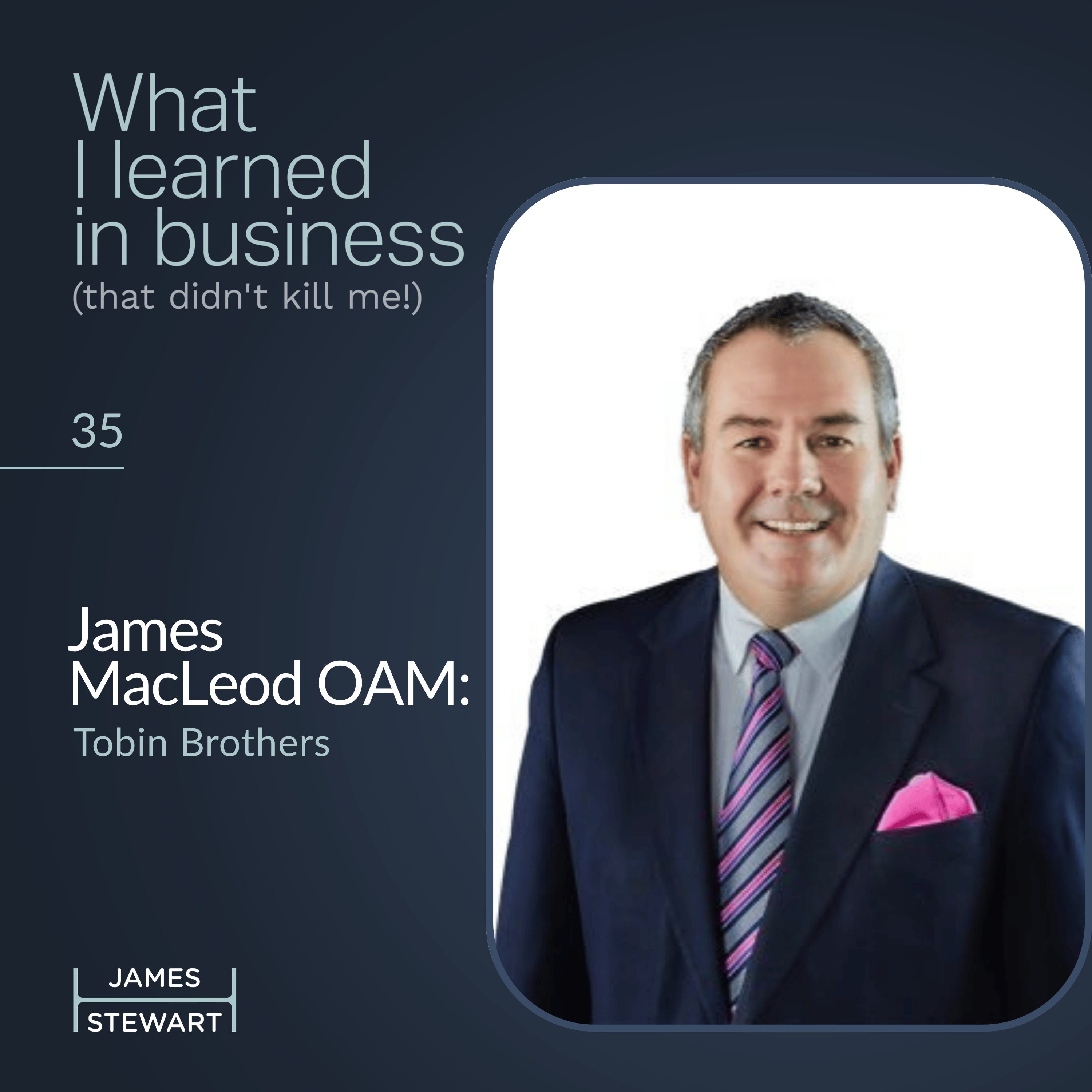
James McLeod, managing director of Tobran Brothers Funerals, discusses the evolution of the funeral industry from a secretive, tradition-bound sector to one embracing transparency, personalization, and technology. Born into the business, McLeod started as a coffin trimmer and worked his way up to become the first non-family member to lead the company, which now handles 7,000 funerals annually with 280 staff. Key changes include a shift from burial to cremation (70% in Victoria), the rise of life-centered celebrations with customized coffins (e.g., a speedboat-shaped casket), and the normalization of webcast funerals due to COVID-19, now used for 70% of services. To address market disruption, Tobran Brothers launched a separate no-service, fixed-price cremation brand, inspired by the hotel industry's Formula One model, targeting customers who prefer unattended funerals. McLeod emphasizes the emotional toll on staff, who face daily grief and tragedy, and describes support measures like a dedicated psychologist, mental health training, and peer support groups. The business prioritizes its people, recognizing that supporting employees is crucial in an industry where "some weeks are really bloody tough."
Some words are really bloody tough. They're really tough on our people and you get runs of deaths and tragedies. For too long the funeral industry has hidden behind a veil of secrecy where there was a lack of transparency in the funeral industry and a transparency on costumes, what happens once you engage the funeral director along every step of the journey from the time your loved one has died to the time of their funeral or the time we hand it, cremator remains back to the family. They beat the water to a temperature, a very high temperature in the body, slightly breaks down. The water circulates and accelerates and the natural death composition of the deceased. Go everybody and welcome to another episode of What I Learned in Business That Didn't Kill Meep. Today's episode is a little different because we're stepping into a business that every single one of us will need at some point in time but very few of us truly understand and I'm talking about the business of death. Now today's guest is James McLeod, OAM, who is the managing director of Tobran Brothers Funeral's. James was born into the funeral business which we're going to come to but he started as a coffin trimmer as a kid, worked his way through to the mortuary. This is sounding a little bit like the Adam's family but I can assure you it's not. Over the nearly four decades has done just about every role in the business you could think of. Today he leads 280 people delivering around 7000 funerals a year in a business that quite literally never stops. No boom, no bust, it just keeps going. And yet under James's leadership, Tobran Brothers has had to evolve. It's had to navigate disruption from low cost competitors, its embrace technology and artificial intelligence and it even launched a no service fixed price funeral business next to its own core offering, more about that later. So today we're going to unpack what's involved in running a business in constant proximity to grief, how you lead people in one of the most emotionally demanding industries imaginable, the realities of succession and governance in a multi-generational family business, and how in industry that's traditionally been opaque is being reshaped by transparency, technology and changing social attitudes towards death. And one more thing, this episode is proudly sponsored by the Family Business Association and organisation that plays a critical role in supporting, connecting and advocating for family businesses across Australia and New Zealand. Let's get into it. Now from one former corporate undertaker to the managing director of Tobran Brothers Funerals, welcome to the show James McLeod. It's great to be with you, James, that's a very generous introduction. Well I have to say, you being born into the funeral business is a bit like me saying I was born to be a liquidator and it's just not there's not many people you can say that about. I would love to know how you got into the funeral business and how it actually framed for you and you became a coffin trimmer and then you worked in the mortgary. Can you take us through that journey? Absolutely, so my parents were both funeral directors and my dad was started work with Tobran Brothers in fact in 1962 and my parents lived in funeral locations so they lived above the funeral home or behind the funeral home and as a kid I grew up at Tobran Brothers at Noble Park and then later we moved to Tobran Brothers at Fransden where our home was at the rear of the property and just like I guess if you're involved in a family business you get to help your dad and your mum doing the things that need to be done whether it was the lawns, the gardens around the property and I learned how to trim coffins from a very young age, from a very young teenager and so it was sort of second nature to me and that was the role I commenced in when I commenced work with Tobran Brothers in 1987. Well I have to say it's one of the more interesting professional journeys that I've heard of because I've of course I've had nothing to do with the funeral business from my business perspective unfortunately as I mentioned earlier just because we're a user but so you've been in the business 39 years and you're the first non-family member to be managing director so I do want to talk about that but I before we get there I thought we should start with the history of Tobran Brothers and what the funeral business is all about because most people only buy funeral services a very few times in their lives I think you might correct me on that. Could you take us through the history of the Tobran Brothers business? It's a business that commenced in 1934 for brothers of course commenced the business in Leo, in Fonds, in Kevin and Tom and I did it in 1934 and it was just a bright move when you think about that era in history you know the height of a great depression post-World War One and just tried a World War Two it was a real a real cutscene moved by these brothers they had 200 pound and they needed a fair whack of it for the person they purchased and then and then leasing the property and stock and starting up the business and in their first year in 1934 they conducted 53 funerals they paid all the debts and made a modest profit and they really went on to doing very very well in the years that followed because they were heavily connected with the Catholic Church and the Melbourne Fibergate the MFB two of the brothers worked in the MFB so they get a lot of funerals from the Catholic Church and they'd also get a lot of funerals from you know five employees right around the city and that was really tremendous for the business in establishing yourself in those early years. Well that's incredible and so when we when we think about that journey I mean it is incredible that time that they actually started the business particularly that time in history when we think about how the operating models evolved and how the business actually works now can you just talk us through the operational complexity of running a funeral business because in my mind it feels like it's pretty simple but I've got a feeling it's not that simple. Yeah certainly it's evolved over the years and it's very different to when I started to what it is today and of course with the Furnals today are very life-centred they're very much a celebration. Historically Furnals used to take place generally speaking at a church so there was already you know the church's structure in place whether it's a Catholic funeral or a underfinity uniting etc each church has its own structure that you must follow for a funeral service. And over years we've seen it evolve and you know now the largest growing funeral today is the service which doesn't have any religion involved in the funeral celebrations so they usually fuels the held in a funeral of Rex Chappell at a crematorium maybe a your club is sporting a club that the the deceased has been involved in etc basically our philosophy of table roses if it's legal it's possible we'll do a funeral anyway. And so we're seeing life-centred Furnals today where there's a lot more personalisation involved in the funeral and that gets you know from the venue to selecting the coffin you know and people can really you know use their imagination when it comes to the coffin we're seeing lots of coffins and different colors we're seeing lots of coffins that that had photographs on them and we're even seeing the changing of shapes in some of the coffins and cascades now today too. So we're really seeing some great personalisation and where funerals are a true celebration and very much life-centred hence their by-lawed at table and brothers is celebrating lives. Well so I'm interested in the people changing the cascades in the different shapes what sort of shapes would they be changing the cascades into. Oh we were recently had a speedboat and we had a person who had their their cascad made in the design and the shape and the colours of their speedboat and the speedboat was actually on display at the funeral and it was amazing I wasn't physically there but I saw all the photography all it was and it was a very immediate one. So our job is to give people permission to do these things and as you said earlier on it's it's something that people will only purchase once maybe twice or possibly three times in a lifetime and they'll usually do those purchases if you like you know those once twice or three in a very short space of time and it's usually and hopefully it is later on in what one's life to. So it's important that we give people permission we allow them to make really well informed decisions about what they can do rather than what they can't do. So we focus on the kind of sort of stuff right and the car to stuff and and our job is to make it happen and to make it possible for client families. Let's just talk about a couple of the basics and so it's a competitive market and I'd love to you know token brothers are not the only provider of these services in Australia obviously. How have the how have service delivery models [BLANK_AUDIO]
changed over time. In my mind, I'm thinking about pricing, physicality versus virtual cremations versus burials. Can you talk us through, have there been some big trends around the funeral business that have been, have impacted the model over time? Certainly changed in the 39 years I've been doing it and the first change will address is burial versus cremation. Once upon a time burial was far higher than cremation but it just continues to change in every decade. So that sort of in Victoria we're doing around 70% cremation in Victoria now and 30% burial. And it's higher than some of the other states in Australia but Queensland has a very high cremation rate in Queensland. And I guess as is Laura Melbourne and Victoria because the strong cultural mix that we had down here, particularly Europeans and a lot of Asians and they generally speaking prefer and choose burial over cremation. So that's the first thing that has changed and changed significantly. One of the other changes to his COVID changed the mindset I guess of the way the funerals are done in many ways and also attendance at funerals too because during code families were forced unfortunately to choose who could attend the funeral and who could not attend the funeral. And it was a really trying time for families particularly in Victoria where the vast majority of our lockdown periods were only allowed 10 people. Remember we were one of the most lockdown states in the world Victoria and Melbourne in particular. So it was really tough for families. So whilst we've been wet casting funerals for many years, generally speaking there would be a dozen funerals a month where families would request that an uncle or a cousin could watch from overseas etc. It became something that happened every day or every day during COVID and so much so to die. As a result of COVID, people have been educated and demonstrated that it's okay to be a part of the funeral process of the funeral celebration although it not being there physically but still being involved online. So COVID goes that which is a great outcome and certainly about 70% of all the funerals we still conduct today are Tobin Brothers, a webcast. So it's something that's grown and I was just looking to numbers the other day for a funeral. We can see how many people are watching at any one time. We can see what countries they're watching from where the webcast that I did the funeral was the other day and there was over 90 people participating and from every just about every continent of the world watching the funeral also. So it's certainly evolved and changed. And of course there's different products and offerings that have been introduced over years. Historically one would never think of having no one attend your funeral. Historically they were referred to as a porpoise funeral. If you like. No one would attend. Or for known for a funeral. Particularly difficult funerals to be involved in when no one's present at the funeral. Historically and there was no one present because no one was aware of the death of a person but isolated themselves etc. Well today many people and during COVID chose to have funerals where no one attends the funeral. So they're called no service funerals and no service cremations predominantly. There are some burials but predominantly cremations and then families have a service following on the funeral at perhaps a memorial service or an appropriate time in the months ahead and a place that they're choosing. So there's some of the main changes that we've seen over recent times. Well I know. Fascinating. Well can we just talk about your your new business fixed price cremations or maybe it's not that new and that is your no service business. And before the call you'd mentioned that to me and I had never heard of a no service business before. How does that actually work? Well it's something that's been around for a very long period of time as I said it's sort of in Australia. It started with porpoise femils if you like. But it's it's involves in a significant way particularly in the United States where just about all cremation funerals I know service funerals they view cremation very differently in the United States to the way they view very good. Right. And so it's evolved here in in our country and I I went away to insiad in to study in 2016 and we did a major research project at the Blue Ocean Institute on the A-Core Hokes Hill group and it really resonated with me how much A-Core had in common time with Brothers. We've got tape at Brothers is our premium brand if you like it's it's very nice to want to a solitle in many many ways when I was sitting there taking in the lectures and then we've got some other mid-level brands there but we didn't have anything in the sort of formula one brand in area and yet many people are choosing to have no service promotion funerals. So we built a model, came back and started a business in that area that operates out of both Melbourne and Sydney and we're capturing a fair percentage of the market that we would never have captured under time and Brothers or our other subsidiary companies and we're learning more and more and more about the market in each different area from no service funerals all the way through to state funerals. Right now and just to be clear for people listening to the show Formula One is A-Core groups no service hotel chain is that's basically right correct? That's correct. So it's one offering one offering I mean there's no choices whatsoever and that's the same with this top of funerals. It's a no service promotion funerals that's the offering and there's no other options available. And when you when you launch that I love the fact that you've compared the funerals business to a hotel business not literally obviously but in terms of the model and the segregation of your offerings is just terrific. How did you go when you bought this idea back to the business and you talked with the business about no service funerals how what was the reaction was there any any sort of how was it embraced was there any pushback? I look it was interesting when we when we studied the A-Core model at NCAT they they talked about the biggest objectives to the Formula One model was the you know vice president of food vice president of beverage the vice president president of room service the vice president of customer service etc so I was already pretty commissioned with that so I knew what I was walking into when I came when I came back and a number of people just saying we can't do that you know this is this is the way we do things etc and I made it very clear that it would be a separate company it would operate separately it wouldn't operate under our under our roof line and it would be service by a separate team of people etc so it had a sound cost modeling etc look I'm going to say the board were very very good and they they embraced it it was a bit of it was a bit of a hard sell with some of my management team and there was a lot of people who followed our owns around the table when I was talking about it there's a lot of learning that's come as a result of it so and it's been it's been a really important introduction in our broker companies I've been defunals most almost all of us will abandon funerals and I often find that the the funeral director the service provider they've got a great amount of empathy which they must have in the situation and I was actually at a funeral a little while ago and the the funeral director was crying during the funeral and the funeral director didn't know the deceased didn't know the family and it kind of occurred to me that the I mean the impact of having to deal with death on a day-to-day basis that could be potentially stressful and challenging for your team to work with how do you how do you support the people in your business through dealing with death every day how do you think about that from a cultural perspective and from a support perspective yeah well at the end of the day we're all people and I think that one of the things that we as fueler X is always trying to do is we don't try to walk in the people's shoes that we're serving but we try to imagine in some small way what they're going through and it's it's it's really really challenging and the stories that we're here and and that we see each and every day challenge our people and I'm many bad people with our hearts on this live it just goes hand in hand with what we do if you a lot of the stories resonate you know you look at people the same age as you or the same ages as sibling of yours or the same age as your children the same ages other people in your lifetime so you know hearing that story the funeral director's crying you know that's something that you would often say at Tobin Brothers with supporting our staff it's it's always something that we're braching yourself how can we do it better I don't think that we have all the right answers and there's lots of circumstances that we're not aware of when you're a company that does I know we said 1,000 funerals a year there's plenty of things that you're not aware of right across the state
But we have a psychologist on board, our team, and they're available seven days a week. They come to do all of our company events, if you like, et cetera. It's always interesting seeing them at the Christmas function. Often a lot of people want to come up and talk to the psychologist after 11 o'clock at night and tell them their stories. Of course. So we've got that person on board. We've got many of our team are trained in mental health and signs of mental health, et cetera. So we've also got a group of peer support trained members of the team that could jump in and assist other team members. We're a business that has a lot of downtime in it. When you think about when a funeral service is on, traveling from point A to point B in the funeral service, we talk a lot with one another. We're pretty real about what we're dealing with each and every day. And some weeks are really bloody tough. They're really tough on our people. And you get runs of deaths and tragedies. Can we do it better? You bet we can. And we need to continue to, because the world is very, very different today. And we need to support our people because our people are the number one priority in our business. Yeah, look, that is incredible. And I can only imagine it. I've dealt with, for 40 years, I've dealt with businesses that were often broke. And sometimes they didn't survive. And people were put out of work. And there's a very human side to doing that part of the job. But it's nothing compared to dealing with what you've had to deal with. And that just sounds like an incredibly challenge situation. So hats off to Tob and brothers. Hats off to people in the industry. You have to deal with that on a day-to-day basis. Yeah. So let's talk about some succession issues. Let's just go back to the family. So you've had 13 family members working in the business. You've got, I think you've got second, third and fourth generation. You're the first non-family managing director. Can you talk to us about how the businesses manage governance, succession planning, and also capability gaps inside the business? You've been often, you know, family members are involved in the business. Not everybody has the same aspirations. Not everybody has the same skills. Not everybody has the same experience. How have you managed all those things as part of the journey? How has the business thought about succession planning, which actually ended up leading to you taking the role that you currently got? Well, look, I think the company overall, it's lifetime has managed succession planning overall very well. And it's something that was planned as the full managing director of the business in its life. And Kevin Togman, who was one of the four brothers, who was the first managing director. He was called Careful Kevin. And he really watched every dollar and every set. And managed the business really, really well. And then Des took over from him, Des Togman. And Des really was a big thinker, a very, very good marketer. And he really took the business forward and did a lot of. Des was big on taking risks and etc. And not all, everything would work out. But it still took risks anyway and tried new things. So we progressed the business under Des leadership. And then Des is so mad and took over the business. And that was a planned succession plan. And Martin had a background in law. And then Bob, you know, had his own way of doing things. He made a lot of acquisitions. He grew the business under his tenure. And then when Martin left, I'd been working as general manager of the business for, you know, about a decade. And so the company has always put through its senior leaders through extra studies, masters, etc. Sent them overseas to study, work overseas, work in other businesses, be exposed to a variety of different things. So at a high level, we've managed succession planning really, really well. And that's really also triggered down to the total family members. And as you said, James, there's a variety of members, second, third and fourth generation. All of them have different skill sets. All of them have desires to work in different aspects of the business. So we've got some of the family members are in the mortuary. And that's their career aspiration. That's what they're chosen to do. They're in Barnas. We've got people at work in operations. We've got people that are on the call face doing fumerals and serving client families each and every day. And that's very powerful for our business because everyone lost the B, cared for by Mr or Mrs Tobin. And that's very good for us. And then we've got some other members of the team that are in management. We've got a bride, bride, who's done her masters and has had experiences of being exposed to a variety of different things. She's a fourth generation, employees and family member. So it's something that is a focus of ours all the time is succession. And the family members like every other team member, they need to earn it. It's not just something that's gifted to them because of their names, they need to earn it. And thankfully, we've got a number of them, third, or even working the business today. And they're all doing some really extraordinary and some good things. This common denominator that comes out as I've been interviewing family businesses recently of getting them people to work outside the business, getting them extra study, to bring them back and bring those skills in. It just seems to be that really great anchor for keeping family members in the business over a long period of time, but making sure they're skilled for the job they're set up to do. Absolutely. And we've got a criteria that we work for every family member that wants to join the business. And they've got to meet that criteria before they can join. And some have been being successful in their first application to join the business and be encouraged to go and do XYZ, whether it be study, whether it be work, in another industry for a period of time. And I think that that's been very successful for us in having that criteria in place and really art as well for when you do join the business and for the future. Have you had any challenges with the transition of family members appointing non-family members to key roles and how they'll ever come? Has there been any particular things that maybe didn't go as planned that our listeners could learn from? Well, I think not a family member or family member or I think there's challenges of every word as you roll. And there certainly is. Yes, there's some additional ones there with some of the family elements of the business. But I think one of the things is being independent from the family is that historically all the family members around the business have been part of one side of the family and the other. And the poker business where four separate families involved in the business. And that would have presented themselves with a lot more challenges than I have. I just pretty even with it all. And something that yes, I'm sure on the way to be disappointed with decisions I've made or what have you. But I think that there's great respect for the independence. Not only in Iraq, but we've got an independent chairman too of the board, which has been a tremendous step forward because historically we've had a family member who's been a chairman. And of course, there are always on one side of the family and sometimes you're dealing with something that goes across families. And that can be really challenging when your chairperson is a family member also. And someone independent has really assisted greatly, certainly assisted greatly from my perspective. Our chairman is a lawyer. There's also a company lawyer. So it's and also runs their own family business works with these two sisters in the family business law firm. So he gets it. And but it's also good from my perspective to have someone independent that I can speak freely, whether it's about. And you know, something we're dealing with across family or an individual family member. So I think that that's been great maturity by the business to have an independent chairperson and an independent managing director. Before I jump into the second half of my conversation with James, a quick thank you to the Family Business Association for proudly supporting this episode. Family businesses are responsible for a significant proportion of Australia's private sector employment and economic activity. Yet many face unique challenges around succession planning, governance, family dynamics and long term stewardship. The Family Business Association in Australia and New Zealand exists to help family businesses navigate exactly those challenges through education, networking, advocacy and access to community of business owners who understand the journey. If you're involved in a family business, whether you're a founder, next generation leader, executive or advisor, I'd encourage you to check out what the FBA has to offer. And if you're enjoying these conversations, I'd love to stay connected. You can find me on LinkedIn at James hates Stuart on Instagram at what I learned in business, one word what I learned in business. And now on YouTube with a handle is what I learned in business that didn't kill me. sharing full interviews and video highlights and some of the best insights from our
our guests. And finally, if you're interested in reaching a highly engaged audience of directors, investors, executives, advisors and business owners, why don't you have a chat to me about sponsoring the show? There's a lot we can do together. Now, let's get back to the conversation with James McLeod. Okay. Can we talk a little bit about technology and artificial intelligence and other things like that that are impacting the business? And I can understand the obvious impact of COVID, the obvious impact of virtual funerals. So that's all pretty cool. Before the show, we would, you talked me through the concept of acclamation, which is a different type of cremation process that I think you said Desmond Tutu that happened to him when he passed. And I think you also mentioned there's another type of methodology to do with freezing technology. And without sounding too foolish, which maybe I do a little bit, I'm just so curious about this because when I thought about cremations, I've always thought about the big gas oven and away you go. But technologies evolving, can you just talk us through what's happening out there in the world of cremations and how that's changing things with technology? Certainly. Well, as I said earlier, cremation is grown in great numbers in Australia and worldwide for that matter. Some countries, it's compulsory to be cremated. So places like Japan, for example, and with the Royal Family of Buried in Japan. And that's more to do with land than anything else. But we're certainly an introduction of acclamation as you learn a two and yes, Desmond Tutu, that was how he chose acclamation over cremation. He just, I remember ringing out of a city, he liked the process. And I saw the first acclamation, sort of about 15 years ago in the United States. I went and viewed it. So it's a stainless steel container that has ceased his place into it. It's predominantly 95% water and 5% is alkaline chemicals. They heat the water to a temperature, a very high temperature in the body, slowly breaks down. The water circulates and accelerates. The natural do composition of the deceased in that process. And it takes about six to eight hours, depending on the temperature, if it's a high temperature or 14 or 16 hours at a lower temperature. Now, it's available in Australia and it has been for some years. The take up of it has a little going, if you get it, it's only available in some states of Australia. It's not licensed. They're allowed in a few states of Australia, but it's something that is an alternative to cremation. Now, people say, well, why haven't you got one at Tarot and Brothers, why haven't you purchased one? And we may well do that down the track. They just hasn't been the interest thus far from the community. And furthermore, it's sort of, I find it difficult to market in a sense of the selling point, you know, of it. And when I saw the process, that's what I walked away. I thought, gee, how do we really market this in a soft and delicate way? And it's still something that I need to work through at this stage. There's another process which is called Ecolation. And it's been, this technology is being developed in Ireland and the latest technology in the Netherlands, where essentially the deceased is frozen. And to such a point, it's just like a glass that would just shatter. And for a vibration in the machine, the body would be slowly but surely break down. And it's very, very powerful. There's nothing significant testing on it. I've seen the results of it. I've physically seen a machine working. It's particularly a real game change in our environment. We sound process. And I think that it will be something the first units of plan to go into Canada. And I think it will be a real game changer. And I think it will grow in pace in a significant way. Could you just pronounce the name of that process for me again? I'm not sure I caught it. Ecolation. Ecolation. Yeah. Wow. Are these, are these technology, acclamation and Ecolation? Is that being driven from a cost perspective or from an environmental perspective or from a demand perspective or both? Well, acclimation has been around for many years. It's more expensive than promotion at the moment. And that's just because promotion, promotion got sheer volume. And I think that as acclimation grows, the price will come down. Ecolation is being driven by a variety of things. But predominantly from a environmental perspective. And I think that it just doesn't have an environmental footprint like cremation does and like acclimation does also. So I think that it's a process that they've done extensive testing. So it's just the most in process. And I think that when it does get started, I think it will be really well taken up. Wow. Wow. Okay. All right. Well, something to kind of look forward to in a sense, but I get it. That's still fat. Still, I love the fact that every industry, I talk to the game through some sort of technology change. And even the funeral business industry is also impacted by technology. And I think that just goes to show you how far things have come along. So let me just ask you about the impact of artificial intelligence. Are you seeing that play out? A really notical not long ago about people being able to record their life story or record their messages to their family before they pass. And there's been artificial intelligence adaptations of those sorts of things. I'd love to get your perspective of how I is playing in the funeral process. I think we've all been a funeral services over the years where the tributes or the eulogies and you turn to one another and you say, we're really at French funeral here at the moment because they're describing a whole different person to the friend that you knew. Well, artificial intelligence takes it to a whole new level. And it uses words that Fred would never have used in his lifetime. And so we're seeing the creation of a lot of eulogies with artificial intelligence. And so I think that client families and look, those listening out there that happen written in eulogies, one of the most difficult things that you need to to get down and paper and to write. It's really, really challenging. What's the right balance in eulogy? So it has a helpful role to play there. Sometimes individuals take too much advantage of it. And there's too much mayo on it. But we're seeing more and more of it being done today. And I think that it can really enhance and can really assist client families. And let's remember, when you're sitting down to write eulogy, you may have well just been through a couple of months of caring for your loved one in their last days with bad health, etc. By the time you get to the funeral, by the time you get through our front tours, you just get broken. The health systems broken. You had to deal with banks. You've had to deal with all things as a power of attorney and they've given you the runaround, etc. You haven't been able to talk to human beings. You're talking to robots, you're talking to chat lines, etc. So you've got now right their life story. So we're seeing that a lot. We're seeing the introduction of chat bots too into businesses and online chats. And we see just a token, but as we don't have a chat bot at token, but we've got real people there on the end of our chat line. And a lot of people reach out at very, very strange times. And you've got to think about the client family. A lot of them are sitting around at hospitals. They're late at night. They're really the morning, etc. And these sort of conversations happen and these questions need to be asked. So we're seeing that happen more and more often. We've got in our fixed price promotion business. There's a chat bot that's been built into our website at the moment too. And I did some testing with it just recently. And I tell you what, it's certainly a lot quicker than I am. And it's pretty hard to catch it out. It's on the money just about every time. So we're seeing those things happen more and more often with funeral services and funeral service industry. Yeah, well, incredible. And make sense too. Of course, I think the human touch, you know, when people are dealing with loved ones who have deceased or on the verge of being deceased, I mean, you know, they're stressed, they're emotional. They may not be thinking clearly, you know, they're having that epithetic voice at the other end of the phone rather than maybe a robot is probably a key point of difference. So let me ask you a couple of questions before we finish. It's been a really interesting conversation because I've learned things about the industry that I didn't know. Tywin Brothers has been a family business for four generations. And I put in my sort of investment bankers head on for a moment, private equity loves businesses at a sustainable level, long periods of time. I don't know whether they've approached Tywin Brothers and I'm not saying they should, but how have you thought about the long standing family business nature of this business virtual versus an alternative position whereby the business is owned by somebody else down the track and the interest of the family members? Absolutely. And there's no shortage of the amount of private equity firms that knock on our door and are very, very regular biceps. And I'm talking from all parts of the world, not only in the
Australia with Faddox on the door from just about every continent in the world. That continues on today. Certainly the owns of the business were in the third year or five year strategic plan where they said that they wouldn't entertain a divestment or part divestment or a full divestment of the business in any way, shape or form and it's something that will be reviewed and we have an annual day or two where we review the strategic plan to see if we're staying on that pathway or not. Look, their mature about it too is there's a lot that's involved in a family business that's coming up towards its centenary and that's significant. Their mature enough to have these conversations and open enough to have these conversations. I think that when they feel the time is right they may consider a part divestment or a full divestment. We're well supported at the moment in a family unit and there's interest from across the generations and there's passion and at the moment I think they're very happy to stay as a family owned company but at the same time they're open, very open to what the future holds. Yeah, look, I love that. I love the maturity of thinking about things objectively particularly when you're carrying on a family legacy, a family name that can get really difficult to separate that from the interests of your younger generation coming through and your children's children, right? So having the ability to be objective and stand back and think about where are you on your journey doesn't necessarily mean creating artificial cliff but just having that awareness is so important. Great, agree. So let's let's okay a couple of things I wanted to wrap up with. First of all, if you were to give someone buying a funeral service for the first time, one piece of advice, what would that be? Well, I think the first piece of advice is making form decision, making form decision before you engage a funeral company. For too long, the funeral industry has, if you're liking it too, hidden behind a veil of secrecy where there was a lack of transparency in the funeral industry and a transparency on costings, transparency is on what happens once you engage the funeral director along every step of the journey from the time your loved one has died to the time of their funeral or the time we and their promoter remains back to the family. So I think that it's important that people make really informed decisions to your research. And if you're not happy with the answers that you're getting when you're doing the research, I'm not sure that you're going to be happy with the process that will then follow thereafter. So I think make really informed decisions and ensure that the business that you're engaging with is one that is transparent, that you don't have to go searching for the answers to your questions. The answers to your questions should be there if they're a funeral company that's sort of the test of time. So I think that they're really, really important things. Map out what you'd like. Talk to your loved ones about what they'd like. There's nothing worse than sitting down having to arrange a funeral and there's no discussions. You don't know whether your loved one wanted to be buried, wanted to be commited. You don't know where their funeral should be held. There's a lot of questions that you need to get answered. And I think the good starting point is you've got parents that are only who are retired or what have you asked these questions. There's a mature conversation and they're difficult conversations, but I tell you what it's a lot better to have those conversations now than waiting until they've died and you don't have any answers to the questions that will need to ask you. That's a great piece of advice too. I think that's we're all going to face in the word and if you're lucky enough to have the opportunity to talk about such a difficult topic with your friends or your family's rather or your loved ones, then that is a conversation that just needs to be had. I mean, it's just it's life and we're all going to have to deal with it. So that's a great piece of advice. You've been inside a family business in one shabble form now your whole life. And if you were to give other family businesses one piece of advice, particularly those who are managing multi-generational family businesses, what would that be? I think it's always to have an advisor, to have an independent advisor. And I think that we all need that resource. I'm lucky to have that in a chairman in our company and I think that it's really assisted me. Not only it did make difficult decisions or during difficult periods, but it's just assisted me knowing that you've got that support, knowing that you've got some of the subjective in giving you that support and that advice. And the emotion has taken out of it. It's completely taken out of it. So you can reach a balanced decision if you like. And let's face it, family businesses are emotional. They're emotional businesses. People are passionate about their business. They're passionate about their name being above the door. And that's great. And you want that and you want to be able to use that passion in the best possible way. But equally, equally, you need to reach the right decisions. And I think that if you consult and you have good people around you, independent people around you to consult with, I think that that's a key ingredient for success. The ability to disconnect what is a natural degree of emotion in a family business and have that mirror. I call it a mirror. Put back at you without bringing that emotion back into players. It can be so helpful. So, hey, James, this has been a great conversation. I, from one, I'm from a corporate undertaker to an actual undertaker. I've really enjoyed it. It's been it's been fascinating. It's an area of business that I've not had a lot of exposure to. And I really enjoyed learning about it. And I'm sure it'll land really well with our listeners. So, James McLeod, thank you so much for coming on the show. Big great, but with you, James, thanks to your time. James, thanks for joining me on this great conversation. I think what strikes me most about today's conversation is that while Tobin Brothers operates in the feudal industry, the lessons extend far beyond it. We've talked about trust, leadership, succession planning, governance, innovation, culture, customer experience, and the challenge of evolving a multi-generational family business while remaining true to its purpose. Most people only engage with a feudal director a handful of times in their lives. But today's discussion has provided a fascinating insight into the complexity, responsibility, and humanity behind an industry that touches every family at some point. So, a huge thank you to the Family Business Association for supporting this episode. And for the important role they apply in strengthening family businesses across Australia and New Zealand. If you enjoyed today's episode, please subscribe, follow and share the podcast with your networks. You can also connect with me on Instagram with a handle is what I learned in business, one word what I learned in business, on YouTube at what I learned in business that didn't kill me, and of course on LinkedIn at James Hates Stewart. If you're interested in sponsoring the podcast and reaching an audience of business owners, directors, investors, and senior executives, I'd love to hear from you. Until next time, keep learning, keep growing, and remember, sometimes the most valuable lessons in business are the ones that didn't kill you. Thanks for listening.
Podcast Summary
Key Points:
The funeral industry has historically lacked transparency, but is now being reshaped by technology, changing social attitudes, and new business models.
Tobran Brothers Funerals, founded in 1934 by four brothers, has evolved from traditional church-based services to life-centered celebrations with personalization like themed coffins.
Cremation rates have risen to about 70% in Victoria, and COVID-19 accelerated the adoption of webcast funerals, with 70% of Tobran Brothers funerals now streamed online.
The business launched a separate no-service, fixed-price cremation brand (similar to Formula One hotels) to capture a market segment that prefers simple, unattended funerals.
Leading a team in constant proximity to grief requires support systems, including an on-call psychologist, mental health training, and peer support, as staff face emotional challenges from daily exposure to death and tragedy.
Summary:
James McLeod, managing director of Tobran Brothers Funerals, discusses the evolution of the funeral industry from a secretive, tradition-bound sector to one embracing transparency, personalization, and technology. Born into the business, McLeod started as a coffin trimmer and worked his way up to become the first non-family member to lead the company, which now handles 7,000 funerals annually with 280 staff. , a speedboat-shaped casket), and the normalization of webcast funerals due to COVID-19, now used for 70% of services.
To address market disruption, Tobran Brothers launched a separate no-service, fixed-price cremation brand, inspired by the hotel industry's Formula One model, targeting customers who prefer unattended funerals. McLeod emphasizes the emotional toll on staff, who face daily grief and tragedy, and describes support measures like a dedicated psychologist, mental health training, and peer support groups.
FAQs
Tobin Brothers Funerals is a family funeral business founded in 1934 by four brothers in Melbourne, starting with £200 and conducting 53 funerals in their first year.
For too long, the funeral industry lacked transparency in costs and processes. Now, there is a push for openness at every step from death to funeral or cremation return.
A no service funeral is a cremation without a funeral service, often chosen by families who then hold a memorial later. Tobin Brothers launched a fixed-price version to capture market share they previously missed.
COVID-19 normalized webcast funerals, with about 70% of Tobin Brothers funerals now webcast. It also increased demand for no-service funerals due to attendance restrictions.
They provide a psychologist available seven days a week, mental health training, and peer support teams. Staff also talk openly during downtime to cope with emotional challenges.
In Victoria, cremation rates are about 70% and burial 30%, influenced by cultural preferences from European and Asian communities who often choose burial.
Chat with AI
Loading...
Pro features
Go deeper with this episode
Unlock creator-grade tools that turn any transcript into show notes and subtitle files.
 PodcastTranscript AI