Before we begin, we want to let you know there are descriptions of violence and
sexual abuse against children in this episode. Please take care while listening.
Previously, on stolen, surviving St. Michael's.
I don't think up till that point any residential school survivor had confronted him with.
What I had, four or maybe five priests, I had to take turns trapping that guy.
I know, I know what happened. I lived it.
It makes me mad. For all the years, my growing up years that were taken away from me.
That were taken away from me brutally.
Have hesitant anything that has helped you to heal?
My sweat on you. The only justice I got out of that was the way I treated my kids.
You know, and we raised them right. That's the only justice I got was the way I loved my kids so much.
When I was in my early 20s, I had dinner with my dad at a restaurant in Saskatoon.
I hadn't seen him in a while and I remember sitting in a booth, my dad across from me,
and beside us my younger sister and brother, Sherry and Harry.
My dad was basically a stranger to them. They were just babies when he and my mom split up and we left.
I don't remember what we ate or what we talked about, but at one point my dad got serious.
He apologized to us. He said he was sorry for how he treated our mom.
That he had changed and he wished he could go back and be a different father to us.
I don't remember what I said in response.
I'm sure I saw how hard it was for him to say those words, but I'm also sure I wanted the moment to be over.
I wasn't ready then to hear his apology. I didn't know my dad's story. I didn't know what happened to him at St. Michaels.
What I know now would have helped me meet him in that moment to face him with empathy and accept his apology.
Before I knew about my dad's past, I never appreciated what he and thousands of other survivors were expected to overcome.
Survivors have been asked to get over it, but with no real reckoning, accountability or justice, how could they?
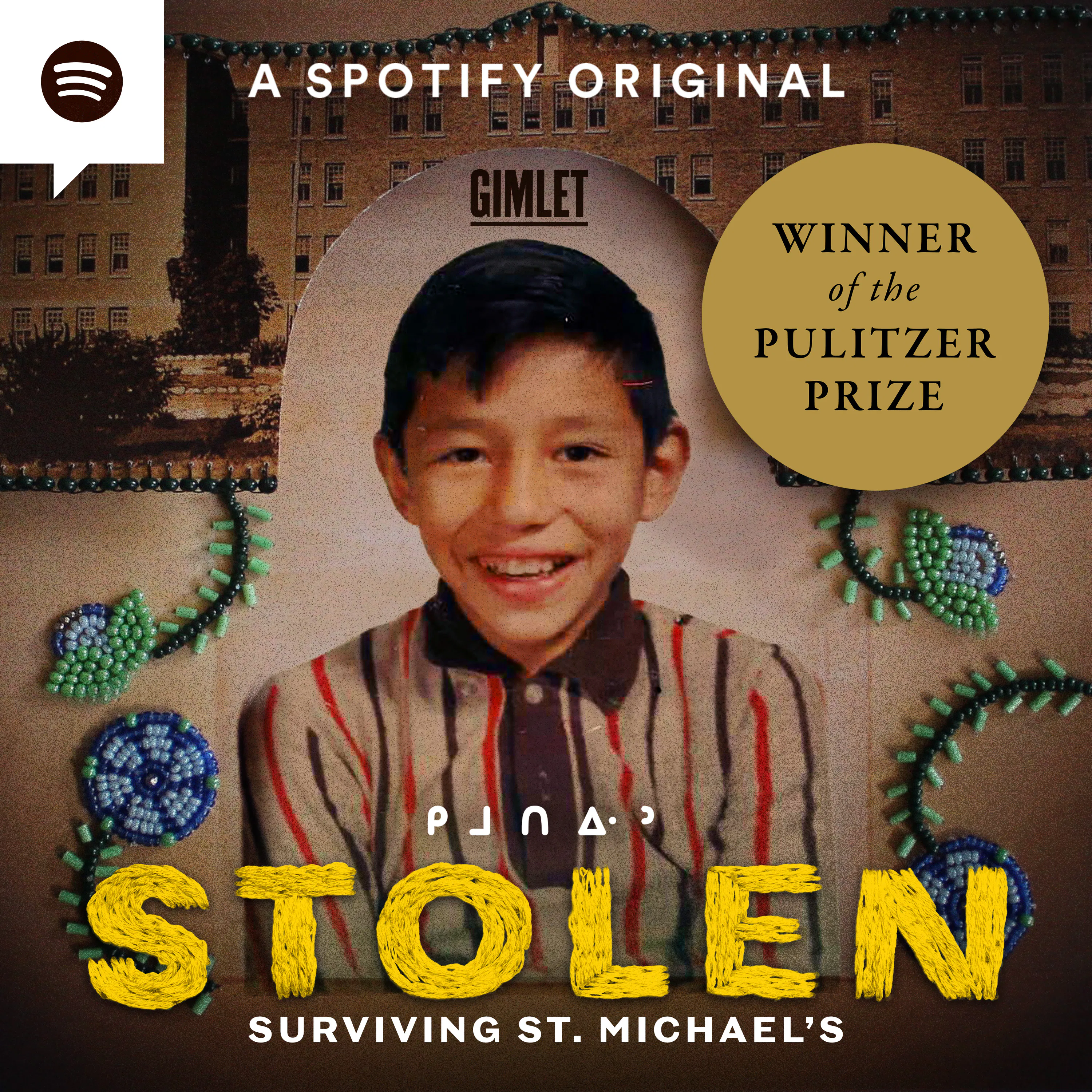
I'm Connie Walker. From Gimlet Media and Spotify, this is Stolett, Surviving St. Michaels.
Observe the North American dad. 50s. Great polo collection.
He enters his vehicle information on Carvana and offers appears in minutes. Remarkable.
He squints, reads it again, smiles and says, "Dang, that's a good offer."
The highest form of approval. No haggling. No hassle. No one called him boss.
He's still on the couch, astonishing. Sell your car today on Carvana.com. Pick up these may apply.
Tammy regularly haul stuff to her kids at college. That's why she shops at BJ's wholesale club, saving up to 25% off grocery store prices.
Beef jerky, microwave meals, laundry pods, even they can't screw up.
Have you met my kid? And with BJ's gas, she gets there for less.
They call me the road warrior.
This is your home, Road Warrior Mom, home of the SAVE. Join for just $20 at bj's.com/maskeet and save 10 cents per gallon for six months.
Open soon, limited time offer, new members only.
BJ's home of the SAVE.
My dad's wife, Narlaine, told me his life changed in the summer of 1989. He was 34 at the time.
He and Narlaine were married and had a new baby at home.
One night, my dad got a phone call. My oldest brother, Darwin Cameron, my dad's firstborn, had been in a car accident.
He was 16. He and his friend were driving to meet their girlfriends and they rolled the car.
Narlaine says my dad rushed to the hospital in Saskatoon and when he got there, he realized how badly his son was hurt.
I remember hearing him saying it, whether he was praying or whether he was just talking to me, I heard him say that if my son lives, I won't drink anymore.
Darwin survived, but he was paralyzed from the neck down.
Narlaine says my dad did what he promised. He quit drinking. He quit drinking. That was it.
That was it, cold turkey, that's when. And how much was he drinking at that point?
He was drinking like every day, like every day and sometimes not eating.
Sometimes it was drinking right away when he'd wake up in the morning and then drinking all day till he passed out.
I can't imagine how tough it must have been for him to quit.
And I never realized it was Darwin's accident that pushed my dad to get sober. He wanted to be a better father.
He wasn't able to forgive himself. He blamed himself for Darwin.
Why did he blame himself?
If always felt like he could have took better care, I guess, of his kids, he carried a lot of that resentment, that guilt, that he missed out on lots with your kids.
And he was trying to make sure that he didn't make those mistakes again.
Narlaine says my dad had regrets about Darwin, but also about all of us.
And once he stopped drinking, everything he'd been trying to suppress came to the surface.
Him dealing with everything sober was just torture for him. He was just struggling to find a happy medium.
How do I deal with this shit? Then he actually, I don't know exactly who it was that he went to talk to an old man that invited him to go to sweat with him.
And that's how that started. And first it was his dad going like, you know, like say every Sunday, can you get me some bowls? I'm going to go to sweat.
Okay, you know, so I would. I might be the only person in my family who's never been to a sweat, but I know for a lot of them, it's an essential part of their lives.
It's a ceremony with prayer, singing, and reflection. And Narlaine says it gave my dad something had been missing.
He wanted more, he wanted more, he wanted more, he just wanted to just take it all in. It was like something was a woken inside of him and it had been missing or it was be suppressed or whatever, right?
And he just, you know, wanted to learn the songs and he learned the songs, you know, like that. And he helped, you know, other pipe carriers and that so he really engulfed himself in the role.
Embracing his spirituality affected every part of his life. Eventually, my dad built his own sweat lodge, ran feasts and helped with funerals. People started to see him as a cultural leader in the community. And his life at home changed too.
I was noticing when your dad was going to sweat and stuff like that, I changed in him like there was like something softer. He wasn't so like hard, you know, he was different. It was nothing for him to hug me in public, pulled my hand in public to kiss me in public to hug the kids to, you know, and when he finally reached that turning point, I'll say.
It's just like his eyes were wide open and he was seeing the beauty of things around him for the first time, you know, and that's when things started getting better.
My dad was healthier and happier. And while he was quietly rebuilding his life, the horrors of residential school were becoming a national conversation in Canada.
Today, the head of the assembly of Manitoba Chiefs called for an inquiry into one of the rost wounds of Native History.
Residential schools were operated mainly by her.
In a TV interview in 1990, prominent First Nations leader Phil Fontaine spoke openly about his time at an oblate-run residential school in Manitoba.
We talked about physical abuse, we talked about psychological abuse, deprivation and, of course, sexual abuse.
The majority of Canada was oblivious to what went on in the schools.
So when Fontaine became one of the first survivors to speak out publicly, it was a shocking moment for the country.
What form of abuse were you talking about in your own case?
Well, that's something that's, as you well understand, incredibly delicate, sensitive and very much a private matter.
If we took an example of my grade 3 class, if there were 20 boys.
In this particular class, every single one of the twenty would have experienced what
I experienced.
But are you saying every one of twenty was sexually abused?
They've experienced some aspect of sexual abuse.
The interviewer is sound skeptical.
There's a sense of disbelief that what Phil Fontaine is saying could be true.
But his words broke the dam for countless others who'd been carrying their stories often
alone.
Over the next decade, more and more survivors started opening up about their experiences
and demanding justice.
They filed lawsuits against the Canadian government and the churches seeking damages for the abuse
they suffered.
For years, the government and the churches fought them.
But eventually it became clear that the cases weren't going to let up.
Survivors started winning and being awarded large sums of money.
By the early 2000s, there were as many as 20,000 active lawsuits.
At one point, the obliques, who ran 48 of Canada's residential schools, said they feared
the cases would bankrupt them.
The churches and the government were desperate to limit their liability and wanted to settle
with the thousands of survivors who were suing them.
In 2006, 16 years after Phil Fontaine spoke publicly about his abuse, a settlement was reached.
Through the settlement, residential school survivors could apply for compensation from
the government.
At least $10,000 was awarded to everyone who was eligible.
And survivors could receive up to $275,000 if they had been abused.
But if they took the money, they had to give up their right to sue again.
Many survivors needed it, so they applied.
But it often came at a terrible price.
Because first, they had to revisit their childhood traumas from residential school, through
what was called the independent assessment process, or the IAP.
The IAP compensated survivors without them having to go to court, which could take years.
It was meant to be faster, easier, and less confrontational.
But many survivors say they still felt like their abuse and their memories were on trial.
They had spent their lives trying to forget what they went through in residential school,
trying to block out the abuse, but the IAP forced them to lay everything bare.
After they applied, they had to attend a hearing.
In front of government lawyers, they were sworn in, then the questions began.
An adjudicator asked them in graphic detail about the abuse they experienced.
What happened to you?
How many times did it happen?
Who did it?
Over and over again.
Survivors were grilled about their memories of some of the worst moments in their lives.
What was it like for you sharing your story?
Well, the traumatic is very, very traumatic.
They asked me to describe what happened in that room, and why.
You know, I'm pretty well disclosed my whole life, you know, at that hearing.
The burden was on survivors to try to convince an adjudicator who would decide their case,
that what they were saying was true.
I tried to say as much as I could, and they told me that I was lying.
They didn't really believe my story.
I guess I didn't sound convincing enough, but I was really reluctant to tell it.
That wasn't a problem.
I couldn't even tell my story.
I broke down in tears.
Even now when I think about it and talk about it, I get a choked-up feeling.
One St. Michael's survivor shared her IAP documents with us.
To protect her privacy, we're not naming her.
She said that a priest abused her when she was a young girl at the school, that he gave
her candy and cookies, and that he spoke to her in French.
She remembers he put her on his lap, and that his robe was slippery.
She would slide off, and he would pull her back up.
In her hearing, the adjudicator questioned her at length.
She told him the priest fondled her, and that on two occasions, he touched her under
her bloomers.
But that wasn't enough detail.
The adjudicator said he needed to know exactly what the priest did to her.
She struggled to say the words, and tried using hand gestures to show him.
She was told that the gestures couldn't be entered into the record.
She needed to say the words out loud.
In the adjudicator's decision, he wrote that the survivor said the priest digitally penetrated
her.
He described her as an honest witness, but questioned how reliable and accurate her memory was.
He suggested the priest may have accidentally touched her under her bloomers.
The adjudicator wasn't convinced this was sexual abuse, and he denied her claim.
The survivor appealed the decision, and a new adjudicator reviewed her testimony and concluded
that, yes, she had been sexually abused.
She received a payment of about $33,000.
These hearings were closed to the public, but survivors were allowed to bring a support
person with them.
In Orlain says that for people on beardies, that was sometimes my dad.
He would sit next to them as they testified, sometimes for hours.
When he would come home from those hearings, he'd be just drained.
He would just spend like a couple hours in his little shack, and he'd be just smudging.
Sometimes he'd be just, you know, praying with his pipe.
It was heavy.
My dad saw firsthand how survivors were affected in the days and weeks following their hearings.
You know, sometimes he'd get a call in the middle of the night and he'd have to get up
and he'd have to go and sit with somebody who just needed to talk, or needed a smudging,
you know, like that.
I had no idea my dad had been such a support for so many people in his community, and I
also had no idea that he decided to apply for his own IAP hearing.
Orlain says that first he seemed strong and determined to tell his story, ready to take
what he felt he was owed.
He was all gung-hole and he was going to, you know, going to make them pay.
But as the date for his hearing approached, Orlain started to see cracks in his strength.
She got worried.
I almost lost him like he, I thought that he was going to revert back to that angry person,
you know, and I was so scared because he kept talking about this date that's coming.
You know, I was noticing he was agitated or, you know, showing a little bit of frustration,
but trying not to be obvious about it day.
But I know it was probably weighing on his mind, and many times I thought, oh, God, you
know, he's going to start drinking or, you know, he's going to lose it.
And then I was about a week before he was supposed to go for that hearing.
And I remember the one day he came home and he just broke down and it was just him and
I.
He said, I can't.
He said, I can't.
I don't want anybody to know.
He said, I don't want anybody to know what happened to me.
He said, I just can't.
And I just, but he was like, you know, and he said, you don't have to then.
No, you don't have to then.
We're not going to do it then, you know, and we didn't, you know, but it was just too
much, I guess.
I hate that my dad might have felt any shame about what happened to him.
It was never his fault.
It was done to him.
But I understand why he didn't want to go through with it.
There's a stigma attached to being a victim of sexual abuse, and the IAP made it worse.
Because the victims were scrutinized, not the abusers, and this took a toll.
Their testifying so many survivors relapsed or got sick, some died by suicide following
their hearings.
They were seeking some form of justice, and yet many only got more pain.
More than 26,000 people went through IAP hearings, and around 90% of the claims were found
to be credible and were compensated.
And every single survivor would have been asked to name their abusers.
At the time the hearings were happening, the government took those names and hired private
investigators to track them all down.
We talked to some of those investigators.
It would just give you a person's name that you better try and track down.
I would just anywhere from three to eight people a day to try to locate.
And then the government sends them a letter saying that you'd been identified by two or
three people saying that you had molested them in this time frame of this school.
Then he could respond and saying, "Well, you know, they got the wrong person because I
have nothing to do with it."
They found priests, nuns, former staff, and students, but only to notify them of the
allegation and give them the option to respond.
You know, in some cases, do I think that they should have been criminally charged?
Yeah.
Yeah, of course.
I'm a former law enforcement.
Yeah.
But that wasn't my decision.
I was a civilian contractor, asked to try to find these folks.
So I do that in the best of my ability.
Fighting.
- 100 children.
- Survivors were essentially reporting thousands of crimes,
crimes committed against them as children,
but no one was ever charged through the IAP
because it wasn't a criminal process.
It was designed to offer financial compensation
and to keep all of the findings hidden.
To this day, IAP records are sealed
to protect the privacy of survivors.
As a result, the privacy of alleged abusers
has been protected too.
All IAP records will be destroyed in five years
unless survivors ask for their records to be saved.
The most complete accounting of the residential school
experience in Canada will be lost forever.
That's one of the frustrating things
about reporting on this story.
I know the one very concrete thing that I'm searching for,
the name of the priest who hurt my dad
has likely been documented.
Because when my dad submitted his IAP application,
he would have been asked to name his abuser.
If he named a priest, it's on a piece of paper
that the government has and that I can't see.
(gentle music)
(gentle music)
Tammy regularly hauled stuff to her kids at college.
That's why she shops at BJ's wholesale club
saving up to 25% off grocery store prices.
- Have you met my kid?
- And with BJ's gas, she gets there for less.
- They call me the road warrior.
- This is your home, road warrior mom, home of the save.
Join for just $20 at BJ's.com/maskete
and save 10 cents per gallon for six months.
Open soon, limited time offer new members only.
- Fall never arrives all at once.
First the air, then the light.
And slowly the things you love begin to find each other.
A jacket meets a dress, a hoodie slips beneath a blazer.
An old cap finds a new scarf.
Because you don't simply step into the season.
You create it, layer by layer,
until it finally feels like fall.
Find fall your way at Ross.
- If anything happened to me,
your dad looked after me.
He's gotten to a lot of fights actually over for me.
- Air just like this.
- Yeah, you guys were close, right?
- Very close, yeah.
- 'Cause your age or,
'cause how would kind of after him?
- He would think you had a quarter from the brand here today.
- That's my uncle Harris and his wife, my anti-carol.
She says that after my dad left St. Michaels,
when he went to another residential school in LeBret,
he sent mail back to his little brother.
- A quarter, once in a while he sent me a quarter.
- Like in the mail?
- Oh.
- How would he get a quarter?
- I didn't know it'd be a, you know it'd be a,
there was lots of money back then.
- Yeah, what would you do with it?
- Yeah.
- And much I just kept 'cause we had no place to spend it.
We weren't even let to leave with air.
- It, it's a waste.
- Yeah.
- Yeah.
- So you gotta look in.
- Really?
- Yeah.
- Was it the priest or was it people who weren't there?
- The priest, nuns, the childhood workers.
- Mm-hmm.
- That's terrible.
- It was, I was even glad when that place burned down.
- Do you remember which priest were there,
when you guys were there?
- Yeah, for the, for the him or the Gucci.
- What, do you remember anything about him?
- Must be good.
(laughs)
- That'd be good.
- Mm-hmm.
- Yeah.
- He must be dead now though.
- He's not.
- No.
- He's still alive.
- Really?
- Holy shit, he must be in over there.
- He's 89.
- Mm-hmm.
- And he lives in the St. Albert, Alberta.
- Really?
- Yeah.
- I ask my auntie and uncle,
if they've heard the story of my dad beating up the priest
on the side of the road.
- I'm, I'm curious about if you think you might know
who that priest would be.
- No.
- He kept things for himself after a year, right?
- Yeah.
- Every member of my family that I talk to,
says my dad mostly kept the details of his abuse to himself,
even when it came to the IAP.
My uncle, Harris, says he only just learned
that my dad withdrew from the process.
- I just found out about him,
not, not going through it on himself.
- Oh.
- Yeah.
- How did you find out?
- Did this work in, at an ordained house,
across the room?
- Mm-hmm.
- That's what she was telling us.
- Yeah.
- That's the first time I heard of it.
- Really?
- Yeah.
But he came, he came to mine when he come and spoke on my behalf.
- My dad was with my uncle Harris during his hearing.
- That must have been a hard process to go through.
- It was, yeah, it was, to be, that to tell everybody
what happened to you and who did this and all that.
I don't think I would have done this if your dad wasn't there.
- And was he there for like supporting you
or was he there to like corroborate what happened?
- Supporting you?
- Yeah. - Yeah.
- He tried to charge that priest him and the other guy,
but--
- You wanted to charge the priest who he would have used you?
- Yeah. - Yeah.
- But nothing ever came of it.
- Did you took over the police?
Is that--
- No, I went through my lawyer and--
- No.
- But my lawyer didn't do what dad did.
- My uncle Harris hired a lawyer to help him through the IAP,
but he wanted more than compensation.
He says he wanted his abuser to face criminal charges.
- Is he still alive?
Is he still alive? - He was.
- Yeah.
- Who is it?
- I wanna go check.
- Father Gochie. - Yeah.
- Oh, I didn't know that about Father Gochie
and you and I'm sorry that I don't know,
I started to bring that up.
It's like,
because I heard about him from a girl in Attila Rain,
and so I started looking into him
to see like, could he have been there when my dad was there
and then I said, he was there.
- He was there.
- And then I went to the library in Saskatoon and I asked him.
- I feel terrible that I talked about Father Gochie earlier,
without realizing my uncle had also accused him
of sexual abuse.
That's now two of my dad's brothers
who say that Father Gochie sexually abused them
at St. Michael's.
I'm still thinking about that moment
after I leave their house and drive away.
- We just finished talking and my uncle told me
that Father Gochie abused him in residential school.
And that he thought Father Gochie would get charged
and something would happen and nothing ever happened.
And I was telling him about how he's still alive
and living in Edmonton.
Oh, fuck, fuck, fuck, fuck, fuck, fuck, fuck, fuck, I didn't know.
(soft music)
When I get back to my hotel that night,
I go over everything I've learned since coming home.
All of the abuse children went through at St. Michael's.
How all these survivors lived with their traumas
from that school.
How it's affected not just me and my dad,
but every family.
These are stories I never would have known
if I hadn't come home.
And I think about all the stories
that have already been lost.
In one of my first interviews,
I learned that my uncle Ivan named Father Gochie
as the priest who sexually abused him.
And now his brother, my uncle Harris,
told me that he accused the same priest.
I can't help but think about that article
I read about Father Gochie.
About the quote where he said that maybe he should be in prison,
but he never got caught.
I think about how Eugene Arkant told me he confronted Father Gochie
at an event in 2014.
Eugene said that multiple survivors there saw Gochie
and were afraid.
I talked to two survivors who were also at that event
and who saw what happened.
I was here with him when he said that.
Is this the most children?
AJ Felix and his wife, Patsy, both went to St. Michael's.
That's when Eugene tried to kill Father Gochie.
I kind of wanted to turn so I wouldn't be a witness.
You saw too?
Yeah, huh?
Oh, in the four-year having a smoke, and then Father Gochie
came and happily said hello.
What did you see?
What happened?
Grabbed him.
By the next, I can put him over the railing
for stories I had.
And he held him there, you son of a bitch
and stuff like that.
And what the hell are you doing here?
He was going to kill him.
He was going to throw him over.
And by the father of Gucci, he started to cry.
- Holy cow.
He was going to drop it. Really? Yeah. Now, I was telling you,
you didn't know how you just don't. Don't do that. I was telling them where you'll be.
You'll be convicted. Don't do that. Don't have to. Now you got him crying. That's good enough.
But tell him to get the hell out of you. AJ says he understands why Eugene attacked Goche,
because he also took revenge against an oblate brother from residential school.
In fact, I beat up a brother before I left something that happened
four or five years previous that I still owed him,
or he still owed me and I paid him back the last day of the school.
So, few of those people were ever charged. That's right. They got away with it.
But then it's not over. It's not over.
You mean they could still be charged? Yes.
AJ is the third person I've heard who's confronted an alleged abuser from residential school.
Not in a courtroom or by going to the police, but on his own.
Criminal investigations and convictions for residential school abuses are extremely rare.
And so when survivors had a chance, they exacted their own form of justice,
like dangling a priest over a balcony or beating one up on the side of the road.
But so many others have never had any chance to see their abusers held accountable,
to question them, to make them answer for what they've done.
And now I have the opportunity to go, to put these accusations to an alleged abuser,
and to not take this chance when I have it, doesn't even feel like an option.
I'm going to Alberta to talk to Father Goche.
Next time, on stolen, surviving St. Michael's.
Can I show you a picture of my dad, since you can remember him?
Maybe I will remember him, I don't know.
Actually, it's my dad and his brothers.
My dad, his dad and child there. Oh, why is he?
His name was Howard Cameron. Do you remember him?
Stolen surviving St. Michael's is a Gimlet media and Spotify original production.
The show was hosted and reported by me, Connie Walker.
Additional reporting by Betty Ann Adam.
Reporting and producing by Chantal Belrichard, Max Green, and Anya Schultz.
Our supervising producer is Ellen Frankman.
Our editor is Devon Taylor.
Our consulting editor is Heather Evans.
Additional editorial support from Lydia Pohlgreen, Rayhon Hermancy, and Saeed Tijon Thomas.
Facteching by Naomi Bar.
Original music by Emma Munger, Chris Dirkson, Raymond Cameron, and Catherine Anderson.
Scoring Sound Design and Mixing by Emma Munger.
Music supervision by Liz Fulton.
Legal support from Iris Fisher, Natalie Russell, Whitney Clotter, and Rachel Strong.
Interview of Phil Fontaine by Barbara Frum and CBC News.
If you have information that you'd like to share about St. Michael's Indian Residential School
and Duck Lake Saskatchewan, you can write to us at
[email protected].
If you're a survivor or intergenerational survivor of Canada's Residential School system
and you need help, there's a 24-hour support line you can call 1-866-925-4419.
And if you or someone you know is dealing with physical or sexual violence,
you can find resources in your area by going to spotify.com/Stolen.
Thank you for listening.
This is your home Road Warrior Mom, home of the SAVE.
Fall never arrives all at once.
Verse the air, then the light, and slowly the things you love begin to find each other.
A jacket meets a dress, a hoodie slips beneath a blazer,
an old cap finds a new scarf.
You create it layer by layer until it finally feels like fall.
Find fall your way at Ross.
 PodcastTranscript AI