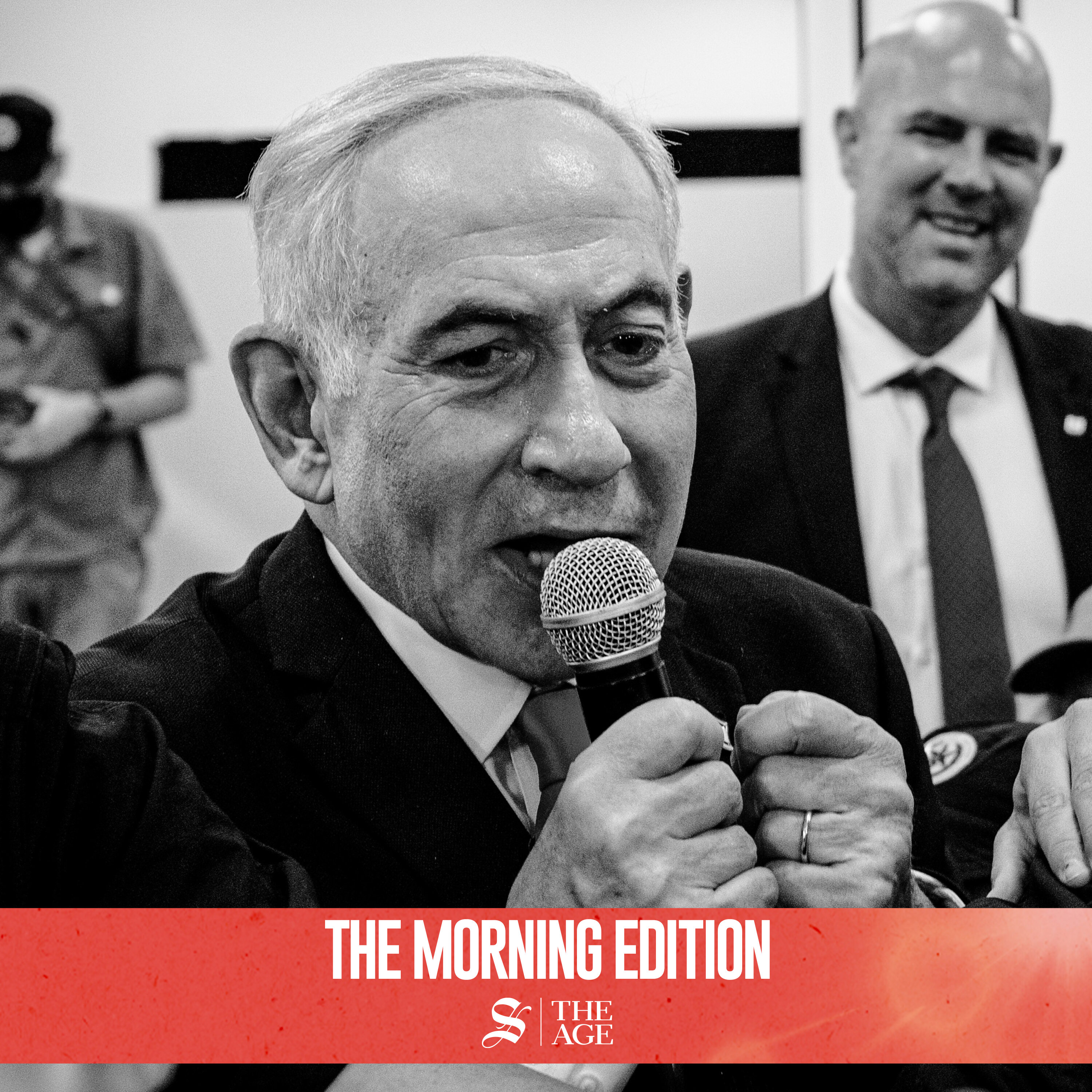
Israel's upcoming election, the first since the October 7 attacks, is widely seen as the most pivotal in decades due to deep national trauma, security crises, and political instability. Prime Minister Benjamin Netanyahu, a long-standing figure with a "Mr. Security" image, is campaigning on his experience and warning that opposition leaders will allow terrorism and a Palestinian state to flourish. In contrast, Gadi Eisenkot, a former military chief, is gaining traction by advocating for accountability, military reform, and a state commission to investigate the October 7 attacks. While security concerns dominate the discourse, the issue of a two-state solution has faded from public debate due to national trauma and trauma-driven consensus. A key turning point could come from Arab Israeli voters, who are increasingly mobilized by rising crime and distrust in current leadership, especially under Netanyahu’s far-right minister Idan Arbel, who has a history of inciting hatred. Most opposition parties have refused to govern with Arab parties, creating a political deadlock that may shift post-election. Despite these tensions, the election is not a simple victory or defeat—government formation could take weeks or months, and Netanyahu may retain influence through diplomatic or military actions. The outcome will not only shape domestic policy but also Israel’s strategic posture toward Iran and the broader Middle East.
After the October 7 attacks, Benjamin Netanyahu's prime ministership seemed in ruins, his government repeatedly looked on the verge of collapse.
Today, Israelis head to the polls for Israel's first national election since that harrowing day three years ago.
So how are they viewing the prime minister now?
I'm Samantha Celendromores and you're listening to the morning edition from the Sydney Morning Herald and The Age.
Today, foreign affairs and national security correspondent Matthew Nott reporting from Israel on the key issues tearing Israelis apart
and the surprising block of voters who may be the king makers in this election.
Welcome Matt back to the podcast.
Thank you very much.
Okay, this is monumental.
You are recording from Tel Aviv right now and many analysts are calling this the most consequential election in Israel for decades.
So is that fair?
Is it a stretch?
And if it is fair, why so? Like what's that stake here?
Yes, it's interesting.
In one way, I would say yes, they certainly are amongst the most important elections in Israel's history.
In another way, perhaps not and we can get into that, but there is a strong a feeling here on the ground in Israel that these elections are absolutely crucial that this is not just another regular election.
Proof of that actually is the fact that Israelis who live overseas are flying back to vote in huge numbers, much more than in the past in Israel, you have to be here in person on election day and cast a paper ballot.
And I think that fact that so many people are flying in gets at the enthusiasm that people have for voting. It's voluntary voting, but turn out everyone expects it to be incredibly high.
These are the first elections since the October 7 attacks of 2023. And I think everyone is familiar with everything that has followed since then the war in Gaza was in Lebanon, the war with Iran, Benjamin Netanyahu is facing charges.
I mean, the international criminal court, Israel has been charged with genocide at the international court of justice. This has been an issue that's inflamed passions around the world.
But Israelis haven't voted since 2022. Benjamin Netanyahu has been in power for most of the past 20 years. It's pretty amazing to think he was first elected in 1996. That's when John Howard was first elected. And you know, now Benjamin Netanyahu is still going and still wants to be in power.
That's the reason why people think these elections are so important. He's governed over the past four years with the most right wing government in Israel's history because of some of the far right ultra nationalist ministers that he's had to bring in to his government.
That's why people here say it's so important that they want to take the country in a different direction. Why some people might say they are not so important is because there's actually a lot of consensus on some of the big issues that used to really divide Israel.
In the past in the 90s say you saw elections where relations with the Palestinians was a huge issue and there was a peace process going on and that was a very lively debate right now following the October 7 attacks. There's there's actually a lot of unanimity about what should be done on some of these big issues.
That's fascinating. So we're going to get into some of those very soon. But first off, I just wanted to ask you about the two main contenders for prime minister really so really the main contest as I understand it is between the existing prime minister Benjamin Netanyahu and gadi eyes and caught.
He's a centrist in a former military chief. So if you had to break down what their respective platforms are, you know what they're fighting for with regards to how they see the future of Israel. How different are they?
Well, Netanyahu is really campaigning on his experience that longevity. I was just talking about he's known in many parts of Israel as Mr security. He presents himself as the man who can keep Israeli safe.
Now that reputation obviously took a huge battering on October 7, which was the deadliest day in Israel's history.
But he's tried to build back that reputation with the wars that are followed. I think of things like the page and walkie-talkie attacks against Hezbollah in Lebanon.
The fact that he convinced Donald Trump to attack Iran not just once, but twice something that past Israeli leaders had failed to do with different US presidents.
He's saying that Iran still presents as a catastrophic threat to Israel. And he's the man who can handle it.
Donald Trump endorsed him last week, which is pretty unusual. That's never happened before in Israel and relations with the United States.
He's absolutely crucial here. So that he's campaigning with a lot of fear. I would say about what his opponents would do. He's using the slogan vote right or Palestine.
He's basically saying that any government except his will create a Palestinian state and allow terrorism to flourish.
And now Gaddi Eisenkot, who as you say is the leading opposition figure, ran against him. He was formerly the head of the Israeli military before entering politics pretty recently.
And he's had a really recent, a huge surge in the polls. It wasn't obvious say a year ago that he was going to be the leading contender.
And now Gaddi Eisenkot's son was serving in the military and died in the war in Gaza. So that shows Israelis that he has a personal stake in this issue as a bereaved father.
We describe him as a centrist compared to Netanyahu and his government. In some ways, he's quite a hawkish on security very much. He said, for example, that Israel needs to take a mass out of power in Gaza within 18 months and he'll basically do whatever it takes, including if that requires going back to war.
So he's no kind of lefty or peace lover at all. But what he's campaigning on is restoring integrity to the Israeli system, fairness.
He's campaigning a lot on this issue of recruiting everyone, including ultra-orthodox Jews into the military. He's campaigning for accountability for October 7th. Think about the situation in Australia after the Bondi attacks and all the calls for a royal commission to find out why 15 people were killed that day.
In Israel, 1,200 people were killed on October 7th. And there's been no substantial inquiry into how this happened, what led up to it, how to prevent it from happening again because Netanyahu was blocked that.
So Eisenkot and the other opposition figures are saying that basically the first thing they would do if they win is to create what's called a state commission of inquiry into the October 7 attacks.
Okay, well let's talk about, I guess, another issue which has become, I think, pretty big and even bigger, I'd say, in the last couple of weeks. And this is the issue of a run and how it might possibly sway this election or impact it.
Because as you've just written, Benjamin Netanyahu shocked many Israelis. And as you pointed out, not easy to do. Israelis are not easily shocked.
But the other day, many of them were when the Prime Minister posted an apocalyptic AI-generated image of a nuclear bomb being dropped in the middle of Tel Aviv on social media. And the message you wrote was clear, you know, vote for me or Armageddon will follow.
So walk us through the growing threat in the last couple of weeks alone of resumed strikes between the US, Israel and Iran, and how Netanyahu is sort of playing off this threat.
Yes, this really is gathering steam here in Israel. And there's a lot of anxiety about what's going to happen. It was interesting last week, not long after I arrived to our interviewed former Israeli Prime Minister Ehud Barak.
And he's a big critic of Netanyahu, and one of his big points in the interview was essentially that Netanyahu will do whatever it takes to remain in power. If necessary, he will start a war to try and delay the elections if necessary.
He could use other tactics as well. And I said to him, you know, many people might think this sounds a bit paranoid. You don't like him. And he said essentially, no, I know this man. I worked with him for a long time. And he's desperate to stay in power in part because he's facing a criminal charges.
And if he's not in if Netanyahu is not prime minister, he'll be much more liable to potentially go to jail. So he's got a personal big personal stake in being reelected.
this is not just like a normal election in Australia
where you win or you lose.
The way Netanyahu is thinking about it is,
if I lose, I might well go to prison.
So he's got a big motivation to stay in power.
And yes, we've seen reports that Netanyahu tried
to convince a Donald Trump to restart military strikes
on Iran in the lead up to the elections
that Trump pushed back on that,
but was more open to it after the midterms,
which are happening the following week in the US,
and he may not want to be in a war with Iran
that's very unpopular there ahead of polling day,
but after there seems to be more willingness
to strike Iran, we're seeing reports that Netanyahu
has had a big clash in recent days
with the head of the Israeli military,
essentially what these reports are suggesting
is that Netanyahu was trying to create
some kind of military interaction with Iran
for what the head of the army thinks was for political reasons
and under law, he's not allowed to authorize anything
and he's pushed back and he said there's no particular
strategic reason to strike Iran before the elections.
The military in Israel is a huge institution in society
and they don't want to be seen as being part of one side
of politics or another at election time
and a key thing to know as well is that
this could still play out after the election.
It might be tempting to think,
oh, well, Israel is voting on Tuesday, October 7,
and then it's all done.
There's been no war, the results will be the results.
In one sense, that's true, the results will be there,
but we're expecting a lot of haggling
over who can form a government.
This can take weeks and months in Israel
throughout that whole time Netanyahu will remain
as Prime Minister so he can launch wars.
He runs Israel's foreign policy.
He's got as much power as ever.
And there's a lot of thought of, well, could he make the argument?
Look, yes, we just had an election,
but we're now in a war again with our fiercest,
fiercest adversary.
Missiles might be coming down on Tel Aviv.
He might say, I absolutely need to remain as Prime Minister.
Perhaps can we have some kind of unity government?
I'll let you take power later on.
And these are all hypotheticals,
but this is very much active in Israel's minds now.
There's absolute hatred of Iran here
that transcends all divides that's seen as Israel's big enemy,
not just in itself, but the way it funds terror groups
like Hamas and Hezbollah.
So Netanyahu thinks he's onto a winner,
but there's a lot of cynicism about his motives
and what he's potentially trying to do here.
That's interesting.
And I wanted to ask you a question about what the temperature is
like, how voters are on the ground
or actually responding to this in real time,
because the amazing thing about you being there
in Israel right now is you are speaking
to people in various sectors of the community, right?
You have visited an ultra-right community
of settlers essentially near the border of Gaza
and the south of Israel.
You've also spoken to Israelis on one of the Kibbut scene
that was struck on October 7th.
You are currently in Tel Aviv.
So what are people feeling in terms of who will protect them?
Are they sort of vying for one leader rather than the other?
'Cause it's interesting, Netanyahu has long portrayed himself
as Mr. Security, and then you've got Gadi Eisenkot,
who of course was the head of the military
and has that foundation in his own right.
- Yeah, people feel that there's so much at stake
on both sides.
So those settlers far right, settler activists
so I was talking to near the Gaza border.
They've set up a camp there
and they're essentially saying, look the day after the election,
if there's any kind of government we can work with,
we're going to campaign to go in
and establish settlements in Gaza again.
This is the time to do it.
That will keep Israelis more safe.
It'll show that October 7th can never happen again.
There are hundreds of them camping there.
Then on the other side, you have more left-wing Israelis
who are absolutely desperate to get Netanyahu out.
There have been big protests here in Tel Aviv,
which is a very secular city.
They really see it as existential
for the democratic nature of Israel,
not just as a predominantly Jewish state,
but also as a democratic state.
You have very, very polarized,
different from Australia in terms of many different parties
on the extremes and catering to different groups.
People here are very politically engaged,
very active, just talking to ordinary people
at the supermarket at cafes.
They're very well-versed in all the nuances and intricacies
of the way the Israeli system works.
They're very strategic also about their vote.
Voter turnout is going to be very high
even though it's voluntary.
And you sense a lot of anger
between different groups, most from before,
about secular, ultra-orthodox Jewish Israelis,
Arab Israelis, the left, the right.
The way people talk, there's a lot of us and them
are between the different factions of Israeli society.
And we're going to see that on voting day.
- We'll be right back.
So is it fair to say then that this election,
it will absolutely not be won or lost
on the issue of what's happening in Gaza and the road ahead
and whether Israelis support or do not support
a two-state solution?
- No, in the past, say in the '90s,
this was the big divide in Israel and the big discussion
about how to resolve this issue with the Palestinians.
Right now, this nation is still, as many people say,
it's still traumatized by October 7th.
There's no appetite right now
for the creation of a Palestinian state.
Even people like Ehood Burak who say they supported
and it's still the right idea, they say,
it's not a time for any politician really
who wants to win to be proposing this right now
that the public is not interested,
the most realistic thing to expect is,
basically, for things not to go backwards.
Yeah, so it's interesting for me speaking to Israelis here.
I was speaking to a cafe owner at the other day
who said he really wanted to send a message to people
in places like Australia and around the world
that we don't all like this government.
This government doesn't represent us here
in places like Tel Aviv and I asked why, why in particular,
and then he was talking about essentially Netanyahu being corrupt
that he'll do whatever it takes to remain in power.
It's more about domestic issues.
It's not particularly anger about what happened in Gaza
and the amount of Palestinians there,
Palestinians there who were killed.
You do find people here who say that the war went on too long
and was far too brutal, but it is not an animating issue
at all in this election.
And despite the opposition trying to avoid this Netanyahu
is still trying to beat them over the head with it
and say that the opposition wants to create a Palestinian state
and only he can prevent it.
So yeah, that's where that issue is at here.
Interesting, even though I know that Gadi Eisenkart has said
that he has ruled out supporting a Palestinian state.
I guess connected perhaps in a way to this
is you've just written that Arab Israelis
could be the key makers in the selection.
So how so?
- Yeah, I think this is something I must say I don't think
many Australians would know as much about.
I've been learning a lot about it here.
But Arab Israelis, also many of whom call themselves
are Palestinian citizens of Israel.
Make up 20% of the population here in Israel.
So they should be a big and powerful voting block
but traditionally have had a much lower turnout rates
than say Jewish Israelis.
That's because of a variety of different factors
ranging from apathy to a kind of opposition
to participating in the Israeli system.
But I've been speaking to Arab Israeli voters here
and they say that crime has absolutely gone
through the roof in their communities.
The murder rate is exceptionally high.
Very few of them are ever solved.
Idem Arbengaviya, who is one of Netanyahu's
far right ministers is in charge of the police.
He himself was convicted as a younger man
of inciting hatred against Arab citizens of Israel.
And now he's the man who is entrusted with solving these murders.
So everywhere I've gone speaking to Arab Israeli voters,
they say that everything's gotten worse
under Bengaviya, that they feel absolutely neglected
that the authorities don't care about them at all.
And so participation in the election
is expected to go up significantly.
And that's going to have a big impact on the election.
The quirk or the question here, though, or the catch,
is several of the main opposition parties have said
that they will not serve in a government
with Arab parties, essentially it's just become a taboo
after October 7th to serve with majority Arab parties.
They say they want to have a Zionist, Jewish majority, but the polls right now suggest that neither Netanyahu's block nor the opposition's block have a majority in their own right, and if the opposition was to team up with the Arab parties, they would have a majority.
So this is a big issue that I think is really going to play out after election day.
Eisenkott has made pretty clear statements about conditions he has to have from any parties about joining that kind of seem like he's ruling out serving with them, but that could all be thrown overboard after the election if you want to form a government.
Yeah, I've spoken to Arab Israelis here, a family whose son I was killed just last month, and there's no sign of it being solved, and they're very activated by the election. They actually think things could improve for them and their other children if there is a change of government.
So it's very real for them the stakes of this election too. Wow, and Matt, just to wrap up then, I mean, how soon will we know the results of this election, and know who will be able to form government?
I think it's going to be a bit different to in Australia where we're used to Anthony Greene calling it pretty early in the night. Relatively early on the night, Israeli exit polls tend to give a pretty accurate summary of the results.
So I think we will have a pretty good idea of how Israelis voted, and whether the polls have been right, the issue then is forming a government negotiations, haggling.
The president of Israel after the election goes to all the parties, ask them who they think should be the prime minister of Israel, and he will appoint someone to try and form a government.
So that process, it can be quick, but if it's a bit of a deadlock, it can take a long time. As we said, four weeks or months, we could be in a war with Iran, anything could be happening.
So some people here actually say that, you know, election day is not the end. It's really just the beginning of the end because so much politics play out after election day here.
Well, Matt, we are so lucky to have you there on the ground and Israel reporting on this for us. I thank you so much for your time.
No worries at all.
In other news today, Yoshi is getting political.
The popular Australian frozen yogurt chain acquired by the sons of boost juice founder Janine Alice in 2020 is encouraging customers to send postcards to local MPs to lobby for stronger regulation.
Against plastic packaging.
And as polling day nears for the midterm elections, the United States president Donald Trump's rallies are getting weirder, looser, and more racist, according to North America correspondent Michael Coziole, who is following Trump across the country as the president desperately drums up support for an election that will determine which party controls US Congress and shaped Trump's final two years in office.
You can read more at the age.com.au or smh.com.au
Today's episode of the morning edition was produced by myself and Julia Carcassel.
Our executive producer is Tammy Mills. Tom McKendrick is our head of audio.
To listen to our episodes as soon as they drop, follow the morning edition on Apple Spotify or wherever you listen to podcasts.
Our newsrooms are powered by subscriptions, so to support independent journalism, visit the age or smh.com.au forward slash subscribe.
And to stay up to date, sign up to our morning edition newsletter to receive a summary of the day's most important news in your inbox every morning.
Links are in the show notes.
I'm Samantha Selinger Morris. Thanks for listening.
Podcast Summary
Key Points:
Israel is facing its most consequential election in decades due to the trauma of the October 7 attacks and the ongoing political and security crises.
Benjamin Netanyahu is campaigning on his security record and experience, framing opposition as a threat to Israel’s safety by enabling a Palestinian state.
Gadi Eisenkot, a former military chief and centrist, is gaining momentum by appealing to demands for accountability, military reform, and a state commission to investigate the October 7 attacks.
High voter turnout, especially among overseas Israelis, reflects the gravity of the election and public mobilization around national security and democratic integrity.
Arab Israeli voters—making up 20% of the population—are expected to significantly increase their participation due to rising crime and perceived neglect under current leadership.
The political landscape is deeply polarized, with deep divisions between religious, secular, ultra-orthodox, and Arab communities, and strong "us vs. them" sentiments.
Netanyahu's survival is seen as personally at stake due to criminal charges, and he may use military or political maneuvers to delay or disrupt elections.
The election outcome is not final—government formation could take weeks or months, during which Netanyahu may retain power and continue influencing foreign and military policy.
Summary:
Israel's upcoming election, the first since the October 7 attacks, is widely seen as the most pivotal in decades due to deep national trauma, security crises, and political instability. Prime Minister Benjamin Netanyahu, a long-standing figure with a "Mr. Security" image, is campaigning on his experience and warning that opposition leaders will allow terrorism and a Palestinian state to flourish.
In contrast, Gadi Eisenkot, a former military chief, is gaining traction by advocating for accountability, military reform, and a state commission to investigate the October 7 attacks. While security concerns dominate the discourse, the issue of a two-state solution has faded from public debate due to national trauma and trauma-driven consensus. A key turning point could come from Arab Israeli voters, who are increasingly mobilized by rising crime and distrust in current leadership, especially under Netanyahu’s far-right minister Idan Arbel, who has a history of inciting hatred.
Most opposition parties have refused to govern with Arab parties, creating a political deadlock that may shift post-election. Despite these tensions, the election is not a simple victory or defeat—government formation could take weeks or months, and Netanyahu may retain influence through diplomatic or military actions. The outcome will not only shape domestic policy but also Israel’s strategic posture toward Iran and the broader Middle East.
FAQs
This is the first national election since the October 7 attacks, which marked the deadliest day in Israel's history. Voters are deeply traumatized and politically engaged, making this election a crucial moment for national direction and security.
Benjamin Netanyahu, a long-serving leader known as 'Mr. Security,' campaigns on his experience and ability to defend Israel against Iran. Gadi Eisenkot, a former military chief, focuses on accountability for the October 7 attacks and military reform, including a state commission to investigate the events.
Netanyahu has used the threat of military action against Iran as a campaign tactic, claiming that opposing him would lead to a return of terrorism. However, the Israeli military has resisted such moves, citing the need to avoid political manipulation during elections.
Arab Israelis make up 20% of the population and have seen a rise in crime and neglect under current policies. They are expected to boost turnout, and their support could shift the balance of power in a coalition.
No. Public sentiment remains strongly against creating a Palestinian state following the October 7 attacks. Even opposition figures have ruled out supporting such a solution, as the focus is on security and accountability.
The opposition, led by Gadi Eisenkot, is pushing for a formal investigation into the attacks to examine how the events unfolded and what measures can prevent future tragedies, which many see as essential for national healing.
Chat with AI
Loading...
Pro features
Go deeper with this episode
Unlock creator-grade tools that turn any transcript into show notes and subtitle files.
 PodcastTranscript AI