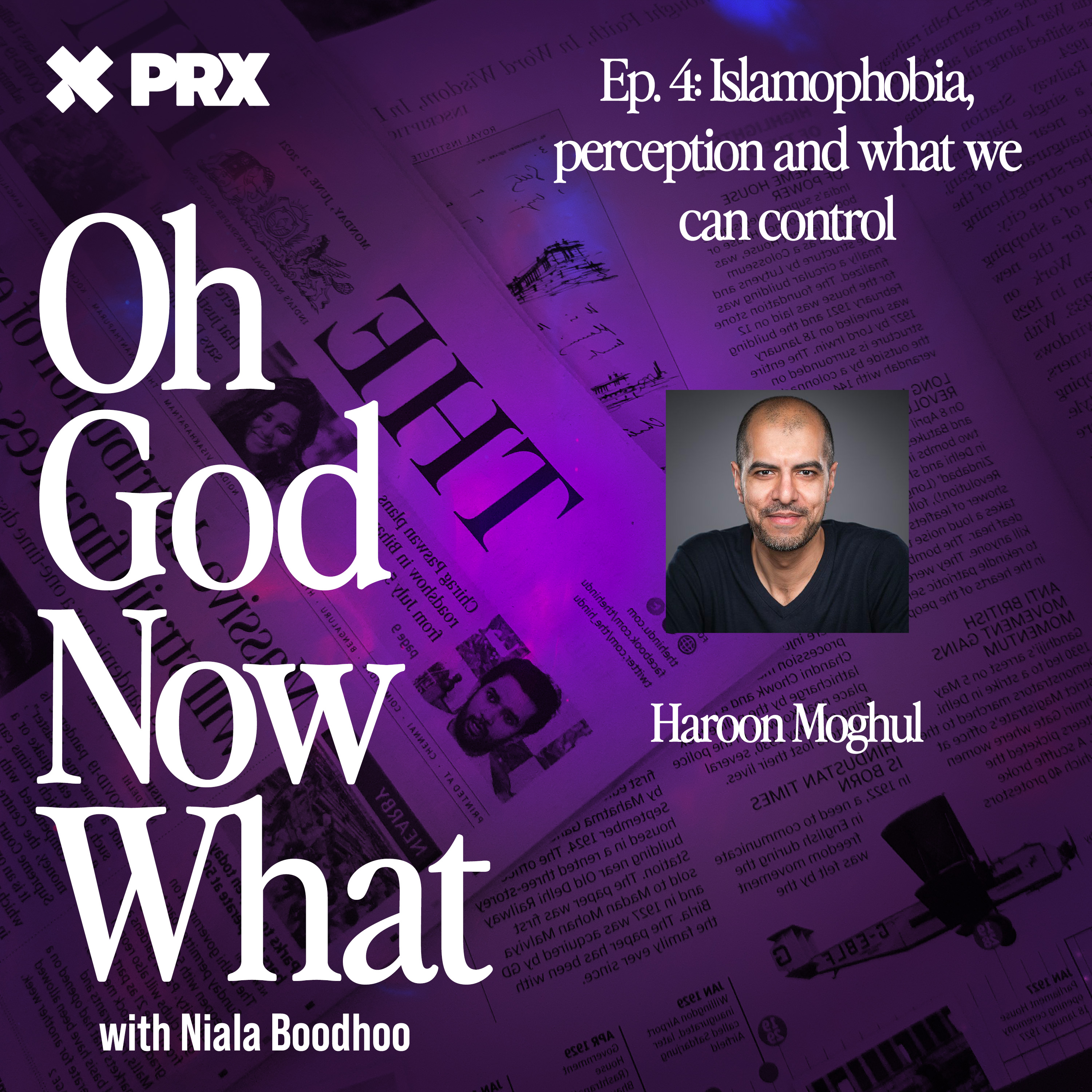
Speaker 1Hi, I'm Naila Boodoo. Welcome to Oh God, Now What? Almost 25 years ago, the September 11th attacks changed America and the world. I was starting my journalism career here in D.C., and my guest today, Harun Mogul, on September 11, 2001, was head of NYU's Muslim Student Association. He was in class when the towers fell. And well, you're going to hear from him firsthand how his life and career were marked by that day like so many American Muslims, especially those of South Asian descent. He's actually still at a university as the current Muslim chaplain at Xavier University in Cincinnati, where he also teaches, and he's co-host of the Avenue M podcast. And I invited him today because I wanted to talk about and hear Muslim spiritual wisdom from Harun about how he lived through not just that moment, but this current political moment, a time when we have Texas Governor Greg Abbott spending a lot of time talking about and legislating against Muslim Americans. But it's also, at the same time, we have the first Muslim mayor of the largest city in the country, Zoran Mamdami in New York. It's a political moment where even as we have people in Congress saying things like, this is a direct quote, we need more Islamophobia, not less. We might also still see the first Muslim senator elected this fall. It's also a current moment where many of us are finding that we have to answer for things other people have done in our religion's name. So I'm hoping there's something all of us can take away from this conversation. Harun, welcome to Oh God, Now What? Thanks for being here with me.
Speaker 2Thank you for having me.
Speaker 1So my 9-11 story is that it was the beginning of my journalism career. And I was literally in the Senate press gallery trying to get my press credentials on September 11th, when you actually still walk into like the Rotunda area to like get your press credentials. And the woman was like, something happened in New York. And I was like, yeah, my cab driver said that. And she's like, yeah, maybe you should come back tomorrow. And then I went on my way to the Reuters Bureau. And everything happened. I feel like for the young people listening, like, I feel like it's kind of like as a kid growing up, when people talk about like JFK being assassinated, like my parents could tell me every single moment. And I feel like 9-11 is that where I could tell you 25 years later, every single moment of that day. Can you share your moments of that day?
Speaker 2The first thing I heard was the first thing I saw, which was getting out of the subway, coming down to NYU. campus, and one of the two towers was on fire. And I asked someone just out loud what happened. There might have been an expletive in there. But I asked what happened. And someone said a plane had flown into the tower. And my imagination proposed that it was a small passenger plane, like a private plane. And it was a horrific, terrible, purely accidental accident. And so as bad as that was, I was going to go to class because I was probably going to be late for class. And so I got to class. Class was in the basement of the Kevorkian Center, New York University, from which, outside of which, you could see the towers. They were actually a landmark. You could orient yourself with the tower. But if you could see the towers, you would automatically know which direction you were going in or were supposed to go in. And then early during the class, one of the students in our major, Middle Eastern Studies, came downstairs, just poked his head into the room and said, I don't know what's going on. I don't know what's going on. And I was like, I don't know. I don't know. I don't know. I don't know. I don't know. I don't know. I don't know. And that's when we started a piece together that obviously this was not an accident, that something intentional and awful was happening. And it took me only a few more minutes to realize that I was president of the Muslim Students Association at NYU, which we call the Islamic Center at New York University. And I think, unfortunately for us, as young Muslims coming of age in New York City, we're not going to be able to do that. We're not going to be able to do that. Thinking about all the things mosques didn't have, we were deeply frustrated by mosques that made themselves inaccessible. So we had gone out of our way to produce a website, to plaster our email everywhere, to connect with different communities, to make it very easy to find us, to join us, to be part of our community, to say that there's different paths in and we're not trying to judge anyone. We want to welcome everyone. And perversely, that meant that after that day, when anyone in the world and everyone in the world was looking for, a Muslim voice to talk to, they usually found us because we were the easiest to find. And unlike a lot of mosques, we were a student-run mosque. So we were a lot more social and outgoing than perhaps, let's say, a mosque of recent immigrants or folks who just don't have the time, the bandwidth, right? That's literally, that was our bread and butter. That was our extracurricular activity. And so it was a very strange day because it was a combination of feeling like we were all in this together. And so it was a very strange day because it was a combination of feeling like we were all attacked because we were, but that we were exempt from any sympathy or any consideration, that we weren't allowed to say that we too were afraid, that we too felt that we had been, we'd been attacked. We'd been, our world had been overturned, just like anyone else's, just like as you had said.
Speaker 1Yeah. I'm sure this is like also a very kind of painful memory. Do you remember the moment whenever that person came in and said like, the second tower has been hit? Did you think automatically then like, terrorist? Did you think automatically then like, the second tower has been hit? And then like, uh-oh, what if they're Muslim?
Speaker 2It was thought for me in part. I was in Persian class and our Persian teacher took a minute when he processed what had been said. And then he said something that I have not forgotten clearly, and I doubt I ever will forget. He said, if you are Middle Eastern or Muslim or confused for either or both, stay in the room. And that was a strange thing for him to say in the moment. And I didn't, I didn't fully follow. Wow. He was actually a refugee. From the Islamic Republic of Iran, he had fled. He was a political refugee. He had actually been singled out by the Shah's regime and then by the Islamic Republican regime. And so kind of, you know, it had a pretty tough go of it and ended up in the U.S. and was a brilliant Persian teacher. And once the few students in the room who were not so described had left, he said, listen, I don't know what happened, but I'm pretty sure I know that there will be a lot of people out there who will think that you had something to do with it. If I were you, I would get home to your dorm, to your apartment, wherever it might be, and probably lay low for a while just to be safe. And if you don't have a way to get anywhere, let me know.
Speaker 1Did you think he's overreacting?
Speaker 2As soon as we got out of the building, we could see the sky filled with smoke, and it was absolutely surreal. And people kept saying this is like a movie because, of course, the only time we ever see anything like that is in a movie. And so the scale of what had happened was obviously beyond anything we could have conceived. And then there was a rumor mill, right? So we were told within the first hour or two that car bombs were going off in cities across the country, that other skyscrapers in other cities had also been hit. There was no way to really get a handle on what was happening in the immediate. So obviously, your mind goes to the worst places or is tempted at least to the worst places.
Speaker 1Right, it's like pre-social media, right?
Speaker 2Yeah, yeah, exactly.
Speaker 1And I remember, I'm sure it was the same thing. It's the same for you. Like in D.C., my family couldn't get a hold of me because the phone lines were just like, the phone networks were overwhelmed. So did you go home? Like, what did you do?
Speaker 2So I have vignettes of the day. And one was, we congregated near Washington Square Park, and I saw some friends and we tried to figure out what to do. I lived on the Upper East Side, which was very far. The subways had been shut down. There was no reasonable way one could walk that far. It didn't also feel like the right thing to do. I mean, it probably didn't feel safe, right?
Speaker 1Like, did you feel like that was sort of the confusion of the day, at least in D.C.? People were like, get off the streets, you know?
Speaker 2Yeah, yeah. No one knew what to do. And at some point, I met up with a friend of mine who is on the board of the Islamic Center. And we said, maybe we should make our prayer space into a meeting point and make sure there's someone there to check in on everyone if anyone needs anything, just see how people are doing. And we did. And then eventually, campus was shut down. It was shut down for several days. And we were like, oh, we're going to do this. We're going to do this. I spent most of that day between our prayer space and a friend's dorm. And that's where, when we got to the dorm, that's where we watched the news and saw what had actually happened. So, like you said, we didn't have access.
Speaker 1Yeah. I feel like it was like one of the most surreal moments of my life. I was working for Reuters, and I had to walk from, I was based at the Securities and Exchange Commission. I had to walk across to the main bureau. And I remember being told, I'm going to do this or what to do. And he said, I don't know. And I thought that was like one of the weirdest things. But can I go back to, can you just share sort of like how you ended up president of the Muslim Student Association?
Speaker 2Yeah, I joined the Islamic Center at New York University, first and foremost, because I was looking for people to hang out with. The week that I got to campus, my freshman year, fall 1998, one of the first people I met was a fellow Muslim student. Because NYU, for those who are listening, don't know, New York University does not have a campus. It is a massive university. It's a sprawling university, but it's kind of like skyscraper, office building, NYU. coffee shop, skyscraper, NYU office building. So at the time, especially, it was very hard to just find people and have a feeling of campus if you didn't belong to some kind of club or student association. Otherwise, you just get lost in a crowd. And I had come from a very small town where, on the one hand, I was very used to small numbers of people. But on the other hand, very much wanted to be in a place where I could find more people like myself. I thought I was a unicorn, for lack of a better term. When I was growing up, I think, where I was growing up, I think there were only one or two other Muslim students my age, like around high school age. And when you're growing up, these certain things take on this huge valence, like, oh, they don't listen to the same music as me, or they don't wear the same clothes as me, or they're a year and a half older than me. And those become like chasms you cannot cross or wouldn't even want to dare cross. And so if people weren't like me, then who was I going to befriend? And I found at the Islamic Center a group of people. Not that different from myself. There were a lot of other Muslim kids from small towns across America, and we had pretty similar interests. And it was a nice feeling. And over time, I found I was really good at building campus life, planning events, building alliances with other clubs, relationships. And we grew almost exponentially because there were all these other kids who felt like they didn't know where they belonged. And so we had a tagline, what a great Muslim community should feel like. And that was your tagline? That was our tagline.
Speaker 1What a great Muslim community should feel like. Yeah. Were you religious?
Speaker 2So the sad fact of it is, is that I lost the chance to figure out my own relationship to religion because after that day, after that Tuesday, I felt like I had to be a public voice. And how could I negotiate my own relationship to my religion when it felt like the world was falling apart? I just went into some kind of emergency mode. I had planned to be a very good Desi boy. And have a nice, stable, middle-class life and live in the suburbs and have nothing to do with media, with all due respect, to you and to me. And to not go into fields that, frankly, I had no precedent for, I had no mentors in, if not for what happened that day. And I think that's, to me, that's the rupture because as much as I enjoy the work I was doing, I never wanted that to be a national thing. I never wanted that to involve media. I just wanted to build a fun community. That was pretty much it. And then the whole world came knocking. And because of my family background, because I knew a lot about Islam, because I was a Middle Eastern studies major, I was better equipped than most students my age to answer those questions. I was not emotionally or psychologically equipped, though.
Speaker 1So I just want to go back to what you said about not being able to figure out your own religion. What was happening then?
Speaker 2So what's interesting to me, there's been a surge in Islamophobia, as you noted, in the last few years. And I think that's a big part of it. It feels very familiar. And so it feels very frustrating, because I haven't felt this kind of anti-Muslim animus in America for many years. But if I go back to that year, the first months after September 11th, there was anger, but there was also curiosity, there were questions, but there was no narrative that had taken hold. I think the narrative of civilizational war of endless war of a 24 seven state of emergency that did not take hold for many months after until until maybe the run up to the Iraq war. And I would argue that some of that had to do with trying to sell the Iraq war to make a link between two things that weren't actually connected, you had to create a civilizational threat, as opposed to, there is a terrorist group, they are dangerous, they are bad, but they are not representative of 2 billion people. And they are not an existential threat to the West, right. And so I think that initially, the work just felt like explanatory, like I would get up in front of people and answer questions, Islam 101. And then over some months after the initial panic and intensity, when things seemed like they were going back to normal, I noticed a shift. And then it felt like I was playing defense. And then at some point, I felt like we were on the verge of something catastrophic as a country, that we were talking about policies and approaches that I was sure would be very bad for our country. And yet, what could I do as a kid in his 20s with no institutional support, no real sense of what he's doing? I should just go talk to everyone and tell them why this is bad.
Speaker 1What was it like in your head, where you weren't even sure how you felt about your own religion, and then you sort of became a spokesperson for it?
Speaker 2Where do you think my hair went? It's good. Well, I'm laughing, you're not laughing.
Speaker 1I feel like I should point out.
Speaker 2I think in my head, and now that I look back on it, it makes sense. But I also have no idea why it made sense. I told myself I wanted to build a Muslim community for people like me who felt left out. But I still felt left out. Because I had not done the work myself. And to be a young American Muslim then was particularly fraught, because we were building our own institutions, because the models that many of our elders had created, some of which were great, didn't necessarily speak to us, and certainly weren't sufficient for us to be a Muslim. And so I was like, okay, I'm going to who we were before 9-11, let alone what happened after 9-11. So you're asking a 21, 22-year-old with no real life experience, who's not been able to ask hard questions, who's never had a reckoning with religion, to be like, go out there and do the work.
Speaker 1You write about this in your memoir, How to Be a Muslim, an American Story.
Speaker 2I proposed How to Be an American, a Muslim Story, but they felt it wouldn't sell as well.
Speaker 1What a surprise.
Speaker 2It did sell better, though. So who am I to say?
Speaker 1And I mean, there's so much you write about in that book, just frankly, how tough life was for you then. When you look back now, what do you think is important to share for us to know?
Speaker 2Religion is a very powerful force. And it can do a lot of good in people's lives, but it can cause a lot of harm. And one of the reasons I do the work that I do now, I spend a lot of time working with high schoolers and college students, I separately from my work at Xavier, which is a Jesuit Catholic university, I also run what's called a halakha, like a study circle. And I think in many ways, their experience is a lot easier than mine, because there's just a lot more kids. And if I look back on it, the thing that actually hit me is, I think that if I had spent more time with people my age, I probably would have avoided a lot of this too, because I had a very solitary childhood. I spent a lot of time with books. And my parents, and very well-intentioned, they were great parents, but they're immigrants, they didn't really understand. As far as they saw it, it was just your grades that mattered. And I think if I had had a slightly more social, normal childhood, I probably would have developed a little bit more of an ability to deal with other people and with myself in a more healthy and kind of normal way. But I think it's really about every religion has points at which it can be exploited or misunderstood. And when you're in a situation where you're in a situation where you're and we have to be very mindful of those and correct for those. And that's what I spent a lot of time thinking about now, for myself, first of all, but also for the work I do as a teacher, as a professor.
Speaker 1How did you get from being the spokesperson to being the person who's now helping? You're the person who you wanted to have 25 years ago. How did that happen?
Speaker 2This is an answer no one has ever given you before. Dubai. Because what happens in Dubai does not stay in Dubai. And I don't know that anyone has. I did not think you were going to say Dubai. Nobody has ever had a spiritual epiphany in Dubai until I did. And then after that, they stopped that. They just banned it. That was a terrible thing to say. But that's the perversity of it. I want to acknowledge that because it is a police state. And it's not a place where you would think a person would find any kind of enlightenment. But it was because of that that I did. Religion is very strictly controlled there. To the extent that, basically, the same sermon is given in every mosque on Friday. Because they're all prepared
Speaker 1in advance. Who decides that?
Speaker 2They have a Ministry of Religious Affairs, just like a lot of Muslim majority countries. And so things are vetted. And they will say, you know, in their defense that their societies are afraid of extremism. They are very pluralistic societies. If they want to run a city-state where I think, what, 80, 90% of the population is not Emirati, obviously, you'd have to take great care. So I'm not trying to turn this into a kind of black or white scenario. I'm just saying, you know, it's a very pluralistic society. It's a very pluralistic I'm flagging something because it was very counterintuitive. And I didn't know it going into it. Basically, my health fell apart in my early 30s. I was in and out of hospitals. I was doing really badly. I had to leave my doctorate. I left my job. Marriage fell apart. It was a pretty tough few years. Yeah, it was not how I anticipated my 30s going. And my brother was living in Dubai. And he said to me, why don't you come out here for a while? Why don't you spend some time here? It'll be good for you. And I said, yeah, I'll come out here for a while. And I'll just choose one moment because it's there's a lot there. But I went to a mosque on Friday. And I walked in and nobody had any idea who I was. And it was the most liberating feeling in the world. And then I realized that I mean, thanks to geopolitics and all kinds of things. Nobody needs to fundraise for the mosques in Dubai. They've got more than enough money. So effectively, it was like public infrastructure, I didn't even have to pay taxes for. And the reason it was so important to me was because I was a Muslim. I was a Muslim. I was a Muslim. I was a was like, I could just go in there and talk to God. I didn't have to be a face. I didn't have to answer questions. I didn't have to think about, you know, who's in, who's out, who's on the board, who has access to the space. And again, those questions are necessary, but there's times when you just need to talk to God. And so I could go into a mosque and sit there for an hour or two, perfectly undisturbed. And the amount of reflection that proceeds from that is formidable. I ended up joining a Sufi tariqa, what you would call Sufism, or particularly take on Islam, which I did for several years. And I think that was very healing for me and very important for me. Eventually, I left for certain reasons. But those years kind of gave me space to rebuild myself.
Speaker 1As you're talking, I'm just thinking about when I went into the Grand Mosque in Abu Dhabi, like the part that they let visitors go to, and just like the beautiful writing on the wall. And I'm just wondering, when you said, like, you were there and you were talking to God, were there specific passages? Were there specific things that you feel like there was like, that light bulb started coming on? Or what was it? Where did that healing start?
Speaker 2Sure. So part of it was getting to spend Ramadan in Dubai. And I had not really ever spent Ramadan in a Muslim-majority society, or at least a society where Islam is the default religious tradition. So that was fascinating, because I could go to the mosque, and you had some of the best Qur'an. And I could go to the mosque, and you had some of the best Qur'an. And I experienced a kind of faith I had never experienced before, that I didn't know was possible. What I had often experienced before that was a surface level faith. So Islam does have a strong tradition of formal outward practice. So very similar to the Jewish tradition in key respects, right? Like, how you pray is very specifically prescribed. When you pray, what you say, what you're supposed to wear. And that can become, instead of the start of the journey, the end of the journey. And I had never taken it any farther, in part because, and to just be as charitable as possible to those who taught me the religion, most Muslims in the world are refugees from their own civilization. Because of the brutality of colonialism, we pick at only pieces of what our religious tradition once was. And so I remember, there's seven verses of the Qur'an. It's the opening chapter. Fatiha literally means the opening. It's the first chapter of the Qur'an. It's sort of like the Lord's Prayer, for those who are familiar with it. And I remember, I was in a small mosque. And I was like, I'm going to pray. I'm going to pray for Ramadan in a quiet corner of Dubai. Nothing like the Grand Mosque of Abu Dhabi.
Speaker 1Yeah, which is like, as I was saying that, I was like, it's like the most expensive, beautiful mosque in the world.
Speaker 2Yeah, like if you showed someone the mosque now, they'd think it's AI. Like, who actually would have made that, right? It's kind of wild, right? Most people do not pray in those mosques. And I remember the imam, you know, he recites the first verse, which says, all praise is due to God, Lord of the worlds. And he just stopped. And he started praising God. As if he had forgotten we were even in the room with him. And so if you've seen Muslim prayer, it's sort of, you know, you have an imam at the very front, someone who's leading the prayer, and then people are lined up behind him. And, you know, we move in sync. And he was just on another plane of existence. We were just kind of along for the ride. And I thought it was amazing that he turned the Quran into an actual living text in the course of his prayer. That every time he read something, and obviously it helped that he spoke and understood Arabic, he would, like, reflect on it. But not in the sense of, you know, not in the sense of someone who is reflecting on something very emphatically and performatively. It's as if it had hit him the first time. And, you know, there was another night a few weeks later where they had brought in a famous reciter, and he gave this extended supplication in prayer, like a dua, where you call on God. And I had never heard anyone call on God like that before. And he just kept saying this thing over and over again, that you brought us from non-existence into existence. And then he would just start crying. Like, he was crying. He was just talking to God, and we had the privilege of being in the room for the conversation. And that hit me so hard because, to me, what he was saying was, there's a moment in many people's lives, especially maybe when we're younger, where we ask, like, why me? Why this? And he just kind of hit the nail with the Muslim hammer, right, so to speak. Like, he answered that question with the answer Islam proposes, which is, it wasn't supposed to be your choice. You don't get to ask, why me? You're supposed to be asking, what do you want from me? That existence is not a choice anyone has, right? Like, I didn't choose my name. I didn't choose my ethnicity. I didn't choose what I was going to look like. And I'm not saying those things are not important, but they are not the ground on which we build our identity, nor are they what determines our destiny. And so he was having his own. I was having this conversation with him. And when it was over, I remember looking at my brother like, what just happened? There's thousands of people here. I have no idea what their stories are. And I've been so stuck in my head. But maybe part of the reason religion is communal and embodied is because maybe no one's supposed to be in their head all that much. To an extent, and I know I'm saying this as someone who's teaching philosophy at Xavier, but, you know, within reason, sometimes you just kind of need to get a hold of yourself. Get out of your head.
Speaker 1Is that what you say to your students now?
Speaker 2I mean, I wouldn't say get out of your head. That's a little bit harsh. I can be mean to myself, right? But what I would say is that if we don't have commitments outside ourselves, commitments that we can't shake and can't break, whatever that might be, heck, have a cat, right? The cat doesn't really care how you're feeling. The cat needs to be fed. You have to have commitments that you cannot break and cannot shake because with those and through those, you can't shake. With those, we build ourselves. I think that the Muslim take is not so much that you just find yourself, but you find and make yourself. And self-construction is an ongoing, persistent process. It's not something that happens once and then is done. There's a lot of maintenance.
Speaker 3Stay with us. We'll be right back. Chutzpah is back with brand new episodes starting September 9th. We're talking about aliens, therapy, and how to show up as your authentic self during this year's high holidays. That's Chutzpah, Real Life Lived Better from PRX with Rabbi Shira Stutman and me, Hannah Rosen. Follow and subscribe so you don't miss a thing.
Speaker 1So would you say one of the big commitments or one of your major formations now is that I'm thinking particularly of the idea of Islamophobia, the fact that you are constantly being asked to answer for 2 billion people, extremist behavior, all of those things. Does it come from what you were saying about existence? Like, I did not choose this. I just have to move through it. And that's my responsibility?
Speaker 2I don't want to frame it like that exactly because I'm worried that that might sound a little cynical, maybe. I think that's the moment when it hit me that this is what it is, what you want to make from it. And then a lot of work had to follow. When it comes to Islamophobia, I have three things that I want to say on this. The first is, I hope people can understand how painful and infuriating it was to be on the receiving end of Islamophobia. Like myself and tens of thousands of people around the country protested against the Iraq war. We said, this is going to be a disaster. And sure enough, it was a disaster. And one of the disastrous outcomes was ISIS. And then we were blamed for ISIS. And I was like, hey, excuse me. We were here saying, don't do this. Why is it my fault? That was the first moment. The second was, after that, I had this reckoning with activism in my own mind where I said, maybe street protest doesn't work. Maybe we need more. And I jumped into policy spaces. I did more media engagement, that kind of thing. And I remember working at a think tank in DC on the question of the Iran deal. And we actually gamed out what would happen if there were no Iran deal. And every scenario that we came up with was absolutely terrible. And mind you, in every scenario we constructed or pursued, the interlocutors on the American side were, shall we say, more committed and informed civil servants, not drawing any particular contrast to any other administration. Nudge, nudge, wink, wink. But then it was like, well, you know, now it's come back, this Islamophobia, right? That this is the reason America has problems. And it's like, no, this is not the reason America has problems. Actually, I think Islamophobia is, and I know this is a bold claim to make, one of the most harmful forces in America in the last 20-some years. For all Americans, not just for Muslims. For Muslims as well, obviously, and particularly. But think about how many trillions of dollars and how many years of war have gone into conflicts that were fueled by bigotry and a refusal to see complexity. And imagine where else those resources could have gone. So that's the second point. And the third point is a more religious and uplifting one, which is there's an Islamic concept called amanah, a trust. That we don't really own anything, including ourselves. Everything we have is an amanah, a trust from God. It's a verse, I believe, in Surah Baqarah in the second chapter of the Quran, to the effect of make not your own hands the source of your own destruction. Meaning that what you have control over your hands, what you have in front of you, you can do things. Don't do things that destroy yourself. Do things, rather, that build yourself. That leave good in the world for those after you. In fact, the very word for faith in Islam is iman, which comes from the word imanah, the word the words are related. Faith is a trust. And that is a beautiful thing because the all-powerful creator of everything, somewhere outside of time and space, decided that you and I would exist and decided when and where and how we would exist. And that is God's decision, not our own. And so it is not something to get through. It is something to cherish. God chose for me to be born in America. America is also an imana. It is something that we have been entrusted with. And when you're entrusted with property, what you're saying is you know that at some point you will have to pass this on to someone. It is not really yours. Just like my life is not really mine. I didn't choose to exist and I'm not going to choose how I leave the world. I have no idea how that'll happen. But while I'm here, I have to protect and cherish it.
Speaker 1So is it trust? Is it responsibility?
Speaker 2Yeah. It's a trust. It's a responsibility. It's something that's been vouchsafed to you. It's a gift. It's a loan. However you want to see it. The way I would look at it is imagine if someone says to you, hey, I'm on vacation for a few months. Can you watch my house? And you would take care of that house. But the house is your life. And that's what that imam in Dubai was saying that you brought us from non-existence into existence. And in that case, I was chosen to be Harun, born to Pakistani parents in New England. And so, yes, I should be proud of and embrace that because that's what was chosen for me. But other people had other identities chosen for them. My identity is not better than someone else's. It's important because it was decided from on high. And so that's how I look at the question of patriotism is that part of my response to Islamophobia is I don't want to respond anymore in this gotcha kind of way. I mean, that can be kind of fun from time to time. It feeds the ego a little bit. It feels good when you're tired and bored and frustrated. What's the gotcha?
Speaker 1What is the gotcha?
Speaker 2So Governor Abbott a few days ago called ablution stations in Dallas airport like the Washington stations. Yeah, the foot washing stations for you to prepare before you pray. He called them like whites only bathrooms. And I was like, really? Like the fun thing about American Islamophobia is is as wrong as you could possibly be. Like it's not an analogy to something that has nothing to do with anything. Governor Abbott is saying that this is like racial apartheid. Mind you, 10 to 30 percent of the enslaved Africans who were brought here against their will were Muslim and were not allowed to be Muslim. So you drew on that history to make the opposite of Islamophobia. Do you even know what you're saying? Also, has anyone ever stopped Governor Abbott from washing his feet in an ablution station? I highly doubt it. There's no sign any like it. I mean, just it's preposterous, right? So there is a part of you.
Speaker 1So that wants to be like answer to Governor Abbott. What if you were talking to Governor Abbott now? Like what would be the actual what what was the answer you feel like you should do?
Speaker 2The answer I feel I should do? No, no, no.
Speaker 1Well, you feel like you should do the gotcha. But what's the answer that you write? I wouldn't respond directly.
Speaker 2And I mean that 100 percent. I'm tired of responding directly. I don't want to fight on that ground. I would rather say, hey, what do you want for the future of America? Do you think the policies you line up with and support are going to leave our country better off? Can you really look everyone in the eye in Texas and say this is working for us? Do you feel like it's a good place to leave our country to be picking fights with everyone in the world and doing nothing to prepare for what we see coming? You know, like that that's an Amana. An Amana is, it's like if you have a kid, right? You have to think about the kid now, but you also have to think about the kid in 10, 20, 30 years. And so I feel like what I like about a Mamdani and an Abdullah Sayyed is not necessarily a specific policy. It's that they choose to respond to hate with a message of let's build a better country for each and everyone. And I think that is a deeply religious and deeply Muslim message. Islam doesn't prescribe how you should do that. One might come up with a different solution. Have some shared ends. And to me, religiously, those ends are sanctioned by God.
Speaker 1Arun, unfortunately, I think your experience having to answer for your religion is something that's actually applicable to a lot of other traditions now, to Christians, to American Jews. Just wonder what your thoughts are about that.
Speaker 2So one of the things I often tell my students is that we cannot let our faith be defined by Islamophobia. Neither do we let it get defined by those who demonstrate clear hostility and bigotry towards us, but also that we can't let that be the place where we stop. That our focus becomes responding to the bigotry as opposed to a larger moral vision. So I had a friend who is a rabbi in Washington, D.C. who once said, speaking about anti-Semitism, said, do you think that the bigotry your community faces would change if the circumstances of your community changed? And I said something along the lines of, well, given everything that's happening in the Muslim world, it gets picked on, people focus on failed states or political upheaval, and they extrapolate from there to make a judgment about all Muslims. And he said, look at my community. Do you think that if your community were prospering in the United States across the board, would the bigotry stop? Or would there still be bigotry, just with a different explanation for itself? And that, to me, is a very important question. And I think that's a very important point, and it sits with me for two reasons. One is because what he was trying to say is that he wanted his community to focus on what it means to be Jewish independently of how people perceive him or perceive them as a community. And I tell my students that all the time, and actually that point has been made many times over. One of the reasons for the current surge in Islamophobia in America, I think it's a very deliberate attempt to undermine certain political candidates. But the fact that those candidates are prominent proves that the country has changed. So, it's not a simple story. We are not the community we were 20 years ago. We've got Aisha Wahab, who just won a special election in California for Eric Sawolsi. We've got Sorhan Mandani. We've got Abdullah Sayyed, right? We've got Yemeni coffee in every city in America. Those cultural and political achievements, that prominence, will also promote a backlash. And so, the question is then, if you've defined yourself by the backlash, who will you be, if the backlash recedes, or when the backlash recedes? And if the story we tell ourselves is that we as a community are always discriminated against, how do you explain what we're seeing
Speaker 1right now? I'm just curious what you are hearing from your students. I mean, you're in Ohio. What are they coming to you and saying in the realm of what we've been talking about here?
Speaker 2In terms of the Islamophobia, what's very interesting among Muslim students is that they are the problem. They're the product of 20-some years of dealing with this, whether directly or indirectly. They're kind of just tired of it. They're not intimidated. They're not moved by it. And one of the interesting things about working on a college campus is you realize how old you are, but then it also makes you more nimble, intellectually, right? Because you're forced to reckon with things you don't understand. Okay, so do you remember at the end of the World Cup when Spain beat Argentina and a fight broke out? Yeah. And they held up the sign
Speaker 1about the Falklands War.
Speaker 2Yeah. So, leaving aside the Falklands War, Lamin Yamal was on his knees praying. And I think that for me, it's so weird, even now, to see so much prominence given to certain Muslims in certain spaces. In the UFC world, in the World Cup, in the NBA, there's a lot more cultural reference points that invoke Islam, right? Like, Mamdani is a Jew. He's a Muslim. He's a Muslim. He's a Muslim. He's a genuinely popular politician. And to me, I still look at that as, wow, look at how much things have changed. Whereas to someone who's 15, 20, 25, that's not a change. It's just their world. So, I don't think Islamophobia lands the same way. Because when I walk into a Xavier classroom, none of my students are Muslim, by the way. I teach philosophy courses. And I reference Lamin Yamal. They all know who I'm talking about. It's not a mystery to them. And so, I think that the frustrations I hear about Islamophobia, I think that they're not the same. And I think that they're not the same. And I think that they're aren't necessarily specific to Islamophobia. They're a feeling that they have been let down. That the people in charge are not treating the world like it is an amanah. So, like, our youngest, our son and I watched Independence Day over the summer. We make it a point to watch some, like, classic movies. It's one of my favorite movies. Right? It's a great achievement of Western civilization. I love that it's, like, my favorite presidential speech. Right? Oh, okay. So, perfect. Today, we celebrate our Independence Day. But it's not as cool. And we will remember, the 4th of July will be not for Americans. It's not an American holiday. For the world. For the world. Yeah. Oh, trust me. When the world stood up and said, we will not go quietly. Yeah, I think it's great. Yeah, it was great. Right? So, then I asked him, what'd you think? And he's like, it's a little unrealistic. And I was like, yeah, well, like, obviously, right? It's about aliens. And he's like, no, no, not the aliens. He's like, I know it's a sci-fi movie. And he rolled his eyes. Right? Because it's not a sentence if there's not an eye roll. And then he said, who would ever believe a president could be that young? And I was like, oh, damn. He doesn't look at the presidency as an office for people who care, or even who have competency. Do you see what I mean?
Speaker 1I mean, that's terrible.
Speaker 2So, like, why would he think Islamophobia is a special or unique concern? The larger problem is, like, look who's in charge.
Speaker 1But I think that jadedness, which I will say I see in, like, the 20-somethings in my family. They're gonna be so mad that I said that on this podcast. Great. It's okay.
Speaker 2Do they listen to the podcast? There's the question.
Speaker 1I think that jadedness is kind of an all-age thing now. There's so much despair. And it's just become like so normalized yeah what other things do you turn to to kind of overcome that yeah
Speaker 2so i i would push back a little that i think that a lot of the young folks i work with are not quite as jaded as i had initially expected i think they are frustrated i think they are let down but i see in some of these young candidates a kind of collective eye roll in a good way that we're really not interested in responding to these arguments so we understand a diversionary tactic when we see one or hear one i think that this generation trained and honed on social media is far more sophisticated and not in the least intimidated by these narratives which is why i thought it was very interesting when abdul el sayyed did that interview on fox news to jesse waters right and they kind of sparred back and forth and even jesse water at the end was kind of like i kind of like him right because i think he actually got jesse
Speaker 1water so like it was a we'll put a link in the show notes i feel like it's 20 minutes everyone
Speaker 2should watch yes but what i i think what he appreciated and and now i'm speaking through the mind of jesse waters which i never thought i would do so thank you for this podcast but what i thought was interesting is that i think he appreciated that he was not interested in becoming a punching bag and he refused the terms of the conversation
Speaker 1he refused the narrative so what lessons you think then the older people like us should be taking from younger people about
Speaker 2narratives we're all going to die and i mean that in a very profound and spiritual way not not in a depressive or negative way that the mark of a good life i think as a parent is god willing that those kids will be able to live lives of their own long after i'm gone that's what a job of a parent is and the job of a citizen is not really that different to take care of a country so that it can continue thriving long after you're gone i think the problem is that we have created a culture that does not believe in the importance of facing death and preparing for it and i don't mean facing death in the sense of giving up hope but rather clarifying like i don't have the energy a 20 year old has i don't i'm not supposed to i have a certain amount of time in this world i have certain things to do and i want to do them and i'm doing a lot of things and i'm doing a lot like hamdulillah i'm very happy for that but in the back of my mind i have to think am i making plans to live forever i mean imagine how gone we are as a culture when someone is in their late 70s and thinks now is the time to become president that that strikes me as someone who does not believe that life is an amana
Speaker 1this podcast is coming out the week before yes the anniversary you are actually going to be giving a sermon in your local mosque on on september
Speaker 211th it is on september 11th because that's friday yeah as we're thinking
Speaker 1about this idea of reframing the narrative right like we started this conversation with you saying because of your actual 9-11 experience like you didn't actually get to be like what is islam that was taken away from you what are you saying now what do you want us to know about what islam is and then what are you going to be saying to people on this
Speaker 2anniversary so on on the anniversary itself i want to talk a little bit about how many of us experienced that day or the after effects of that day and to mark and to recognize that but the congregation the mosque asked me specifically to reflect in the last 25 years and so i want to make three points one is that patriotism is consistent with our faith that our country is an amana and that no matter what people say to us we are still responsible for what is in our care and in our power and in our responsibility that's one point the next point is when we become defensive and talk about what islam is not then we are not actually spending any time with what islam is and the third point is the point that answers your other question and there's a concept in in physics that i think is called hysteresis it's not that different from a feedback loop and what i want to point out is that and this sounds trite in the moment actions have consequences but i i don't mean in a trivial way when i was young i had a crisis of faith i lost my faith and i remember when i thought to myself god doesn't exist i winced as if i would be struck down by a bolt of lightning because that is of course naturally what happens when you when you doubt your faith right and needless to say there was no lightning strike directly on my person and i might have immediately concluded from that that making a mistake is a mistake
Speaker 1because god doesn't exist sorry that's
Speaker 2because because right because
Speaker 1particularly on the show
Speaker 2although the the funny thing is as i'm telling the story i realized that our house was actually hit by lightning many times so maybe it was sort of an indirect note but but the reason i'm bringing that up is because sometimes people think that moral laws have consequences akin to physical laws they do but they don't have immediate consequences morality is like the climate you can pump up the climate and you can pump up the climate and you can pump up the climate and you can pump CO2 into the atmosphere for decades and not notice anything but it's there and it's making a difference not in a way that people should make a difference and then one day you will feel those consequences and even then if you cease the activity the consequences remain right like if we switch to a fully let's say renewables economy globally today we would still have climate change to deal with right the problem would not be more bad but it is the same lesson that i think we as americans need to reflect on is that what we are doing right now to our country and in the name of our country has consequences it is not a game and we may think that it's not a big deal because i don't feel anything immediately that it's still raining and snowing and sunny the stock market is going up life is normal but that's not how morality works and i think the lesson of islam is that you have to submit yourself to certain norms and norms that are going to affect you and that's what i'm trying to do i'm trying to practice consistently every day not just because they keep you in the presence of god and a consciousness of something higher and more beautiful but because who you are at the end of that process is not who you were at the beginning that actions accumulated do have consequences a person who chooses to spend every day with people they might not be familiar with will inevitably be a different kind of person years down the road a person who is willing to look himself or herself in the mirror and say was that the right thing to do every day is not going to be the same person and it may not happen overnight but it does happen that that god works slowly and faith works slowly and it's meant to and what i would like to leave the congregation with and i suppose the audience is we might not be able to control what other people are doing and accumulating in our american atmosphere but we have more control than we realize over ourselves and our communities so what are we going to do haroon
Speaker 1thank you so much and obviously we want you to come back and talk about other things that don't have to be about islamophobia so i hope you'll do that
Speaker 2thank you i would like that haroon mogul is a muslim chaplain and
Speaker 1also teaches at xavier university in cincinnati he's also a host of the avenue m podcast and if you want to hear more he and i are actually going to be in conversation with a couple of other folks from religion news service on september 9th reflecting about this 25th anniversary and what it means in the face of islamophobia it's free and if you want to register we'll put that link in the show notes you can join us live or listen to a recording later i'm nyla budu you can find oh god now what on substack where you can join the conversation around each episode get bonus behind the scenes and also be in conversation with other people who are listening to the podcast oh god now what is a co-production of prx productions glad you're here and rhyme media our production team is nick minoni robin lynn genevieve sponsler sandra lopez monsalve and edwin ochoa the executive producer at rhyme media is dan bobcoth and at prx productions it's dan bobcoth and at prx productions it's dan bobcoth and at prx productions it's jocelyn gonzalez our theme music is by hansdale she oh god now what is made possible by the john templeton foundation
 PodcastTranscript AI