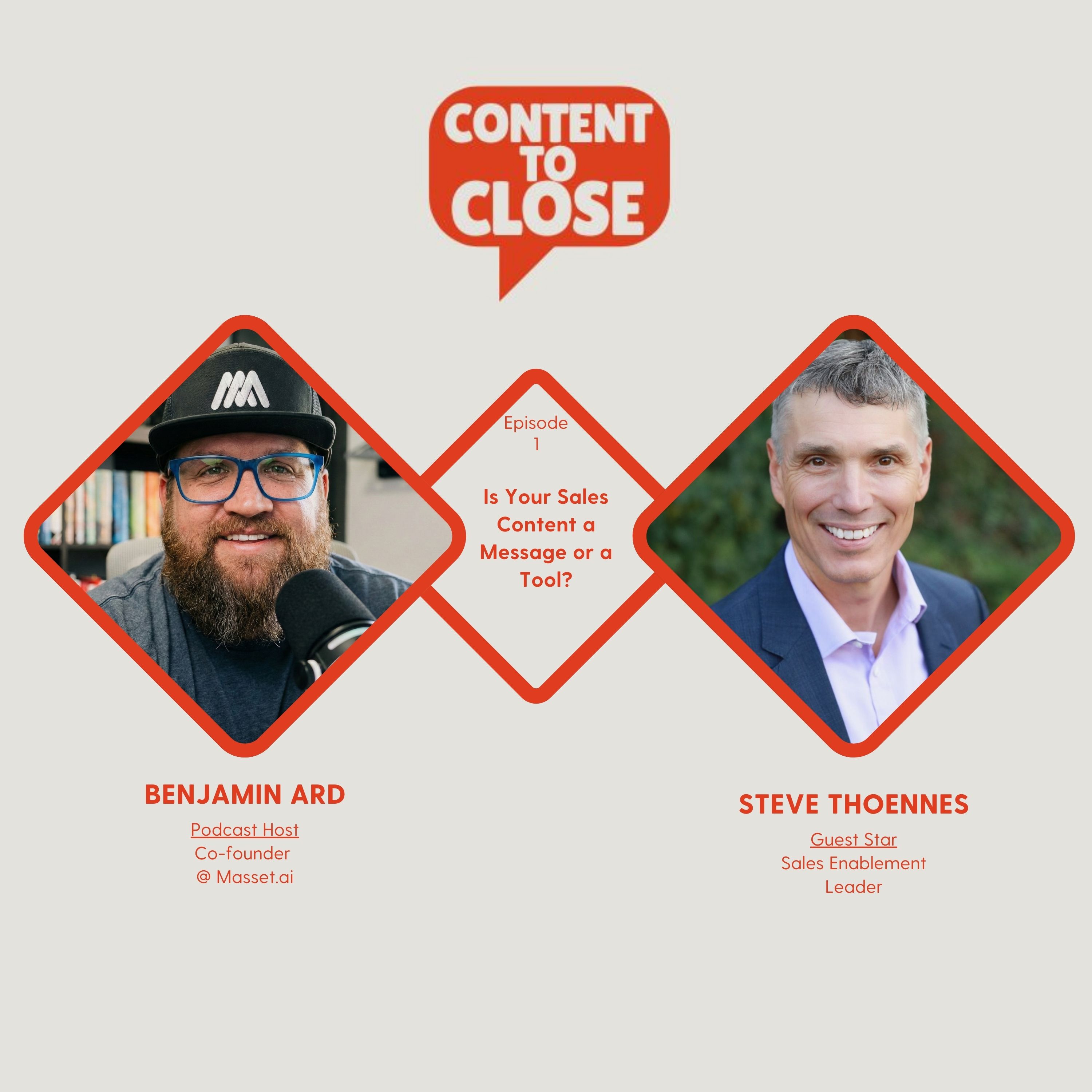
In this podcast episode, Steve shares his journey from psychology and technical support to sales enablement, emphasizing the importance of turning company content into practical tools for sales teams. He outlines a three-part enablement framework: content as actionable assets, clear communication, and engaging training. Steve stresses that content should be designed like a tool—such as a snow blower—to help salespeople efficiently drive conversations, with a focus on discovery questions and competitive insights. Collaboration with product and marketing teams is essential to ensure content is relevant and not overwhelming, while training should be interactive to keep participants engaged. A key takeaway is to "don't sell to sales," instead empowering them with balanced resources that build confidence in customer interactions, as illustrated by an example of reframing a Magic Quadrant announcement into a consultative discussion tool. Steve advocates for understanding sales needs deeply and fostering a culture of practical, collaborative enablement.
[Music] Welcome to our very first episode of Content to Close. This is exciting. Steve, thank you for joining us today, the very first guest on our podcast. Hey, super glad to be here and thanks for the invitation. Love it. Steve, well, I'm excited to dive in. The whole premise for Content to Close is sales enablement leaders teaching us how they use content to enable sales teams and organizations to use content to close more deals. Steve, I'm excited for you to have this conversation and really let the audience get to know who you are and all sorts of good stuff. So to kick things off, let's get to know you. Tell us a little about yourself, your career, all that kind of fun stuff so the audience can get to know you. All right, hey, thanks for that. And when you first reach out to me and asking me about it, just really kind of reawakes into all my passion about this topic. So super glad to be here. My career has kind of had three different phases and I got out of school at the degree in psychology and started in technical support. Did the 10,000 calls with end-user customers and enterprise customers and moved into leadership and in the day of big viruses, cybersecurity, viruses taking down enterprises and figuring out how to get them back up and running. Got asked to start up a sales engineering team that would be like inside-based and a phone of friend for the field as well as the inside sellers. That team ultimately grew from seven to 60. And part of something special, a really cool culture that we had that helped drive a lot of sales and a lot of great customer interactions and did so in a really streamlined way, but also did connection. And it was actually in a training that one of my SEs was doing for this group, kind of early career specialists. They're supposed to focus on driving businesses as product line. And this was the 34 training that they'd had in 10 months and they still weren't getting it. And my SE great presentation skills. You have a good presentation. There were 15 people on their own and I was just observing it and I could tell they were tuned out, checked out, mostly. And this ended up kind of kicking me off with working with some other peers and we came up with this training on how people learn and how we can do better training and help people learn with adult learning principles and that pivoted into a career and sales enablement. And I've done a variety of different roles in that globally based teams and everything and it's a passion point in an area where I really love kind of the technology, marrying the teamwork and really trying to figure out like what's the key thing that matters most to the sales people and ultimately to the customers. I love that. That's amazing. Steve, I'm excited to have you on this episode. It's going to be great. So the focus for today is how to turn company content into real tools for sales. So Steve, to start to kick this off, when you look at a new release or a campaign or an MQ result, how do you start translating it into something a salesperson can actually use? Yeah. A full, good question. Well, so first of all, the product management teams and the product marketing teams that they've just done such a ton of work to be able to to bring that release or that magic quadrant or whatever to to result. So good honor for that. But ultimately, enabling sales, they get tasked with that because they're bringing expertise, but it isn't their primary job and they don't always have time to really focus on it. I love working with the product management and the PMM teams on that and kind of translating and orchestrating that side of it. I love that. Often when we have content, sometimes it can be overwhelming, right? We're working with sales reps or trying to provide what we need. You're training them. There's all sorts of stuff going on. How do you kind of know the threshold? How do you know when they're drowning in it? What's the right? Now, how do you do that and manage it? Yeah. Well, I guess on the first side of it is like, I kind of think of enablement being three main parts, one of them's like content. Like, what are the tools and assets I've given you? Next one is communications that making sure sales knows that there's a new thing or what they need to know about it. They don't just need a training on it. They just need good communications and then there's also the training and enablement of the practice sort of thing. So that's one lens to look through. The other thing is when we think about, hey, we have this new message we're going to take out to the market. Or maybe it's like a this new release and here are the three cool new features that we need to tell customers about. I like to look through the eyes of the salespeople and actually bring in some of my salespeople I've talked to and run things past them and find out like, how are you going to use this? How does this show up in your conversations with customers and partners? And I think of that content is also a tool. So you live in the Salt Lake area, you get lots of snow. It snows outside, you got to go clear the drier by your walkway. How do you do it? I pull out my trusty snow blower. That's a that's a tried and true tool that I use all the time. Okay, I love it. So the snow blower, it's a tool that helps you do work more efficiently and effectively. It's dubtailed for that. So when we're looking at that release that comes out that that's ultimately a tool that we need to look at it from the salespeople, what conversations does it help them create? What are some discovery questions that it evokes? What are new opportunities that can potentially do? And then once we understand that, we can back into what what do they need? What are the assets they need for that release? Certainly on LinkedIn posts they can share. Is there an email? Is there a little signature file? Do they need that list of discovery questions? Do they need to also know how that plays with the competition? And hey, we're actually just catching up. Or is this actually a cool new thing more of an advancing? I love that. That's so cool. So as you're working with these individual groups, there's obviously like the other side of the equation. You've got the the PMs PMs and all of them that are actually generating content that are really close to the product and releases. How do you collaborate with that side of the house so that when you get content? I love and I love how you look at this as like a tool versus a message or just content. How do you work with them so they're producing tools? Things that actually accomplish something versus just content or messages? Yeah. Gosh, that's a great question. So I think there's one aspect to think about is, you know, the bomb, the build the materials and getting some good agreement in advance from the sales teams, what they need. And then from the marketing and PM teams about what they're going to deliver on release based on tier and those kinds of things. So like, let's start there. That's that's that's the good place to go. And the next thing is in working with the product management that typically when there's something big, we bring them on to trainings. And I oftentimes tell them like sometimes you all are the worst possible presenter for this because you know too much. The depth of conversation you have with customers, you're brought in because you're the specialist goes too deep. How do we hit the level that a sales person needs? So there are two approaches that I've found hope with this. One is what do you want them to know? What do you want them to feel? And what do you want them to do? So when we're planning with the product teams, we start off with the no field and that at least starts to shape how we spend our time in the agenda. And I'd like to say this next thing that we made more progress on because it's really difficult that let's say we're doing an hour long internal training. It's over, zoom, people are going to tune out a little bit sadly, but there's so many things we need to tell them about that we just wire owes it. Ideally, if we can just go back to how we all like to learn. So while we like to learn from each other, two, we like the opportunity to take an information, digest and put it back out there. And so we really try and bake in time in those to find out, to ask the question, hey, this release is coming out. Everybody type in the chat. How do you see leveraging this with your customers or pulling out the wins and having them share, hey, how is this successful for you? Or what are your recommendations? Those kinds of things. It really bring in the audience into the training and make it more of a workshop. That's amazing. I love that idea. I have actually never heard of anyone doing that, but I love the idea of let's do the training, but let's get everyone's opinions. Let's get the conversation going. And now you can hear it from the people that you're legitimately sitting next to and look up to that are hitting their numbers and you're like, great, like let's let's start adopting what they're doing. So I love that pure side of the training and all of that. I just want to say like my job and sales in a moment, my very first job is one, keep people awake. Two, keep their attention. Those are the first things that we got to do. Have something that's relevant. That's engaging. Kahoot, Poles, engagement. Those things just keep people paying attention. And then we can hit those little higher order things and like, hey, there's actually information coming at you. And then how do we help them process? So never underestimate, keep them awake. Part of the training. I love that. That's amazing. Well, Steve, I love stories. So I'm curious if you can walk us through any examples or stories that come to mind where you took a big announcement and you really turned that into something that drove really powerful customer conversations. I'm just sure the audience would love to kind of hear some of those experiences firsthand if you don't mind sharing. Yeah, great. We recently had announcement that we were magic quadrant. We were up in the leaders quadrant again. And it was outstanding. And there's ultimately the kind of the marketing message that we're putting out the world, the chest pounding, you know, look at us. We've done it again. That kind of thing. And there were seven other competitors also in the leaders quadrant. Many of them hire an up and to the right than us. So that was a little bit of the bringing the principle of don't sell to sales. That there's this tendency to give them the customer message, which is the chest pound. We're a great, everything's great. But what we also really need to do is to take the step back and make sure that we're arming them for success. So when we say, yeah, we're in the leaders quadrant. And so are they and that help them to answer the, hey, how are we different? And how might the competitor actually be better? You know, it's so they're aware of that. And from that, our PMM, she put together a really nice little objection handling document, a little comparison of that, which I think helped the salespeople. And when we hit the training, we did spend time on like, Hey, you got this new batch of quadrant. How are you going to use it with your customers? And actually, it was one of our leaders in EPJ, who completely kind of flipped things on his end. It's like, this isn't the chest pound. This is more of like the, hey, here's the comparison. We've actually been a leader not only in the MQ, but these two other ones. And we're actually the only one that's done all three of those. And so that was just a new thing that came out during this training that was was a great opportunity that we then cascaded out to the rest of sales. So I like this phrase, don't sell the sales. Like how, how do you avoid this concept? How do you reframe things, provide value? How do you do this the right way? I know you just gave some great examples, but like, I'd love to double click on that content and that concept, because I do think there's just this natural tendency to do it. Maybe a little bit wrong. I'm curious kind of how you've avoided that and how you handle it. I have to say it's, you know, short time frames, especially when there's something big going on. Everybody's at a shortage of time. And so just, you know, pure vulnerability. We don't do a perfect all the time. That's for sure. But I do think it really starts with being super in tune with the sales people, have the phone or friend checking in with them and trying to make sure as we're planning whatever we're putting in front of them that we really have a good sense for what they're needing. And let's be frank, like no one likes to be sold to. So it's that don't sell to sales, but also we just recognizing that we're also can't tell the customers, you know, how do we really focus on if there's kind of one key thing that was the was the mission of my team was to create confidence in the conversation. You have this new MQ or the leader. We want our sales team to be confident having that conversation with customers, knowing the customers have their objections. There's some areas that might lead us to expand some, hey, you're doing this could be at that and ultimately not telling the customers either, but kind of that more of the consulted sale. I love that. Steve, well, these episodes are meant to be quick. So everyone can get back to their busy days. And this is amazing. We have run out of time. But Steve, for everyone who listened today, how are work and they reach out to you to connect with you online? Yeah, go ahead and hit me up on LinkedIn, LinkedIn/in, S-thonus on my last name. Thonus isn't bonus. It's a mispronounced German for you there. But yeah, pick me up on LinkedIn. I'd love to have a conversation. Love it. Well, Steve again, thank you so much for the time and insights today. It has been absolutely amazing. Really do appreciate it. All right. Likewise.
Podcast Summary
Key Points:
Steve's career evolved from psychology and technical support to leading sales engineering teams, eventually pivoting to sales enablement after identifying gaps in training effectiveness.
Effective sales enablement involves three core components
Content should be treated as a tool tailored for sales conversations, focusing on discovery questions, competitive insights, and actionable assets like email templates or LinkedIn posts.
Collaboration with product and marketing teams is crucial to ensure content is practical and aligned with sales needs, avoiding information overload by prioritizing relevance and engagement.
Training sessions should be interactive, incorporating audience participation and real-world examples to maintain engagement and facilitate learning.
A key principle is "don't sell to sales"—enable confidence in customer conversations by providing balanced, consultative tools rather than just promotional messages.
Summary:
In this podcast episode, Steve shares his journey from psychology and technical support to sales enablement, emphasizing the importance of turning company content into practical tools for sales teams. He outlines a three-part enablement framework: content as actionable assets, clear communication, and engaging training. Steve stresses that content should be designed like a tool—such as a snow blower—to help salespeople efficiently drive conversations, with a focus on discovery questions and competitive insights.
Collaboration with product and marketing teams is essential to ensure content is relevant and not overwhelming, while training should be interactive to keep participants engaged. A key takeaway is to "don't sell to sales," instead empowering them with balanced resources that build confidence in customer interactions, as illustrated by an example of reframing a Magic Quadrant announcement into a consultative discussion tool. Steve advocates for understanding sales needs deeply and fostering a culture of practical, collaborative enablement.
FAQs
The podcast focuses on sales enablement leaders teaching how to use content to help sales teams close more deals effectively.
He recommends looking at content through the eyes of salespeople, understanding what conversations it enables, and creating assets like discovery questions, LinkedIn posts, and email templates tailored to their needs.
Enablement consists of content (tools and assets), communications (informing sales about new updates), and training (practicing and applying knowledge).
By focusing on what salespeople need to know, feel, and do, and incorporating interactive elements like polls, chats, and workshops to keep them engaged and facilitate learning.
It means avoiding simply pushing marketing messages to sales teams; instead, arm them with tools and insights to handle customer conversations confidently, including objection handling and competitive comparisons.
By collaborating with sales teams to understand their needs, prioritizing key assets, and designing content as practical tools that support specific customer conversations and discovery processes.
Chat with AI
Loading...
Pro features
Go deeper with this episode
Unlock creator-grade tools that turn any transcript into show notes and subtitle files.
 PodcastTranscript AI