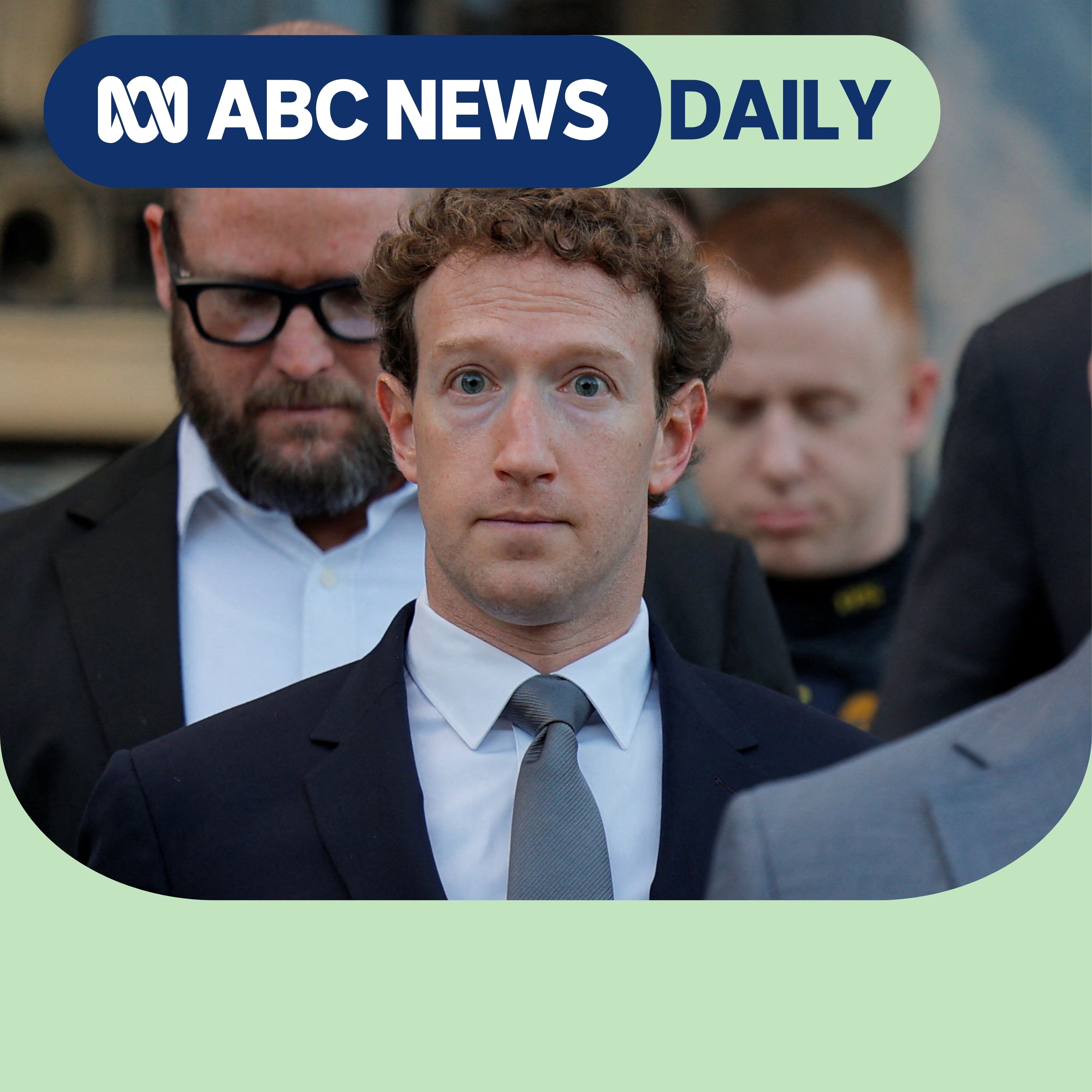
This ABC News Daily episode, hosted by Sam Hawley, examines a major US court case where 29 states are suing Meta, the parent company of Facebook and Instagram, for allegedly designing addictive platforms that harm children. The trial’s star witness, Arturo Behar, a former Meta safety engineer, testified that he raised concerns directly with CEO Mark Zuckerberg over 100 times between 2019 and 2021. Behar’s testimony stems from personal experience: his 14-year-old daughter received unwanted sexual advances and harassment on Instagram, which Meta failed to address despite internal studies showing 1 in 8 teens aged 13–15 experienced such advances weekly. The states’ attorneys argue Meta’s business model relies on "hook, hold, harvest, and hide" tactics—enticing children, keeping them engaged, collecting data, and concealing risks. They seek up to $200 billion in penalties and demand algorithmic changes, such as removing likes and infinite scroll. Meta denies the allegations, calling the case a pursuit of payouts, and has tried to block Behar’s testimony. This trial follows a March case where Meta was first held liable for product design, awarding $8 million to a plaintiff. If Meta loses, it could face fundamental operational changes, potentially influencing global regulations. The trial, expected to last six to eight weeks, may conclude by October, with experts viewing it as a pivotal "big tobacco moment" for the tech industry.
ABC Listen, podcasts, radio, news, music, and more.
Do you ever think that maybe the people making all the important decisions don't have a clue what they're doing?
Stable, stable coins, do you know what a stable coin is?
Does anybody know, please raise your hand.
The obvious solution to war is to have the West having the strongest, most precise, deadly weapons possible.
I'm Matt Bevan, and on my show, if you're listening, we take a look at every terrible decision that led to where we are today.
New episodes every Tuesday and Thursday on ABC Listen, or wherever you get your podcasts.
They're taking on one of the biggest social media empires in the world.
Cusing it of knowingly harming children and getting them hooked on scrolling.
In a landmark US court case, state attorneys are suing Mark Zuckerberg's meta,
company behind Facebook and Instagram, in a case that threatens to upend its business model.
Today, dare occur, tech reporter with the Guardian and the tech industry's big tobacco moment.
I'm Sam Halley on Gadigal Land in Sydney. This is ABC News Daily.
I appear before you today as a dad with first-hand experience of a child who received unwanted sexual advances.
On Instagram, as an expert, with over 20 years of experience, working as a senior leader,
including leading online security for and safety and protection at Facebook.
Dara, we're hearing there from Arturu Beha, who was speaking at a Senate inquiry in the United States back in 2023.
Now, just some context, he started working for Metta's Facebook in Silicon Valley in 2009.
And part of his job was simply to teach users really to be nice to each other, wasn't it? Just tell me about him.
Right. Yeah, he worked at Facebook. This was before it was named Metta in two separate stents.
And yes, the first one he started in 2009, and he worked there until about 2015, and he took a break to focus on his family.
And then he came back right before the pandemic started. And his job kind of changed because he really wanted to focus on young people's experiences on the platform.
And a lot of this was because how he saw his own daughter was being treated during that time off.
As a parent, I took the work personally, and it worked hard to help create a safer environment.
By the time I left in 2015, I felt the work was going in the right direction.
A few years later, my 14-year-old daughter joined Instagram. She and her friends began having awful experiences, including repeated unwanted sexual advances, harassment.
She reported this incidence to the company, and it did nothing.
So he was a safety engineer at Metta, as you say, he had that time off.
And then he realized that things weren't good for his 14-year-old daughter. So just tell me what was happening to her.
Initially, she asked if she could join Instagram before she was of age, which is 13. And he said, no, she had a weight. And so she waited.
And when she finally got on, she's really into cars. And she would have responses that were really misogynistic, what seemed to be online predators reaching out to her.
Okay, so he then really concerned, of course, about what his daughter is subjected to online. He returns to the company. And he says he did raise these concerns directly with the Metta CEO Mark Zuckerberg in 2021.
Metta must be held accountable for their recommendations and for the unwanted sexual advances that Instagram enables. As soon as I understood this gap, I did what I had always done. I researched the problem,
I did it at the numbers and informed Mark Zuckerberg, Cheryl Sandberg and other executives. He raised them throughout his time period. He came back in 2019 and he left in 2021. And throughout that time period, he said he spoke to Mark Zuckerberg at least 100 times.
What we're seeing in court is all these internal emails that he sent to Zuckerberg where he's raising the alarm. He's conducting studies about young people's well-being on the platform and finding that they are having really bad and harmful experiences more often than not.
In a carefully designed survey by Instagram in 2021, we found that one in eight kids, age 13 to 15 years old, experienced unwanted sexual advances in the last seven days.
This is unacceptable and my work has shown that it doesn't need to be this way.
He is now central to this trial in California where a jury will decide whether Metta is guilty of harming children with technology designed to be addictive like cigarettes.
Now he was the first to give evidence, wasn't he? Just tell me about that.
Yes, he's definitely the star witness in this trial and he came off cross really strong. He said that Metta had used this don't ask, don't tell strategy when it came to the safety of children.
So it knew that this was happening here, ledges, but they were hiding it from the public.
In the California and Attorney General Rob Bonta, he's actually leading the case against Metta. He spoke outside the court.
We of course heard from the first witness a whistleblower engineer from Metta who was in charge of child safety while they're who talked about their motto, their culture, if you will, which was to move fast and break things.
Unfortunately, the thing that was broken here was the mental health of our children.
But what were they arguing inside the court? So they're very aligned with their arguments when the lawyers for the state governments open their statements.
They use this pneumonic that said Metta's business can be boiled down to four words at begin with the letter H, which is hook, hold, harvest and hide.
And so what they're saying is that Metta hooks in these young children, they hold them there through these addictive technologies. They harvest their data and then they hide that from the public.
This is about our children, the next generation. Our kids, they deserve to be safe.
And Metta has acted unlawfully here. We are here to hold them accountable. We look forward to continuing our trial and bringing our case forward.
Well, Derek, let's just step back a moment and consider how this case came about and what the complainants are hoping to achieve.
Now there are four lead states in this case, aren't there? And well, billions of dollars at stake.
Right. Yeah. So this is, this is one of actually thousands of cases that have been brought over the last several years, but this one is a very major one.
The other cases we've seen have been brought by individual states. We've seen individual victims, bring cases and families. And we've also seen school districts.
What this one is is 29 states have joined together to sue Metta over these same allegations that it's intentionally creating addictive products to get children on the platform. And that's leading to their harm.
And so these 29 states are working together, but just four of the states are representing the cohort and court, which is California, Colorado, Kentucky and New Jersey.
So you're seeing there too. It's a very bipartisan issue. We have concerned parents from red states and blue states. And so it's really interesting to see this play out.
And they're seeking hundreds of billions of dollars in penalties.
Right. So the kind of the ballpark figure that the attorneys general have said is 200 billion, but that really will be up to the judge and the judge will decide on the financial damages and she'll also decide on other requests that are coming from these states, such as changing how the platform works.
And as I understand, the attorney generals of these states, they'll use internal documents and interviews with current and former staff to show that met a discussed compulsive use of its platforms and how various tools actually contributed to that.
Right. Correct. And as someone who's been covering this and I've covered previous lawsuits, a lot of these documents are similar. So I'm familiar with a bunch of them. There's one where employees are talking about how Instagram is a drug and they say, yeah, we're basically pushers.
There's all these internal surveys and reports that meta did that found that children were being harmed and showed that meta didn't do anything to ameliorate.
rate that. So it's really interesting all of the internal documents that are coming out
in this lawsuit and other lawsuits. So tell me, then, will Mark Zuckerberg himself met
as CEO face questioning during this trial? And what does Metta have to say about these
allegations? Everyone's saying that he is going to testify. We don't have the schedule yet
for the witnesses. So it's kind of wait and see. But Metta is saying that these attorneys
general are not sticking to the facts, and they're not sticking to the law. And then
instead, they're just chasing this big payout. And specifically in the case of Arturo
Brehar, they have filed tons of motions to try and stop him from testifying and trying to
stop any internal documents he was affiliated with from being presented in court. They're
also actively trying to get another inside whistleblower from testifying and the judges yet
to rule on that. Interesting. Okay. And it's worth noting, as you say, there have been
a range of lawsuits of this nature. In March, a woman known as Kaylee, she was actually
awarded $8 million in damages. Pugs and tears outside an LA court as the finding in
a case against big tech was handed down. After more than 40 hours of deliberations, a jury
found Metta and Google were negligent in the design of their platforms. So there has been
success in the courts, hasn't there? Just tell me about that case. Right. That case
was the very first of these thousands of lawsuits that have these very similar allegations
to go to trial. So it was a really groundbreaking case because it was the first time ever that
Metta has been held liable for the design of its products. And what's really different
about these cases are their product liability lawsuits. So what the plaintiffs are alleging
is that there's something wrong with the actual products. It's not the content, like that's
not the problem. It's the products themselves that have been designed to be addictive. It's
very similar with what we saw with the tobacco cases in the 1990s. Yeah. So they're arguing
it's addictive like cigarettes. Yes. Well, this trial is being referred to as the tech
industry's big tobacco moment. What do you think though? Do you think this could be a pivotal
moment for change? I think it's extremely significant, especially because that very first
case with Kayleigh Metta lost on all counts. It was found liable. And so that really set
a precedent for these thousands of other lawsuits to, you know, play out. And this one with
the attorneys general is the biggest of all the lawsuits. If the judge makes a similar
ruling as the last one, Metta could really be forced to change the design of its platform.
What we saw with Kayleigh is under that jurisdiction, which was under California State Court, they
could only award damages. They couldn't make Metta change its platform, but this one since
the federal suit, they're able to demand these changes. And if Metta is forced to change
its algorithm, its algorithm is its lifeblood. And that could really change its business model
and change how its platforms work. If Metta loses, it could be forced to fundamentally
change the way its social media platforms operate. That could include eliminating likes and
the infinite scroll that encourages users to look at new posts.
Well, Dera, of course, this is a case in the United States, but it could not open the
way for similar legal action around the world, including in Australia. I mean, there's
users everywhere who could argue they have been deeply damaged by these algorithms. They've
become addicted to social media to things like Facebook and Instagram.
Right. Yeah. It could open a can of worms and child advocates around the world are looking
to see what happens with these cases. A lot of countries have more strict laws that
govern these technology companies. The United States has extremely relaxed laws. And so
it'll be interesting to see what the jury thinks. And if Metta is found viable, how the
judge decides to find it and if it decides to change its platform.
And so when do we expect to have a result then?
The trial is expected to last six to eight weeks and then there's the jury deliberation
and then the judge will be making the final decision. So we probably won't know until October
at the earliest. These are the conclusions I have come to. One, Metta knows the harm that
kids experienced on their platform and the executives know that their measures fail to address
it. Two, there are actionable steps that Metta could take to address the problem. And
three, they are deciding time and time again to not tackle these issues.
Derek Kerr is a tech reporter with The Guardian. This episode was produced by Alaria Brofi and
Louise Mylon, audio production by Sam Dunn. Our supervising producer is Sydney Pete.
I'm Sam Hawley. Thanks for listening.
Podcast Summary
Key Points:
Arturo Behar, a former Meta safety engineer and whistleblower, testified in a landmark US trial accusing Meta of knowingly harming children through addictive platform designs.
Behar reported unwanted sexual advances and harassment experienced by his daughter on Instagram, and he claims Meta ignored internal warnings, including studies showing 1 in 8 teens faced such advances weekly.
The trial involves 29 US states, led by California, Colorado, Kentucky, and New Jersey, seeking up to $200 billion in penalties and demanding changes to Meta’s algorithms.
Attorneys argue Meta’s business model relies on "hook, hold, harvest, and hide" tactics, comparing the case to the 1990s tobacco lawsuits.
A prior case in March awarded $8 million to a plaintiff, marking the first time Meta was held liable for product design; this federal case could force broader platform changes.
Meta denies the allegations, claiming the states are chasing payouts, and has tried to block Behar’s testimony.
The trial could set a global precedent, with child advocates worldwide watching for potential regulatory or legal shifts.
Summary:
This ABC News Daily episode, hosted by Sam Hawley, examines a major US court case where 29 states are suing Meta, the parent company of Facebook and Instagram, for allegedly designing addictive platforms that harm children. The trial’s star witness, Arturo Behar, a former Meta safety engineer, testified that he raised concerns directly with CEO Mark Zuckerberg over 100 times between 2019 and 2021. Behar’s testimony stems from personal experience: his 14-year-old daughter received unwanted sexual advances and harassment on Instagram, which Meta failed to address despite internal studies showing 1 in 8 teens aged 13–15 experienced such advances weekly.
The states’ attorneys argue Meta’s business model relies on "hook, hold, harvest, and hide" tactics—enticing children, keeping them engaged, collecting data, and concealing risks. They seek up to $200 billion in penalties and demand algorithmic changes, such as removing likes and infinite scroll. Meta denies the allegations, calling the case a pursuit of payouts, and has tried to block Behar’s testimony.
This trial follows a March case where Meta was first held liable for product design, awarding $8 million to a plaintiff. If Meta loses, it could face fundamental operational changes, potentially influencing global regulations. The trial, expected to last six to eight weeks, may conclude by October, with experts viewing it as a pivotal "big tobacco moment" for the tech industry.
FAQs
Meta is accused of knowingly designing addictive features in Facebook and Instagram that harm children, similar to the tobacco industry's tactics.
Arturo Béjar is a former Meta safety engineer and whistleblower who testified that Meta ignored internal reports of child harm, including his own daughter's experiences on Instagram.
29 states have joined together to sue Meta, with California, Colorado, Kentucky, and New Jersey representing the group in court.
The attorneys general have suggested a ballpark figure of $200 billion in penalties, though the final amount will be decided by the judge.
The trial is compared to 1990s tobacco cases because it treats Meta's products as intentionally addictive, and a prior case already held Meta liable for product design.
Yes, if Meta loses, the judge could demand changes like eliminating likes and infinite scroll, which are core to its business model.
Chat with AI
Loading...
Pro features
Go deeper with this episode
Unlock creator-grade tools that turn any transcript into show notes and subtitle files.
 PodcastTranscript AI