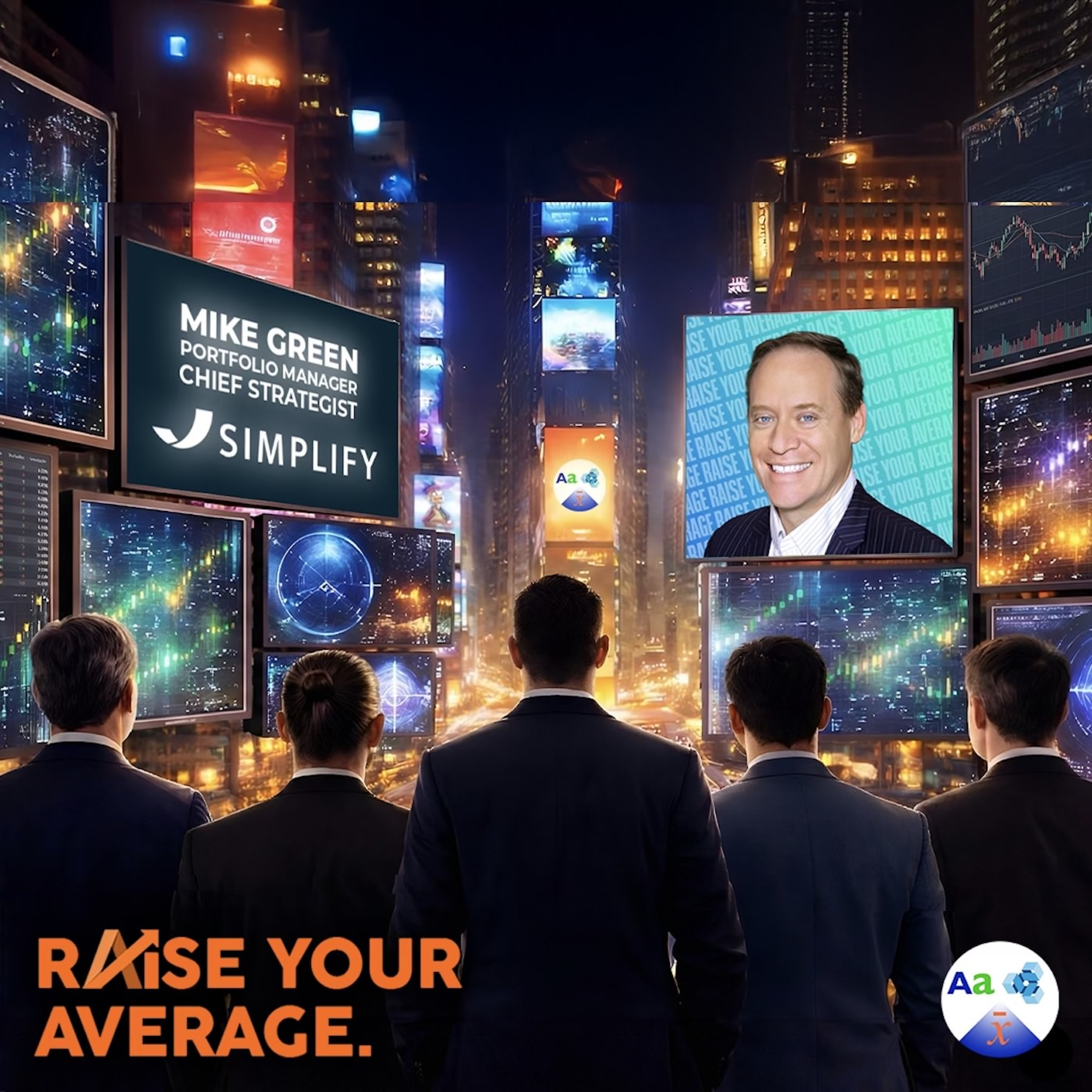
Is the Biggest Investing Solution Becoming the Market's Biggest Problem?
86m 17s
The conversation centers on Michael Green’s thesis that passive investing has fundamentally broken market pricing mechanisms. Over the past 15 years, trillions have flowed into index funds that mechanically buy the largest stocks, regardless of valuation, while active managers and short sellers—who once questioned prices—have been defunded and marginalized. This structural tide has overwhelmed fundamental factors, decoupling markets from economic reality. In 2026, global equities sit at all-time highs despite severe geopolitical and economic shocks, because a relentless wall of passive capital must be absorbed, pushing prices up irrespective of fundamentals. Green highlights that ETF inflows, especially the shift from mutual funds to ETFs, lower market elasticity, as instant execution forces immediate purchases. Leveraged sector ETFs add procyclicality, with daily rebalancing creating volatility and depressed correlation, masking risk. He draws parallels to the 2000 dot-com bubble, noting circular earnings from vendor financing, where tech giants finance customer purchases of compute, inflating profits. Additionally, GDP growth is overstated by flawed intellectual property investment assumptions, while consumer strength is illusory, evidenced by rising credit card debt and a collapsed savings rate. Green argues the economy is materially weaker than headlines suggest, and the passive phenomenon is entering its end stages, with distortions worsening and market behavior increasingly inconsistent with history. His decade-old warnings, once dismissed, now appear prescient, explaining today’s market anomalies.
I'm pure daily. I'm at a butler. This is raise your average. Here's a question nobody in finance likes to ask out loud. What if the market stopped working? Not crashed, not corrected, but stopped doing the one thing it's supposed to do. Figure out what things are worth. In the last 15 years, trillions of dollars have moved into index funds that buy automatically, mechanically, with no opinion about value whatsoever. Every paycheck, every 401k contribution, every RSP contribution goes into the biggest stocks, making them bigger, giving them a bigger claim on the next dollar in. Nobody is asking whether the price is right and the people whose job it was to ask that question, the active managers, the short sellers, the contrarians have been defunded, benchmark chained and when they showed up anyway, run over. Meanwhile, the real economy is showing cracks, the headline numbers are designed to hide, jobs data that counts door-sign-ups as new businesses, private credit defaults dressed up as liability management exercises, young people being quietly crushed by student loans and by now pay later debt landing at the same time. The market goes up, the fundamentals say something else, and the mechanism that used to reconcile the two has been quietly removed. Today's guess called this over a decade ago, his predictions were dismissed as far-fetched, his blow-up scenario was called "fatuous", the disentanglement of passive's effects was called "impossible". The research has now done all three. Our guest is Michael Green, Chief Investments Strategist at Simplify Asset Management. My green is Chief Strategist and Portfolio Manager at Simplify Asset Management, but I don't think that credits him with the breadth and depth of experience that he's going to bring to this conversation. You know, he writes the "yes, I give a fig, substack, which I look forward to every week, he comes out every Sunday and covers a huge variety of different topics, but Tenza Centauron, policy themes, macro themes, invest in positioning, and the topic that he's been focused on as a personal passion, as you mentioned, for the last 10 years, passive flows and their impact on markets and on policy and retirement and how they generally corrupt the private economy in a wide variety of ways that don't get critically examined very often for a variety of reasons. So, I mean, the challenge with this conversation candidly, I know Mike is a friend and have had many conversations with him over the years and so the challenge is always which part of Mike's vast knowledge base do we want to explore today, right? I know it's a good plan and I'm really excited. I am too. Mike has been really sort of an eye opener for those who care to listen and you know, one of the things that, you know, I think before even meeting Mike the first time, now I think five, six years ago, was hearing about his track record and his career. The things, you know, the things he has accomplished and the places he's been and you know, the things he's done, even even, you know, right down to I think one of the most sort of prescient things that he called was the dislocation of Volma Gedan. Right, you know, and among other things, that's just that's just one of many. I mean, you know, his history goes back, goes back 20 years, but what we're talking about right now is something he's been actually working on for at least a decade. And it's really controversial. I find it fascinating and if you stop and think about it, it actually makes an enormous amount of sense. You know, whichever camp you're in. Yeah, definitely. What people don't realize too is that Mike started his career under Peter Teal and worked at Peter Teal's. Right. That's right. I mean, I didn't even mention that, you know, for several years. And I know that to some extent, conversations and debates with Peter have informed his thinking in a variety of ways, not that he agrees with Peter on all points, not even close, but just having those kinds of conversations and forcing him to forge his own opinions in a highly, you know, high pressure environment, I think, has a very unique mind. And I think that that's a product obviously of his genetics, but also of his formative years in the business. Yeah, I mean, he's one of the most, you know, he's one of the most rigorous and unconventional thinkers in macro and market structure working today. But yeah, but that's just putting it modally. I think I think when when folks actually tune in to what, you know, Mike has to say, it's, I mean, it's astonishing. It's astonishing to me. I find his, his view and the amount of work he's done on digging into this topic and trying to either prove it or disprove it, because in that way, you know, Michael has really a scientist's mind in terms of of the way he looks at it. If the, if in the end, he's, he proves himself wrong, he'd be willing to accept it. That's the thing. I think that people don't realize is that, is that if someone came along with a better argument and could prove it, and then he tore that apart and realized, you know, there was a mistake in my thinking, he would actually call himself out. Well, it's one of these discoveries or, or feces that you really hope is wrong, you know, yeah, it has all kinds of negative implications. And so, you, while intellectually, you know, you, you come up with a thesis, it becomes your baby, and it's hard to not look for for confirming evidence while being, while remaining open to disconfirming evidence, it's, it's something that eventually you hope to discover was a false alarm, but it's becoming increasingly clear that it's, it's not that it's a real phenomenon and it's getting worse. And it's starting to feel like it's explaining a lot of the behavior of the market today, because I think a lot of, a lot of practitioners, a lot of participants, allocators are often lately, at least, been scratching their heads, wondering, you know, the market's not behaving in a manner that is consistent with history. So when, when people are left scratching their heads, they, they will go looking for the answers. This is Raise Your Average, dedicated to making you a better long-term investor. Join us as we sit down with some of the most interesting names and finance to discuss macro markets, investment strategies, and more. Michael, welcome. It is terrific to have you on the show. Thank you very much. We're glad to be here. Really looking forward to our conversation today. Michael, let's start with where the world actually is right now. You come into mid-20026, having navigated the U.S. Iran conflict, closing of the straits of Hormuz, a 30 to 40 percent oil shock, fuel riots, general strikes, and global equities are sitting at all-time highs. That's a sentence that shouldn't make sense. So walk us through what's really happening underneath because your read is that the headline picture is badly misleading. Yeah, I think, unfortunately, that we can't really just look at it as 2026. We have to think about this in the context of a much broader theme that has been in place. I would argue now for going on almost 50 years, which is this general idea that everybody should be invested in the stock market in one form or another. This period basically started with the death of equities headline in the business week that's famously from 1980. Now it ends with the alternative, which is all equities all the time, and if equities aren't enough, we'll go into levered variants of equities because those provide slightly more excitement. When you start talking about all the things that are going wrong in the world, the one thing that is going right is that unemployment remains relatively low. Employment remains relatively high. Participation in 401(k) accounts, IRA accounts, and a growing participation in defied contribution around the world is sending a wall of money into US equity markets. It has to be absorbed in one form or another, that it is coming through in a passive vehicle that has no judgment as it relates.
to where valuation should be cash as an alternate asset, alternate assets as alternate assets, means that they have to go up. It's just a solution to a supply and demand equation. And so we have seen somewhere in the neighborhood of a trillion dollars worth of inflows into ETFs. I would estimate about half of that is coming from mutual funds. The process of converting from a mutual fund to an ETF actually slightly raises the elasticity, inelasticity of the market or lowers the elasticity of the market even further, because part of the calculus that you have to enter into is the periodicity of which the orders are placed. Mutual funds are placed over a one day period and averaged into the close at the end of the day. ETFs are instant execution. So an order comes through if it is a net surplus in terms of demand, then ultimately shares have to be created and the underlying securities have to be purchased at that moment. So we've raised the elasticity or decrease the elasticity of the market and create a conditions under which that flow of capital is more than enough to offset almost everything that has been thrown at it. So I think the broad thesis, Mike, is that there's a lot of fundamental factors that under different structural circumstances you might expect to represent tailwinds to equity prices. But the broader structural tide is so overwhelming, right? This consistent wall of systematic funds that flow into markets are so overwhelming that the vast majority of the time it's not useful to discuss what's going on in the broad macro economy or even really what's going on at the level of corporate fundamentals that markets have largely become disconnected from the forces that most analysts historically might look at in order to figure out how to price the individual equities in the market as a whole, right? Would you say that that's right? I think that's correct, but I would put it into a broader category, right? So if you were to go to work for one of the pod shops in millennium or Valleas, Ne etc, what you would very rapidly find is they have no interest in fundamentals or valuation as an argument because the catalyst is not in valuation. The catalyst that is creative evaluation is people deciding it's cheap and choosing to buy it more aggressively. As those members of our population have diminished because they have underperformed, they've been redeemed, they've experienced adverse outcomes in terms of portfolio performance that's created conditions under which a growing fraction of the market simply does not care. That is the passive bid and it rewards market capitalization. It directs flows on the basis of that component. I want to be very clear here. There are vehicles that are conceived of as passive, things like a triple levered SOX ETF, for example. That is in no way passive, right? That is a sectoral allocation. It is a decision to lend or to invest in a particular sector on some basis, whether it's momentum, whether it is earnings, whether it is this is the future and the addressable market is unbelievably large and the cyclicality is gone. Those are discretionary choices. The fact that we are levering that in the form of an ETF actually does have a significant impact. Importantly because many of the companies in indices like that overlap with the largest stocks in the S&P 500 or the NASDAQ 100, we're seeing a compounding effect. It's basically getting hit with both barrels of a gun as compared to only getting shot once. You're unlikely to survive the double barrel blast or in the case of momentum, you're likely to go skyward. That I think unfortunately is really what's happening here. It sends the signal to me that we have entered the end stages and stages. I want to be very clear on that. Of this passive phenomenon, we're seeing two things. One, the increasing sense from people that, oh, I get it, it's all about AI or it's all about large cap or it's all about X. It doesn't really seem to matter what it is, but once they start directing flows into a subset, particularly into vehicles like leverity ETFs, that effectively just consume capital. The volatility drag associated with something like a 3X-levard variant to something with 60% implied volatility is that it needs a 100% plus annual gain in the underlying to break even. That's an astonishingly bad long-term investment. And people crowd into these types of strategies and there's actually some evidence that they're being used thoughtfully by professional investors for various forms of wall harvesting. But just to be clear, those are not permanent funds and they are creating distortions that would argue are similar to what happened in the 99 to early 2000 time period in which people suddenly said about the internet, oh, I get it. Let's just put it with Monday Net Net or let's put it with Ryan Jacobs of the Jacob's Internet fund or Kathy Wood of the ARC complex as we saw in 2021. She reserved beneficiary in 1999 as well and so that's ham for Bernstein. So we saw a component of that and it looked very, very similarly this time it's happening in some of the largest market cap companies and we do see evidence that it is redirecting flow in fairly material ways. The work I do tier one is research from I'm associated with as a special advisor and we're working on some research and insights on that. But what we're finding is that the daily rebalancings and things like the Soxil which has an endogenous liquidity feature to it. If it moves significantly in either direction, it has to lever or de-lever creating flow without any transactions by the end investor. Those are currently dominating what we're seeing in terms of volatility in terms of the low levels of correlation because these securities have an external influence that is not directly tied to the flows that the rest of the market is receiving. And in some ways those flows are actually counter to what we're seeing in the overall market because people have decided, well I don't want to buy the S&P, I want to buy the Sox and if I buy the semiconductor Sox, why not get it in three times levered form? So we are seeing this have a huge impact but I would argue that it's showing up right now largely in the volatility that is being created in the vehicles tied to these levered ETFs and the extraordinarily low levels of correlation which depresses index volatility and creates the perception that there is no risk out there. Yeah, there's this prosyclical element to these leveraged sector ETFs as you describe where if they go up a lot in a day, they actually have a reliever by more notwithstanding whether new units were created, right? So it injects this prosyclicality, it exacerbates the prosyclicality of the market especially when the sectors that are getting the most leveraged flows are also the same as the sectors that have the largest weight in the cap weighted indices, right? So you've got this sort of multi-dimensional feedback loop. You you invoked the the 2000 kind of bubble experience and I've had all three of us are old enough to remember that having lived through it, right? Fairly vividly and and you know this just has so many characteristics of that of that bubble qualitatively but also you know I'm just wondering whether as a bit of a sidebar what you're thinking is on the circular funding nature of the of the earnings environment at the moment and the fact that you know 50 billion dollars of mag seven earnings in the in the last quarter came from the appreciation of yeah of ownership and in in companies that they that they then vendor finance to buy their compute it said like what are your general thoughts on all that? I think it was very similar and I've drawn the direct analogy obviously to Cisco's vendor financing in the late 1990s the narrative was the exact same Cisco is the real company they're selling tools to you know the the mining equipment to the miners by the by the vendor of mining equipment don't buy the miners because they're inherently uncertain in terms of their outlook. The problem of course was that Cisco's extraordinary earnings margins etc which pale in comparison to the levels that we see today from any of the semiconductor companies and memory companies were being created by financing activities now it's not as bad in the memory sector there I think you largely just have a hugely cyclical component in which I would emphasize that China has very clearly declared that they're coming for that market you know there's there's not a long history of industries that have stood up against China's onslaught in terms of capacity so I find this a little bit humorous I think it's a species forecast that semiconductors have solved their cyclicality but they at least are being driven by demand because once you buy an overpriced GPU and contract to build an overpriced data center you might as well buy the overpriced memory to go along with it it's a little bit like a pocket square and a finely designed suit right you you don't need all of it but man would it really finish it off and
You know that that I think unfortunately is kind of what's going on is that we have this Complementing component or complimentary component where GPUs are being financed data centers are being put into shadow of vehicles and financed As you know effectively SPB's many of which are variable interest entities that if there's failure to take the contracts Ultimately it falls back on to the parent itself and so it really should be considered as debt on the parent balance sheet But it's not all of these factors are compounding right now to create extraordinary growth and then it is exacerbated By the way that we actually report GDP in the United States the primary driver of GDP growth is now what's called investment in intellectual property and This is one of these unbelievable shenanigans that you know as you know I am an anti-conspiracy theorist They generally think people want to do their job go home and kiss their wife and hug their kids They aren't you know Rubbing their hands together to figure out how to deprive their their neighbors of you know 0.2% on CPI reimbursement But when the government calculates investment in intellectual property what it assumes is The profitability is constant and any increase in profit margins must be the result of almost an an astrophysics Since the dark matter of intellectual property they literally assume it cannot be market power And so if profits expand investment must have expanded and That's a huge chunk of the investment that we're actually seeing. It's not real money It's effectively a multiplier that is being put on the R&D spend that is coming from these companies and their anti-competitive activities So you know, I think the economy is significantly and materially weaker than the headlines suggest I find it ironic that people quote Retail spending and then point to credit card usage and say gosh look how healthy it is and say wait a second I'll kick up you put put gas bills on their credit cards. This is not healthy This is basically, you know somebody choryling back a donut two steps from the emergency room with a heart attack You know and they don't have a choice because part of what I've highlighted in some of my other work is that expenses Particularly coming out of the avoided expense environment of COVID Have exploded at rates that are far higher than wages have actually risen and this is why we've seen the collapse and the savings rate It's you know, it's it's a very challenging environment I think unfortunately more and more Americans and Canadians feel that they are on the Gaslight side of the equation where they're being told everything's great and They're watching the stock market go up and they're looking at their own balance sheet and saying wait my my money is not Compounding my you know my ability to live is not compounding I go to the grocery store and I have to put things back that I didn't have to put back before This is the real world for most people and gasoline on credit cards. It's just one example of that Yeah, the accounting You've got accounting increasingly abstracted from the reality on the ground, right? And I think like I'm hearing you say that That's true in the corporate center sector through these types of circuit or financing and off-balance sheet type vehicles and and You know definitional games balance sheet games and it's also at the GDP level, right? And so you've got this sort of GDP bubble, but it's an abstraction not reality. You've got this earnings bubble Which is from a gap point is real on paper? Yes, it is it is effectively a forward credit contract that is not you've been properly priced And that's been and there's been Circularly funded between the various players and yeah dad one more level is that most of the financing that's coming out of areas like private credit or out of banks where they're still doing the financing We'll often reference the underlying asset values a little bit like if you check out a mortgage on a house and you put 20% down the bank would say okay You're fine, but if that was a $200,000 house and you put a million dollars down and financed it for five million dollars The bank is still going to take an absolute bet Yeah, and you know despite the fact that you're gonna lose everything you put into it But the key is you had a call option and the bank is short of put and those are very different pay-out functions Yeah, which in the current market means that the the taxpayer is short of put right? Or because you know They're not gonna let the banking sector go under and and all the deposits are guaranteed So we just totally fine because we are told over beginning that the wealthiest 1% pay the majority of taxes So what does the average person have to worry about that's right? That's right. There's gonna be people who are watching this and saying you know how you like How can this be possible right and Then and that's that's one question and then you know the same question is is Really how can this be possible? You know like you're acting like it's never happened before or it's never you know This kind of thing hasn't hasn't occurred before in the past and it has You do have a very specific explanation. I think we've you know We've already sort of touched on it to begin with for why the market behaves the way it does and it has Little to do with fundamentals and nothing to do with momentum in the traditional sense It has everything to do with the plumbing Yeah, I mean, I think that's right and again This is the underlying component of the passive bid and it is part of that 50 year arc 1977 we in 1978. I'm sorry we create the 401k as an extension of the Arissa language That allows companies to shed the responsibility for Defined benefit pension plans but importantly put it on the backs of individuals and There's a variety of impacts of this one of the best papers I've read in a long time is a brand new paper They cannot in February by Coimbra and Gomes It looks at the implications of the shift from defined benefit plans which offer income in retirement that allows you to meet your obligations versus a 401k the fine contribution plan that offers assets that you accumulate and then theoretically other cell or harvest the Interest or dividends associated with them into your to provide income into retirement We've allowed dividend yields to become the demand that creates a significantly larger for a variety of reasons But the most important one being I have no idea how long Pierre is going to live I have no long no idea how long I'm going to live or how Adam is going to long Adam is going to live if I'm building We're insurance portfolios for their retirements. I have to assume the quote-unquote worst and you're going to live to be 110 years old If I'm doing that across a large pool of individuals in the form of a pension plan I can assume the Actuarial outcome and that is some around 86 right so that's a radically lower number than 110 I need far less assets and I need far higher cash flow associated with it that shift drives an outward shift in aggregate demand for financial assets that drives dividend yields all else equal significantly lower and so Unfortunately, we now confront that uncertain retirement length with uncertain expenses and We're confronted with an uncertain cash flow associated with it because the dividend yield has been depressed to such an extraordinary level which is just another way of saying valuations are really high Ultimately, that means that we will almost certainly necessitate selling and I think one of the great irony is of course This is that interest rates have been hiked to the point that the vast majority of households that have saved for their retirement can probably take off most of that risk go into fixed income in various forms and replace the income they would have received from a pension plan um But nobody wants to do it Yeah, I've I've said been saying for a long time that that one of the greatest policy errors of the last 50 years was the privatization of retirement and um, I've I'm sure you've come to similar Numbers, but I've calculated that uh the individual needs to save about 25% more than he would otherwise uh that then the pension What otherwise need to save in order to produce the same level of income at the same probability of You know not depleting the total pool Because we're we're forcing individuals to underwrite their own longevity risk, right and um So I think what what you're saying is that that that translates into higher necessary savings rates and because of the individual preference for for yield producing assets which itself is actually You know, I would I would argue weirdly irrational, but but there is this preference for for dividend yielding or yielding assets over just crystallizing gains even though it's Tax disadvantaged to do that that there's There's larger flows into the sort of dividend sectors, but there's also just larger flows into the markets for saving purposes and that has driven down the earnings yield of the market in other words It's driven up the price of the market
So there's a couple of things you said that I just want to be very clear on. One, when you're seeing a preference for yielding assets or dividend yielding assets, I would suggest that much of, like if that were actually what was really going on, I would be a little bit more enthusiastic about it. Instead, what we're seeing is people largely seek to create synthetic income, like creating low quality corporate bonds. If you think about what a call overriding strategy is, you are capping your upside, you are accepting all the downside in exchange for yield. And that's just a bond, right? Now, it's a bond that also has no contractual terms to it other than whatever the price is at expiration. And so you don't have the ability to claim assets in the event that the company has a materially adverse event. You just take the loss. And that lack of recourse is really what you're receiving a much higher premium for. And the demand for those assets as you're highlighting, Adam, has depressed implied volatility to the point that the compensation associated with it does not appear to offset the risks that they are taking, particularly with high valuations. But it's part of the perverse component that people point to, and they're like, well, there's no debt out there. Well, the minute you enter into a call overriding strategy, you've just actually incurred debt. - Yeah, you have an obligation and you cannot sell your underlying until you've cleared that option contract. And if that option contract goes the exact wrong way, that's what you get to take the loss. - Yep. - Yep, absolutely. So it allows investors to hold onto their stocks, use them to collateralize income strategies, not realizing that what they're doing is selling effective corporate debt to their market. - They're underwriting corporate debt. - Yeah, that's what they're doing. - Without any skill in terms of credit appraisal or anything else. And by the way, I'm not picking on the individual retail investor here. First of all, most of this is done through fund structures. - Yep. - Secondly, it's really critical to understand that even within the credit writing world itself, these types of short cuts are all over the place. It is very easy to write a $10 billion loan against a trillion dollar market cap company. If that trillion dollar market cap company has no cash flow and earnings though, that $10 billion is actually very much at risk. I hate when people do this, but you can't help but do it as we analogize in the manner that we're doing. And I'm thinking about the implications of this stuff. And I said this relatively early on, when SpaceX managed to get the indices to start to change their methodology to drive inclusion into the indices, a lot of people looked at this and said, "Oh, this is obviously the end." Now we've got this huge blow of supply coming in. And I guess the point that I would emphasize is that this feels very much like almost a net scape IPO, almost to kick off to the process. Now could it be compressed and condensed this time around? Absolutely. But with people who look at SpaceX IPO and say, "Oh, it traded off its highs." It's clearly a failed IPO. My reaction to that is just like, "Are you kidding me?" You realize how much capital is liberated for the insiders at this firm? And you gave the ability to issue overpriced debt within a couple of days of the IPO. This is a home run that generated extraordinary fees for Wall Street. And of course, right behind it is SK high necks. And then Samsung's gonna come and then we'll see any number of companies come through. We're in the, again, this is to me, the final stage indicators that basically say, "Okay, now we've cleared the path to radically increase supply, which is part of the process of offsetting that increase in demand, that it's occurring at exactly the point that alternatives like treasuries exist or alternatives like simply getting older and dying exist, we are navigating an increasingly narrow path." Yeah, that mean the HBM, the high bandwidth memory makers are going to issue stock and raise more money than their entire market cap two or three years ago. You know, like, it's as they thought, "This is unfortunate. "I mean, you talk about the analogies to the dot com. "Anyone who has listened to me at some point "has heard me refer to Michael Jensen's 2005 paper, "the agency costs of overvalued equities." This paper was written in the aftermath of the dot com to help explain the behavior management teams who clearly knew that their securities were overvalued, but still engaged in uneconomic activity. And the reason why is very straightforward. What else are they going to do? They can stand up and say, "Hey, our stock is terribly overvalued. "You should sell it now." And negatively impact the employees that they just granted stock options to, as well as their own personal finances. Should they stand up and say, "You know, we're issuing a whole bunch of stock "cause you idiots are paying way too much for it." Well, that doesn't feel like a particularly strong marketing pitch. What did they think? We've unmeted CapEx opportunities. And the total addressable market is all of space and time. It's totally predictable. Like it's just an incentive structure that exists. And eventually those incentive structures take things to their logical, if absurdist conclusions. The thing that worries me most about this at this stage is that the US equity markets are the retirement system for the US economy. And increasingly, similar systems are set up to fund retirements around the globe with incredibly adverse impact on real world investment. That is one of the shocking things that comes out of the Coimbra and Gomes piece is you would think that an increase in savings would translate to an increase in real investment. But it does the exact opposite because most real investment doesn't offer the sort of unlimited speculative narrative that you can get from an equity investment. If I'm going to build infrastructure, it's going to stay in one place. It's totally addressable market is limited by population growth. It has limited returns and it's typically financed through a debt. Well, think again about that difference between a defined contribution and a defined benefit plan. The defined contribution plan is going to bias towards equities. And in our current structure, it biases heavily towards equities. A defined benefit plan tends to focus on debt. And that debt can underwrite all sorts of infrastructure. And so this is one of the shocking findings in that Coimbra and Gomes paper is that if you run through the implications of this, everything that we're experiencing from reduced investment to infrastructure to overallocation to equities, et cetera, is really explained by what feels like an administrative choice that was made in 1978. Yeah, that's pretty wild when you. When you start, it really goes a long way to explaining this non-stop bid in the market. Yeah, I mean, look, I started sharing this viewpoint a decade ago. There was a lot of pushback at the start. Most people thought that I was somewhat insane. Adam, I think, was a relatively early convert, a convert to the belief system. Now it's increasingly accepted, although as my last sub-stack highlighted, there are many market participants and market commentators that simply refuse to look into the light. And that's one of the reasons this is gonna keep going. In 2018, after the XIV event, they gave me some credibility around this type of discussion. I met with a Federal Reserve in Boston. They wrote a paper titled, "Is Passive Investing a Systemic Risk?" And who's the first person you call after my green comes into your offices and tells you that this is a catastrophe in the making? You call Vanguard, right? And so the entire piece reads, like he said, she said, "I'll hear a film mark as though this spends day X." Other market participants with significantly more capital say why. And this is what we're gonna continue to play through. And from a regulatory standpoint, Vanguard and BlackRock and the passive complex largely control the narrative. There is no desire to change this. There is no capacity to change this, even as the academic literature just explodes to support my underlying thesis. - Yeah, so actually I wanna dig into this because I wanna address what might be a bit of an elephant in the room for some of the RIAs that are watching this, the advisors that are watching this, right? You've got an active manager, you were an active manager in 2016, you're an active manager now, you're the chief strategist of a firm that leans on in profits from the narrative that there's value in active management, right? And you are making the case that passive indexing is corrosive. And that the reason why active managers have been underperforming is because there's been such a shift to passive. So you can sort of see this resistance forming, right? In the minds of many advisors and who have increasingly sort of embraced this passive phenomenon over the last 10 years. and each year been vending
by the fact that their passive allocations have outperformed, comparable, active managers. If you look at the speed of data and a variety of other sources, year after year, passive does continue to outperform. Your thesis is, yes, of course, almost definitionally that's going to happen in nine years out of 10. For the very reasons I've been giving, the other side is saying, well, of course, but yeah, this is just sour grapes. Let's address that head on. Yeah, I mean, the other side is right. It is just sour grapes. No, um, no, to make hay while the sun shines, right? Exactly. No, um, look, first, that is a valid approach. It's an ad-hominum attack, which in general, we look down upon. And so I do want to actually emphasize that, you know, we would not tolerate this line of argument in most other areas, right? The second is, is that I've been very straightforward and said, outright, active is going to underperform passive in large cap equities in particular, and increasingly in areas like small cap in the mere allocation to small cap is going to be adverse to your financial health because of the rules of passive as is allocations, the emerging stocks, value stocks, et cetera, right? All the traditional approaches precisely because the active managers who have been the adherence of those approaches are being redeemed that forces them on net to sell their portfolios, that places downward pressure on the securities that are in their portfolios relative to the overall market. And then the second component that ultimately occurs, is that the momentum feature associated with a market cap waiting index has become effectively overwhelming. And importantly, it's not the momentum that we think of in the traditional quantitative sense out of mere quant and is your training. And you know that 12 minus 2 momentum has really not worked. What has worked extraordinarily well is just momentum, with an emphasis on basically the last month. And that sort of auto correlation, again, is a prediction that comes from the continuous bid from a passive flow type framework. So, you know, I can't open up my heart and show the inside to say, you know, look, I'm being honest in my representation of this. I have from day one said that, you know, the reality of this situation is, is that it is creating a unique portfolio that unless you match that unique portfolio and even better effectively leverage that portfolio, the odds are very high that you are going to underperform. If you add leverage to that portfolio, your risk of ruin begins to multiply exponentially, depending on the degree of leverage you add to it. So, there's not a lot of easy solutions out here, other than being aware. And that's really what a boy else knew too. I just, yeah, I guess I was, I think there's an enormous amount of testable falsifiable hypotheses. Right? That all out of that accusation. Right? Like, if what you're saying is true, if I'm just trying to like, excuse the poor performance of active managers, active stockpickers, then there's a number of different studies that we can conduct. Right? That would prove your thesis or my thesis more likely to be correct. Right? And over time, all of those these have been tested and as they've been tested, they've all fallen your way. Right? So, I really wanted to give you an opportunity to kind of go through the, because I feel like you've attacked your pro-tucinum. I have to push Mark a little bit because, as you said, all of that has occurred. And yet, the financial times will look at it and say, we're going to seek an alternate explanation. That is literally dismissed within the paper they were reviewing. Right. Totally. Yes. Right. And so, you know, look, have an AI read the paper first. Right? It's not that hard. But to simply turn around and reflexively say, well, we actually think it's all about skill. Right? And, you know, the fact that the game has become more skillful, which is empirically disprovable. Hold on, though. Before you go into that, like what, I feel like we actually want to dwell here. So, Malbus Singh's paradox of skill. Yeah. And, and, and Grossman still gets stiglets. That whole thesis, I think needs to be unpacked for people to, to be able to grasp what, what came after? Sure. So, we, we have to take ourselves all the way back into the 1950s and the development of modern portfolio theory, which made a number of assumptions around them. One is generalize Brownian motion or stochastic random distributions associated with security prices. Basically, the economics world looked at the stock market and said, we can't predict it and therefore, let's just assume it's random. And from that, we can build any number of theorems. If we assume the distributions are random and structured in a log normal way, then a mean variance optimization portfolio becomes the most efficient frontier consistent portfolio. Once you accept that generalize Brownian motion, then you're one step away from saying, well, you know, there's really no point to doing any research because a room full of monkeys throwing darts in a newspaper could pick stocks as effectively as active managers. And so, you start with that assumption. Right. Then you have to make additional assumptions. And what does cause transactions to occur? Why don't people completely ignore research and simply throw darts? Part of it is labeled as hubris. Right. Everyone wants to believe that they have skill in the casino at playing Blackjack in one form or another. But the more important component actually came out from what is called the Grossman Stiglitz framework, which highlighted that for a market to be efficient, it has to have access to information. The production of that information is costly. And therefore, there has to be a return associated with that information that should translate to alpha for the active managers that may or may not be offset by fees. That's the entire theory behind Grossman Stiglitz. The problem with Grossman Stiglitz is a couple of things again, and it always boils down to the assumptions. One is that it presumes that any decrease in effort from other market participants is matched by a one-for-one increase in the active market participants. We now know that is untrue. The work of Valentin Hadad in a paper called How Competitive Is The Stock Market suggests that only approximately one-third to two-thirds of the impact of the decline in effort from a subset is matched by an increase in effort from those who remain in the market. In other words, there is a partial competitive response, not a full competitive response. So if one active manager leaves the market, because their fund is no longer viable, because they've been redeemed, the idea Grossman Stiglitz says, "That's fine. That manager did not sufficiently demonstrate skill. He's been weeded out of the market, but another manager will come in and replace him one-for-one." In reality. Actually, under the full theory, it is an instantaneous replacement. There's niggered diminishment of the number of market participants. The second assumption is just absolutely disprovably false, but somewhat realistic when it was initially made, which is that every market participant has the exact same endowment. In other words, everyone gets the same voice. Now, what that means is my portfolio is the same size as your portfolio. Pierre's portfolio is the same size as ours, and we all basically get to argue without any net transfer of wealth on a permanent basis in any meaningful way. That's not the world I live in. It turns out that the implications of that assumption are quite profound. It's similar to the idea of you play poker with your friends. You all start with the same amount of money. It becomes a game of skill. If one person shows up and has a thousand times the bankroll of everybody else, it's no longer a game of skill. Or even more perverse, if four out of the five players at the table have wives coming up and continually asking them for money to go gamble at the slot machine, and another has a wife who works all the time and shows up to give them money, that's going to be a very different game. It's not going to reflect the skill and luck distribution of the cards. It's largely going to reflect the bankroll capability. And so again, we actually know this. We can model it. We can build it, but it completely violates the assumptions and regressments. Stiglitz in terms of equal endowment. And the implications of it are that the large stack player, the largest player in the market, is increasingly going to set the terms of engagement. That happens to be passive players. Yeah. The third component that I would argue is now completely wiped out is the general idea that markets are highly elastic. In other words, they can accommodate almost any amount of activity in terms of buying and selling. And so the efficient market hypothesis presumes because every buyer is matched with a seller in an exchange market that the impact of order flow is diminimous. The actual number is a dollar into the market creates about one penny of market capitalization. 2021, Gabein Coijen,
years 2020, GBA and Coigen come out with a paper, the inelastic market hypothesis that documents between 1992 and 2019, the average multiplier is not one penny, it is $5. And so 500 to one miss specification, right? You do not get into airplanes that are being flown with 500 to one miss specifications. This is just life advice. The problem with that Grossman's stiglets, or I'm sorry, the problem with the GBA and Coigen analysis, it's similar to a brand new paper that just came out that hits on another topic, I'm going to address, is that it uses an average from 1992 to 2019. And going back to Haddad, what he has shown is that the increase in passive actually is driving an increase in elasticity. My analysis suggests that the historical multiplier for an active manager is about 1.8 or 2. It is a function of the pool of remaining active managers, but it tends to be about 6 times higher multipliers for passive vehicles than it does for active managers. And that number begins to expand as the share of active declines more accurately, even the flow of active turns negative. That's highly convex. Yeah, it's highly convex. And so my current estimate is the multipliers risen to 22. And for the largest stocks, it's approaching 100. And so a relatively small influx of capital can create extraordinary market cap gains that are then incorporated by the rest of the world is, oh my gosh, these are the greatest thing in the world. Why don't we lend people money against these securities so they can buy more of them? Which just exacerbates and adds additional fuel to the fire. The last one that I think is actually really critical is this idea behind Grossman Stiglitz that ultimately if the share of market participants who don't care about valuation rises large enough, then the multiple the opportunities emerge for active managers to correct those prices profitably. Part of that assumes the endowment, part of that assumes the elasticity components to it. But much more importantly, it actually presumes that the growth of the noise trade or not the noise trade is the growth of the passive market participant is not negatively affecting the active manager and creating conditions under which they lose their capital and ability to respond. It also ignores that there's two types of roles for active participants. They can be a contrarian or a corrector and bet against an extreme move either up or down or they can be a facilitator like a market maker. And what we have actually seen is the facilitator's profits have done exactly what Grossman Stiglitz would suggest. They have exploded. Look at the profitability of Citadel or Jane Street, the market, the participants that are very active in their underlying construction. But are not trying to stand in the way of this valuation increase instead they are actually providing the tools that facilitate that valuation increase. Such an extraordinarily profitable part of the business and nobody's paying any attention to it. Other than just to celebrate it. The entire canon of economic literature that leads to macro consistency and cap-witted indices being the most efficient portfolio completely ignores the existence of the intermediaries. It assumes the only participants in markets are active decision makers. So it actually ignores passive decision makers entirely, assumes that there is sufficient active decision makers in markets sufficient in terms of number but also in terms of endowment in order to equilibrate prices and achieve macro consistency and ignores the existence of these intermediaries that actually end up being the greatest beneficiaries of the --I need a little bit of the list they are. Yeah. And look, we build models because the world is too complex. And so like leaving something out of a model is not a sin. It's not like you've done something bad. It is a necessary component when you pull up your Google Maps. It doesn't show the cigarette butts on the sidewalk because they are irrelevant to your directions. You may want to watch for them so you don't step in them or other things that are often left on sidewalks. But the simple reality is they are unnecessary features of the model. That is always true until you lever that model to an extraordinary degree. And we often think about these things in reverse, right? Newtonian physics got us to the moon. Quantum physics are necessary if you're building a microprocessor. And so like it feels like the scale is almost off but the reality is a microprocessor is extraordinarily levered because it's effectively a map of a city. Like if you look at a semiconductor, it's a map of a city shrunk down to every road is, you know, one tenth of the width of a human hair. And so precision becomes increasingly important when you leverage scale in that way. And I would argue that analogy is what we're now experiencing in financial markets. A 10% market share passive was not a huge impact. In fact, it was a facilitator of lower volatility because it created a heterogeneous agent who simply said, oh, I have some cash I got to buy. All right. That was a diversifying criteria. As they become the dominant player, oh, I have some cash I need to buy is running into a whole bunch of other, oh, I have some cash I need to buy a players and that is driving prices in a manner that wouldn't occur if somebody said, oh, I'm a little short of cash, I need somebody to sell to. All right. The only place that's happening is in the area that the active managers are being redeemed or from companies themselves emerging to offer the shares and inflated valuations and changing structural outcomes. All right. This is one of the things that I emphasized during the game stop phenomenon. There were a lot of young retail traders on Twitter who were saying things like, oh, I'm shorting this is going to zero. I'm like, what are you talking about? They just raised a whole bunch of money. Now there's cash underlying the shares. All right. They have staying power and capability here. Will the stock price go down? Of course, but is it going to go to zero? It's really long path to zero from here. On the flip side of that, you have guys like Michael Sailor who did the inverse. He raised a whole bunch of cash, used it to buy a non cash flow producing asset and then issued additional liabilities that require them to show up with US dollars to settle their obligations. That is a self-liquidating vehicle. Those are less problematic to me than the ones that effectively assume suspended animation forever. I want to make sure we bring this back to the implications for advisors. One of the studies that I conducted over the last little while was I wanted to know how much skill an active manager in US large cap equities needed in order to be able to beat the index. I ran a very large scale study of random portfolios and I isolated only managers with a level of skill that would have put them in the top 1% of managers over the last 25 years. My experiments yielded the conclusion that actually no manager in the entire history of active management had demonstrated sufficient skill to actually be able to beat the market. Use of fees over the last 3 years. There's just actually no level of plausible information coefficient or skill that would have allowed a manager to beat the market. I feel like this is an enormous vindication for those advisors who with a background in finance who believe that markets serve a purpose that allocate to active managers because they believe in manager skill and yet year over year over year for the last 10 years and the phenomenon has gotten worse. Continue to get their head stowed in every year by that bet. Do you see this trend continuing and if so is there a terminus and how can advisors position for the ride to that terminus and also manage the risk of what happens after? Let me just share a couple of slides with the audience just to walk them through this and then I'm going to show a chart that illustrates exactly what you are articulating and highlights some of my more recent work which is not yet available for distribution and unfortunately I have not yet filed so I can still show it. One of the many fun things that active managers get to deal with. So look what you are describing in terms of the way markets have historically functioned is a function of flows within the active manager community. When I began doing my work on this there was very little research on how did active managers behave in response to a flow of capital. So I went out and they surveyed managers and I asked them to do that.
ask them a question. Your portfolio manager with 5% cash in your portfolio. You receive a new inflow or a redemption request. What is the likelihood that you will deploy funds or sell securities to me to redemption given some type of normalized valuation? And so here on the chart on the left, what you have is valuation expressed in multiples on the y-axis is your marginal propensity. You can see this, right? Adam, you can see this. We can. Yep. Okay. So totally and surprisingly, your marginal propensity to sell rises as valuation rises. Your marginal propensity to buy falls as valuation rises. This is totally unsurprising. This is the best fit line from all of the 452 responses on both directions. It's a polynomial fit, as you can see. So it's not a straight linear extrapolation. But these are just downward sloping demand curves. If something becomes more expensive, you demand less of less of it. As something becomes more expensive, you supply more of it. That should be totally unsurprising. What is really fascinating, though, is that among this survey, the intersection of the two at almost exactly 50/50, maps the market's historical valuation average. And the reason why becomes actually quite clear, if you build an agent-based model. So I built a 10,000 agent model. I fed them the responses from the 452 investors. And then I randomly gave them cash and took cash away. And what actually emerges is a mean-rebirding market. The theory under which Schiller's PE is based. Now this is gross and sticklets in the data. Yeah, that's exactly correct. And so what you actually see is if the market purchase spends our discounting, if they are valuing securities and following traditional downward sloping demand curves, mean reversion becomes a property of the market itself. It's not that the Schiller PE was magic, or that the 16 times level was magic. It's that mean reversion is actually a feature of a market in which people discount. They can have totally different views on what those valuations are. But as long as they are at least directly in the same direction, in terms of a large normal distribution, what you're going to get is a mean-reverting market. When you introduce passive investors, because they have a different algorithm, instead of saying thank you for the cash, now should I choose to buy? They instead say if you give me cash then buy, if you ask for cash if so then sell. As a result, they have a 100% marginal propensity to buy and sell. And when you introduce them into the market, you are shifting that distribution of investors away from the 50/50 mean-reversion towards a mean expansionary market in which valuations rise over time. This is the theoretical extension of the empirical findings from the prior one, and unfortunately it is perfectly described what we have experienced in markets. Not only are the largest most cap-weighted stocks rising the most and experiencing the most distortion from this, the median stock has increased in valuation almost 5x over the past 40 years. My work suggests that this is not a function of interest rates. Notice they didn't even exist in the prior model for the 16x normal valuation, and in fact there's pretty strong evidence that only it extremes to interest rates effect equities. It's literally just a function of the behavior of the participants and how we have changed the character of those participants. Now where this gets really interesting is the implications that that has on the performance of active management. Because the minute you actually enter into a mean expansionary world, you've changed the character of how returns are generated. Let me go back one to slide. Modern portfolio theory assumes that assets can be modeled as normally distributed around an expected asset class return. We have lots of debates around what that asset class return is, but we generally presented as historical. When you have a market that is transitioning from active to passive and experiencing this mean expansionary component, instead of the market maintaining a stable expected return, it shows a rising and actual exponentially rising return. And if you think about what alpha actually is, it's simply the intercept to a linear equation. Y equals mx plus b, you learn this in sixth grade, probably fourth grade in Canada. The return on a portfolio is equal to its beta times the market plus alpha. It's the exact same equation. And what we know is if you use a linear equation to solve a convex surface, mechanically the property is at the intercepts are forced negative. And unfortunately, again, this is exactly what we see in the data. The theoretical model on the left, the empirical data on the right. I don't bother to update it because as you said, it just gets worse and worse than speed. You can analogize this to your kid. If your kid comes up and says, Hey, I failed the test. He said, what'd you get? He said, I got a 45. He said, Well, it was a class average. And I say 25. Then your response to that is not to berate your kid. Your response is stable. The teacher screwed up. Rashed something wrong with the top. Yeah. Right. And yet we tolerate that in financial markets. And we actually use it as evidence for how we allocate capital. It's it's a phenomenally interesting experience to go through that. The other chart that I wanted to show you. Well, the classic, the classic explanation for this decline in alpha is the paradox of skill. Right. The the the less skilled players are leaving. You're only left with the highest skilled players over time. And because as the higher skilled players are competing with one another, the markets get more and more efficient over time. And the amount of alpha residual left over declines. Right. I think what what's most interesting about the the canon of research that has emerged around the passive analysis is that that paradox of skill explanation has been completely debunked. And in fact, the increase in in the passive share of the market completely dominates as the explanatory variable for why this phenomenon is correct. Right. Now, this is the paper that was written up in the financial times that I wrote my most recent sub stack in response to. And it is again, repeating something that I had said and I just demonstrated on screen that the growth of passive is actually the causative future. It's very quickly. The most important thing to understand about the paradox of skill is this that alpha remains positive at all points in time under the paradox of skill model. There's just less of it and it's increasingly shared by a smaller pool of capital or smaller number of individuals. What this most recent paper that just won the two sigma award in February or in June highlights is exactly what I'm saying that the growth of passive is actually driving the active return and the excess return that we generated from making decisions that differ from the market, which is what active return measures has actually turned negative. There is no capacity for that in the skill explanation. And so it is failed and yet its adherence still say, well, that just makes more sense. Yeah, so in aggregate, the players in the market that in theory are there to perform the markets were designed for, which is the most efficient allocation of capital. The theory says that they require some reward to do the work that they do to make it efficient and effectively allocate capital. In the modern context actually that reward is negative, the sign is flipped on it. There's, they're penalized for doing that work. That's exactly correct. And so it's been removed from the field. Well, most of them somewhat violently or through exhaustion. Reality is that active management, particularly as it's carried out today is a scale-based process in many ways. You need access to distribution. You need access to compliance people. You need access to all sorts of data in order to perform your job in a remotely competitive way. And what you're increasingly seeing is the active manager world is saying, why are we even bothering? Right. This is actually, again, the academic community comes along. David Sinhith and Matthew Cole's wrote a paper in 2017 that's often used to push back against my stuff. I have an in no both authors at this point and they both will exceed the, exceed that they made a critical error in their process. They'll blame it on their grad student, by the way. I'm joking about that. That's not true. But their paper on index investing mechanically documents that collapse and information once a stock begins and enters in the index. They then assume Rosman Stiglitz to demonstrate that there's no impact on market efficiency. But once you acknowledge that Rosman Stiglitz is not accurate because of the assumptions that it's making, they will immediately accede and say, yeah, we made a mistake. And so actually their work is on the fundamental side telling us why information production has decreased because nobody cares. Right. It's really that simple. There's no reward anymore. We know cell side research is terrible.
Yeah, so again, coming back to what does an advisor do in this environment? So I think there's that there are only a few things that you can convince people or argue that people should do. One is if you think this game will continue, you don't necessarily have to change anything. But I want to show this chart that hits on exactly the point. There's some of the stuff I'm working on right now. If you would canically think about how hard it is to beat the market. This is actually highlighting some of the work that I've been doing. You can see the two lines on there. This is basically selecting the top 200 stocks within the 500 largest US stocks that are most positively affected by passive inflows. And that's the black line, the pale blue. Mike, you're not showing your chart that I can see at least. I can't see it either. Yeah. Well, good. Then I'm not going to run into any compliance problems. This is my current area of research. What I refer to as passive aware products. What we're doing here is we're taking the 500 largest stocks in the US. We're selecting the top roughly 200 that are most positively impacted by passive flows. And so these are stocks that present a surface to a passive inflow that is particularly impactful. That means that they are large. And so they receive a large share of the flows. It also means that they are volatile, meaning that they have a high propensity to be moved. This unfortunately explains all the failings of factors like small size, low volatility, etc. Because this is a positive selection criteria for passive impact. The black line is the performance of that index. The pale blue line is after transaction costs. One of the reasons why market cap waiting is so efficient is because it minimizes your transaction values. So we've incorporated a component of that. But what I actually want to draw your attention to is the gray expansion area. So that is taking 200 stocks out of the top 500 randomly. Waiting them on the basis of market capitalization and projecting that portfolio forward. It's the range of possible outcomes that could be created from the 500 stocks in the index. This is similar to the, well, there's only 3500 stocks and there's 10,000 ETFs at this point. How is that possible? It's the same observation that there are more words than letters in the English language or any language for that matter. I think you're the first person I've ever seen use random portfolios in an investor deck. I use them constantly, but they seem to be under utilized. I absolutely love this. Okay. And so what we're actually showing here is the performance of this portfolio relative to a random structure portfolio, a non-skill portfolio. The non-skill portfolio would center somewhere around here. All we've done is make the thing passive aware. We've added no information other than the components that I was highlighting. And it turns out to be the 95th percentile sort of performance. So is the double sort on market cap and is it any overall or just just regular vol? We are actually using a combination of the two and we're using it. We're sampling in a different time periods. Probably what we're trying to avoid is excess integration of simply earnings volatility, for example. Right. Okay. Yeah. But this to your point, if I were to look at the top 200 stocks simply by market capitalization, they would be right about here. Right. In other words, they would have ended up the 90th percentile. So you know, fighting against market capitalization in part because of its much lower transaction costs and maintaining the portfolio is an extraordinarily difficult component already. How far back does that chart go? I'm sorry. Say that again. Is that $20,000? That goes to $20,000. What is 13? I feel that's 2020 that dip. Okay. Gotcha. Yeah. And so, you know, if you think about the implications of how difficult it is simply on the basis of market capitalization because of its much lower transaction costs, that's part one. But you then exacerbate that with the flow characteristics and it unfortunately creates conditions under which exactly to your point requires an extraordinary amount of quote-unquote skill in order to accomplish this or you simply hack the roles of the biggest player. Right. Yeah. No, this is this is amazing. And you know what's what is also amazing about this chart is there are there are obviously lots of studies that show that cap waiting underperforms almost all other forms of stock selection over the vast majority of history. Right. If you go back to sort of 1926 and you run that through kind of 2010, for example, then you get the exact opposite conclusion, right. So if you use a longer history, a you don't condition your decision making on the knowledge that actually in the modern era, passive flows or the dominant explanatory value or variable, then you would invest in the exact opposite way because the for the vast majority of history, this was a losing bet. But once you can go ahead and this is this is part of how you and I met, right. I mean, I got you know, on Twitter, I was I had the unique distinction of pissing off all the value managers by telling them were shorters and explaining to them why it wasn't going to work and it had nothing to do with whether they were wrong in quote unquote theory. Right. I completely agree that over a long enough time period value does win out. But in the long run, as Kane said, we're all dead. And the life of an active manager is at most about three years of underperformance. Yeah. So the so I think from an advisor standpoint, what you're saying is that if you believe that this passive this migration to passive will continue, then fighting that through active stock picking is a perennial losing bet and the the magnitude of that losing bet is likely to grow through time. It gets more painful to make that bet through time. Right. Yeah. That is so fortunately exactly the conclusion. It is what I've tried to share with people for over a decade as we've talked about. And it feels that people are slowly understanding the point. But as you know, it created, you know, at this point, it's it's not that I'm tan. It's that my face is so bruised from all the blows I've taken. You know, from people swinging at me in various forms, but the reality is is that it is it is true. Right. Like there's no other way to say this. This is correct. Okay. But you just I was talking about what times will have something can't go on forever. It'll stop right? And that is exactly what I saw it with the XIV and the implosion around Volmageddon was finding a market that had already hit the outer limit of where I thought it was sustainable and had enough leverage that it was, you know, at least in my analysis, highly, highly probable that the correction event would occur within a reasonable time period. If people who listen to me closely know that I resisted that characterization for a long time that we're close enough for this to reverse itself, even as I as, you know, an original value manager, right? Like you know this, I'm a small cap value guy by origin. Yep. And for me to sit here and be like, you know, don't touch small cap value, like it hurts my heart. Like I have to be entirely honest with you on that. Like it hurts my heart, but I can't tell people going dust in good companies at good prices and monitor their catch flows and maintain focus on their fundamentals. But it's a negative selection criteria right now. And I don't know how else to say that. And I know there's somebody out in the audience who says, well, I'm a value investor and I will perform the market. Congratulations. You are the definition of a statistical distribution. Right. You're the guy. You're the guy. I was, I used to say, I know you, right? But it's just that straightforward. No, Michael, I was, I was saying when we were chatting before you joined us, I was telling saying, I was saying to Adam and to our audience that, you know, you're the kind of guy you've devoted a good chunk of your career to this thesis, this idea, this research. And I said to Adam that that, you know, if somebody came along, or if you came along and eventually disproved this idea, you would be the first person to call yourself out. 100% and again, Adam knows the background here. When I first began to do this research, it was profound enough from my perspective that I actually scheduled meetings around the world with the smartest investors I knew and I said, how am I wrong? What am I missing? And we're now a decade later and all the academics are coming in behind me. And candidly, like I come across sometimes as arrogant on this, but man, like I had been through so many battles on it at this point and it is held every single test. And we are now able to see wrinkles around it and some of our newer capabilities allow us to drive it down to the individual stock level to the point that, you know, the some of the stuff that I was just showing you, we actually realized that we had an oversight and and we had excluded
an index that had actually grown in relative size. Actually, thank you, Eric Alkunas, for highlighting how much spy M had grown the futures-based alternative to spy. When we incorporated that, it took our squares and predictability up a material amount. It increased performance as a portfolio. It's telling you that the more accurate we get on flow data and understanding on flow data, the better we're getting. Yeah, I've observed exactly the same thing in the research that I've done. The deeper you dig for better flows data, the more accurate your model becomes. The more dominant flows as an explanatory variable becomes as well. It's remarkable. No, I mean, we are absolutely on the right path, but it's also terrifying to realize that we are on the path and we're standing at the back of the line and we're saying, "Hey, guys, we just looked at the map and we're about to go off a cliff." Everyone's like, "Oh, you've been saying that for the past 500 yards, nothing happened." We're 500 meters for our international audience. If you're going to look for active bets in the market now, then that was not the time to look for them in active stock picking. It's the time for them to look for them in genuine alternatives. The opportunity that exists, I would argue, for actual active investors, quote unquote, and I'm bastardizing that in the most horrific form possible, is unfortunately to become a facilitator. Right. You take the right at this point. Look, I can't stop this, so I might as well front-run it. That's really, unfortunately, the direction that we're heading. In this same process, we are also building tools and capabilities that allow us to navigate the aftermath of it, but I'll be very straightforward. The only way to beat the market right now is to effectively be more aggressively exposed to the quote unquote passive factor. Yeah, I'll push back and I am to an extent talking my own book. I do see strategies that are structurally convex, like for example, manage futures trend following as being genuinely a positive contribution to most portfolios here. And as we approach the terminus of the dynamic that we've been orbiting this whole conversation, I feel like those types of convex strategies like manage futures trend get more and more attractive as diversifiers. So I completely agree with that as you know, I push manage futures as a marrying component to equity exposure for exactly that reason, but I would actually argue that if you really internalize the return for managed futures, it is liquidity provision. And so you're actually a facilitator. Hmm. So say more about that for a second. Well, the idea behind a market maker is that when there's nobody else on the other side of the trade that they will step in and provide the capital for that. That is effectively what you are doing with manage futures. Nobody else wants to quote unquote buy when it's down or sell when it's high or carry the trend because it is obviously outstripped any fundamentals that can be explained by the past. That actually leads to it having a negative correlation to most strategies like equities. Even though it is quote unquote trend following, it tends to have a negative correlation and therefore provides diversification benefits, but that actually reveals that at its course is the liquidity provision strategy. I see. So that's the sort of that's the underreaction thesis for wide trend trend following networks, which is fair. Yeah. That's a great point. Yeah. It's a true ballast. Hmm. Well, it can be. Yeah. One of the challenges that manage futures experienced is because of very low interest rates, the carry component of manage futures was deteriorated significantly. That exposed them much more to market direction is compared to carry as a fraction of their return and return suffered. They sought out all sorts of aesthetic markets, which then perversely turned them from liquidity providers to liquidity takers in illiquid markets that led to in my opinion, a lost decade for managed futures in a variety of ways that seems to have ameliorated itself, although I am cautious as more and more people, you know, charging to the system with basically, okay, let's build our own managed futures and let's see how this works. And let's replicate the index and let's build an index of trend followers and we'll just invest alongside us. Well, we need to start doing that. Like literally, it's just a carry portfolio. And so, you know, it's exposed to all the risks of a traditional carry portfolio when expressed in that fashion. So, you know, I think everything has its limits. I think the irony is is that all of us would look at managed futures and say it is a capacity constrained asset class. It's not tiny, but it's capacity constrained. And perversely, it's up against a growing equity behemoth that everybody are users not capacity constrained. I know, right. Exactly. It's a subset solution, but not everybody can pursue it. Yes, absolutely. You know, I'd argue we're nowhere near that capacity constraint, but it does narrow the opportunity set, right? Like you can like you can trade narrow in their group of markets. Yeah, I think that's right. Yeah, that's a question. Amazing. We got to let you go because you have things to do for your day and we're in a few units. Yeah. But I mean, for me, this has been as usual a huge amount of fun. I learned a lot. I wish we had a chance to do this more often. Thank you so much for your time and for sharing. Michael, Michael. Thank you very much. Thank you very much.
Podcast Summary
Key Points:
Passive index fund flows have grown massively over 15 years, buying automatically with no valuation judgment, inflating the largest stocks and sidelining active managers, short sellers, and contrarians.
Real economy shows cracks hidden by headline data
Michael Green, Chief Investment Strategist at Simplify Asset Management, predicted this over a decade ago; his ideas were dismissed as far-fetched, but research has since validated them.
The market’s all-time highs in 2026, despite geopolitical shocks like U.S.-Iran conflict and oil price spikes, reflect a 50-year trend toward "all equities all the time," funneling trillions into passive vehicles.
ETF inflows (~$1 trillion) and the mutual fund-to-ETF conversion lower market elasticity, as ETFs execute instantly, forcing immediate purchases of underlying securities regardless of price.
Leveraged sector ETFs (e.g., triple-levered SOX) are not passive but discretionary, creating procyclical flows and volatility drag; they dominate volatility and depress correlation, masking risk.
Earnings are circularly funded
GDP growth is overstated via "investment in intellectual property" assumptions, which treat profit margin increases as innovation, not market power; consumer spending is weak, with credit card debt and a collapsed savings rate.
Summary:
The conversation centers on Michael Green’s thesis that passive investing has fundamentally broken market pricing mechanisms. Over the past 15 years, trillions have flowed into index funds that mechanically buy the largest stocks, regardless of valuation, while active managers and short sellers—who once questioned prices—have been defunded and marginalized. This structural tide has overwhelmed fundamental factors, decoupling markets from economic reality.
In 2026, global equities sit at all-time highs despite severe geopolitical and economic shocks, because a relentless wall of passive capital must be absorbed, pushing prices up irrespective of fundamentals. Green highlights that ETF inflows, especially the shift from mutual funds to ETFs, lower market elasticity, as instant execution forces immediate purchases. Leveraged sector ETFs add procyclicality, with daily rebalancing creating volatility and depressed correlation, masking risk.
He draws parallels to the 2000 dot-com bubble, noting circular earnings from vendor financing, where tech giants finance customer purchases of compute, inflating profits. Additionally, GDP growth is overstated by flawed intellectual property investment assumptions, while consumer strength is illusory, evidenced by rising credit card debt and a collapsed savings rate. Green argues the economy is materially weaker than headlines suggest, and the passive phenomenon is entering its end stages, with distortions worsening and market behavior increasingly inconsistent with history.
His decade-old warnings, once dismissed, now appear prescient, explaining today’s market anomalies.
FAQs
The main concern is that trillions of dollars flowing into passive index funds buy stocks automatically without assessing value, potentially disconnecting market prices from fundamentals and reducing the role of active managers who traditionally questioned prices.
Michael Green is the Chief Investment Strategist at Simplify Asset Management, known for his research on passive flows and their impact on markets, policy, and retirement over the past decade.
He draws parallels to the 2000 bubble because of similar circular funding, such as companies financing purchases that inflate earnings, and the crowding into levered sector ETFs, which he sees as end-stage passive market behavior.
Leveraged ETFs, like 3X semiconductor funds, create procyclical flows by rebalancing daily, increasing volatility and reducing correlation, which can distort market perceptions and amplify moves in already large-cap sectors.
It suggests that jobs data may count door-sign-ups as new businesses, private credit defaults are dressed up, and consumer spending is partly fueled by credit card debt, masking underlying weaknesses in wages and savings rates.
The government assumes constant profitability in intellectual property investment, so any profit margin increase is treated as investment, which may overstate real economic growth by counting anti-competitive activities as productive investment.
Chat with AI
Loading...
Pro features
Go deeper with this episode
Unlock creator-grade tools that turn any transcript into show notes and subtitle files.
 PodcastTranscript AI