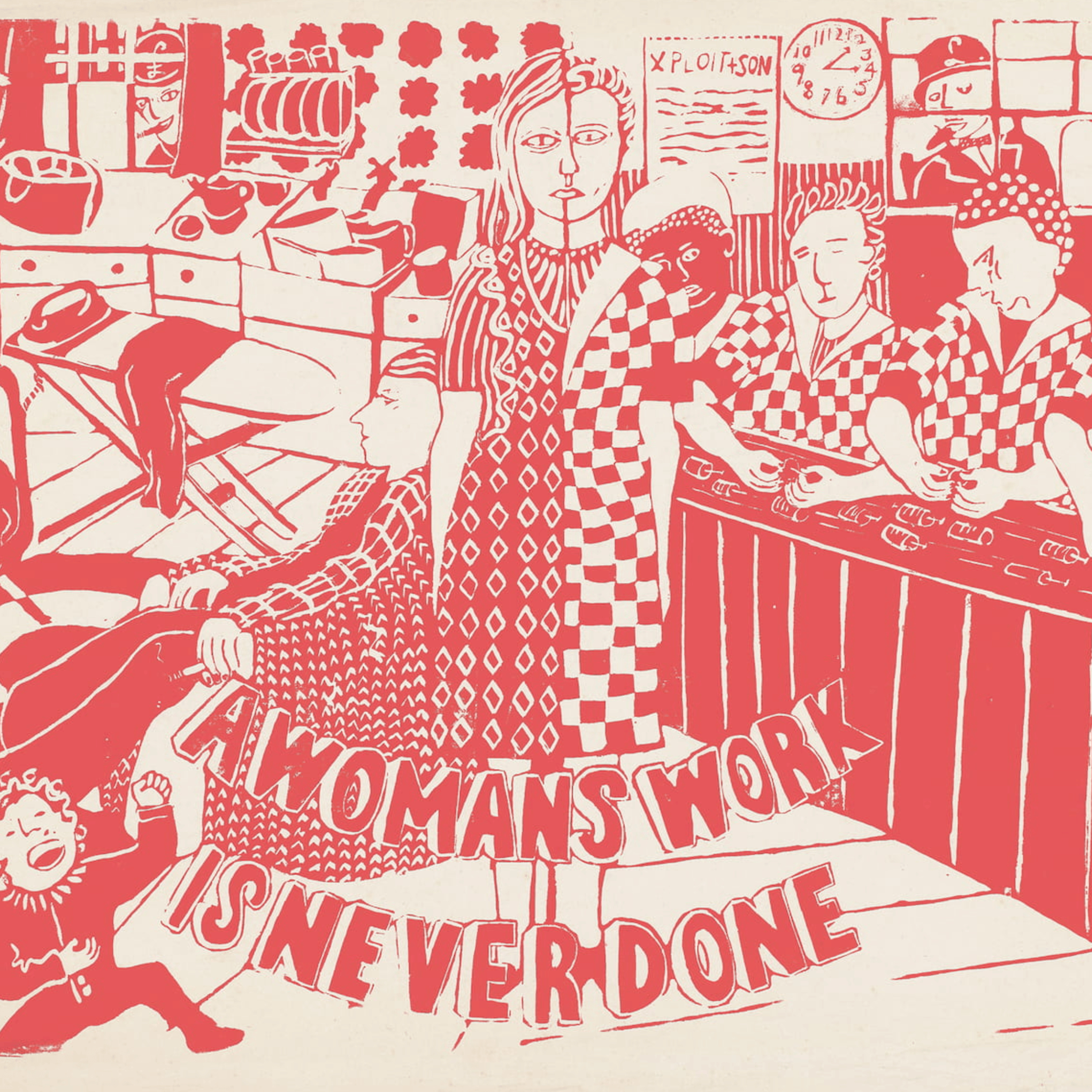
The speaker critiques the common label of "Marxist feminist," arguing it is a superficial and misleading category that falsely unites diverse thinkers with conflicting ideologies. Figures like Eleanor Marks, Rosa Luxemburg, and Angela Davis rejected feminism as bourgeois and individualist, while Sylvia Federici, though often labeled a Marxist feminist, identifies as a feminist critic of Marx. Her work, such as *Caliban on the Witch*, focuses narrowly on witch trials as the origin of women’s oppression, ignoring historical context and Marxist analysis. Marx and Engels, in contrast, systematically examined women’s exploitation under capitalism—highlighting the double burden, degradation of domestic labor, and the rise of patriarchal structures. Federici’s solution of paying housewives for domestic work is dismissed as regressive, reinforcing domestic servitude and undermining social services. True liberation, the speaker argues, lies not in respecting domestic labor but in its automation and socialization through revolutionary class struggle. Historical examples—from the Soviet Union to the 1984 miners’ strike—demonstrate how women’s participation in the workforce and political life transforms gender relations. Ultimately, Marxist feminism is not a unified ideology but a method rooted in class analysis, and the emancipation of women is achieved through systemic change, not moralistic appeals to respect or traditional roles.
[APPLAUSE]
Thanks.
Yeah, so a few weeks ago, I was rage-baited by my FU page
on TikTok because I came across a TikTok
with a list of prominent Marxist feminists
that the person who posted it thought
were really key for you to understand.
And this list had on it, Eleanor Marks, Rosa Luxembourg,
Alexandra Colin Ty, Angela Davis, and Sylvia Federici.
And this got me thinking about this title of Marxist feminist,
right?
Because I think this title allows the smashing together
of really radically different kinds of figures.
So yeah, let's talk about these figures for a little bit.
Eleanor Marks spent her life building socialist organizations.
Rosa Luxembourg obviously she fought not only German capitalism,
but she fought the opportunist wing of our own party,
which led to her brutal murder.
Alexandra Colin Ty, a complicated figure.
She was a leading Bolshevik organizing the women's work
in the Bolshevik party, but actually ends up
siding with Stalin and backing the kind of degeneration
on women's rights.
She writes an article defending the banning of abortion.
Angela Davis, who comrades will know in recent years
has backed the United States Democratic Party.
And then of course, the topic of this discussion, Sylvia Federici,
who is an academic, who has spent her life
at the front of university lecture halls,
being paid a really high wage to talk and to write.
So the idea that all of these people
can be placed under the same banner
that they all have the same kind of ideas
is obviously a completely ridiculous one.
But it is something that's very common, right?
And as much as I was annoyed at that TikTok,
I don't blame the poster who sees these people as Marxist feminists.
This is how they're talked about.
But in reality, actually, none of the people on this list
would refer to themselves as Marxist feminists.
Elana Mark, Rosa Luxembourg and Colin Tai,
they would all have been disgusted with the idea
of being associated with feminism.
Because they saw that word as being synonymous
with middle class and bourgeois women
who were looking for their own individual liberation,
their own individual ability to be able to exploit people,
to be able to exploit workers
in the same way that the men in their class did.
And even Angela Davis, in the days that she
stood closer towards the Communist Party,
she specifically distanced herself from the label of feminist.
And she called herself a Marxist instead.
And you can see as she's moved further right,
she has begun to use phrases like intersectional feminist
to describe herself.
And that's come as she's been doing things
like defending the democratic party.
And Frederic She, as Ruth said in the introduction,
Frederic She has never called herself a Marxist feminist.
Frederic She calls herself a feminist critic of Marx.
So in her magnum opus, the Caliban in the Witch,
she begins by kind of marking the USP of the book.
And she says, the USP of it is,
I want to say both radical feminists and Marxists
have got it wrong on women's oppression.
And she claims very clearly that Marx only viewed history
through the lens of the white male proletariat.
So I think in truth, Marxist feminism doesn't really exist.
It's a title that is slapped equally
on both female Marxists and feminists
who pay lip service to the idea of class and capitalism.
And that latter category, they warp, they critique,
and they deny the Marxist method in their writings.
And that's the camp that Frederic She falls into.
But because the title of Marxist is given to her,
her ideas do have a sort of popularity, right?
They are relatively popular.
Someone who is anti-capitalist who cares about women's liberation,
they see a TikTok like the one I described
and they think, oh, I'll read Caliban on the witch, right?
But these ideas, I want to be very clear,
these ideas have nothing in common with Marxism.
Because Marxism, as we know, is not the admission
that class or capitalism exists.
It's a method to study the world around us,
which leads to revolutionary conclusions.
So I'll talk about the Marxist method a bit in a second,
but for a second, let's just talk about
Frederic She's method, right?
So Frederic She, rather than studying
how to fight women's oppression
by looking at the whole history of their suppression,
looking at it all the way back to its roots,
she just kind of randomly plucks a few hundred years
from history and says, that's what I'll study.
I won't look at anything else, that's what I'll study
because this is where I've decided already
that women's oppression comes from.
So she takes the 300 years that last between the 15th
and the 18th century, when the witch trials
were happening across Europe.
And the argument that she has for focusing her study
on the period of the witch trials is number one,
that apparently hundreds of thousands of women died,
which is not actually true, right?
In fact, it looks like it's between like 30 and 45,000
people died, not all of them were women,
most of them were, but not all of them were women.
Two, a second argument for focusing on this period
is that previous scholars that she respects
have looked at the dawn of capitalism
as the origins of women's oppression,
and the witch trials generally kind of happened
around this period.
And three, that no one else has studied the witch trials
specifically, and therefore this is a new angle
that she can have, it's something new that she can say
about women's oppression.
Clearly, none of that is a serious method
for studying history, for studying theory,
for studying oppression, right?
This is dodgy facts, it's an A priori view.
All of these classic traps of bad theory
that people fall into, which has already decided
where she wants to place the blame,
and she says, "That's what I'm gonna do basically."
For Marx and Engels, they did the opposite of this, right?
They studied as much of history as they possibly could.
They looked at all of the changes that occurred
over thousands and thousands of years of history.
And then, from that study, they pinned down
where they think the oppression of women comes from.
But Freda Ricci instead, she begins with the idea
that she wants to blame the transition to capitalism,
just because other people have
and because she kind of thinks it's right.
And therefore, she does, she blames capitalism.
But actually, I would say even more so
than blaming directly capitalism,
she blames the existence of the working class.
I eat the most progressive development
that capitalism had.
That's what she blames for the oppression of women.
She blames both the existence of the female working class
for its creation, it's for the creation
of the double burden, right?
The fact that you have to work and do the domestic labor
and then also work in a factory, do an informal exploitation.
Obviously, this is completely ridiculous, right?
As if female serfs weren't working the land
and taking care of the home and de feudalism.
It's completely ridiculous to say
that capitalism just created the double burden.
So she blames the existence of the female working class,
the female proletariat, on the oppression of women.
But she also blames the existence of the male proletariat.
She says this is a class that has been created basically
to oppress women.
Again, completely ridiculous.
As if men under feudalism didn't degrade
and repress women, right?
She just completely picked this out of nowhere
and says that it's correct with no backing for it.
And I think this is only one example
of how limited her understanding of even that,
just that period that she studies, right?
She's only picked 300 years
and she still hasn't done a very good job.
I've actually learning about what that period is about, right?
And you can see this in Caliban on the witch.
She admits loads of facts that don't work
in the favor of her argument.
Throughout the book, she blurs the lines of capitalism
and feudalism.
She blames capitalism for what she considers
the state repression of women
when the state that she's talking about
is a feudal state, not a capitalist state.
She also slanders and bastardized enlightenment thinkers
such as Hobbes and Descartes.
She claims that they are anti-woman and reactionary figures
because they push for reason against magic and spiritualism.
She conflates random events across different parts
of Europe she takes into account
at all the different stages of development
of these different areas.
And of course, importantly, she claims
that Marx misses everything that she's discussing,
despite the fact that many books and many chapters of books
are dedicated to all of the topics that she says Marx misses.
So the core point of Caliban on the witch
is basically that the transition to capitalism
has been a step back for women
and therefore that Marx's idea of progress is absurd.
And she says this in the introduction.
She says I should add that Marx could never have presumed
that capitalism paved the way for human liberation
had he looked at history from the viewpoint of women.
That quote is a real thread that runs through
all the threads of each of these ideas
on certainly this book.
She's claiming that Marx did not study the role
and the plight of women in the development of capitalism.
But this is entirely incorrect.
In a capital volume one, Marx dedicates loads of time
to this question.
And Federici actually mentions capital
in the introduction to Caliban on the witch, right?
She says that she's read it.
I don't think she has.
I think maybe she's done what a lot of us do
and we're 17 and read half of the first chapter
and be like, "That was too hard, let me leave it for later."
Because if you manage to get to chapter 10
and chapter 15 of capital, Marx talks extensively about women.
In chapter 10, he talks about the brutal conditions
that women faced when entering the factories.
He talks about how capitalism has forced women into work
and he talks about how it's broken down
the traditional structures of the family.
He talks about the impact this has had on mothers,
on working women.
And he also talks about how the ruling class viewed this
and their fear over falling birth rates
and the legislation that they put into place
to try and fight against this.
And again, in chapter 15,
Marx talks about how and why women have found themselves
on the factory floor.
He talks about it being partly because of the need
for capitalism to constantly expand, creating new ways.
work is to exploit, but he also talks about how it's the development of machinery that
has allowed for women to do a wider range of jobs. Also, in Engels' conditions of the
working class in England, there are numerous sections of the book that dwell specifically
on the life of women under early capitalist development. He talks about the drudgery,
the hardship and the oppression, but he also talks about how all the old family ties
were being ripped apart in the development of capitalism. But Federici ignores all of this,
right? She also ignores, she has this whole thing about the double burden, right? That is her
main point that she thinks it's really bad that women have to do domestic labour and labour
in the factory, which it is, right? It's this very stultified, awful work. But she says, you know,
Marxists don't understand this. Marxists have never considered this kind of oppression before.
I just want to give you two quotes from Lenin that completely show how ridiculous Federici is being
here. So Lenin said, under capitalism, the female half of the human race is doubly oppressed.
The working women and peasant women are oppressed by capital. In addition, and this is the
main thing, they remain in household bondage. They continue to be household slaves,
crushed by the most petty, most menial, most arduous, and most stultifying work of the
kitchen and the individual household. And he said this, you all know that even when women
have full rights, they still remain fatally downtrodden because all the housework is left to them.
In most cases, housework is the most unproductive, the most barbarous, and most arduous work
a woman can do. So clearly, this understanding that women face a double oppression under capitalism
is not specific to Federici. It's not something she's come up with. And it's not specific to people
who call themselves Marxists feminists. It's not something that orthodox Marxists have missed.
The difference, instead, is actually what is the solution to that burden. Because for Federici,
the solution is to remove the burden of formal employment for women, to send them back into the
household and to give them only one burden to be the slave to their husbands. For her, the development
into capitalism has been a wholly negative thing for women because it has forced them into
formal exploitation in the factory. And importantly, she says that it is lowered the social
importance of domestic and reproductive work. So Federici says this, she says that the women's
movement must realize that work is not liberation. Work in a capitalist system is exploitation,
and there is no pleasure, pride, or creativity in being exploited. So Federici instead sees liberation,
not in the involvement of women in economic and political life, but in reverting to what she sees
as kind of natural in the female existence, to reverting to caring for and living off the local
land, to healing, and as the title of her book suggests, to magic and witchcraft. This is what she
sees as being naturally women's work, female in the female body. In Caliban and the Witch,
she spends a large chunk of the book discussing how in the medieval period, women supposedly had
access, free access to this communal land, which was then taken away from them in the dawn of
capitalism. And she says that meant they were forced to either work for a wage or be kept by a
man's wage in order to access the necessities of life. But we have to be really clear on this point,
feudalism was not some beautifully free communal, like, communist society. Federici is in this classic
style of her method, she's cherry-picking fat, and she's been really deliberately vague, so she's
not exposing the holes in our argument. Because the communal land that she's talking about women
having rights to, this was bad land, right? This was land where not much could be grown. It was used
for the grazing of animals. It was land that the Lord had said, yeah, whatever, I don't care about
that, it's bad land, I'm not going to get anything from it. It would have been difficult to even
provide for one person on that land, let alone the idea that you could care for a whole family
living off this communal land. And that is why, if you look at the free serfs, the serfs that weren't
tied to a Lord, which Federici seems to paint as the bastion of women's liberation. These people were
mostly found kind of hopping from Lord to Lord, like begging for employment by him in order to
achieve access to better land, basically, right? Clearly, because that communal land that existed
was not able to provide for people. And obviously, once you were then in the employment of a Lord,
all of the serfs had huge chunks of what they produced taken by the Lord. So this idea that
Federici has that women could live freely and without a massive burden is completely ridiculous.
And actually, if you read Caliban on the witch, you'll see no evidence that she puts up that
suggests there's no examples, no, like, this happened here and this, just didn't even tell this
one woman did that, like, she has nothing to say that women were able to live in this way,
able to live free from the general mode of production. I also think that this reversion
into kind of looking at the feminine ways of doing things or what the female body is made for,
it's like caring and healing. This is obviously incredibly reactionary and regressive. And I do
think this idea has a certain kind of popularity today. I think there's like an increased propaganda
around home birds and natural birds and like, denying modern medicine and so on. Obviously,
that propaganda is increased as the NHS has continued to be defunded. And then you go on social media
and you watch like Nara Smith and she's making Cheerios from scratch and a ball gown and this kind
of thing. It's all this at all, this is what it is to be a woman, right? Clearly, that is incredibly
backward-looking ideas around what gender roles should be. But actually, this is exactly the kind
of politics that Federico promotes. She claims that under feudalism, the witch and the prostitute
played an important role in the social order and therefore that they were more appreciated
and more liberated than women who work today and also raise children. So for her, what is progressive
and regressive is purely based on a kind of moralistic feeling, right? It's purely based on whether
she thinks women's work is appreciated or not. And there's an example of this. Federico sees the
enlightenment as this reactionary attack on women because it casts aside this magic in witchcraft
and she claims, well, this is women's work, right? This is what women are meant to do so the idea
that you would be against magic, yeah, means that you're anti-women. She's against modern medicine
in general and she references a lot of like Foucaultian and postmodernist arguments to struggle
against the idea of modern medicine. And she claims, yeah, that women's work doesn't hold the same
respect that it used to, right? That it doesn't have the same kind of position in society it used to.
She mixes that up with the actual oppression of women under capitalism and then she claims, well,
it's agreed just that Marxists seek capitalism as a progressive step forward from feudalism.
But, and I think this is the most important point in answer to Federico. This is a complete
misunderstanding of what Marxists mean by progress. Our prognosis of what is progressive or not
is whether something develops the productive forces. And why is that the case? It's because the
development of the productive forces gives us the ability to be able to provide the necessities
of life with as little human effort as possible. Ultimately, that, of course, lays the basis
for socialist and communist societies. But progress is not some sort of one-sided thing, right?
Class society has been a necessary stage for the development of the productive forces.
And that means that each society that has come into existence has had a lot of different
poisonous ideas and features that have existed within it. Clearly, for example, when we look at
pre-class society or primitive communism, as we often call it, this lacked the exploitation and
oppression which came with all societies that succeeded there. But this egalitarianism, as we
understand, was based on necessity rather than want. People were only providing the very basic
necessities of life for themselves, and therefore culture, art, and philosophy were all lacking
from these societies. Life was this very narrow and parochial thing, right? The development of
the productive forces gives the ability for both the freedom from survival combined with the freedom
from human to human exploitation. But in order to get there, lots of different stages of
development have been necessary. And through different forms of class society, each of these
things have had their own oppressive ideas. And that's how Marx both claims that capitalism
came into the world dripping with blood and dirt. But simultaneously, that capitalism has created
wonders greater than any society prior to it. And Marx actually talks about this specifically
through the lens of women's oppression. He says this. He says however terrible and disgusting
the disillusion under the capitalist system of the old family ties may appear. Nevertheless,
industry, by assigning, as it does, an important part in the process of production,
outside the domestic sphere, to women, to young people, to children of both sexes,
creates a new economic foundation for a higher form of the family and for relations between
the sexes. So, yeah, again, you see, Marx really did not ignore this. He did not like cast this
aside. This is not something new that Frederichi has figured out and begun to study. So either
Frederichi doesn't understand that or she just chooses to ignore it, right? It's not Marx that
is missing anything. It's of course her that's missing things. She is seeing capitalism in a very
one-sided way, right? She's purely looking at the fact that women have been forced to take on
lots of domestic labor on top of also being involved in capitalist industry. But the reality is
that in an advanced capitalist country today, the objective ability for women to be freed from
domestic labor exists. Household technology and machinery exist. Socialized child care exists.
Socialized elderly care exists. Places to eat outside of your home exist. Pain killers exist
that seriously. limit the pain of childbirth, safe abortions exist, methods to limit or completely stock
your periods in reversible ways exist. Of course, all of these things are hampered and
unheld hostage by the profit motive, right? They're either run for profit or they're part
of the NHS, which is obviously, as I said, being like systematically underfunded. But they do
exist, right? They are there, and that is a creation and a development of the productive forces
and the capitalism, the ability to have the socialisation of the domestic labour.
But actually, the socialisation of domestic labour is also something that Freda Ritchie is
against, and this is a very classic kind of petty bourgeois anarchist-y sort of idea,
because she's against all the socialisation of domestic work, and she says there's very clearly
in wages against housework, which is the pamphlet that Ruth mentioned at the start. I'm going
to give a slightly lengthy quote to I apologise in advance. She says, as for the proposal of socialisation
and collectivisation of housework, a couple of examples will be sufficient to draw a line between
these alternatives and our perspective. It is one thing to set up a daycare centre in the way
that we want it and demand that the state pays for it. It is quite another thing to deliver our
children to the state and ask the state to control them, to discipline them, to teach them to
honour the American flag not for five hours, but for 15 or 24 hours. It is one thing to organise
communally the way we want to eat, buy ourselves in groups, etc, and then ask the state to pay for it,
and it is the opposite thing to ask the state to organise our meals. In one case, we regain some
control over our lives, and in the other, we extend the state's control over us. So clearly,
this is a direct response to the gains of the Russian Revolution for women, and actually I think
this really shows Freddie Ricci's lack of understanding of the dictatorship of the proletariat.
Because in that quote, you can really hear Freddie Ricci's disdain for the state, right? She sees
it as this naturally negative feature, this thing that always will oppress and hold down the masses.
She can't imagine a state that is run by and for the working class. She can only imagine one that
run in the interests of a small minority. In reality, she's disgusted by the idea of being a part
of society, right? She's disgusted by the idea of her children listening to anyone but her,
or maybe the nanny that she employs and can tell her whatever to do. So she's for the privatisation
of domestic labour. She's for women's den outside of the social, political, and economic life,
and continuing her woman's work as she sees it. But of course, Freddie Ricci herself doesn't stick
to this, right? She has her own income, she has her own social circles, she has her own life
outside of this domestic bliss. So it's only other women that she wants to not be involved in work,
right? And of course, in spite of the double burden, right? Under capitalism,
women's rights have taken great steps forward. You've got the right to vote, the right to an equal
wage, the right to own property, the right to abortion, the right to divorce, the right to live
independently without a man. These aren't small gains, even the fact that some of them are not
fully realised right there, four more gains. These are still not small gains, these are still
massive steps forward for the liberation of women. These fundamental democratic rights that
have been fought for throughout capitalism. And I think this is another really important point
for us to consider. Why and how have these gains been made? Have they been made through this kind
of abstract women's movement that Freddie Ricci talks about? Or have they been made through class
struggle methods, right? They have, they've been made through classical methods which have involved
both working class women and sometimes working class men often working class men
behind the working class women fighting for these things alongside them. An example of this is,
of course, the Dagenham strike, which achieved the legal right to equal pay for women in Britain.
The vast majority of these gains have been made because the bourgeoisie felt the threat of socialist
revolution breathing down their necks. The involvement of women in the workforce, it hasn't only given
them their own wage and therefore greater independence. It's not only given them social circles
and human connection outside of the family, but it has put women's demands on the agenda of class
struggle, which actually gives them a real way to be fought for and achieved. But for Freddie Ricci,
she doesn't see any of that right. She doesn't see any of that progressive development that has
existed. She sees only one side of the development of capitalism, this double burden for women.
And she can't imagine how that can be moved beyond. So her solution, rather than automating and
socializing domestic labor, which women are shackled by, her primary demand is just wages for housework.
And her argument for this is that by paying for this work, it will grow to be seen as work,
rather than something separate. And therefore, it's going to be respected more, right? And that's
going to raise women's social status and society. So again, it's really clear to see this like
moralistic and idealist method that Freddie Ricci falls into. She doesn't actually care about
freeing women from the drudgery of domestic labor. She just cares about it being respected.
And Freddie Ricci really, she specifically says this, right, in this pamphlet.
She says it's not about giving women more financial independence, but it's actually just about
the dignity of a housewife, right? It's about paying lip service to the dignity of a housewife.
Again, I'm going to quote her in a bit of length here to show what she means by this.
She says, when we view wages for housework in this reductive way, i.e. viewing it for many,
we start asking ourselves what difference could some more money make to our lives?
We might even agree that for a lot of women who do not have any choice except housework and
marriage, it would indeed make a lot of difference. But for those of us who seem to have other choices,
professional work and lightened husbands, communal way of life, gay relations, or a combination of
these, it would not make much of a difference at all. For us, there are supposedly other ways of
achieving economic independence. And the last thing we want is to get it by identifying ourselves
as housewives, a fate which we all agree is so to speak worse than death. The problem with this
position is that in our imagination, we usually add a little bit more money to the shitty lives that
we have now and we ask so what? On the false promise that we could ever get this money
without, at the same time, revolutionising all of our social relations. And we have to take it
as a political perspective, blah, blah, blah, blah. But for her to reach, she doesn't even explain
how wages for housework would actually be struggling for. She doesn't explain what the struggle for
housewives would look like. Because this is a real question about what methods to housewives
actually have to struggle against their oppressors, right? To struggle in favor of whatever demands
they want, be it wages or anything else. She doesn't name any of these in her writing. Actually,
she focuses and said on the aftermath of getting the wages. So she said, okay, the struggles weren't,
let's talk about afterwards. And she claims that this would allow housewives to see their work as
actual work, rather than as something that is just natural to the woman. And she says, therefore,
women could like conduct strikes or partial withdrawal of labour to show how important their domestic
role is. But she doesn't explain why wages would be needed in order for women to withhold their
domestic labour. Because surely refusing to do your husband's laundry is going to cause him the
same stress, whether you'll be impaid by the state for it or be in kept via his wage. In fact,
actually, being paid by the state for this work would only entrench women's roles in the household.
It would confirm women as the domestic servant. And I think this idea is particularly
panicious and dangerous when it comes to sex. Federici says that, you know, prostitutes, they used
to play this important role in pre-capitalist society and respect was given for the job of being
a prostitute. Obviously, this is completely outrageous thing to say. prostitutes, yes, they have
played important roles in all societies that have needed the existence of a monogamous family
for the order of society. They have been the horde to the Madonna wife, right? In all these
societies, men's monogamy obviously does not matter for the development of the monogamous family.
But the idea that they were respected in these societies is obviously completely outrageous.
These women were at high risk of rape, a high risk of murder, infection, all these kind of things.
And they were viewed as machines, not as humans. And of course, under capitalism today,
that still exists, right? prostitutes also face these conditions of deep pain and fear
under physical or economic coercion. But Federici actually thinks that basically all housewives
should be turned into prostitutes because she says that part of the wage that a housewife should
receive should be for the sex that you have with your husband. Clearly, that is only going to
further the problem of marital rape, of men thinking their old sex by their wives,
of the role of sex being to pleasure the man at the cost of the woman.
And once again, actually, we come back to the problem, how do women struggle for their freedom in
this situation? Because we know the most revolutionary aspect of the working class is that they are
united, that they're pulled together in large workplaces. And therefore they can struggle together,
they have the same interest that they can talk about, discuss, raise their own consciousness and
struggle together. And on the opposite side, we also understand that the backward-looking nature of
the petty bourgeoisie is because of their individualistic nature of work. So, Federici thinks that
women would be better placed to struggle if they're just individually isolated in their homes,
if they're working all hours of the day, unable to meet up and discuss with each other.
And again, she gives no examples of where that kind of thing has been successful, right? Because
there haven't been any way, she couldn't find any examples if she tried to look for them.
So she continually obfuscates as well, who the housewife is going to struggle against? In part,
she says we would need to struggle against capitalism, she kind of pays lip service to it.
but never puts anything concrete forward about that.
But in reality, when you read her work,
she's advocating for the struggle against your own husband.
And she says this that sums that up very well.
She says, "When hundreds and thousands of women
are in the streets saying that endless cleaning,
being always emotionally available,
fucking at command for fear of losing our jobs,
is hard hated work which waists our lives,
then they will be scared
and they will feel undermined as men."
So it's not capitalism, it's not the bourgeois
that she wants to struggle against.
It's the male proletariat, right?
And that is where her clear feminist ideology comes through.
Because yes, of course we understand.
It is often the man who is the direct perpetrator
of the direct oppression that exists in women's lives.
But that doesn't mean that it's men
who have created and can destroy patriarchy or oppression.
Because as comrades know, from a Marxist point of view,
it's the rise of class society and private property
which led to the fall of women out of occupying
an equal status in society to men.
And Engels Marx, the point at which domestic labor
was degraded as the fall of mother right,
essentially at the origins of the monogamous
and patriarchal family.
It wasn't created consciously by men, right?
It was created automatically by the development
of private property which needed to be passed down.
At this point, women became property
which could be owned as well.
And ideas that reflected that real relationship
in society began to take place,
began to take hold in society.
Women's, there was a degradation of women's bodies
and minds in the public consciousness.
But it reflected the real relations
not the other way around.
And since the dawn of class society,
that has been upheld by the ruling class
of every single society, right?
And under capitalism today, even though women have been allowed
into the upper echelons of the ruling class
in their own right, these women still uphold
and promote the poisonous oppression of women.
Because it's an important divisive tool
that exists under capitalism
and it can be used to cut across the class struggle.
Rosa Luxembourg summed up about these bourgeois women.
She said, once they've got their rights,
they'll trot like docile lambs into the camp of reaction.
And that is exactly what exists today.
So what difference does it actually
make to struggle against the male proletariat?
Because his ideas don't come from inside his own mind.
They come from the real relationships
that exist between men and women.
He sees his wife as his servant or his prostitute
because under class society, that is the relationship,
that is the role that women have to play.
And actually, what is it that has begun
to wither those ideas away, that has begun
to create more freedom for women
in the kind of public consciousness?
It has been the involvement of women in the workplace.
It has been pulling women out of the home.
It has been sending them into the workplace.
I am materially blurring the lines, materially blurring
the roles that men and women play in society.
That's what's begun to change ideas, right?
Not the other way around.
So embedding women as domestic servants
and then just demanding respect for that role
is only going to have a negative bearing
on the real relationship that exists between men and women.
So there are all of these holes in Frederic's argument already.
And we haven't even got onto how would these wages actually
be paid for?
And what would they mean for the wages of those
in formal employment?
And I think in order to understand that,
the best place to start is it's marks, right?
It's best to-- with what wages are under capitalism.
In capital, Mark says, the value of labor power
is the value of the means of subsistence
necessary for the maintenance of a laborer.
So essentially, wages are around the kind of cost
of what a capitalist needs to pay the worker
in order to keep them able to turn up for their next shift,
just healthy enough, just happy enough to turn up for their next shift.
And that can vacillate, of course,
depending on features like the class struggle,
the general economic situation and so on.
But when women were on mass out of the formal workplace,
when they were on mass in the home,
as a general rule, the man's wage existed
as the maintenance of the man, the woman,
and the 2.4 children that they were probably going to have.
So we can also count as well in those wages, social services,
which don't cost the individual money.
So state schools, the NHS, state pensions,
all these kind of things.
So then you have to ask yourself, well, where would
these wages for housewives come from?
Federity doesn't directly answer that.
But I think it would be assumed that they
would be paid for by the state, because the idea
that you could get any individual capitalist company
to pay for something that doesn't directly
improve their profits is obviously not going to happen.
So where does state money come from then?
It comes from taxes, which makes it mainly
a cut from the direct wage which goes into the workers' pocket.
So even if it was possible to convince the state
to spend money in this period of austerity,
this money would have to come from somewhere else.
Either taxes would have to be increased
on those informal employment, or the last remain
in social services would have to be cut.
So not only would these wages materially
and socially embed women as housewives,
but they would also undercut the wages
of people in formal employment, which
would further the problem of people's economic situation,
would further the problem, for example,
of people having to stay in abusive relationships,
because they can't afford rent by themselves.
It would further all of these issues,
but it would also undercut services,
which take the pressure off the domestic burden,
which take the pressure off women, right?
So to have a wholly negative effect in every sense.
Federity's method for freeing women
is, of course, the complete opposite
of the method of communists and of Marxists.
For Earth's liberation, it doesn't begin or end in how
society views domestic labor.
Instead, we are looking to do a way
with domestic labor altogether.
And as the need for domestic labor withers away,
those who are shackled to the sink
will be able to step further and further into society.
They'll have more involvement in the social and political
and economic worlds that exist outside of the household.
You could see this in the Russian Revolution.
After the Russian Revolution, women
were given free access to abortion.
The church and state were separated.
Marriage, registration of children, all that was separated.
It was all taken out of the control of the church.
Marriage became a very simple registration process
based on mutual consent that you had.
Marriage is not even needed to be registered after 1926.
And you had divorce made incredibly easy, right?
There was also real material improvements
made for women-paid maternity leave.
That it was existed after birth, before and after birth,
actually, a network for pregnant women
and women who had just given birth was prohibited.
And Lenin and Trotsky, of course,
also looked towards the development of social canteens
to take the pressure of cooking for your family,
of socialized nurseries, to take the pressure
of the burden of childcare.
All of this precisely in order to give women
control over their own lives.
And actually, it was women who organized
and built these social services, right?
Through the what we've called the genital,
which was like the women's department of the Soviet state.
They were put at the forefront of organizing
their own faith.
And this massively increased the confidence of women
and led to, in the Petrograd Soviet,
20% of the delegates being women,
which is something that most bourgeois parliaments
can't claim today, right?
So this is a clear indication that the old social ideas
around women were starting to wither away,
especially amongst the women themselves, right?
They were gaining confidence.
And you can see this in a report that
was written that was written online women
in the Soviet system.
It said, "The proportion of women
who performed the most basic civic duty
that of voting in elections rose steadily
in both urban and rural areas,
from 42.9% in urban areas, in 1926,
to 89.7% in 1934, and in villages from 28% to 80.3%.
Efforts to extend the level and scope
of political involvement by drawing women
into the work of the local Soviets
also achieved substantial results.
The proportion of women deputies in local Soviets
rose in rural areas from 1% in 1922 to 10% in 1926,
and 27% in 1934.
And in urban areas, it rose from 5.7% in 1920
to 18% in 1926 and 32% in 1934.
And that was not only the product of resources
that undercut domestic labor
and brought women out of the household,
but it was also the product actually a revolution
itself of the act of revolution.
Because the act of women's involvement in class struggle,
this Fiona was talking about this in terms of racism last night.
The act of women's involvement
in the class struggle in revolution,
it has a profound impact on the confidence of women
and on men's views towards them.
Of course, in Russia, it was the women
who called the men out in February,
who started the February revolution.
And the men weren't like, oh no,
it's women calling me out, I refuse to come out, right?
They saw their objective interests
as the same as the women workers who were out on the streets
and they followed them into battle.
And in other moments of intense class struggle or revolution,
relationships between men and women
have completely turned on their heads.
For example, in the 1984 Miner Strike, relationships
between men and women in these very socially backwards
mining villages were transformed.
I was reading a BBC article that had a lot of different quotes
of members of a group called Women Against Pet Closures,
who were like the wives of the miners.
I copied down three quotes 'cause I thought they were,
I thought they really proved this point.
Sean James, who was one of these women against pet closures,
she said, for the first time really,
these men were setting and listening to women.
Michaela Horkin said the women did feel empowered.
yn ffordd oeddwn ymwyr yn ffordd ymwyr yn ffordd yn ffordd ymwyr yn ffordd ymwyr yn ffordd ymwyr yn ffordd ymwyr yn ffordd
but more importantly, I felt powerful.
The square was an egalitarian and inclusive space.
I felt that I was accepted and that I belonged.
Zainab Magdi said, "Teria Square felt like a gender bias free zone."
Women felt safe in teria, and we were not constantly afraid of being harassed.
That in a society like Egypt, right, that has a huge problem with the oppression of women.
That is the mood that is created in revolution.
Not out of a feeling of anything more realistic,
but because both women and men realize that a new society can only be built
by the involvement of the greatest proportion of the working class possible.
Imagine how that kind of feeling, that revolution in Egypt that I talked about those quotes from.
That was only 18 days long, right?
Imagine if that feeling was extended to a successful revolution
to that classical being successful and work has taken power of society.
All of the old ideas would be up for question
just as they were in the bourgeois revolutions.
A post-revolutionary world would be a blaze with a discussion of what kind of society we want to build.
And this would be backed up with the real material gains to wipe away domestic labour.
In the USSR, these attempts were hampered obviously by the economic underdevelopment
that existed in society at that time and by the civil war, of course.
But in Britain today, socialised canteens don't need to be built from scratch.
Every chain restaurant could be nationalised, you could pull down the prices drastically
and mean that people could actually go and use restaurants,
could actually take themselves out of the household and take away that burden of domestic labour.
Socialised nurseries don't have to be built from scratch.
They can just be brought into public ownership,
getting rid of the need for parents to pay half of their full-time wage for childcare.
Care homes for the elderly already exist and if he ended the profit motive,
they could be used without the exorbitant costs.
Hospitals, if they were properly funded, could do more aftercare for patients,
keep them in the hospital until they're able to live independently
instead of placing that burden on the women in their lives.
Machinery also exists which can make cleaning your home as easy as possible,
a robot vacuum cleaner or dishwashers in every single home.
And whatever else could be created with the unleashing of the productive forces
when they're allowed to expand again.
Empty homes could be brought into public ownership,
more could be built with the many expropriated from the bosses,
which would mean that no woman would be forced to stay in a home with a boyfriend
or a husband she no longer wants to live with.
This would completely transform the relationships between men and women.
It would allow for relationships to exist on the basis of real human attraction and love,
not on economic necessity.
So it's on that basis that communists look towards the liberation of women,
not through pain respect to the domestic labour that oppresses and holds down women today,
but to the existence of a new stage of society where all of this so-called women's work
could be automated or socialized.
Where rather than trying to change ideas around women's roles,
we change the reality of the roles that women have to play.
Where women have actually been involved in the building of this society,
where they're not only a victim or a beneficiary of the political and economic whims of the ruling class.
Where both working class women and working class men control society themselves
and control their lives, free from both the economic exploitation
and the social oppression of capitalism and class society.
I want to leave the final words to Engels,
because I think he must still be today considered the greatest teacher
on women's oppression and on the struggle against it.
And I think he pointed the way forward for the freedom of women in origins of the family.
I'll end on this quote.
The emancipation of women will only be possible
when women can take part in production on a large social scale
and domestic work no longer claims anything but an insignificant amount of her time.
Thanks.
Podcast Summary
Key Points:
The label "Marxist feminist" is a misleading and inaccurate category that falsely unites diverse thinkers with fundamentally different views on feminism and Marxism.
Figures like Eleanor Marks, Rosa Luxemburg, and Angela Davis rejected the term "feminist," seeing it as linked to bourgeois individualism and a denial of class struggle.
Sylvia Federici, often labeled a Marxist feminist, does not identify as such and instead calls herself a feminist critic of Marx, offering a highly selective and ideologically driven historical analysis.
Federici’s method—focusing solely on the witch trials and claiming women’s oppression began with capitalism—is methodologically flawed, relying on cherry-picked facts and preconceived biases.
Marx and Engels extensively analyzed women’s oppression under capitalism, highlighting the double burden and the rise of domestic labor, directly contradicting Federici’s claims.
Federici’s solution—paying housewives for domestic labor—reinforces patriarchal roles, undermines social services, and fails to address the structural roots of gender oppression.
True liberation, according to Marxist theory, comes through the automation and socialization of domestic labor, enabling women full participation in society and politics.
Historical examples like the Soviet Union and the 1984 UK miners’ strike show that revolutionary class struggle transforms gender relations, not just cultural perceptions.
Summary:
The speaker critiques the common label of "Marxist feminist," arguing it is a superficial and misleading category that falsely unites diverse thinkers with conflicting ideologies. Figures like Eleanor Marks, Rosa Luxemburg, and Angela Davis rejected feminism as bourgeois and individualist, while Sylvia Federici, though often labeled a Marxist feminist, identifies as a feminist critic of Marx. Her work, such as *Caliban on the Witch*, focuses narrowly on witch trials as the origin of women’s oppression, ignoring historical context and Marxist analysis.
Marx and Engels, in contrast, systematically examined women’s exploitation under capitalism—highlighting the double burden, degradation of domestic labor, and the rise of patriarchal structures. Federici’s solution of paying housewives for domestic work is dismissed as regressive, reinforcing domestic servitude and undermining social services. True liberation, the speaker argues, lies not in respecting domestic labor but in its automation and socialization through revolutionary class struggle.
Historical examples—from the Soviet Union to the 1984 miners’ strike—demonstrate how women’s participation in the workforce and political life transforms gender relations. Ultimately, Marxist feminism is not a unified ideology but a method rooted in class analysis, and the emancipation of women is achieved through systemic change, not moralistic appeals to respect or traditional roles.
FAQs
The label 'Marxist feminist' is seen as a misrepresentation that forcibly combines radically different ideologies. None of the listed figures identify as Marxist feminists, and the idea that they share a common set of beliefs is inaccurate and misleading.
They viewed feminism as synonymous with bourgeois individualism and saw the term as promoting middle-class women's exploitation of workers. They rejected the idea of feminism as a movement separate from class struggle.
Angela Davis has distanced herself from the label 'feminist' in her more right-leaning political positions, identifying instead as a Marxist. As she has moved closer to the U.S. Democratic Party, she has used terms like 'intersectional feminist,' reflecting a shift away from strict Marxist positions.
No, Sylvia Federici calls herself a 'feminist critic of Marx' and explicitly refuses to identify as a Marxist feminist. She argues that Marx missed the roots of women's oppression and that capitalism has regressed women's conditions.
Her method is criticized for cherry-picking a narrow historical period (the witch trials) and ignoring broader historical context. She begins with a pre-determined conclusion and fails to study the full history of women's oppression or capitalism's development.
Marx sees progress as the development of productive forces that reduce human labor, leading to greater freedom. Federici claims capitalism is a step backward for women, ignoring Marx's analysis of how capitalism created new forms of women's liberation in the workplace.
Chat with AI
Loading...
Pro features
Go deeper with this episode
Unlock creator-grade tools that turn any transcript into show notes and subtitle files.
 PodcastTranscript AI