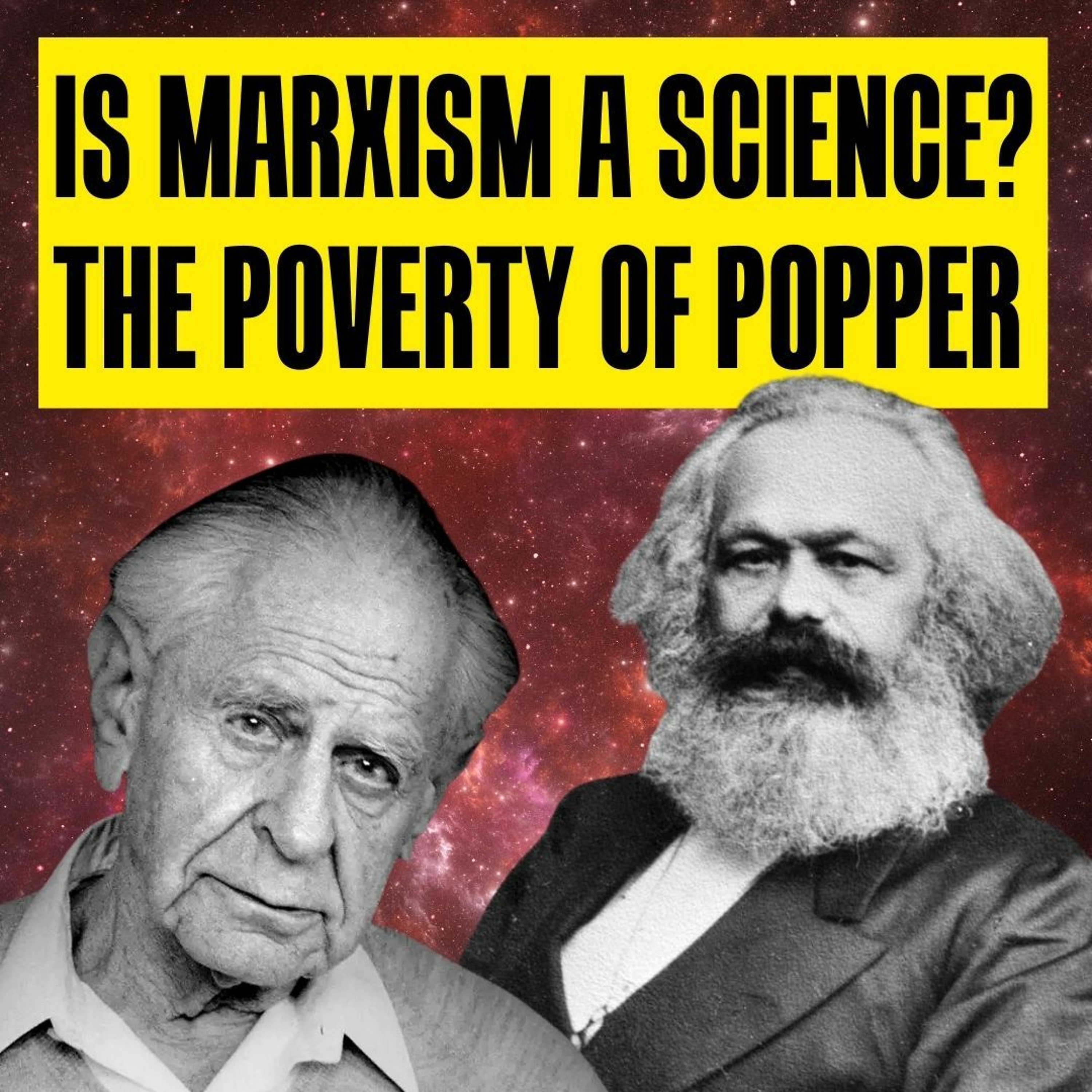
The Marxist Voice podcast defends Marxism as a scientific way of understanding the world, countering criticisms from figures like Karl Popper. Popper's arguments against Marxism, based on falsifiability, are scrutinized for their implications on scientific knowledge and rational thought. While Popper emphasizes the need to falsify theories, Marxists argue for a broader approach that includes both induction and deduction in the process of cognition. The podcast advocates for a materialist perspective that acknowledges the existence of a material world independent of perception, emphasizing the role of practice in proving the validity of ideas. Critiques of Popper's scientific approach are grounded in examples showing the limitations of rigid falsifiability principles in the development of scientific theories.
Transcription
7456 Words, 43871 Characters
Hello comrades, and welcome back to Marxist Voice, the podcast of Socialist Appeal.
For those listeners who tuned in a few weeks ago to listen to our episode on the crisis
in modern science, they will know that subjective idealism and mysticism are bound in academia
today.
And given that is the case, the claim that Marxism is scientific is often met with scorn
and laughter from its adversaries.
However, we at Socialist Appeal and the international Marxist tendency do hold it to be true that
Marxism is a scientific way of viewing the world, and one of the philosophers that is
often seen as the man who took up the cudgel against Marxism to prove that it was in fact
a pseudo-science was a man called Karl Popper.
So in this week's episode, we're going to hear a talk from last year's revolution
festival given by Khaled Malachi, who will defend the scientific status of Marxism and
reveal the faults in Popper's one-sided approach to both science and history.
So without further ado, let's get started with this week's episode of Marxist Voice,
the podcast of Socialist Appeal.
Well, comrades, we have all heard the arguments before that socialism is a nice idea, but
it's never worked in practice.
And though we are young and we are filled with anger that capitalism offers us no future,
that one day we will pack in our hopes for a utopian socialist or communist future.
And we will instead settle for more realistic, more practical solutions of gradual change.
But beyond being just a nice idea, Marxists argue that socialism is a science.
Now this is bound to get a laugh or two from our adversaries.
Any talk of the working class coming to power is scoffed at and seen as outdated, and is
it any surprise?
In academia today, we are taught that the working class doesn't exist.
And they also teach us that society is too complex for us to ever understand it.
And so any theory that challenges this or cuts across it, of course, is met with the
utmost of contempt.
And so there are many academic quacks that popularize such ideas.
At first, they take aim at the method of Marxism, but through this, they aim to discredit the
idea of a socialist future.
And so enters our picture, Karl Popper, the man of the hour, who is adored in the halls
of academia.
And he is held up as this gold standard of scientific method.
Maybe some people in the room have the unhappy acquaintance of Karl Popper.
And he fits the bill perfectly.
After a brief flirtation with communism in his youth, he defected.
He became a lifelong critic of the Soviet Union.
And all of his fire and fury was directed at socialism and communist ideas.
And there is a transferable tale here that maybe when we grow older and wise, we will
leave behind our little dalliance with socialism in much the same way as this champion of the
liberal establishment.
And Popper dressed up his criticisms of socialism by trying to give them a theoretical backbone.
The most famous of his arguments was that of falsifiability, that Marxism could never
claim to be a science.
And because of this, Marxism becomes blunted.
It becomes a moral complaint against capitalism.
And therefore, Marx did not take a step beyond the utopian socialists in their constructions
of a perfect blueprint for a world beyond.
And looking behind this conception of science, which might seem a little bit remote at first,
he's actually an attempt to throw back what we can say we know about the world.
And this conditions his second point, that we are guilty, everyone here today, we are
guilty of the impossible dream, the oldest of all prophecies.
And that is by studying society, we can unearth historical laws.
And on the basis of knowledge of these laws, we can make certain forecasts, and we can
make certain predictions and act accordingly.
That is to say, as Marxists, we believe that our perspectives ground us, and we can have
a certain predictive power on the basis of these to use it to the best of our ability.
Now Popper knew exactly what was at stake with his criticisms of Marxism by trying to undermine
the basis of scientifically understanding history, society, and the role that we play
within this.
He aimed to blunt what Marxism is therefore, which is, as of course, we all know, a revolutionary
guide to action.
Now the key argument that Popper makes is that for something to be scientific, it has
to be it has to be falsifiable.
So something is genuinely scientific, if we can test it, and if we can falsify it, anything
that falls outside of this is essentially speculative or pseudoscientific.
And he set himself the goal of making a line in the sand, so to speak, a criteria of demarcation
between science and pseudoscience.
And the problem he saw was that there are many theories that claim to be scientific,
but he said that they were couched in such vagaries, in such elastic language that any
kind of positive confirmation for them could be found in the world.
And so it was this line of argument that led him to say, when we have an excessive belief
or a faith in a theory, perhaps we are poorly disposed to make observations.
We might see in the world what we already want to see and neglect important facts that
run counter to this.
Now it was on this basis that he argued that Marxism was akin to a pseudoscience, akin
to the theories he said of Adler and Freud.
For when someone would say, Dr. Freud, I have read your work, and I have very good relations
with my father, I certainly don't want to sleep with my mother, this would be of no
concern to the theory, perhaps it could be easily rebuffed.
Well, you do want to sleep with your mother, Dr. Freud could say, and this will sully your
relations with your father, because my Oedipus complex says so.
Well apparently, this is the logic that Marxists use, nothing can be said to disprove the idea
that the working class will move, and in doing so they will overthrow capitalism.
Therefore, it is similar to the claims you might find in religious creeds, that talk
of a second coming perhaps, which of course can only be based on sheer superstitious belief.
Now Popper argued that despite its initial explanatory power, since revolution had not
led to the socialist reconstruction of the world, Marxist would always find a way of
explaining this away, without actually ditching or doubting the theory itself.
Now to give some background to these attacks, we must refer to his first work, The Logic
of Scientific Discovery, which is more of a criticism of the positivists, the logical
positivists, who draw from the traditions of empiricism.
Now for the positivists, they base their theory of knowledge on experience and on the inductive
method.
Now incidentally for Marxists, this is our one point of agreement with the positivists,
but it is Popper's first point of disagreement.
Now the inductive method and Popper's criticisms, I would say are best explained for an example.
So if I was to hold this bottle in my hand, and I were to drop it, it would fall to the
ground.
And if I was to do this again and again, eventually I would draw the universal conclusion, which
becomes firmer with every repetition, that an unsupported object under the influence
of gravity falls to the ground.
This is the process of induction, which proceeds from the particular to the universal.
And the opposing process is the deductive method, where we have general ideas and based
upon them we make predictions about the world.
But Popper exclaims, there is a contradiction in the method of induction.
I may describe this bottle falling to the ground, but this is a particular statement
about a particular bottle.
The law of universal gravitation is, as the name suggests, a universal statement.
And so he said that there was no justification in making the jump from the former to the
latter.
After all, the next time I drop this bottle, it might fly off into the crowd.
It might fly off into space.
And with it, surely, so too would our law of gravity.
Now there is another famous example in which the method of induction apparently goes awry.
And this is the attempt to prove that all swans are white.
Some people, I'm getting a bit of laughter here.
To prove this, or to verify this theory, perhaps I Jetser, I go around the world and
I try to inspect all of the swans I come across.
That is to say, I try to verify my theories through looking for positive confirmations
of them.
But no matter how many swans I might find on my odyssey, there might still be a black
swan out there.
And the punchline, of course, of this example is that there are, in fact, black swans native
to Australia.
Now there is indeed a contradiction here, a dialectical contradiction that exists within
nature and that cannot be eliminated between the particular and the universal, which are
opposites and yet which can only exist in virtue of one another.
Now Popper's entire theory is predicated on the vain attempt to banish contradiction
from nature and, above all, from our theory of knowledge.
But I'll come to this later.
I think it's first worth pausing to see where these ideas actually come from.
And the philosophical basis for these ideas grow out of the theories of David Hume, who
I would say is one of the most unscientific thinkers in the entire history of philosophy.
Hume argued that it is logically impossible to say that something causes another, because
this would go beyond the single fact registered by our eyes and ears at a particular moment.
And so he said that causation simply did not exist, that it was a habit of the mind or
a psychological reflex.
And so the philosophy of empiricism, which initially was progressive, comes to a dead
stop with Hume.
Empiricism is turned inside out.
From at first saying that everything can be learnt through the senses, we arrive at the
conclusion that nothing can be learnt from experience and that the world is unknowable.
Now Popper, our man of science, accepts these criticisms and throws out the method of induction
entirely and, with it, the ability to verify any theory that we might have about the world.
In making these arguments, Popper remains agnostic on the question as to whether or not the material
world exists outside of our perception of it.
After all, if we can't positively know the world, what does it matter?
So Marx's writings on economics that start with the basic atom of capitalist society,
the commodity, and draw out the general, the secrets of surplus value, the antagonism between
labour and capital, these essentially are a complete waste of time.
And Popper argues this because the open-ended nature, a finding count for examples, perhaps
outliers in nature such as the black swans, or perhaps distorting factors in economics,
show that falsification is the only method, the only valid method that science can base
itself on, is what Popper argued.
In Popper's case, he said that scientific pursuit should be limited to actively trying
to find counter examples to overthrow theories and put them to the test.
And he claimed that this embodied the critical spirit of science, as he said, which he puts
in direct contrast to the alleged dogmatism of us Marxists here today.
Right, and as he finishes his book on the logic of scientific discovery, I really want
to just take note of what this title is.
The logic of scientific discovery, this is what he found after his investigations.
And I quote, "Our science is not knowledge.
It cannot claim to have attained truth or even a substitute for it, such as possibility.
We do not know.
We can only guess."
And get this, this is a good book.
And our guesses are guided by the unscientific, the metaphysical faith in laws, in regularities
that we can uncover and discover, end of quote.
So Popper wants science to proceed on the basis of conjectures of guesswork, essentially,
that might not be true.
It might not even be probable.
And he says we have to do this on the metaphysical faith that laws exist in the world, that
these regularities exist.
But he says to us, we don't have any justification to thinking so.
Now as Marxists, we believe in the positive, we answer in the positive that we can know
the world around us.
And we can do so because we are part of that world and we are subject to its laws.
It is through our sensuous experience and our collective labor over the world that we
go from not knowing to knowing, not individually, but collectively.
And from an observation of a large amount of facts, for instance, unsupported objects
falling to the ground or commodity production in exchange, we draw out the general conclusions,
which if they have been sufficiently tested and shown to have a wide scientific, sorry,
a wide application, assume the role of scientific laws.
And this is based on the whole aggregate of human experience that we unearth the laws
of the natural world and of society.
And this is the point to underline.
Human understanding is not simply registering facts in isolation, but uncovering the general
processes by going beyond what is immediately apparent.
His statement, "I interpret the world through my senses," is of course true.
We agree with the empiricists on this, but it is one-sided.
We must add that the world exists independently of our senses.
Otherwise, I'm led to the absurd proposition that when I close my eyes, you will disappear.
Now this is how we go beyond the limits of empiricism, without throwing the baby out of
the bathwater.
Even within the empiricist tradition, I would say, broad generalizations of a theoretical
character have been treated with a kind of suspicion, and this has led to problems in
the philosophy that philosophers like Hume and later Popper exploit.
But regardless of their suspicions or their skepticism, the progress of science shows
one discovery after another, that we can understand the world, and we can make it work for us
on that basis.
From the industrial revolution to space exploration, these are definitive examples of humanity
reaching heights that would once have been considered unimaginable.
And as the saying goes, the proof of the pudding is in the eating.
Now what does Popper have to say about this?
Well, he remains firm.
He says that we do proceed on guesswork, and we can only guess.
And actually, he goes further.
He says that our ability to generalize or abstract is guilty of the same sin as induction,
that we can't justify it.
We can't.
It's not logical.
It doesn't follow.
Now I mentioned earlier that Popper's rejection of contradiction in nature leads to a whole
host of problems.
The contradiction between the particular and the universal is a completely impassable barrier
to his ever having positive knowledge about the world.
But it is precisely a dialectical approach that allows us to understand the relationship
between the two.
So in having an abstract idea of something or making a general statement, we of course
simplify what we are talking about.
We also remove it from his connections to other things, which adds an element of one-sidedness
to it.
But if I write general ideas of, for instance, class, accurately reflect the makeup and the
relations of classes in society, of the patricians and the plebians, of the serfs and the feudal
lords, or today, of the wage slaves and the capitalists, of the definite relations that
these classes play in a mode of production, then our general idea of what a class is,
actually comes closer to the truth, then further away from it.
It gets to the essence of what we are investigating by stripping away all of the accidental features
that individual instances might exhibit.
And it allows us to unearth the role that class struggle can play within history.
And we can make powerful generalizations on this basis.
And this is a tremendous conquest for the human intellect.
And it is what is necessary for us to scientifically approach any subject matter whatsoever.
So the unthinking rejection of abstract thought, of Popper, indicates a kind of narrow, doctrinaire
mentality of said professor.
He can deny this all like, wholly he likes, he can say it doesn't logically follow.
But thought is inherently universalizing in itself, as Hegel once explained.
This is exactly what thought is for.
The very definition of to think is to generalize, otherwise experience would just be sensation
and instinct.
So in order to make his arguments against abstraction, he must rely on the power of
abstraction, albeit in a shame faced way.
Now for Marxist, how does the process of knowledge come about?
Well, it's through both induction and deduction.
Human thought proceeds from the particular to the general and back down to the particular.
It is therefore incorrect and one sided to counterpose the two to one another.
These are inseparable parts of the process of cognition, which are connected and conditioned
one another.
So the rigidity of Popper who denies abstract thought denies induction is really it relies
on undermining the basis of rational thought itself.
For Marxist, it is testing back our general statements, such as revolution being the locomotive
of history to the real world that we prove their truth, and we prove the objectivity
of them.
We are able to do so, of course, because we are materialists.
We believe that there is a material world that exists independent of our perception
of it, and from which we draw our general ideas about the world.
And any attempt to deny this or deny the forward march of science is both unscientific and
is also completely irrational.
Our knowledge of the real world in its development in its change in its complexity is not achieved
through scholastic experiments, as Marx once commented.
It's not achieved by setting up falsifiability principles, as our friend Popper would like
us to believe.
It is through practice that we prove the validity of our ideas.
Now we should treat Popper's supposed goals standard for science.
I would say with a very healthy dose of skepticism.
It begs the question, is this how science actually develops?
Well, sadly for our professor, it is not.
Theories are inferred from our experience using the inductive method, but perhaps we
can frame the question a different way.
Does the attempt to falsify theories in science represent kind of the soul of scientific discovery?
And I'm going to give an example which I think suffices to bring out some general points.
At the beginning of the 19th century, it was discovered that the orbit of one of the planets
departed from the predictions made by Newton's theory of gravity.
At the time, it was assumed that there was only seven planets.
One possible explanation for this, of course, was that Newton's theories were wrong.
But given all of the empirical success up until that point, this seemed like a very
poor explanation.
And so there were two astronomers working independently of one another that posited
that there was an eighth planet that could explain the deviating orbit of Uranus.
Now, not much later, this planet now known to us as Neptune was discovered.
So what does this show?
It shows that it's perfectly reasonable for a theorist to dig in and say while an experiment
might seem to be bad news for a theory, perhaps the fault lies with the experiment or at least
the working hypotheses.
And if the astronomers would have stopped at the point at which Popper prescribes, they
would have simply just falsified Newton's theory in a very superficial way, of course.
And what would they have done this for?
Well, for the sake of remaining critical in Popper's sense of the world.
Well, in reality, I would say that all of science, the development of science as a whole
shows the one-sidedness of trying to construct some kind of rulebook like he does.
Now Popper could dig his heels in and say, even if science doesn't proceed like this,
maybe it should.
After all, he was a very arrogant type by the sounds of things.
But this isn't the only problem that falsifiability runs into.
The idea that a theory is dismissed by coming into contact with one counter example, with
one outlier, is too naive even for Popper to admit.
The problem with his criteria is it runs into an indissoluble problem.
It is impossible in almost all science to isolate one failed prediction, and in a truly
laboratory fashion, use this to devastatingly falsify a theory.
And yet this is what he set this principle up to do with Marxism.
The physicist, for instance, can never subject an isolated hypothesis to an experimental test,
but only a whole host of hypotheses.
And when the experiment doesn't go the way he thinks it will, he could say, OK, well,
one of these hypotheses needs to be modified then, or changed, or is incorrect.
And but the experiment itself doesn't actually say which one of those it is.
The point is that our man of science, rather embarrassingly, does not understand what science
is.
He clearly believes that science deals in very neat, very discreet situations that that
are based upon single causes and effect.
And this is the hallmark of a very mechanical view of nature is very outdated, I would say.
But it is what is required for his falsifiability to make any sense whatsoever.
But most systems of nature are not stationary or isolated from their surroundings.
Nature is open, unbounded.
And whilst we see certain cyclical developments, the development of nature never forms perfectly
closed loops that spirals of development.
That is to say, it develops dialectically.
And as such, there are varying degrees of accuracy to science itself, many of which are historical.
So but his own excruciating ignorance is revealed in the following quote.
The fact we can predict eclipses does not mean, therefore, that we can be expect to
predicts revolutions end of quote.
Well, this is a straw man.
Marxism never claimed to be an exact science, such as astronomy.
And the triumph of the socialist cause is not written in the stars.
It's not predetermined in the same way as an astronomical eclipse.
Since the factors of human consciousness and timely action are, of course, decisive.
But Popper's catch-all for science doesn't just dismiss Marxism.
It dismisses whole hosts of science just to name a few.
Geology, meteorology, climatology, and even worse of all, the evolutionary theory itself.
Now, in each of these sciences, prior evolution is everything for determining a system's future evolution.
This cannot be understood apart from their history.
None of these are exact sciences in which we understand isolated physical systems to be exact.
And yet, these sciences are gigantic leaps forward for humanity.
It's only on evolutionary theory that we can explain the basis for life today,
stripped away from the mystical and the religious explanations that are dominated for so long.
And climatology can track the ways in which capitalism is killing the planet
and make very poignant predictions about what will happen if we don't overthrow the prophet system.
Now, this does not fit Popper's rulebook.
Well, I think we can say to hell with his rulebook.
There is a reason why this is not a working ethic to scientists
or, for that matter, anyone interested in changing the world.
Now, as I said at the beginning, this idea of science might seem a little remote from class struggle.
But it is from this philosophical basis, one of subjectivism, one of agnosticism,
at which he launches his tirade against Marxism.
He argues that there is no factual basis for forecasting economic, political, or historical developments.
And this is the sin that we are all guilty of.
And yet, as Socialist Appeals' recent front page shows, no Tory survives the Socialist Appeal bow.
They were destined for shipwreck, we might protest.
Anyway, Popper's main arguments are concentrated in his book, The Poverty of Historicism.
In this, he claims to have given a refutation for strictly logical reasons
of why we can never understand or predict historical development,
which boils down to essentially saying that history is unique and history is arbitrary.
And really, it's his formalistic philosophy that leads him down the road of some very strange arguments.
For example, he argues that holes or social systems, such as capitalism,
cannot be made the object of scientific discovery or investigation.
Since they are not empirical, that is to say, I can't touch capitalism in the room today.
I can't walk down the street and meet capitalism.
And therefore, it must be an ideal object, perhaps something that just exists in my mind.
And for Popper, the hole is not greater than the sum of its parts.
It's just the addition of one thing to the next to the next.
And this, of course, is captured quite nicely in the Thatcherite motto that there is no such thing as society.
It's just atomized individuals pursuing their own interests separate from one another.
For Marxists, we understand that it is from the interrelations between the different parts,
the classes in society that gives rise to the whole,
the exploitation of one layer by another under the trappings of commodity production and exchange.
And that this can be understood, it can be studied, and it can be scientifically explained.
But the criticism against understanding systems or holes is as ridiculous as it sounds,
because on what level would we stop?
We cannot understand the brain without first connecting it to the rest of the nervous system,
and that it turned to our sense organs.
And if we were to stop at the brain, this is clearly made up of different parts
that work to create the organ primarily responsible for thought.
Dialectically, we understand that the hole is greater than the sum of its parts
because of the interrelations of those parts.
No one cell is conscious.
And this reductive approach has led the theories of consciousness, if you can call them that,
up the garden path.
Consciousness is an emergent property of matter organized in a definite way.
But this can't be understood without connecting it to a greater whole,
the natural world, and understanding how labor mediates our relationship to it.
Popper's one-sided extreme is contradictory and not in the dialectical sense,
because the unique event or thing under investigation is itself a whole of smaller things.
And clearly, any individual part can be what it is as part of a wider whole.
Without a dialectical approach, we would be lost in trying to explain
how patterns or trends emerge in history or society.
And Popper has to begrudgingly admit that we may find such trends,
but that there is no reason to believe that they will continue tomorrow.
That is to say that they are trends, they are mere trends, they are not laws.
So the kind of predictability pursued by Marxists,
who believe that human affairs are causally determined and lawful,
is an illusion because he argues that history exhibits no important regularities whatsoever.
But I would say it's clear to a child of the age of five
that there are indeed important regularities to our lives.
We all must survive, we all must eat and clothe ourselves,
and we are led to do similar things on the basis of this,
as the saying goes, similar material conditions produce similar material results.
And so what we do is constrained and predictable to a certain extent.
Under capitalism, we enter into definite relations as wage laborers.
We are alienated from all of the wealth that exists in society.
The only thing we have to sell is our ability to work,
and we must sell this to a capitalist who enriches himself off the back of it.
But presumably then, it's random that we go to work for our professor.
We all just love working, and that's why we don't skype off.
Well, I would propose this peculiar idea to everyone in the room today.
How about we just don't go to work next week.
We have a lie-in and see if we all randomly find ourselves unemployed by the end of the week.
Another point, if there are no regularities of note,
then underlying necessity must be a bit of a misnomer.
But necessity does express itself, not just in our everyday lives,
but in revolutions themselves.
Necessity, of course, is a relative term.
The laws of society and the laws of revolution
never assert themselves in wholly pure ways.
There is no identical revolutions we can compare.
But the contradictions that Marx understood do assert themselves
and do lead to social crises and political crises.
Now, Popper's emphasis on history being unique is ironically not unique at all.
I think everyone has heard these arguments before.
And it leaves the door open for fantastic and mystical explanations
as to why society is the way it is.
And I think it's here that we most clearly see the poverty of Popper himself.
His account is entirely unhistorical and it is based and flows directly from
his mechanical and his formalistic philosophy.
But the likes of Popper can get away with this, you see.
Because all they do, all their ideas do is serve to prop up the status quo,
mystify the real relations in society.
On the other hand, Marxists have made many real powerful predictions
on the basis of dialectical materialism.
And dialectical materialism is not some magical formula or a master key for all questions.
It is, as Trotsky once described,
a guide to direct our scientific analysis along the correct path
and keep it away from the sterile wanderings of subjectivism.
Now, here's an example.
He's not simply spoken into existence by religious decree
of the benefits of the planned economy.
And as far as I can tell, and the historical record shows,
it wasn't unearthed by the Bolsheviks in some book resembling revelations.
And Lenin might not, I don't think he had a particular Mount Sinai moment.
No, the benefits of the planned economy were proved in practice.
And I will quote again from Trotsky in his masterpiece,
"The Revolution Betrayed."
"With the bourgeois economists, we have no longer anything to quarrel over.
Socialism has demonstrated its right to victory,
not on the pages of death's capital,
but in the industrial arena comprising a sixth part of the Earth's surface,
not in the language of dialectics,
but in the language of steel, cement, and electricity," end quote.
Now, in spite of the bureaucratic degeneration of the Soviet Union,
which we have a talk on tomorrow,
the planned economy proved its vitality through taking Soviet society
forward leaps and bounds.
And Trotsky made a very important cautionary prediction
before his death in the 1930s.
He argued that if a political revolution did not sweep aside
the bureaucratic crust that had placed itself at the head of society,
the USSR would continue to degenerate,
and the possibility of the restoration of capitalism would open up.
Now, this has sadly been vindicated,
but it was this scientific understanding
of the social antagonisms growing within the Soviet Union
and the monstrous and disastrous policy of socialism in one country
that led him to believe the Soviet Union
would find itself at a decisive crossroads.
This dumbfounded a lot of people at the time
that could only see the strength of the Soviet Union,
especially emerging more powerful off the basis of the Second World War.
Now, put this in contrast to some so-called Leninists today
who blame the demise and the destruction of the Soviet Union
on one particular figure,
either it's Khrushchev's revisionism or the final betrayer of Gorbachev.
That is to say, they believe that the restoration of capitalism
came about owing to the great man theory of history.
But these idealistic explanations, which are fairy tales essentially,
I think stand in direct contrast to the scientific understanding
of Leon Trotsky before his death.
Now, to go back a little bit,
we see the Marxist method is responsible for magnificent foresight
in the communist manifesto itself.
The insights of Marx and Engels into globalization,
into the domination of the world market,
into the bourgeois creating the world in its own image,
into wealth inequality,
actually are more applicable today than they were back then.
And all over the world, we see mass trade unions
that have been used in country after country,
generation after generation, as weapons in the class struggle.
This was not present when Marx was writing, and yet he forecast this the case.
And I don't want to give off the impression from this talk
that Marx simply had a good insight here and a good insight there.
No.
What Marx and Engels did and the job they undertook
was to make a science of socialism.
And in order to do that, they had to place it on a real basis.
And this was from ruthlessly criticizing, falsifying perhaps,
past philosophies that, but in doing so,
they preserved the rational kernel of what came before.
And in this way, dialectical materialism can be understood
as the culmination of all past philosophy.
On the basis of this method,
we could for the first time explain our relationships to one another
and to the natural world.
Not just for us to ponder on, but as a philosophy of action,
as Marxism points the way forward to bringing about change
and applying this method to history,
Marx discovered that the development of the productive forces
was the key factor underpinning a society's development.
It was through their scientific approach,
how they initially uncovered how a system that was progressive
in its youth, like capitalism,
could actually become an enormous fetter on taking society forward.
But not just this, that capitalism creates its own grave diggers,
the international working class.
And they did, and it was through this understanding that they saw
that it is only through socialist revolution
that we can become the masters over society and out of our own destinies.
Now, for Popper, as is the case for any liberal professor
that you might have been taught by, this is, of course, anathema.
And he denies the ability for there to be any scientific theory
of historical development that serves as the basis of prediction.
Well, I would agree with him, with the addition of just one word.
There can be no bourgeois scientific theory of historical development
serving as the basis for prediction.
Because social sciences under capitalism
cannot come close to explaining the real relations that exist in society.
Look at how they explain war.
Look at how they explain economics and crisis and revolutionary upheavals.
Well, comrades, we have had no shortage of one-potted psychological profiles
on Putin that read like gossip columns.
When the economy goes into crisis, they talk about animal spirits gripping onto it
and riding out these moments of madness.
And they discuss revolutionary struggle as this aberration that needs to be curbed.
But it's an aberration that happens to repeat itself again and again across the world.
Now, contrast this with how the bourgeois approach passed modes of production,
slavery and feudalism, for instance.
We are taught that these systems explicitly relied upon the exploitation of one layer by another.
And that this was justified through the dominant ideas of the dominant class in society,
that slaves themselves had no souls and that the rulers had a divine right to rule.
But how are we taught about capitalism?
Well, it is a perfect ideal and capitalism can do no wrong.
It is the best of all possible worlds.
It is always something external that causes the crisis.
Or it's poorly chosen politicians or perhaps greedy bankers that lead to discontent and upheaval.
That is to say, we find an apology for capitalism everywhere we look.
Whereas the official social sciences, however, can be as vulgar as they like.
It is essential we are as scientific as possible and approach the class struggle
without an air of sentimentality or with rose-tinted glasses.
The need to objectively appraise the situation for Marxist is absolutely key.
Well, why is this?
Because we set ourselves the sites of overthrowing the system and seeing the working class come to power.
So any kind of exaggeration or seeing in the world what we already want to see in it
would greatly hinder us in this task.
Well, Popper is resolute that such a task is doomed.
He says that he characterises socialism and the future of socialism as an unverifiable prophecy.
As he smugly wrote, "I'm convinced that revolutionary methods can only make things worse."
Haven't we heard that before?
"That they will increase unnecessary suffering, that they will lead to more and more violence,
and that they must destroy freedom."
But hold on a second professor.
Isn't this an unverifiable prophecy warning us away from revolutionary rift means?
It reads as an oracle of doom.
To state the obvious, he has no qualms with the revolutionary means used by the bourgeois
to install themselves and to consolidate their power.
And the bourgeois revolutions as Marx characterised and the bourgeois creating the world in its own image
saw capitalism arise with blood and dirt dripping from every poor.
No, it is the working class using revolutionary means that he is opposed to.
And here I think we see his political bias painted in quite bright colours.
After all, he set up the Mont Pelerin society in the 1940s with a whole host of rogues,
free market fanatics like Milton Friedman and Frederick Hayek, just to name a few.
And this was really a hive of neoliberal economic theory and policy that though initially ignored,
decades later these policies of course would be carried to the rest of the world under Reagan,
under Thatcher, under Pinochet, and not in a peaceful or freedom loving way, but very often at gunpoint.
So so much for his concern for freedom.
But what Popper takes as unquestionable is that fighting for incremental changes,
he describes it himself as piecemeal social engineering,
which is a rather bizarre phrase, is the best way to bring about social progress.
And it seems to make sense, right?
Reforms here and there will maybe keep us on the straight and narrow to a more accommodating world for all.
Now I would say there is a certain irony that after making such a song and dance about falsifiability,
we can test his main political argument and show it to be false.
After all, we often say that it is the reformists that are the worst utopians of all,
since they believe that it is one uninterrupted march to a fairer system for all.
That every time a crisis comes about, which his free market friends have no serious explanation for,
the reforms that workers have won and secured are all of a sudden clawed back.
Our living standards are thrown backwards and it's in this that we see the incomplete nature
of our rights and our freedoms and our reforms under capitalism.
That is precisely why revolution is necessary.
And though we are accused of unverifiable prophecies,
the movement of the working class to take power into its own hands,
I would say it's very verifiable.
It's alive and kicking if you open your eyes and see what is happening in the world today.
From Kazakhstan at the start of the year to the insurrections in Sri Lanka,
up until the fight for freedom in Iran today,
we see revolutionary developments breaking out.
And even in sleepy little Britain, we have begun to see the working class begin to stir.
Now, the failure of these mass movements is often, and I would say decidedly,
down to a lack of revolutionary leadership.
Far from the masses being imbued by Marxist ideas or Marxist historicism,
it's these movements that are typically hijacked by liberals,
preaching of piecemeal reform, of talking about tinkering with the system,
that leads the working class to defeat again and again.
And this is the real tragedy,
a one that we must aim to rectify as a matter of urgency.
But the hubris of those defending liberalism or the rigors of the market
has really turned into its opposite, I would say.
All we find is a vulgar defense of the status quo,
which the youth have no time for, they have no patience in, they have no illusions.
My final point, Engels once commented
that the bourgeois revolutions called for intellectual giants,
and they were duly received.
But in the 20th century and in this century too, capitalism is clearly in senile decay.
And such is the time for intellectual pygmies and pretenders.
Popper and his friends are incapable and uninterested
in furthering our understanding of the world.
And why should they be?
They are very happy with the way that it was set up in the first place.
But the fact that Popper is held up as this gold standard for scientific method is laughable.
It shows that this is the best they had to offer at the 20th century.
And though this talk has focused a lot on Popper,
I wouldn't want to give off the impression
there's anything particularly special about him.
He represents all the old crap, given a new coat of varnish,
and what we find behind this, this professorial aura,
is the class interest of a petty bourgeois intellectual,
frightened by the revolutionary events that were breaking out throughout his lifetime.
But the scribblings of this professor
will provide little comfort for the capitalist today,
with the revolutionary events breaking out and more and more young people,
especially looking for ideas capable of understanding the world
and understanding the role that they can play within that.
And armed with a scientific understanding of Marxism,
an organization can harness this energy.
It is then that events will march over the heads of the cynics and the skeptics.
And theories like Popper's and many, many other theories
will end up where they belong, no longer aggrandized,
no longer adored, but chapped into the dustbin of history.
So that brings us to the end of this week's episode of Marxist Voice.
Thanks very much for listening, and we hope you've enjoyed it.
And before you go, if you'd like to learn more
about Marxist philosophy and science,
then we'd recommend checking out Socialist Appeals Education Hub,
which is filled with talks, articles, and reading recommendations
on a whole manner of different topics,
including an entire page dedicated to the question of Marxist philosophy and science.
We also would recommend Alan Woods and Ted Grant's book Reason and Revolt,
which applies the Marxist method of dialectical materialism to the world of science.
You can get your hands on this book over at our bookshop,
wellreadbooks.co.uk.
And as always, if you agree with the ideas that have been put forward in this talk,
and you want to educate yourself in the genuine ideas of Marxism,
and furthermore to put those ideas into practice
by fighting for revolution in our time,
then we urge you to get organized and to join Socialist Appeal today.
Socialist Appeal has branches across the country
who meet regularly to discuss Marxist ideas,
and who are actively striving to build the revolutionary leadership
that is needed to overthrow capitalism.
So we would say once again, if you are a communist,
then it's time to get organized.
Head to socialist.net/join to sign up today.
And with that, we'll end this week's episode of Marxist Voice.
Thanks very much to our listeners for tuning in,
and make sure you stay tuned for future episodes covering Marxist theory,
revolutionary history, and current events from a Marxist perspective.
All brought to you by Marxist Voice, the podcast of Socialist Appeal.
[BLANK_AUDIO]
Podcast Summary
Key Points:
Marxist Voice podcast defends the scientific status of Marxism against criticisms.
Karl Popper criticized Marxism as a pseudoscience based on falsifiability.
Popper's rejection of contradiction in nature leads to problems in scientific knowledge.
Marxists believe in the positive knowledge of the world based on collective human experience.
Popper's approach of falsifiability is critiqued for being one-sided and undermining rational thought.
Summary:
The Marxist Voice podcast defends Marxism as a scientific way of understanding the world, countering criticisms from figures like Karl Popper. Popper's arguments against Marxism, based on falsifiability, are scrutinized for their implications on scientific knowledge and rational thought. While Popper emphasizes the need to falsify theories, Marxists argue for a broader approach that includes both induction and deduction in the process of cognition.
The podcast advocates for a materialist perspective that acknowledges the existence of a material world independent of perception, emphasizing the role of practice in proving the validity of ideas. Critiques of Popper's scientific approach are grounded in examples showing the limitations of rigid falsifiability principles in the development of scientific theories.
FAQs
Yes, Marxists argue that socialism is a science, despite being met with scorn and laughter from adversaries.
Karl Popper's main criticism was that Marxism could not claim to be a science due to lack of falsifiability.
Popper proposed falsifiability as a criterion to distinguish genuine science from speculative or pseudoscientific theories.
Marxists use both induction and deduction in the process of cognition, considering them as inseparable parts that are connected and conditioned by each other.
The discovery of Neptune based on deviations in Uranus's orbit showed that rejecting a theory solely based on falsifiability could hinder scientific progress.
Chat with AI
Loading...
Pro features
Go deeper with this episode
Unlock creator-grade tools that turn any transcript into show notes and subtitle files.
 PodcastTranscript AI