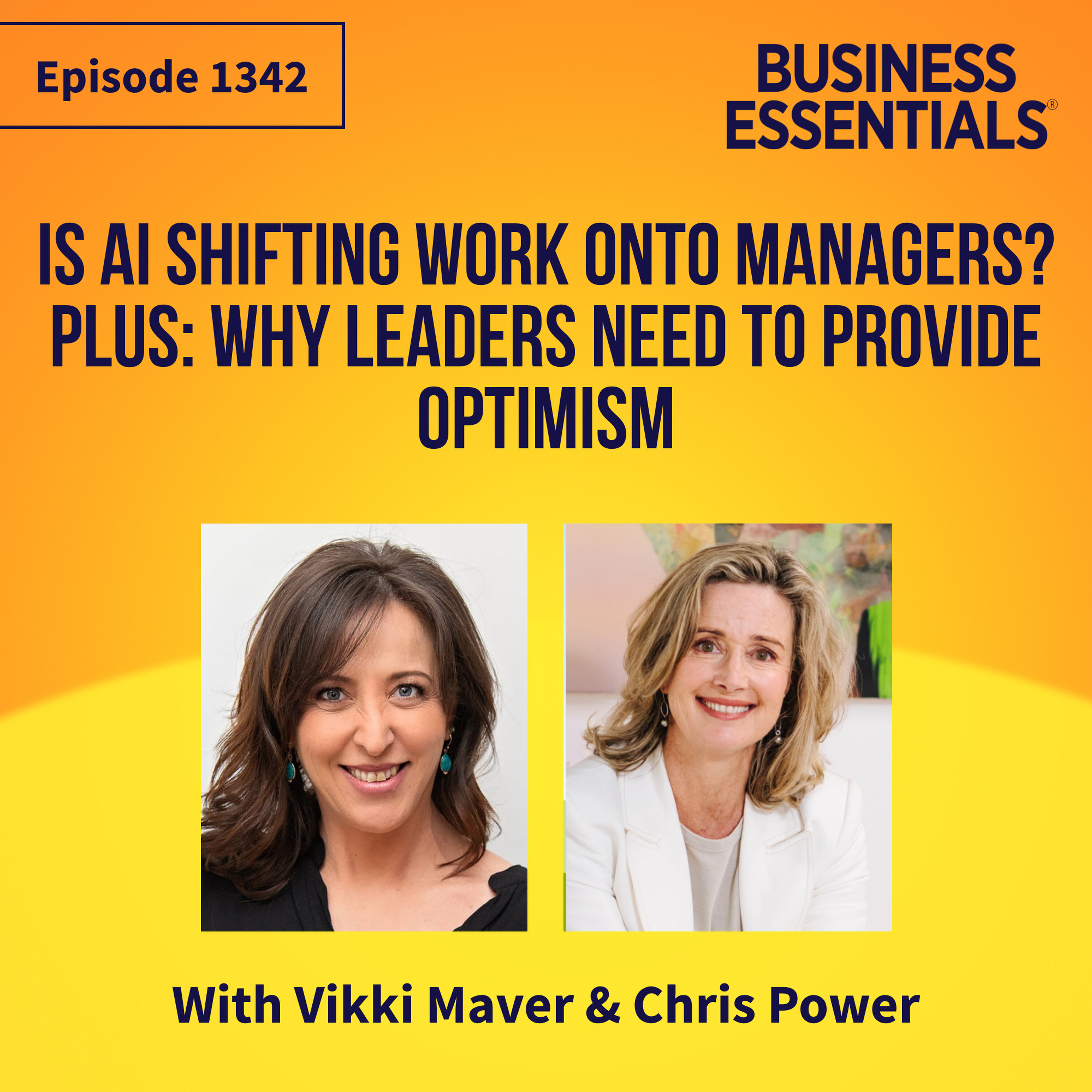
Speaker 1Is your team's AI use actually making work easier, or is it just creating more work for your most experienced employees? In this episode, workplace writing expert Vicky Maver explains the hidden costs of AI, sharing how poor governance can increase rework, shift responsibility onto managers, and even undermine customer trust. Then executive coach and leadership team coach Chris Power explains why optimism, direction and hope are essential in these uncertain times. And she shares how leaders can build trust and unite teams without pretending to have all the answers. From Sound Cartel, I'm Grace Jennings-Edquist, and this is Business Essentials. We all know AI is transforming the way we work, but is it really boosting productivity, or is it simply shifting more work onto managers? Workplace writing expert Vicky Maver explains. Vicky Maver is the founder of Communication Skills Academy and Refresh Marketing, and she says many businesses are overlooking AI's hidden costs. She joins me to explain why strong guardrails are essential to protect productivity, trust, and the quality of your business communications. I started the interview by asking, what are some of the ways businesses might actually be losing time and productivity through AI without realising it?
Speaker 2I can comment to this mainly from a perspective of AI as a business writing tool. So that's my. My area of specialty. And look, there's no doubt that people are using AI to write their business communications and their marketing communications to save on time. And I have no doubt that it is saving time, but the cost can come back in various forms. Certainly, what we're seeing is managers and leaders reporting that the amount of rework that's coming from their staff writing AI-generated communication or submitting AI-generated communication has dramatically increased. So I actually had one of my clients on the phone to me just on Friday afternoon a few days ago, you know, almost just absolutely bamboozled by the content that's falling on her desk now and doesn't even know where to start in terms of fixing this. And it's adding up to a lot of time on her desk, but also the rework that comes from it from the staff member initially. So that's one of the most common forms where, you know, the real time that's lost. But probably the more significant cost that's coming to businesses is the loss of trust. And how do you put a figure on that? It's almost impossible. But, you know, we need to remember that communication is ultimately about trust. And the more important the message, the more readers want evidence of human thinking, judgment and authenticity behind it. And, you know, where are we? We're in almost, you know, July 2026, where the first question most people ask themselves when they receive communication is, is this a human or is this a robot? And, you know, if you've got people questioning that, then obviously trust is immediately something that wasn't even secure in the first place. So I'd say that the loss of trust is the biggest cost and people are becoming increasingly on guard and suspicious of people outsourcing their soul almost to AI.
Speaker 1You touched in that response about AI shifting work essentially. Can you talk a bit about that? Like, how does that happen in practice and what impact can it have on team performance and morale? So,
Speaker 2look, I've been working with businesses for close to 20 years now on improving their business communications and their content marketing communications. And look, it would be misleading for me to say that to some extent leaders didn't always have that cost, even before AI, where they would get writing from their staff, whether it's, you know, a proposal or a proposal. And I think that's a big part of it. needs to know how to write for business. every working professional needs to know how to write create financial models so you know how many people do you know that can get through a day without communicating in writing like as far as I'm concerned pretty much zero so it's not a skill that you can afford to skip it's just not particularly if you you know you're in the position now of having to edit and judge and critique like you never have before.
Speaker 1That was workplace writing expert Vicky Maver founder of Communication Skills Academy and Refresh Marketing.
Speaker 3If you're building a business your reputation is everything and a podcast can help build trust at scale and turn your expertise into authority. Sound Cartel's new thought leader package is designed for business owners who want impact without the overwhelm so we handle the strategy production and launch while you can stay focused on what you do best. Now to difficult conversations in the workplace.
Speaker 1Economic uncertainty rapid advances in AI and ongoing geopolitical tensions are creating unprecedented challenges for business leaders so how do you inspire confidence when you don't have all the answers? Leadership advisor and executive coach Chris Power says optimism direction and hope have become some of the most important qualities leaders can offer their teams. Especially right now when there are so many changes around. I kicked off the conversation by asking Chris how can business leaders project optimism to their team without being inauthentic?
Speaker 4The first thing that I think leaders need to do for themselves is that they need to make sure that they're in good shape to lead and as I've mentioned on the previous conversations we've had a lot of leaders are running really fast right now and they are right in the doing and they are not stopping and they're not going to stop. They're not going to stop. A lot of them are kind of starting to fall over a little bit in my experience. I do executive coaching. They are coming to me and the first thing I do is go pause. It's not magic. It requires attention you know physically, emotionally, mentally, spiritually. Leaders need to actually do that work for themselves and on themselves so that they are then in a great position to be their authentic selves. To show up and have the emotional intelligence that's required to navigate something that is actually really uncertain right now. We don't always have the answers and the old school way of leading which is that I must know all things that's kind of gone which is great actually. So for leaders the optimism is about saying I am here and my leadership team is here and we are doing the work that we need to do to navigate our way through this uncertain time. It's not Pollyanna. No everything's going to be actually really great. It is about that we are in good shape to lead through this uncertainty.
Speaker 1I was going to ask this a little later in the conversation but I think I'll just go there now because this is kind of naturally coming to my mind. It seems like there's this tension between needing to be transparent that you don't have all the answers but also you need to maintain confidence in the future. So how do leaders strike that balance then? Balancing transparency about challenges and disruption while maintaining confidence in the future within themselves. So I think that's a really good question. I think it's a really good question for their team.
Speaker 4Yeah that's a great question because it is tricky. A few things come to mind. One is that I use that it's a bit bumper sticker but a vacant wall invites graffiti. So if you don't say anything people will put their deepest fears and imaginings on that wall. That's the graffiti. So don't create a vacant space. Keep your people close. Keep them in your confidence. Now of course this requires you to have a mature team that you are leading and then it requires a culture where people say we know that not everything's perfect. We know that we are experimenting. We're shifting. We're trying different things. We've got our ear to the ground or maybe that's on the horizon about what else is actually coming but it's about the culture that you create in the team. Leaders who don't have high levels of trust with their people, it doesn't matter whether they're transparent or not. People won't necessarily believe what they're saying. So it is about creating a culture of high trust and transparency but also knowing who's in the team and not frightening people and not presenting people with a whole lot of stuff that they can't actually do anything with. So you know AI is a really great example of that of you know all the rhetoric that's out there is you know AI is coming for your job. Okay well what does that actually mean? What does that mean for our leadership and the culture that we're creating that actually has people saying no we're not going to make every role redundant. Come with us. Let's look and explore about what might be possible. What makes sense for our customer? What makes sense for this business? It's complex but it does require you know all of the things that I've talked about in our previous conversation. This is why you want to have you know a leadership team that is aligned that can actually be presenting a message that you're going to be able to deliver. That makes sense and is authentic to its people.
Speaker 1Why do you think direction is just as important as optimism in uncertain times?
Speaker 4I think we all want to know where we're going. That there is in fact a direction. So I think and this is the link to optimism if I can cover perhaps that as well. In times of you know of big inflection such as now that we're experiencing, optimism really is important. It matters to us. Because we want to know that there is something ahead. What the direction part you know something ahead sorry that is positive. That counters a lot of the ordinary that we're experiencing right now. And when I say ordinary, deeply distressing in some levels of what we're experiencing right now. So that's the optimism part. What direction does is that it provides us with a view of the future. It also is about the pathway. What direction does it take to get there? And without direction, different business functions will all go off doing their own thing. They may or may not coalesce into something that actually shifts the business positively. They may or may not mean that budgets are spent in the best way possible for the time that we're in. So a direction allows the team to then coalesce and realign and knowing that we're actually all here working for the same thing.
Speaker 1And do leaders also have a role in offering hope for their employees? Why is hope important?
Speaker 4Well, that's a really interesting one. You know, you often hear that, you know, hope is not a strategy. What's interesting is I like to think of it as being closely aligned with the optimism. And the interesting point, I guess, for me is that one of the biggest workplace studies ever, which is Gallup, in their most recent, which was I think the end of 2024, the number one leadership trait that employees were looking for was hope. And that's fascinating because that even surpassed trust. It came in at about 51 or 52%. It was even new to the whole list. So that is really telling about in these times of big inflection, what are your people looking for? And when I think about hope, And when I think about hope, And when I think about hope, it could be really important to understand that it's not just about the people who are looking for it. It could be really easy to get into some kind of paternal leadership response to that. And people often talk about the team as a family. No, we're not a family. We're a business and there's all the stuff that's involved in a business. But we have optimism about the way forward and optimism that we have an agile, resilient culture that we can shift. We can notice what's happening and we can regroup. We can experiment. That's one of my favourite words. For this time of inflection is this concept of experimenting, trying, see what works and, you know, make changes really quickly. That all gives a sense of optimism and hope.
Speaker 1That's so interesting. And as you were speaking, Chris, I did pull up. You've published a fabulous white paper, which I would definitely encourage business leaders who are listening to get their hands on a copy via soft copy or it's also published in hard copy, I know. And it actually talks about this idea of hope in your white paper, where you've outlined some stats from the Gallup research. You mentioned it's the Gallup State of the Global Workplace Report for 2024. And it's fascinating to see that, as you say, hope is at the top of the most needed leadership trait, followed by trust, compassion and stability. Really interesting stuff. My last question, Chris, is for a leader who feels stuck or overwhelmed and understandably so. There's a lot going on in our world right now. It is just huge. And look, it can feel overwhelming for leaders. What is the first step to becoming a source of optimism and hope again? Get a coach.
Speaker 4Get the support. I mean, of course, I'm a coach, so I would say that. But I actually do believe it. It's fit your own oxygen mask first. It's get the support that you need. This is really hard. And I think every leader needs some support. And I say get a coach. I have a coach because it's about getting help to challenge you, how you're showing up, how you're leading. And how you're supporting your people through the inflection. It's about developing relationships. reflective practices so that you are able to show up in the best way possible. This can be overwhelming. And it is about surrounding yourself with the people who help you lead in a whole new way or a better way. It may not be a new way, but it's helping you lead in a more effective way given the challenges that are currently occurring.
Speaker 1Chris, thank you so much. This has been a fabulous and fascinating discussion. Now, for listeners who might want to get their hands on a copy of this really interesting white paper that you released, I believe it was end of last year, but in my opinion, has never been more relevant than it is now and no doubt will continue to be so. So how might listeners find that white paper? Is there a website or somewhere else they can navigate to? Yeah,
Speaker 4probably the easiest way is to jump on my website. That's chrispower.au and it's on the front page and you can just download a copy of the white paper. Also, come and find me on LinkedIn and you can grab a coffee via that.
Speaker 1That was executive coach, leadership team coach and founder of Power Projects, Chris Power. Thanks for joining us for this week's episode. Follow Business Essentials podcast across social media and head to businessessentialspodcast.au for more. Business Essentials is a sound cartel podcast. Producers are Nick Schildberger, Nicole Goodman and myself. Technical production is by Pete Letts. I'm Grace Jennings-Edquist. Thanks for listening. We'll bring you more Business Essentials next week.
 PodcastTranscript AI