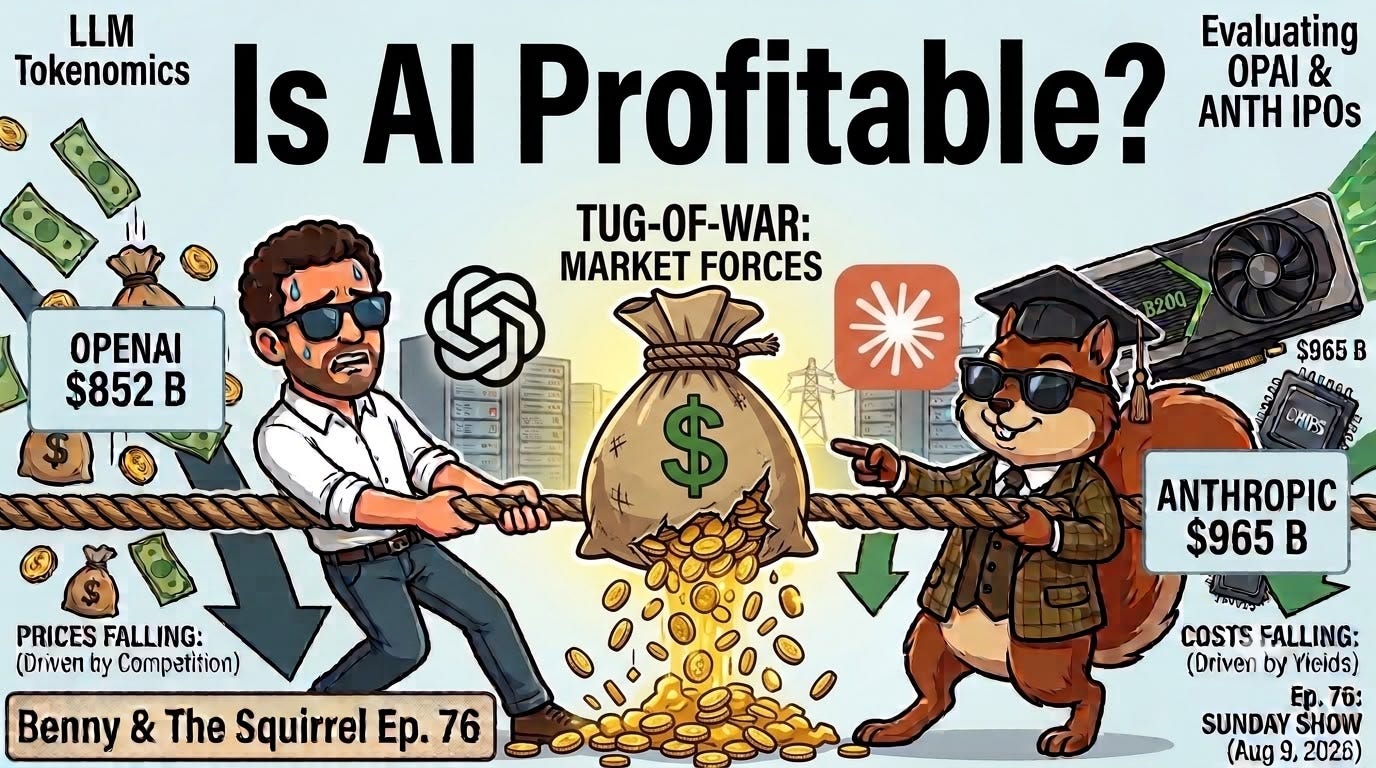
The hosts discuss the financial underpinnings of the AI industry, focusing on Anthropic and OpenAI as the key tenants driving hyperscaler capital expenditure. They argue that the entire boom relies on these companies’ spending, making their valuations critical. Recent funding rounds value OpenAI at $852 billion and Anthropic at $965 billion, but the hosts’ models—based on four scenarios from bear to bull—suggest these are overvalued: OpenAI’s last private round is roughly 25% above their expected value, while Anthropic’s is 8-10% above. They emphasize that token economics reveal fierce competition, with DeepSeek’s models causing price deflation and OpenAI cutting prices, while usage data shows DeepSeek consuming more tokens than OpenAI and Anthropic combined. However, they note that task-specific routing means aggregate data oversimplifies the picture. The hosts exclude AGI scenarios from their valuations, citing scaling limits, energy constraints, and human-gated tasks that cap upside. They also highlight that hyperscaler capex and depreciation are deferred until data centers become operational, creating lurking costs. Finally, they contrast LLM economics with traditional SaaS: inference costs introduce variable costs, unlike the near-zero marginal costs that drove SaaS valuations, making profitability harder to achieve. The model is provided in show notes for user feedback.
Right, and we're live at 6 p.m. Eastern Sunday, the 9th of August. Welcome to another unmissable Sunday show. Hi, Benny, back from St. Bartz. Looking forward to seeing you. From St. Bartz, bought a new mic so we don't have any more issues, guys, although I do blame that on you. Sorry about that in the last show. I think the shame should be promoted to Minister of Telecommunications for the Caribbean. He can fix the Wi-Fi. But anyway, listen, we are going AI heavy this weekend. I spent last week trying to basically put some numbers behind Salmandario's heavy lift. You know, the idea really is that if you look at the, if you like the economic underwriting of all of this hyperscaler CapEx boom, it's essentially built on the spending of these two private companies, anthropic and open AI. Right? Yes, there are other foundation labs around, but ultimately it's the spending of these two tenants of the data centers that's underwriting everything. And so whether you're a memory bull, whether you're fighting about whether or not the hyperscaler is going to return to free cash flow positive PNLs, you know, it's all based on whether or not these guys can be and also whether or not these guys can get public at a valuation and with a liquid currency that can support continued further CapEx, right? So essentially, essentially you need to understand, you know, one, what these companies are really worth today and, you know, what the sort of steady state PNL for them looks like that's got to, you know, underwrite the constant continued CapEx, which is really off X for those for those businesses, you know, you fall behind on the state of the art front pretty quickly in foundation model land. You do, it is, it is a very, very competitive market. Let's just put it that way and it's moving so fast that like, I mean, I think as everyone who watches this know as I'm involved the AI company and like just the amount that's changed in the last eight months is just incredible honestly, like and it's still changing and like so that's we're going to give you a first shot valuation, but just keep in mind that like this is not like valuing a shoe company, like the economic, yeah, the economics and the dynamics are changing and there's three wars going on, you know, you have the China War versus the US, the open or the local versus the cloud and then the intra cloud and, you know, no one's going to be able to tell you including anybody at any of those places exactly how this will play out. Yeah, and listen, just just a reminder, you know, we've got these spending commitments from the hyperscalers that are laid out here and this government put together this interesting shot. I mean, these two charts are really saying the same thing. You know, so much of this capex and depreciation is yet to be visible because the clock doesn't start ticking until the data center becomes operational. So you've got, you've got all of this cost lurking in the background and at the same time, right, if you look at, you know, and we talked about this a little bit, if you decompose these headline beats by the hyperscalers, I mean, this is Google's, you know, the markups on their stakes in in this case anthropic and SpaceX were all of the beat, right? By we put a great, we put a great meme out about that today, it happened. Yeah, exactly. So, I mean, I think, I think it, you know, it, it warrants doing the work. Now, you know, back in April, when we were starting to talk about SpaceX, right? And remember, we did the valuation back then, right? We decided that Starlink and the launch business were pretty straightforward to value because they are, you know, our, who times number of subs in the case of Starlink and then you have a fork, you can forecast a number of external launches for SpaceX, I, ones that aren't serving Starlink and then, you know, put, put some numbers around that. And then really for, for XAI, we kind of phoned it in, right? In our case, we just took the XAI SpaceX merger value from February, right? Yeah. And there's one, one caveat to that. I think that when we look at it now, the cursor acquisition was actually a really good acquisition. Like, I'm using GROC 4.5, a decent amount now since Rupert and I have to have the blue checks. We get that. Rupert, Rupert, such a fundamentalist he refuses to use it. But like, it's actually pretty good. And it went from being not even on the plane field. It's like, it's basically like, if you ever saw the movie Hoosiers where Ali comes in and wins the game for them at the end, I know this is probably not Rupert's thing because he doesn't like basketball and he's not American. But like, a lot of people who watch you knows, it's a equivalent of that. They came out of nowhere. And now they have a competitive model. So XAI has been revalued up in my mind. But, you know, again, we gave them the benefit of the doubt. Okay. But rewind right now, I mean, we had SpaceX's Made Learnings last week. And really just to tie back to the earlier points, you know, this jumbo build out that they've announced for, in terms of gigawatts for the next 18 months. I think that that kind of spook people some. I mean, it's just, it's compounding the issue, right? And again, you know, they are, they are leaning on and thropic and open AI's as tenants. Now, back in, back in March April, we were doing the valuation, you know, and thropic was valued at a relatively humble, I think, $400 billion and an open AI somewhere close. Now, you're looking at a very different order of magnitude in the, you know, the last round valued open AI at $852 billion. And the series H for anthropic the other day, valued at $9.65, right? So, you know, these are real numbers, right? In the case of certainly in the case of anthropic, we're looking at, you know, a targeted 2026 IPO. So these numbers need to need to start getting tested. And that is in the context of as we touched on earlier, some real competition, right? Yeah. So this is a good chart. This is a good chart because as we talked about whenever I went on a tyrant about the atomic unit of AI ROI, that it's a task, right? You don't, you don't measure your journey in gallons, you measure it in the cost to get the same parts, the cost for me to get to Melbourne to visit the squirrel. Like, you don't really care what the unit like variable cost is. And what we're seeing here is the traditional cradle curve, you know, frontier risk reward, same thing or, you know, utility of wine versus cost of wine. So we see like, fabled an opus 4.5 out on the, or four, or five out on the right. But deep seek V4 came out and it was a massive dump like in terms of deflation. And then now you had open AI, dropped their prices. And my buddy Brandon Carl wrote a really great piece. You guys should follow him on a sub stack. And he like, basically, we're just talking like this curve, we're keep trying to push that upper left. And so we'll talk about a little bit when we talk about token economics. But like, this is not exactly something that you're looking at and you're being like, oh, I really feel really good about inthropic here, sitting at the highest price by far on the curve. And yeah, they have the best models. But not by like a wide margin. Look at that. And it's showing up in the usage data. So this is the open router token usage data. And so just last week, in terms of token consumption, deep seek was 130% of open AI and anthropic combined last week. So I mean, and we've already seen open AI cut prices on a lot of their models in response to this. And this is happening at a hairy time when you come to think about valuation. One caveat to this that I would add, because when I was in St. Farts, I was teaching a guy who was a client of us there. And I was, you got to remember, by you can go to open router and they classify it by task. So they show you of like the 14 taxonomy tasks that they have who, what the model, the most popular models are by task. Because remember, when I talked about that is like different tasks, different models. And that's an important thing. So the aggregate, which Rupert just showed, doesn't tell the exact story. But like, yes, people like more or less is the way I would view that. Yeah, makes, makes perfect sense. And you know, it's going to depend on the sophistication level of the user, right? And people have got their hunt, people have got their harnesses set up so that easy tasks get automatically rooted to the cheap model. And they just reserve their token budget for the
for really tough stuff, right? - Yeah. - You know, you don't go to Fable for a chili con carne recipe. - And I think that that's the one like bridge of disconnect in the market right now, is there's still a lot of usage. Like the 1% of users who use 50% of the tokens, they know what they're doing, okay? But the 50% of users who are kind of like JV players but are in the game who, you know, there's still, it's still better deal for them than hiring off a Fiverr or, you know, whatever, like the price structure still collapsed on a lot of the things. But like basically you have to remember that we're in a situation now where these guys will get better. Like I, you know, I think there's gonna be a lot of people who are gonna in the next year go from novice. I don't know what I'm doing to, you know, middle of the curve users. Like, but remember it's middle of the curve is kind of much more to the right. So I would just say that like everyone's gonna get more efficient like every week probably. - Okay, I'm just gonna talk about the model for a second and I'm just gonna share a screen for a second and we're gonna put a copy of this in the show notes. So you can see that, right? So I mean, essentially really simple, what? - I cannot see it. You cannot, okay, let me just try that. - But just as Rupert finds that, he wrote an initial note, we took a little stab at the first valuation in the same way that we did with SpaceX as he mentioned. Obviously both the filings are now, we don't have Ed Zitron's insider guy giving us the financials, but this is based on, you know, the data we have. - Listen, what I'm gonna do is I'm gonna put the, I'm gonna put the the Excel in the show notes so people can play through it. But essentially let me outline what I did, right? I modeled four scenarios for both Anthropic and OpenAI, ranging from on the, on the bare side, you know, the Y-PAT scenario where they just sort of collapse in on themselves as they never get to a positive contribution market. And we'll talk about contribution margins in detail with your tokenomics. And then on the bull case, you're looking at sort of, Anthropic doing 450 yards of EBITDA in 2030, right? And putting appropriate multiples on that and then doing an expected value of probability weighted, waiting of those 2030 valuations and then discounting them back to today. Top of trees, I reckon that OpenAI's last private round is probably 25% above where I see that probably if you waited expected value today for the business. Anthropics 965 is just marginally, may eight, eight, 10% above where I am. Now, the point there is that your dammit, you know, when I used to take a lot of companies public, there was something called an IPO discount. And ultimately, you know, you want, you want to be, you want to be growing into a valuation as you become public. And so they're looking to come out with something which is, you know, where everything, the, you know, the best of all possible worlds is frankly already baked into the price. - Can you talk about that for a second real quick? 'Cause it's an interesting, you say that like, OpenAI was very obviously to us fully valued, if you will at 135, they jacked it up to 215, and I think I talked about it. - Hey, say, you talking about SpaceX, just back here. - Oh yeah, sorry, yeah, SpaceX. And I waited for the options to open and then I put on that back spread, which was pretty good. 150, 120 where you got a four to one convexity on it. And is that a fake move? Like was that, obviously wasn't really a discount, but like, is that like, you know, how do you think about that? Like what, what was that move? It was like, the initial move and then it went down almost every day until earnings. - So I think what happened here is, I mean, you had a classic Elon move, don't overthink it, think it, don't try to justify it. Yeah, we were being canmudgeonly bears of around, around the story and, you know, like idiots focusing on valuation and just everyone piled in and bought it, right? On a very thin float, number go up, right? Then what's happened, listen, when even CNN is talking about IPO lockups, right? Ultimately, the whole world, yeah, that the whole world got onto the sort of common knowledge business around supply, right? And then, you know, just in line with earnings, where massive headlines about, you know, the billion dollar, the billion dollar number coming forward by a year, the billion dollar, the billion dollar number coming forward by a year, you know, massive bullish investment numbers around, around capex. And that's when, you know, the hand of God, Jan, the option, the, the listed option chain. And so that, that's the spike that we saw last week, you know, everyone was-- - Well, the other law, right? The day that options came out was the top. - Well, no, you're talking about, you're talking about, I'm talking about last week now, right? - Oh, yeah, okay. - I'm talking about last week now, around the earnings. And that was the textbook, Gamma Squeeze, which, which, you know, we had to assume that was coming. But, you know, ultimately, I've heard it from several sources that, you know, there's been delays in some of these pre-IPO shares getting into brokerage accounts. So, you know, did we see a lot of selling yet? No, probably not. I mean, for me, for me, it's still a do not touch stock. But getting back to OpenAI and Anthropic, and again, the model will be in the notes, and you can play with my assumptions. And, and, you know, I'd love feedback on what we're missed. Now, one of the scenarios that I didn't price, right, was the AGI scenario. Now, $87,000 worth of volume on AGI by a certain data on culture is not really swinging my opinion very much. We've talked a lot about whether LLMs are a path to AGI. I'm certainly on the skeptical front there. But in terms of the economic model where, you know, they have created digital God. I think you need to be really careful of what kind of numbers you can put around these foundation model companies if they do even achieve that, because you get, you know, revenue and profit scaling issues, right? Even in a world where intelligence is only defined by availability of energy and compute, right? At the end of the day, you know, there is a limit to the share of economic growth that Skynet can take. And so, I actually think that the bull cases for my models probably represent the sort of the cap on a rational valuation for these businesses. And I took, I took, I developed that AGI argument in a bit more detail in my note that was out on Saturday. Yeah, and I would just add that like an LLM transformer is just not the model that's going to get you there. Like, yeah, that's what I'm saying. Yeah. Yeah, it's not. And when you understand the mechanics of it, and like, you see the societal pushback already, the data center is getting, you know, said no to the fact that it's like, why would we give all our power and energy to this? And then when you, when you learn how to do graph engineering or loop engineering, you realize like how much it uses to get there because it's all recursive. It's not like it knows it does. It just, it kind of keeps, has to keep computing in order to get to a really good answer. And it's amazing that it can, to be fair. But yeah, this is not going to be, yeah, it's not going to be an AGI. Like, this isn't what's going to get us there. Yeah, I mean, and also just another simple way to look at it is that even if it did get there, right? Even if it did get there, there are still going to be tasks, you know, whether it's as simple as laying, laying the, laying the electric cabling and, you know, pouring the cement to build the next data center or getting planning permission or anything that involves sort of a human gate, whether it's, you know, for compliance or empathy, heaven forbid. You know, ultimately the cost of those tasks and it go through the roof, right? And if, if AGI is coming for the 30 trillion of global white collar payroll, who's paying for all this, right? So that sort of, that, that caps the scaling to the upside as well, right? Yeah. But I mean, spoke about this, like, you know, this concept of Jebans paradox, you got to remember that like England doesn't even use any coal power anymore. And like, you know, it, it ran off the exponential. And so there's four ceilings and we talked about this. So I don't need to go into it, but like it's like human capacity. Then it's the third one.
dynamic ceiling that it's like basically the substitution you know something that's better than it and then it's what Rubberidge talked about the final ceiling is oh you're 80% of global GDP you know like that's the final ceiling. Exactly so let's talk about token economics and Ben Benz puts together some slides here which which I think I think are useful to run through because people start banding around sort of cost per million tokens etc but I think this really needs to be framed properly because not all tokens are the same. Yeah so we put we'll have for paying subscribers we'll give the full deck but I included a couple key ones here and you gotta think about these like the power plants actually a decent analogy so you know you build a power plant generates power or generate you know it takes it energy whether it's from the sun or it's you know uranium or it's coal and it generates electricity which then increases your standard of living very similar to this right and not surprising that power is the big constraint and the big thing for these things so think of electricity produced as tokens the actual capital as the chips and the cooling and the data center shell and and then basically the what your utility charges you as the token price like so your cost of using the utility and thus you've heard a lot of people say these are LLMs are actually utilities because they kind of are right so you know it's a too pronged utility in the sense that the hyper scalers are making bets that they're the power generators and there's a the the LLMs are kind of weird transmission line I guess would be the way you think about it and you know which is funny because actually they make all their money on transmission lines where we'll decide or we'll see if the LLM frontier models can actually make money but like just so everyone knows like the initial freak out in SaaS was because if you have a line of code that you know are a lot of lines of code that become a program the incremental or marginal cost of a new user is almost zero and that's why these things got astronomical valuations over the years because all you really were worried about is how much do I got to pay a sales guy or marketing or whatever your customer acquisition strategy was versus the incremental seat but then you know really then what's the turn because yeah absolutely and and so this is the thing this is so the if you think about it in in industrial terms right in the V 2.0 SaaS the contribution margin was the EBITDA margin right okay we have some fuckery around stock based compensation getting in the way of true EBITDA but you know this is Silicon Valley but also remember now go ahead and keep going sorry but ultimately in in a world of LLMs you've got a mobile variable cost in the form of inference and ultimately ultimately unless you can really smash down the cost of inference going forward you know this is not the the SaaS analogy just does not work because the contribution margin is always under threat and go to the next slide and I want to like talk about the concept that it why it's like a power plant in sense that like the token capacity if you don't use it it parishes the same way that if you you know why nuclear doesn't work right why did nuke excel excel on like complain constantly it's because they were generating at a hundred percent overnight where people weren't using power whereas like wind and even gas and coal you know coal's the slowest but there's only a couple hours wind is almost instant solar like these in gases within a couple minutes they can dynamically adjust their capacity versus demand right which is why if you ever meet a power trader like my buddy Tom art friend of the show Tom Jen's those guys pay attention to the weather quick because that is the number one driver of variants in electricity man but so let's go through this real quick so gross profit because if you talk to an AI bowl like I was talking about it a big tech hedge fund one of the biggest and they're like well the difference gross margins are almost 80 percent well that doesn't that's the contribution margin right that doesn't include the R&D team that doesn't include the training cost what was the what was the acronym you're using so this is the one that the AI spoke spoke to banning around which is Ebtit right which I think is going to age as bad as as well as community just that EBITDA did for we work this is earnings before training interest and tax and you know you can't you can't training these models which increasingly you're having to do once every three to six months you know is OPEX it's not one off cap X it can't be stripped out yeah so just in just to be clear tokens so that's how many tokens you sell times the average token price which will get it I can get into a little bit but understand that that's not just the listed price because there's it's a blended of API plus the subscription and remember subscription is a wildly variable margins think about it like all you can eat buffet fat Albert hey hey like that guy's killing you whereas Rupert and I that makes a little bit of money on us on the all you can eat buffet and so that that's a very hard dynamic to shift and understand and then the gross margin is uncertain at this point but basically you're going to have a situation where this first is the demand engine second is the supply engine so tokens apply equals hardware so all gentsons product you know other guys are entering the fray and then what Rupert talked about the inference share versus the training model share you think about inference is like that's the incremental cost of providing the service the training is like creating the service like the cost of creating the shoe factory and so it isn't surprising that they're trying to like create a profitability metric that excludes the cost of actual creating that and then remember the slide we showed you before of like how models keep getting better it's not like this is a 20 year factory making you know magazine paper like or shoes or or steel like you know who's using chat GPT for these days and then you know the token yield is the final like part of that and that's a big efficiency gain so ultimately we're coming down to a situation where is cost going to keep dropping faster like then then you know then demand or then you know the demand so here's the first one token serve per million I think most people are generally like aware of that or price per million I guess so tokens then time to gross margin that's your gross profit and then basically go to the next one it gets a little bit better um you know this is that exactly what we just showed like token yield is the usable tokens produced per hour you know and the inference shares what we just talked about and so you have to think about these two things as two exponential curves and which curves moving faster than the other and that's really where the games being played so everybody gets like in their mind they're like oh demand's exponentially growing okay fine but like what what is like of those two curves what's moving faster supply or demand moving faster and and you go economics 101 demand supplies what's going to determine profitability price especially in a market that has enormous capital costs combined with global competition it's not like this is like the internet where it was just Silicon Valley game you know what I mean like this is a China's involved I actually subscribed to a Japanese model I'm sure the Europeans will get off the mat there is a German model that's okay like point is it's not only that it's local models are becoming the thing when I was in St. Bartz I had an AI engineer say that she's gonna start up that AI startup they're using more and more local you know I think Apple's stock price reflects that Siri will go from just not that smart to being Opus 4.6 or Opus 4.8 or like you know something that's decent that that $100 price increase will just year one right and locally installed on your phone yeah spell that out a bit more because we we talked about this length yesterday right so Apple did a 20% price increase and like I think if you were just like oh what are you giving me for $200 incremental that's a huge inflation but I think that it will feel less if you have a local Opus 4.8 model on your phone that works pretty well and you don't have to pay $20 per month because like Rupert what is that 240 a year and there's your price increase and then everything you use beyond that accrues you kind of like a car or an oil well or any of these things where you know the you pay for the first year to a value and then you accrue the tail or less yeah yeah I think I
I kind of, I mean, if Apple wasn't already so goddamn expensive for a pretty mayor growth rate, yeah, I'd get much more excited about this. But, you know, with hindsight, they're going to look to have played this phase pretty well. Yeah, I don't know if that was luck or skill, but like, they definitely look good now. And then we have this concept of perishability of just creating more capacity. So when everyone's like, oh, I want to own Vistra, I want to own Nvidia, like, because everyone needs more compute. Well, when are people using compute? How are they routing the compute? Like, and as we talked about earlier in the show, like, people are going to get better at all this. There is this perishability to the compute, just like there is to power generation, which is why there's not been a whole lot more power. And remember, there's, if you ever look at the, the PGM, which is the biggest power grid in America, they constantly have had higher demand forecasts than realize. Big part of it was LED lights got introduced. Smart electronics got to let it reduce smart fridges, better LED lights in TVs and computer screens, like, and again, don't short engineers, like guys are going to optimize. Right. And so, you know, the bottom line here is, is that it's a margin race. It's, will the costs drop faster than the prices are dropping? And competition is what drives prices and yields and, you know, innovation is what drives the, the cost down. And this is the key question to like focus on as we go forward, because ultimately, demand is going to grow. So don't like get sucked into that because I think that's the big trick, is that like demand growing will be this bug a boo, right? Like that. It's like, oh, I'm using it more in the agents. And then only this percentage of people, but I think we can go back to Rupert. Like, this is the fastest, if you use technology ever, my mom uses quad and grok. I mean, she's so washed as the nightly news, you know what I mean? Like, so if my boomer mother is already on two models, you know, and actually, we're talking to the consumer part of it. That's actually a good thing to like add on here, because I think, and then we'll, we'll touch on the enterprise too. And then we'll Yeah, I mean, and this is, and this, and this really comes through in the modeling and the difference between modeling open AI and an anthropic. Obviously, you know, there's an argument that open AI has, you know, has got to a position in consumer AI consumption that Google got to in search. And the question is, to what extent can they continue to fund consumer inference, you know, to the extent that they are, right? I mean, you know, your mom looking up a chili recipe on on chat GPT, you know, is not is not is is not what and her her her writ large lots of lots of Ben's mums around the world, you know, open AI subsidizing all of that. And they if it's on your iPhone, as part of your cost of your new iPhone, you're losing that business right there. Yeah, absolutely, absolutely. So, you know, I think that's why my valuation exercises, you know, extracts a much higher penalty on on open AI. But then, you know, the enterprise business is really at risk of becoming McKinsey, right? Because ultimately, you know, these super super powerful LLMs that the foundation labs produce, maybe maybe they just get introduced as a kind of, you know, Delta Force for fixing problems that enterprises have got with their, you know, self-hosted open source, because they don't want to share all their data with the they don't share all their data with the foundation labs. And so, you know, we're already talking about forward deployed engineers for both for both Amplropic and for open AI right now. This is scarily sounding like becoming a sort of consulting type business. And we know how those scale. And the thing that we need to remember is that we're finding data security is super important. So, in the enterprise, it's, you know, consumer don't care, I mean, maybe they care, but they they're not going to put the effort in time, or maybe they don't even know how, like, but like an enterprise, like the data security is like number one. And with the Trump administration, as it is kind of Silicon Valley favorable, you know, there's got, there's a trend of moving your data where you're like storing it outside of the US, not a good sign. And also, like, maybe we want to live above. And I think I've talked about this a number of times, the upper stack, like, you're not exactly like we're just going to give it to inthropic or we're going to give it to open AI. We'll like, we'll use them. But even open router already has a model where you can put three or four models in there, see what the result is for each of them. Just put your task in there. And so this is just starting, right? Like this, this concept of like, what the models are commodity. Like I just, we, that's why I started with the power plant. Like you, you want to put a super multiple on a commodity. We did that before when you go back 100 and some years of electricity and go see how that worked out. Yeah, absolutely. And I think the other thing is that the fortune 1000 global enterprise, right, they're not going to make the same mistakes as they did, handing over all of their customer data to Salesforce, right? They're not going to get that data lock in, right? They've learned, they've learned from that mistake in the past. And I think they're going to be super sensitive around how they construct their AI usage as a result of that. And you know what it's a good enough. Go ahead. So go on. Yeah, I was just saying, you notice a good analogy of that when I was a young analyst, fidelity, I was one of the largest theater owners and I was trying to figure out, and I used to sit and read Hastings office a couple times in Netflix when they were trying to turn from a DVD to streaming, the movie industry was not interested in being napsured the way the music industry was. So Rupert's point is very good that like once you've seen it, you already have like a visual analogy in your head of like, we're not doing that again. So like, I think that's right. Yeah. Yeah. So anyway, so please, please, please check out the show notes. So that's available for both many of my subscribers. I would love feedback. I'd love particularly to hear for where I'm wrong on the bull case. The bear case is pretty easy to model, right? Because that's just that's just widget math, right? But I want to I want to really understand where I'm wrong on the bull case. And in the full deck, I put the full deck of the token economics on there and Rupert's model. So this actually a good extra episode here for you guys. It's a good bundle. It's a good bundle. And I think also more importantly, you know, than just valuing two two private companies that you can't buy or sell yet. You know, let's not underscore, you know, just how much of the AI value chain is predicated on these businesses being worth the trillion dollars, right? And sustainable and growing trillion dollar companies. And I just think the jury is sure is absolutely still out on that. I mean, because think about it SpaceX has a lease with Anthropic for 1.25 billion a year. They got Google has 2027 clouds 50% is Anthropic. So the four and you know, I was looking at a core weave deal. And you know, these guys have an open AI as a key part of the credit. So this transmission mechanism is violent. Let's put it that way. Yeah. These two these two companies are the anchor tenants. I why the one of them on any big cap X bill out there right now. And you know, the the economic the economic model is far from fully tested. Yeah. And also just let's remember, we're still in this subsidized period, right? Like so there's a ton of I mean, so many startups that are using this stuff funded by people. There's so many people who don't know how to use this stuff as I've hammered on a lot on the show over the last two months, like harnessing optimization, route optimization, you know, et cetera. And it's only going to get better as the cost per token is, you know, we showed the curve like this is not a place where you want to be like thinking about it like it's steel. So I'm trying to tell you like this is a dynamic and the China component of it really throws a wrench because we didn't have an international competition before like this. So it is a unique beast that we've never seen before that has a lot of capital behind it with heavy capital and a price war and international war and even an intercloud war. So be careful. Recipe for capital misallocation and that caps in capital destruction. Listen, we'll leave it there. Have a great week everyone. Inflation inflation numbers this week and we I mean, you know, listen, the wall the wall the wall the wall trudges on. Apparently apparently we're just going to what was it we're just going to play it like. We're going to low key the straight this week.
Let's see how that works. Anyway, good luck out there. Um, Benny and the squirrel are out.
Podcast Summary
Key Points:
The AI boom is underwritten by spending from two private companies, Anthropic and OpenAI, which justifies analyzing their valuations.
Recent valuations are high
Token economics show intense competition, with DeepSeek’s models causing price deflation and OpenAI cutting prices in response.
Usage data reveals DeepSeek consumed 130% of OpenAI and Anthropic’s combined token usage last week, though task-specific routing matters.
The hosts model four scenarios for both companies, finding OpenAI’s private round is ~25% above their expected value, while Anthropic’s is ~8-10% above.
AGI scenarios are excluded from valuations due to scaling limits, energy constraints, and human-gated tasks capping upside.
Hyperscaler capex and depreciation are hidden until data centers become operational, adding future cost pressure.
LLM economics differ from SaaS
Summary:
The hosts discuss the financial underpinnings of the AI industry, focusing on Anthropic and OpenAI as the key tenants driving hyperscaler capital expenditure. They argue that the entire boom relies on these companies’ spending, making their valuations critical. Recent funding rounds value OpenAI at $852 billion and Anthropic at $965 billion, but the hosts’ models—based on four scenarios from bear to bull—suggest these are overvalued: OpenAI’s last private round is roughly 25% above their expected value, while Anthropic’s is 8-10% above.
They emphasize that token economics reveal fierce competition, with DeepSeek’s models causing price deflation and OpenAI cutting prices, while usage data shows DeepSeek consuming more tokens than OpenAI and Anthropic combined. However, they note that task-specific routing means aggregate data oversimplifies the picture. The hosts exclude AGI scenarios from their valuations, citing scaling limits, energy constraints, and human-gated tasks that cap upside.
They also highlight that hyperscaler capex and depreciation are deferred until data centers become operational, creating lurking costs. Finally, they contrast LLM economics with traditional SaaS: inference costs introduce variable costs, unlike the near-zero marginal costs that drove SaaS valuations, making profitability harder to achieve. The model is provided in show notes for user feedback.
FAQs
The discussion focuses on valuing AI foundation model companies like Anthropic and OpenAI, and the economic factors underpinning hyperscaler capital expenditure.
They are the primary tenants of data centers, and their spending underwrites the hyperscaler CapEx boom, making their financial health and public market prospects critical.
OpenAI was valued at $852 billion in its last round, and Anthropic's Series H valued it at $965 billion, with a targeted 2026 IPO.
The speaker estimates OpenAI's last private round is about 25% above expected value, and Anthropic's valuation is marginally 8-10% above, suggesting they are fully valued.
The atomic unit is a task, not a variable cost like gallons; it's about the cost to accomplish the same task, which is key to evaluating AI model efficiency.
DeepSeek's token consumption was 130% of OpenAI and Anthropic combined last week, indicating significant competitive pressure, leading OpenAI to cut prices.
Chat with AI
Loading...
Pro features
Go deeper with this episode
Unlock creator-grade tools that turn any transcript into show notes and subtitle files.
 PodcastTranscript AI