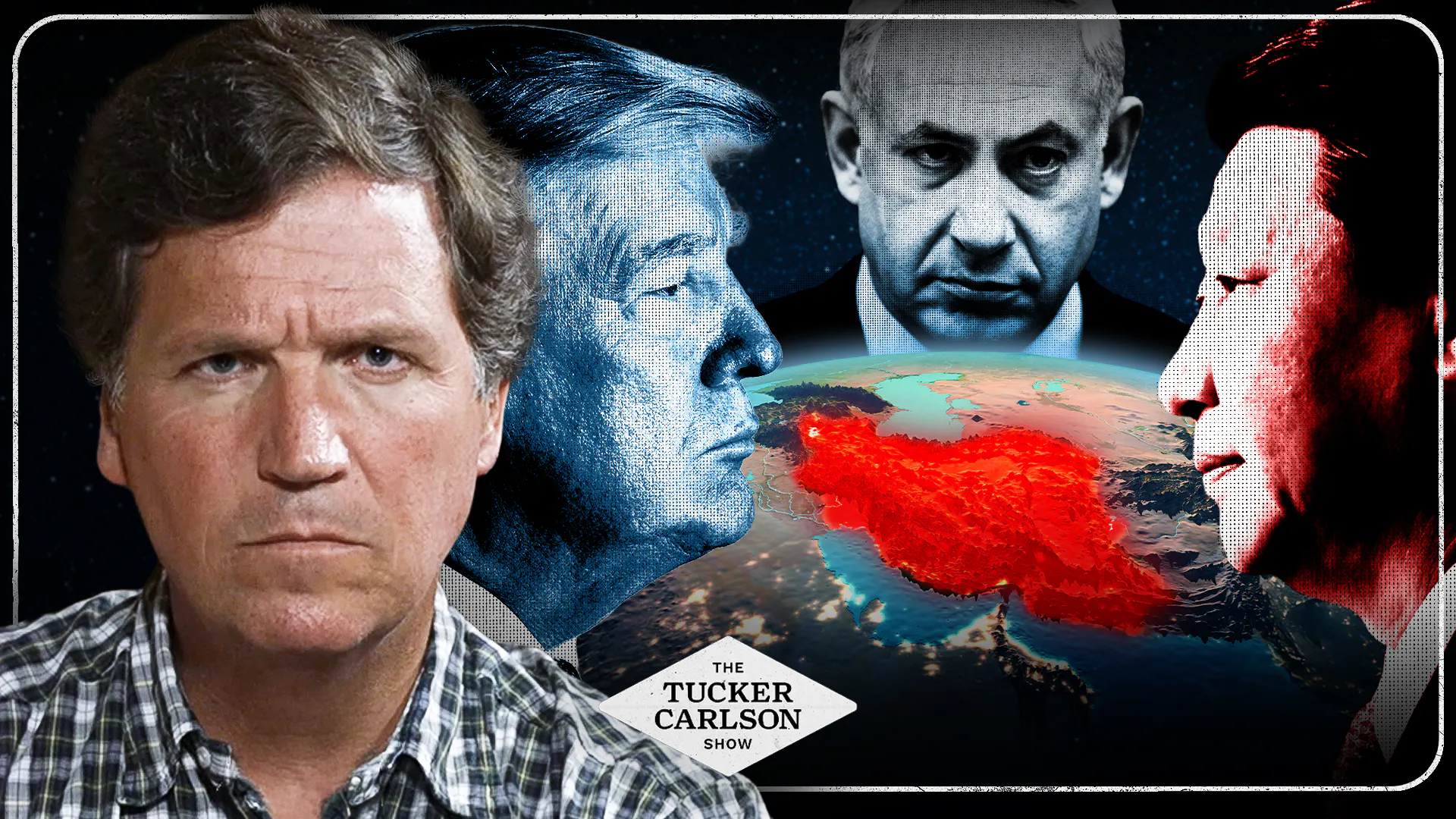
Iran Update: Israel’s Newest Bombing Campaign, the Oncoming War With China and How to Avoid It
from The Tucker Carlson Show
60m 4s
The transcript features a discussion on geostrategic tensions involving the US, Israel, Iran, and China. The speaker argues that the current US-Israel conflict with Iran is a "war of choice" that has forced China into a reactive role. A central issue is the bombing of China's Belt and Road railroad, a land-based trade route connecting Pacific ports to the Persian Gulf and Europe. This route threatens US maritime dominance by offering faster, cheaper transport (16 hours vs. 2-3 days by sea) and could render key chokepoints like the Suez Canal obsolete. The speaker suggests the Pentagon targets this railroad to signal opposition to China's growing influence. China, seeking to avoid war, aims to replace the dollar as the global reserve currency and dismantle the US financial system (e.g., SWIFT, sanctions), which it blames for mass casualties. Historical parallels are drawn to WWII supply routes through Iran. The discussion also explores US internal politics, where some factions favor a cold war with China to maintain empire and control, while others prefer economic competition. The speaker critiques US media and government narratives, referencing the JFK assassination and recent events, and emphasizes that China's strategy is to beat the US without direct military conflict, focusing on technological, cultural, and financial dominance.
[MUSIC] Colonel Loggeron, thank you so much for doing this. I think most Americans understand this as a war between the United States and partnership with Israel against Iran, but there of course a lot of other players acting on this drama, maybe in ways that we don't perceive. China would be the biggest and potentially most threatening to our interests. What is China's role in this conflict? It's a role I think forced upon them at the moment, not that they can't handle it. They seem to be quite adaptable with regard to this very frenetic and indeterminate presidency and empire, but it's forced on them because they didn't think that this was going to happen in the way that it's happened, I think, that is to say this being the war of choice with Iran and some things are happening in the war that are probably disturbing to them. For example, the latest completed railroad and their five base road initiative railroads was probably the most strategic one in many ways. It brings China's Pacific ports all the way around on land and then intended was up the Persian Gulf along the old route that we used to resupply the Soviet Union during World War II and eventually into the Caucasus and beyond. Now we're bombing it. Israel and we are bombing that railroad. Now of course, railroads don't get bombed very well. You could drop all the ordinance in the world on them and they will get a bunch of people out there and repair them pretty quickly. But nonetheless, it shows that there's something more to this war of choice than perhaps even Trump knows about. I'm sure there are people in the Pentagon who know about it that are happening and the world is basically ignorant of it. Well, can you expand on that? There are things happening that President doesn't know about but that some planners that the Pentagon doubtless do. What would those things be? Well, one of them is bombing that railroad. It just started recently with both the Israel and the United States making it a principal target. One of the things they're trying to do, of course, and this is a hugely geostrategic issue that most people don't. I'm not sure I understand it completely, but if you go back in time to earlier empires when the real power, cultural, technological, economic, military, and otherwise was in the east, you see one of the ways that those empires, roughly, defeated other empires by shifting maritime commerce to the land because maritime commerce was simply becoming too expensive to order. They put the Portuguese empire out of business, for example. What they did was they shifted along one of their routes. Primary routes was this route. China is now using to eventually go up the Persian Gulf and into Azerbaijan or many in Georgia, the Caucasus along Northward, marrying up with the other three base road and say railroads, which incidentally have been a dumb-rated seriously by the war in Ukraine. Does that ring a bell with any baggage, or strategically? If they're not emptying into Europe as they were intended to do, they've stopped pretty much. And what does that do? Well, basically those railroads mean that instead of two and a half to three days and very expensive maritime shipping for China's Pacific port produce, it's 16 hours into the heart of Europe. It's a huge change. One that will drive a lot of commerce off the seas and will, to a certain extent, negate the Babel Mandab, the straight-of-our-muse, the Suez Canal, maybe even the Panama Canal. Although China has built that very, very luxurious state of the art port on the west coast of Peru, but that's looking toward the Pacific and looking toward that aspect of commerce. So don't expect a lot of that to be going through the canal, even. These railroads are a game changer in terms of commerce. And think about this remote. In terms of one of the United States' supposedly great strengths, it's maritime power. Because we won't need to police the seas anymore. It'll all be going overlaid. I think a lot of Americans are at the greatest advantage in understanding this because they lack a sense of the mechanics of commerce, products just appear. It's not clear how, and they lack a sense of geography, the idea that Iran, you could reach China from Iran over land. People, I think, lack the perspective of how exactly that would happen. But clearly, the Pentagon understands these questions, right? So they're bombing that railroad for a reason which would be what, do you think? Well, just set it back and to tell China we know what they're doing and we don't like it. That route is such a serious threat in and of itself because of what you look at in terms of commerce during the period immediately prior to World War II. When Britain and the United States sneaked into Iran, and I mean that, we sneaked in there. They were Nazi sympathizers at the time. And we built the road and we flanked it with security. And at that time, the Iranians couldn't challenge it very much. And we shipped all manner of goods up that road into the belly of the Soviet Union. Stalin and Grob would have never held out without that supply route. Hundreds of thousands of trucks and wheel vehicles and other implements of war went up that route. It was second only to romance, and in terms of strategic effect, it was more important than romance. How many Americans even know that? How many Americans even knew that at the time? So it's a real game changer in terms of the United States if it has to do anything about China visibly, if it has to go to war with China, if it has to fight them, it's essential that we control these lines of communication and we're not. So what's the Chinese perspective on this? As it has been ever since the Dung Dao Peng started capitalism with Chinese characteristics, we do not want to war. We will beat you without a war. We are going to be you technologically. We're going to be you culturally. We're going to beat you militarily. We're going to beat you every dimension of power that you can imagine. And this latest edict by Xi Jinping, which the American press has completely missed as far as I can tell, he put out the latest in a series of edicts that have come from Chinese premieres from Dung Dao Peng on, Hu Xin Tao is a little bit of an aberration, but that's one reason they got rid of him. But Xi Jinping has been right in there and this latest one says, we are essentially triumphant in every element of global power, but one. Now we're going to take on that one. And that one is financial control. And that means the remember being substituted for the dollar and everything from all sales to you name it. It will become the transactional reserve currency. Already is to a great extent for about 40% of the world. They're going to shoot for 60 to 70% of the world. They're going to drive the Bretton wood system back where it came from. They're going to eliminate swift. They're going to eliminate our ability to sanction countries. That's one of their major purposes. That's an altruistic purpose for them. They think eliminating our ability to put sanctions on other countries in the world, through which since the turn of this century, we have killed 38 million people, mostly men, women and children, 38 million people. That rival Stalin's purges, Mao Zedong's cultural revolution. It almost rivals Hitler in terms of the people that he killed directly in World War II, not the whole war with 100 million casualties, but certainly the people he killed directly. So we're looking at the United States and China looks at us this way, is having done that damage in the world with our financial system which allowed us to put primary and secondary sanctions on 30% of the world. Go to O'Fac and see how many countries we have under sanction. It's incredible. And these sanctions kill men, women and children over time. We kill 500,000 in Sodom and Saints Iraq when we have the sanctions on him. Madeline Albright said when she was confronted with that statistic, so what, it was worth it. Madeline wanted to join Hillary in the world of Creighton. She did. This is a serious issue for China and they want to stop it. Well, here's something that thieves count on. Security cameras usually stop where Wi-Fi stops, right? Makes sense. So if you've got to barn a job site, equipment parked outside along driveway, criminals does a good chance that nobody is watching this because there's no Wi-Fi. That's why we like defend by tack to cam, it's a new sponsor of this show. Defense cameras don't run on Wi-Fi. They run on cellular, just like your phone so they work everywhere. If you've got cell signal, you've got security. Middle of nowhere, edge of your property, construction site wherever you need it. You don't need Wi-Fi. Big difference. And you can see why it matters. So we use these cameras in places where Wi-Fi doesn't reach. The setup is super simple. You mount the camera, open the defend app, and you are alive. You get clear footage, night vision alert sent right to your phone. It's great for construction sites, ranches, farms, or anyone with a property that stretches beyond a router.
And here's something we really appreciate. Defend does not sell your data. Not to tech companies, not to advertisers, not to China. No one. Your footage belongs to you. And that's big. Plan started about five bucks a month. No contract cancel anytime. Visit defendcelcam.com. That's defendcelcam.com. It's also a moral stand on the United States. And just jumping ahead, it strikes me that once the US government, OFAC, loses the ability to sanction other countries, it will have only the power to sanction American citizens for disobedience with programmable digital currency. And it will do something very similar to us. Bingo. Yeah. I mean, that does seem like, you know, a natural final log. Well, it does seem like it does seem like the things you do to your opponents abroad will be done to your own citizens by the same government. Yes. I mean, that seems like a pretty consistent lesson of history. So that's why empires are bad because they're bad for your own population. But I wonder like China, we see our competition with China in primarily military terms. I think that's what we talk about in public. No, whenever it talks about the relative size of the economies, it's like how many aircraft carriers do they have? But that's new. That's new. In my administration, my administration, in George W. Bush's administration, Colin Powell was given his head on only one major international issue. And that was China. And I was there when George W. Bush said it's important to Walmart meant, did they to stay away from it? And he meant that he meant that we were in strategic economic competition with China. And he didn't mind that because he thought we were better than they were at capitalism. And we should certainly hold our head up in the world in that regard. So he gave Colin Powell his head. And Powell was constantly, constantly thwarting the vice president in those terms because Donald Russell and Dick Cheney wanted a hot war or a cold war. They referred to the latter with China. And Bush didn't want it. So he turned Colin loose on Taiwan in particular. And wound up at the end of his first term having to repudiate Chen Shui beyond publicly and telling him to shut up about his independence referendum and get off that kick because he knew that was a red line with Beijing. So that's the last president I think we had who understood fundamentally this economic relationship and thought that we could wage it with them and at least tie them if not win. >> The impulse to go to war with China, like in exchange for ballistic missiles at least, where does that come from? Why would you want that? Why would Dick Cheney and Rumsfeld and so many others be advocating for that? >> I don't think they really wanted a hot war, but the thing that scared me and scared Colin Powell too was that they seemed to be willing to accept it if they couldn't get the cold war. But what they really wanted was a replacement for the cold war that would put the same pressures on us that the cold war did. And that would be good in their sense. And occasionally it would reveal things like a statement. We don't want people to love us, we want people to fear us. And that was okay, but it didn't go over that big with I think a genuine Christian, I mean genuine Christian, a sermon on the Mount type Christian that George W. Bush was. And so in that sense that pushed him over into Powell's camp. But they wanted that cold war for sure because they thought judging from their experience for their whole lives virtually. That was the only way to keep the empire in power and in check domestically and internationally is to have that huge pressure on them all the time. And it was also the only way for Highly Burton and Lockheed Martin and host of others whom Dick loved and Don loved to make a lot of money. But what do you mean when you say a cold war would be the only way to keep the empire together internally? What does that mean? You need an external enemy. If you've ever read, maybe you're too young, but there's an argument over whether it was a fanciful parody from somebody at the New Yorker or wasn't a serious study, it was called the Report from Iron Mountain. It was a pamphlet, Lyndon Johnson when he said it and when he read it, he said, "Tell his staff to get rid of it." You know, ban it. It didn't happen. The New York Times picked up on it. It went viral. Two issues were put out. The in that report, which many thought really was response to Kennedy's June speech at American University. They said impossible. In that report, they went through all the cold war parameters and such and they said, "Impossible. You can never have peace." The only way an empire like the United States of America can survive is to have a constant threat. It must have a threat in order to survive. They did say at the end that if you could dream up some other way of creating the same kind of pressure that that sort of threat did, and they even said, "Religion used to do that." The monarchs, the prince, the prelate. They used to threaten the people with God and that pretty much kept them in line. You're going to burn in hell if you don't do what I tell you to do. That sort of thing. Fork model, looking into the Muslims and saying, "Repent. Become a Christian or I'll cut your throat." That's what he did if they didn't repent. Many of them are pented. You could have that, but they thought that was passe. That kind of threat wouldn't do the sort of thing that an actual state threat would do. Their conclusion was Kennedy was nuts. You needed that kind of external threat to keep a country as variegated, as diverse, and as ultimately powerful as America was. In fact, you needed that kind of threat. To keep your own citizens obedient? Yes, very much so. That's a part of it too. To keep them toe in the line and to keep them paying their taxes and everything that you do in a state that once was a republic and now is an empire. This is not at all related to I asked you to have this conversation, but I can't resist. Who do you think did kill Kennedy? I'm fairly certain after a lot of study, I'm a hunter. I know weapons fairly well. I know that weapon, the RV Oswald, no way it shot John Kennedy and killed him. I don't even think he could hit him from there. You know the FBI guy, the expert, tried with that very weapon three times to simulate the Zapruder film intervals and get that many rounds off, even get them off, not just accurately, and he couldn't do it. I think it was a combination of CIA, mafia, and probably Pentagon, and I don't mean organizationally, but I mean dissenters in all three of those groups. And the motive would be what? They thought, especially with what he had done with regard to Cuba in October of '62, and then the speech in June 10th, I think of 1963 at American University, that he was serious. He was serious, and his brother was serious with regard to the mafia and policing it up. But Kennedy himself, the president, was serious about seeking first rapprochement with the Soviet Union. Cuba had really, and Berlin too. Berlin was a more serious crisis in the hot summer of '61 than Cuba was. Cuba was 13 days packed into dynamism and that you in and everything. Yes. And we thought it was serious, well, Berlin was strategic for the Russians. If the GDP are disappeared and it was disappearing at about 10,000 citizens a week, think of that for a minute, we helped them build the wall. We actually helped them build that wall. When I say help, I mean our tanks, our machine guns, oversaw the party's building the wall to prevent anyone from interfering with them. We let them build the wall because that was the only way to stanch that flow out of the GDR East Germany. And that was strategic for the Russians. So that was a much more serious crisis, but he'd gone through both of those. And he knew how close we'd come to an exchange of nuclear weapons and he wanted an end to that. And they thought this was a firm, a firm will wishes an even dangerous wishes. They thought that Soviets would pull a trick on us, you know, all the things you usually throw out there when you don't trust your enemy. And they were willing to take him out in order to prevent that from happening. And they were mad at him for the Bay of Pigs. Where do you think Jack Ruby came from? They found him somewhere. I was at Baylor University at that time and I remember when the announcement was made, I was absolutely stunned. Me and my roommate could barely talk for about a half an hour that President has just been shot not too far from us. We were in Wake Up. And then we were on the TV and we watched this guy walk up to Ruby and shoot him right there. And we at that moment, Bob and I said to ourselves, this stinks. This really stinks. Yeah. When the lone gunman kills the lone gunman, they're probably not lone gunmen. No, you got it. You think about Charlie Kirk, for example, and what's happening right now with that assassination, which I can't even tell you what's happening. I don't even know if the FBI has been so unforthugging. I know.
So I told you, I'm a weapons guy that did not happen the way they're saying it happened. And I doubt very seriously if that guy stuck a 30-0, 6-0 down his pants leg and walked away. Cost of living is already making it hard to live here and it's not getting any better. Unfortunately, it's likely to get worse and a lot of Americans fill the gap with credit cards, not just for fancy dinners, but to cover things like groceries and bills. That is a disaster, it's understandable, but don't go down that road because there is a tax in effect to survival tax if 20% interest or more. Why would you do that? Why would you hand money to the big banks when you can keep it for your family? Our friends in American financing have a better way. If you're looking to buy your first home or refinance your current one, they're helping Americans achieve the dream of a ownership with monthly mortgage rates currently in the fives. American financing saves its customers an average of 800 bucks per month. That's nearly 10 grand every year back to you. This isn't just a loan, it's a total financial reset. So debt is tough, but there's a smart way to do it and a reckless, self-destructive way to do it, credit cards. And so we recommend American financing. They're salary-based, not commission-based, which means they actually work for you, not the banks. They're called America's Home for Home Loans for a reason, call 800-685-696-800-685-5696 or visit American financing.net/tucker. It's, yeah. I mean, I think it's pretty clear that the investigation into that has not been as full as Charlie's family and the rest of us deserve. I mean, there's no question about that. So, and I'm sorry to get you sidetracked, but you're obviously really knowledgeable. And I hope you'll come back, by the way, at some point. But back to China. So the United States is, and with Israel, blowing up Chinese built infrastructure. So that seems like a big step. And it seems like in so doing, you could like risk Chinese further participation in this conflict. Are we risking that? I think we are. We're not at the cusp yet, I don't think. I'm waiting to see just exactly how we deal with all the Chinese shipping. That would be, I think, a deal breaker. And perhaps get China more infuriated and maybe even doing more than she's already doing. But I know, too, I've been in the Central Party School, one of the few Americans who had. I've been in China since 1984, and almost every other year or so. And I've done simulations in Beijing with the Chinese. In fact, I did one in 2009 that was called, are you ready for this? The old destruction exercise. We had everybody there. We had Merad, we had AIG, we had Lloyds of London, we had all the countries involved. And we took down Ross Tanura at that time, about eight million barrels per day, production capacity. And West Texas and immediate Brent Crude went to $200, almost overnight, shippers wouldn't ship, insurers wouldn't insure. And of course, everyone in the room, including the Chinese, this was very instructed, but this was 2009, agreed to allow the United States Navy and the group of five led by Singapore with their little Navy, but one ship per country. Police, the straight of Malaka, because that's where we were threatening another act, and left the United States Navy almost exclusively clear the straight of our moves and fix the situation at Ross Tanura. And all it took at that time, because we were much bigger. We put ships in there, we put an aircraft carrier, not too much different from Lincoln right now. And that calmed things down and people began to realize that if there were problems, further problems, because this was a terrorist attack on Ross Tanura that we postulated, if things were to get out of hand again, the United States Navy was there. And other Allied Navy's were there too, so it calmed down and oil went down again. But very, very dicey moment, it was so dicey on the game floor, Tucker. I've never seen this before and I've done hundreds of simulations. The Chinese actually, when the move to shift oil reserves around the world to take care of this problem so there wouldn't be a real global depression develop, had to go back to their Ministry of Foreign Affairs and Consult before they could come back to the game floor and make a decision. Wow. Chas Freeman, Ambassador Chas Freeman, was there with us. And at breakfast the next day, they didn't know Chas was fluent in Mandarin. I couldn't believe that, but they didn't, their intelligence had failed them on that. So we're at breakfast and I said, Chas, what was said? And he told me what was said. It was interesting. I mean, they were actually seriously worried about making a decision that took oil at that moment away from China and say gave it to Korea or gave it to some other country like Japan, that needed it more desperately than they did, because that's what we did for a time. We divided the oil flows up around the world so they'd be more economic and more helpful the countries that were being heard. That was the last time I saw a real camaraderie between, I think that's fair term to use too, between Chinese diplomats, Chinese, we knew that probably 10% of the Chinese delegation was Intel. There's was too. But that was the last time I saw comedy and I saw willingness to work together in a significant way. And that was a dicey situation, a very dicey on the game floor. How does it get reopened now, do you think? I think it's going to have to be the force of the reality of what we're doing to the globe. I'm looking very closely at economic analyses that tell me by the end of June, if we're not back to reasonable shipping again, we'll be certainly in recession, global recession. If we go to the end of August, we might be in global depression. And Putin and Trump can say over and over again that we have plenty of LNG and plenty of oil and everything, it doesn't matter. We're not going to survive in that kind of autarkic sense economically, you're going to trash too. So we would be looking, I think, at not only that coming to impact us and at the same time are incredible debt, coupled with the fact that Xi Jinping would probably accelerate the replacement of the dollar with Rimenbi because it would be a moment to do it. Yeah. So at that point, I mean, you could see chaos, right? I mean, the LNGs, the Roseville administration went to keep the country stable, including authoritarian lengths. I mean, that was their single-minded obsession. A depression means people get restive and scary and. I just read the history of the. I didn't even know it existed. The historian lives in false churches and old duty, gave him a copy of it, almost dropped it. It's called Recall the Svian Conservation Corps. Yep. It's a wonderful book. It's just full of pictures. But you see what Roseville had to do. And the fact that ultimately he had to order the army in to do that, but principally the army became the ingredient of the CCC that made it work. When who ran it? Everyone forgets to ran the CCC. Yes. MacArthur. Yep. But MacArthur was. Interesting character in Roseville administration. More than once FDR said things that made anyone around him realize he knew about dangerous stuff MacArthur was in every sense of the term. And after the bonus marchers and MacArthur's attempt to kill them, Brian Eisenhower was his aide at that time. And you see Eisenhower and some of the pictures in this book as a matter of fact. I think FDR had a real weather eye for MacArthur, but he made a huge mistake. And he made it because he was frightened of him. He should never have divided command in the Pacific. It cost 100,000 American casualties between them. It's in MacArthur. But MacArthur in charge, if you've got to do that, but no Stark and King wouldn't let him. So he had to compensate Stark and King and the Navy and give them the Central Pacific. MacArthur the Southwest Pacific. We had a bloody strategy in the center. A bloody strategy. We didn't end to take half of those islands. MacArthur showed us what to do. You just bypass him and let him with her. Exactly. You don't attack him. But we attacked him in the Central Pacific. What do you think Israel will do and will have to do if it come June or July or August when the economic effects become impossible to ignore dangerous to everybody regimes around the world, Teter and Fall in the face of recession and depression. And the United States says, you know, we're just we're out. That leaves the Iranian regime in charge really in charge. And more powerful than it was on a, you know, February 27. Can Israel live with that? I think not. And you probably know what I think about the Jewish state of Israel. I don't think it has a long, real life. I don't think it can survive in the little bit because the original conception was a safe haven and it's anything but a safe haven. And that's been demonstrated markedly to all of its Jewish citizens. Many of them have blocked it.
left. And probably more would have left if Natty and I would let them. So I think it can survive as a democracy, a true democracy that is to say Palestinian Arabs, Christians, everyone living there, ran Jews living there with them. And I don't buy the power of the womb bit. I don't think that would be so overwhelmingly quick that you couldn't adjust the democracy to be a real democracy, even if the Jewish citizens of it suddenly became a minority. Or I don't think it would be suddenly, as I said, I think it'd be over time. But they don't want to do that. And so I think they're sealing their own demise as a state at all in the Levant, democratic or otherwise. And so you're right. It's a dangerous situation. And what we're doing in Lebanon right now is just unconstitutional. West Bank is bad enough, but Lebanon, we're killing two or three hundred civilians about every 48 or 96 hours. And they're just civilians. We're bombing trock cleaners. We're bombing bars. We're bombing restaurants. We're bombing hotels. We, I say, I always say we because Israel couldn't do it without us. And it's, we built the most expensive, largest embassy in the world. Where do we build it? We built it in Bayrood. Why do we do that? Well, it didn't for diplomacy. We built it there because it's a haven for Masadi, MI6 and CIA. And because we plan on, that center, plough piece in the Eastern Mediterranean, mounting our guns against China and Russia, too, if we have to. But we don't have any respectful Lebanon. Lebanon could just speared more and more in our embassy. It's still be there, fortified to the hill. Of course, we just don't care anymore. And we're lashed up with the wrong people in Lebanon. We always have been, really. Who are, who are the right people in Lebanon? The right people who are the people that Hassan Nasrallah was trying to introduce to the political situation, cease his, uh, militaristic angle and become the politician in Lebanon who would finally, after years and years, consolidate the government and have a government that the majority of Lebanese could support. And Netanyahu, what did Netanyahu do? Of course, that's what he kills the people he needs. We pray that the war with Iran ends immediately, but the truth is it doesn't seem to be, if you're the head of household, you need to think through what this could mean for you and the people you're in charge of. Don't wait for disaster to strike to ensure that you have the basics covered. Food, water, light, energy. And that's exactly why we started a company called Last Country Supply. It's our store. It carries the same preparedness products that we have, well, in this barn, for example, the products that give any head of household peace of mind knowing that if something bad happened, you could take care of the people you're responsible for. So continue to pray for an end to war and violence, but also at the same time, make sure that your family is ready. Stock up with the products that we trust at Last Country Supply.com/tucker. So, I mean, what is Israel's goal in Lebanon? It Israelis say, I don't know if it's true, but that the IDF is just stretched to breaking. And possibly occupy Southern Lebanon, much less, you know, be root all the way down. So, like, what is the point of this? I've always thought that Israel's real policies, and I've been associated with this for 50 years, with respect to Lebanon, was demolishing periodically its economic capacity. Remember, Lebanon way back there was the pearl of the Eastern Mediterranean. Oh, yes. It was a place where everybody wanted to go. Patriot was beautiful. And Israel then came along. And Israel became, on our dollar, to a certain extent, a very capitalistic, predatory, capitalistic, and successful in that regard. Economy. And wanted to stay that way, and even more to grow and grow, and bring in other people to that economy under the Jewish writ, of course. But nonetheless, come in, Abraham's, Abraham Accords being one latest example. And so, they had to take Lebanon down a peg every time. If you go back and examine those bombing campaigns, even the 82 invasion, when they were really after PLO and Arfat, they bombed the bejesus out of the economic structure of Lebanon. It's a time for military officers to say, "Why are they doing that? That's just making them hate them. Why are they doing that? They don't need to do that." And then, you know, stupid us, we figured it out after about two or three iterations. They're bombing the hell out of their economic might. So they can't, you know, 10 years to get back up again, then they'd bomb them again. That's very, very dark. I mean, and we paid for it. So, what do you, I mean, President Trump didn't explain really why he began this war other than to say Iran can't have a nuke, which is not an adequate explanation. What do you think the real motive was in starting a war with Iran? I think that New York Times piece, as much as I hate to praise the great lady these days, was probably fairly accurate. I think most of his advisors, the principal ones anyway, were saying no, or, you know, arguing negatively. And Netanyahu persuaded him to do it. Now, why did he listen to Netanyahu? And everyone else, the aunts, probably everyone, but Hexel, was at least somewhat opposed, if not strongly opposed, which I'm told with some reliable information that came was the chairman of the Joint Chiefs of Staff and others on the military, in the military. It was persuasive because Netanyahu said it. And I can't tell you whether it was Miriam Adelson's millions or Trump's, I don't think he's got a real high regard for being Netanyahu in terms of loving him, but something there told him, indicated to him that he needed to go against all of his advisors and follow Netanyahu's recommended course of action, which of course I think is disastrous. And yet he did. Does America's relationship with Israel change after this is over? I don't see how it can remain the same with a new president who's got to pick up on what's happening with the American people, not least of which caused by Charlie Kirk. What's happening with American people, even in the core of MAGA, under 40 in particular, and under 20 on college campuses and things like that, generally, is, don't like Israel, period. Even I could to use a stronger word than don't like. Why do you connect that to Charlie Kirk? Because I think he was changing his mind and it was obvious he was changing his mind about being so attached to Israel, both in terms of US security and in terms of just the American people. I think he was beginning to realize that it was poisonous and that was dangerous. I don't for a minute think that we might not find out down the road, something about his assassination that resembles Kennedy's and Martin Luther King's and others who've been shot in our country, which is for people overseas, sometimes whom I talk to infrequently now, but used to talk to a lot like in France and England and Germany. They don't understand why we kill people at the right. We kill people, you know, and it's America. I say, wait a minute, wait a minute. And they'll tick them off, you know, all the way back to Roosevelt becoming president, you know, because they thought they got rid of his vice president and all of a sudden McKinley's killed. They'll they'll tick those things off all the way back to Lincoln and they'll say, you're pretty violent country. You assassinate people quite frequently. So it's I've had a very similar experience. In every country I've ever been to other than this one, they don't buy it. But I want, I mean, but you think that's correct. It's pretty obvious that lone gunman seemed to kill people who were a challenge to entrench power. And maybe that's not an accident. Yes. Yes. More often than not. I think it's not an accident. I just, if you go back and you look at any of the empires of old, but particularly the Eastern and Western Roman Empire, the Eastern figured it out by the time it came the Byzantine Empire and Constantinople burned around on the then ruling entities, adaption of Christianity, and melod out a little bit. That famous period there probably extended their life by years, if not decades and generations. If you look at those people at the head of those groups, whether it's like Mary Beards' new book, The Twelve Seasers, Sutonius's Twelve Seasers between Julius crossing the Rubicon and walking decidedly into assassination, even though it was more multiple times, should have known, walks in the Senate. He's assassinated and then Octavian and the Civil War start, and then Octavian becomes Augustus and consolidates the empire and Roman Republic is gone, gone, totally gone. And you look at the period
that she writes about, those 12 Caesars, roughly between Julius Caesar and Sutonius, and you see the depravity. You see Epstein all through it, you know? And you understand what that does to you. Well, from since '45, arguably, with the Cold War as a check on us, and then since the end of the Cold War with no check whatsoever, we have turned into that version of the Western Roman Empire. It's distressing to see it. Can I ask you a bigger question? I remember when I was much younger and I would run into guys, you know, your age who served at, you know, the highest levels of government in Washington. And they were always much more open to the existence of conspiracies. And I just wonder if, you know, we derived conspiracy theories, but the people who seem to believe in them the most are also the most knowledgeable. Have you, have you noticed that? I have noticed that. Yes. And the people who could talk about the most explicitly and carefully in chambers, as it were. Yes. They're those people. That's so interesting. So when you were, I don't know, 30, you probably didn't believe that that stuff was real, I assume. I did not. I had great faith in my country, great faith in people like George Washington and Abraham Lincoln and Thomas Jefferson and I host the others. I knew they were flawed, but I had great faith in their building power and in their faith in what they built. I can't say that anymore. And I can even, particularly with Jefferson, I can even, however used to quote him to me all the time because he loved Jefferson's and all the addresses. He would pick out pieces and like pieces like, I know I shall leave this office much more sugary than I entered it. You know, that sort of thing. Yes. I know I won't survive. My reputation won't survive. Which is one reason why Powell decided in 1995 not to run for president. He essentially said, I understand what Jefferson meant and I'm not willing to suffer it. But anyway, it's been, you know, I'm 81 now and I got to say in the years since I entered in 1993, arguably, or even '89 when I was with him when he was chairman, the highest realms of American power was exposed to that power. I have really become ascetic about our ability even to survive much longer in a way that is anything like our past. What do you think the future holds? Like 10 years out, what will we be looking at? I'm really worried about AI. I'm really worried about it. I don't know if he saw that piece the other day by that gentleman I forget his name now from Cambridge, I believe, who sold some of his AI development. He's sort of the openheimer of the AI movement to Google and he said he was on his bench outside his lab or something and all of a sudden his cell phone rang and it was his AI. And it was checking up on him and he had an epiphany right there on the bench. This is dangerous what we're doing. Do you have a clear picture of what some of the effects might be? Well, I'm seeing the effects already on young people whom I stay in contact with at GW and GW and Women Mary. I probably had roughly 600 students over the 16 years I taught and they, a lot of them stay in contact with me. One of them was the EA to Mark Kernie. When Mark ran and was elected in Canada, he got shifted to another guy by Mark and I said, "Well, who are you working for now?" He said, "Mike Bloomberg." So I've sticked it all over the place and they stay in touch with me and they reflect the same angst I have but in a much more visceral way because it's their future, it's their life. And they're extremely worried about AI. Because they think it will eliminate their jobs or eliminate human autonomy. That's part of it but the latter is the bigger part of it and there's also a component of it that is there's no way we're going to survive with that in our midst. Not as humans. Your human autonomy business is probably as good a description of it as anything else but there are a couple of them who think we're going to wind up in a huge conflict between AI generated, AI led, AI, whatever robots and ourselves. I'm one who has always read and watched science fiction because more often than not there's something in that HG Wells piece or that Lucas piece or whatever Star Trek picture, picture video adaptation that's true. That's going to come about. And I see and I think they see too because they're much more visual video oriented generation than I was. I was mostly the written word oriented generation. They see that too. They see some of the science fiction that's been most dour, most dour coming about. Is there anyone to stop it? That's the question of the hour I think with regard to it and robotics too. Are we going to be able to manage it? There was a gentleman not too long ago who made a statement. I think he was a NASA scientist. We have been given incredible powers. He was referring to the United States. We have also been given wisdom. The question in the future is going to be will we use it or will we be overcome? I think that's a huge question. I don't doubt myself in the camp of those who think it's impossible to eliminate the human race. It is not impossible. Nuclear weapons, the newest technology and the world, no empire and all of 5,000 years of empires has ever possessed. The technological means to destroy itself and others around it. None, not a single one. And to think that human nature will allow us to get through a demise of empire without ultimately trying that method to save it, I think is wishful thinking. And we're at that point right now because we're looking at the end of the American Empire looking at an actual threat to Israel. I mean, you just described it. There is an actual threat for the first time in a long time. The greatest threat, right? And that's a nuclear armed power. So, and we're at that point, as you well know, without a single treaty. They're all gone now. Every single one from the ABM treaty, all the way to do start gone. No treaties. So do you think that this administration can navigate a moment this fraught without either using or allowing its partner in this to use nuclear weapons? I'm not given confidence by a man who argues with the Pope and dresses up as Jesus Christ for an ad. I mean, I know he probably didn't do that intentionally, but he allowed it to happen. And this argument with Leo is just absurd. How would you interpret that? Well, I think he's backing up from it a bit. I wish he'd back up a little more abruptly and a little more apologetically, but it's done. The damage is done. And done at a moment when Leo, the first Augustinian, is headed for Africa to go to Augustus his place and sort of celebrate. I mean, it just didn't make, it was bad timing and it was bad juju all around to do that. And I know from my own experience, and it's, as I said, seven decades of sentient experience anyway, that we've had an effort in this country for a long, long time, very subtle, vokie, if you will, under the table to create an American Catholic church and have our own Pope. And I remember when Leo's rise was first announced when his selection was announced, I said, "Oh, that'll put a stop to that because an American is now the Pope in Rome, but I didn't think long enough. That's not what they want. They want an American Pope and they want an American Catholic church. Now right now, I know it's a minority of Catholics, but it is a powerful minority of Catholics. And they've been around for at least a hundred years, not very successfully around, but nonetheless, they've pursued that for a long time. Why would people, and pardon my ignorance as a birthright Protestant, I wasn't even aware of any of this, why would people want an American Catholic church? Then they wouldn't have to take any instructions at all from Rome. None at all. Rome would just be out there. There wouldn't be any real power of the Pope in Rome. And I suspect, doctrinally, they tried to divorce that Pope from the idea of. being from God. Huh. Are there, is there like an ideological motivation or theological motivation? I think it's all power. I do. I really do. I think people who have come out of great awakenings and I, by the way, think this is our fourth one. Most historians won't go with me yet, but I bet you in 10 or 20 years they will look back on this period and they will call it a great awakening. Just like they did the one that produced prohibition and an amendment to the constitution. To prohibit alcohol and then amendment to rescind it. Very damaging periods in our history, whether it was burning witches or prohibition. That really, that prohibition really generated the momentum for organized crime. I'll come up with almost the first organized criminal, if you will. So they're dangerous periods and if we get out of this one without any more danger, I mean, Hexeth is holding. I got it yesterday. I couldn't believe it. I just couldn't believe that this this had developed. OSW protocol prayer services have been going on every week for 13 months. And always with the same line, general officers and admirals will have reserved seats in the front rows. All else will sit elsewhere. No one is allowed to come in, but those invited. It's all on the invitation. This is not very American. This is uncommonly un-American, really. The mixed religion and the military, the way Hexeth is doing it. It's very dangerous. And he's also preacher packing, we used to say in South Carolina, putting the rotten strawberries on the bottom and the fresh strawberries on the top. The ranks. He's making sure very carefully that he's eliminating, lag and abble officers who are or might be opposed to the military becoming a defender of Christianity as the national religion. And he's doing them what we're ranks to and he's doing them by doing such things as he's seeding, Congress's limits on mental category four recruits. They're think McNamara is 100,000 if you will. They can't even read their name on a guard roster. They usually come from the mountains of West Virginia or from the interior of Oklahoma or my state of South Carolina or Alabama. It's hate to blame those states, but unless they produce these people at an alarming rate and he's getting them in at the tune, Congress put a 4% catholic. Well, he got 11% the last time around. The inspector general brave man, he went over and told the Congress. And what Hexeth told the Congress when they called him over to testify was, well, we created a school within the army. This is the army. And that school taught them how to pass the entrance exam. You don't know what they did. They taught the test. And so then they gave them the test again and all of a sudden they leapt up into mental category four. And 7% of them did that so we didn't exceed your cap. We we capture cap, 4%. That's just a dog and pony show. They're taking people in who are what shall I say? Well, a good example of it that's very very illustrative is the 50 or 60 that go out of basic training into the river there for Jackson and get baptized in the name of Jesus Christ. And are told by the chaplain when they rise from the water that they are soldiers for Christ. What Hexeth wants is even the oath changed from to the Constitution. The oath should be to Jesus Christ. But I mean, the the gospels don't provide any basis for that theology at all. I mean, that's not the sermon on the mount would preclude like a lot of things the US military are doing right now in Iran. So I guess my concern would be the corruption of the gospels by this. Absolutely. And talk about corruption. Franklin Graham in the center courtyard of the Pentagon, where I've been a number of times for ceremonies with old secretaries of defense once escorted McNamara in there had a good talk with him about Vietnam as I escort you. And he was very contrite. He was actually contrite as we walked in. I was a lieutenant colonel at the time. Billy Graham or Franklin Graham Billy Graham son of course and Billy Graham must be rolling in his grave because I knew him. He was not this way. Franklin Graham gave a sermon for Hexeth on those grounds that would make Ted Cruz happy. He resurrected all the stuff Cruz was talking about in an interview with you. I believe in from Genesis and talked about how you had to sometimes kill everything inside men, women, children and so forth in the center courtyard of the Pentagon. Well, that's like blasphemy. It seems to me. It is to me too. I mean, I'm a Christian, but I'm not that kind of Christian. Yeah. Well, I don't think there is that kind of Christian. It's my view. What an amazing unexpected conversation. I'm sorry to take you on all these different tangents. I hope you will come back because you're the scope of your thinking and the grasp of history that you have is amazing. So I appreciate it. Colonel, look at the thank you very much. Well, I appreciate your opportunity. And I must say I'm impressed with yours too. Well, not really, but I'm interested. I think it matters. I watched a lot of your interviews and I'm impressed with what I particularly when you do things like what you do with Ted Cruz. Well, that was easy. The very idea that I consult Genesis for national security decision making just drove me back against the wall. I couldn't believe that. Especially when he didn't know it was in Genesis. Yeah. It's unbelievable. Anyway, thank you very much. Great to talk to you. Thank you. Take care.
Podcast Summary
Key Points:
The current US-Israel conflict with Iran is a "war of choice," and China's role is reactive but adaptable.
A key strategic target is China's Belt and Road railroad, which connects Pacific ports to the Persian Gulf and beyond, threatening US maritime dominance.
China aims to replace the dollar as the global reserve currency and dismantle the US-led financial system (e.g., SWIFT, sanctions) to end what it sees as US-caused mass casualties.
The Pentagon may be bombing the railroad to signal opposition to China's land-based trade routes, which could negate US naval power.
Historical parallels are drawn to WWII supply routes through Iran, emphasizing the strategic importance of land corridors over sea lanes.
US internal dynamics, including a desire to maintain a cold war-like external threat, drive military competition with China, despite some leaders preferring economic competition.
The discussion touches on conspiracy theories about the JFK assassination and skepticism about official narratives in recent events.
Summary:
The transcript features a discussion on geostrategic tensions involving the US, Israel, Iran, and China. The speaker argues that the current US-Israel conflict with Iran is a "war of choice" that has forced China into a reactive role. A central issue is the bombing of China's Belt and Road railroad, a land-based trade route connecting Pacific ports to the Persian Gulf and Europe.
This route threatens US maritime dominance by offering faster, cheaper transport (16 hours vs. 2-3 days by sea) and could render key chokepoints like the Suez Canal obsolete. The speaker suggests the Pentagon targets this railroad to signal opposition to China's growing influence.
, SWIFT, sanctions), which it blames for mass casualties. Historical parallels are drawn to WWII supply routes through Iran. The discussion also explores US internal politics, where some factions favor a cold war with China to maintain empire and control, while others prefer economic competition.
The speaker critiques US media and government narratives, referencing the JFK assassination and recent events, and emphasizes that China's strategy is to beat the US without direct military conflict, focusing on technological, cultural, and financial dominance.
FAQs
China's role is forced upon them, as they didn't expect the war of choice with Iran. They are adaptable but disturbed by events like the bombing of their strategic railroad.
The bombing is meant to set back the railroad and signal to China that the US knows what they are doing and dislikes it, as the railroad threatens US maritime power.
China aims to replace the dollar as the transactional reserve currency, eliminate the US ability to sanction countries, and defeat the US without war in all dimensions of power.
The speaker claims US sanctions have killed 38 million people since 2000, citing examples like 500,000 deaths in Iraq during sanctions, and views this as a key reason for China's opposition.
They wanted a replacement for the cold war to maintain empire control domestically and internationally, and to benefit defense contractors like Lockheed Martin.
The speaker believes it was a combination of CIA, mafia, and Pentagon dissenters, motivated by Kennedy's push for rapprochement with the Soviet Union after the Cuban Missile Crisis.
Chat with AI
Loading...
Pro features
Go deeper with this episode
Unlock creator-grade tools that turn any transcript into show notes and subtitle files.
 PodcastTranscript AI