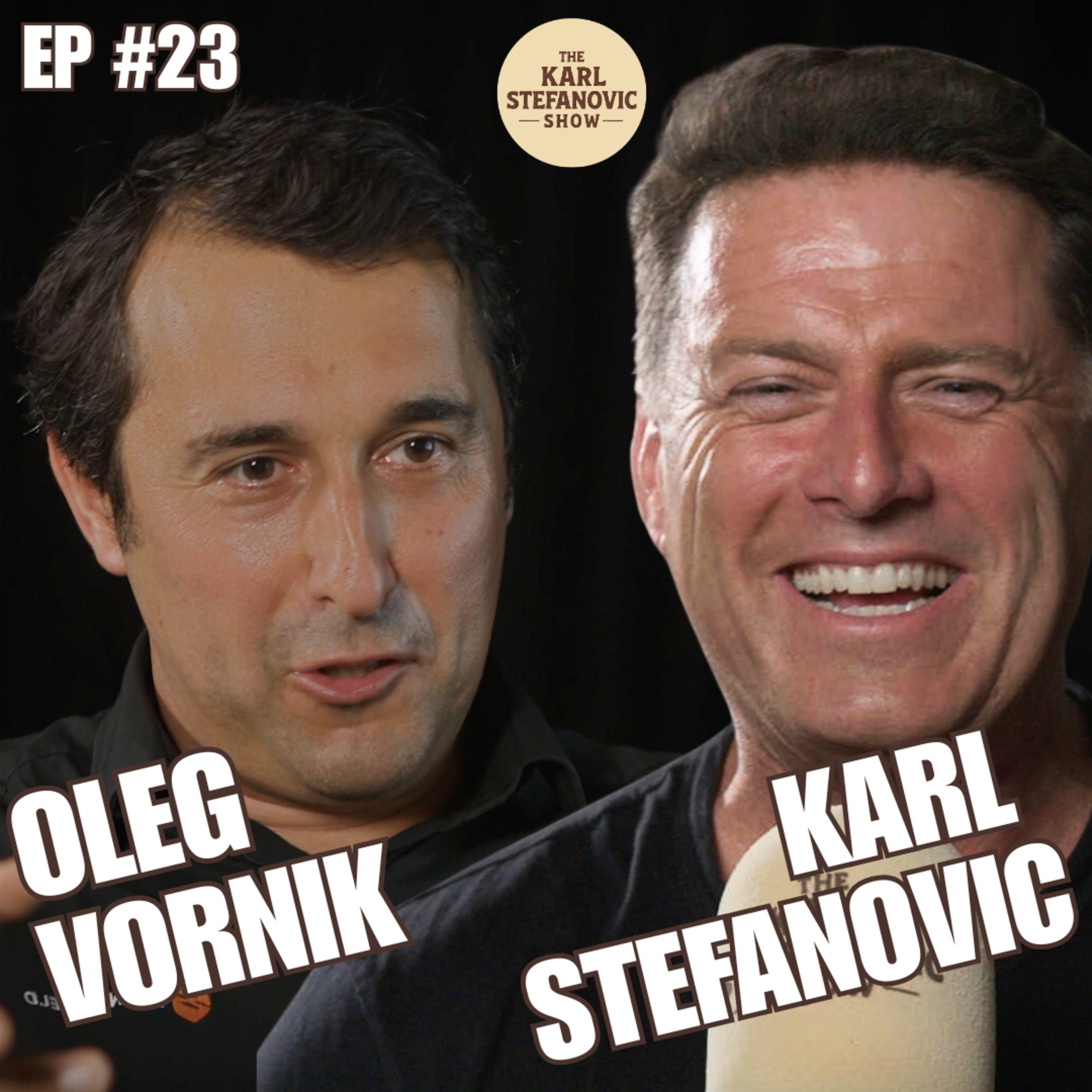
Iran, Russia, Lebanon — Drone Warfare Is Already Here. Meet The Man Behind The Billion-Dollar Defence
55m 36s
The transcription begins with a promotional segment for a sports betting app before shifting to an interview with Oleg, the founder of a counter-drone technology company. Oleg recounts his background as a Russian refugee who moved to New Zealand at age 15 to avoid military conscription, later pursuing a career in finance in Australia. His transition to the defense industry began when he joined a startup idea focused on drone detection, eventually leading to the founding of DroneShield. The company listed on the ASX in 2016, raising $7 million primarily from retail investors, and developed products like drone jammers designed to resemble guns for easier military adoption. Oleg discusses the challenges of entering the U.S. defense market, including skepticism due to his Russian origins and the complexities of hiring effective sales personnel. The interview underscores the nascent stage of drone technology at the time, the speculative nature of early counter-drone solutions, and the strategic decisions that shaped the company's growth in a high-stakes industry.
So clear to me Darren, you're such a genius. Well, none like the Darren Lockier book. The Broncos season is a bit upside down this season. However, we're going to turn it around this Friday night. Yes, we are. I don't care what you say when the Broncos play the storm. So you've heard me talk about Ned's new app. Now I want to show you how easy it is to build a three-leg SGM with my favorite tri-scorers for Friday's game. Do-do-do-do-do-do-do-do-boom! So if you want to have a play today, download the Ned's app, built for sport, multis, and you. Now let me get back to some more reading. What's gambling really costing you? For free and confidential support, call the number on the screen or visit the website. I have this curious beast that lives inside my head and I'm about to unleash it. All right, let's go. Oleg, first of all, your greatest feat in life, getting Albo, our prime minister, to pose with one of these. How on earth did you do that? It's a great question, Carl. I wasn't there at the time. It was when Albo was at a White House function and it was around Australian industry and several of our people were there. And I think one of them basically thrust into his hands and I think it took a picture with it. I mean, usually getting politicians with anything that looks like a gun, even though it doesn't fire any bullets or projectiles is very, very difficult. But I think we're kind of done it before. His staff was realized what happened. Yeah. Well, he's probably going to regret it now because it's going to be all over the Cal stiffen only, sure. How did you come up with that bit of kit? I mean, tell me all about it. So Dronger is a jammer. It sends a signal that disrupts drones anything within a proximity of the device. And before we came along, jammers were more like what you think of bomb, roadside bomb jammers. I can never get any stand. There were boxes with lots of antennas. And we thought, well, we had this realization that militaries by emotionally, much like you and I might walk into an Apple store and fall in love with the product and we're like, I want this. There was no scientific reason for a jammer to look like a gun, but we said, okay, well, a soldier wants something that they're familiar with form factor wise and something that's easy to use. And a gun makes total sense. And I remember when we released the first generation of it. This was end of 2016. We had a million YouTube hits on our promotional video on YouTube. YouTube was offering us ads on what it was essentially our advertisements. So this was insane. So that was just kind of that realization that if you're selling to military, you kind of need to be cool as well as functional, which is how the gun came along. Okay. So that's a terrific tease for this chat, but take me back all the way to the start because you have an incredible story of your own. Thank you. So Russian born I force 15 when my mom has decided that it was time for us to migrate and leave as she was saying. Kids of just a couple years more than my age go to church now at the time, which is basically what at the time was same as Ukraine now and just get used as cannon fodder. And she said, well, that's not happening to my son because you obviously have military draft and you have to go and serve and all that. So we managed to basically escape as refugees go. You little draft, Ojiye. Well, hey, a lot of people migrated Russia sort of from the 90s through to even now it's happening. What a terrible time for your family and for that particular part of the world of that time, right? Yeah. Yeah. I mean, if you think about the fall of communism and massive changes and the amount of crime on the street because I remember in the 90s, I was living in a city called Cerata, which is about a million people in Russia. And you might get a knock on the door in the middle of the day and you think, okay, is it like somebody just, you know, something innocent or is it basically somebody who wants to bergle the apartment you live in and kill you not to have a witness. The value of human life kind of was always not very high in Russia, but the difference is now there's essentially one party, the government controlling the whole situation and sending soldiers to the front. But back then, a lot of it was basically petty crime. So, you know, people that just suddenly realized that could kind of do whatever they wanted that there was no government really in charge. And so you had all these gangs roaming streets and engaging in a record hearing and so on. And so obviously ordinary citizens, those that could realize that there was really no future in the country for them. So those that could start migrating and and their two parts to actually one is a country like Australia and New Zealand, we actually end up getting to New Zealand to to leave. And the second one is for Russia to actually let you go because and it's very difficult to fail them being based in Australia. But Russia perceives its citizens as its property. And so you actually need permission from an essentially equivalent of KGB, like Ministry of Internal Affairs to let you go. And that part is actually equal as difficult as getting for the country you go into to give you permanent residence or visa. You can't just flee. Where would you go? Well, we ended up basically saying, okay, you want to be in a first world English speaking country. So that narrows your choice to the usual suspects. US was always very difficult in terms of visas. So that was kind of an obvious path. Australia in terms of skill migrant points category. All that wasn't still is more difficult than New Zealand. And so New Zealand basically was a country where my mom who was a medical doctor in Russia ended up getting enough points to get a permanent residence CVs, a bass and a skill set. And so this was the country we ended up going to. So it's basically where can you out of the first world English speaking places. So you were 15, you got a New Zealand? Yes. And you spent how long there? Until 23. So I started working and then basically on my first opportunity I was in finance back then I was working for a big bank. There was a project that I wanted to temporarily do here in Sydney and I just sort of stayed as I mean better weather, better opportunities. I mean, it's pretty hard to justify living in New Zealand if you can be in Sydney. That's true. I lived in New Zealand for some time and worked for TV and Z. I enjoyed it, but the weather was a killer and I just wanted to get back home. And home became that in Australia for you. Yeah, totally. I mean, Sydney is amazing. And I think a lot of people like you like she has a sense of it. Okay. So you were a banker in Sydney and how did you decide? How did it pop into your head? What were the flow of events that led you to arms? Because I'm not, I mean, obviously I can compare the industries. If you're not a man, but from banker to armaments. So how in what? It's a huge leap. So how I ended up in banking was when we came to New Zealand, even though my mom got the points for skilled migrant visas, the doctors she couldn't work as a doctor because she had to retrain fully from scratch. So we had no money. We lived in social housing. And as a result, I grew up in fairly poor kind of situation, you know, like 10, 10 difference in a supermarket makes a difference. Well, you buy something or not. So one of my kind of resolutions though is graduating and getting into workforces. I want a job where I would not have that life following getting a job myself. So finance seemed like an obvious gig because if you want to make reasonable money in your 20s, well, where else are you going to go? But then I realized that as I was getting to my early 30s that I was kind of tired. I was in M&A. I was doing long hours. I didn't really see like one of the things about defences. There's a strong sense of mission in terms of making world a safer place and working really exciting problems. When you're in banking, I think it works for a very few people in terms of what them genuinely enjoying it. Most people are doing it for the perception of prestige. The reason I say perception is it's among certain groups, but certain enough from all and for getting more money than in some other places. But ultimately, most people get fed up with it and try to go and do something else. Now, just as I was starting to have those thoughts, I was with Royal Bank of Canada in Sydney. A fund in New York ended up getting approached by two defense scientists in Virginia saying, "Hey, we have this idea." Counter-Dromes. And Drone Shield was actually there, call it a startup idea number two. Stead up idea number one was zapping mosquitoes in your bedroom with a laser. So they had this concept that was marked there for when you were asleep and you hear that buzzing noise and you're like, "Damn mosquito." So basically for a computer to triangulate the location of the mosquito and zap it to the ground. I don't know that I've ever heard a better idea. So they had all these videos. You know how you have World War II planes when they were hit with like plume of smoke coming out and the plane spiraling to the ground? Well they had those with mosquitoes where lasers would zap them. Mosquitoes basically have like a bit of mosquito with a bit of smoke coming out of the mosquito spiraling down to the ground. Now idea number one never took off for health and safety reasons. So I did. How far along the way did it get? I think we're early trials, let's say. And so I don't think anybody will volunteer their bedroom for it. So idea number two was detection of drones. And you have to think the back in 2014 and 15, the two ideas were probably equal in terms of the validity. And their inspiration was, well, there was Boston Marathon bombing in just a couple of years earlier and they thought, well, why can't a crazy person load explosive on a drone and do a mass attack? Just about to record another.
addition of the Cal Steffanovic Show as you've probably seen. My life is pretty manic at the moment. I'm doing the recordings. I'm doing the today's show, but also I'm still going to the gym and look, I wouldn't be able to do it at the moment if I didn't have the energy. And I've got to tell you this stuff is helping. As you can just put it in a drink and you can drink it. It gives me everything I need. I go straight to the gym after this. Hode Carlos for 20% off, revive5.com.au. Taste great as well. I'll see you soon on the Cal Steffanovic Show. Drones at the time, correct me if I'm wrong, these are the pretty early days. And it was just the start of the huge advancement in drone technology. Drones. It's pretty rudimentary drones. Drones would be insanely difficult to fly. You're probably smashed it against the nearest object. You probably fly it for five minutes. But the inspiration was that like any technology, a drone is a compilation of technologies. It's a flying machine. It's something that carries payload. It sees it, does sense in avoidance. And each one of these individual technologies were going to get significantly better all the time. And so with it, it will be potential for the bad guys to take advantage of it. So anyway, so the guys, the two guys in Virginia, one X-Darp and other X-Jones Hopkins, which are venerable US defense institutions, they said, okay, we're gonna create an acoustics-based acoustics to kind of carry all from the mosquito zapping idea, which was also acoustics-based for the detection. I mean, you have to reuse the technology best you can. And acoustics-based technology to detect a drone. So now mosquito in the bedroom gets replaced by drone in a, you know, out there on the street. And so the fund in New York, when they pitched the idea to the fund, which was basically just a little garage concept at the time, said, okay, I'll give you a bit of money on two conditions. One, you need a listing on ASX to basically gather more funds to expand on your idea. Now, why ASX? ASX branded itself very differently to other stock exchanges in being the stock exchange for the little guy, so to speak. So if you think about Wolf of Wall Street in the '70s, and it is like the movie, right? Penny Stokes, Nasdaq and New York Stock Exchange, following that have significantly moved towards only catering for really, really large listed companies in terms of how the compliance works, how the legal fees, the whole structure. Well, there are a few issues with those Penny Stokes in the end, right? That's exactly it. But ASX said, well, how about we democratize the situation? So the problem in the US as defensible as the actions of the US exchanges are, is that you're basically giving huge returns to private equity and other really wealthy people and the average Joe on the street only gets access to little returns once the business is really mature and it has listed. But ASX can say, okay, well, we'll enable little mining stocks and biotech stocks to list and sure a lot of them will never go anywhere, but also some of them can really strike it rich and that enables the little guide to be there from day one and reap the return. So ASX branded itself substantially as a stock exchange for early stage companies, in addition to bigger companies, which of course it is. So in the beginning at the time, there was really nothing else. Like Toronto Stock Exchange tried to be the same, but never really succeeded. There is a secondary exchange in London called Aim, which again, never really took off, but ASX became the biggest nonsense. So anyway, so ASX and the reason why listed versus unlisted is listed game back then and even so now it's probably about who you know in terms of the ecosystem of various VC so you can fundraise through and the fund didn't really have access to that ecosystem. So they said, okay, go listen ASX. And then I said, okay, you two are two scientists, you kind of need a commercial person to run the company and they knew me from before. So they called me in there like, okay, how about you sell counter drone equipment? You don't know anything about it, but not that does anybody else. Like it's a new brand new industry and I said, okay, well it beats I guess being, you know, being an investment bank, which is where I'm. Now the company didn't have a lot of money in the bank 'cause all the funds had to be deployed towards essentially, it costs towards the listing. So I worked for $100 a day for about nine months until we got the listing away in mid 2016, raised $7 million and 20 million valuation at $0.20. So back then, what's your pitch? The pitch is look at all the disaster that drones can create. And back then it was entirely hypothetical because drones weren't really doing much. I mean, I think drone has landed on the lawn of the White House and this was kind of, the only real tangible point, but we said, no, no, no, no, no, look at the potential. So a lot of it is ultimately selling, right? So that's another thing about retail versus institutions. I bet your institutions look at it, they would say, well, this is all like a little crazy. But we had a lot of retail support who was like, great, yeah, we see your vision. And this is like back on things like drone gun, I think having a visceral story is really important towards retail as opposed to institutions. So I like it, we'll buy like a real estate business or whatever, like much more boring kind of situations. So anyway, so at this point, okay, we have money in the bank except like nobody's buying any kind of drone equipment because we're way too early to market. And we have very basic acoustics based equipment and just basically a couple of engineers. So said, okay, we're gonna start hiring engineering and start hiring a few salespeople. - Who's mad enough at those early stages of your sale? To say, oh, I'll write a check for a couple of mill. Who's crazy enough to do that? - Well, we didn't really have guys who were that crazy. That's exactly the point. So if you think about a spread of 300 shareholders and you raise $7 million, like a lot of the investors end up putting 20 grand, 30 grand into it. And that's actually one lesson I've learned if I do the listing all over again. We had one fund manager who put in a million bucks and the thing I've learned is that the stock actually lifted off really well on day one. I think went from 20 cents to like 33 cents. So they're about, and the guy basically decided he wants to take profit on day two or three. He dumped and tied million dollars, which doesn't sound like a lot, but they just demolished the share price. So we went from about 33, 35 at the time to probably 15 and it took us literally a couple of years of momentum to recover from that. So if one thing I've learned is that even if there would be demand for somebody for several million dollars, do not give somebody the power and just take a whole lot of little guys at 20, 30 grand a piece so you're not dependent on decisions of anyone guy. OK, so I'll come, I'll circle back to that. You've got the money together. You're on the path. Now you've got the scientists. You've got the meat in the sausage machine as it were. How is the sausage made? Well, first I'm like, OK, better try to figure out what's happening in the US because if you are attacking defense and security market, US is the king, right? The trillion dollar market, much bigger than anything. Like we always knew that Australia was going to be a tiny, tiny part of what we're doing. Like even today, it's like 5% of our revenues, right? And so I moved myself to the US for two years, except then I realized that if you try to, like I remember, head a meeting, several floors deep in a subterrant structure underneath, underneath one of the white house structures. And I'm in a room with basically a bunch of-- Tell me about that. Well, it's pretty amazing. So we're basically-- You walk in because I've been to the White House, but never inside of just outside of being a pesky reporter. So you have a subterrant structure underneath the Capitol in the White House with connecting trains and security rooms like going floors deep underneath, think like almost men in black kind of situation. So I'm sitting in one of these subterrant rooms and you have army people and stuff like that. And you try to advise them towards your view on the threat from drones, except you realize they're not really listening to you because they're like, OK, this dude with like a Russian sounding name, born in Russia. And to them, remember, they're not like the new generation from the Chinese main enemy. This is before Ukraine war. For them, the Russians are the main enemy. And they're like, this dude is right here. Is this a joke? Like, well, like brought him here. And so this was a watershed moment for me, when I'm like, OK, I need to focus on hiring real American ex-defense salespeople because nobody's going to take me serious. I mean, and these are heavy dudes. If you've got anyone underground at the White House or the Pentagon, you're talking about heavies. They're looking at you going, I don't get this. So then you go and hire some Americans. So they try to hire some Americans. Except the problem is, how do you hire? When you're a banker, hiring is super easy because you're basically hiring minimies. So people that used to be you maybe five years ago. So you know what to look for, what skills you want them to have. Now, imagine your next banker. And now you are hiring weapon salespeople. Like, what do you know about weapon salespeople? And the other thing about Americans is that they're very confident. So they're bamboozled you with terms. And you're like, you kind of know more than I do, which doesn't take much. So you're like, OK, hired. And so then what happens is the sales don't really materialize. And you're like, well, is it the market? Because like nobody's really sending any counter drone. Or is it the person specifically? And over time, you spend more and more in front of customers. So we over time built a network and about 70 countries around the world. And other countries outside of the US, I can spend a ton of time on the road in Europe and South America. And-- Boy, you're trading the boards. I mean, like, for example, Colombia, I haven't been to a single tourist destination, but I've been to probably most army bases in Colombia through my job. It's brain-saving. So over time, you get a sense of what a good sales person looks like, because you meet more of them. And so over time, you kind of upgrade. So it's like, OK, you're not selling. Malibu.
Let's get a better salesperson. So you build up a sales team all the time. A lot of them are ex-military, but not all of them are. There are some great salespeople who kind of came from other things like our best sales guy, the guy who's always essentially chief salesperson on the world. He's literally ex-car salesman. But he's amazing, like in terms of classically trained sales person and the industry kind of learn as you go. So that was basically my experience in the US. After two years, I packed my bags, moved back to Sydney and continued to scale the engineering team. And engineering hiring is something else. It's like back to if you're an ex-banker, it's like, OK, now you're hiring software engineers. Like what do you know about hiring software engineers? So the good thing is once you hire one essentially, like a head of a team or a department and you get confidence they're good, then they hopefully help you assess the technical skills. So very early on, we were very lucky that we hired a guy called Angus Bean. He became our chief technology officer, now chief product officer. And he really learned basically just about every bit of tech. Because the problem-- what separates Drone Chef from say, it lasts in is-- I don't want to talk badly about it, but it lasts in, but we're talking basically one or two products. So yes, they have 1,000 plus engineers, but they're kind of very similar engineers to each other. We're talking a wide variety of skills, hardware, software. We're basically building from chip to circuit board to all the software in between, all the applications, software that goes on top, everything you have inside the product, which takes in say in a month, there's probably a dozen different engineering teams that goes inside of the Drone Chef tech stack. And where are you doing that construction? All in Sydney, which is pretty unusual. So we-- You're, I think, on your building these things in Australia. 100% Australia. To explore. 100% Australia. Yeah, yeah. So people don't really think of Drone Shield as a hardware software export story, but that's what we essentially are. So out of the 500 people in Drone Shield, there's probably about 430 odd based in Sydney. And 100% of our manufacturing is here in New South Wales. Now, we are looking to do parts of our assembly in Europe and in the US for essentially geopolitical reasons going forward. But ramp of what we're doing will be always in Sydney because when you have such rapidly evolving technology, you need to have your engineers and your production co-located because almost every batch you're making a little bit better. OK, so you're climbing closer to prototype? Yeah, so you-- well, essentially, you look at MVPs, right, minimum viable products. So the very first Drone gun that we released at the end of 2016 was basically a Goal's Buster type situation. 5KG sort of rifle, a backpack behind. It was like the most cutting-edge thing out there at the time. And then the next product didn't have a backpack. It was like a 7KG rifle, Drone gun tactical speaking of, Polly's holding it, we have a great picture of Macron holding Drone gun tactical and we sold a whole bunch of them to the French government. Not easy to make that go. I look like a man. Well, we've done our best. We've done our best. I should start displaying like a wall of politicians holding our product. Yes, please. And then eventually Drone gun Mark IV came along. So a 3KG product. So this is actually one of our simplest technologies compared to the others we have, but still the best in breed in the world. Sorry, I didn't mean to point it out. It's a dummy product. So it's not going to emit anything, don't worry. But it's roughly 3KG. So it gives you-- It's a little bit disgusting. It hands up, buddy. You can probably rob a bank with it. So now we have a huge amount of these deployed in Ukraine, deployed around the world with teams like US Army taking down drones. Tell me about it. And then specifically on-- Is it called a gun? Drone gun. Drone gun. Tell me about what specifically the different parts of it do, first of all. So what makes it up? So from front to back, you have what is a pathented antenna. So antennas are considered kind of basic. But in order to emit on a very wide amount of frequencies, in an effective cone, you need very smart antenna design. Behind antennas sits basically the firing mechanism. So the mechanism generates the jamming signal, which then goes through the antenna. And then you have the heat sinks and so on, and the battery at the very back. So it seems kind of easy, but it took us years to perfect it. So everything fits and works in very unusual environments. Like for example, you would sell something like that to Saudi. That would absolutely trash, whatever you would sell to them. So the product has-- What is that? Well, you are in a very extreme environment. Like in a desert, you'd be looking at temperatures of pretty extreme, whatever it is, plus 40 plus 50. Sometimes you're not necessarily in the air conditioning situation. You would deploy-- like when we deployed to Ukraine, I see pictures of these things with bullet holes in them. It's pretty crazy. So I'm just to skip back to here. And then you've got what the battery at the back. So how does it actually work? So you would know where the drone is coming from. Either visually or one of our detection devices would tell you, like we have a radio-looking device, about 1 kilo size, maybe about 20, 30 centimeters long, that would tell you, with a directional antenna, this is where the drone is coming from. So you would point a drone gun on it, and it gives you a wide cone degree of effect. What's the efficacy of that? It's pretty wide. We're kind of-- It's probably a talk about it. But the idea is that single drone or a swarm of drones can be 50 drones. And one, like you see this huge Chinese light show, so you can affect a whole lot of those. So you can do rapid fire on multiple drones. That's right. So it will be instant effect on essentially unlimited amount of drones inside the cone. So all of them will get affected at the same time. So the drone basically feels that as of all of its communication with the outside world is lost. So it doesn't know how to communicate with its controller with other drones, with a satellite. And the drone says, OK, I don't know what to do. And so depending on the drone, they'll either just crash, or they will land themselves in the control section. So presumably you did test on this extensive. What was the success like? And what were you firing against? We buy a ton of different drones to test against. And also our customers, when they do their test events, obviously, far too long. They do a bunch of different drones. You have essentially several types of drones. From the flying drones, you have your fixed wing and quadcopters. So fixed wing are like airplane sentially. And quadcopters are kind of what you think drones are. So multiple propellers. And then you have now drones which are crawling on the ground. I've called unmanned ground vehicles, so like little robots and tracks. And drones which swim in the surface of the water, similar to what Ukrainians use to inflict damage in the Russian Navy or USVs and then surface vehicles. The only thing type of drone does in work on is UUVs, which is basically little submarines. Because when you're underwater, the effects are different. Yeah, yeah. It blows my mind, what's out there, and what we don't know. But you have success at a rate where you go into production. Is that how it works? Yeah. So you have each device getting better. But then drones keep getting better all the time as well. So when you think about what you're doing, which is disrupting the connection between the drone and the satellite and the drone and the controller, back maybe 10 years ago and we started, the Chinese didn't think about dealing with devices like ours. So by the way, Chinese are by far the best makers of drones out there. I mean, Americans aren't trying to catch up, but Chinese technology wise up the best. Like you think of DJI or tell the big brands. What's the range on? It's pretty significant. Far more than what you can see with your eyes. Like with your eyes, you can normally see a drone maybe a couple of hundred meters away on a clear day. This will give you many multiple times of that. So you, like as far as you really need. So then what happened was 10 years ago, drones were reasonably easy to disrupt. So they'll communicate in fixed frequency and you basically jam, you break the link and the drones are toast. Now what the Chinese figured out several years ago is that there are people like drones who are out there. So they started to evolve drones specifically to avoid counter drone equipment. So it becomes almost like a game of whack-a-mole where you hunt the signal up and down the spectrum and stuff you get in a $5,000 Chinese drone you buy in JB High-Fi five years ago to be classified Chinese military secret. Now you buy it in a basically children toy. Now why the Chinese do it? Because obviously the expector of that to end up in a war zone trying to veid products like ours. Wow. And so who was the first country you sold us to or was it an organization or was that classified? So 10 years ago we, I'm trying to remember who was the very, very first, the very first large purchase of actually Saudis. So Saudis in 2017, 18, were fighting in Yemen and Houthis were bombing their world facilities using drones because that's kind of the only thing Houthis had access to. So Saudis gave us what I believe was about a $3 million order for a bunch of drone guns. What are they worth? So you'll be looking tens of thousands of dollars or comparable to a cost of like an expensive car. Okay. So the Saudis buy them and what are they? What's the threat they're under from drones? Because I'm finding this drone thing very fascinating. So a drone will basically fly from Yemen, from Houthis with a whole bunch of drones.
explosive on it, attacking flame will part of the Saudi oil complex with intent to basically blow up their oil extraction facilities, refineries, whatever they have. You can imagine very flammable environments, right? So there were days where literally half of Saudi oil facilities were offline as they were trying to appear them from the drone attacks. How much success did you have against those, against the hoodies? Well, ultimately we never really get told by the customer, but happy enough, they kept placing repeat orders with us at the time, sir. What came next? What came next? So, US really woke up to the threat. So we started seeing significant amount of demand from the US Army, from intelligence community, from border security, because Mexican drug cartels started sending drugs across borders using drones and also spying on the border agents using drones. So interestingly, we ended up basically attacking same problem both sides of the border. So Mexico is now one of our customers as we supply Mexico government to fight the narco cartels. So what you're telling me is you're not picking a side? Well, here the two sides are the same. Here, Mexican and American governments are attacking the same thing, but generally what we sell are very highly export restricted items. So in order to sell a drone gun to any customer, first of all, it's going to be government customer because, like, safe, you're concerned about a magazine doing paparazzi shots of you. Like, you cannot legally own it, legally use it, because basically it interferes with radio spectrum, which is a very highly regulated kind of infrastructure. I definitely need one of these for the paparazzi. So if we can do a deal, no one knows about, no one's saying. So my recommendation is to contact Australian Federal Police, so actually do use our equipment and they can lawfully do so. I don't need to call the police again. The AFP know exactly where I am. So then where does it go from there? Because I know that Ukraine, I mean, this is a big deal for you, right? And when you saw the Russia invasion, I'm sure that also got personal. Yeah. So we were supplied to Poland before the start of the war. And when the invasion happened, the Polish turned around and donated a bunch of our equipment to the Ukrainians. And Ukrainians had a chance to deploy it right away. And so that created a ton of demand from Ukrainians, basically saying, "Hey, we need more of this." And so we started basically leaning towards military aid programs because Ukrainians didn't have a lot of money of their own to spend, certainly at the time, so in terms of European, American, Australian. So we had about $10 million of aid through the labor government here, about two years ago. And we're continuing to ship those, like for example, we had a big European contract in the middle of last year. And some of the gear that the purchase ended up in Ukraine. And so we expect to ship more. In terms of our personal sentiment, I guess it reminded me of, back when I was a teenager in Russia and Chechnya, and kind of the same thing happening again of human lives, not being very valuable and it's really a tragedy. But I think the unique thing for drone shield was that Ukraine has become the birthplace of drone warfare, truly. As Ukrainians have realized that they can use drones effectively to fight against the Russian war machine. We saw some incredible acts during the last couple of years, highly efficient attacks on Russian targets, didn't we? And so what's the future of that? What's the future of drones and how do you stay ahead of the game? So drones are going to be already out, but going to continue being central to warfare. So if you think about their ability to have a $5,000 drone with a bit of explosive blow up a $5,000,000 tank or doing surveillance on the front line without needing a soldier there. Now you're already reading reports of the battle lines being no man zones for kilometers or by the side because they all just patrol like terminator movie style patrol by drones looking for soldiers on the other side to like ram and to and kill them, right? So that kind of surveillance payload delivery, all of that is the future. Now that importantly doesn't take away from the kings of battlefield. So you still have demand for tanks, although I wouldn't want to be in a tank in today's warfare with all the drones flying around and you see pictures of tanks basically looking like hedgehogs. So that warfare is in for one of a better term, a brave new world where what you're talking about, I mean, where does it lead? So Grazon warfare is an important thing, which is war that doesn't look like war, right? So for example today and we can talk more about Australia position from what I'm seeing, we get regular cyber attacks, most likely originating from China. Now that is war, but doesn't necessarily look like war. Does it hurt us? Do we have defend against it? Yes, absolutely. But so drones are very convenient in that sense because you can't necessarily attribute a drone attack to a particular country. Like for example, in Europe, we're seeing drones disrupting flights at various airports flying around military bases. Now can you conclusively say it was linked to Russian government? No, but is it likely I'd say pretty certain. Now technically if you dug into it, you probably would link it to local criminal gangs, but ultimately I think the breadcrumbs would lead to the Russian government. And that's that's war, right? But that's not really war in a sense of hitting those bases with missiles because you don't want to be starting a World War III. We've seen number of countries too, I think it was Israel. They had a whole bunch of drones positioned and then they were able to get in and use them as well as Ukraine. And I guess for Australia, one of the great things about being isolated is that that's a bit more difficult to do, right? I would have thought. It actually not. So when you think about drone attacks, so whether it's in Israeli operation rising lion, when those drones attacked inside of Iran or in Ukraine where the spider web operation attacked those Russian military facilities, if you think whether attacked in Russia, we're talking thousands of kilometers from the front lines. Those drones did not fly all the way from Ukraine to attack those bases. They were delivered inside the trucks, which then just opened up in the middle of the night and attacked the facilities. So we're not going to have drones in Australia flying from Indonesia or God knows where else is the range isn't that long. The range isn't that long. It's maybe 5, 10, 20 kilometers max. So what we're talking about is nefarious agents driving to fence line of emberley or other defense bases and basically at night, the drones fly out and easily destroy our F-35s or other military assets that we have. And Australia is just as vulnerable as any other government in Europe elsewhere. So what do we do with that then? And how do you help combat that? So Australia launched program called Land 156, which is 1.3 billion dollar counter drone program that started to point a panel. So we just got a point on the panel of counter drone suppliers literally in the last couple of weeks. And a large US defense prime called LIDOS is basically like a program administrator. So we expect Australia to stop making purchases of counter drone equipment to field inside of its military bases. Now that leaves a question on what happens at Sydney Airport and our data centers and what about stadiums in terms of drone attacks. And unfortunately right now nothing is being done. So if you're a bad guy and you want to load a bunch of washing powder on a drone and basically spray stadium like it looks like an anthrax attack, I can tell you unfortunately there'll be nothing that will stop you and then probably you'll never find out. This is frightening. Absolutely frightening. And Australia realistic is it? It's not hard, but in defense of Australian government, the situation is not the different in the US or in Europe. It's civilian market is completely unprotected right now. And that's not just in Australia. So military market and people think of drone shield as a military company and you think of our branding and the guns. But ultimately half of our market as I think about next 5 or 10 years will be protecting civilian installations. Like you think about people delivering contraband to prison windows using drones. It's insane. So you literally have people loading cell phones, cigarettes, escape kits and delivering it to the windows of prisons. And prisons are really good at keeping bad guys from the ground but not through the windows. How vulnerable is Australia from this kind of attack? Very much so. In fact, I think it's shocking or it's very good that it hasn't happened but it's very surprising that it hasn't happened. I think it's a matter of time. That's frightening to me. I mean, you don't even think about it. You don't even think about the technology being used in that way. But the world's a different place now. And I'd be surprised if Australians, many Australians wouldn't have even heard of you in this technology but the conversation's going on between government and people like you. Yeah, and it's very new, right? All literally happened in the last 5 years. I think it's a huge undertaking in terms of considering that as a security feature. Drones are getting bigger as well. We'll yours and we're deploying our own drones in the air and in the water. Autonomous. Will they take down those things? Eventually, these as a defense mechanism? Not very big drones. So within the drone technology, there's this informal divide between
little drones and big drones. And when you think about big drones, you'd almost treat them like a manned asset of itself. So for example, if you have a drone like a loyal wingman, which is our unmanned aircraft made by Boeing. So if you'd be a bad person and you want to be taken those down, you will treat, you'll use the same artillery as you would for a manned aircraft because it's just as easy. But you can't be firing $100,000 missiles against a small $5,000 drone. And similarly, if you're hunting down an unmanned submarine, you will be using basically the same technique as for a manned submarine at the end of the day. But those techniques would not work against really small drones because they either cost ineffective or they're just not designed to detect such small objects. These things have a tendency. They're expensive at the start and they get cheaper and cheaper and then they get more available. Is it within the realm of possibility that these will be available for retail in Australia? So for the counter drone, the detection, I think, will very much become so. But although that said cheaper and cheaper assumes that the standards don't need to rise because drones themselves are becoming more and more sophisticated to keep up with the with their rising sophistication. The amount of gear that goes in is remarkable. Like I'm thinking about our next generation of detection technology, the cost for us is about three times as of the cost of the current technology just of the hardware in terms of the chips you putting the circuit boards. And so that kind of keeps the cost up, but also the galaxy. Right. So it's legal to the tech drones, but it's very restricted in terms of taking them down. I heard some fantastical stories. I don't know how real they are, how credible they are about the capability of drones now in terms of what they can hold in terms of, you know, I heard Glocks, you know, I heard obviously explosives that we've seen in your experience. What's true? What can they do? What can they hold? So you see some drones can easily be able to carry 10, 20 kilos of payload, which is a lot, right? So a lot of these larger drones are designed to be crop spray kind of irrigation. So perfectly benign sort of applications. You can buy a lot of them. Online, except you can also load any various agents. So explosive or what thankfully never happened, but probably will in the future is a biological chemical agent onto the same kind of thing and like spray half of the city, right? That can entirely possible. In terms of drones distances. So in the early days, the drone may fly maybe 30 meters. Now a drone can easily do 10, 20 kilometers or maybe more so you have range expanderers in terms of how they communicate and so on. You think about sense and avoid you think about artificial intelligence inside the drones, how they kind of operate as a hive. So they can kind of feed information off each other. So the amount of sophistication is insane and keeps getting better. Fear is good fuel business though, isn't it? Well, reasonable fear, right? Like you look at how the technology advances and there's enormous amount of like Ukraine really open the flood gates where there's a ton of investment going on in drone technologies and so it's a bit like a lego in a sense that you remember how I was saying in the beginning that a drone is like a flying machine, a payload carrying machine, a machine that sees and so the best features that kind of get developed and get get rapidly implemented across a whole range of different drone types and so it just keeps getting better. I'd imagine you'd be a pretty popular person if you went back to Russia. Well, after our assistance to Ukraine, I was put on the Russian government sanctions list so yeah, it would not end well for me if I decided to go back to Russia. What would happen, tell me? I try not to think about it so the list of being on sanctions, government list with Russia is not that exclusive. I would say there's probably a couple thousand Australians on that list, including most of our generals and so on. A lot of the journalists that wrote negative things about Russia, so it's not that exclusive. But how does it feel to be an enemy of the state? Look, I never had desire to go back. I remember when I was actually kind of funny. I remember when I first found out about it. So the way I found out about it was maybe this is maybe three or so years ago. I set up like a Google alert feature because I sort of needed for my business if something happens in real time when there's an article involving all in my name. And Russian interior ministry was putting lists every week at the time of new people that added to the sanctions list. And Cambra Times was monitoring those lists and basically copying the names of Australians that end up on that list. So I basically get a ping saying from Cambra Times, you know, all egg like is added to the list. And I was actually on a way to an online date that I met online for the first date. So when I arrived, I think the girl saw me getting little pale and she's like, are you okay? And I'm like, I'm still processing what just happened. I'm not entirely sure. And so yeah, and so she's like, what happened? So I explained she's like, what does it mean? I'm like, I don't know. I'm still trying to think about it. And you married her? No, no, look, she got scared. No, maybe she got scared. I'm not sure. Yeah. So no, I'm still still back in the dating market. But in terms of in terms of the in terms of the sanctions. So what it means to me practically, I think Australia is a pretty safe place. But you just have to be careful when you go to places like London. Look at then on the day, I think you have to give you that if a state wants to deliberately target you as a private citizen, there's really nothing you can do. But if they want to just target you opportunistically because it kind of happens to be an easy thing to do, that's what you can basically stop doing. So for example, do not post Instagram pictures of you having breakfast in in Bali in real time, because that just makes you more easy to opportunistic things and stuff like that. Do you worry about being taken out? Depends where I am. And Australian node. If I travel in places overseas, which I'm known to be popular with with Russians, then for sure. Like for example, there was a well publicized article. Plenty of Russians in Bali, by the way. Plenty of Russians in Bali. Plenty of Ukrainians, actually as well, interestingly. But thankfully, they mostly go for holidays. So I hope that I want to get into trouble with the Indonesian authorities over that. So no, you just try to be careful how you kind of go about your life. This business of yours. Do you have rules? Do you have a moral guideline on who you will and won't sell arms to? Well, we do. And that coincides with the Australian government essentially permissions list. So Australia follows pretty bang on same set of rules, but maybe we'll only want to acceptions of how US would look at it and so do other Western allies. So most of the time we wouldn't even try to go for where you know, you're not going to get approval. So we don't deal with guys like Russia, China, North Korea, Iran, and so on. And obviously, deal with government agents. He's only for vast majority of the sales as well. And it's all very strictly documented in terms of end use certificates. And obviously you deal with through the channels that you know. So it's not like some random person contacting you online and you just making them a shipment. In fact, even down, speaking of professional, as a professionalizing organization. So the guy who runs our shipping operation is an Italian guy who before coming to us in Italy, his business was working for an Italian defense contractor shipping, misout shipping torpedoes for like for submarines around the world. And it's like similar kind of scrutiny in terms of kind of how you do your paperwork that constraints on shipping as for equipment like drone gun. God, what a world you work in. It's an unusual kind of situation. And you have pretty big characters like sort of big in life. What's the strangest thing that you've seen? What's the strangest thing that I've seen? I'm probably not seen seen in person, but more more the stories. I mean, I've been in situations personally where we had to do a demo to Saudis, but they delegated the technical evaluation to their, so Aramco had like their Korean subsidiary of scientists to evaluate our kit. So the basically said go turn up in Korean and then basically will evaluate you there. And so somebody booked what basically was a wedding chapel. I don't know why I think because the site was available. And so then I end up doing this group presentation to a bunch of Saudi and Korean engineers in what basically looks like a wedding situations where the situation where they sit in like chairs like in wedding ceremony. And I'm like a party and where like a priest would be basically taking them through PowerPoint. This was like one of kind of more unusual scenarios. And then you go into product demonstrations and things like that. This is does it look like Iron Man when you do the product demonstration? It's actually thankfully because we don't blow things up. It's usually pretty benign. So you just fly drone, you wouldn't detect it, then you press the trigger, drone comes down. It's
It's pretty basic. Yeah, I mean, when you've got a Columbia, you've got a military base, you see them training for things like right control and whatnot. That's kind of pretty unusual. Well, an interesting job. You've got yourself in a bit of trouble in the fin review. And I noticed that because we've already booked you. And do you regret anything in regards to that? Well, I think what would have been different? So for context, I absolved a bunch of shares which crystallized when the company hit a $200 million revenue threshold, which was amazing momentum and continues to be amazing momentum for the business. And I think the gap in hindsight was around basically talking more about why I've done this. So it's things like half of it going towards tax because of how this training taxation system works. So essentially, whether you sell the shares and audits, the tax on unrealized gains and so on. The reason at the time I haven't was this was not the first time I sold shares when the company hit revenue threshold and I received those shares through vested options. And in the past, this has never been an issue either for the share price or for the media. And I think what I didn't appreciate is the company has become much larger and being an ASX200 business now. But I mean, thankfully, I think people are appreciating that this was not my reflection on the state of the business, which is going amazing. I mean, the share price also is higher than what it was when I was selling and the business has had amazing performance. We're about to release our annual report for 2025 next month. At more of a reflection, the fact that look, I grew up, as I was saying, really without any financial security. And this was an opportunity for me to become financially secure while continuing to drive the business. So I guess lack of probably having done more communications at the time would have been probably the smarter choice. Remember when you told me about that initial investor with a million dollars, his old shares and I mean, you've become that haven't you? Look, I have, I think, look, I think the human psychology is that you are more careful not to lose money than to make money. So if you're in a position where you have enough to secure your financial future, you're kind of saying, okay, well, yes, I can triple or quadruple that, but do I really need to. I mean, this is enough, but that still doesn't diminish my hunger, my folks on the business. And in some ways, I think it's probably better to have, not to have essentially all of your wealth just in shares and then, you know, if something happens, then you're basically back to being really poor because that kind of enables you to make a more balanced decisions. Was it hard going through that with the press, the focus, the attention on, you know, the reputable newspaper at the Finnevee? Look, it was difficult. I found that there were a range of articles. So there were articles from journalists like Jonathan Shapiro, who I met before in person, I really respect and I found the way like, well, well-written articles and there were articles like Career Mirror, where I felt the report, I think it was Hadin-Wooten, who's basically closed its socialist and probably should have never progressed past the writing for a university newspaper, somehow God, the gig working in Finnevee. So I think it really dependent on the, well, you're just drawing chill with him. What's the future hold? I think we're going through an immense amount of momentum. So DroneShield has great reputation in the market that's absolutely exploding. The market situation for counter-drawn is probably less than 5%. So if you think about, in the military, a battalion that, you know, for every one drone gun that have, there really need more like 100. Most vehicles have nothing, any protection. You think about aircraft, ships, ports. You go into the civilian sector, we talked about airport, stadiums, prisons. So I think we're at the very beginning of the journey and I think in terms of the amount of engineers in terms of our AI databases, in terms of our brand with customers in terms of our positioning, because to sell to the military, there are just so many pieces you have to get right, like your government relations function and sales function, the right kind of areas. And you just got to have it looking like this. Like a sexy looking product. It's a sexy looking product. I reckon I could sell the shit out of these. It will hire you. So no, we're super excited. So like for a long time, a drone shield, my function was how do you make best you have on very limited bandwidth, because you basically just don't have any results to hire people and so on. But now for us, the investors basically gave us mandate and how far just grow absolutely as fast as you can. Obviously, we still want to be profitable and operating, casual, positive. But at the same time, having enough results, enough cash, just to absolutely pin out years back and go for it, which is super exciting. I'll take five. Good to talk to you, my man. Thank you. Appreciate it.
Podcast Summary
Key Points:
The speaker transitions from discussing a sports betting app to an interview with Oleg, founder of a counter-drone technology company.
Oleg shares his personal history as a Russian refugee who migrated to New Zealand and later worked in banking in Australia before entering the defense industry.
The company, DroneShield, was founded to address emerging drone threats, initially listing on the ASX to raise capital from retail investors.
Key challenges included early market skepticism, the importance of product design (like making jammers resemble guns for military adoption), and navigating U.S. defense sales as a foreign-born founder.
The narrative highlights the evolution of drone technology, the strategic shift from acoustics-based detection to jamming, and the difficulties of hiring and scaling in a specialized security sector.
Summary:
The transcription begins with a promotional segment for a sports betting app before shifting to an interview with Oleg, the founder of a counter-drone technology company. Oleg recounts his background as a Russian refugee who moved to New Zealand at age 15 to avoid military conscription, later pursuing a career in finance in Australia. His transition to the defense industry began when he joined a startup idea focused on drone detection, eventually leading to the founding of DroneShield.
The company listed on the ASX in 2016, raising $7 million primarily from retail investors, and developed products like drone jammers designed to resemble guns for easier military adoption. S. defense market, including skepticism due to his Russian origins and the complexities of hiring effective sales personnel.
The interview underscores the nascent stage of drone technology at the time, the speculative nature of early counter-drone solutions, and the strategic decisions that shaped the company's growth in a high-stakes industry.
FAQs
Ned's app is designed for sports betting, specifically for building multi-leg bets like SGMs (Same Game Multiples).
Dronger is a drone jammer that disrupts drone signals within its proximity. It was designed with a gun-like form factor for ease of use by military personnel.
Oleg and his mother left Russia to avoid mandatory military draft and the dangerous crime environment post-communism, seeking safety and better opportunities in a first-world English-speaking country.
Drone Shield raised $7 million through an ASX listing at a $20 million valuation, targeting retail investors who believed in the potential of counter-drone technology despite its early stage.
Oleg encountered skepticism due to his Russian background, leading him to hire American ex-defense salespeople to build credibility with US military and government clients.
The technology was adapted from an earlier idea to zap mosquitoes with lasers, repurposing acoustics for drone detection as the counter-drone industry emerged.
Chat with AI
Loading...
Pro features
Go deeper with this episode
Unlock creator-grade tools that turn any transcript into show notes and subtitle files.
 PodcastTranscript AI