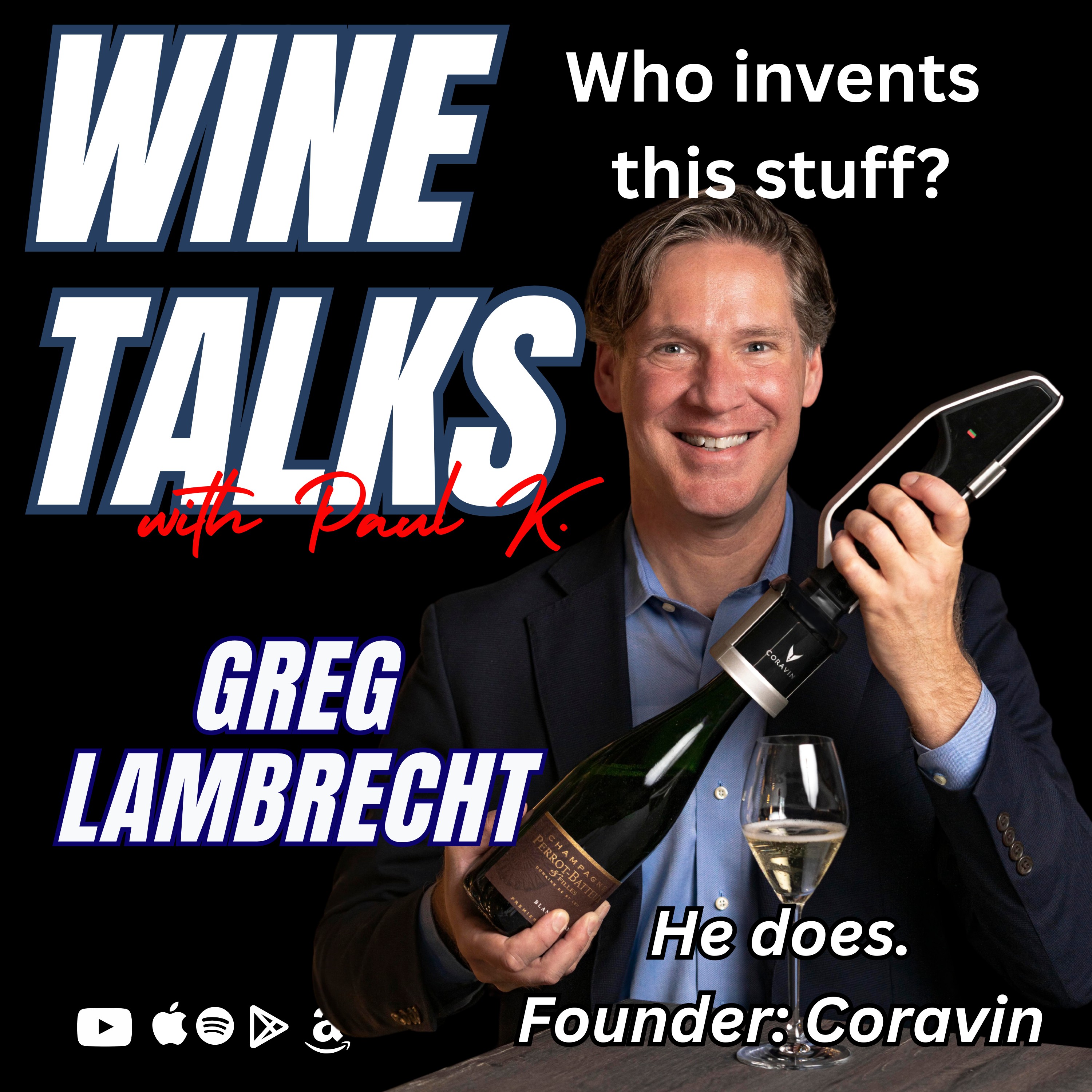
Inventing the Coravin: Greg Lambrecht on Transforming Wine Culture and Expanding By-the-Glass Exploration
75m 32s
In this conversation, Greg Lombard discusses the resilience of wine as a social beverage and his journey as an inventor and entrepreneur. Coming from a background in physics and medical devices, Lombard founded Coravin to solve a personal problem: wanting to enjoy a glass of wine from a bottle without committing to finishing it quickly. He explains that his approach to invention, learned from a mentor at Pfizer, involves methodically redefining the unmet need. Instead of asking how to preserve an open bottle for a few days, he asked how to drink from it now and again years later, leading to the Coravin system that uses a needle to extract wine without removing the cork. Lombard emphasizes the importance of a "ferocity of purpose" and risk tolerance in entrepreneurship, noting that the U.S. venture capital culture supports such innovation. He also shares his deep love for wine, which began in high school in Napa Valley, and his fascination with how wines evolve over time. While the market for premium wine preservation is niche, Coravin also serves professionals like distributors and restaurants who need to sample wines without opening full bottles.
I believe that no matter how silly we might be in our marketing efforts and everything else in the wine world, wine will still survive. One way or the other, and it's going to be a matter of scale. And it's going to be, you know, is it growing or is it not growing, but it is going to be there. And it's going to be there for its core strengths. Its core strengths are it is the most social beverage. Sit back and grab a glass. It's wine talks with all K. Hey, welcome to Wine Talks with Paul K. And we are in studio today. It's not so beautiful Southern California, a little bit of rain out there. But to have a conversation with Lombard. Greg Lombard. I do say that. Yes, that's close to us. I miss pronounce it. So, you know, you can say I mean it's German, right? Dr. Lombard. Dr. Lombard. You can probably put like an Arabic twist on it. He is a chairman and inventor of the Coravans, which you've seen a thousand times, and I have maybe more than a thousand times, which is a device used to preserve wine as you pour off a bottle and it can last for weeks. But so glad you're here. Thanks for coming on the show. Thanks for having me, Paul. I really appreciate it. So, when you say chairman and inventor, obviously you invented this product where I talk about that, but you no longer like run the show? No, I mean, so I come from medicine originally. And so I've had multiple medical companies where I was CEO, their businesses that I founded. I'm an serial entrepreneur, an incurable entrepreneur. I can't help myself. And I got into Coravans because I loved wine, but I had absolutely no idea how to run a consumer product company. I did a medical device. And so back in 2011, when I founded Coravans, I made the life choice of no longer being CEO. And you know, probably the best decision I've ever made. I've been able to hire great CEOs and work with great CEOs to run the business. And then by becoming chairman, it's a role that nobody really, they don't know what you do. And so you can basically do whatever you want. Yeah, great. And so I do all the fun stuff at my medical company, Anna Corbin. I asked Chab G. T. Dean, it says asking what he does. No, that's a great site. I don't know if I can answer. Really digging deep there. So you, so you are then from the medical field. Yeah. Yeah. And devices. I heard you talking before I walked in about a number of certain types of surgeries that go on and the number of dollars that go with that. So did you start like just thinking I'm going to create medical devices that are. I fell into it. I had a, I was in my first career was in physics and I was working in plasma fusion, the kind of nuclear power that doesn't work still. And I began to realize I worked in Japan after I graduated undergraduate on a fusion reactor. And I realized it wasn't going to happen. And so I kind of had a crisis like, oh my God, I've spent all this time learning this field that's not going anywhere. You know, and so what am I going to do? And so I ran back to my, my university and went to grad school and sort of hid in mechanical engineering, which was the easier of the things that I'd studied. And one of my professors was like, you know, you seem like an inventive guy. Johnson and Johnson wants to invent something. I'd like you to do it. And I was like, okay. And so I had no experience in medicine. I've been to the doctor. I never had surgery of any kind. And, and so I fell in love with it. I loved, I loved that. Number one, it's not all that I was building fusion reactors was for billions of dollars and take forever and those governments involved. And here, you know, it was piece of metal. It was a needle and a catheter that went into your vein and a little shield that slid out over the needle to protect the healthcare worker from AIDS and hepatitis and that kind of thing, which was big back in the early 90s, late 80s. And, and I came up with this thing and it wound up being really successful. And I was like, wow, I, I can positively influence so many people's lives. Yeah. Easily. How interesting. And, and you know, that product is used all over the place still. So, you know, you invent it. It gets out into the market. And then it's sort of like as an inventor, if your goal is to make people happy. I didn't even have to do any additional work. It was out there. And every year it's used. Right. And so that position because they have conscience of a couple thoughts. One, I don't think people in general realize on a day, day basis when the, when a product is introduced with as medical or I'll tell you a story a little bit about my wife's uncle. But you don't think about the origin. You don't think about the consequence of it. You don't think about the trial and error of it. You just, you just, I get, I get to use it. You know, it is. It's a lot of people have the misbelief that medicine comes from universities, and ultimately or from some sort of scholastic endeavor somewhere. And what I realized was its companies that are doing it. Johnson and Johnson, for example, the one that I worked with then and then I worked at Pfizer and striker and. And I've worked with Medtronic in the past. So, you know, these, these companies are, you know, actively involved in inventing new things to try to make people better. And it's one of the things that I love about the United States is that it still has this venture capital world that is willing to put money at risk to create something new. It doesn't always work out. But when it does, it can, it can change the course of a particular medical field. And I've loved my part in it as the inventor, you know, I always thought it was interesting that the generationally venture capital is venture capital has always been the same. And it's in 10, maybe 20 units to get one thing that it hits. And it's, it's changed. You know, when I was selling software back in the day, it was a certain way you went about it to find people to do it now. There's like, you know, crowdfunding and all kinds of stuff. But it's the same thing. What is shark tanks is the same thing. Yeah. Right. I think the United States is willing to put money at risk. We're gamblers. Yeah. At our, at our core. And. And I think that is a character that is pretty rare in the world. Where people will take like retirement funds and pension funds, and then put a portion of them at risk on these crazy ventures that boy, if they work out, it's going to be world changing. But if they don't, okay, we lose a little bit. Not many cultures around the world. A little risk. I willing to do that kind of thing. That's true. I really could only have this career here. What did this gentleman who said you look like an inventive guy? Yeah. What does that mean? Because this, I mean, it may at least the question is this a, do you have you noticed in your realm of entrepreneurs that it's sort of an learned type of risk ability avoidance, not avoidance, but risk tolerance as an inventor or is it something this guy just noticed in you. You know, there's, there's, it's a, it's a great question and just sticking off the top I had that there is definitely a natural entrepreneurial spirit that is part of a person or not. That, and it's, it's risk taking for sure. It's also a culturally inhibited, uninhibited person. Like I, I don't care what your doctrine is. This is better. Right. And a willingness to force change in behavior. Because you think about it in any entrepreneurial endeavor, you're trying to get somebody to change something. Right. And change for the better in some way. And so you've got to be willing, not only able to see the change, but unwilling to stop until others recognize that change is what should happen. And so I think there's that kind of force of will component, a ferocity of purpose, a friend of mine described it as that he that he would look for. A ferocity of purpose. And, and I think then there's the other part. There is a learned portion. You know, you can have all that spirit and still be a bad entrepreneur. Yeah. And I was very lucky to get hired by a guy who's actually one of the co-founders of Corbin, who also saw that in me hired me into Pfizer. And we help to develop a process of invention. So it's not just the light bulb going off at random, but there you can methodologically schedule invention. That was his belief. And then you could execute on a plan to invent and create. And so Josh MacHour is a walking company is an MD, MBA, engineers, amazing guy. And he's been phenomenally successful in my field of medicine medical devices, but now teaches at Stanford, he developed a program to teach this to other people. That's now taught everywhere around the world. So he's a great guy. And, and he and I learned how to do this. And I was lucky enough to have that skill set when I ran the problem that I was like, I want to be able to taste that one, but I want to commit to the bottle. I just wonder like I was at USC, the picture of my father there, he came to America as an entrepreneur, he just had that in him to do things and try things and test things and just fail and go to the next one. But they started teaching entrepreneurship in college about right when I graduated. Yeah. And I was like, how do you teach that? I mean, maybe there's some methodologies, there's some practicalities to it. And like you said, there's a schedule to it, but it doesn't take away. And I've seen this many times and not only vendors that would come and tell me why when they use the quarterback, we'd have all these conversations over all kinds of things they want to do. The only thing I've always noticed, and I worked for Xerox, which was a Fortune Finder company. Every salesperson that thought they're going to hit with a product. But no one knew how to do it. We all thought we were going to retire at 35 and you know, find a, you know, invent the best.
slice it around or whatever, but it never happens. Yeah. And I have found the interesting, and I along the way have found personalities is that it will never happen. Even though they wish it will happen, there's no way that personality's gonna get there. I think so. I mean, there's an unwillingness to quit and can be self-destructive, unwillingness to quit, no matter what. I believe so much I'm not going to stop. I think that's absolutely necessary. And then it's just the important learned part of being an entrepreneur is how to target. So I am going to dedicate the next 10 or 15 years of my life to something 'cause I really believe in it. How do you pick the right thing? That picking and that process of invention and picking is what Mac Hour taught me. And it all comes down to a really in-depth and unique perspective on the unmet need, on the problem that needs to be solved. And I'll give you an example with Corvon. I mean, when I invented Corvon, the need that was being addressed that was out there was how do I preserve an open bottle of wine? Right? How do I get a bottle that I've opened to last longer than the day or two or the time? But that question's been asked forever. Right. And it's like vacuums, what comes from that? What comes from this stuff? Spray cans of everything. I asked a different question. I asked, how do I drink a glass of wine from this bottle today and then drink it again five years from now? How do I do that? How can I drink a glass of wine from any bottle I own, any day of the week whenever I want without having to think about when I'm gonna drink it again? It's not possible with vacuum or spray cans of it. That, you know, and so I asked a different question. That's interesting. And that different question enabled me to, oh, you know, if I don't wanna open it, it's just like medicine I can use this orange and suck it out or, you know, I can do what we do. So that's the interesting. And my wife's uncle, I'll tell you the story now. He passed away years ago, but he invented first the Flexi straw and then invented the Spoon Straw. Whoa. And, but it's exactly what you said. Yeah. Seven, eleven had called him, Southline Corporation, at the time, he said, we need this straw for this new drink called the Slurpee. And we want a bigger straw, like a boba straw, right? Yeah. And so he went home and was sitting at his table and he'd tell you the story and took out a pair of scissors and cut the spoon out. Yeah. So he went back and said, no, you don't need a bigger straw. Right. You need to do the better straw. (laughing) And so that's exactly what you're saying. It's a different way to look at it. It is. It's not always some radically new technology or foundational material or whatever. It's a different view of the need and understanding what the size of the market is that that need represents. You can actually characterize a market side without knowing what the product is. Just by understanding the need and the value of solving that need. If we could solve this need, how many people would benefit? And what is the extent of that benefit that each personal experience? I didn't fully comprehend it in that way when I came up with Corvon in particular because I really invented it just for me. Were you a wine guy before that? You know, I-- That means you're like wine. I loved it. I loved it passionately. I grew up in Newport Beach, down south from here. No, we just got back from looking at this morning. There you go. I used to bike to the good every day during high school to body surf, to play volleyball. Beach volleyball. So I fell in love with wine. Friends of mine brought me up to Napa Valley because I looked older when I was in high school. I was 16 and I had a beard and I apologize. That's funny. The statute of limitations is over. And Tony Paisley poured me my first glass of wine. And I fell in love and I just thought it was incredible. And what I love about wine is, you know, I was in Walley's yesterday in Santa Monica. And you sit down and you look around you and you notice there's thousands of different wines. And I love that there's this insane variety that I can taste and taste and taste and I'll never taste it all. But I want to try. I love that. I love the exploration. I love the comparison between Chardonnay's from California and Oregon and Burgundy. And I had a passion for wine when I was 30, when I came up with when I invented Corbin. But, you know, I was also frustrated by it 'cause I work in medicine. I can't be drunk, right? I get I can't. I've got to be sharp. I'm in surgery all the time supporting cases. And so I wanted to be able to taste and explore faster than 750 millimeters in committing to it. Well, that's gonna open this conversation. I don't wanna go there yet because of so much of what's happening in this industry. And so we'll talk about that a minute, hopefully we'll probably run out of time for that. So you're thinking that I'm gonna tell you a funny story and my dad's shopping that picture right there. We used to sell-- I tell him who was who, I thought that one of them was your son, right? You look very similar. Yeah, we talk, we spoke the same way. And I'm the only one who talk about personalities of the three, my brother's sister, that would have done something like, oh yeah, this one of the month clubs, it's like a pretty good idea, dad, he was fledgling along and took take it over. And it took a little bit of, you know, I felt ready for it. This is a backtrack a little bit because I had worked with corporate America and seen how the hierarchy works and the structural works. And then I went off and sold software with a company that had a fish bowl of business cards and a two line phone that we had in the office. And so I'd done both of those extremes. And so my dad said, hey, the one of the month clubs I've been offered in for sale, I'm tired. You know, before I sell it to somebody else, do you want to come check it out? And I felt prepared to do that. And I could risk, it's not a problem for me in general. Yeah. That's not the point. We used to sell, okay. Marbles, bags of marbles at the liquor store. Oh yeah. Yeah. And so if somebody wanted to, how many, drop, you know, stand size, sterilize the marbles and drop them in the bottle and bring the bottle back up to the village to where it needs to be. And then you can record it. Yeah. That was the preservation system. Yeah. Reformatting. Yeah, I know a lot of people, I like it. I know a lot of people that have, that save their half bottles, empty half bottles so that they can pour wine into the empty half bottle and put a cork in it and even water bottles. Like small water bottles, a coke bottle, the plastic stuff, in smaller volumes trying to reformat. And it works for a couple of days, right? It does, it does the job. I was looking for something different, right? I, one of the wines that I fell in love with very early on was served to me by my father and grandfather in law. And he had a big collection of wine. Like this is the first guy that I met that had thousands of bottles. He was in a really important physician in Cleveland. And, you know, root seller in all these wines. And I remember looking at it going, there's four, five thousand bottles down here. You're 85. Like, what's the plan? - He lived in the math, really. He lived in 104. So, well, you think, the math actually worked out. - You did pretty good job. - But he served me my first air massage. It was a shop of air massage in 1985. And I loved it. And I went out and I bought some. This was back when it was still reasonably affordable. And I tasted a new vintage and it was all white pepper and it was completely different from the wine that I just had. Like, is that a vintage thing? He's like, no, no, the white pepper goes away after about six or seven years. And then it's all four as floor. And then it becomes olives and blood and bacon and meat. And that's what I liked. And I was just so fascinated that this wine changed so much. And one of the reasons I came up with Corbin is, I wanted to watch. I wanted to not have to pull a cork on a full bottle of wine. I didn't think it was ready. I wanted to be able to taste it now, taste it later, taste it again, learn how it went. And how it changed. There's so much, it's such a living thing. You know, you talked about this and it was, understanding the marketplace that you are going after. And I don't think most, most entrepreneurial bother with that part of it. They just, they just, they just, they just, they just, and if you ask the Institute of Wine, the wine, the, Master's of Wine, now the American Coral Master's of Wine, which one is the Association of Wine Mickers in America? - Oh yeah, yeah. - Why am I, don't I like anyway? If, 100,000 people, if you ask 100,000 people in America to drink wine, the, they would have told you back then 25,000. But that includes the person who has the house key on T at Olive Garden. - Yeah. - They would say yes, but they're not, in a candidate for the Corván or for, you know, a wine club at the time that I sell in the wine. - Yeah. - So it's really a very small niche of people, but the Corván in this case not only addresses the consumer part of this, but I learned of it and many, many distributors and Los Angeles use it because they don't want to go through a whole bottle of wine in a day or they only come, they came to see me. Sometimes I was the only appointment they had on the day. - Yeah, that was full of cork. - You got to open the whole bottle of wine. Now the rep sometimes like, "Well, I get to take it home," because, but that brought in the market for this thing and was a part of the plan originally thought. - You know, I was remarkably naive about the wine industry. I knew there were wineries. - I still are. - Right, yeah, well, I'm learning. - I am. - Yeah, I'm learning. And the more you taste, the more you know. But the, I knew wineries might have an interest in it.
'cause I was talking to Tony Paisu and what he would do with it. And then I knew restaurants had an interest in it, but I did not understand the whole imported distributor, structure in the US at all. I had no idea how wine made it to the wine store or the restaurant. I had no clue. And I was in a wonderful wine store locally. I live in Boston now. And it's a place called Marty's Newton, which has a great collection, really wonderful people and Marty's wonderful. And I was buying a lot of my wine from them. And I made a bet with them before they knew what Corbin was that I could steal a glass of wine from one of the bottles in the store and they would never be able to tell. And I did that because I had set this spec for myself. I wanna make it fast and easy enough to do that I could walk into Marty's and take a glass. And so one day I came up and I had a glass of shatter enough for my head at the marty and nobody knew where I took it from. And I bought the bottle and he goes, show me this thing. And I showed him Corbin and he goes, come back. It was an early prototype. Come back with me and there was a distributor. And in a back room and I showed it to the distributor and I was like, do you have any interest in this? And he goes, I'm doing everything I can not to leap across the table and knock you on conscience to learn from. (laughing) That's what we learned about it. They are an important part of the market. There's like 40,000 distributor reps in the United States. That's 40,000 units, right? - It's changing of course, but. - Yeah, yeah. - Well, yeah. The wine industry, I got into this, found a Corbin in 11 and then launched the product in 2013 in the US, 14 Europe, 15 in Asia. And at that time, wine was going up and up and up in the 2009, 10 Vinegians of Bordeaux and Napa Valley through the roof. And then with all this madness with the pandemic and then who knows what's going on now in the younger generation and the World Health Organization and CDC going crazy, I mean, it's a weird time for the industry. I feel bad. I feel badly because Corbin sales are highest ever been. But I don't understand why wine's going like that and we're going like this. - Well, it would seem to me and that makes some rough sense. First of all, the wine depression is, yes, it's noticeable. There's still drinking a ton of wine. - Yeah. - It's just that. - It's not a small market. You know, part of the pressure, we can talk about that later, but part of the pressure of sales coming from all kinds of competition, but there's also overproduction. And so you mix all that together and all of a sudden, you're not going to have the same volume as you had. - And potentially overpricing, right? - Yeah, and there's certainly, you know, I was telling the story today to somebody about Napa Valley. Like you try to make wine Napa, you're not going to be able to sell for less than $150 bottle. And if you want to buy good grapes and so all that goes, it's just perpetuating. I think much of that has to do with the fact that it's an agricultural product, it ebbs and flows, and it's a five-year reaction. If you plant, you can't use it for five years, and if there's a depression at that five-year point, you need to pull it out. - You're screw. - Which they're doing now. - And you look at the, like, Rioja can spend six years in barrel. - Yeah. - And then bottle. And then you've got champagne, and they're the same thing. They want to sell it with a fready. - It takes forever. - And they've got the CIVC thing that's deciding how much you can harvest and trying to make a prediction about what we're going to do in that pool. And everybody respects the CIVC, and I needed to, but it's still, it's nearly impossible to predict what a global market is doing. - The one in the month club when my dad started, and the years I ran it, and Trader Joe's relied on the fact that somebody would overproduce because of the fluctuations in the market, and there'd always be something interesting sitting around at a discount to move it on. Because you have to move it on. You can't sit on a wine for too long, unless you have a corve on, of course. But so during this process that I did all this tasting, we always tried stuff. We looked at stuff. I had customers always asked me, how do you handle this problem, a non-open bottle of wine, an opening bottle of wine, having half a bottle left to put in their fridge, all these people's ideas. So we used to use the private preserve, and there was, there's another one called Vineyard Fresh now, and there's a few others. - Those were the, by the way, the best of the systems that were out there. - Argonne and Mechis. - Those guys are great too. - So I would do tests, just like you were talking about, you did a William Weinbaum, which you're doing with at Wally's, where I would spurg bottle, not spurg bottle, you know, all the different machinations that come back on a week, and I'd taste them all over again. And there were differences between the ones that were treated, and there was a logical division, the ones that weren't treated, or, and then there was one test we did where we opened the bottle, poured it off, sprayed it, then vacuumed it. - Oh. (laughing) - So all these different machinations. - I love it. You know, as an engineer, we call that the Takuuchi method, isolation of variable. - Yes, right. So it was interesting, but here comes this device. So you took your medical experience, your medical device experience. For instance, it's obvious with the needle, the sharp as it is, as it pierces, and seems not to stick out a cork, and that seems to seal its, all those cool things that happen with this. Were those byproducts of just playing around with it, or like part of the original concept? - Very part of the original concept. I developed a chemotherapy delivery system for Pfizer way back when, and we were looking at other alternate uses of it too. And so it's an implant that goes underneath the skin, and there's a tube that goes into your heart. And you would stick this implant with needles that you could inject chemotherapy to agents during the course of somebody's therapy. And that could go on for months. And so you, because this implant was stuck multiple times, you had to make a needle that didn't do damage to things. And so there's a category of needles called non-choring needles. They don't remove the material they go through. And so I had a familiarity with it. And I think I developed this product back in 1993 and '94. I invented Corbin in '99. So it wasn't an immediate thing. - Yeah. - The concept was it. - I had the skill set of the technology. And it was once I stated the need, then it became obvious. And so I was very lucky to not come from the wine industry. So I didn't have any cultural inhibition to change. I didn't think there was a right way or wrong way of pouring a wine, you know, I just loved wine. That nothing held me back. And so I remember sticking a needle through, and I had a syringe, and I tried to suck the wine out. One of my chemotherapy needles. But that creates a vacuum. And so it sucks back. And so I'm like, okay, I can't pour half a bottle doing that. - Yeah, right. - And so I got to push the wine out. And because I was a nuclear physicist, I understood gas and the periodic table of the elements. And I knew the noble gases. And Argon was the first one, is the first one, heavier than oxygen. It has no smell, no taste, no color. And so I was like, okay, I'm gonna try Argon. And I'll inject it into the bottle. And that'll build pressure and it'll push the wine out. No air will get in when I'm pouring. Just Argon will go in and it'll push the wine out and replace the wine. - It's that easy. - Theoretically, should've seen prototype number one. I actually showed prototype number two in all my videos. One was a disaster. But you know what, it worked fast. And so the Corvans still has a non-coronatal of the same design. It has a pressure regulator, a trigger, and a inert gas. And I made an early, early prototype that was hard to use. It's all been iteration on the system to make it easier and easier to use. And again, I was just doing it for myself. I didn't think anybody else wanted to drink this way. And I was running two medical companies at the time. So I was super busy. But I did want to make sure, I think the other way that medicine came in was the way you test a new medical device or medical thing is you do a randomized prospective clinical trial, right? You compare A and B randomized and you see if there's any difference. And so with, you normally hope that your device has a positive impact, right? With Corvans, I was just, I was like, I'm gonna run a randomized prospective trial with wine. And I'm gonna, 'cause I wanted to be able to drink my shower advantage today, come back to five years later. It should be no different from a bottle that was not accessed. And so I was like, okay, I'm gonna test it at five years. - You've done that five years. - Oh yeah. - Literally five years. - I've done 19. 19 years. Blind tasting. - I find it fascinating. I have not had that success. - Oh yeah, it comes down to usage. So there's the way to use it and not use it. So nobody washes their Corvans. I feel like somebody's mother. Why do you never wash them? - I have seen many dirty ones come through. - Oh my god. - I feel like the stain in the white one, particularly. - Yeah, yeah, we call that R2D2. That has been terminated. So maybe one day we'll bring it back. But yeah, wash it Corvans. So I call it clean, clear and cellar. Wash it end of the night. Any day you use it. This is true for distributors, importers, wineries, restaurants and consumers. And then the other thing is the needle is it has wine in it or air in it from the last sort. Just before you go on to the next bottle, give the trigger a quick press. It sparses the whole system, clears the needle of any wine and fills with argon. So that only argon goes in. But we've done five year blind tastings with the Burgundy producers there wine. They Corvans them, they couldn't tell. - Wow. - 30 different burgundy. - Even getting down like a half a bottle. - Oh yeah. Yeah, I poured last glass of a Bordeaux to a master of wine, writer for the Cantor and a master of some of the way in New York. I remember it was a $20 Bordeaux. Renyeck, Chateau Renyeck. - Oh, I love that one. - I love that one. It's a great wine. It's a great $20 wine. and, so our plans took place in an bulk force.
And one unbed Corvon down to the last glass five years ago, but it had been first access nine years before. And then another bottle had been access multiple times down to a half bottle over one, two, three, four years. And then there was a fresh bottle. And we blindtasted them and they couldn't tell. So it's a blind. That's quite the statement. Blindt, it's true. That's quite a thing. It's the benefit of being true. Blindtasting, we've been written up in Bloomberg and DeCanter. I did a blind tasting with Jansus Robinson with wines that were out three and four years written up in the financial times. So you've stopped there. You've not only have you created this device, which is obviously industrious and entrepreneur and successful, but you immediately are hobnobbing with the greatest minds in the business, like right out of the shoots here. I don't want to name it. Take three years to meet these people. You know, I did want a name drop, but it was part of the strategy. When we launched Corovan, we knew we couldn't, there's 34 million Americans to drink wine. There's no way you're going to advertise to them to sell them a device. We're like, like, how do we get to them? We'll start at the wineries, then we'll go to the Somalia in restaurants because we can get to them. And we'll talk to the critics in the press. So wine spectator, Robert Parker here in the US, you know, it's James Suckling. You know, these guys have an influence and a bullhorn. And so if they believe, they will talk about it. That was our theory. And it worked. No, it's a valid theory and it's a really important theory. And before I get to it, I want to elaborate on it, but I just thought of an image. I had a woman complain to me when I sent her a screw cap, wine, which I tried to avoid generally, but this was a great wine. And she tried to open it with a corkscrew and broke her corkscrew and I want to be replaced. Have you heard of any stories like some of you? Oh, yeah. Then didn't know we've had beat you could Corbin. You could Corbin a screw cap once. Yeah, right. It'll go through. It'll go through the self-seal. Yeah, it won't self-seal. And you're the second time you try to do that, you will break the needle. But it's, we made a Corbin screw cap adapter. So you actually cracked the bottle open, put our screw cap on and you can punch it like a cork. And so that's funny. Yeah, we're just. Anyway, you know this, when you said to get to the people, I've seen so many devices come through and I've tested many. In fact, the software I used that has all my wines I've tasted in house was a beta database that never got published, but I still use it. I see a lot of products that come through. I've saw the, you know, the, the ariators come through. And which is a beautiful product that sure. And it has some ariation value to it. I don't think generally it does a lot that anybody could tell, but it generally works. But then there was a product that came along here, which is called the Bev Wizard. And it was a master of wine, Patrick Farrell that had, had, had designed it. And what it is is two opposing magnets, the really strong magnets from China. And he found the idea in an 1800 patent for bourbon house. Very cool. Pass through the bourbon would have it aged and oak, whatever the tannic, whatever comes from oak. And this is what they, he was not prepared to pay for the study to figure out what it is that does this. But it real lines the molecules and it softens anything that's been aged and oak. Very cool. And it works. Yeah. In fact, my uncle who invented the Spoon Straw, my wife's uncle, he didn't believe me when I told him the story. And he's an MIT master's mechanical. Yeah. I also went to my team. It's okay. And he, I drove to Luganabeech, took a beverage with me. We went to three bars and grabbed a random, he thought, you want a shot of bourbon? Yeah. Okay. Tell me which one you like better. Yeah. And it worked on every, it worked every time. But it was an ugly product. Yeah. It was a blister pack at a liquor store. Yeah. And no, it had no sensual value to it. Yeah. At least the, the Venturi does. Yeah. Venturi's beautiful. Looks like a 90 to 10 jet engine. He gives you a gift and it feels like, yeah, I got this really cool thing. And so, same with the core, it has a very classy look to it. Yeah. So that's why you hire a great team. So I am, I am not an aesthetically pleasing designer. Like, it's just not, I'm a functional guy. Yeah. And the form follows function. We know this, right? It does. So I was very simple. It was minimalistic for sure. And I still have that influence on the company of it. We've got an incredible engineering team. We've got an incredible design team. What are they doing every day? Oh, we're always, so we have three different systems now. We've got Timeless, which is the original needle-based system. Two different versions of that. And then we've got Pivot, which is a new system that pours wine from a bottle you, with any closure. You take the closure out, you put our stopper in, our stopper has a valve and you pass a big tube through it. Pours very quickly. It preserves wine only for a month, but it works well. And so it's been used by restaurants because it can pour out. It can pour five-ounce glass. In three seconds. It's super fast. Because that would be a complaint of the way people get to. It's too slow. It was an Australian who complained to me that that's why I designed it. I got to complain to him. No charge. I accept. Yeah. So I, you know, that's the big advantage of being out in front is that you get the complaints first and redesign. Yeah. And it's your responsibility to redesign. And the third thing. The third thing is sparkling, champagne. Oh, yeah. We're going to demonstrate that a bit. That was, that was, that was huge for us. That changed everything again. And for me personally. Yeah. Well, when I sold wine at the month club, they only bought my 15, the retail stuff that was 15 and 20 bucks. This stuff I sold to the club. Yeah. And in the meantime, there's a massive collection here for lots of different reasons. Part of it was COVID. They wanted nothing to do with it. So I was sitting here and around the corner. There's 25,000 to 3,000 bottles and a lot of it is champagne. Oh, yeah. And I made the huge mistake of teaching my son a law about champagne. So my depletion is much greater. Yeah. The rate is greater than accumulation. Yes. The I expected it to be. It is the wine that runs out in my house fast as, and it's because of spark, Corbin sparkling. I have, I have six bottles of champagne open all the time. Oh, really one. And I've a different life experience. It's a, and now I, it works so much. It's one of those things that exceeded our expectations. You know, we wanted wine to last for a month on a Corbin sparkling. Champagne guys are saying it's nine months. Some English sparkling guys have tested it for a year and they're like, yeah, we don't know when it doesn't work, but it's still working. So it's way better than we thought. It's rare to have that happen in engineering to have something be better than what you were trying for. And then you're struggling to get to some goal. Well, a great opportunity. Oh, particularly champagne for the, for the consumer because champagne is so different from bottled a bottle for manufacturing, a manufacturer. And it's so brand focused, you know, in the industry, right? Yeah. And I've told the story of the day. I think, I think we'll make 25 million bottles a year. Yeah. Don Perennial's got to be in the four, five million. Yeah. And it feels like it's a little boutique fancy house. Yeah. They do amazing job of branding. Yeah. But you, people just reach for the, when they go to a looking store, it'll be a M.H. It's a master. Yeah. And so, but here you get, you're giving me a chance to have this wide variety of sparkling wine, which is so dynamic and it's so great. It's the thing that I realized I didn't drink much champagne before we developed sparkling. We developed it during the pandemic. That's how I spent my pandemic. Yeah. Great. I had tested on 220 different sparkling wines. I had a great pandemic. I, my spouse and I, we loved it. But the thing that I realized was that the world of sparkling is as big as still. Like it's, you can get sparkling wines from Germany, sects. You know, you can get wines from South Africa. There's a sparkling wine producer in Massachusetts that with indigenous grapes from Massachusetts and Germany. No England, you know, the England. Very, very good wines. Tasmania and Australia is making really good sparkling wines. Sparkling shiraz from, from Borosa. You know, there's all these different wines. It sounds like you have a ton of fun. Oh, yeah. Well, you know how you find the secret. So you've been everywhere in the world for this. Chairman again. So I'm chairman. Yeah. And, you know, we, I am about as happy as I can imagine. People ask me whether I would leave my medical device job and do 100% of my time on, on Corbin. I don't think so. I would become ungrounded. Yeah. And I love still the, there's a piece to surgery. There's a patient on the table with a particular problem, your goal and soul goal of everyone in that room is that one problem. And you know, you will do whatever your, your role in that room is to make sure that that patient's outcome is the best as possible. But the, the wine side of my life going from a consumer with no training. Yeah. And still no training, right? But going from a consumer and wine lover to someone who can walk into a winery anywhere, walk into a restaurant anywhere in the world. I get the other piece that I've gotten through Corbin is, you know, wine is part of our culture. And it's been part of our culture for thousands of years. And there is a, there are cultural differences between the United States and France and even within France and Australia. And China and Japan and Korea and South Africa and Brazil. And, and so one of the things I realized as an inventor entrepreneur that I love is trying to change
behavior toward this better behavior that I see and I want others to see and In medicine you can imagine the resistance of that resistance that is enormous Right, I'm not gonna introduce this new spinal implant. Are you crazy? I know I could ruin my career as a physician I know hospitals like I don't want to touch that thing with a 10 foot pole We'll never get paid for it and governments are like that's got to be unsafe a whole lit lit lit Little things you gotta push these guys and and I love that part. I didn't realize I was gonna run into the same thing with wine, right? the French invented the screw cap and they don't use it Yeah, it's all kinds of well, let's peel that back a little bit Because I've determined with listening to all the pundits and every generation has their pundit and their their paintings It was going on. I'm listening to linkedin and all the social networking and Wine ebbs and flows as we talked about but is it culturally relevant if if not the most culturally relevant Product or Consumable that a human can have in the opinion. Yeah, and that's the side that that I want to understand how we're gonna Tell these people and get the excitement that you got when you had your emritage and learn to Teach the general public that this really does exist and not What I'm fighting is that packaging is not the cultural relevancy of wine putting in a small bottle putting in a can put in Making it low-elk all those little amaciations to sell more yeah versus Understanding the cultural value and that soul You know that soul touching value of a glad the proper wine Because it has to that has to exist because it has for six thousand years plus yeah, yeah, yeah, I Believe that no matter how Silly we might be in our marketing efforts and everything else in the wine world Wine will still survive one way or the other and it's gonna be a matter of scale and it's gonna be you know Is it growing or is it not growing but it is gonna be there and it's gonna be there for its core strengths It's core strengths are it is the most social beverage right it is the most social beverage That's something that Guillaume Dongeville of a Volney said to me, you know, he's like this is the most social beverages, you know think vodka's on the social beverage I say all the time yeah jack Dan it jack Dan's a shoot the breach of my friend Exactly, you know, he's like wine is social. It's what it is and and I think that's gonna keep it going I think the other part that's gonna keep it going and that this is the piece that I want to expose people to is The that variety piece one of the things that you see in wine is that it's got so much variety that's intimidating It's overly Variable 2000 grape varieties and you know, right? You're never gonna figure it out or Armenian grapes like there's grapes everywhere and then there's 140,000 different wines bottled every year so You know people when they go to a wine store they find a wine that they like They tend to buy that one over and over again. Mm-hmm. Oh, I like I like cake bread cake price a great wine sure Chardonnay is beautiful, but you know open up your mind a little bit. So the place where I Want to I've tried to get people to use Corbin and wine stores to explore wines some people do total wine and spirits will do it To get people to try new and more things The wine bar restaurant the restaurant wine by the glass list That is where people will take a flyer That is where they're like okay or the listen like you interact with the song right or somebody who knows about wine They're passionate about something. It's on the list and the best thing that a consumer can do is walk into a wine place or into a restaurant that has a decent wine list and buy the glass list in particular is And it's what I do it's asked the somebody what are you drinking? What do you love what are you passionate about on this list? What do you really care about and to to Experience somebody else's passion for a reason and and then taste and smell that in a glass You know that that discovery moment and hopefully you'll then go out and buy a bottle of it I just did that while he said a clements bush cabinet I've had a lot of the non cabinet the the trochan recently and I'd never had the cabinet before I had a glass Because I had it on by a glass list and fell in love with it and I immediately walked over and bought it like I you know That's the interesting thought because we were the restaurant last night in Laguna Beach at surf and sand They were new restaurant. They just remodeled the whole place. It's really really nice that changed a lot But the I thought the list was very well curated and I told the song that I said really good listen turns out He was a song from the Disney network So he was a Napa Rose and then yeah and club 33 and I think he worked at 21 Royals well, which is upstairs And I told myself this is a really curious is beautiful now here's here's the issues that come with this idea of yours It's a right idea like if there's a properly curated list and there's interesting wines to pour by the glass Yeah, the question is that they use a Corvette to the they use a proper preservation method Right because those are the wines that aren't open all the time the interesting one. That's it right. It's not the first one So you know we've we've a and it Change behavior right it's it's a risk for some to put an interesting wine on a list if they don't Corvon right because they like when I was champagne was the worst right that people got fired for opening 10 bottles of champagne right team models of champagne and I I Really want to encourage Restaurants to open up their wine by the glass list Because the ones that do Our our financially successful at it when they when they do it 67 Paul Maughan London has almost a thousand wines by the glass There's a place called sticks and sones and burgundy or in Munich that has 900 wines by the glass Right they they have Corvon you know Corvette a crew van a of some sorters a Corvette no it's Corvette straight up and and you know They the funny story about it 67 which I'll tell if we have time, but anyway the the We've actually just launched to to encourage people. We've launched a guide And it's not a guide on quality. We don't judge your quality of your wine list It's the number of wines you have by the glass So 20 40 and 60 or three different levels 60 or more are three different levels of in our Corvon guide And we're launching it city by city. So it's here in California. It's not you had in New York it will be But I was just in Melbourne Australia and we're in Australia and I looked on the our guide on our our wet on our Corvon site And found this place city wine shop and I walked into city wine shop because they had 20 wines but a glass and I'm like okay Serve me your favorite for That's just one of them teach me about kronash from Australia teach me about nebielo from Australia I've never I don't know and you know teach me about what your what's your favorite Tasmanian wine? What's your and they they came over and the the song was psyched and they get to pour me all these different things because they're using Corvon They didn't know I was a Corvon guy and And I'm I'm tasting through these wines. Hey my card. I learned exactly. No, I just left it I know you know sometimes I I don't want to work sometimes I just want to know but that In a big scale Because like we go back to the population availability for wine drinking is not that big But then you added the idea of distributor reps can have this and then they can save the bottles and distribute Distributes themselves love you for for saving their inventory but now If you can expand with this idea the the house poor the glass poor at a restaurant And expose the public yeah to all these different things that they can test Uh At no risk of buying a whole bottle and not liking it. Yeah And the the restaurant tour or wine bar can also pour off a couple on the house just because yeah They they can they want it they want people to experience it. Wally's is doing it I just had a wife in the song close by yeah close by here. I know they're doing it They're doing comparisons of Chardonnay from California and Oregon and you can order that's just and order yeah three Answer six ounce pours of each should feel craft beer you know little right yeah Yeah, but now it's this beautiful place with a tree on the inside it and you know he's got a great Long wine by the glass list. Yeah, and he's like yeah, it's good portion of what I sell And it's allows you to do comparisons that allows you to you know explore wines some white wines to the northern realm right it It it it encouraged Exploration how do you how are you getting to because I'll tell you a story Not too far from the wife and the summers of the restaurant friend of mine and he was just complaining his bottle sales And that that just saying that now changes the whole perspective bottle sales are off 30% that's it Well, you don't need bottle sales that's it and so we've actually one of the things out you know I'm a scientist so I want to do tests One of the things we did globally was we took a set of restaurants that didn't use Corbin and We we only worked with the restaurants. We're willing to share their wine sales data with us So here there's but here's their bottle sales here's their glass sales here's their wastage Because they're dumping some of the glasses down there. Yeah, and um then we gave them a Corbin Timeless sparkling and then we measured their sales after So Gordon Ramsay was part of this and some of his restaurants are and And we saw the that the bottle sales stayed the same Glass sales went up revenue went up profit went up because you're selling a better dollar margin Glass wine wastage plummeted and so economically it made sense Yeah, that's how wife and the song got started with us. We were doing a An event and he he took part in the event and he's like yeah, I know I changed my wine list As a result because it was economically good for him and and my belief
is that this creation of an opportunity to explore variety is a virtuous circle, that the consumer benefits and the restaurant benefits. And if you can find there are very few examples in the world where you find something that everybody gets better, right? Only somebody's losing out. And I really do believe win win win win win win. I really do think that people are drinking much more intentionally now. I think economically bottle sales are going down. I think this health thing people are worried about with which I can go into forever. Because of my medical course. But so there I think bottle sales are on the decline, but glass sales aren't. And so if we can expand that section and then encourage people to explore in the volume they want, the quantity they want. It'll be better for us. It's you know because it's industry so slow and because it takes time for people to come to the table sometime. But I think this is an incredible opportunity for the industry in general to get over this hump because I don't think the hump slash forever. You know this store here that we sold bottles and James and we've done it all. Gallo was all there. There's 1.5 you know, Ryan wine stuff like that. They make some good wine. Yeah. But there was all you know, those are all cycles that this industry has gone through. And the one piece of it that never changes is this this this connection. And you say it's social there's social almost delutes. Yeah. What it really is because I think it's a connection to the earth in the soul. Yeah. And it reacts to the soul different than the other product because of what its purpose is in humanity. So. Usually that. This is interesting because we are up in Concord, El Gaul, one of the greatest car shows in the world and the money in the cars. We watched a Ferrari not sell for 21 million dollars. So it wasn't enough money. Didn't meet minimum. You know, so yeah. And here we are in this environment. And I'm in a restaurant at a bar having a martini. And I noticed that the house pours behind the bar were from one of the regular distributors around here. And I know the wine well is just not very good. Yeah. Yeah. And somebody decided that they're going to take big black felt pen and write on the label when they opened the bottle. Yeah. And I happen to notice that the Pino Noir was open two weeks earlier. Holy cow. And not even a vacuum. Yeah. Right. Just the corks sticking out. Yeah. And so I have an in next to the waitress station and the waitress came up and says, blah, you know, glass of P. You know, you know, just calls it out. And the waiter, the bartender didn't even bother. Didn't. Yeah. To look at the date though somebody had gone to painstakingly didn't smell it. Nothing. Didn't do anything. And he said that right in front of me and poured it. And I just looked at I go, that's coming back. He goes, what do you mean? I said, well, look at the date. It's your date. It's brown. Right. It's not supposed to be. And he thanked me. Yeah. You know, but wow. You know, it's it's a it was a fundamental problem. Right. It is no longer products like Corbin. It would should prevent that. And it's one of the responsibilities that Corbin gets who's telling these people this? That so you know, it's it's interesting. It we have tried different strategies in different countries. And every culture is different. And that's true in restaurants as well and getting people to change is different. So the highest density usage of Corbin in the restaurant world is London. Bar none. Really? Well, every restaurant uses Corbin. They use every part of Corbin, sparkling, timeless. It's the same version we're talking about same same version. And we have a pro version as a longer capsule. So for the trade at the same price. So it pours more glasses. And so it's more efficient. And so the the London just changed and they got it. And they optimized it. And it's like a normal part. We're almost saturated in London. We can't. And Australia is the same. Australia is an enormous one. You would know from a restaurant and London without without Corbin. And and same same with Sydney, Melbourne, Brisbane. You know, I was just just there. And they don't have a cultural resistance to change. They just don't care. If it's good for the consumer, they do it. And they don't fear change. We were talking about the entrepreneurial spirit in Australia. They have no fear of change. Right. They're culture. That's interesting. Doesn't care. It's really interesting. And France, Paris, you know, getting them to change. No, they're French. But you know what? They're not all just French. Like Burgundy accepted Corbin right away. Champagne accepted Corbin sparkling right away. They were just open to it more out of necessity, right? Sparkling it goes flat. Burgundy. The price is the production. So tiny. They couldn't afford to open the bottles all the time for press that came by. They started Corbin and everything. I just heard a famous producer who I've never met in burgundy is as a Corbin in their cellar. Right. Like hooked up to a big tank and they're serving to everybody by Corbin. So, you know, they have need, right? Whereas Bordeaux doesn't. Bordeaux has got so much damn volume and so much. Not as many Bordeaux producers use Corbin. And so the way you sell it depends on how that culture responds. Does the appellation control, if you've seen that the appellation control have an impact on how they think towards them like this? Like the Bordeaux appellation. The Bordeaux is very specific with their appellation control. Yeah. And maybe that's just the Sean the Darf. I don't think so. They have not played a big factor. So, for example, I mean, I think CIVC and Champagne is extremely conservative about any form of sparkling preservation system. But that hasn't stopped Delcar Samo from using it and crew from using it and Dom Pernio from using it and Ruinar from using it. Like they don't they don't they pay attention to CIVC for what they do. But Corbin's sort of outside of that. That's not a responsibility of those guys, right? They have control for appellation and that kind of thing and making sure labels are good bottle formats of the same. But with us, the reality is that wine is such a global thing. You can find one reselling producer in Japan and in Germany and in Italy and in the US. And so they need to be able to sell their wines in all these different markets. And so they can't have somebody tell them how. And I think one of the things that was really important to me was that the wine makers believed in Corbin. So every time we develop a new system, we give it to them first before we launch. Because if they don't believe in it, like this Pinot Noir that was at the restaurant that was two weeks out, threw it out. That glass had gone to the table. That consumer would have thought that is what that producer intended. That's the problem. That's one of the problems. Either they think that or they reject the wine and they go with a crappy restaurant. Yeah. It's one of the two. Both are bad. Yes. And so we wanted to make sure that the producers new Corbin work so that when they saw Corbin being used on their wine in a restaurant that didn't freak out, right? And say, what are you doing to my wine? I have noticed a couple of restaurants that put on the menu Corbin, a Corvan list versus a writer. Yeah. More and more. And it would help me tremendously because I send back so many by the glasses. My wife drinks only likes Bordeaux-Varados and Cabinets and things. And I first asked when did you open this? Yeah. If they lied to me out, I'll know. Yep. Or they'll open a fresh bottle. Yeah. Now, these are just ways to the rest of the bottle. They pour it off for somebody else that just accepts it but realizes it's not very good. Yeah. And that's not a good reflection on the restaurant brand. I mean, why would you do that? It isn't. And I, you know, you would. So I think in the end, not in the end, but partly issue that we run into in restaurants is that a sommaray's job was essentially an art critic, right? And they had to know, if you look at the quartermaster sommaray, is it in start teaching business until just recently? Yeah. Right. And so it's insane because a good portion of the profit of a restaurant comes from beverage. I remember when somebody told me wine page for the kitchen. Oh, no question. Right. And so to not think about the business potential of wine and the business potential of wine by the glass, which is the most profitable dollar margin wise opportunity in a restaurant is tragic. And so I'm hoping more and more that restaurants will put things like Corvon by the glass because some of the consumers are beginning to recognize what that means. Okay, the wine hasn't changed. I have to worry about one. And we're seeing it more and more around the world. This is the Corvon by the glass list. Honestly, interesting thought that says you've already loosened up this idea of being able to expose consumers to a variety of variety of varietals, for instance, I used to even say my first time I featured in our meeting wine in the wine in the month club was a Voska hot, the white wine. Yeah. And my pitch to my consumer, my customer was you're not going to walk into Wally's even and say, do you have any Voska hot? Yeah. But you're going to have a chance to taste it. That was the pitch of the wine in the month club. You're going to taste something that's a correct representation of what it is. Yeah. And if you don't like it, then don't get it next time you go to the store. But now you know, you know, and I'm not going to message you good examples. But there's obviously there's this whole aristocracy of wine and this the somthing and you should mention the master of wine program is now teaching business, which is so important to do this. And part of the pitch that people are doing in the Gen X is they've got to change the language. And I don't believe any of that. But maybe this loses the aristocracy a little bit. I went to a fancy port
tasting. I love port. You know Don Schliff my chance? No, I don't. Don Schliff used to run Wine Warehouse. Oh wow. And he was the first sales guy to call on my father in 1972 from Wine Warehouse and that was his now breakthrough beverage. Oh yeah, breakthrough. But he has one of the greatest port collections in the world, top five at least. I mean, we've done amazing things. I mean, we did want to cut at the Beverly Hillsville Street recently. And it's the aristocracy of wine. Yes. You know, these guys everybody comes. Depending on the subject. Anyway, he, I was talking to some there, great guy. Yeah. Very knowledgeable. And I came away going, I think he's, I think he's good for the consumer, but not all sums are good for the consumer because they want to protect their academic base and all the stuff that they know that you don't know. Yeah. Yeah. And I'm actually thinking about it. My mind is a love obviously media, as you can see. Yeah. Creating a little mini series, mini drama that handheld stuff of the way his songs react and consumer reaction to restaurant. And it could be comedy. I've access to, you know, dark booth restaurant and set up these little skits that would have some fun showing the aristocracy of some and some naivete or the consumer. However, I haven't written in my head yet. But I thought it'd be really fun to use that as a training method. I love it. Yeah. You gave me an idea. And this is how brainstorming works. But I love the idea also of having, you know, different consumers at a, at a mock table and a fixed wine list, wine by the glass and bottle and just watch different sommelier answer this question. Right. What should I order? Right. And I just see that kind of thing. See what happens and see what somebody actually winds up ordering. Right. And then what they think about it. Right. It's time to lie though. You want to do real. Yeah. Like fill the sommelier, you know, in the, in the beginning, film the couple or the people in the beginning and then film them afterwards separate from each other and have them comment on the wine choices. Like the person comes out of shark tanks. Yeah. Exactly. Are you crazy? I can't believe he suggested that one. That was, you know, or that was amazing. Like that would be, I like that. And just to see the, because they're, I mean, they're some beautiful salespeople in the sommelier world. Yeah. I mean, that the good ones. Oh, gotten me to their job. The purchase things that I shouldn't have. And I try and I'm like, "Oh, wow. That really was unfortunately very good." Right. The job is a self-stuff. I mean, that's the reality of wine, despite this romantic opinion we have of it and touching our souls. You got to sell the stuff. It does both. I think it's, you know, I'm okay with that. I'm okay with separating with my money for an experience. I don't forget. It was a sommelier in Paris, guy named Zabie Rousseau, who said, you know, it's our job to create memories. People don't forget. Yeah. But it's all about the memory. It's like it's the worst thing in the world. If somebody does remember your restaurant, doesn't remember you, doesn't remember that evening. I wonder if, you know, we're just going to keep talking here, even though we're a way past time. I'm sorry. The demonstration was because we have too much to talk about. But in 1993, we went to the Venexpo in Bordeaux. And my father at that point was well-educated wine. He was teaching wine, all the things that were happening in the 70s and 80s and 90s prior to today's accolades. And we went to Tour de la Jean. And I closed the nest girl for my parents when they're on vacation from my grandma's house. And my dad goes, I'm going to treat you to Tour de la Jean. So we went. And that was 1993. And my wife and I went back last year because of that experience. Yeah. Because we wanted to relive the memory of that. And part of the memory was my dad in my dad's book, Fringe, ordered a bottle of Lafitte 45. It was $3,500 at the time. Okay. And it came out of the basket and the village was like this. Yeah. And my dad explained to the Psalm in French. He just looked, if it's good, I buy it. If it you open it, it's bad. You buy it. And he goes, no, he's not in front. They won't take a court bottle. Yeah. So we had over like 62 custests or no. And but a great wine, by the way. Very good wine. But the whole point was what you just said was that experience took us back there. Yeah. And we had that memory of that. And I think that's so critical for wine. It's an experiential. And I think the industry needs to go back to promoting those experiences. That emotional connection. It's from a medical standpoint. The olfactory memory, the smell memory is one of the most powerful in the human conjugated. It's linked to memories incredible. Yeah. You can smell your car. They're scientifically. What are they? Oh, yes. It's one of the oldest senses because it's been around since the creatures were in the water, right? And you had to know what you were swimming through. Yeah. So. And so, you know, they, I believe that's part of it. For me, it is. I've had a memory loss issue due to a brain injury from surfing. And so wine is a way I remember things. It's the way I remember people. It's where I remember places. And so, you know, it's it fills that for me. And it does bring you right back to the first time you had it, the first place you had it. I grew up in PV. Oh, what? So I post very sorry. I surfed all the indicator, bluff cove, you know, Haggardies. I was going to beach, Newport Beach. Yeah. Right. And body surfing at the wedge. And I know, well, that was a mistake. That's serious stuff. As it turns out, it was. It's. Oh, well, yeah. I got far south as a high in the cliffs. We'd surf there. I don't know. Big stay of my life. And most panicky day of my life was surfing the cliffs. It's a rough spot. But is there a difference in camaraderie in the industries? Like, I sense, particularly since the podcast started, which is now 500 episodes long, may I show up at a winery or I call ahead and I'm bringing the podcast in the response is amazing. The camaraderie in this industry is amazing. And I wonder if the same in the medical device industry. Oh, medical device industry. Yes, ish. The relationship that you form with surgeons when you're in the medical device industry, because you'd co-develop. Also, you're selling to them. And it's their job to protect their patient, right? And to protect their hospital. And so there's some of my strongest relationships are with physicians, some of my strongest friendships are with physicians. Because by nature of the work, there's so much at stake that you only work with the people that you truly trust. You have to believe, when I tell a surgeon, hey, we tested it in this way. Here's the ways it can fail. Here's the ways it can succeed. They have to know I'm not lying to them, right? Because dishonesty in medicine is a risk and an intolerable, absolutely intolerable risk. And so you, you, by nature form very close relationships once people trust each other. And there is a big barrier to that trust, right? Well, you have to earn it. You got to earn it. And so I love that part. And, you know, if I were to fly to San Antonio, Texas tomorrow, I would call a surgeon that now. And he, and the other thing is doctors, lawyers and bankers drink all the wine, right? Yeah. And so doctors love wine. And so I, the Corbin part of my world crosses over with the surgeon part of my world. They also can't drink a ton because they got to do surgery. So by the glass has been a big thing. Yeah. For surgeons. And so there's a, there's a wine connection with me. And I would never leave medicine. I love the people. And I love the work. And I love the socializing, the wine and food piece of it. You just, you just triggered a thought that was so funny. It separates the people that collect and play and want to understand that we're trying to move the general public into that direction with wise body glass and testing other things. But when my dad started selling memberships to the original one of the month of 1972, he would go to doctors and attorney's shows, a set of booths. Yep. And they were miserable. Yes. Because they knew it all already. Or they thought they knew it already. And they didn't need an Egyptian merchant, you know, who was very well trained and very knowledgeable and very academic. It's just like them. He's a pharmacist by trade anyway. And master in pharmacology. But it wasn't until he went to the LA County Fair in 1984, where there was a million half people that would walk through the turnstiles and go to the gold metal booth and see what's going on in the wine world that he found the client base that he was looking for. Yeah. But it was, it's an important distinction because you're with, in both exist still, yeah, they're both important for us. One to migrate from one to the other and the other one to satisfy the needs of those collectors. The thing that I never want to happen to me, and I've been fortunate to taste insane wines all over the world because of Corbin. And the thing that I never want to have happened to me is to believe there's a right and a wrong, a good wine and a bad wine. And I never want to believe that there's that if it's not expensive, it's not good. And I never want to be closed-minded. And I feel badly for people that have gone in that direction as a consumer collector. I only drink burgundy or I only drink bordeaux or I only drink bordeaux. And you know, there's so much opportunity out there. There's so many beautiful wines being made. There's that opportunity to explore. And maybe I need variety to keep me going. And I find a lot of surgeons do as well. They're often bored with their work right? Because they were the top in their class and they went to the medical school and they were the top in the medical school and then they go into neurosurgeon.
or that's not a good example. Let's say they go into orthopedic surgery and they became really good at hip. They do, you know, hip replacement. And so then they realize that here there with the smartest person and in the end, they're doing the same surgery every day. There are car mechanic that only does one thing mufflers. - That's right. - My good friend is a surgeon that Kaiser and he does knees. - Yeah, and that's it. I just do knees. - That's very good at it, right? - Caltech grad, that kind of thing. - Right? And so they need the variety. I think that's why they love wine. It's 'cause their work is the same thing every day. And we pay them to do a perfect job at the same thing every day, right? But they need that. - That's interesting. - We, I was at Margot tasting Tuesday. Tuesday, and you were talking about the variety, you were talking about bad wine. I don't want people to drink it bad wine and thinking that's good or whatever, right? So, A, we tasted the 14, it was incredible. And then 14, I was at a bad rap in Bordeaux and we were getting the wine geeky stuff, but that's just the way it was. And this was, I thought it was the best wine in the group. Because it had come around, fine. - Yeah. - So you never know. But this is the definition that I throw at wine makers when they come here, particularly the French. There is no such thing as a bad vintage. - Yeah. - Because if the wine is made honestly, if it's to reflect where it came from, when it came from it, then it's successful. - Yeah. - If it's been doctored up and played with like somebody whines to the market and all that stuff, we see that's different. But it takes the same if there's an honest wine that's made to reflect honestly, then it can't be by definition a bad vintage. - Yeah. - Because it was made properly. - For that vintage, yes. - Right. - And it's gonna be different than the one before. That's the nice one. And this is the part that I think confuses the gen X's and what's caused the problem with at least amongst pseudo academics in wine is, it's not consumer driven to the palate. It is if you go, if you want Josh and Apothec Red, you're gonna get the same stuff every time. But a real wine, an honest wine. The consumer has to come around to that bottle. The bottle's not gonna come around to you. You get to taste it and feel it and understand it and know where it came from at the time it came from it. We're not gonna craft that around what you expected to be. - Yeah, well, you can't hope to. And people like cilantro, or they don't. - Yes, but that doesn't mean cilantro is bad or good. - No, exactly. - Right. - So there's frequently all the more important. The worst problem for the Corbin guys, like Corbin and the bottle at home and I'm like, I don't like this wine. And so I give it to somebody else and I frequently, I used to write, dope any more of this wine, I don't like it. And on the label. - Okay, that's funny. - Right, and I wound up giving it to friends and I'm like, well, maybe you'll like it. - Yeah. - So I don't, but it doesn't mean it's bad wine. - Yeah. - I mean, when you say it, I don't like it. And we wrap up with this. We say I don't like it. That doesn't mean it's atrocious. You maybe don't like the structure of it. Maybe you don't like the flavor profile. Maybe it's not the finishes. - Or I had a bad day, right? And I always tell people there's two things involved in the wine tasting. There's the wine in the person. And if you come in and have, you've just had a lousy day and you drink a wine and it's not the right wine for that lousy day, I've had a bottle that I wrote. I don't like this. And then I came back and I tasted it again. And I was like, I love this. And then I read my note and it says, I don't like this. And I'm like, okay. - Yeah, that's a lady. - And that's me, right? That's the person that you bring. It's the person you had it with. Maybe you were with somebody you don't like and you're stuck in it. So there's a wine as part of that, the whole milieu of whatever it is that's going on around you. - It's also the reason why people come to me and buy wine from them that they had, whether sitting in front of the panther, panther me in Rome, and they go, it doesn't taste the same. - Yeah. - And I'm like, well, yeah, because the kids are pulling on your shirt. - Right, you're not looking at $2,000-year-old foam. (laughing) - You're not looking at this age of the ocean. Brilliant. - Yeah, brilliant. - As an engineer. - So, yeah. - In a frightable thing. - Yeah, incredible. Well, what's your next step stop in this whirlwind trip? You're on. - I just came back from literally a trip around the world and a lot of our different markets. And so I'm now back in the US and so I'm splitting my time between my surgical company and, and so I go through Whiplash from a time zone standpoint, but also from a purpose standpoint. Like I'm not selling you my spinal implant today. Or I'm not supporting a surgery with my spinal implant, but that's my next stop is back in a surgery. - Wow. - And when I go training as surgery. - Take a bottle of wine with you. - Yeah, of course. - Because you break that. - Of course, but after. - Yeah, or actually. - It's such an honor to have you here in the story. And I hope we can do it again. We have so much to talk about. And really, the fact that you get to meet with the people of the players in this industry and get a perspective that keeps us inspired. Because it's hard to be inspired sometime in this trade and then you get to hear from the people that make it happen. And that's really what keeps me going. - It's worth the work. It's an unmet need that was met by wine in society 6,000 years ago. And it's something that's brought us all together. And we just need to keep perfecting and keep perfecting and keep perfecting. Modify as it needs to change with the culture, right? - A little bit. - As Florence Cathy Art said, welcome to civilization. (laughing) - Cheers. - Long way last. - Cheers. - Take it.
Podcast Summary
Key Points:
Wine will survive as a social beverage regardless of marketing, due to its core strength as a social drink.
Greg Lombard, inventor of Coravin, is a serial entrepreneur from a medical device background who chose to be chairman rather than CEO.
He learned a methodical process of invention from a mentor, focusing on redefining the unmet need rather than just solving existing problems.
Coravin was invented to allow drinking a glass from a bottle now and again years later, not just short-term preservation.
Lombard’s passion for wine began early, and he wanted to track how wines evolve over time without committing to a full bottle.
The wine market for premium preservation tools is niche, but Coravin also serves distributors and restaurants.
Summary:
In this conversation, Greg Lombard discusses the resilience of wine as a social beverage and his journey as an inventor and entrepreneur. Coming from a background in physics and medical devices, Lombard founded Coravin to solve a personal problem: wanting to enjoy a glass of wine from a bottle without committing to finishing it quickly. He explains that his approach to invention, learned from a mentor at Pfizer, involves methodically redefining the unmet need.
Instead of asking how to preserve an open bottle for a few days, he asked how to drink from it now and again years later, leading to the Coravin system that uses a needle to extract wine without removing the cork. S. venture capital culture supports such innovation.
He also shares his deep love for wine, which began in high school in Napa Valley, and his fascination with how wines evolve over time. While the market for premium wine preservation is niche, Coravin also serves professionals like distributors and restaurants who need to sample wines without opening full bottles.
FAQs
Coravin is a device that preserves wine by allowing you to pour a glass without fully opening the bottle, so the remaining wine can last for weeks or even years.
Greg Lambrecht, a serial entrepreneur with a background in physics and medical devices, invented Coravin. He also founded medical companies and worked with Johnson & Johnson.
He wanted to drink a glass of wine from a bottle and then drink it again years later, without committing to the whole bottle. He was frustrated by traditional preservation methods like vacuum pumps.
He emphasizes a ferocity of purpose, an unwillingness to quit, and a learned ability to deeply understand the unmet need. He suggests picking the right problem to solve is crucial.
After working in plasma fusion, he returned to grad school. A professor asked him to invent something for Johnson & Johnson, leading to a successful needle safety device.
He loves the insane variety and the living nature of wine, how it changes over time. He enjoys exploring and comparing wines from different regions.
Chat with AI
Loading...
Pro features
Go deeper with this episode
Unlock creator-grade tools that turn any transcript into show notes and subtitle files.
 PodcastTranscript AI