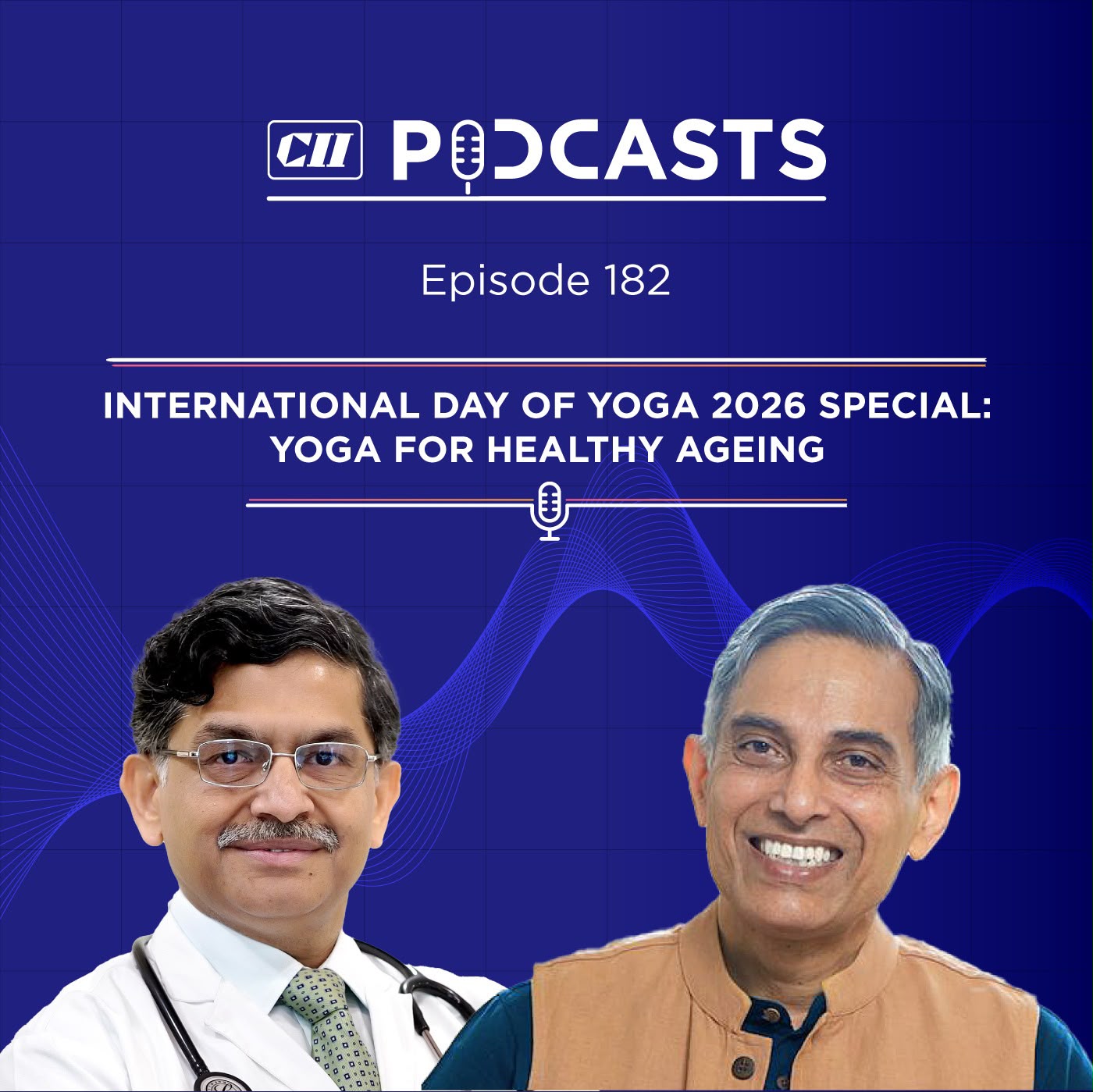
International Day of Yoga 2026 Special: Yoga for Healthy Ageing ft Rajiv Vasudevan & Dr Ashutosh Shukla
from CII Podcasts
32m 28s
In this podcast commemorating International Yoga Day 2026 on the theme "Yoga for Healthy Living," speakers Mr. Rajeev Pasudevan and Dr. Ashutosh Shukla discuss yoga's true essence beyond physical exercises. Mr. Pasudevan emphasizes that yoga is a holistic way of life rooted in the eight-limbed path of Ashtanga Yoga, starting with Yama and Niyama, not just Asana. It aims to remove ignorance about one's true self and achieve union with universal consciousness. He contrasts this with common misconceptions that reduce yoga to contortion or fitness routines. Yoga and Ayurveda are described as sister sciences from the same Sankhya philosophy: Ayurveda heals disease and restores balance, while yoga transforms the mind toward higher consciousness. The theme of healthy aging is explored through the concept of entropy (Vata) in the body, which modern lifestyles accelerate, leading to premature aging, chronic diseases, and mental health issues like depression. Yoga slows this process by channelizing energy, regulating brain waves, and fostering mindfulness, purpose, and social connections—key factors in longevity seen in blue zones. Dr. Shukla shares his experience introducing yoga in a global corporation, noting initial enthusiasm waned because employees saw it only as exercise. He advocates for education on yoga's deeper benefits, including meditation and pranayama, to sustain engagement. The discussion concludes that corporate leaders must embed yoga as a core value to combat stress, heart disease, and burnout, promoting holistic health and a longer health span.
Welcome to CII Podcast. Namaskar and welcome to a special CII Podcast commemorating the International Day of Yoga 2026 on the theme Yoga for Healthy Living. To discuss this important subject, we are delighted to be joined by two distinguished leaders. A special guest today is Mr. Rajeev Pasudevan, Chairman CII, I with a Council and founder and CEO of Apollo, I with a Hospital. In years leading chain of evidence-based I with a Hospital. In conversation with him is Dr. Ashutosh Shukla, founder and medical director, Kana Center for Integrative Medicine, who has been pioneering the integration of yoga, I with a and modern medicine to patient outcomes. Welcome to CII and over to Dr. Shukla to take this forward. Namaskar and welcome to this special International Yoga Day Podcast. International Yoga Day is observed every year on 21 June across the world because 21 June is the summer solstice in the Northern hemisphere, which is the longest day of the year. And in yogic tradition, this period is considered specially significant for spiritual growth and well-being. And this particular date symbolizes harmony between nature and human consciousness. Namaskar Rajeev, welcome to this podcast. We are so delighted to have you with us. Same here, absolutely my privilege. These days as you know, most people think of yoga as a set of exercises for fitness. What is yoga according to you? Thank you Dr. Shukla because as I said, begin I would first of all like to acknowledge the very important role that CII has played in the evolution of awareness of Ayurveda, yoga, Indian systems of thinking in the industry fraternity and business leaders who really command a lot of respect. The awareness that the contributions in policy making and in general awareness building and fostering the ease of doing business, all of these over the last decade and more in particular. In very focused initiatives, he has taken, I really appreciate what CII has done and said, "Prible it should be here with you Dr. Shukla." So coming to your question and it's also a good milestone because an eminent modern medicine practitioner is yourself getting engaged with this entire field, augers very well for Ayurveda, yoga and Indian systems of thinking. So yoga as we know today as it is presented to the common man, immediately evokes a certain picture of people contorting themselves and creating exercises. So if we look at the the theme for today, yoga for healthy aging per se, right and I will talk about it maybe as we go along, the fact that every Indian system of thinking was never focused on just one dimension, it was always about holistic approach to life and when you say holistic let's understand the correct definition is a physical dimension, a mental dimension and the spiritual dimension of self-acquisition. So this was the foundation on which every Indian system of thinking would come to. How do I fulfill my complete potential? So yoga is no different and therefore when we reduce it to a set of body exercises, we also have to realize before I get into Asana, in the Ashtanga Yoga tradition of the eight step mode, we are talking about Yama, Niyama and then Asana, then Brahana Yama, right. So unless I have disciplined myself, my body and mind through a Yama and Niyama set of practices, I don't get to the Asana. So when people jump, what somebody on TV start doing exercises, it is probably a shortcut to this whole thing. So the Hata Yoga, which is the first four parts of the larger Ashtanga Yoga and then the Antaranga Yoga, right, or the Rajya Yoga. How do I go beyond the body and then how do I and we'll talk about it as we quickly go through the talk. But when you go to the restraint of the senses, then as we go to Pratyahara, then Dhyana, Dhyana, Dhyana, Samathi, that whole phase, that's where the entire thing and as you did elude in your opening comments, that how does one align and unite, one's consciousness with the universal consciousness, right. And actually I just want to touch upon this because Yoga very often, when you say union with the higher, very often you forget is what Yoga always said and this is very subtle here, that when you look at the panchaklesha, the five, the mind, what disturbances typically prevail, you know, the human mind, what Yoga foundationally said was coming from a ignorance of not knowing one's true self. So when the ignorance is removed, right, and one identifies with this and to remove the ignorance from its root and to attain the Samathi, I need to go through all these steps. So that's the way, you know. So it's very, very deep and powerful and I see Yoga is also misunderstood two parts, one it's a bodily thing, the other part is union with the higher means what is not clear. So this is the removal of the ignorance which leads to the correct union. Yeah. So it's a way of life that harmonizes the body, mind and our spirit. Absolutely. Yes. I would say that on this international Yoga day, let us all embrace this ancient gift of ours, 5,000 years old and let's use it to build a healthy, happier, longer lives. And that's what you alluded to, healthy aging is the thing for this year. So, you know, Dr. Stosh, you know, the fact is that this Sampati, you know, the treasure of our civilization, of the people of this Indian subcontinent is something which is helping the world and the Indians should warmly embrace and look at it in its totality and I'm sure that that's the aim that all of us have, you know, well wishes of India, you know, have a bite. So, Rajeev, Yoga and Ayurveda, what we understand are often described as sister sciences and they are originating from the same philosophical tradition of ancient India. Yes. While they are distinct disciplines, they complement each other closely. So, can you elaborate a little bit more on how do they differ and because many people think of Yoga as exercise and Ayurveda as a herbal treatment? That's it. So, can you elaborate? Yeah. Absolutely. See, they're joined at the hip. Right? Although the school came, as you can see in Vedanta, you don't talk about Yoga. In Vedanta, you don't talk about Ayurveda. But they all spring from the same foundation and if you look at it, most of Indian thinking, although they diverge, they diverge on or they separate in certain finer points, but Sankeya philosophy, school of philosophy is the better rock from which other systems then came. And Sankeya really positive and Yoga as a school and Ayurveda as a school comes springs from Yoga from Sankeya, which posits the 25 Thanmatras and the school of creation and how does it come? And why I bring this up? How they connect totally is because from the universal energy, Mahat and then the Trigunas, there is a certain definition of how the universe came into being. In creation, the body and the mind, the sensory organs, the physical organs and physical health, mental health was really positive. And Yoga and Ayurveda are inextricably linked that way, although they're physically separated because the way that the Patanjali Yogasutra has will approach because that focus is completely on the mind. You'll find rarely two or three references to the Bhaktini in Patanjali Yogasutra. It's almost entirely about how to achieve Samadhi, the highest Asampranthasamadhi, the highest Samadhi. So that is it, but Ayurveda how does it come together? If I may say Ayurveda enables the physical aspect a lot, lot more focused particularly where there is disease in the body, you're able to correct Arogya, now Rooga and Restore Arogya, that is the Avastya where there is no Rooga. And what is Rooga and Arogya if you were to take? I have a Prokritic state, see this is where Ayurveda Yoga comes together. I have a Prokritic state, right? And the Prokritic state is what I defined at the time of conception. From the Prokritic state, I go to a Vikritic state, where Ayurveda Yoga both right to bring us back to a Prokritic state. And while Yoga is extremely powerful in preventive and promoted health, Ayurveda is very powerful in preventive, curative. Even Yoga, there is a complete medical school, but if I take deep and I want to touch this, where I have chronic inflammation, I have you know metabolic syndrome, where I have syndrome of diseases, neurodegenerative conditions. Once the disease has gone out, I have a lot of problems,
Ayurveda has to come in, yoga will sustain a body in mind. What is your own view, Dr. Shastra? You would also know your thoughts. I mean, you've given such good insight and from if I were to just summarize it, I'll Ayurveda heals the body in mind, whereas yoga transforms the mind and the consciousness. Absolutely. I think I can't disagree with you at all. It's that next stage, and unfortunately, yoga has also been brought into the lower two. But actually, yoga goes from mind to consciousness, as you correctly said, absolutely. To attain kivalya, that highest level of samadhi. So, they are sister traditions and therefore, how to get the, wait, we look at the fact of chitta vritti niroda, the fact that the fluctuations of the mind need to be stopped. And as you told, the very foundational concept of tada, drastay, swarupaya, avasthanap. So, abhydance in self, so swastya itself, being defined as abhydance in self, the higher self. So, that is the beauty of Indian systems of thinking. It is not the absence of disease. It's the highest that a human being can achieve. Yeah. Yeah. It reminds me of an Indian, any system of medicine where in the village, every person had to give a ex amount to the local physician. And the moment he, somebody fell ill in his family, that contribution stopped. So, it was the beauty of the condition to make sure that everybody is healthy in that community. Definitely. Yeah. Yeah. So, this year, the official UN came for this year's International Yoga Doer days, yoga for healthy, and his particular experience, was very important. And the reason why I was here is because I was a doctor, I was a doctor, I was a doctor, I was a doctor, I was a doctor, I was the most wise man in the community, was a doctor. And the doctor was attached to the Raja to keep the Raja healthy and the Praja healthy. This year's International Yoga Doer days, yoga for healthy, and is particularly relevant in this era where chronic diseases, stress and life-time disorders are increasingly becoming common and more common. So, how can yoga contribute to optimal, you know, health and better aging? So, the basic thing, if you know, those who are from non-vehicle backgrounds, if you look at the, you know, and probably technical backgrounds, the second law of thermodynamics, that entropy in a system continues to increase. Right? It never ceases, it continues to increase, and death is the maximum point of entropy. So, when you look at, and what is entropy, disorder in the system. So, what Ayurveda and yoga has posited this thing is the Vata in the body. Right? Vata is required for functioning, Kabai structure, pitta is metabolism, transformation, but this Vata process in the body is disorder in the system. So, healthy aging is slowing down, I repeat it, slowing down the process of Vata, Vata's agumon to slow down that, decelerate, because you're constantly accelerating. And today, what has happened, our diet, lifestyle, in its totality, lifestyle is what we do is only accelerating Vata, increasing disorder. And you might be aware that the highest contribution to disability in just life years now is depression. Yes. globally, it's mental health. So, in my practice also, 80% of my patients have subtle anxiety, depression stress which they don't realize themselves. And this is completely under the radar, nobody yet looking at the manifestation. So, why I bring this up, healthy aging is essentially a need to look at these concepts which I'm sure you relate to. Psychosomatic is very well known, when my mind is something I have. So, my body is in a particular state, that is an impact on this. So, when you look at gut brain access, it works both ways. And in look at this environment which is metabolic dysregulation or gut health, gut dysbiosis. And you look at inflammation, both of this are the clear connect with the brain. So, you can see today in the 40s and 30s, people having health profiles of people in the 60s. Because of the cognitive overload, the cognitive burnout and yoga fundamentally is able to do, I guess. It's like an engine which is designed to go at 60 KMPH. It's running at 120 KMPH. The engine was never designed to run at 120. Right? And we are running it at 120. So, we are running the marathon race like a sprint. And by the time you figure out and as a corporate executive, everybody wants everything early. I want to retire by 40 with the fortune in the bank. In the process what I've known realizes I don't have anything to enjoy because I've already messed up my health in the intervening years. So, this awareness and what yoga I just want to tell very fundamentally is Yamaniyama that whole process of working with a yoga guru, getting into a practice where I wake up at a particular time or go in the evening or build it into my routine, that the moment I do this, that what the the westerners have called mindfulness, right? And taken it out. Of course, our way of looking at mindfulness is at a much higher level. It is not this being aware that I'm going to stop with you. It is not the mind analyzing the mind. It is really going higher than that. And why I'm bringing this up? Even that mindfulness immediately brings up to disorder. That is your great benefit. And as I do the Yoga Suna, as you know, Dr. Shiklaya, as a Yoga Suna has done, the brain waves, the body, the energy in the body is getting regulated. So, this is a very beautiful concept called Vata Anu Lohmanam. That is not reducing. It is channelizing the flow of energy. So, when you say the chakras, the energy which you're talking about, you're basically channelizing. And why this becomes important quickly, it's from the same. Where I'm telling, Prana-ayama, right? I'm joking. I'm joking. I'm controlling the breath. But Prana is not breath, as you know, right? You know very well. Prana is everything in this function in the body. It's function not only at the body level, not just the pancha prana which is upana, avayana, samana, udhana and, I'm just one more, right? So, Prana, Prana, you, there. Prana, you and the other four why you say spoke about. This pancha prana is, you look at the body level. But they are also energizing the mind. They're energizing the spirit. So, when I do prana-ayama, what we are effectively doing, the channelizing the breath itself is the means to the whole process of going up. Then I'm enabled to my concentration and other levels. So, what I want to bring, aging to your question is breakdown of the system. Premature breakdown. Our longevity is 120 years. But with our modern choices, by 60, we are telling when 50% of my life span, I'm telling time to retire. What do I do next? Right? But actually, I got another 50% head. So, yoga allows you to think about that larger marathon life or race. And tell in body, mind and spirit. In my 90s, do I retain the same mind, sensory organs and the body to fulfill my life potential. So, a healthy aging of certainly is a way. Yes, sir. So, it is more important to have a good health span, not a good life span. Absolutely. Whatever you live, you should live good. So, and if you see the research on all these long-lived populations across the globe, so-called blue zones, they're consistently, they have identified typical common characteristics. All of them have regular physical activity. They have predominantly a plant-based diet. They have strong social relationships. They have sleep. And they have effective stress management. And all of them have a sense of purpose in life. That's true. Absolutely. So, and yoga, like you rightly said, addresses all these things. Your physical health, your mental health, your sleep quality, metabolic health, social connection, mind body awareness. So, it's all about completeness. I couldn't agree more with you because whether it's the blue zones or the, within India, I think what we have done now is destruction. If you really look at the Indians as a nation, are in lead from one IPL to another, this thing, we're continuously distracted from what we do. So, you talked about relationships. You talked about purpose. Right? None of this, there is time. Because we're all just distracted from one moment to the other. Right? So, I think yoga is a set of values. But if I may ask you Dr. Shuttosh, you have worked widely abroad in India. And I would like to understand from you as both a leading modern medicine practitioner and also a rotary and you know, sympathizer with the values of yoga, I would be the Indian systems of thinking, when you engage with corporates, because today as you know, India has become well-deer, the corporate sector is going out. And particularly, we both are talking on a CI platform.
which is the effects body representing Indian industry. - In this case. - And this thing, you know, industry captency to keep in mind, you know, to benefit from the larger wisdom that yoga, Ayurveda, and particularly yoga on yoga day, I would you think that they should aspire to bring into their organizations. - So to answer your question, I'll use some of my past experiences. - Yes. - For about 15 years, I was the global medical advisor for GenPAC. It's a corporate organization which has about 95,000 employees and it's offices across the globe. And I wanted to introduce yoga. So what happened was, we got these yoga trainers and we started these programs in each office. We had a gym where we started this. And in the initial two or three months, there was a lot of enthusiasm. - Yes. - And people, you know, used to come down regularly for the classes. But after two or three months, gradually the enthron level started fading away. Then I tried to analyze what's going on. What I realized after taking feedback from all the employees was that people didn't know what yoga actually is. They just thought that you just go there, do these exercises and you'll be fit and you'll be fine. You'll know like you said, yoga is not going to it. And that's what we've been discussing. It's about your consciousness, it's about your relationships, it's about your purpose in life. It's so much to it. And so that's when I once I got this feedback, then I started taking sessions on webinar, on educating people what is actually yoga. And once that started happening, then people realized that, how is the exact benefit because yoga includes meditation, it includes pranayam. - Absolutely. - So it's not just physical exercises, that's it. - It was very interesting, Dr. Shesho. It's the fact that people come and then people feel, "What is this every morning? "You have to go, it becomes a chore or a headache." And then people wane off. So is there something, you know, even from a corporate leadership angle that if you look at the mental stress and you hear very often people in their 40s getting a heart attack, 50s getting a heart attack, right? Now it's not just a body feature because you'll have grossly obese people, smokers who don't get a heart attack. We say just the genes which is protecting, but it's a lot more, I guess, as you told, purpose, relationships, a bunch of other things, you know, the deep, you know, of course, breath, exercise. So from the industry angle, if you were to look at it, do you think the concept, because I heard in Google, for example, 100 locations globally, every Friday from some X, 2 PM to 3 PM, right? And one fixed time, they all get into a place where they do yoga smas, right? And those meditation and, you know, the relaxation techniques, yoga, and etc. So is there a need to bring in from the top, not just people who come in. So the leaders are realizing that life purpose, we live one life, yoga gives us a framework in which we are able to balance as usual body, mind, spirit. That's an Indian system. - So it's a very good thing to do that, but one should add a education webinar, or write that we are educating everybody to complete the full complete dimensions of Ayurveda and yoga. Ayurveda teaches us dinsharya. I was reading the other day, you know, what's the importance of Brahma-Murad, when the sun rises for you minus 48 minutes, and then you minus another 48 minutes. - Yes. - That hour is Brahma-Murad, and that's when your body is the most lightest. And that's, and if I remember my days in medical school, I used to wake up at that time and memorize it. - The study, yeah. - Yes, study. And I had huge retention power at that time. - Because of that, yeah. So, just on that point, you know, if you see how did yoga spread in India? The chief executive or the managing director of India, ink, Sri Narendra Modi came to power. As he said, I want to take India, you know, yoga globally, and he said international day of yoga. So since it came from the top, you see today, many, many crores in every yoga day, they say 10 crores, and then every new record they're trying to set. But clearly, that impetus that was given from the top. So I guess one of the things that we need to do, perhaps here I can do, is to really educate or share knowledge with the CXOs on the power of Indian systems of thinking and building a more harmonious organization. A more aligned, productive organization, where people are calmer, peaceful, attrition goes down, right? - Yes. - Right? - Healthcare costs go down. All of this, right? There are many productivity will go up. - Right? - So maybe we should do performance and groups. This, and people have quit smoking in alcohol because of practicing yoga in Ayurveda. - Yeah. - So, I think there's a lot we can do. - Yeah. - But, you know, in today's world, where we are focusing so much on modern medicine and aloe vera, what we have been practicing at Prana is that we are trying to integrate Ayurveda, Yoga, mind-biting medicine along with modern medicine. - Yes. - And what is your opinion? Can these, gentle together, can, I mean, I feel it's the way medicine should be practiced in the future? - Yeah. So, and first of all, I want to applaud you and Dr. Ashima Shukla for and all your stakeholders for attempting what you're doing, right? It's based on very sound values. Having said that, the way to integrate is to realize that to learn one science or one knowledge system itself with a lifetime pursuit. So, for somebody to learn multiple things and bring that rigor to personalized, safeguard is a lot of work. So, the way we have looked at it is a concept called co-managed care. Now, what does that really bring? It means that there is a concept of Rogi Roga Avasta. That means there is, every person is in state as we, from childhood, from birth to death, there is breakdown happening in the body. Some is visible, some is not visible to breakdown. So, depending on the person and the manifestation of this ease, the absence of ease, you may say, here, modern medicine is more appropriate to treat the symptom, get it down. Or, I need a surgery, I do a surgery. On the other hand, you're seeing something at an early stage, you can bring yoga or Ayurveda. Is it breath related? I do that. Is it, you know, non-communicable diseases? You can bring in Ayurveda as opposed to symptomatic care. So, what I call a co-managed care is a very simple integrative approach where the patient is at the heart of care. Clinicians come together. There is a protocol of assessing. Each person assists and without wasting time, they're able to seamlessly integrate with each other and work out what is best. And this model we do in very serious patients, including traumatic brain injury, stroke, metabolic syndrome, et cetera, that model definitely is the future. And India can take the lead globally, Dr. Shuttosh. What Prana is doing in Gurgaam should become a model, but protocols for working together, for safe working in the interests of patients, will have to be developed. I see the next 10 years are the very, very interesting period in India. Yeah, yeah. And there are scientific reports. You know, people who have been meditating, who have been practicing Ayurveda, there's a study from Harvard where they studied the telomeres. At the end of the chromosomes, the parts of the chromosomes, the telomeres, they have started lengthening. And also the levels of the interleukin, six and eight levels of check. And they found that the levels had gone up. This is a study from Harvard. And so when we are getting these evidence, I think this is the way we practice in that sense. You brought a very important point quickly on that, Dr. Shuttosh. So if you see Dr. David Centlair from Harvard Medical School, who has written a lot of books on longevity, and healthy aging, his seminal paper in 2023 in Cell, the medical journal, positive that 80% of health impact comes from epigenetics, not from genetics. So focus on the epigenome, which is the resultant of, which determines how my genes express themselves, is determined by the impact of environment, air quality, sound quality, stress, the food, all of that, inner outer stressors. So 80% of disease or health is determined by epigenetics. And I believe that's going to be the very powerful ramashtra that yoga and I are with us. And the ability to potentially reverse the epigenetic changes happen. If we do that, healthy aging will be made possible, or retarding the unhealthy aging, slowing down unhealthy aging, which is tantamount to telling healthy aging, we should be achieved. So, yeah. And the informative markers, yeah.
So it's very important for us to realize the tremendous and the huge benefits of Ayurveda and Yoga that have not been tapped fully so far. So thank you so much for your insights and your using your engineering language to interpret medical information. This is a fabulous photographer you. Thank you sir. Thank you so much for this interesting conversation and before we wind up would you like to give one last comment for some last one message on the International Yoga day? Dr. Shtosh, thank you very much and to CII but you know together it's been a great conversation but I wanted to say healthy aging right is also a mindset. I want to begin to tell this thing. There is a very famous tale from the Mahabharata where I believe Yudhishthira no talks about the paradox that we see people dying every day, every way and we still believe man is immortal or I am immortal. Till it's time for me to go. The fact the other paradox which I say people believe longevity right are you that word longevity is not number of years as you correctly told the number of years I live with healthy body, mind and self-atchlizing but the other paradox I say that number is not laid down somewhere in some book somewhere in outer space or in heavens or wherever you want to say that number is in your hand my hand exactly. You work words that healthy aging and living to our life potential. Yoga or Ayurveda is not about just doing things for being healthy in terms of telling my cholesterol isn't the control but it is about fulfilling one's life potential and I hope that CII will take this message of healthy aging to the Indian industry world and to spend the good words that good work that Ayurveda and Yudhya. Yudhya and Ayurveda can do. Thank you so much Rajitit. It was wonderful talking to you. Thank you CII for this wonderful platform. Thank you. Thank you for listening to CII Podcasts.
Podcast Summary
Key Points:
Yoga is not merely physical exercise; it is a holistic system integrating Yama, Niyama, Asana, Pranayama, Pratyahara, Dhyana, and Samadhi to unite individual consciousness with universal consciousness.
Yoga and Ayurveda are sister sciences from the same philosophical roots; Ayurveda heals the body and mind, while yoga transforms the mind and consciousness.
Healthy aging involves slowing down entropy (Vata) in the body, which modern lifestyles accelerate, causing premature breakdown and conditions like depression and metabolic syndrome.
Yoga addresses all components of well-being—physical activity, mental health, sleep, social connections, and purpose—as seen in longevity studies of blue zones.
Corporate wellness programs often fail because employees misunderstand yoga as mere exercise; proper education on its deeper purpose is essential for sustained engagement.
Industry leaders should embed yoga as a core value, not a chore, to combat stress, heart disease, and burnout, fostering holistic health among employees.
Summary:
In this podcast commemorating International Yoga Day 2026 on the theme "Yoga for Healthy Living," speakers Mr. Rajeev Pasudevan and Dr. Ashutosh Shukla discuss yoga's true essence beyond physical exercises.
Mr. Pasudevan emphasizes that yoga is a holistic way of life rooted in the eight-limbed path of Ashtanga Yoga, starting with Yama and Niyama, not just Asana. It aims to remove ignorance about one's true self and achieve union with universal consciousness.
He contrasts this with common misconceptions that reduce yoga to contortion or fitness routines. Yoga and Ayurveda are described as sister sciences from the same Sankhya philosophy: Ayurveda heals disease and restores balance, while yoga transforms the mind toward higher consciousness. The theme of healthy aging is explored through the concept of entropy (Vata) in the body, which modern lifestyles accelerate, leading to premature aging, chronic diseases, and mental health issues like depression.
Yoga slows this process by channelizing energy, regulating brain waves, and fostering mindfulness, purpose, and social connections—key factors in longevity seen in blue zones. Dr. Shukla shares his experience introducing yoga in a global corporation, noting initial enthusiasm waned because employees saw it only as exercise.
He advocates for education on yoga's deeper benefits, including meditation and pranayama, to sustain engagement. The discussion concludes that corporate leaders must embed yoga as a core value to combat stress, heart disease, and burnout, promoting holistic health and a longer health span.
FAQs
The theme for International Day of Yoga 2026 is 'Yoga for Healthy Living'.
June 21 is the summer solstice in the Northern Hemisphere, the longest day of the year, which is considered significant for spiritual growth and well-being in yogic tradition.
Yoga is a holistic approach to life that harmonizes the body, mind, and spirit, involving disciplines like Yama, Niyama, Asana, and Pranayama to remove ignorance and achieve union with the higher self.
Yoga and Ayurveda are sister sciences from the same philosophical tradition; Ayurveda heals the body and mind, while yoga transforms the mind and consciousness, working together to restore balance.
Healthy aging involves slowing down the process of Vata (disorder) in the body through yoga and Ayurveda, addressing chronic inflammation, metabolic syndrome, and mental health to extend health span, not just lifespan.
The program failed because employees viewed yoga as mere physical exercise; after educating them about its true purpose, including meditation and Pranayama, engagement improved.
Chat with AI
Loading...
Pro features
Go deeper with this episode
Unlock creator-grade tools that turn any transcript into show notes and subtitle files.
 PodcastTranscript AI