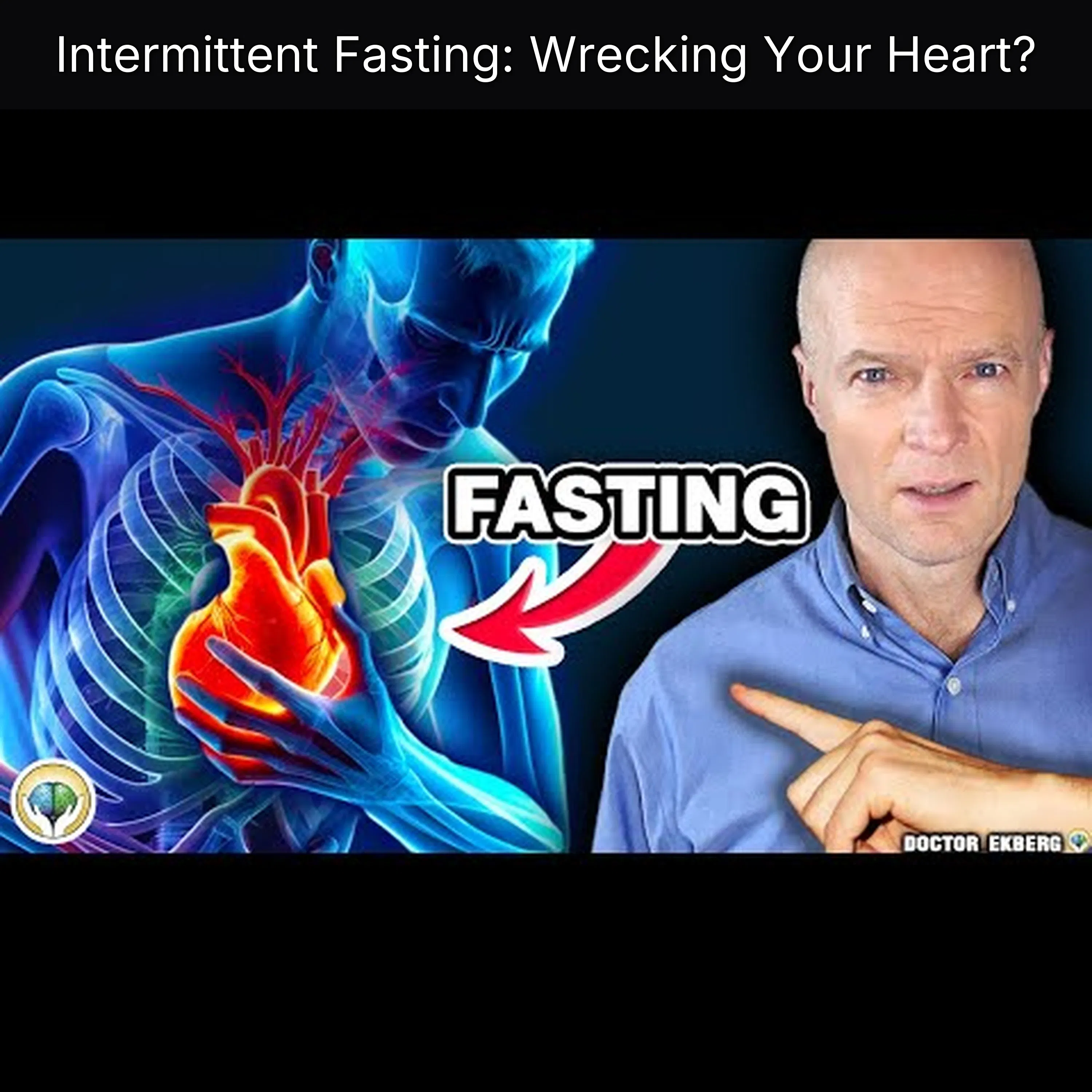
The speaker critiques a recent American Heart Association study claiming that eating within an 8-hour window increases heart attack risk by 91%, calling it flawed and premature. The study is not peer-reviewed, relies on self-reported dietary recall, and fails to control for critical factors like food quality, sleep, stress, exercise, and smoking. Moreover, the data was collected from 2003 to 2018, before intermittent fasting became mainstream, so participants likely skipped meals due to busy, unhealthy lifestyles—not purposeful fasting. The speaker suspects the American Heart Association rushed to publicize the study to undermine a growing health movement that threatens pharmaceutical and institutional interests. In contrast, abundant evidence shows that time-restricted eating with real food reliably improves markers of metabolic health and reduces cardiovascular disease risk. The speaker advocates for a personalized "study of one": measure real risk factors—insulin resistance (glucose, A1C, insulin, HOMA-IR, triglycerides, waist size, blood pressure) and inflammation (HDL/LDL ratio, LDL particle size, hs-CRP)—then implement a 6-8 hour eating window with whole foods for three months and reassess. This approach empowers individuals to base health decisions on their own data rather than sensationalized headlines. The speaker concludes that for over 90% of people, intermittent fasting improves these markers and is a powerful tool for heart health.
Hello Health Champions. Can fasting actually increase the risk of heart attacks? Well, according to a new study that was presented at a conference by the American Heart Association, there is a 20,000 people study where they found that if you eat your meals in a period of less than eight hours per day, as opposed to the normal 12 to 16 hours, then there would be an increased risk of heart attack of 91%. Now, this would come as quite a shock to all the millions of people who are practicing intermittent fasting for the opposite reason to actually save their heart and improve their metabolic health. So let's talk about this. Well, there are some serious limitations to this. First of all, it is not a study at abstract. It's like a preliminary study. It has not gone through the peer review process, meaning that experts actually look at this and validate the data and that the conclusions and the reasoning is sound. Secondly, the data is self-reported and they sent out a survey and they ask people a couple of times during a several year period and they ask, "Do you remember what you ate?" And even the author of the study admits that this depends on recall and therefore may be inaccurate. Perhaps the biggest problem with this is that they don't survey any other factors. They don't control, they don't ask about anything else other than the time period during which food was consumed. So there are some factors of critical importance such as what kind of food do you eat, what sort of nutritional value does it have? But they also excluded factors such as sleep, stress, exercise and smoking which have huge, huge impacts on heart health. But here's where we really need to question the validity of the study and their conclusions because the study, the data was collected during a period from 2003 to 2018. And then in the study they reported as intermittent fasting. But intermittent fasting is a very new concept. Even though certain cultures have practiced it for thousands of years, the concept of regular intermittent fasting wasn't really a thing until the late 2010s, which means that it was either after or toward the very, very end of when this data was collected. There was probably no one in this study or extremely few people in the study surveyed that thought they were actually practicing intermittent fasting on purpose. And then you have to ask yourself, if they're not consciously practicing intermittent fasting, then why are they doing this? What type of person would be eating during a shorter period of time if they're not consciously doing intermittent fasting? And the guess is that this would be something like a type A personality. Someone is very driven, very busy. They're probably too busy to eat and that's the reason that they skip breakfast and they eat during a very short period of time. They probably skip breakfast, they may even be the type of person that just goes through the first half of the day on cigarettes and coffee, maybe the occasional doughnut. And when they're very short for time chances are that they're going to frequent fast food places. So I don't know this for sure. This would be my suspicion. But the fact is the people in the study don't know this either because they didn't ask. Now what's really disturbing to me is the fact that this study isn't even published. And yet the American Heart Association jumps on it. And then as a result of the authority of the American Heart Association, now of course all the media like NBC News are going to cover it, Washington Post, US News and World Report, USA Today, and New York Times. I think there were about 6,000 different instances that had restated this study. And then of course all the people writing for these news media, they're not health experts. They are not versed in critically evaluating or assessing such a report. No, they just want to create some sensationalism and tell everybody about the dangers of intermittent fasting. So now millions and millions of people who had their hope in getting healthy from intermittent fasting now get really scared. What are you supposed to believe? And what's also disturbing to me is that to me it seems like the American Heart Association is not anchored in science because there is no foundation in physiology. There's no way to open up a physiology textbook and read something that makes sense to why this study would have that particular outcome. And if it doesn't match physiology, then it should be the very last study that they bring out prematurely. Not the very first one. But yet they jump at the chance to get this information out there. It's as if they're just waiting for an opportunity to silence the voices of people who do things differently than mainstream medicine. And whenever there's a movement that threatens the American Heart Association and the establishment because people can get healthy on their own, then of course that's not good news for the American Heart Association or anyone in that establishment. Because most of these organizations and most teaching hospitals and research universities, they depend on funding. And a lot of that will come from Pharma who depends on a system where they can distribute their medication. And we always have to ask ourselves, why did they jump so quickly on this information? And we have to ask ourselves, who is involved, who have anything to gain or lose by this information? And unfortunately what's so disturbing is that a lot of times it comes down to politics and power and finances rather than patient health. The reason they shouldn't jump on the premature study is that there is now abundant evidence in just a few years about the power of intermittent fasting on how if you eat real food and you time restrict your eating, then it will very reliably and very consistently improve all markers of metabolic disease that are related to cardiovascular disease. When I say all markers, I don't mean every single marker in every single person, every single time. I mean that on a study scale that we consistently improve these markers for the majority of people. And that's also why you don't ever want to trust anybody's opinion explicitly. Not mine, not the American Heart Association because everyone can be different. So what you need to do is you need to study health, not just read lists off of the internet. You want to watch some videos that will actually teach you mechanisms to help you understand the body and some of the basic mechanisms in the body until you can see the information on the internet come together. And then you want to do your own study with an end of one and that means that the sample size is one person, you. Normally in terms of research, that's a joke because that means if you only have one person, then it's not statistically significant. But when you do your own study on yourself, it's the most significant because you are learning about you. And then you want to measure your actual risk markers, the real markers for heart disease, the risk factors. And I'm going to share those with you in just a second. Then of course you do something, you change something. And you limit your feeding to six to eight hours a day and it's probably not absolutely necessary that you change what you eat so much, even though I would strongly recommend it because your chances, the probability of getting good results, going to go up dramatically. If you start eating real food, which means you cut back on sugar and soda and ice cream and cookies and all the packaged foods that is basically primarily made up of sugar and flour and seed oil. And if you do that, if you start eating real food, you will automatically cut out at least half of your carbohydrates, maybe more. And you don't have to go into ketosis or go extremely low carb for any of this to work. works in itself, but your chances are going to go up if you
eat real food. And then you keep that up for three months and then you run those blood tests again to reassess all those markers. And what is it that you're going to measure? What are the real risk markers for heart disease? Well, they fall in two categories. Things that measure insulin resistance and things that measure inflammation and oxidative stress. So the first few markers are glucose, A1C, and insulin. Glucose is how much blood sugar you have in any given moment. A1C is the average glucose over a three to four month period of time. And insulin is the hormone that controls glucose. So when your glucose goes up, your insulin goes up correspondingly to bring the glucose down. But when you become insulin resistant, then it takes more and more and more and more and more insulin to keep the glucose down. So now there's something called HOMA IR. And what you do now is you multiply the glucose by the insulin and you divide by 405 if you measure glucose in milligrams per desoliter. If you measure in millimoles now you divide by 22 and a half. And the result is a number called HOMA IR, homostatic model assessment of insulin resistance. And this would be the strongest indicator there is of your risk of heart disease. Because by far the strongest correlation to heart disease is type two diabetes. And this is the best marker to assess your risk or your tendency of type two diabetes. Some of the strong indicators of insulin resistance would be your triglycerides. How much fat is floating in your blood? Because if you're insulin resistance, it stays in the blood for a long time. If you're insulin sensitive, your cells will absorb it and use it. Waste size is another strong indicator because once you get insulin resistance, you get fatty infiltration of the liver and your abdominal cavity and your belly grows. Another strong indicator is hypertension or high blood pressure, which is also very strongly associated with insulin resistance. Measuring inflammation and oxidative stress is not quite as straightforward, but we have some really good indicators. And HDL and LDL cholesterol will give us a good indication. And it's not about how many milligrams you have on each, but it's the ratio because when the ratio goes down, meaning there's less HDL in relation to LDL, that tends to indicate inflammation. We also want to look at the size of the LDL particles. And you have to run a test call an NMR test to get this information, but it's well worth it because you're assessing the actual risk factors. And what you're looking for on the test is to have what we call large and fluffy LDL particles, because a lot of inflammation and oxidative stress will shrink and increase the densities. So if you have small dense LDL particles, then that is a strong risk factor for heart disease. And one more factor we can measure is called high sensitivity, sea reactive protein, which is a general inflammatory marker. Now these are not the only markers, but they are the main ones. And if you really want to dig into this and start understanding your blood work in terms of how the body works, I created a blood work course and I'll put a link down below for that. And we can also get you some discounted blood work where we measure all of these factors plus a whole lot more. But the biggest problem in making change is that there is so much attachment to the status quo. There are so many people, so much money invested in keeping things the same. So when something like low carb or intermittent fasting becomes popular because hundreds of thousands, millions of people see improvement, they get healthy, they make changes that they've never been able to do before, that threatens this status quo. So now people desperately cling to their old beliefs and they say, "Well, we admit that you can reverse diabetes. We admit that you can lose weight. We admit that it's really good for reducing visceral fat, but we don't know the long term effects. That's kind of their fallback that will save the day for them in any situation." But that is why it's so important. We understand the real risk factors because if you measure those and they get better, then you get healthier. And this is both short term and long term. It's so often what they're saying when they say we don't know the long term effects, what they're saying is, "Well, it might be good for your short term, but it's probably dangerous long term." And that's not how it works if we address and improve the real risk factors. And the exception is if we use some chemical, some medication, to suppress body physiology. If we just bring in things that the body wants naturally and we let the body do its thing and the body uses its infinite intelligence to achieve homeostasis, to regulate all these thousands of variables to find that best balance. Now this holds true. When you improve the markers, you are getting healthier. But if we're not allowing homeostasis to do its thing, if we introduce chemicals that interfere, that suppress certain markers, that block what the body is trying to do, now we're not allowing this balance. And now we're creating a stress load and a toxicity on the body. And this is probably why a lot of people have such a hard time understanding this because we're trained in the idea that medication will make us healthy. And medication can't do that. Medication is not always a bad thing, but it cannot restore the thing that isn't working. All disease is because of something that isn't working right. And if we can address the root cause, if there's enough healthy tissue and function in the body that we can support it and bring back that function, now we get healthy. If we don't have enough balance, enough tissue, there is sometimes a good idea to use medication, but it's only going to control something at the expense of something else. It will not restore the original function. So here is in my opinion, the real risk factors and how important they are. So we have insulin resistance, then we have gut health and other sources of inflammation like leaky gut and autoimmunity and food allergies and so forth. Then we have LDL particle health. Are they large and fluffy or are they small and dense and damaged by inflammation and oxidative stress. And then we have total cholesterol as in measured by milligrams per desoliter or millimoles per liter. And here is my belief. This is my opinion. I don't have any data to support these specific numbers and I just kind of grab them to give you an idea of how I feel about this. So I think insulin resistance is by far the strongest correlation, the strongest risk factor for heart disease. It probably accounts for about 80% of that weighted importance. And then I think that gut health and other sources of inflammation probably account for another 10%. I think the LDL particle health particle size is another 9% or so. But keep in mind that most of the LDL again has to do with insulin resistance and other sources of inflammation. So this is not really an independent risk factor. It's dependent on these two other factors. And then maybe total cholesterol accounts for maybe 1%. But this is only in my opinion for people with very, very large numbers. I don't think a number of 300 in itself is a risk factor if everything else looks good. I think maybe and I'm saying that because I don't know if your cholesterol gets up to 6, 7, 800, then you have some severe metabolic imbalance, some genetic imbalance that can probably predispose you. But for most people that is not going to be a factor. So this stuff can get really confusing. When you learn something and you believe it and then they publish a study or they talk about a study like this that contradicts everything that you believe. So your proof is going to come from your results and your understanding. So if you go through and you do your own trial study on yourself a three month trial, put it in the description.
pre-imposed blood work, then the question is what happened? That's going to be your proof. So if there is no significant changes in most of these variables, then chances are that your issue is a little bit more complex. It's going to be something like auto-immunity or inflammation or maybe you have a chronic infection or some emotional trauma. The variables are unfortunately pretty endless. It can also be that you get your test results back. You've gone through these changes and all or most of your markers are worse. And if that's the case, then intermittent fasting is probably dangerous for you. It's something you should stay away from. But if that happens, please contact me and report to me on that because I'd love to know what planet you're from. Well, kidding aside, we never want to say never. So it is possible that it could happen because there's billions of people on the planet. There's probably a handful that would have some extreme inexplicable reaction. But it's going to be so rare that it is extremely unlikely that will happen. What's much more likely that I would say is probably an account for more than 90% of people is that you would see all or most of your markers improve. If you haven't done intermittent fasting or low carb or some healthy living already for a period of time, if you just kind of knew to this and you go through this process, then I would say that all or most of your markers are probably going to show some positive change. And then if that's the case, then intermittent fasting, like for most people, if you can use it to reduce insulin resistance to improve metabolic health, that is the best thing that you could do to improve your health, to reduce the risk of heart disease and save your life. If you enjoyed this video, you're going to love that one. And if you truly want to master health by understanding how the body really works, make sure you subscribe, hit that bell and turn on all your notifications so you never miss a life-saving video.
Podcast Summary
Key Points:
A new study presented by the American Heart Association claims that eating within a less than 8-hour window (time-restricted eating) is associated with a 91% increased risk of heart attack, based on self-reported data from 20,000 people.
The study has serious limitations
The speaker argues that the study likely reflects unhealthy behaviors in busy individuals (e.g., skipping meals, eating fast food) rather than purposeful intermittent fasting, and criticizes the American Heart Association for prematurely publicizing it without physiological evidence.
The speaker emphasizes that real risk factors for heart disease include insulin resistance (measured by glucose, A1C, insulin, HOMA-IR, triglycerides, waist size, blood pressure) and inflammation (HDL/LDL ratio, LDL particle size, hs-CRP), not just meal timing.
The speaker recommends a personalized approach
Summary:
The speaker critiques a recent American Heart Association study claiming that eating within an 8-hour window increases heart attack risk by 91%, calling it flawed and premature. The study is not peer-reviewed, relies on self-reported dietary recall, and fails to control for critical factors like food quality, sleep, stress, exercise, and smoking. Moreover, the data was collected from 2003 to 2018, before intermittent fasting became mainstream, so participants likely skipped meals due to busy, unhealthy lifestyles—not purposeful fasting.
The speaker suspects the American Heart Association rushed to publicize the study to undermine a growing health movement that threatens pharmaceutical and institutional interests. In contrast, abundant evidence shows that time-restricted eating with real food reliably improves markers of metabolic health and reduces cardiovascular disease risk. The speaker advocates for a personalized "study of one": measure real risk factors—insulin resistance (glucose, A1C, insulin, HOMA-IR, triglycerides, waist size, blood pressure) and inflammation (HDL/LDL ratio, LDL particle size, hs-CRP)—then implement a 6-8 hour eating window with whole foods for three months and reassess.
This approach empowers individuals to base health decisions on their own data rather than sensationalized headlines. The speaker concludes that for over 90% of people, intermittent fasting improves these markers and is a powerful tool for heart health.
FAQs
A preliminary study presented by the American Heart Association suggested a 91% increased risk, but it has serious limitations, including self-reported data and lack of peer review.
The study is not peer-reviewed, relies on self-reported recall, and does not control for other factors like diet quality, sleep, stress, exercise, or smoking.
The data was collected from 2003 to 2018, before intermittent fasting became popular, so participants likely weren't practicing it consciously, and their eating patterns may reflect other behaviors like being too busy to eat.
The main risk factors are insulin resistance, inflammation, and oxidative stress, measured by markers like glucose, A1C, insulin, triglycerides, waist size, blood pressure, and LDL particle size.
Run blood tests for glucose, A1C, insulin, triglycerides, HDL/LDL ratios, and high-sensitivity C-reactive protein, then measure changes after a three-month trial of time-restricted eating with real food.
If markers worsen, intermittent fasting may not be suitable for you, though this is extremely rare; contact a health professional for personalized advice.
Chat with AI
Loading...
Pro features
Go deeper with this episode
Unlock creator-grade tools that turn any transcript into show notes and subtitle files.
 PodcastTranscript AI