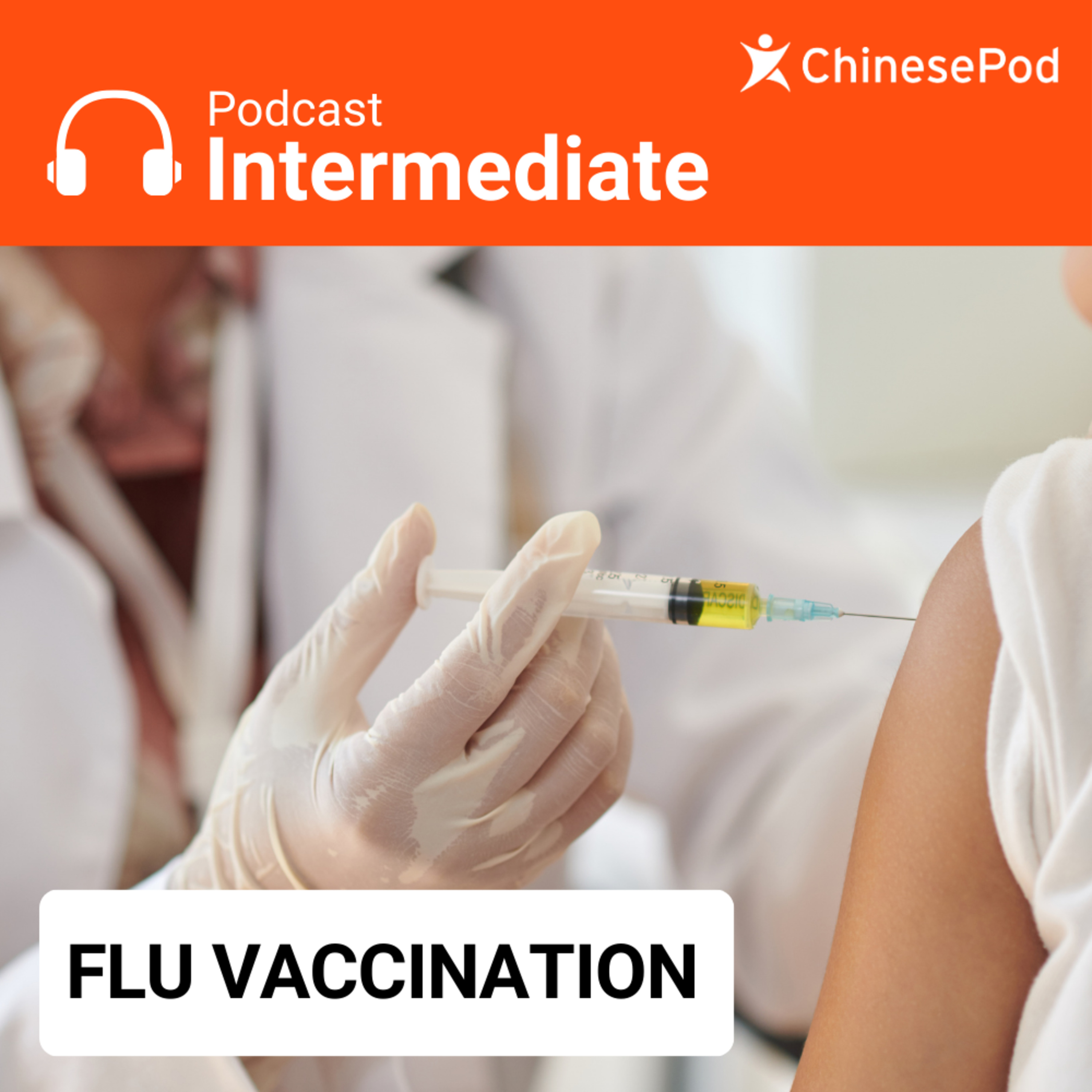
This intermediate Chinese lesson centers on vocabulary and dialogue related to receiving a vaccination. The hosts, Dilu and John, introduce key phrases such as "打针" (to get a shot) and "打疫苗" (to get a vaccination), specifically for a flu vaccine ("流感疫苗"). The lesson features a simulated conversation where a mother takes her child to the doctor for a flu shot. It covers typical interactions, including the doctor greeting the child, asking their age ("你几岁了"), and inquiring if they are afraid of pain ("你怕痛吗"). The child responds bravely, leading to instructions like rolling up sleeves ("把袖子卷起来") and a request for a gentle injection ("打针轻一点"). After the shot, the doctor advises holding a cotton ball on the arm ("按住棉花") and drinking more water afterward ("多喝水"). The hosts add cultural insights, explaining that such questions are usually for children, and share personal anecdotes about vaccinations in China. The lesson concludes with a review of the process and an invitation for further questions on ChinesePod.com.
[MUSIC PLAYING] Hello, welcome to Chinese Part. You're listening to an intermediate lesson. My name's Dilu. Hey, guys, I'm John. John, today we have a very special guest. So what's special about it? We're going to talk about da jung. So getting a shot, right? Mm. Da jung. Da jung. So that's third tone, first tone, right? Right. And we're not just talking about any shot, right? Right. We're going to talk about one second. So e-mail, fourth tone, second tone, that's a vaccination. Exactly. Now, can you give us a little bit of context who's going to be talking in this dialogue? Oh. [SPEAKING SPANISH] OK, so we've got three people, a mother, a child, and a doctor. And they're all female. I see that. All right, so let's do it. [MUSIC PLAYING] [SPEAKING SPANISH] [SPEAKING SPANISH] OK, so how do we say to get a shot again? Da jung. Da jung. All right, and then to get a vaccination. Da e-mail. Da e-mail. But today, it was a specific type of vaccination. [SPEAKING SPANISH] So, liogan, that second tone, third, right? [SPEAKING SPANISH] All right, literally, it means popular cold. It's the flu. [SPEAKING SPANISH] And then e-mail, fourth second. So when we add the verb to the whole thing, we get-- [SPEAKING SPANISH] All right, and there's no june on the end there. [SPEAKING SPANISH] All right, so Da jung is just for a generic, get a shot. [SPEAKING SPANISH] All right, and then the mother says something to the child about the reason they're getting the shot, right? Do you think it's real? It sounds a little bit like an exaggeration. [SPEAKING SPANISH] So in the future, you won't get a cold. But we got Mao. And you also won't-- [SPEAKING SPANISH] So it's a cough or to get a cough. Right. What are the tones on that? [SPEAKING SPANISH] OK, got it. OK, so anyway, they're at the hospital and the doctor calls the men, right? What does the doctor say? [SPEAKING SPANISH] So this is next child. [SPEAKING SPANISH] Actually, means child. It doesn't mean little friend, right? [SPEAKING SPANISH] It's just kid. Right, there's no meaning of little friend at all. OK. And so how does the kid address the doctor? Ah, the kid is very polite. [SPEAKING SPANISH] And let me just ask you. Saying, "Easyung Hao, better than saying, Ninh Hao." [SPEAKING SPANISH] OK, anyways, not just Ninh Hao. All right, and then the doctor, of course, makes some conversation with the Xiao Pang Yao, right? [SPEAKING SPANISH] And then he asks, "Ninh Jisui La, Ninh Jisui La." All right, now this is pretty easy. But I want to ask you, "Ninh Jisui La, this is something that you only ask the children once you get to a certain age. You don't ask it this way, is that right?" [SPEAKING SPANISH] So literally, how old are you? That "dad" doesn't mean big. It's not how big you is. How old are you? Why people want to ask how big you are? Yeah, that's kind of silly. [SPEAKING SPANISH] OK, and this "l" just kind of means up till now. OK, now this next question, I think, is very interesting. What's the question? [SPEAKING SPANISH] So the doctors just like, are you afraid of pain? [SPEAKING SPANISH] Why would the doctor ask that question? Get the kid thinking about the pain that's about to come. [SPEAKING SPANISH] OK, so kind of trying to gauge the kid's level of fear. Right, so fortunately, though, the kid is not afraid of pain, right? [SPEAKING SPANISH] So "yong" is two-thirds tones, right? [SPEAKING SPANISH] And this is the adjective that means brave. [SPEAKING SPANISH] Ah, brave heart. [SPEAKING SPANISH] OK, so now it's time to get down to business to have the shot. And what does the doctor say? [SPEAKING SPANISH] So mommy's going to help take the sleeves and roll them up. Let's look at the verb now. [SPEAKING SPANISH] So "juan"-- third tone, that means "to roll." [SPEAKING SPANISH] But if you want to roll something up, you say-- [SPEAKING SPANISH] Roll it up, all right? And what we're rolling up is-- [SPEAKING SPANISH] So that's x, i, u, fourth tone, and the neutral. [SPEAKING SPANISH] Ah, then the whole thing is-- [SPEAKING SPANISH] So roll up your sleeves. [SPEAKING SPANISH] Ah, kind of food that uses "juan." What is it? [SPEAKING SPANISH] So spring rolls that we all love. [SPEAKING SPANISH] We're talking about delicious things to eat, but this kid's getting a shot. And-- [SPEAKING SPANISH] Yes, he has a request. [SPEAKING SPANISH] So when you give the shot, be a little gentle. This "ching" isn't light. It's more like gentle. [SPEAKING SPANISH] [SPEAKING SPANISH] They all think, oh, you're too gentle. I won't be able to touch it. This "e" is-- he says, ah, it's very gentle. [SPEAKING SPANISH] OK, so "e" is kind of like all at once. So all at once, it will be over. [SPEAKING SPANISH] So it'll be over in no time. [SPEAKING SPANISH] So after the doctor says, "e" is just fine. She starts to administer the shot, right? [SPEAKING SPANISH] And that's why she says-- [SPEAKING SPANISH] [SPEAKING SPANISH] So literally, persist a little bit longer. So the verb persist is-- [SPEAKING SPANISH] OK, first one, second one. So "jiench" to persist, to hang in there, and the pattern we have to do something just a bit longer is-- [SPEAKING SPANISH] So here, it's "jiench" to "e" for. But what are some other common verbs we might use with this pattern? [SPEAKING SPANISH] So just wait a little longer. Something else? [SPEAKING SPANISH] Ah, my favorite sleep a little bit longer. OK, and then anyway, the shot is over before they know it. [SPEAKING SPANISH] [SPEAKING SPANISH] So "mianhua" literally means cotton, right? [SPEAKING SPANISH] OK, second first, "mianhua". So that means like a cotton ball, right? [SPEAKING SPANISH] Chinese just like cotton. [SPEAKING SPANISH] All right, so what are we doing with the cotton? [SPEAKING SPANISH] OK, so "an" means to press, like press a button, right? [SPEAKING SPANISH] So "an" means to press and to hold, right? [SPEAKING SPANISH] So like hold this cotton here on your arm. [SPEAKING SPANISH] Press it like it's a button. [SPEAKING SPANISH] OK, what about "eji an"? Can you say that? [SPEAKING SPANISH] Yeah, so "eji an" could mean to repeatedly press. [SPEAKING SPANISH] So if you want it to be very clear that you're pressing and holding continuously, then you should say, [SPEAKING SPANISH] Can you say "一直按住"?
也可以 okay, can you say "可以"?
我去到哪里喝一口
然后回去以后要多喝水
多喝水
我问你一个问题
可以说喝很多水
喝很多水
喝很多水
听上去好像是一次要喝很多水
对 多喝水就是每一天
你可能原来是喝两杯水
现在要喝四杯水
所以它会更加沉淡
更加沉淡
是的
多喝水
好 所以那就是这段时间
我们再听一段时间
我们有几个问题来说
好
欢迎回到一个更新的证明中
ChinesePod 卷尼亚
然后问题是
"比如恭喜的話
以上給給請因性能的youtube
是 Veronımı
為什麼到聶子
會有推薦商
例如做這本報 Welcome
下台角色講來學 Budyi
開唱電副
還有接錯
簇新資訊
找很多初發的小朋友
去看中國
也有新頻道
以及消息
最後一「B Fold Slash HSK」
還IG
說是吧
英文
不如點一張
"B Fold Slash HSK"
媽媽
今天要打針嗎
今天
寶寶要打流感疫苗
這樣
寶寶以後
就不會感冒咳嗽了
哦
下一個小朋友
一聲好
小朋友
你好
你幾歲了
四歲
四歲了
你怕痛嗎
不怕
我不哭
我很勇敢
真棒
讓媽媽幫你把袖子
捲起來吧
一聲
打針輕一點吧
很輕
一下子就好了
很好
再進食一會兒
好了
小朋友
你真勇敢
我沒有哭
讓媽媽幫你按住棉花
回去以後要多喝水
好的
謝謝一聲
再見
再見
所以
Dulu, let's review a little bit the process of getting a shot
ok so to get a shot how do we say that
打針
打針
ok, so in China how do you normally get a shot especially a vaccination
如果你要打疫苗呢
你要去醫院
ok and the doctor is going to ask you how old you are
對,他會問你 I don't think this applies to our listeners
那如果你是一個30歲的男人
那醫生會問你
外國朋友
你多大了
why would you ask that try to make conversations
ok, fun conversation and then he's going to ask you if you're afraid of pain
你怕痛嗎
你怕痛嗎 will they ask you that if you're an adult
我覺得應該不會吧
這個問題有點奇怪
it's for kids
ok but of course before you get the shot there's something you need to do right with your long sleep shirt
是的,你要把袖子捲起來
把袖子捲起來
ok and if you're lucky the doctor won't be too rough with the shot
打針會很輕
然後一下子就好了 right but after the shot there's something you got to do so you don't get blood on your shirt
對,你要按住棉花
按住棉花
而且要多喝水 and then you'll never get sick again
然後你就再也不會生病了
ok, so Dulu Have you had vaccinations here in Shanghai?
你說打疫苗嗎
對
很多 Really
對啊 So how old were you at the time?
就是在很小很小的時候
媽媽會帶你去醫院打針
然後在幼兒園的時候也會打針
Oh really, you don't do it at the hospital you do it at the kindergarten
是的,也會打 Do you remember?
我記得因為我會哭 So you're not very勇敢
我不勇敢
你沒有勇敢的心
我怕痛
ok So anyway if you have any more questions about vaccinations and shots please come to ChinesePod.com and ask us
好的,那今天的課就到這裡
我們下次再見
再見
我們下次再見
Podcast Summary
Key Points:
The dialogue is a Chinese language lesson focusing on vocabulary and phrases related to getting a vaccination or shot.
Key terms taught include "打针" (dǎ zhēn, to get a shot), "打疫苗" (dǎ yì miáo, to get a vaccination), and "流感疫苗" (liú gǎn yì miáo, flu vaccine).
The conversation simulates a scenario where a mother takes her child to get a flu shot, covering interactions with the doctor, such as asking the child's age and if they are afraid of pain.
Additional practical phrases are introduced, like rolling up sleeves ("把袖子卷起来"), asking for gentleness ("打针轻一点"), and post-shot care like pressing a cotton ball ("按住棉花") and drinking more water ("多喝水").
The hosts, Dilu and John, provide cultural context, noting that questions about age and pain are typically directed at children, not adults, in such settings.
Summary:
This intermediate Chinese lesson centers on vocabulary and dialogue related to receiving a vaccination. The hosts, Dilu and John, introduce key phrases such as "打针" (to get a shot) and "打疫苗" (to get a vaccination), specifically for a flu vaccine ("流感疫苗"). The lesson features a simulated conversation where a mother takes her child to the doctor for a flu shot.
It covers typical interactions, including the doctor greeting the child, asking their age ("你几岁了"), and inquiring if they are afraid of pain ("你怕痛吗"). The child responds bravely, leading to instructions like rolling up sleeves ("把袖子卷起来") and a request for a gentle injection ("打针轻一点"). After the shot, the doctor advises holding a cotton ball on the arm ("按住棉花") and drinking more water afterward ("多喝水").
The hosts add cultural insights, explaining that such questions are usually for children, and share personal anecdotes about vaccinations in China. com.
FAQs
'打針 (dǎ zhēn)' means 'to get a shot' or 'to receive an injection' in English.
To say 'to get a vaccination' in Chinese, you use '打疫苗 (dǎ yì miáo)', where '疫苗 (yì miáo)' means vaccine.
The Chinese term for 'flu vaccine' is '流感疫苗 (liú gǎn yì miáo)', with '流感 (liú gǎn)' meaning flu.
To ask a child 'How old are you?' politely in Chinese, you can say '你幾歲了? (nǐ jǐ suì le?)'. For adults, '你多大了? (nǐ duō dà le?)' is more common.
'勇敢 (yǒng gǎn)' means 'brave'. In the dialogue, the child says '我很勇敢 (wǒ hěn yǒng gǎn)' to express that they are brave and not afraid of pain.
To say 'roll up your sleeves' in Chinese, you use '把袖子捲起來 (bǎ xiù zi juǎn qǐ lái)', where '捲起來 (juǎn qǐ lái)' means to roll up.
Chat with AI
Loading...
Pro features
Go deeper with this episode
Unlock creator-grade tools that turn any transcript into show notes and subtitle files.
 PodcastTranscript AI