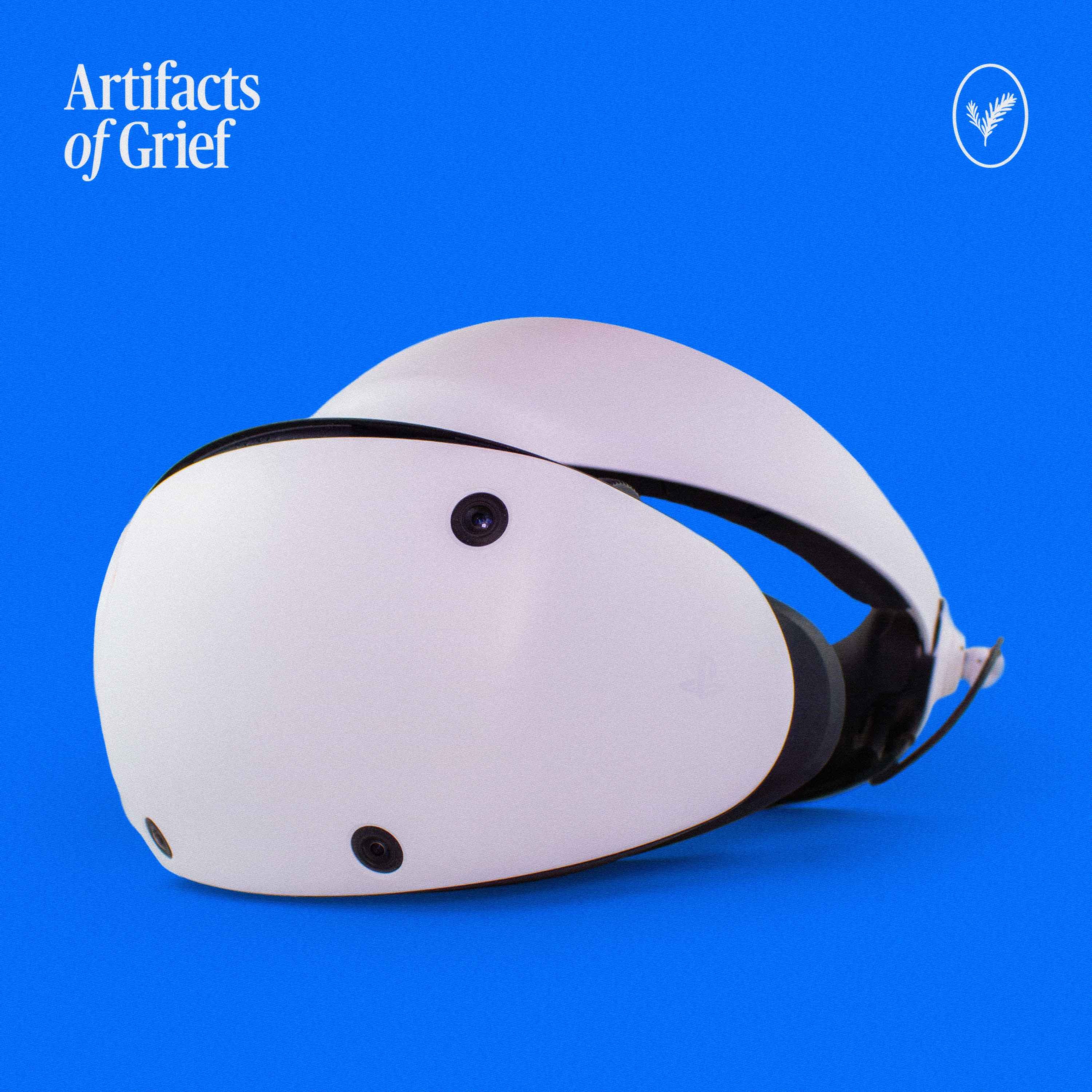
Greg D'Yong shares how a PlayStation 5 VR2 headset became an unexpected artifact of grief after losing his close friend and business partner Brett in August 2023. Brett died following a violent altercation at a bar in Toronto, leaving Greg—who lived in Alberta while working remotely for their company in Manitoba—in a state of shock and uncertainty during the days before the wake. To channel his restless energy, Greg turned to *Beat Saber*, a rhythm game where players slash colored blocks with lightsabers. Playing the BTS song "Dynamite" became a pivotal moment: the song's vibrant, joyful energy perfectly captured Brett's exothermic personality—his love for life, generosity, and ability to make everyone feel good. From then on, the VR space became a "portal to grief," where Greg could intentionally replay the song to connect with his feelings about Brett or encounter them spontaneously, mirroring grief's unpredictable nature. Greg reflects on their decade-long friendship, which began when Brett hired him at a small agricultural company. Despite their differences—Greg reserved, Brett extroverted—they forged a deep bond built on trust, with Brett relying on Greg's judgment and Greg admiring Brett's infectious enthusiasm. Greg notes that Brett's spirit lives on in his own actions, like picking up tabs or being generous, as a way to honor his friend. The artifact represents both a fun space and a tangible link to loss, helping Greg learn deeply from a rare and profound grief experience.
[Music] [Music] Today, Elliott Kusenai are joined by Greg D'Yong to share a grief story. When Greg suddenly lost his close friend and business partner Brett in 2023, he found an unexpected place to process his grief energy, finding a strange synergy between digital space, tangible feeling, and loss. This is Artifacts of grief. [Music] What is your artifact? I've decided to look at this through this PlayStation 5 VR2 helmet and controls. The VR2 kit, without getting too commercial promo about it, is it's a surprisingly lightweight actually. That's the first thing I'll describe about it. Now, you've probably seen VR helmets. There's different styles that, of course, there's a headset that goes in front of your eyes. It completely blocks out all the light so that your eyes are just seeing these stereoscopic screens that are focused in front of you. This one also has earbuds, so they give the audio sort of thing very immersive. Definitely, you go into this alternate space inside this helmet. You generally don't have to move around. There's all these horrible videos of people jumping into their TVs and things like that, but you actually want to stay still. You hardly ever need to physically change your location, even if you're doing a standing-up game. Then the controllers, one in each hand, pretty cool high-tech stuff. Like I say, it's the most bougie toy I own. These hand controllers sort of take your common controller, but split it into two independently moving hand-wands of sort. For safety first, always wear the little straps on your wrist when you're using it. There's all kinds of buttons and controls on them. Some of these helmets require a base unit so that it can orient and follow your track your movements. This one uses cameras on the outside. It kind of looks weird that you've got these little wide-angle lenses on the outside, but that's how it actually tracks the room and you can figure out your movement. And thankfully you can push a little button and you can see through it. You can see what you're doing outside of that. That's nuts. I hadn't clocked at those for cameras. Yeah. Kylie and I, we work gamers. We like playing video games, but we've never delved into the world of VR before. And we, I mean, we've seen them, but I'd say this is one of the coolest looking ones that's on the market. It just feels like something that if we were watching, it looks like something that be back to the future part too. Sure. When we imagine what virtual reality will look like, this is something that you would expect them to be using. It looks sick. It does look pretty fun. And it doesn't have that thing. Whoever made that other one, you can just put it in a mold where you can see your eyes through it. Whatever that one, like Google, I think maybe that one. This is what you'd expect it to look like, basically. Yeah, it's so bougie. I already told you how much money I spent on it. And it's like, you commit. You say, okay, I'm going to do the PlayStation one or I'm going to do the Oculus one or something like that. Don't think second. Give it a second thought once you buy it. Just move on. And like, this is my unit. Well, it's, it's, it's so interesting looking and so cool. And it's just such a testament to how far along this technology has come. And this at its core, this black and white, very futuristic looking piece of technology is built with the intention of generating and creating a sense of fun, which brings us to the question of for something that is meant for playing games. Why is this an artifact of grief? Totally. Yeah. And the premise of your, of your show, but artifacts of grief, I think this is a bit of a hybrid answer to that because this is sort of like a portal to a grief space. For me, you know, it's not like I look at this thing and I feel sad. It's more, and I still use it for other games too. And I have lots of fun with it. It's, it's incredible. But I was intrigued by seeing if you would take me up on describing this as, yeah, an object that I used to access grief, a very particular grief. So this is one of my favorite games on this is called Beat Saber. The premise of the game is you're in this 3D space and you can choose a song from a huge library of songs. You dive into the song and what's happening is these color blocks are coming at you in patterns and you're holding lightsabers like come on Star Wars fantasy and you slash the blocks to the time of the music and in certain directions to get your high score and all of that. Kind of akin to like a guitar hero rock band. Very similar. Yeah. And yeah, that one, these like notes are, and you have to coordinate your timing with the notes. But this one is, yeah, the blocks sort of thing. Fruit Ninja is a related, so yeah, there you go. So let's roll back to August 2023. I was, I've been working from home for years and love it. I really love it. I can actually get my work done. Apparently that's not so common. And one day I got a phone call that I never thought I would get. It's from one of my coworkers. He was stumbling on his words and he's saying, I don't know how to tell you this, but Brett, our boss and friend, he's in the hospital. He was in Toronto and he was at a, just hanging out with buddies and there was an altercation at a bar. And long story short, he's now in the hospital there in Toronto and it's not looking good. So that was like, you know, this cold splash of reality that. Okay, here we go. I'm going to brace myself for this. We have at the time everybody was still holding out hope, but I learned later that that was kind of like just to pace out the news. He was done for. He was pretty much just on life support and done for. So that's okay. So I'll work here in Alberta. My company is in Manitoba. I can go back and visit once in a while, you know, just do some in-person work and that sort of thing. I had not been back since I think Christmas prior. So of course, we're going to have a wake for Brett in the town there in pilot mount Manitoba. And I knew I'd be going back. So there's these interstitial days where I can't do anything. I'm in Edmonton. I am have all of these wild mental tangents happening little on the emotion like well that was piling up. Not to skip over the things that I wanted to say about just like what it's like to lose a friend of violence. Super, that's the first time in my life. And let alone losing somebody, you know, I've been spared a lot of the experience of the grief of death of losing somebody that you love. Grandparents when I was young and like nobody sends pretty much. So yeah, super rare in my life. And I had the presence of mind that I wanted to understand that I was plunging into a grief experience. Let's do this, you know, but like I could say those couple of days being at Edmonton before I could travel back to Manitoba. What do I do with this weird energy and uncertainty, you know, like what's going to happen to our company and how did this happen and how are his parents and the just an idea of thoughts. So one of the things I did to get out some of that energy was play Beat Saber just dive into that that virtual space. It's such like dopamine hits, you know, the vibrant colors and all that moving the body really important. Getting the blood going. And so in this game now, a song pack that I bought was BTS, the Kpop band. Yeah, probably my favorite set of songs. It's so apt. It's so apt for the premise of the game. And of course I ended up playing the song Dynamite by BTS, which is, you know, probably their most famous song.
And as I'm slashing these blocks in virtual space, I'm really, you know, thinking clearly again about the lyrics of the song. And it's just connected with me how much this embodied Brett's spirit is his, his Alan, his like love for life, his gregariousness, his way was so much and anybody would attest to this. I just wanted everybody to feel good. And so some of the main ways that he did that was if we were out at a bar or something like that, around for everybody, everybody who's there, stranger or friend alike, like very, very generous. And the song, Dynamite, gives such a sense of like that limitless, this is us now, let's thrive in the way that we can in this, you know, party space or just like even if we're doing nothing, let's take joy in each other. That's kind of what I get out of the lyrics of this song. So yeah, there I am playing this game and all the health benefits that it's giving me and mental, you know, relief. And by the time I was done the song, like, I'm sure I could have pulled the VR helmet off and poured the tears out of it. And it was indelibly linked from then on, if I go back into that space and I play that song, it doesn't always hit the same way, but I register it that there's that space where I really clearly planted that feeling about Brett, about my friend and who he was, tingeed with, he did not deserve what happened to him. You can look at the news and see how that court case went. But yeah, it's very fascinating to and unexpected to have this, like you say, a fun space that has this link to something so tangible and so real and so strange with grief as the overarching theme. Do you find yourself after having that moment? Did you revisit specifically playing dynamite to kind of live in that grief space a little bit more, or did that experience in playing dynamite? Did that just extend further into everything that you were playing on beat saber? I think I know what you mean. I found that if I intentionally wanted to connect with my thoughts about Brett or the grief that surrounded that, I would go into this, the game and play that song. And there it would be unfailingly. There it was. And then other times I'd be just playing for the fun of it and thought, okay, I'll play dynamite and see what it's like. And it may or may not bring it up and that so correlates with what I've been learning about grief about just it's like shape, shift, the surprise moments. I could from then since then from the past to your two plus years, if I recount the story of Brett and it comes up and I tell it on purpose, I have learned that it might suddenly be overwhelming. I haven't found it overwhelming to the point where I stop. It's like, no, no, don't worry about these tears. I'm familiar with them and they mean something, but I'm telling a story that I really want you to hear. So that's like today, you know, it's, I sort of feel like I'm just right at this nice suspension point right now in talking about it because it's just so familiar. And I've come to treasure it. I've come to treasure that space. I decided to get all the flavor out of the gum, you know what I mean? Like, again, I hope I wouldn't mind if my life has a minimum of this kind of experience about losing people, especially in that kind of way. And the track record being that I've been spared it quite a bit in my opinion based on what I see around me. So I want to make sure that I learn as deeply from it as I can. You told us a little bit about Brett's spirit and how that song embodies it. Can you tell us a little bit about your friendship with him? Absolutely. Yeah, I was living in this little town in Manitoba and I was working at the newspaper. It is a great vantage point for any little town community newspaper. We support them as much as you can. And an ad came across the desk. I was doing graphic design and a bit of writing for this new company in town. And they're doing a service called Tall Drainage. It's an agricultural service. And I sent a proof of the ad over and he said, okay, this looks good. Can you add on the bottom now hiring? I was like, yes, I can. There's your revised proof. Also, let's talk about this job. What are you hiring for? So I walked over to their office, you know, down the alleyway basically and met Brett. And I think it was thanks to Brett. I think there was something more in terms of the inevitability of our friendship. But I also put a lot of credit to him for being excited to meet me and excited about, about yeah, how much of it was inside? How much of it was just his straight up enthusiasm for other people. And it was just infectious. So we, I started working there. We became instant buds off. We went off. We went. You know, so even if I was starting at a very like entry level position, literally in a muddy hole, yeah, I took him up on the invitation. I think is the way I would put that to be, to be best buds. No, I'm a bit more reserved kind of guy. I'm definitely not the, I don't know how to put it exothermic. I guess he was very exothermic. Back to the point of exhaustion. He was incredible. He would fall asleep on the couch and just like, you know, be watching a movie and he'd be out in an instant because he spent the whole day like energizing other people and making things happen. So yeah, we spent those many years. I mean, that was back in, I'm going to say 2014 off the top of my head, but that's like a decade of us just cooperating, making as much of we can as this company, finding lots of times to hang out and just be good people together. Because you're so generous, you'd always run into these people that were kind of saps. They would take him up on it and then take him up on it and then just like, hmm, start to abuse his generosity. And that hurt him really deeply. We would talk about that. And it's just not something that I ever did. It's not in my nature to do that. It's like, I'll accept your generosity, but I don't expect it from you. It's you that I'm interested in as a person. And I think the more we talked on that level, the more we really cemented our connection. I loved how different we were. You know, that's the thing that I think made it really special. Was he a very extroverted person, would you say? Oh, yeah. Yeah. If you go out with him in the evening, which is his favorite thing to do, is like go bouncing from restaurant to bar to restaurant to bar. You won't get a lot of time with him in person because he'll be off just like following. He picks up on things with like, yes, he or something that there's another person in the room that he wants to meet and get to know. So he'll, he's kind of hard to keep up with. You know, I'm also noting that I speak sometimes in the present tense as in the past tense. I do that a lot with Brett and I have a comment about that because he moved so quickly. And again, I'm living out here in Alberta at this point, having moved away from Manitoba. Thankfully, I was able to keep that job. He wouldn't let me not keep that job. It meant that there were longer and longer gaps of time where we wouldn't be in the same room together. He'd be off starting another business or just keeping putting out fires with the main company that we work with. We did our best to try to meet up, you know, sometimes he's saying, hey, I'm going to be in Vancouver. Let's go hang out there for a week. Yes, please. Let's do that. But there are these longer and longer gaps of time. And so I noted this interesting thing when he was killed, different from his parents or his partner and whomever else, you know, local friends, et cetera. For me, it was almost this imaginary trick that for all I knew, he's actually still out there somewhere, making friends, buying rounds at the bar. I liked the freedom to imagine that, my freedom to imagine that. Yeah, he, I know that his body is like gone. I know that he's had organs donated. I know that there's all the repercussions, the very real world repercussions of this for everybody that knew him. I also get to have this private little thing that, yeah, there's still a breath out there just kind of touring the world and living as a good life kind of thing. I love that a lot. In you speaking so.
kindly and generously about him. He strikes me as just the kind of person that can really pull, pull not just the best out of people, but maybe the best parts out of people that those people didn't know that they had. An example, like I feel like you, Kylie, pull a lot of thoughtfulness and being reflective out of me, which is something I wasn't born with. There's something I had to learn and continue to have to learn. And I think in the case of this, like Brett just seems like somebody that was just magnetic and you couldn't help but see him and then he could just do so much for you. I'm wondering if there's anything in the years of friendship that you had with him that he pulled out of you that maybe you didn't know existed if it in yourself or discovered existed about yourself. Great question. Yeah. Yeah. I've seen reflections of it in the past couple of years and my partner can attest to this when we'd be at a familiar kind of thing at a bar or whatever. And all of a sudden Greg is picking up the tab. And it's just me having a little moment, like I feel like doing a Brett thing right now. Because look at the way it affects people. It's really amazing. Granted, I would like to do that in more situations than just around booze and stuff like that. But I've had a friend who's unemployed at the time. Don't let that stop us from going and having fun doing something. Let's just go. Like, let the credit card pay for it. And that's a little touch of that. I get to have that inside that internal moment to say, you know, see Brett, I'm doing what I can to kind of like keep this moving along. That strikes me as so linked to the artifact you've brought that as you describe these like interstitial days, these limbo days, the way you used movement and song. And then we're kind of surprised by this song that embodied Brett's spirit. It seems in the way you speak about this that so much of the grief has been about honoring him as you grieve him. It seems like the song is an honoring of his spirit and not just a sadness. Has that been largely your experience? Has that been intentional in attempting to honor him through grief? Or did that just naturally spring out of his spirit? Who is do you? Yeah, I too say I think the grief side of it is very much mine. And my sense of the Brett that I got to know would be way more interested in knowing about the ways that those other like gregarious things. I know my name is Greg having a gregarious. I can't, there's no better word. Those gregarious moments are when he would say thank you, thank you for focusing on that and making that the lasting effect of our friendship, of our literal friendship. Yeah, it's still related to the work that I do because I work for the same company still. And I like recalling all the times that we had like troubling over how to make this thing work better, this business, it's just a little business with like 12 people. And he came to really depend on me to be his yes, no guy. You know, he would he would try anything and ideas just come flooding in sort of thing. And I would say from my vantage point, no, that's not going to work. Yes, that has potential. And he would just take my word for it. If I said, especially the things that I say no to because it's it's important to say no to, you know, projects or dumb ideas or toxic staff even like all of those things. He came to really depend on my take on it. You know, there's a responsibility in that knowing that he's going to do what I what I, he has his wing wing man, my word will have a huge weight on his choices. So all of that together, just like what was the focus of our connection? It was it was about striving. It was about positivity, you know, and I know that Brett had his flaws. I know that he had his fears. You know, we got to know each other on so many levels. And I hold those things pretty private. There's a lot of it that he can go on. He had all kinds of frustrations and I don't know, a life of of uncertainty like any of us, you know, really. So the way that he exercised those things could be really challenging for him. So I know that he on top of all those things of us having fun times together of us making important business decisions to decisions together. There was also him finding a safe space with me to try to talk about just things that he was going to custom to talking about or having the space to do so. Like what a rich, what a rich way to do all of that. Going back to your question, I would say that that grief thing. Again, I feel like it's something that I, it's the learning that he couldn't have given me in life. It's a learning that he could only have passed me through these unavoidable, let's call it this sort of the inevitable thing, not to be fatalistic too much about it, but to say like, this is what happened. Therefore, here I go with my memories of him concurrent with this grief experience that I've decided to take on. How quickly did you decide to take it on? I think of having lost people, but not in a violent way. And I felt angry at losing them non-violently. Was they anger? Oh yeah. Oh yeah. It all came in waves. Yeah. And the, like I don't want to delve too much into the details of it because I don't think it's worth it anymore. Like again, all that information's out there. But even the fact that it is a silent was a military, is a military guy. It has planted deep mistrust of the military and me and a lot of people as well around this particular incident. So yeah, what a mess. What a complete mess. How did you move from anger, anger, sadness, undoubtedly? How did you move out of anger? Where is it still there? Less and less. You know, I'm realizing one of the ways that I think I redirected that anger towards something useful was on the flight when I was on my way out to Manitoba to attend this wake and to kind of like help the dust settle with the workplace. I thought I should probably write about this. I should probably do some writing. It's not one of my instincts, but I have a feeling I'm going to need some of this down. So here I am on this flight. Let me just kind of tap out some words and see what happens. That ended up being the bulk of draft one of one of the words that I would say at his wake. I was invited. I didn't realize this, but I was invited to speak at the wake. And I gave myself a few paragraphs to talk about Brett and to talk about our friendship and connection. And then once I'd kind of concluded that I paused and I said, I think Brett would have encouraged me to speak to something else here. And I gave a little speech really about how men need to look at their anger. They need to look inward and take this as an example of what can happen if you don't have an act of sense about what your anger can do because it can be so overriding. And if you don't think you're capable of killing somebody out of anger, well, have you studied it? Like I don't expect somebody to to ask himself, am I a murderer potentially? But it's more like look inside and just see if you've got an anger that you've never really looked at and you're not sure what it would look like when it came out. Or something even deeper than that. Have you seen yourself be angry in a way that you are not in charge of your choices there? So once you've done that, and this is what I'm saying to this crowd of grieving people, once you've done that, talk to somebody like no matter what you find how small or if you don't find that or if it's significant and you're scared, just talk to somebody about it. And I was so uncertain about saying this at a wake, like to do a little TED talk. But I received a lot of positive affirmation for having done that, mostly from women, mostly women who came up and said thank you for saying that in this moment. But I was assured that there were nodding heads in the room there. That was me. That took off.
so much of that anger level. Like, I've said it now, it's in the room audibly. What is significant about this, the way this happened, the way this was like alcohol, fuel, damage, and it's got to stop. Like, it's got to stop. I remember, I know that there were echoes of that anger, though every time, I mean, this is before October 7th. There is such pronounced echoes of this every time I see a news article now where it's the death of a young man or something like that on top of all the other news articles about death. But when you see an article, now when I see an article about one case of one man losing his life, it's like, look at the repercussions from one death, whatever the circumstances, like just the exponential scale of that is, is, is wild. I'm really moved by the way you're speaking about how the anger that was inherent in what that led to the loss of bread, even though you felt anger, you used that as an opportunity to think about where that anger was coming from, where that anger could be directed, how that anger can be thought about, talked about, and not moved into further destruction and not have this chain of anger that spreads like wildfire from this initial moment. And what I'm hearing you say now was the specificity of the loss of bread that conversation around anger is also global. Yeah, the whole, the saying hurt people, hurt people makes a lot of sense. And like, it, it's everybody's project. It's all a more shared project to try to have different outcomes. Not to deny the anger, but to recognize it, think about it. Yeah. And I think that that just adds to the power that led to the affirmations that you received of you speaking to that in a room that is undoubtedly full of a lot of anger, just based on the very way that bread's life was taken. Yeah. I think a lot of people struggle with the many stages and many forms that grief can take. And there's no doubt that that room was just a complicated stew of all of those things. So any sort of validation that you were able to give people, and I would assume that that's what that was with receiving words of affirmation after you spoke. That's a really powerful thing. How did you feel in those, in those moments when you you said you spoke those words and then you received those affirmations? What were the feelings and thoughts that were going through your head? Yeah, I was definitely thanking myself for sticking to the task I'd assigned myself to try to put words to it, setting aside my uncertainty, but what is this socially unacceptable? I don't know. But to me, not talking about it is socially unacceptable and in a bigger way, in a much bigger way. I don't know. There's the humility bone in me that wants to be like, no, no, no, it wasn't me. I was responding to something. And I have a way with words. I really love words. So why not? Why don't put those two things together? But it's hard to know because that was so soon after it. So much has happened since then in our lives, in the life cycle of the company of all that surrounded bread. I guess now it's more interesting to me to let me pivot just for a second actually in the days after his murder. Let's use the word. There was a lot of uncertainty obviously with the company. This is a very terrestrial concern, of course. But I mean, this is 12 people's livelihood. So how are we going to put this back on rails? And the discourse had a lot to do with like honoring Brett's work in building this company. It's been interesting to see, again, it is just a company. Like it is just a capitalist endeavor that has a service for a farming community is kind of thing. I've been working out what it means to for this, it has to be able to run of its own volition. Like it can't run on memory. It can't run on honor and honoring somebody who's no longer with us. It just has to literally work as a project. What do those feel at odds? Like honor and memory and capitalism? Yeah. You know, and the separation of those as necessary perhaps for yourself, I don't know. Yeah, it's complex. Yeah, very much. I'd say that's an area where there's still uncertainty about that. I mean, little loan, the pressures that are put on this company by everything else that's happening in the world. The cost of plastic affects it. Like just diesel, like everything, all these variables really make it. It's never an easier challenge to run a little company. So I guess there's, it's trying to figure out where do I place this love of bread and how do I, if at all, how do I, how does that guide me and motivate me in doing this work that I do? He didn't want to work. Nobody wants to work. No, who does? He said, if we're doing this right, we hardly have to do any work at all. That's out of complete respect for the labor that we hire every year. And I'd say, I did that job. I know what it's like. I've worked every, almost every position from the ground up. So now when I talk about the work that we do, it's like, what's the most important thing right now? It's the safety of our workers. That is more important than everything else, everything else is nuance and tactical things. It's really important that none of us get injured. So can we have that as the spirit of why we're doing this? And I think that is, preserves a huge piece of bread of his joy and other people. Let's make that this central piece of a company so that it's okay that this essentially about money. It's also about the service that we do. We have quality. We do, we have a focus on professionalism and for our construction to work properly. But also, I don't know, we're not the only company that does it. So what's special about us? It's like, well, we've got this really interesting origin story that took a surprising turn. And what better thing I think to at least give us a persistent sense of that this is about the people involved? Was there ever a part of you after Brett's passing that felt like you needed separation? You would consider leaving the company that you worked that together? Yeah. I mean, this is not like this is a LinkedIn article, but in terms of risking it. But no, I'm pretty much a fixture of the company at this point. But yeah, that uncertainty that I spoke to, I know everybody felt it. How do we pivot from this company that Brett ran the way he did as a disorganized as he might have been? And you know, the hands off sometimes. There were times when it took a lot of us just sort of like taking a grip on the controls of the company and saying, we actually got to get through this fall install like this our busy season, that sort of thing. And it happened. People rallied around. Like I'm curious in was the work saturated with grief? Like the very active, like I'm wondering if that's what you were asking, Elliot is because of the connection to Brett through work, because of the loss of him and the way he lost him. Was there a consideration of leaving leaving that work because of it becoming a grief space, maybe you didn't want it to be right. Well put or was I'm so moved by your language of the game becoming a portal to a space of grief. That was one of the first things you said. By creating that port or I sense that portal kind of accidentally opened up for you, but but then it became a portal you can now intentionally enter. Did that allow you to place the grief there so that it didn't have to saturate work? How did that? How did those
were there other spaces of grief that portals opened up for? - Right. - Potentially run intentionally. - Yeah, yeah. I might have made a really wise choice, I guess, in figuring out where to contain it as best as I could, and still be able to do my job. - Mm-hmm. - Mm-hmm. There was definitely a sense of us together in the company. I think that, I think it would not well. I think that the phase went really well about certainly where we are impacted by this. Let's slow right down, let's get together, let's have this wake, let's check in with each of us, see how this sits. As far as I can tell, people have come through that in their own ways. I know that being there in person and having a chance to speak with his friends and neighbors and the people in the community, it's hard to know how to talk about grief and to plumb that out of somebody saying, to make it clear to them that the invitation's wide open for them to talk about it safely. Unlimited skill, I had interactions with people where I would just kind of like puncture that, that membrane a little bit and just assure, like be the first person to say, if necessary. Here's what I'm feeling about this. And it's, for example, it's super weird right now. I don't, I don't know what this means for all of this going forward, but I'm glad we got the chance to get together in person and just speak confusedly together. And that would elicit a bit more from, even the most like guy, kind of guy who was in the room as we're sitting around drinking beers and just having quiet moments or whatever. Yeah, I can't say I'm, I've had it such a vantage in everybody in anybody's headspace or how things have gone since then, especially let's say that month or two after that when it was again, the peak of the busy season, I'm sure that the work was therapeutic as well to be able to just like focus in on it. We've done this before. Let's do this. We got a bit of a different kind of motivation right now. I'm not trying to prove anything, but it feels so wobbly that the more we can have this momentum in a clear direction of like finishing the work, let's assume that that's gonna be helpful. And so I think it was, yeah. - Seems to be a common thread in what you're talking about today is movement and the acknowledgement that anger, sadness, grief, any emotion is movement and how are we gonna direct that movement? How do we recognize it and attempt to move it in useful or meaningful ways and not destructive ways? How have you gotten to a place of being so intentional about that? - Yeah, maybe I was unwittingly equipped with some good like sayings and things like that that can guide me. When it comes to mind, actually my mom uses and say the root word of emotion is motion and I just take it for granted that that's right. She has the wisdom of that. So if I detect us feeling is sitting somewhere, it needs a nudge or am I holding it back from going in a direction it wants to go. I suppose it's the other side of that. - Yeah, very much that things have an inertia and I wonder if fighting against that, trying to make things move faster or trying to slow them down is where you get the, it's taxing, it can be taxing I guess. I know, that's kind of vague and like conceptual, but it has made sense to me in reflecting on grief to just like toy with those ideas. The toy with the idea that you know, a big one for me was questioning the phrase the grief process 'cause the word process, it doesn't seem right to me. It doesn't seem like like the way it's implied. It's implied like grief is this sequence of things that will happen with a destination. But luckily again, my partner has a compatible grief story, a companion grief story I should say, a case of violence losing a friend of violence. So, but that was like 10 years prior. So they have all this time of having lived with that to be alongside me through this one. And that insinuation that grief is a road that you walk on, that doesn't sound right to me. Maybe that works for some people, but it makes way more sense to me to think of grief as like a mantle or something. It's not the article of clothing I was gonna choose at that moment, but I've been given it. And out of respect for my friend, I'm gonna wear it. It has pockets. There are things hidden in it. Some of them hurt, some of them are soft. And it's worth it to keep exploring this thing, but it's with me and I want it to be comfortable. What you're saying is speaking so profoundly to me. And I couldn't help but think that these words that you're saying about moving through grief and this idea of motion. And I really like that piece that your mom said that motion is at the root of the word emotion. I also just couldn't help that as we started having that conversation, your eyes are drifting back to the VR set, which is all based in motion. It's all based in having those things happen. So it just makes so much sense and just comes full circle for me in that, of course, you would have this really profound moment and then subsequent release of emotion while you're playing this game with this VR set, hearing this song that is connecting all of these thoughts, these feelings and also just acting as a celebration of Brett and who he was as a person when dynamite by BTS comes on. That's so beautiful and such a grateful circle moment in just being such a true form of the grief process, air quotes for you and how specific that is for you and that it is not a linear thing, you can move forward, you can go back, jump to the end again, air quotes. But I love that it is through this lens of movement and motion whether that is intentional or not. - Yeah, Brett was always in motion. - He seemed like a busy guy. - Busy guy. Not one to sit still for a moment. Where's that grief moving now for you? - Lately or in this exact moment? - Either one. - Yeah. I think I found a stability with it, luckily, intuitively, I'm not sure what's worked well for me in figuring this one out. And I know that there's more to discover, but I'm treasured, I really treasure it. I like telling the story. Even though it might stress the listener out to hear me talking quite plainly about a lethal assault, and it was so instantaneous, we're so fragile. But I think I guess in bold and by having spoken to it at the wake about saying, "Okay, everybody's got things to figure out about themselves, but men specifically in this moment, I'm gonna talk to you because you're the ones who are represented in this altercation. We are represented in this. Emboldened by the feedback of that, it seems like what I see in it is this wish or call out in our world to speak more directly about things instead of talking around them or trying to play clearly ineffective premises on what we're doing here. What are we doing here as human beings?" I think it's that profound. I wanna draw a line between this moment in Brett's life, ultimately was the end of his life as we know it, to everything. It's hard not to. It's hard not to, for me as somebody with a bit of philosophical bent and like, you plunge me into this moment, and here's what I'm gonna do with it. I'm gonna extrapolate and I'm going to try to be a force for change because I would really like to see that happen less. Yeah. Elliot's.
earlier to the VR set, seeming like the appropriate link between grief, motion, and your experience. But you've also talked about it as a containment. How do you hold those seemingly contradictory things about grief is something that needs to move, but also as I envision and please correct me that this is something you can purposely put on to go back through that portal. You can also set to the side to maybe close that portal temporarily or pull a curtain over it at least so it's not so inviting or something that is sucking you in depending on the day. How do you hold those two potentially contradictory things of containment and movement as they seem to be represented by the VR set? Can you speak about that a little bit? No, that's right, because there's almost like a. they're almost running perpendicular to each other. The idea of everything that I was saying about trying not to control the speed that things want to go, especially in terms of emotion, versus having a container. I guess I would figure out how this virtual space where I think thankfully I would just able to open the tabs and say, "In this scenario, I'm privately in this space, even though I know my partner is in the room." It's almost an irony on how the virtualization of things, it's an unreal space, but I'm finding in it. I don't know, why not assign a maybe fantastical idea about the spirit of somebody. Why not just drop it in there and see what it's like? It's because what I'm seeing is that because it was so valuable to me in those days right after the news of his murder that it was something that I could do when there was nothing else I could do. I had to wait for the data fly. I'm just stuck here. I can't do anything about it. I have to wait. That movement wants to exist, but it's impossible in the way that it will eventually become possible when you get on that plane. It's so interesting because the set itself, even if we take it outside of the context of the certifactive grief for you, it embodies a lot of paradox. It's stasis and its movement, its reality and its seriality. In your case, it seems to be containment and spillage. You spoke about how you could have taken the set off and dumped out the tears, but it also offers a space of containing perhaps what was unruly grief at the time and maybe giving the beginnings of movement that later channel into something else when that movement feels uncontrollable. But now, how does it function? As a memory of that time or as something else, if you are playing the game and maybe you unintentionally go, "Maybe I'll tap into that." That wasn't my initial intention, but you also spoke about intentionally putting that set on, picking the song. What's happening for you when you make that intentional choice today now? I think it is about revisiting that moment and to see how it feels now. It's like a check. It's a bit of a litmus. It's like I would like either of these things to happen. I would like to go into that moment and see like, "Oh, yeah, there it is. It's registering, whatever little synapse connected on that day is firing and saying, "Yeah, this is a very particular memory resides." I'm willing to have that be comfortable or not, because if it's not comfortable, I feel like that's a good little nudge to go deeper, to go deeper on it and see if I missed anything, I guess, because it's all discovery. I'm no expert, but what a boot camp in grief it's been. I just don't want to miss the chance to learn more. I'm going to have other grief in my life. I talk about this with my partner. I want us to be very solid together because we're going to start losing our parents. I have no idea what that looks like. At least it's one that you can kind of anticipate in a way. It's on the books as something that will probably experience together or alongside each other. I don't know. Maybe I should pick a song now and beat Saber Freighton. I'm going to talk about anticipatory grief. The songs are loaded up. I know what to do. I'm ready to set on and move. Something that's been really illuminating for me through this conversation is, I keep coming back to this idea of motion. I'm discovering about you is that you really relish those opportunities for motion in your life. As long as I know you're riding your bike everywhere. You take public transit. You're looking for new creative outputs, whether it be music or visual or what have you. You're very forward looking. There's paths that you want to go down and those intrigue you that don't. There's not a lot of fear there. Even in what you just said about knowing that there are inevitable griefs that are coming down the pike for you, your partner, all of us. You're being thoughtful about how you're going to navigate those paths. That's something I'm really grateful that you've shared with us. I'm really grateful that I've gotten to know that piece of you. It's just opened up so many more cool conversations that I want to have with you in the future. Let's do it. I feel very seen, but also I'm glad I've gotten all that side of me too. It's not coincidental. I would say that in the past, like 2024, the year following, Brett's murder, I encountered this concept of, if you've ever experienced this where you think, am I undisciplined? Do I need more discipline with how I do my things, my projects, my whatever? I was introduced to this concept randomly by the algorithm that instead of jumping to discipline, take a hard turn and try to go undisciplined, but more inattuned with who you are. Try to randomize or go after the things that you think are impractical or whatever. Spend a whole bunch of time being undisciplined and closer to yourself. So I bought sculpting clay. I picked up calligraphy again. I went on this wild, like I just want to do all the things regardless of whether they do anything for me or not, or they're useful in any obvious way. Because the idea is that by shaking it up in that way, you'll find you hopefully will find things that are easy for you to do with more consistency and you'll find this roundabout way to discipline. You'll find yourself being disciplined about doing things that aren't hard to discipline yourself to do. That was the concept anyway. So in 2024, I probably provoked in part by this big jossal of this grief moment, yeah, I did just thought, what else would I like to try? And let's see what happens. Let's see where those things sit in terms of resonating with me as a person. It's hard as like, I think they're calling them polymath now, the kind of person who's not ever going to be a specialist, like really more just two two interested in things. I probably that end of the scale, but this motion piece of it, I don't ever want it to be a restlessness. I want it to be following a thread, I guess, this invisible thread. Yeah, this is a part that I haven't rehearsed a lot. This isn't the thing that I haven't put into words in a lot of elevators, for example, but hearing you describe your observations of me as somebody who's got all these interests and also physically in motion, I find that is like encouragement. It's encouragement for the choices that I've made over the past many years that I have momentum, that I have some momentum that's visible to other people. And in intentionality, like that's what I read, like, I don't read it as a negative thing in that.
You're just kind of dabbling here and there. I see a lot of intentionality in what you're doing, a lot of like thoughtfulness behind what you're doing. Yeah, that's great to hear. It's taken some whittling down over the past while as well. That's fair. I can show you coverage full of things that I'll never touch again. But I think we're all like that nowadays. Yeah, I want to do something with that. That'll be one of my takeaways from this conversation actually. To think about, it's like a benchmark almost. You've given me a little bit of a benchmark to think about. I'm also feeling like a reciprocal appreciation for this podcast and how I think I see the evolution of your ideas together. I can imagine your conversations together because you've shared glimpses of it in your podcast. So I get a sense of how you two speak together. I see reflections of that. Like it's something in there that I recognize. Sometimes it's cruise control. Sometimes it's hidden the steering wheel. But to give it a moment, to give it a moment to fly and let that tell a story, part of the story, do that with emotions. Let them fly and see what they tell you. You've kind of preset yourself up here, but what are you going to carry with you from us all talking today and sharing the story of Brett that you have shared many times, but on this even more public level. Yeah. Yeah. No, I'm really grateful to have the chance to do that. Just in that again, in 2024 when I'm just kind of like following all wins, I had an idea of doing a video about this exactly. I just pictured like a seven to ten minute video where I say, basically the things I've said in this podcast, try to demonstrate Beat Saber and the song as well. I found that they don't mind with copyright hits, by the way. I already tested that out. So could I make a video that was really like my own account of this? And my main audience was actually going to be my co-workers and his breast parents to try to say, this is kind of how I'm thinking about it. About this? Just so you know, I haven't forgotten about it. We don't get to talk about it much. We're trying to run a company. We don't necessarily want to the distraction, the stress of that. But anyway, all of that to say, I had this video project in mind and I feel like I don't have to do it anymore. It's another thing that I can say, no, I fulfilled that desire. So this is actually, I'm going to come away from this. I'm like, you know what, I'm checking that off the list. I've done something with this cumulative story from my perspective that I want to share with people. I've done it in little ways. This one's pretty effective, I think, like an expedient way of doing it. And I really am curious to see what comes of it. Now the movement that carries forward from here. Yeah. Beat Saber became an unexpected portal of grief for Greg after the loss of bread. By acknowledging how the song "Dynamite" by BTS created a doorway for him to work through his grief, Greg was able to use his VR set to access this particular grief and to actively plunge into the process of going through the journey it was asking of him. Greg's story demonstrates how the unexpected world pool of grief can be welcomed and once acknowledged, intentionally entered. We find ourselves moved by Greg's openness and speaking to the importance of naming and processing grief both publicly and privately. Elliott and I take with us from this generous conversation, the beauty in creating intentional rituals around the objects that call grief forward, even when we might not have expected the call to come from them. In this way, grief can be a companion rather than an enemy. In this way, we might acknowledge that we will always live alongside grief, but that we can often choose when to open the door. Thank you for listening to Greg's story and we hope it interweaves into your own grief stories in meaningful ways. Artifacts of grief is made by humans, for humans, without the use of AI. Photography, artwork, editing, and original music by Elliott Kuss, writing by Kylie Burton. Special thanks to Brian, Jeremy, and Taylor of Snack Labs for their enthusiastic support of this project, as well as to every guest who brings vulnerability and honesty in sharing their grief stories. And finally, thank you for listening and contributing to a culture of grief sharing. You can connect with us further on Instagram @ArtifactsOfGreif.
Podcast Summary
Key Points:
Greg D'Yong shares his grief story about losing his close friend and business partner Brett in 2023 after a violent altercation at a bar.
His artifact of grief is a PlayStation 5 VR2 headset and controllers, which he uses to play the game *Beat Saber*.
Playing the BTS song "Dynamite" in *Beat Saber* became an unexpected gateway to processing grief, as the song embodied Brett's gregarious, generous spirit.
Greg describes Brett as an extroverted, magnetic person who energized others, and their decade-long friendship was built on complementary differences and mutual trust.
The VR space serves as a "portal to grief," where Greg can intentionally revisit feelings about Brett or experience them spontaneously, reflecting the unpredictable nature of grief.
Greg has incorporated Brett's qualities into his own life, like picking up tabs or being generous, as a way to honor his friend's legacy.
Summary:
Greg D'Yong shares how a PlayStation 5 VR2 headset became an unexpected artifact of grief after losing his close friend and business partner Brett in August 2023. Brett died following a violent altercation at a bar in Toronto, leaving Greg—who lived in Alberta while working remotely for their company in Manitoba—in a state of shock and uncertainty during the days before the wake. To channel his restless energy, Greg turned to *Beat Saber*, a rhythm game where players slash colored blocks with lightsabers.
Playing the BTS song "Dynamite" became a pivotal moment: the song's vibrant, joyful energy perfectly captured Brett's exothermic personality—his love for life, generosity, and ability to make everyone feel good. From then on, the VR space became a "portal to grief," where Greg could intentionally replay the song to connect with his feelings about Brett or encounter them spontaneously, mirroring grief's unpredictable nature. Greg reflects on their decade-long friendship, which began when Brett hired him at a small agricultural company.
Despite their differences—Greg reserved, Brett extroverted—they forged a deep bond built on trust, with Brett relying on Greg's judgment and Greg admiring Brett's infectious enthusiasm. Greg notes that Brett's spirit lives on in his own actions, like picking up tabs or being generous, as a way to honor his friend. The artifact represents both a fun space and a tangible link to loss, helping Greg learn deeply from a rare and profound grief experience.
FAQs
Greg's artifact is a PlayStation 5 VR2 helmet and controllers, which he used to process his grief after losing his friend and business partner Brett.
He played the game Beat Saber, specifically the BTS song 'Dynamite,' which embodied Brett's spirit and helped him connect with his feelings about his friend.
The song's lyrics and energy reminded Greg of Brett's gregarious, generous, and joy-filled personality, making it a powerful trigger for grief and remembrance.
Brett was involved in an altercation at a bar in Toronto, which led to him being hospitalized and ultimately dying, leaving Greg and others to grieve.
Greg described Brett as an extroverted, generous person who energized others, and their friendship was built on mutual respect and their differences, with Greg serving as a grounding voice.
Yes, Greg intentionally plays the song when he wants to connect with his thoughts about Brett, and it consistently brings up those feelings, though the intensity varies.
Chat with AI
Loading...
Pro features
Go deeper with this episode
Unlock creator-grade tools that turn any transcript into show notes and subtitle files.
 PodcastTranscript AI