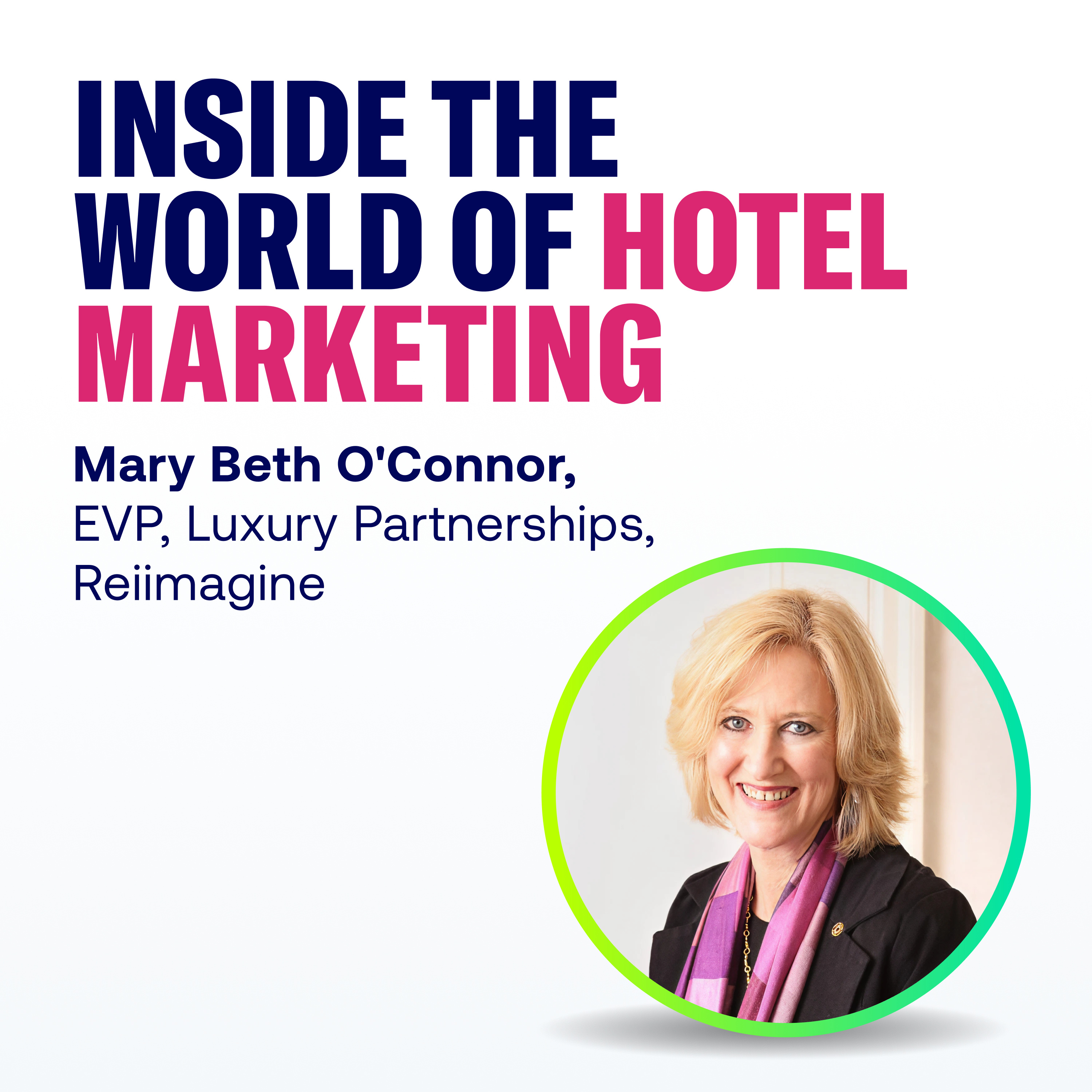
In the podcast, Mary Beth O'Connor, EVP of Reimagine, shares insights into hotel marketing. She recounts her career trajectory from temp job to director of sales and marketing, emphasizing the shift caused by OTAs in the industry. Mary Beth stresses the significance of direct bookings and personalized experiences for customer retention. She discusses effective strategies such as partnerships, events, and digital marketing in promoting boutique hotels. The conversation delves into the emotional connection and experiential aspect of hospitality marketing, highlighting the importance of staff relationships and storytelling. Mary Beth also touches on the post-pandemic travel trends, focusing on the shift towards experiential travel and the ongoing importance of the US market for boutique properties.
Transcription
8107 Words, 43598 Characters
Welcome to Ahead of the Game, a podcast brought to you by the Digital Marketing Institute. I'm your host, Will Francis, and today I'm speaking to Mary Beth O'Connor, EVP of Reimagine, a representation company for five-star independent boutique hotels, fillers and yachts, focused on building brand equity through creative marketing and sales storytelling. So we're going to get inside the world of hotel marketing today. Welcome to the podcast, Mary Beth. Thanks so much for having me. It's an absolute pleasure. I'm always fascinated by hospitality marketing because every time I go to a hotel, I think about it. You know, I think about how is this place marketing both in and beyond the venue. So I've got lots to ask you about that and your career. Talking of which, how did you get into hospitality marketing? Well, I actually got into it by chance. I was finishing up my MBA at night in the city. I had worked for a law firm prior to that. Started as a temp at the Sheridan, New York, working for the General Manager. They asked me if I wanted a temp job. I said, "Does it pay?" And they said, "I'll do whatever." They said, "We don't know if you like it or not." Started there, really enjoyed the environment having had studied abroad my junior year when I was in college. So loved being in New York in the mix. And they said, "We may need marketing." My degree was in marketing and MBA in marketing. And they said, "We may need marketers." Came up through the sales route. They said, "Go interview with the director of marketing," which I did. And from there, it was hired initially on the service side of things because there was not a sales position open. And then the rest is history. I kind of went up through the ranks and through the sales, international sales. I traveled a lot, I was bringing international guests into New York and then not evolved into a director of sales and marketing position. So combining my sales experience and then getting into hotel marketing. So for the last 15 years or so, I've been in the director of sales and marketing for sales team. Now, I'll be talking more about the marketing side of it. But I'm interested. What does a salesperson do at a hotel? I mean, is it outbound sales and who are you calling? So in those all different types, there's a lot of different segmentations. So there's the individual traveler. Then there's the group traveler, business travelers, leisure travelers. My initial probably the first 10 years I was very involved in. I kind of dipped my toe into a couple of different segments, but then really gravitated towards the international side of things. And I was responsible for bringing international guests into the New York property. So I traveled the world. I traveled all over Asia, I went to Russia, I was in South America, and really just telling the story of the property and to whom, though, to travel agents. To? Well, I was, yes. I was working with travel. On the group side, I was working with travel planners. So those that plan either corporate meetings or those that were incentives, incentive trips for top performers at businesses were on the leisure side. It was those going on vacation. So I was working with wholesalers. I did a lot of wholesale and then also business travelers. So working with the travel manager who would be arranging special rates for their travelers. So I'd be negotiating with them. Yeah. Yeah. Of course, this is the days before OTAs, before the likes of booking.com and XB. Yes. Right. How did that change the game? Just out of interest when these online travel agents, as they called OTAs, disrupted the market. Oh, yeah. I made it very, very challenging, very interesting and very challenging because obviously they're selling it as a commodity. We're selling an experience. So it complicated things because there was always a matter of making sure that your rates were displayed. You had rate integrity, making sure that rates you were giving them were in sync with all the rates you were giving to clients. You didn't want to have an OTA selling your hotel for a lower rate than somebody else locally. That inevitably happens, right? It does. You have to be very vigilant on that. You have to be really careful. In most hotels, they've got book direct programs, right? They want you there encouraging you to book direct. But it requires a lot of careful management of the rate positioning, for sure. Well, that's the personal question to you, personal to me. Is it, should I ring the hotel and ask them for a better rate than what's on booking.com? I would say call the hotel, yes. I would definitely call the hotel, to be honest with you. I mean, when you book through an OTA, they serve their purpose, but also if there's any issue at the property, you're going to be directed back to the OTA. Yes. Because you've booked with them, you've booked with them and basically you've paid them. So at the end of the day, the hotel is really not going to be able to take care of the situation. They're going to direct you back to the OTA. Whereas if you've booked directly at the hotel, it's a more personalized experience and you're dealing with the property directly. So you talk about it being commoditized and that's happened to retail brands, think about the resistance to appear on Amazon. It's sort of an analogy, isn't it, to the OTA issue, and that's probably happened in so many industries, if you think about it, where things get commoditized. From a marketing point of view, how does a luxury premium hotel push back against that and sort of cut through and tell their story and say more about what we are rather than just this commodity of rooms for a price? Well, to me, and this was most prevalent when I was at my last position at the Pierre Hotel in New York, I would always say when I would go out and sell, it's all about the people. It's literally all about the people and the best, I had the best example of that when I was at the Pierre because I have to say in my entire career, it was the best team, leadership team, and entire team that I've ever worked with. I felt everybody was really invested in the property. Everyone really cared. Everyone was very focused on the guest experience, more so than any property I've ever worked at. And that really came through in the amount of repeat business that the hotel got because when clients came in state or guests came in state at the property, they were treated really well and very personalized experiences and they wanted to come back. So we had a lot of repeat business. Which is a very much just, retention is a big way to, I guess, fight back against the OTAs taking their courses, hasn't it, has retention sort of driving that repeat business become more important over the years? Yes, it's the focus. I mean, it's much more expensive to go out and acquire new business, obviously, than it is to retain business that's already at the hotel. But that requires a lot of focus and it really requires, to me, it's all about the leadership at the top of the hotel, right, who's really creating a culture where everybody wants to be part of a team and that then is communicated and demonstrated in how the guests are treated. Yes, you write and the sum becomes greater than the parts or something, right? No, exactly. Holistically, together, that becomes something that's not easy to replicate by your competitors, etc. Yeah. What particular strategies or tactics have you seen work well in terms of driving retention? We, I mean, again, I would say a lot of it has to do with really the training, the employees, I mean, the guests, the employees that I worked with at the Pierre, they were all very proud of the property, very proud to work there, very engaging people and I can say, and I have a good story about one person in particular that I worked with very closely. We had elevator attendants at the Pierre, believe it or not, back from the days from the time she worked technically, did we need one? No, probably not, but she was more of an ambassador for the hotel and she worked in this small elevator back from the original elevators back from, you know, when they were put in the authorities and she greeted guests every day and people knew her a lot of times more than they knew other people in the hotel and I was talking about, I was, at one point, was selling to someone with Virtuo, so one of the luxury advisors, luxury agencies and I was talking about Katie and how important she was and she would greet everybody in the elevator saying, "Welcome to my office" and everybody loved her. And anyway, speaking so much about her, I eight months later this woman from Virtuo, so called me up and said, "You spoke so highly of Katie, I really want to do a piece on her." And she came to the hotel and she said, "We're going to do a photo shoot now to think that this woman in the elevator who was in the elevator for 35 years was going to have a story written about her in the Virtuo so magazine and it was a great testament to her and a great testament to the hotel and how the employees were treated and a great testament to how the hotel treated guests." Well, that sort of reminds me of two mantras that I think we need to, I live by any way in marketing. The first one is people buy from people and the second one is the product is the marketing. The product being great is what you amplify in the marketing. You can't fix a poor hotel, right? It was great marketing, but at the same time, yeah, that people buying from people so important, I had that experience, I went away a couple of times this year and both times, I saw named employees in the reviews when I looked at reviews and lo and behold, they were doing an amazing job when we got to the place and it was what you would go back for, you know. No, I definitely think that was why we had so many repeat customers and they knew the employees by name, our concierge. I mean, I traveled to Mexico for at one point for a trade show and somebody there asked me about the concierge at the pier. So, you know, he was so well known. I said, I said, you're internationally known Maurice, but he was, you know, he was amazing at his job and just amazing at how he connected with the guests. Well, of course, we're seeing in channels like social media, we're seeing more people within a business show up and show their face to the audience and the potential clients. Do you think that a luxury hotel can and should be doing that kind of thing to even more amplify the people that make it special? I believe that whole heartedly. I was actually had thoughts to put or started putting it together and then I ended up leaving, but I wanted to do a whole series on personalities of the Pierre because I felt that that told the story of the hotel and that resonates with people to see people. Like, as you said, it's about the people and they sell it and it's relationships and connections and those are the things that make people want to come back to a hotel, not just the four walls. Obviously, the Pierre's a gorgeous hotel and it's, but it's not just that. You can have a beautiful hotel, but if you, people don't feel warm and fuzzy and valued, they're not going to want to come back. They're going to go on to the next thing. Hey, there are some, you know, very famous hotels that are very storied places that have rested on their laurels. I've definitely visited one of the two of those places in my time. So that word gets around and people don't come back. You never relax, can you? No, you always have to. I think you've always got to be looking for the next thing. You have to be. Yeah. Absolutely. Okay. So, I mean, obviously, your career has been very hotel-focused, hospitality-focused, but from what you've seen from colleagues and friends outside of that, what do you think the big differences are between hospitality marketing and other industries? Well, I get, I mean, I guess we've already been talking about it. I think it is the main thing is that it's so much, it's an emotional, it's emotional connection, right? It's about people and it's about an experience and how do you make people feel versus something that's tangible, right? A product, something, I mean, products make you feel a certain way too, but I think it's the emotional side of it and it's really connecting with people and that's where I see the big difference, I think. You have to be. Yeah. Go ahead. Well, one way to look at it would be, you know, in some industries, top of funnel, brand awareness is so important, right? So like, look at Coca-Cola or a consumer good like that. It's all about awareness, it's all about Christmas, it's all about sponsoring the World Cup and whatever else and it's very top of funnel. There's not really much in the way of click here by now, whereas if you're a seller on Amazon, flip that completely. There's no awareness marketing. You just wait for someone to search for your widget or whatever you're selling and you fight for the click with, you know, Cosper click ads and some curious within a hotel, am I spending my budget more on like, you know, traditional print ads, radio ads, things like that or am I just going all in on paper click Google ads? We did hardly any advert print media at all. We did mostly, it was digital marketing. We put a lot of money into it. We focused more attention on partnerships, events. We did properties on events. We partnerships were great because we would connect with various, you know, we worked very closely with some of the organizations locally on Fifth Avenue. We would tie into some of the campaigns that they were doing. So that helped us, you know, because one of the things obviously in marketing is budget, right, budget, so is an issue. You never have enough money to do what you want to do. So you kind of have to make your money stretch as far as you can. So we did a lot in the way of partnerships. We worked with the Fifth Avenue bid, business improvement district. You know, we did a tie in with the Nutcracker and Lincoln Center. So we did that. We tied in with that. Tried to tie in with what was going on at Central Park. We with pickleball being a big, a big and emerging sport in the US. So we tied in with that. And then we did a lot of events. We did a lot of events which really drew a lot of attention to the property. You mean events on the property that brought new people that otherwise wouldn't have come to or thought about. Yes. Yes. So we would do we tied in with the US open. So we did an event called smash bash and we would have some of the players stay at the property. We did an event. And then we would use that obviously in our social, our social marketing, our digital marketing. We did offers that were connected to those events. Yes. That's that's all very smart kind of theming and building something that feels substantive. You know, when when you when there's there's more than one thing around that theme. It starts to feel more of a thing rather than just a one off. And you can make more noise about it. And you can talk about it more. Yeah. That's interesting. So run a bit of a running theme on our podcast talking to people who talk about the power of partnerships. Because you know, if you work if you partner with non-competing businesses like, you know, retail stores and sports events and the city itself in some ways, then well, it doesn't cost money in the way that advertising does. You're it's a bar to deal, isn't it? You're giving something and in return to something else perhaps. Yeah. No. I mean, that's the way we looked at it. And we, you know, the Pierre was part of a much smaller brand. We didn't have the same type of, you know, a part of Taj. We were part of Taj Hattels. We didn't have the same kind of budgets that you would have that, you know, a Marriott or a Hilton or teams of people coming down, which actually, you know, working there was really interesting and fun for me because I've always wanted to be more involved in the marketing process. And, you know, having had a director sales and marketing title for so many years, but then working for bigger organizations when I work for Starwood Hotels, they had teams of marketers that would come down and help the properties. So my role as a marketer was not as significant as the one that I had at the Pierre for sure. Hello, a quick reminder from me that if you're enjoying our podcast series, why not become a member of the DMI so that you can enjoy loads more content from webinars and case studies to toolkits and more real life insights from the world of digital marketing. Head to digitalmarketinginstitute.com/head of the game to sign up for free. Now back to the podcast. In terms of the audience, did you, did you notice that that changed over the last, particularly over the last five or 10 years are different people going to nice hotels like that? I would say the pandemic had a lot of effect on people and travel tendencies. People wanted to experience after the pandemic, which was so which crazy. And it really affected everybody. It was kind of this whole approach of just wanting to get the experience, whatever they could experience, right? And to go out and enjoy their life. And you know, after that, not knowing if life was, what was going on and if it was ending or not, people were like, I just want to enjoy my life and I want to make the most of it. I want to be with my family. I want to see what I can see. And I think we started seeing, especially in the luxury end of travel. We saw a lot more people venturing out, spending money, wanting to just experience it all. Do you think though it was, you know, your less, let's say, traditional crowd. You know, were there people you could see spending money that might not have splurged in the same way? Before. Yes, I would say that. I would say, yeah, I would. I would say people, yeah, go ahead. Well, I say that's my sense of it, you know, sort of it focuses the mind and you get a bit more, you only live once. No, exactly. Exactly. I think people looked it at that way and said, you know, I better do it because I don't know what I'm going to do it again. So I better make sure I do it. And I totally, I saw that for sure. And I still think that's even six years later. I still think it kind of changed a mindset a little bit. And, you know, travels always been something that people aspire to, people enjoy, people want to experience. But I think even more so after the pandemic and I think still to this day, people are very focused on that experiences. I think less on material things and more on just kind of delving and enjoying life, delving into life and enjoying it. Yes, yeah. And how is the hospitality industry doing? Because depending on where people are in the world, I get a really different answers to that. Well, you know, hospitality and travel is also dependent on what's going on in the world. So, you know, you really have to look at world's events, what's going on, how the economy is doing, right? And whether or not, you know, we've got a lot of stuff going on right now in the world. So that can certainly affect, you know, choices as to where you go, whether you're traveling abroad, whether you're deciding to stay in the US. You know, I know, for example, in the role that I'm in now, we are the sales and marketing, sales and marketing organization for 35-star properties, most of which are located outside the US and all want the US market. So we are putting them in touch and marketing to advisors and we work with the travel trade mainly. But we market to the advisor's, advisor community to get them to know about, to have awareness of these properties, which are small boutique independent properties. But they want the US market. So we focus, that's what we are bringing to them because it's such a big market. Yes. And I suppose is it a more lucrative market, is it a market that's maybe got more spending power is prepared to pay certain rates per night? Yes, that's exactly it. The spending power is more, it's a larger audience. You know, the people are taking, I don't know, the exact number of trips they're taking a year, but they like to travel. It's just lucrative for them. So it's a good market. Everybody wants to be in the US market. Something I found when people come on my courses. So I teach marketing. So I do it. When I get people on my courses from hotels, one of the problems they have is that a hotel does some quite different things. It's got hotels, it's got a restaurant and it sometimes got a spa. And then maybe it's got a golf course and some other things, right? And they really struggle with marketing those things in a coherent, holistic way because they feel that it's very different people who are into those things. And it's very different things to say. I mean, have you dealt with that and overcome that? Well, I can't say that I've ever worked at a resort. So I haven't been involved in golf. I have been involved in selling more so than ever. Actually, prior to the Pierre, I was not as involved in marketing the restaurants and we didn't the restaurants. But now when I was at the Pierre, I was very involved in that. And I worked very closely with the chef. I didn't really see that. We kind of did take a whole, and we were small property. The Pierre is 189 rooms. It's not huge. Now, we, we mainly, we, we sold the whole package, you know, we would, but we did markets, we did market it separately. So we would, we marketed the restaurant as a stand-alone restaurant, even though it was within the Pierre. Obviously, there were references to the Pierre, but it had its own identity. And then we sold, we actually marketed the property. I mean, I guess if you, to your point, if you're looking at the restaurant and marketing the restaurant, you are also marketing very heavily to a local, a localized pop, you know, population. You're looking right around the corner, people that are in the general area. In addition to those, obviously, that are coming to stay at the property. So you want them to use the restaurant, but you would have, we did a lot of marketing to the neighborhood to get some buy-in from those that were just within walking distance. Yeah, I, I, I get that. I mean, I think in, that's what I see in London is that, you know, the, it's, it's the palm caught at the Langham. And that's, it's, it's got its own brand. Yes. The restaurant has its own brand, its own reason to exist. And I think it's quite an important brand and decision that because if you make it feel like it's just very much under the shadow of the hotel, I mean, I just think in general, we, we assume it's not an amazing restaurant, you know, some, if it's just the tucked away restaurant that serves the guests and probably would like serve breakfast to them, or anyone wants to go to that restaurant when there's all the amazing restaurants in New York, whereas when you, if you build it up as its own brand and it just happens to be situated at, Pierre, then that seems to work. Yeah, and that's exactly what we did. And you're right to, to your point, if you're, you know, there are so many restaurants in Manhattan. So you really have to, it really has to have its own brand identity, otherwise it will get lost. So we did, we did market it separately. It, it had its own website, which had a tie into the hotel's website. So there would be, you know, you would, it was linked and you could, there was references back and forth, but it did have its own website. Yeah. To him out brand though, I mean, how, how important is branding with hotels? It's not something I really think about much, but how important is building that brand and having, giving it the sort of real attention in the, in the way that, again, you would for like a consumer brand product? I think it's important. More so for me, it's about selling the actual, the property versus selling, you know, I mean, the last property when I was at the Pierre, it was a much smaller hotel in New York. So I, I think we, and it was kind of a unique situation because we're part of a bigger brand, but yet we only had two properties in the US. So it was kind of interesting because we sold more the Pierre versus selling it as a brand of Taj. Yeah, I get that, but is that because it's quite a well-known hotel? It has a brand. I mean, that what I'm getting to is the Pierre itself, it's a, it's quite a well-known hotel. It's got a brand, it's got a story, it's got a history. And so to what extent, even though that's not really what you providing for my so many dollars a night, how much do you lean on that? No, we lean on that all the time, a lot. Yeah, a lot. Because that's a balancing act, you know, you don't want to start sounding like the places, some sort of museum to things that happened before. Again, I see some of the more storied London hotels, you know, the Savoy and the Ritz etc, really kind of, they put some of that in there, but they don't overdo it because they want to make it clear that there's more special amazing things to happen. And you could be part of that if you come and stay. Well, and you can't rely on the past completely, as you say. I mean, because then you're, do you're not relevant, right? You have to constantly be re-evaluating, but I think to pull, we did pull a lot on the history. And I think that the interesting people that were at the hotel many years back and, and people like that. I mean, I think there's a cachet with that. But as to your point, you don't want to rely on that totally because you need to remain current and you have to, you have to be relevant to a different, a newer audience, right? Because some of the people that are staying at the hotel now, they don't, I mean, some of, they don't remember, they don't know, they don't know the history all the time. Okay, that is interesting. But in saying that, who, who do you look to in your industry like, who are the examples that everyone's jealous of and everyone constantly reels off as the people that we should be more like in terms of marketing specifically? I mean, the big brands, I think the big brands have, you know, great marketing like, you know, the Marriots of the world and the Hilton's of the world. They've got a lot of, they've got lots of money behind it. They've got big teams. They do unique things. You know, when I worked for Starwood years ago, that was a very innovative company, which has now become Marriots. So, so I would say those would be the two that I would, I would mention would be the best. They just got loads of money. Yeah, they money. Which is helpful. But I mean, are there any examples of people who do more something more interesting than just big glossy ads? Well, maybe Marriots do, and I just don't see it, but, yeah, maybe the four seasons, some of the smaller, the four seasons, Mandarin, I would say. And, you know, to what extent have you seen things from those kind of brands and taken those strategies and seen stuff that's worked for them and done that yourself, deployed that yourself? Well, again, it's, it's more, I think what you see with some of the smaller brands is the more personalized approach. So, it's more about the individual and kind of focusing on the people at the property. And that's really the kind of, the kind of marketing that I was involved with. Yeah, yeah, of course. You know, as a, as a marketer, you can imagine that when I go on vacation, go and stay at a hotel, I'm often thinking about what are they doing here? Like, what are they doing? For me now, in terms of marketing, do the marketing people have any presence or an ability to inject any presence into the premises itself? What would you think about that? Does marketing play a role on, on the side? Probably sure. No, certainly does. It, you know, as far as preferences, personal preferences, sending into, everything's personalized. So, individual messages, welcome messages in the rooms, marketing and we used marketing in the elevators, talking about the, what was on property. You know, trying to attract guests to use, you know, you really want to use all the facilities in the hotel, right? So, you want them to spend their money in the property, on the property versus going outside, which is a challenge in New York, of course, that gets back to the conversation we had earlier about the restaurant, making sure the restaurant stands alone and has its own reputation, so that therefore, when someone comes, they want to, they want to go to the restaurant. So, we did a lot of internal marketing like that and it was about, you know, personalized messaging and. Yeah, I get that. And of course, now, when you go to some hotels, they, you know, you have a WhatsApp conversation with them. You know, you have that very sort of personal communication channel and so it seems to me that hotels have a, there's more direct line of communication with you and you welcome that in because it feels like a luxury to have that and to be treated like that, doesn't it? But then I suppose it can also be in a very, very restrained and tasteful way be used for marketing, like you say, what's happening on the property. Well, and it's interesting with, you know, obviously over the years tech will tech continues and will continue to play an important part in hospitality, marketing, but it's interesting because when you're dealing with, especially with luxury properties, right, you, you want to infuse that technology, but then you also want to retain the personalization. So, you have to find the fine line between, you know, someone coming in and just being able to check in on their phone and not having any personal, personal interaction, whereas for luxury brands, it's all about the personalization. So, you want the greeting from someone, the hello from someone versus just the impersonal going right up to the room and not interacting with anybody. So, you kind of have to balance that. Yeah, I mean, what's the most important moment in someone's stay from a retention and with your marketing head on? What's the most important moment in someone's stay? The arrival. The arrival, right? Yeah. The arrival. So, if you know, when you come into a hotel and you're greeted with a smile and a very welcoming person versus checking in on, now some people might want to check on mobile, they're in a rush, but most people, I think the arrival. Exactly, but it's the, it's the sense of arrival and it's, and if you get the arrival right, if you don't get the arrival right, then you're kind of behind the eight ball and you have to kind of make up for it as you go along, but you really have to nail the arrival experience. It's really important. And yet, see, I agree with that. And I think that's what you're obviously you're right. And I, that was my sense, but then it bonkers to me that every hotel doesn't lean into that extremely hard. Like, you would think they would over invest in that bit because so many don't, you know, to be fair, you know, you turn up to some hotels and there's a queue for reception or there's just really kind of basic levels of service, let's say, whereas sometimes you go to a hotel and you are literally greeted personally and guided through and given a drink on arrival and stuff and like, you've got me. I mean, do that for me. Right. Right. Yeah. No, I mean, to me, that's where you make it happen at the, at the beginning. You set the tone when you welcome someone warmly and they feel comfortable and then, you know, I think from there, it's, you're, you're kind of setting the stage. Absolutely. And you know what? All businesses can learn something from that. It's not just hospitality. You know, in anything, I used to run an ad agency and we'd have the same mentality. The first thing we would deliver, we would always over deliver on it. You know, to first thing, we would sort of show the client, we'd always spend more time on it than we were probably being paid for because that first thing, when you win them over then, even when it goes wrong later, they'll believe that you've got this and that's just a one off and they'll believe that you are fantastic and they will defend you, you know. No, I think that's so true. I totally agree with that. I think once you've built a reputation and people feel like they can trust you, then if something goes wrong, you know, they're, they're more likely to. They're still on your side. Exactly. They're still on your, that's a good way to put it, they're still on your side. Yeah. No, it's very true. And thinking about that, putting you on the spot, but I mean, are there any other things? Again, you might be so in it, you can't quite make it objective, but are there any things that work really well in hospitality that you think all businesses could in some way learn from? I think it's kind of the same and whatever, but I think really being authentic and being in caring and having empathy, I think those are things that, you know, we're, we're on the lines of people business, so we're talking to people every day, we're interacting every day. If you don't want it, if you're not into personal interaction, you shouldn't be in the hospitality industry, but I think, you know, being authentic is really important and making and building up people having trust in you and knowing once they, once they, once you build up the trust and confidence, and you have confidence, I always was about making sure that my clients had confidence in my ability and felt like I was on their side and I was trying to make do the right thing for them. And once you take, once they have trust in you, I think that then that goes a long way. Absolutely. Absolutely. What are some of the biggest trends? Are there any interesting trends that you're seeing in marketing at the moment that are particularly caught your eye or that were you even? I would say big trends are, you know, the focus on wellness. That's a huge one. You know, again, going back to the pandemic, you know, people are very concerned about longevity, life, making the most of their life and wanting to be healthy. So that is, you know, wellness retreats. That's one of the pillars of the company I work for now. Most of the hotels that we work with have a spa or a wellness aspect to them because that's important. The other one I would say is sustainability. Everybody's, you know, very focused on the earth and making sure that we're taking care of it. So sustainability and hotels are really focusing on that and, you know, changing out amenities and the, you know, the amenities that they used to put the individual shampoos and now they're putting, now they're going through a whole other phase of having to go in, which is a big cost to the hotels, but they're all doing the right thing and redoing that. And that involves, that's even a bigger thing because you think about it in New York. It's not, it's not as easy to just change something out and put something on the wall in the bathroom. Then you have to get the buy-in from the people that actually do the work, right? So that's a whole other issue. But that, I would say that would be another thing. I would say women traveling, women are a huge traveling population and more women group travel, women wanting to go out and do group travel, which I see a lot. And also women over 50 solo travel. So you see a lot of women going out and, you know, and then creating, and that's why a lot of a lot of hotels will have specific programs like a wellness program where a solo woman can go and travel to a wellness hotel, but then feel part of a community. So you're still, you're going individually, but then you're part, you know, you go to a wellness and you're doing, you know, spa treatments, or you're doing yoga or rate D or whatever it is, but then you're solo, but you're still part of a community. So those I would say are big trends that we see. That's really interesting. That is really interesting. So, you know, I suppose that makes you think a lot about how you reach people through digital, because the beauty of digital is you can be very targeted. You can be very focused on specific personas and use cases or needs, rather. How do you do that in your current job? Like, how do you use the specific digital channels? We do a lot of, well, we do webinars. Webinars is one thing we do. We do a lot of webinars. So we educate through webinars, and they've been very, those are for the travel advisors. So our job in my current job, as I mentioned, these brand, they're unbranded hotels. They're smaller hotels. They're independent. So they really need to get exposure. And so we do that in a very different way. So we have webinars, and those would target the travel advisors. So educating them on the properties. So then they then want to go to their guests and sell that to them, right? So that or educate them on that. We also do it through digital marketing. So we have, you know, a robust list of travel advisors that we market to. So we're marketing, we're not marketing to the consumer, we're market to the travel trade. So we have really unique and fun. And I get back to creativity is a big aspect of it. I think what sets us apart is the creativity. So we do a lot of that. You know, promotional, we send out promotions, obviously, targeted promotions. We'll, we target, you know, we'll send out a mailing, and then we see, you know, we look at who, where the click-throughs are, we have a list, we then follow, we have sales people follow up, you know. Yeah, nice. So, yeah, so a lot of this B2B, and it's funny because, again, it's spoken to so many people here about webinars doing so well in B2B because they're a great lead generation thing. You know, you get people's details that they sign up, but there's something about when people spend time with you on a webinar, they're so much more invested than if you'd send them like a brochure or just an email shot or a PDF or something, you know. Oh, totally. And I, what we do, as you said, when you have people sign up, you get the list, and then you can, you can have sales people follow up from there, and you know that they've, they're already interested, right, because they've been on the webinar. And then you follow up from there, and it's kind of the start of kind of moving things in the right direction. Yeah, no, absolutely. They are, they're really, really valuable channel for people. And how are you using social media? Firstly, tell me about how has, how has influencer marketing changed hospitality? It, it has, is keeping us busy figuring really pinpointing who are the best influencers for the property, right? Because when I sat at the Pierre every day, I would have somebody reaching out to me wanting to be an influencer, because obviously people want to stay in hotels, right? They're beautiful hotels. They want to come and they want to stay. So it's, it's really a matter of kind of shifting through the noise and trying to figure out who aligns with your brand, who is going to best tell your story, and who, yeah, who aligns? I guess that would be the best way to look at it. I mean, I've had some people that reach out to me that in no way would I see them influencing people that are coming to my hotel. They're just not the right audience. But I do think if you have the right influencer, they can make a big difference. Because people, I mean, at the end of the day, video plays such an important part in our lives now. I mean, everybody, even on, if you look at social is many less, many more video videos versus stagnant posts, right? Nobody's looking at posts anyway. They don't have time. They want to look at videos and they have to be really short clipped. They have to be, you have to get to the point quickly to retain everybody's attention. Yeah. And what better way to show an experience like a dinner or afternoon tea or a stay or a hotel or a spa or whatever? I mean, so it's, it's gives this richer experience, potentially in places like TikTok and Instagram, but you're right. The, the main problem I see people having with influencer marketing is like who, who's a partner with? And it is hard because I think the inbound influencers that you get, you can, you can mislead you a bit. I think because I did talk to someone else in influencer in hospitality. And she said, we actually just basically say out no to absolutely everyone who gets in touch. Like it's just, it's just no and we go out and we find people. Well, that's true. That's the better way to do it to be honest with you. It's a better way to do it. I think it's the much better, it's it's better to be proactive than reactive, but that being said, I try to keep an open mind because I've had people that reach out to me that I'm always, you know, I'll investigate it and I'll see, does this make sense for me or not? And sometimes I've found that, you know, I might have said no to that. If I didn't, if I wasn't curious, and I didn't take the time to call, you know, I might just have passed it by and it ended up being a great opportunity. So I try to make sure. Well, what would make you say yes to someone and think that they are a good fit for you? Well, I would, I would talk to them about, you know, what, what they're, light, I would have a conversation about what their likes and dislikes are, how they, what, well, it asks them to convince me why they want to sell my property, right? Or why they want to represent my property, I should say. And if they don't really know anything about the hotel and they don't really know why they want to be there other than they want to stay in the property, no, then that's not going to be convincing. It just involves a conversation to really understand. That's a good way to do it. That's, that's great. Look, I feel like I've learned loads. I could talk to you all day. I'm so interested in hotels and hospitality myself that I could honestly just keep asking you questions, but unfortunately, our time is up. Let me just ask you this one final question. Is there a handful of tips that you would give someone starting out right now in hospitality marketing, or indeed wanting to get into it? Any sort of tips? I would say always be open to learning. And this kind of applies to whatever you do, but I say you have to be curious constantly. And it's ever of, it's always changing. It's evolving. So you've got to stay, stay current on things that are happening. I think you have to, especially in hospitality marketing, it's all, it's very personalized. So you have to be, you know, personalization is really key. And I would say also building relationships is important and partner partnerships. For me, I think partnering has been was was a great thing to do for the hotel because I think it really gets you out there and keep it purse, keep everything personal. Keep, you know, talk about it all about the people. So I think you need to keep it personal. Yeah, I like that. That's great. Well, look, thank you so much. I really appreciate you taking the time to come and talk. Thank you. Well, one final thing. Where can people find and connect with you online? You can reach me at my email address or the. What, you're linked in, maybe, or something like that? Oh, linked in. Yeah, I'm on linked in, Meredith O'Connor. Reimagined. I'm on linked in. So you can reach me there. That's great. Well, look, thank you, thank you again. It's been great to chat and I hope to see you chat again soon. All right, thank you, Will.
Podcast Summary
Key Points:
Mary Beth O'Connor is the EVP of Reimagine, a representation company for boutique hotels, fillers, and yachts.
She shares her journey into hospitality marketing, starting from a temp job at a hotel.
Mary Beth discusses the challenges posed by online travel agents (OTAs) and the importance of direct bookings.
The focus on creating personalized experiences and developing staff relationships for customer retention.
Strategies like partnerships, events, and digital marketing are highlighted for driving business in the hospitality industry.
Summary:
In the podcast, Mary Beth O'Connor, EVP of Reimagine, shares insights into hotel marketing. She recounts her career trajectory from temp job to director of sales and marketing, emphasizing the shift caused by OTAs in the industry. Mary Beth stresses the significance of direct bookings and personalized experiences for customer retention.
She discusses effective strategies such as partnerships, events, and digital marketing in promoting boutique hotels. The conversation delves into the emotional connection and experiential aspect of hospitality marketing, highlighting the importance of staff relationships and storytelling. Mary Beth also touches on the post-pandemic travel trends, focusing on the shift towards experiential travel and the ongoing importance of the US market for boutique properties.
FAQs
Mary Beth got into hospitality marketing by chance after finishing her MBA and working for a law firm. She started as a temp at a hotel and eventually moved up through sales and marketing roles.
A hotel salesperson interacts with individual travelers, group travelers, business travelers, leisure travelers, and works with travel agents, travel planners, wholesalers, and travel managers to negotiate rates.
OTAs made hotel marketing more complicated by selling hotels as commodities, leading to challenges in maintaining rate integrity and ensuring rates are consistent across different platforms.
Yes, customers should call hotels directly for better rates as booking through OTAs may lead to issues and limited assistance from the hotel in case of problems.
Luxury premium hotels can differentiate by focusing on personalized guest experiences, emphasizing the quality of service, and building strong relationships with guests to drive repeat business.
Customer retention in the hospitality industry is driven by training employees to provide exceptional service, creating personalized experiences, and building strong connections with guests.
Chat with AI
Loading...
Pro features
Go deeper with this episode
Unlock creator-grade tools that turn any transcript into show notes and subtitle files.
 PodcastTranscript AI