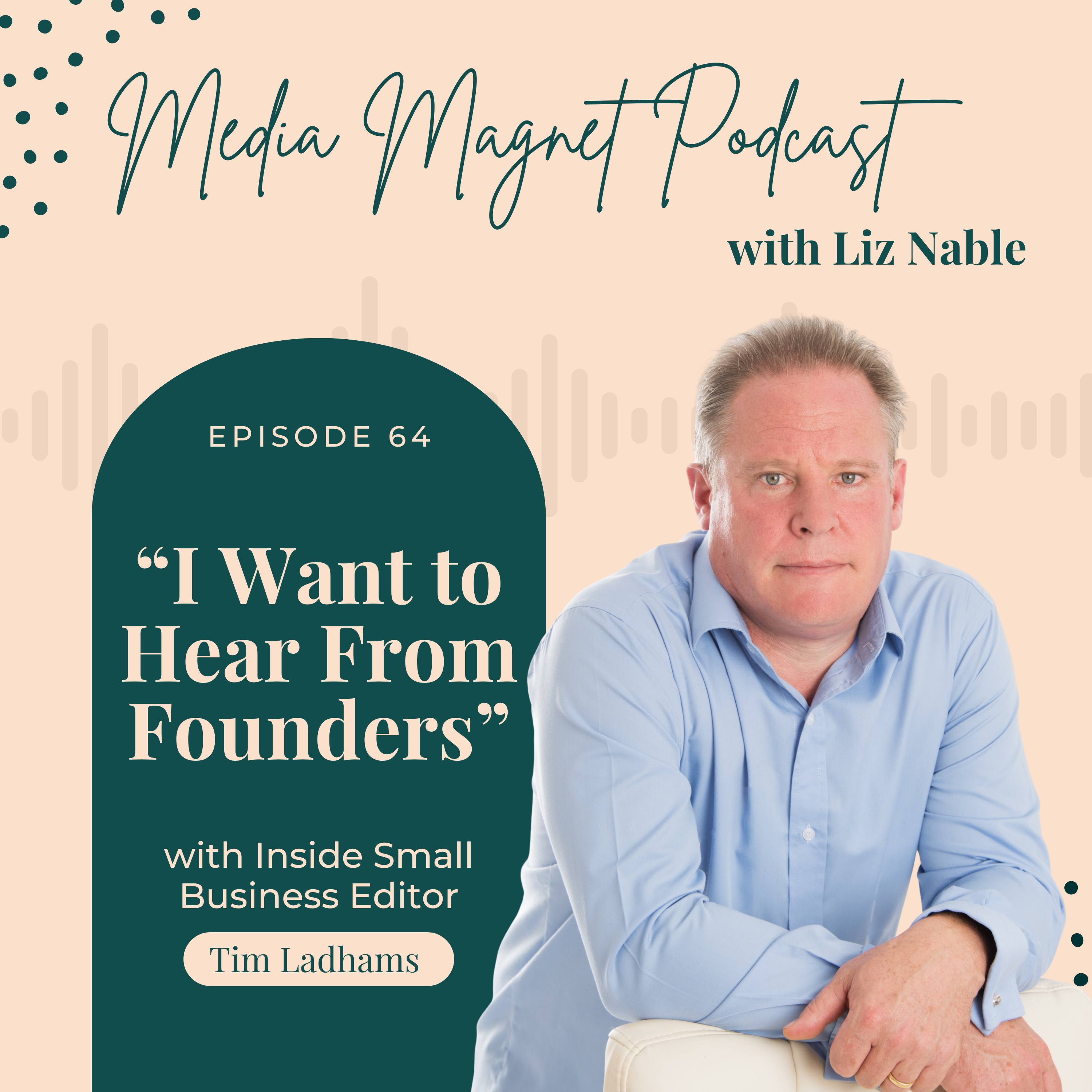
Speaker 1Want a journalist to actually open your pitch email? In this episode, I'm giving you a secret code word that makes it happen. Before we jump into today's interview, I wanted to share something very special with you. As a thank you for listening to this episode of Media Magnet, we've created a secret code word you can use when pitching your story to today's guest, Tim Laddams from Inside Small Business. If you include this code word at the very top of your pitch email, Tim will know you've come through me and he's guaranteed to open and read your email. Now, we're not publishing the code word publicly because we don't want it to get overused. But if you'd like it, simply DM me on Instagram at Liz underscore Nabel, and I'll send it straight through you. All right, let's get into today's show. Today, I'm joined by Tim Laddams, editor of Inside Small Business, one of Australia's leading publications dedicated to telling the stories of entrepreneurs and entrepreneurs. Just like you from across the country. In this conversation, Tim shares exactly what editors are looking for when it comes to small business stories. The different ways founders can get featured from opinion pieces and founder pieces to Q&As and how to pitch in a way that actually gets a response. He also explains why he actively prefers hearing directly from small business owners themselves rather than PR agencies or business owners. And why authentic founder stories with real, lived experiences and insights are far more valuable to his readers. If you've ever wondered how to get featured in the media, position yourself as a thought leader, or share your story with a wider audience, this episode is packed with practical insights you can start using right away. Hello, and welcome to Medium Magnet, the podcast for founders. I'm Liz Nabel, and I'm your host, personal publicist, PR strategist, and dedicated hype woman. My goal with this show is to give you a behind-the-scenes tour of how the media works, to break down the barriers between your business and the big mastheads, so you can see how easy it is to get featured simply by giving journalists what they want. At Media Magnet, you'll also get access to the top journos, editors, writers, and PR people in your industry and beyond, sharing their secrets and expertise on the how, why, what, and when of pitching, and getting featured in the media consistently. I will share with you how to build your reputation as an industry expert so successfully the media will be knocking down your door. When I first started in small business 12 years ago, I had no idea what I was doing. I had no idea what I was getting into. I had spent 15 years as a television news reporter, working at several major networks in Australia, and then as a freelancer in the US and around the world. I spent years dividing my time between working long shifts on a news desk and traveling the world chasing stories. It was unpredictable and exciting. Until it wasn't anymore. I decided I wanted a life where I was in charge of what happened next, and where I was working to build my own empire, not someone else's. There was a lot I had to learn about running my own business, but getting media and great free PR was not one of them. I already knew what the media wanted. I knew the secret formula for what made news, and I knew how to leverage those media outlets to build my business, get more exposure, and ultimately make more sales. I was featured in every major media outlet in the country, and I never spent a single cent on PR. I took that knowledge for granted until it dawned on me one day that I could teach what I knew to other businesses, let them in on the secret, and they too could build their brands with organic media and PR. Let me help you take your brand from best kept secret to household name. This is Media Magnet, the podcast, and I'm pretty pumped to have you here. Thank you, Tim, and welcome to the show. Thanks for giving me the time today to have a chat. It's a pleasure. So let's sort of start from the beginning because I haven't featured Inside Small Business, obviously, on the podcast before. Tell us a little bit about who you are and what you do and then also the magazine itself and the kinds of stories and the audience that you serve.
Speaker 2Sure. So Potted History, as an online, as a significant online presence, that's been about 11 years, and for my sins, I have been on board for all of that time for about 14 months where I went off and did something else, and then circumstances conspired to bring me back. So it was just a quarterly magazine until I came on board, and then it was purchased. So I've been on board for about 14 months now, and I've been on board for about 14 months now. So for example, example, I've got four new features that are going to become recurring in the current magazine. And one of them is called the quarterly event. So it's an opportunity for a small business owner to talk about things that are beyond their control, that are stymieing their growth. So it can be government policy, it can be bureaucracy, it can be late payments by large corporations to their small business suppliers. That will grow over time. We've just done the first one in this issue, which was about a territory government new digital scheme that was designed to simplify things and has actually made things almost impossible for small tourism operators in the Northern Territory. So that's the kind of thing that, you know, we're looking for there.
Speaker 1Yeah. Okay. That sounds like a very interesting column because I get a lot of small business owners who come to me with exactly those kinds of issues, things like meta, shutting them down or closing their accounts with no explanation.
Speaker 2I've covered that three or four times. I mean, that happens. That happens a lot.
Speaker 1Yeah. Thanks to hidden fees.
Speaker 2That we can, that we can do as an opinion piece as well, because obviously the magazine is only quarterly. Yeah. And there's only one of that slot.
Speaker 1Yeah, yeah, absolutely.
Speaker 2The other thing we started last night, sorry, with the magazine that went to print last night, which is really interesting, is, is a, is a piece called the Smart No. And because everyone's telling people what they should do and what opportunities they should grab with both hands, and this is about why sometimes it's better to take a step back and even if something looks shiny and exciting, that it might not be for your long-term benefit.
Speaker 1Yeah, I love that because, and that's so true because small business owners are multitasking all the time. And I see it all the time in the courses that I run, they get sidetracked by something. And they end up, doing five things really poorly, rather than doing one or two things really well. And I think it's hard in small business, sometimes, particularly if you're starting out to know where to focus your energy. So that's, that's really interesting too. Okay, so there's an op-ed potential opportunity that you, you might, you know, apply.
Speaker 2So yeah, so let's, so let's go back to online. So there's the, there's the feature. Yep. Which, if you've got a cool story, Sometimes they are, sometimes they are, we hook them up to, to current events. So for example, during, during the Australian Open, I did, I did two stories related to that. So one was Better Cup, which is a, which is a small business in Melbourne that, that is railing against single-use coffee cups. And they were invited to the Open. And then the other one was a sports nutrition startup who were invited to fuel the athletes at the Australian Open, which is actually one of the co-founders is a four-time Olympic champion.
Speaker 1Awesome. Okay, so that's online. So there's features.
Speaker 2So that's online. So there's the feature. Yep. There's the opinion piece, which is, which is written. And that is written by the contributor and they get, we get their bio, their LinkedIn profile link and a picture of them and that goes in their author profile and then they write the story and that is to a maximum of 750 words. So that's why it needs to be, you know, a really specific topic. Yep. And I then also run Q and A's. So that tends to be with more. With real micro businesses or really quirky stories. So I think the last one I did was an arts and craft business. And the one I did that was a 13 year old girl who started her own swimwear range, that kind of thing. So I just, I will, I will look at a pitch and make a decision on which, which way I think it will present best.
Speaker 1Okay. Sounds like there's so much opportunity for small business owners to get featured. So is there anything else in that list?
Speaker 2Um, so, so online, there is the online, there is the, the, the, the, the new stories, which tend, they tend to be the only place where we do feature bigger companies because they tend to do the research.
Speaker 1Oh, okay. Right. So based off data and statistics and so.
Speaker 2Yes. Yeah. And, and, you know, so. So somebody likes zero, they are a massive organization, but they do their products are designed primarily for small businesses and they do, you know, they do a, they, they do a, I think it's quarterly or might even be bimonthly, a thing called zero small business insights. So that's, that's useful data, useful research and a couple of other organizations do an index. Yeah. Which is how small business is performing. Yeah. Um, the payment times one is huge because obviously that's cashflow is. Yeah. Yeah. Um, so when, when the big, when the big end of town start slowing down their payments to small business suppliers, we call them out.
Speaker 1Yeah. I love that.
Speaker 2Um, you know, and, and, and conversely, if it's interesting. It sounds interesting because different industry sectors treat their suppliers very differently and that's worth highlighting, you know, because if you're, depending on what your business is, that gives you an idea of, you know, well, am I likely to be paid on time?
Speaker 1No. So if someone's sort of listening to this podcast episode and maybe they're, um, they're a startup or they've never been featured in the media before, or perhaps haven't been doing this for a long time, do they still have validity? Are they still consistent? A hundred percent.
Speaker 2Yeah. A hundred percent. So what, I mean, what, what I like people to do is just to pitch to me, um, via email. I don't, I don't publish my phone number because otherwise I would never do anything.
Speaker 1And I'll share the, I'll share your email in these, um, in the notes, in the podcast notes, everyone. So, um, that'll be there.
Speaker 2So what's, what's really useful is if they are sophisticated enough to have already put together, like, a one page bio and what I really want to know is the why, the what, the why and the when and the where, and if they haven't got a bio, it can just be a series of bullet points. Yeah. So it's, you know, my names and I went to buy some thongs and I couldn't find any that were comfortable and practical. So I made my own and I'm just going back to a piece. I did in the, in the last magazine, um, you know, I started the business in Perth in 2017. Um, I grew, and then I will go back and ask questions if there are holes, and then I will either, I might say to them, okay, here are the, here are the op-ed guidelines. If you're interested in writing and you would like to write a 500, 750 word op-ed. Um, this. This is a specific topic. Um, if it's something that I think that would work well in the Q and a format, then I'll, I'll tell them that. And then in due course, I will craft a series of questions for them and send them to them would be quite prescriptive again about length of response and that kind of thing. Um, and if it's something that really appeals to me, I will do an email Q and a, and then I will then write a feature. And that doesn't, that doesn't appear as a Q and a, that appears. Okay. As a continuous narrative written by me, um, which is dotted quite frequently with direct quotes that come back from that Q and a, because they lift, it becomes a, it becomes an, uh, an alive piece of journalism in my opinion.
Speaker 1So a lot of small business owners that I work with will often get bogged down in like the technicalities of the perfect pitch and, and, you know, whether they're bothering you or whether that, you know, you, you, you want to hear from them. How much do you want to hear from these small business owners and does it.
Speaker 2That's, that's who I want to hear from, you know, I mean, I, I, and, and if, if for any reason, I don't think it's quite right. If, if somebody has made the effort, I will invariably try and respond, you know, the, the, the literally hundreds of emails I get every morning from the United States and from the big organizations talking and, and the public. Um, and, and, and, and, and, and, and, and, and, and, and, and, and, and. you know i i can tell where they're from yeah very quickly um and i can you know if if if if they're if they're if they're if they're genuinely a small business or a startup early in their journey then i will do my best to try and accommodate them in one format or another
Speaker 1yeah it's interesting isn't it because we had this conversation on the phone last week um a lot of small business owners think that that editors and writers and media don't want to hear from them because they're not you know they haven't been in the game long enough or they don't make enough revenue but in fact that's
Speaker 2the that's the that's the complete antithesis
Speaker 1the opposite is true
Speaker 2yes and and in the early days you know i think maybe because i was less experienced and there was less content around maybe you i used to run i used to run op-eds by from i'm trying to think some of those people like go daddy and and um what's the what's the people who help you with your
Speaker 1tax oh myob or like um well
Speaker 2them as them as well but also that you know that that franchise thing oh um
Speaker 1the tax h and h
Speaker 2and r block
Speaker 1h and r block
Speaker 2tax block and it kind of i realized after a while that actually they were thinly veiled attempts to promote their own services
Speaker 1and it's interesting isn't it because um a lot of what comes from those big pr companies and internal comms teams is really not targeted it's not something that you guys would ever portray anyway or have on the pages of your magazine so i do feel like the personal story and authentic small business someone with real lived experience on the ground has a far better chance but inside small business obviously but even in a lot of the bigger media organizations there's a real return to like authentic stories real life um opinion-based pieces like lived experience rather than some manufactured prps with b-roll footage and stock stock images yes
Speaker 2i mean there there there is the odd occasion when somebody will pitch to me and i will say to them look i think this sits better with somebody else so um i get pitched quite a lot of things that are around um so i'll give you an example like women's health yeah small businesses now i i map carefully so i'm not covering um you know we look to cover every aspect of running a business so i don't want to do the same thing so i recently said to somebody look why don't you talk to mama mia because i think this is very much their kind of thing and and on one of those occasions which was one of those messy things i actually i i told them to go to a current affair because i thought it was egregious enough to sit
Speaker 1there yeah yeah
Speaker 2because i'm not like a big breaking news no shape the you know shape the shape the tree type of publication yeah um and obviously having done this for a long time and i i sit on probably four panels on average a year at pitching events with people from radio tv and other print mostly online but you know and print sometimes um so i know people and then listening to them i kind of know what they're after you know we're all after we're all after good stories but with
Speaker 1a different angle totally so there sounds like there's tons of opportunities in the online version of the magazine how what are you looking for in terms of like quality and pitch angles and those sorts of things to make it to i guess that next level which is the print version of inside
Speaker 2small business so that's that's that is that is that's a very different beast um so if i get a pitch and it sits it sits either in one of those sort of areas that i've just talked to you about um so another another thing another thing we've introduced is a thing called the devil's advocate where we basically get we get two people to um it's like dueling banjos to to fight viciously for their when they have completely opposing views so the one i've done is here is the value of linkedin for small business so i got i got i got a pitch from somebody who you know wanted to write about how about how best to use linkedin um and i knew i'd had a pitch recently from somebody else who said i thought it was a waste of time so um what am i trying to say the magazine content i i commission
Speaker 1okay so i look
Speaker 2at everything i've got and i sit down with my ceo before each we usually run three significant features um so we the one we've just done um uh the three features are one was is the ai bubble about to burst um so i i interviewed in depth five people who are embedded in the ai space but with specific reference to small businesses and that was like a that's like a 10 page feature and then um another we could you know i sit and talk to amy and she if she's heard something on the ground in sydney that people are talking about and this was the case with she said she'd spoken to a lot of people in she's the ceo of the of opto media but um obviously so she talks to lots of people all the time and she said she'd had this this feedback that the cost of acquisition of social media was becoming prohibitive to small businesses in particular because they're you know the algorithms are changing and when they when they first when the platforms were first around they wanted they just wanted followers so they made it really cheap and really easy for people to market on them and now they've got hundreds of millions or billions of people on they are jacking up prices and trying to make as much money as possible um so i spoke to four people in various different people but generally um people who are in marketing agencies that have small business clients and we talked about that so um that's a question of you know obviously after all this time i have quite a long address book already but somebody new might pitch me and i have a potential stories folder and i might say to them okay i'm going to sit on this until the right opportunity comes along in print and then when it does i go back to them and say okay we're gonna this is what we're doing and this is going
Speaker 1to be the output what would you say um the advantages for a small business owner to get featured in something like small business inside small business in terms of in any capacity q a um the the opinion piece feature stories what are what would you say are the benefits to share your story or your opinion or your lived experience or give value or educate what's the benefit of being in media like inside small business
Speaker 2well because it i think it positions them as a thought leader among their peers that's what i like to
Speaker 1think yeah i mean absolutely obviously i teach this for living i couldn't agree with you more i think some small business owners again wearing lots of hats super time poor have started a business because they're passionate about that product or that service will often say to me oh you know media's dead you know i can just do this on social media what would you say to that i
Speaker 2think that's nonsense because i think that i think that i think i think i think that sort of some if you if you if you exclusively in social media i think i'm not saying it questions your integrity but it what it does do is it it everyone is and everyone's shouting so that thought leadership aspect of things goes out of the window and perhaps linkedin is the only platform that to some extent does offer that um and and you know virtually everybody's on social media to some extent and it's very valuable but it's it's a it's a different thing that's that's that's that's a marketing channel that's an advertising
Speaker 1channel yeah absolutely
Speaker 2or it's a brand awareness channel now you know by being an inside small business that gives you some level of brand awareness to a degree and and we are read by those you know we're read by the by the zeros and the and the miles and the people like that because they want to know they it helps them with their approach to trying to win small business
Speaker 1clients yeah and there's obviously that trust and credibility piece because the media whether it be inside small business or a mainstream news channel or a newspaper there's a big piece about reputation and credibility and authority um i think when you are featured by an outlet like inside small business it tells me that you do have a trusted voice that you know what you're talking about that you are the best um or the most authoritative in your field you really can't get that kind of cut through in social media in i mean social media obviously there's a role for social media no doubt but in terms of building trust and credibility i just don't think you can replicate what media presence gives um in that capacity no and
Speaker 2that's you know and i feel quite a big responsibility in that and that's why i am a real stickler for the rules that we put in place and i get really angry when with people when they try and oh you know can you just do this for me or so the biggest the probably the most so a you know i'm i'm i'm quite succinct with the guidelines about what and what isn't allowed and if i get a piece which is 80 or 90 on track i i saw a piece yesterday and there was some really good insights in there and then there was one paragraph that was just utterly self-emotional and i just took it out and i i went back to the person and i said i'm not going to do that i'm not removing this entire paragraph you know take it or leave it if you would like me to to to i ultimately i have the final call on what doesn't doesn't go in my sight you know now on this occasion this person said okay yeah sure i understand let's you know but they want to be cut they want to be covered anyway
Speaker 1yeah absolutely the
Speaker 2biggest one is links i do not we do not publish any external links in our articles and people say oh you know we anyway i won't even go into the various justifications that people try and come up with and it just doesn't happen so with that bio it's it's it's very clear it's it's a it's a it's a written bio in which you can talk about you know what what you do and how good you are or how much experience you've got and all that kind of thing and a photo and a and a linkedin profile and that's it that's it yeah i think if you're not
Speaker 1familiar with the integrity of you know um how many organizations are built and the rules that they live by i think you can often be a bit confused by thinking that you might have editorial license over an article that's being written about you but really at the end of the day a proper me organization traditional media organizations the writer or the contributor or the person being featured does not get to see the final product before it goes to print um do they they really need to just be sharing their story and the journalist is the one who who who tells it
Speaker 2yeah yeah well certainly with the features and the magazine you know and if people say oh and i want to sign off on it before it's published that's a total no-no yeah absolutely because it's not it's not yeah but you know with i mean with the with the opinion pieces that is apart from a few things like house style i mean it seems everyone in this country has capitalization diarrhea and by capitalizing every third word of a sentence it makes it more urgent or immediate or something it doesn't
Speaker 1that might be an ai thing too um
Speaker 2potentially yes but anyway so so so so i i edit i op-eds to house style but generally it's it's the words of the business owner and it's the voice of the business owner and i don't want to interrupt that so i will only interject if they are breaking the rules in terms of being self-promotional or or you know um disparaging somebody else to an extent that might put us in a difficult position legally
Speaker 1yeah so it's not about sales for anyone who's listening to this podcast tim is not in the business of doing your self-promotion or selling your product it's got to be about the story
Speaker 2yes yeah and the ethos you know um i mean people can look there are six is it six or eight six categories across the top of the website to give an overview of the type of thing so it's one is finance one is technology one is sales and marketing now you've got me planning and management and growth and development that's okay they can go
Speaker 1to the they can go to the
Speaker 2website yeah those are them so and and you know within that we have subcategories so if you're uh old people in hr yeah so if if you know if you're writing a story about um you know there was some there was a change in legislation about psychological safety in the workplace recently for example so that would sit under the people in hr banner and i had a really interesting follow-up opinion piece from a small business owner who has a consultancy that you know works in that field and and those are good i i generally i have about an eight-week tail between something being submitted and something running because i have so many people who want to send me something and i don't know how many people want to send me opinion pieces but last week i jumped the queue with two pieces because they were very clearly linked to international women's day so they were about two very different aspects of women in small business right um but i jumped the queue and then i got i got i got a i got a good piece about linton and apparently it is whatever it is it's its 20th birthday on may the 5th right so i'll run that story on my website and i'm going to put that in the description box below and i'll put that in the description box below and i'll put that in the description box below and i'll put that on the third or fourth of may to coincide
Speaker 1with that awesome so before we wrap up um to clarify it's not about sales it's about the story you definitely want to hear from small business owners no matter what age or stage that they're at in their business you want to hear like authentic stories with you know how they got there what they're doing why they're passionate all those sorts of things how do people get in touch with you can you share your email address and i'll pop it in the show notes as well um and is there a a better time or you know day or time or is it really just sending you their email pitch following up and um making sure there's some sort of relevance to to now or to when that when that story might be um relevant yeah
Speaker 2so so the subject they should give a little bit of thought to the subject and just give like try and make it try and make this subject appealing in terms of and succinct about what they're doing it doesn't matter what time of day or night the email comes and the other thing i would say is please don't send me an email 24 hours later saying did you get my email i mean i i i actually worked out that at the at the weekend i literally did not unlock the front door of my apartment as i was working on the magazine wow now that's that's only four times a year because production it's like there's a there's a tight window the design is overseas and so there's a lot of sharing of anyway that's technical stuff yeah um but there are some times when i might not reply for four or five days it doesn't mean i'm not interested if i have time i will try and say hey i'm in the middle of something really big i'll come back to you in due course but i don't always get to do that yeah um if you haven't heard after a week by all means a polite follow-up um you know just wondering if this was of interest is perfectly acceptable
Speaker 1amazing thank you tim um i can't wait for you to receive a flood of new pictures from the listeners of this podcast yes like you're already time paul we're going to make you more time paul um than ever before it's been a pleasure to have you and really appreciate your insights into inside small business and super helpful and adds a lot of value to the listeners who um dedicated to the show yeah
Speaker 2no well thank you very much for the opportunity because that those are the people i want to speak to are people who are genuinely small business owners so if they're people who are reaching out for help in this field it sounds like they're very much in our wheelhouse absolutely our
Speaker 1worlds are aligned lots of sponsors thank you tim thank
Speaker 2you very much speak to you soon
Speaker 1bye this episode of media magnet was brought to you by my signature group coaching program the media masters academy the media masters academy is a live online six-week course taught by me and designed to teach you how to become your own publicist and give you exclusive access to pitch the country's top journalists and editors doors open just three times a year check it out at liznabel.com along with a ton of free resources to help you get started taking your business from best kept secret to household name right now if you love this episode of media magnet please share it with your business buddies or on social media and tag me at at liz underscore navel and if there's a specific guest you want to hear from on the show or a topic or question you want to know more about please tell me so i can make sure the show stays dedicated especially for you
 PodcastTranscript AI