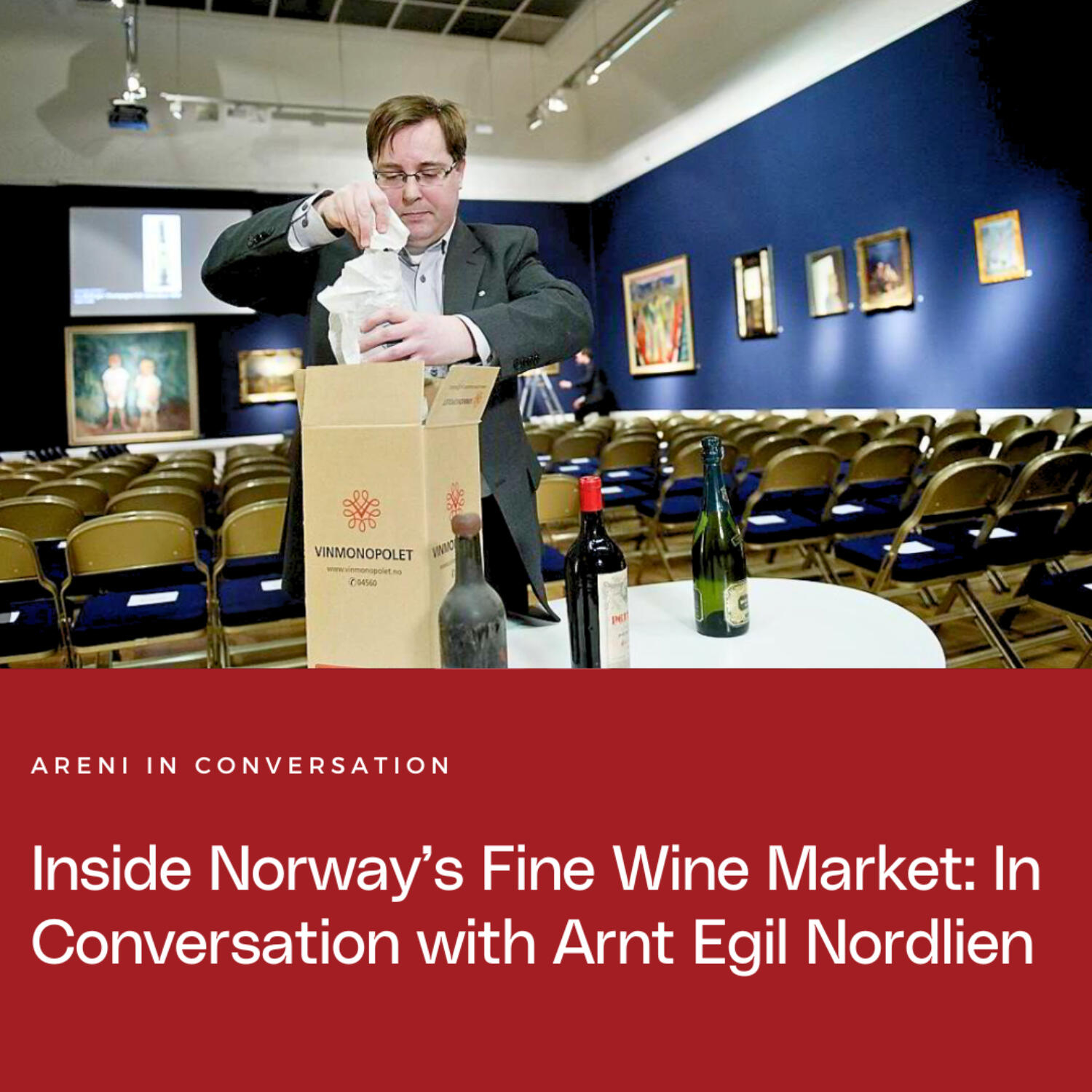
Inside Norway's Fine Wine Market: In Conversation with Arnt Egil Nordlien
24m 3s
In this episode of Aurene Global in Conversation, host interviews Ante Egan Noggin, fine wine buyer for Vinmonopolet, Norway's state alcohol monopoly. Ante explains the unique system: he selects wines from tastings like the En Primeur campaign, issues tenders to Norwegian importers, and buys wines two years before they are sold to consumers to avoid delivery risks. Vinmonopolet operates with fixed margins capped at about €18-20 per bottle, making luxury wines like Burgundy dramatically cheaper than elsewhere. High-demand wines are released through six annual launch events, sold on a first-come, first-served basis in 12 dedicated stores and online, with strict limits (e.g., one bottle per customer for top domains). This creates extreme queuing, as seen when customers camped for a month before the Burgundy launch to buy Romanée-Conti. A legal secondary market was established in 2013 through Vinmonopolet auctions, allowing private collectors to sell older wines, though private resale is otherwise banned. Ante also discusses promoting emerging regions, like English sparkling wine, which he launched with 35 products in 2016-2017 to diversify the fine wine portfolio. The episode highlights how Norway's monopoly model balances accessibility, quality, and control in the fine wine ecosystem.
Welcome to the Aurene Global Podcast. Aurene is a global research and action institute for the future of fine wine. In this series we bring you conversations with thought leaders in and adjacent to the fine wine world to discuss how we as an ecosystem can ensure the collective future of fine wine. Welcome to this new episode of Aurene Global in Conversation. Today I have the pleasure to host Ante Egan Noggin, a discrete personality yet an extremely influential one. Ante is the fine wine buyer for the Vin Munnable Norway State Control Alcohol Distribution Platform. As the fine wine buyer, Ante works with a very specific range of wines that he personally selects to be distributed through 12 dedicated flagship stores around Norway. And I sat down with Ante just after the beginning of this year's Ante Egan campaign and interviewed him as part of our series on La Plas de Bordeaux and we did indeed speak about how the monopoly managed entrepreneur, how Ante chooses the wine and the very specific process he follows to get the wine into Norway and promote them to his consumers. But we ended up talking about so many other aspects of fine wine distribution that we decided to release the full interview as a standalone episode, knowing that it would be of interest for anyone working with Norway or willing to understand this very qualitative market and how it's currently impacting the world of fine wine. So how is the secondary market organised in Norway? Why are fine wines so much cheaper there? And how long do people have to queue to buy a bottle of Roman Aconte? Well, let's dive in. Thank you so much for joining me today and to explain, you know, the first question that I wanted to ask you was about the Ante Egan campaign at the Vin Munnable and how does it work for you? Who chooses the wines to buy? How do you import all the practicalities about an entrepreneur campaign? It starts with me and one of my colleagues. We go to the entrepreneur tasting and we will test the wine. It's a busy week with a lot of tastings and we go around and we test the wines and based on what we taste, we make some tenders, we decide what to buy and we make some direct tenders on some products to buy. This year it was very sudden and normally after the tasting, there's a two, three weeks gap before they put the wines out for sale with this year and ended all the Friday and started on the Monday so it was a very busy weekend, same weekend as the mind-sur-right and both so not much sleep. So on the weekends you had to sit down with your colleague and decide which wines you wanted to import, which one you wanted to sell through the Vin Munnable. Yes. And so just to recap the people who don't know how the Vin Munnable works but you have to buy your wines through importers that are exclusively based in Norway, Norwegian importers. Yes. And you work through tenders so you like I want this particular wine so I want Shadow X and I want that amount of Shadow X. Yes. How many bottles of Shadow X? Can you offer to me in that what price, right? Yes, that's what we do. We ask for now the 23 vintage and we ask for a specific wine, specific bottle sizes like normal bottles and macdames and and the amounts and we put this on an internet page so all importers because we have them not only for the retail but importers they are private companies in Norway and since we have this system then we have to buy all wine we buy from Norwegian importers because if we didn't they would be out of business all of them so they would have to do that. Do you always find the quantity that you need? Do importers always get the right amount of allocation that you need? Depends a little bit normally we get all the amount we would like to buy but it's not always that one single importer can offer us the full amount. Sometimes we have to buy like from the two to three different importers that we have to buy with different prices and we put them in the shelf at these different prices also. So that happens. Okay so you don't have like a level up of prices it's like if I bought this one as at 17 and if I bought that one at 18 they will have one year difference at the end. No we don't we actually put them on the price that we are offered for the different importers that's also due to the fact that in Norway if you have a cork to bottle you can go back to the Winmunderbuller shop but it's not the Winmunderbuller that is very nice they give the bill back to the importer so we have to know from which one it arrived. If I recap so the negotiable sell to the importer the importer will take the normal margins and they will sell to you. Yes. And then you would sell to the client but what you were telling me is that you you don't sell the imprimar straight away right you just sell them when you get them physically. Yes that's true. We were thinking a little bit about this about 10-12 years ago because we could offer also the wine of the winter like the 23 now to the customers but it is a little bit of a risk since we are not allowed to buy directly and we have to go through you know a chain of private companies and the delivery will be two years later there's always the risk that something might happen an importer or even a negociac can go broke and be out of business and the wines never arrived and the wines will not arrive of course we can then give them money back to the customer but he doesn't want the money at that point he would like to have the wines. So to avoid all this we decided to just buy the wine now and like this year we will then start selling 2021 vintage. You've got two years of cash flow on those wines you have to wait two years to get your investment back and can you tell me about the margin system as well because it's very particular. Yes we have a fixed margins on everything it's not the same margin on every bottle it's a margin that goes a little bit on the price also it's a percentage of the price it's a quite complex model actually but it has a low end and also it has a high end of the price and we kept it margin at 250 no vision growner we would be like 18 euro or something 20 euro something like this. There's no wines that are sold through them monopoly that you take more than 18 euros margin on. Yes yes 18 pound 20 euro I would say yes but that's true. Which of course we can be allowed straight away that for the top wines it's nothing those wines must be very very cheap comparatively to any other market right. That top margin it hits around 280 euro per bottle then you reach the top margin and everything about that it would be that margin so for example for the very expensive burgundy they are very cheap in our market yes and so that leads to my next question because with such a small margin applied to high demand wines you know those wines are already in demand but if they are cheaper compared to every other you know surrounding countries how do you manage who gets access to them like who can buy them when you have a small volume of wines that everyone wants to buy. Yes of course that's a little bit of a problem because we get like everyone else that works with the great domains of burgundy for example it's not many bottles that you get every year it's just a few bottles of each QA and for every QA we have of course a thousand of customers that would like to buy these bottles and they are all very few that we will succeed so there will always be more customers that are not satisfied than those that will be happy. If I'm correct you've got 12 stores right the fine wine in Norway because that's something quite unique as well you have stores that are just the fine wine. Yes for the selection that we do for this various sort after wines it's we sell these in 12 shops we also sell online also but they're workshops. How do you distribute for example you get 36 bottles of a very high in demand wine. How do you split those 36 bottles into the 12 shop plus online who gets one. It depends a little bit if there's 36 bottles I would normally not give it to all 12 I would only distribute to perhaps four or five which would be like in the in the bigger cities around the Norway. If for example there is a burgundy producer where you have 36 bottles of perhaps like six or eight different queues which are quite normal it would be more possible to to kind of give few bottles of one of the queues also to the other shops so everyone will have a little bit from that producer but we also do have like one or two shops or three shops in the bigger cities that have a little bit more than the rest so we do split also these wines a little bit on these 12 shops based on how much amount they do sell so they don't get the same amount. And then the only way that I can buy those bottles is by coming physically to the shop and buy them or buy them online righteous that what you were saying they've got the option. Yes we do not do any allocations and you can come and you can buy one very expensive bottle and you don't have to buy anything else we open it at certain day for example the burgundy launch is in in February each year it's one of six launches we do every year and if you want to buy some of the top wines from these domains you have to come and queue up outside one of the shops be there when it's open. So what happened on February the first this year because I love this story. Yes people are queuing up in good time before opening and this year the first customer outside our launch this story no slow here and there were three young guys they arrived on the first of January so one month before opening they were queuing up
- They killed one month. - And it was a cold, cold January. - Was it the Romane Conti that they wanted to buy? - Yes, of course, also. Yes, they could choose from, they had the, they get the number one and they could choose to choose all good ones. Yes, but I'm pretty sure they bought some of the one they could see. - How many bottles were they allowed to buy? - We risked the bottles quite heavily. They could buy one bottle from the producer, the Romane Conti, for example, and also they could buy one bottle from all of the top domains. They only were allowed to buy one bottle. And for some of the wines, we're there a little bit more bottles available, they could buy perhaps one bottle for each QA. And something like this, especially for the ground crews, we do that, but they're also all the wines. Of course, it's a big launch and we also have some QAs where there are a lot of bottles and they're not irrespected at all. - So for the launch of the burgundy and the first February, you had people starting queuing on the first of January and months earlier. On the first of February, how long was the Q in total? - I think there were about 200, 300 people queuing outside, this one shop. - Wow, that's amazing. And again, I'm fascinating by those three chaps that camp for a month just to get their hands on the bottle, were they sent by rich people to queue for them or were they the people that would buy the wine for themselves? - They said that they bought for themselves, that they would drink it for themselves. - And they would drink it and not resell? - Oh, they said so, that they would not resell. - Okay. How does the reselling part impact you? I mean, with wines that would be relatively cheap, that leaves a lot of places to make money reselling those wines on the internet, for example. It doesn't matter to you. Like, do you have anything in place to force them to drink the wine or not? (laughs) - Of course, when the customer buys a bottle, then he buys a bottle and he owns that bottle. And it's of course not that so much we can do about that. Each customer has to decide for himself what they would like to do with that bottle. And if he wants to put it in the bathtub and bath, it's his decision. But no, of course, this is always a little bit of a problem this day, because we know that, especially the producers in Bergen, they are very, very about secondary market. And that the prices are higher in the secondary market. So they want to control that the wines don't end up in the secondary market. And we don't like that either, but yeah, we have customers and they, if they own a bottle, lay on the bottle. But what we do, as I was saying is that we restrict very much the amount of bottles that you can buy. So you cannot come and buy very many of those very priced bottles. High listeners, just interrupting the conversation for a few seconds. First to let you know how grateful we are that you are listening to this episode. And second, to kindly ask you subscribe to our podcast channel on whatever platform you're currently using. And to give us a cool rating, it's an easy way to support us and it really makes all the difference. Thank you so much. Now back to our conversation. So how does the secondary market work in Norway? Because if you've got the monopoly of retail, if you're the only one who can sell wines to consumers, is there even a secondary market in Norway? How does it work at all? For very many years, there was no secondary market. At least there was no legal secondary market in Norway. But we started in 2013 to do options. I actually started these options. And there are part of being on the pool. I worked part-time with this option and part-time with this selection idea. And there was quite a demand because there was a lot of sellers in Norway with a lot of older wines for people who had had them for decades. But they were not allowed to sell them legal somewhere. So they were just lying in the sellers. And then in 2013, we started with the first option. And today, then we have three people working full-time with the options. And we have 13 options this year. There's one online right now, for example. So now there is a secondary market for also private people. But the divinity manager? Yes. Yeah, you don't have the sort of bees of the Christie's wines in Norway. They can't operate when it comes to wine. No, they cannot. It's not allowed. We do collaborate with one professional auction house for this, which is called Blomqvist, which is no region one, because we need a place to have the wine and to store the wine and also place for customers to deliver and to pick up. So there is a collaboration, but it has been all reported that it's behind this auction. And do you all the evaluation of the prices and what you sell and everything like this? And so consumers, for example, if I've got too many wines in my seller and I want to resell, I can either go through the auction of the vine manifold. Or I can't resell to imported, right? No. Because I can't sell to them. And can I legally sell my wine online to an international platform or to an international merchant? Yes, you can take the wines outside of Norway and sell it when you are outside Norway. That's possible. OK, so I could take my wines to far, with those here in the UK and sell them in the UK if I wanted. Yes. But I suppose in terms of tax, it wouldn't be really interesting, because then the wines wouldn't be in bond and stuff. So they will end up being quite expensive compared to the price of the market. How do you access all the advantages? I mean, do you sell all the advantages? And if so, are there just wines that you've get for years or how does that work? We do work a little bit with trying to find the older advantages. If you go back like 10, 15 or more years, it was quite possible to access older advantages. So especially Bordeaux, we also had some importers in Norway that worked with especially some of the large sellers in London or in England. We also then sold all the advantages over to Norway, which we sold. So that's also a possibility. Today we see it becomes rare and rare. It's harder and harder to find some old advantages in the markets, at least for some larger quantities. But we do buy a little bit. And accept this. If you want some really old advantages, you would probably have to go to the auction. Yeah. And I guess also going back to the secondary market, importers themselves can sell to each other, right? Yes, importers, they can sell to the Horeka business. Restaurants who has a wine list and things like that. So they can also sell to other importers or everyone who has a license. Also, if you are a restaurant with the license to sell wine, you can also sell your wine to another restaurant with the same license. Or to an importer, can you sell it back to an importer, for example? Yes, I think that's also possible, yes. Yeah. Since they have a license, yes. And as opposed to importers can also buy wines on the secondary market in other countries, that if they wanted to buy a case from an merchant, somewhere else in Europe, they would be able to do that. Of course. Yeah. So the only difference that you had was for private collectors and private consumers that would not allow to resell their wines. Yes. People would know no license for that, yes. Amazing. So we're going to go back to distribution a bit because you mentioned in previous conversation that the way you work with fine wine is you have a release. So every other month, every two months, you will have, I don't know, in February, it's all the burgundy that go out and then in December, it's all the bordo. And you organize all of that through release and so people are aware that those very high in demand wines will just come out at those particular dates and not be listed all year. How do you arbitrate between the wines that can sit on the shelf all year because they're good, they're fine, but they're part of yours, normal portfolio, or the wines that are so, I don't know, you need or better. I don't know what's the best way. Did they need to go through that kind of release program that you have? For the selection that I make up, everything goes through the release launch with the dates. It's normally around 300 different ques in each of these launches. But you know, for some of the wines also in the fine wine, especially like in Bordeaux, there are some, it's possible to get some, to get larger amounts. So we try to buy what we can get in a amount that we lost. We hope for a year, perhaps it's not possible to get that much amount, but it's our hope to have, if not all the wines, lasting a year, then at least some of it. And we do that. So you will release them on the first of December, I think, for Bordeaux? Yes. And then they will last until there's no longer any Bordeaux in the shelves. Yes. But we do ensure that they will last a year. We do that. And if they are out, if we don't have any Bordeaux on their shelf, for example, in the next year, we will fix that. OK. So you've got Bordeaux, you've got Burgundy, but you've got also a lot of wines that are maybe less well-known that you decide to release through that system. Can you give me the example of the wines of England and how you decided to vouch for them with what consequences? Yeah, we know. We have all the great areas, regions, making fine wine, which are well known. But we also work with, try to find more
areas that we think would be very interesting for the fine wine markets. That's the kind of clue to get into our selection and back in 2016 and 2017 we were quite a lot with England, especially the sparkling wines of England, which we believe that the quality of these wines were really coming and we believe that they were very good. There were a few English spotters in the Norwegian market before this also but just a few and the saves were quite low. So we went to England, we tasted a lot, we visited most of the well-known producers at that time and we come back and we were satisfied with the quality and we said okay we have to do something with this and we didn't want to go silently with just a few products so we brought in what we thought to be around the 35 of the best products that we found and we launched them all like the way we do on the same date and had them all in the shops at the same time and we did the tasting with the journalists, we were also very happy with the quality we tried to explain a little bit about the quality of the English and sparkling wines and yeah it kind of took off and today it's a very large market, the Norwegian market for England, it's actually the largest export market in also in quantity actually. That reminds me so it's not because you're a monopoly that you can't do marketing yourself and organize wine campaigns that you were saying with a particular release date with all those tasting around it so you do the job of the importer when it comes to building a category as well I suppose. Yes we like this date was we had to build everything from the start and that's true we tried to do that sometimes if we see that there we feel that the quality is there and that these wines deserves to be better known to have a better reputation than then we go for it really we do so sometimes we hit sometimes we miss that's also possible we tried for example Italian white wines back in 2014 I felt that the quality of Italian wines was really really really coming but it didn't work so well but so so we have to try and sometimes you have to miss. And tumors were not ready for that? No I think they are more ready for that date to be honest but 2014 was too early for Italian wines. You were ten years too early. Yeah a little bit too early and for that but I think it's important also to try and things like that because also the wine world is in a lot of changes not at least because of the climate change and everything is turning a bit upside down and yes so you have to try new things try to search out new markets. Thank you so much for joining me today it was it was great thank you for listening to this episode of Uniglobal in conversation. Uniglobal is just think tank dedicated to the future of fine wine and when we are not podcasting we are publishing reports white papers articles or organizing events. So if you are interested in the global conversation around fine wine and what the future holds in terms of production distribution and consumption had over to our website www.urini.global that's arieni.global and subscribe to our newsletter all the links are in the show notes because whether you are producing or selling fine wine you need reliable specific data to make informed decisions and we have just that install for you. Until next time cheers! Thank you for joining us for the Arieni Global podcast. If you liked what you heard today please give us a positive review and share this episode widely. Stay connected with us and join our conversations via Facebook, Twitter or Instagram and visit our website at Arieni.global to find out how you can take action to ensure the future of fine wine.
Podcast Summary
Key Points:
Vinmonopolet, Norway's state alcohol monopoly, uses a fixed margin system that caps profit at approximately €18-20 per bottle, making high-end wines significantly cheaper than in other markets.
Fine wine is selected by Ante Egan Noggin through tastings and tenders, then imported via Norwegian importers, with a two-year delay between purchase and sale due to delivery risks.
Wines are released through six annual launch events (e.g., Bordeaux in December, Burgundy in February), with high-demand bottles sold on a first-come, first-served basis in 12 flagship stores and online, without allocations.
Queuing for top wines is extreme; in 2023, customers camped outside a store for a month before the Burgundy launch to secure bottles of Domaine de la Romanée-Conti.
A legal secondary market was introduced in 2013 via Vinmonopolet auctions, allowing private collectors to sell older wines, but private resale without a license is prohibited.
Vinmonopolet actively promotes emerging regions like English sparkling wine, launching 35 products in 2016-2017 to diversify its fine wine selection.
Summary:
In this episode of Aurene Global in Conversation, host interviews Ante Egan Noggin, fine wine buyer for Vinmonopolet, Norway's state alcohol monopoly. Ante explains the unique system: he selects wines from tastings like the En Primeur campaign, issues tenders to Norwegian importers, and buys wines two years before they are sold to consumers to avoid delivery risks. Vinmonopolet operates with fixed margins capped at about €18-20 per bottle, making luxury wines like Burgundy dramatically cheaper than elsewhere.
, one bottle per customer for top domains). This creates extreme queuing, as seen when customers camped for a month before the Burgundy launch to buy Romanée-Conti. A legal secondary market was established in 2013 through Vinmonopolet auctions, allowing private collectors to sell older wines, though private resale is otherwise banned.
Ante also discusses promoting emerging regions, like English sparkling wine, which he launched with 35 products in 2016-2017 to diversify the fine wine portfolio. The episode highlights how Norway's monopoly model balances accessibility, quality, and control in the fine wine ecosystem.
FAQs
Ante Egan and a colleague attend en primeur tastings, select wines, and make tenders to Norwegian importers. They specify desired wines, bottle sizes, and quantities, which are posted online for importers to bid on.
Vinmonopolet uses a fixed margin system with a cap of about 18-20 euros per bottle. For expensive wines like Burgundy, this low margin makes them significantly cheaper than in other countries.
Wines are sold through 12 flagship stores and online. For high-demand wines, bottles are allocated to a few larger city stores, and customers must queue physically or buy online on launch days, with strict limits like one bottle per customer.
Vinmonopolet started its own auction system in 2013, allowing private collectors to legally sell older wines. Importers can sell to restaurants or other license holders, but private resale without a license is not allowed.
All fine wines selected by Ante are released in scheduled launches (e.g., Burgundy in February, Bordeaux in December). They aim to have enough stock to last about a year on shelves.
After tasting in England in 2016-2017, Ante selected about 35 of the best English sparkling wines and launched them all on the same date across stores, integrating them into the fine wine selection.
Chat with AI
Loading...
Pro features
Go deeper with this episode
Unlock creator-grade tools that turn any transcript into show notes and subtitle files.
 PodcastTranscript AI