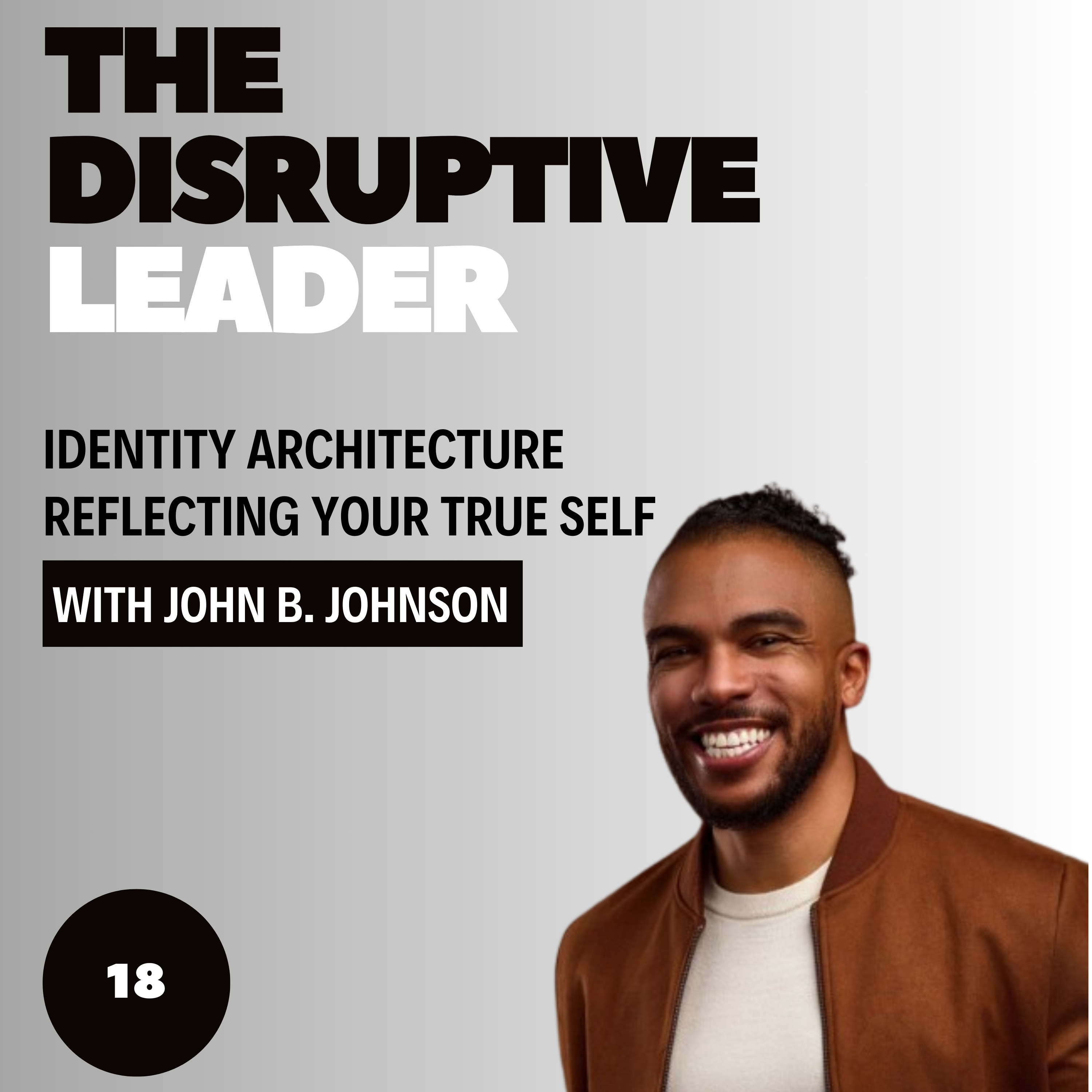
Identity Architecture - Reflecting Your True Self with John B. Johnson
from The Disruptive Leader
53m 57s
In this conversation, John B. Johnson, an identity architect and principal at Small Studio, shares his journey from architecture to brand identity and community engagement. He explains that his architecture training taught him to think in concepts and systems—distilling a core idea and applying it consistently, whether to a building or a brand. This approach helps founders uncover their unique perspective and light, avoiding mediocrity and projection. Johnson critiques the modern identity crisis, where people oversimplify themselves into roles or chase a distant, glamorized purpose. Instead, he advocates living "on purpose" daily through small, authentic actions. Regarding community building, he stresses that businesses must engage authentically, understand their people, and avoid treating them as disposable; otherwise, they risk causing harm. He introduces Small Studio’s "sixth man" philosophy—staying on the sidelines to support clients and stepping in to shake things up when needed, always keeping the focus on the client’s success rather than the agency’s ego. Johnson’s work aims to create space for acceptance and belonging by pushing boundaries and creating new culture, rather than just adapting to existing trends.
(upbeat music) - Good morning, John. How are you doing today? - Good morning, Rhanna. I'm doing well. Doing very well. - Yeah. Is it terrible Thursday, terrific Thursday? - It is a thriving Thursday. - Driving Thursday. There we go. I tend to like to add themes and emotions to the days of the week. - Like that. - Yeah, that's a guy somehow. Thank you for being on this episode with me and for taking time to speak with me for everybody who's the thing to this podcast episode. I'd like to introduce you to the very, very special, unique, gave me an amazing workshop that we're gonna jump into at some point in this conversation that refilled me. So me, John B. Johnson, identity architect, we'll jump into that as well. I'm principal at Small Studio. And so, John, I'd like to just start by going through your unique journey, going from individual to brand identity to community engagement. About whole journey. Who are you? What are you passionate about? - Good question. I'm passionate about helping people understand who they are and helping people. I like to say, helping people find a little bit of light that lives on the inside of them. And I've been able to do that with, in a unique way, I think, through my journey as an identity architect. I realized that I would identify with that title as I would help a lot of founders reflect deeply into themselves and try to find that unique perspective that they have, that uniqueness that they have, that if we all believe that we're one of a kind and there's no one else like us in the world, then we should probably use that piece of ourselves to better market ourselves in the marketplace, in relationships, in life in general, versus, I think, falling into the trap of mediocrity and projection. And so, yes, that's what I'm passionate about. And I love what I do. I feel blessed that I get to run a creative organization like a small studio and working with incredible creatives from all over the world. And I love that I can, I never am selling. I'm always just helping through the work that I get to do. And I just know that's an incredible privilege that I have. And I hope to help other people find that same type of fulfillment in what they get to do every single day. - Yeah. And I just read that description of, how you like helping people find sort of their light and energy. I recently, a couple of weeks, maybe a month ago, attended your identity workshop. I don't know, I don't think I told you this, but it left me with the next day I was very emotional in a way, because it hit me like, oh my God, I have been suppressing this light for so long because of bias, because of projections, because of fear, because of a lack of maybe acceptance of my identity. And then the next day I woke up and started this podcast. I was like, ah, here we go. So thank you, definitely. - That's beautiful. - Yeah, it was. - Thank you for that. And sharing that with you. - It was really like, whoo. But I always. Being a global citizen and moving around and being forced to move and kind of figure out who are you. I used to shy away from my name, and now I signed a whole spoon with great joy. And energy, it was great. So thank you, thank you, thank you. And I, enough about me, this space is all about you. I was doing a little bit of research and correct me if I'm wrong, you have a background in architecture. Is that right? Or do they? - Yeah, I got my diagnosis and architecture, my MBA. - Yeah, and how, if at all, how is your background in architecture informed or impacted your approach with the whole concept of brand identity or identity architecture? - It was just a way for me to be able to take advantage of my many thousands of dollars that I spent on school and make sure that I didn't waste that much. No, I'm joking. I like to say that I use, I was able to use it somehow. No, architecture is a fascinating profession because I like to say that it's the best degree to get as a entrepreneur because the way that we are taught to think, the way we are taught to conceptualize and create to analyze the psychological implications of our designs on communities and cultures, the anthropology that we have to understand, the theory of structures and architecture over the history of time, I like to say that architects were the first designers, right? They were the first creators of our civilization and it was just an incredible way to learn how to think, right? And I get that question a lot, right? Because of my background in architecture, I'm no longer practicing, but for me, when I think about just aligning it with what I do now, it's simply we think in concepts, right? We think in systems and I think architects are probably one of the most systematic thinkers around. So when I was in school and we were training to be on architect, a lot of my projects it would always come down to, what is the concept of this building? Of this project, what is the concept? Is it blue, right? Is it organic matter, right? Is it transnational civilization? Or whatever the concept is, it was important that we understood that concept based on all of our research and then was able to then translate that concept into every application of the building, of the environment, whether it was the way the doors looked or the program intersected or the facade of the building was the landscaping, right? Everything had to be consistent with that concept, otherwise it didn't make sense. And that, I think, is the best thing that I learned through architecture is that I was able to translate that to now working with founders and organizations and branding and design. It's really the same thing, it's concepts, right? A brand is a concept and identity of an individual is a concept, right? And that concept could be as simple as the definition of your name or it could be as complex as the services that you provide and how those services integrate into people's lives. But ultimately comes down to distilling the raw concept of the individual or of the organization and then being able to distill that down, translate it well, and then position it in the marketplace through visual identities, right? The logos, the fonts, the colors, the web, the design components, the component systems, the motion, the avatars, all those things, it's the same thing, it's just applied in a different way. - Yeah, and it's interesting that you, how you relate the architecture, the concepts, I was recently watching the episodes of the apocalypse on one of those episodes, it was going back to the Mayan architecture and the ancient Egyptians' architecture. And not only is architecture about that concept, but it's also a key into the past, 'cause this whole episode was about, well, look at the architecture of this building, or the pyramids, this civilization or this society, must have done blah, blah, blah, blah, blah, and so it's fascinating how architecture ties,
past, present, future together. And I like that you mentioned anthropology 'cause I'm an anthropologist. By the degrees of my bias, I was gonna say, believe it a minute, anthropologist. (laughs) Are you a poor-to-one, but I see what you're saying. And I'm talking about, oh, sorry, go ahead. - Yeah, our architecture is like the quarterback and they have to almost take all of the different applications from the engineering to the design to the art culture, the psychology, so on and so all of that has to come together to create a healthy environment for people to occupy. And EmoTep was the first architect. - Yep. - And that when you read architecture history, that's the first name you hear and it's wild because I remember when I studied it, I was like, wow, that was a Pharaoh, right? He was worshiped as a God. He was also an architect that created civilization. And once again, conceptually thinking, if you don't even think that was a real person who cares if it was or not, the concept of that, I think is a heavy responsibility on people who identify as an architect. Are you willing to carry the weight of a civilization or the weight of people in human's lives on your shoulders and design in ways that hopefully empower them and make them better and healthier and more that social fabric of belonging? I guess that's the weight that I carry in my training. And I also share that same type of responsibility with a lot of the designers that I work with that I mentor, that I hire, so on and so forth. - Yeah. And why do you think this changed? Or what's happening in the world that sort of led to what is often or commonly described as an identity crisis? You feel this or see this more and more in modern business. What got us there? Or what didn't we do that got us there? And that's a great question. I think, and this is, I think back by some research, but I'm not saying that's my expertise. I think that for so long, we as humans have attempted to simplify who we are. And when I say simplify that means, hey, I am a man or I am a email or I am an entrepreneur or I am a artist. I am a head of business development for so and so company or I am a mother to so and so children. And I think that the oversimplification of our identity has led to us which is continuing to try to understand and simplify down to these attributes that actually I think are limiting to our understanding of self. And I think in the business context, it's even worse because you are your title. You are your salary, you are your hierarchy. You are that part of that brand, that organization, that culture. And I think it's led to this epidemic of, if I don't feel like I fit in any of those boxes that everyone says I should fit into, then who am I? And then that's I think the start of a spiral of I wanna say doubt insecurity, fear, lack of belonging. A lot of the things that we innately need as a human, lack of community, lack of connection. And we tend to find ourselves drifting and saying, oh, I'm not good enough. I can't be that way. I don't see myself that way so I'm not gonna be an architect. I don't see other black architects out there so how could I be an architect? Whatever it is, I think that's what's really like high level conceptually thinking. But I think for me, I think we've also on the opposite side of that, I think we've also over glamorized this idea of purpose and I need to find my purpose, right? I need to find my meaning of life. And it's this like big thing in the future that's so big like this, so big like the word God, right? How are you gonna find your purpose if you haven't even felt like an little bit of purpose in your day to day life, right? At work or at home. And then you end up seeing this thing so far away and you're like, oh my gosh, there's no way I can get there. It's so far away or it's so big. And I think that's why I've changed my language around that as I help people and support people as a set of trying to find your purpose. How do you live on purpose right now today in this moment? All right, what is that? Is that just you being a father to your children, right? Is that you being a good mentor to your employees? Is that you smiling at somebody today and almost like breaking it down into small chunks? 'Cause once again, like you asked yourself that question, who am I? Like wow, okay, that's a big question. But when you practice it on a daily basis, it becomes easier and easier. And I think that's where we struggled is, we think that we can just get the answer today just by a snap of a finger or we think when we get that role, we'll have fulfillment or we'll have purpose. Or when we have that children or when we get married or when we move to that new place. And ultimately, that's not a promise, right? - Yep. - How do you start living on purpose and with purpose today right now? - Yeah, and it's interesting 'cause I feel purpose is a very individual thing, whereas father, boss, athlete, musician, those are roles. And so maybe the transition from how do I find my purpose or my identity as an individual soul, maybe that shift went from individual to instead of looking out what role do I have to play to fit into that mold? And what's crazy is that there's this sort of greenwashing for this of a term, where if you think about yourself, your selfish or yourself involved, but in reality to be any role, you need to understand who you are individually on a one-to-one level. Like I need to go in before I can look out. And you mentioned community. And it's funny because if you go back into again, older societies or traditional, what they call rural societies today, there was all about the community. You lived and learned and worked and everything in that community and slowly broke apart. What do you feel is the role of local businesses in community building today or community development? Like what part should local businesses play to bring that back? That's a tough one. Give that question to your local politician now. I think for me, it goes back to this, it's similar to what we've already been talking about. It's authenticity. And I think it's very hard for businesses to engage authentically in their communities, whether it's where they are located physically or is there an area of expertise in the industry of focus that they're in? It's very hard for them to engage authentically if the people who are running that business aren't engaging authentically in the work themselves. I think that in the past, especially I live in Cleveland, Ohio, it's where industry started back in the late 1800s. And the industrial revolution and people were so passionate about their work because that was how they made a living and they found purpose from that when they showed up to the factory or they showed up to work or whatever that was. And the people who ran those factories, they cared for their people. They was all about the people because nothing would run without the people. And I think that there's been a big shift in today's
marketplace where I don't think especially it's in the tech sector. People and their humanity isn't as valued as it once was and so everything seems more disposable and people seem more disposable. So it's very detrimental I think for people to find and attempt to find all of their community and their belonging and that connection from work when the marketplace has only shown us that you're disposable right. So I think it's a hard question because I want businesses to play a better role in their local community by engaging authentically and that means setting up events that authentically align with who they are and what they're doing. Empowering their employees to go out and engage with their local communities programs whatever that is but I think at the end of the day if that business is not willing to put in the effort to truly empower those people and empower their community and understand their community and understand their employees then they should just stick to business and not do it because they'll end up hurting people more so than I think end up helping them. So I think it's a fine line that takes a lot of care and a lot of rigor to do well and if it's not done well it could be detrimental to a lot of people and I think we're seeing that today. And I think also with community is the need for acceptance and sometimes when you think different or feel different or act different or communicate different or look different you can somewhat be canceled from your community and I think that could also be something that local businesses need to maybe consider that everybody is welcome and it's not this or that. And that's I agree 100% but I think you and I are anomalies in a way where businesses are they're very hard if you think about a business and as a system it's they're more efficient the more rigorous it is and the more restrictive it is I teach you an MBA and during in your master's program of business is like the you want to decrease the margin for error as much as possible. So if you think about it like businesses don't want there to be too much flexibility in too many variables. So that's why I think it's very hard for humans to try to find their humanity or their identity or their worth in business because it's flawed in that way but it can be so powerful if the leaders of that business and the decision makers implement and instill true authentic right engagement personal experiences that they've lived that they're solving for and it's not just about making a bunch of money but it's about making a difference in the lives of others who maybe share those same experiences as you have right and that's where I the work that I do I care about deeply where what is what is your unique perspective of this industry and why are you even doing it and if it's not anything unique then I really don't want to work with you because there's other things out there that you're just going to be a part of the clutter and that's what we're seeing with artificial intelligence and the that's the most relevant one there's businesses popping up every single day are you just doing it to launch and stay relevant and just go with the trends and this idea of branding they only goes two ways in my opinion but you're either adapting to the already existing culture or you're really creating culture yourself I only see it that two ways and if you're adapting to the culture that's fine there's probably going to be other people that are doing similar things if you're creating new culture then you're obviously pushing the standard you're pushing the comforts of society you're pushing the boundaries and you're creating new boundaries and you're actually creating more space for people to fill that acceptance and to fill that belonging to fill that love and that care and so on and so forth and I just don't I'm so tired of business just doing the same stuff as other people if there's other people doing it like get out of the way and go do something else you're probably better off doing that yeah everybody else is also yeah I think it's amazing because you I was once described as why are you rattling the cages and I'm like because we can make more space with a good thing but I guess it's not for everyone then John you've explained your studio with there's the term of the sixth man approach tell me about that approach when it comes to client relationships oh how does having a sixth man help your clients win yeah I don't even know how you found that because that was one of when me and Troy who is my was my co-founder when we founded the company back in 2017 that was one of our anchors as a brand as an identity for a small studio and we came up with that anchor because both of us at this time where we're into sports in a way and the six man man concept is in basketball there's five people on the court at all times and then the six man comes in and is posted stir things up and get everybody excited and add some energy and all that things and they're also the ones on the sideline that's cheering you on the way that we've adopted that principle is that we are more than happy and actually we'd rather be on the bench because it's not about us all right an a small studio was named specifically in that way as it's not about us and it's all lowercase a small studio all lowercase it's not about us it's about our clients and it's about those we serve so we will happily sit on the bench but when you need us we're and come in and we're going to rattle the cages we're going to shape things up we're going to slam the hit a three pointer or slam the you know dunk the ball I'm so out of sports now I don't know the analogies anymore but that was the idea of that concept and honestly if I'm going to phase my life that I feel like I'm more radical than I ever have been that I feel like as a designer it's not about you ever and if you adopt that word as a part of who what you do in your profession you're immediately giving up your right to make your work about you because design is innately about solving problems right and I would say that design is about bringing peace and that's the mission of a small studio using our gifts to bring peace so as a designer it's never about us and I think that if any designers listening to this or you can all adopt this any agency right it's not about you it's about your clients and when we start to make it about us we start to project our own identities onto these companies and onto these individuals and onto these campaigns rather than going in and finding them in the word and extracting that and projecting them out to the world versus projecting ourselves and I believe that's why there's a bunch of stuff that looks the same right now in the marketplace on LinkedIn on Instagram it's a lot of the sameness and it's only going to get it's only going to compound with artificial intelligence and it's because I feel like we've gotten very lazy as an industry and as agencies and they're like we'll do it for you and that's the I think that's the culture of the past when it comes to design and I actually have a passion of mine is to change the culture of design to helping people realize it's how do we how do I understand my unique perspective as a designer and how do I bring that unique perspective to someone else and help them find their unique perspective and together we can create something spectacular that's one of a kind that no one else could ever create because we both have brought ourselves to the situation or to the equation yeah I love that I love that and and as you were describing what a small studio does and that mission of bringing peace when I was doing a bit of research I struck me that you your journey you gone through various different roles seed spot feel free and it'll see one million cups and you worked with startups and entrepreneurs and bigger companies what are some insights you have or you want to share on the challenges and
rewards of working with startups and entrepreneurs. That's a big one. You got me reflecting nostalgic. I'm nostalgic now. I'll make it. I had a call yesterday with an entrepreneur. And it was actually right around the same time at you, Rodney. I think he came to me successful. Young. He's, I started this company, but I don't believe that it's a lining with who I am. And when I heard that, I was like, it made my whole year just to hear that because for the first time, and maybe, no, one of the few times, somebody came to me specifically with the problem that I'm passionate about solving. And it's early in their career. It's early in their entrepreneurial journey. And they want to, I want to align authentically to what I'm doing. That's what I heard. And I think that's what is so fulfilling about entrepreneurship for me is that if it's not just intrinsic, it's coming from within passion, fire, drive, connection, authenticity, it's almost impossible to do. And I think that we're, especially with the emergence of Gen Z and these younger generations, I think that they are more in tune with that. And saying that I'm not going to do something that doesn't align with who I am. And I would say that because I've gone through the entrepreneur journey myself, I've mentor entrepreneurs, social entrepreneurs at Seatsbot, feel free was my first startup. One million cups. All of these things did revolve around early stage founders. And I feel like that's the most personal and vulnerable time for founders is when you're just starting. And you can get in up by a shark, you can get manipulated, you can get taken advantage of, you can hit it big and just grow really quickly and lose sight sometimes. So it's very bonus like the incubation period of a plant. And that's what keeps me going and that's why I'm so passionate about working with early stage founders is because they need a creative operating system so that they can't get hurt. They can't be taken advantage of. They can't lose their way because they've done the work up front. They've paused, they've reflected and now they can project with authenticity and consistency because they've done that work on themselves. Right. So I think that's the insight that I gained over the years is if you're not going to do the work early on, you're most likely not going to do the work later because you're only going to, you're not going to get more time. You're getting it less time. So do it now and it's going to pay dividends in the future and I realize that over and over again with a lot of companies I worked for, like even just coming up with their name at the beginning that's authentically aligned with who they are, it just compounds into tremendous success because nothing's like it's them really. So really your work is you when you're an entrepreneur and it's hard to separate the two and honestly I don't know if it's possible. A lot of people think it is. I don't know if it's possible when it's truly intrinsically a part of your identity and your experience. And my goal is to just pardon that up so that it's a matured plant and then they can go out there and whether the storm of the marketplace. Yeah, it's like keeping your eye on the bull and that bull as you were talking about basketball that bull is your purpose, your drive, your values. It's not the dollar bill. It's not that I don't know who gave me a pound back. It's none of that. It's funny that you say that because I, with one of my startups, I reached a similar stage to what the guy or lady you were talking to yesterday was saying. I'm not feeling it anymore. And one of my mentors was like, yeah, but you just keep at it and you're generating revenue and I'm like, I'm not feeling it anymore. And then you're like, oh, but you shouldn't give up the revenue. Are you listening? I'm not feeling it. It's not all because I'm generating revenue that I'm going to keep doing it because if I'm not feeling it. Something is lacking and as an entrepreneur, what you were saying, your startup is you. It's almost like it's a mirror of you. It's a reflection of you. Like your child in a way, there are mirrors. And if I'm not feeling myself, that's going to be mirrored in what I'm doing and clients deserve better than that. But client is not just about, oh, I can pay you. So here you go. It's, am I giving it my all for you? And I appreciate. Yeah. And it's on the run. Yeah. I think it's on the client side also. Right. Like our clients looking at these businesses vendors, even as people. And are they respecting them with the same amount of care that you respect a person? Or they just once again disposable or it's a machine and so on and so forth. And that's a, you're right. I think it's definitely a mirror of you in a way. Because at the end of the day, like, why would you let something in that can hurt you? That can, there was something, and this is I think for another day, but I was talking to a designer the other day. And I said, a lot of times we don't talk about the traumas of business. Like business can be traumatizing when you're taking advantage of, yeah, it's your fault. You were taking advantage of it, but at the same time, maybe it's not your fault. And you still felt that impact. And you felt almost molested in a way. Or you're like, how did that happen? Or when a team member leaves you in a way that you thought they would never do. And it hurts. It's like a breakup. When you have a failed business relationship, a founder or a partner, it's traumatizing. It's human. And we don't talk about that a lot. It's always, oh, yeah, revenue, keep the business alive. Revenue is good. Revenue is bad. That's not, I don't think that's healthy. And when you go to your mentor and you say, I'm not feeling it anymore, I think that's a tall, tall sign that you need to pause, reflect, understand what's going on and how it's why that feeling is there, because that's just you, your intuition, your body, your spirit, whatever you want to call it, telling you, hey, take a moment and then keep going if you feel like it's necessary. Yeah. Yeah, that's exactly what I did. That was back at the end of 2019. And we just did it. I was like, I'm out. I'm not doing this anymore. I think it's fun. It's like what you're saying is so that part of the trauma of the business, think of bullying in the workspace. It happens every single day, just like in the classroom and in the football page and in the changing room. And the expectation is suck it up and deal with it. But no, it shouldn't be that way because you're right on at the end of the day, we are showing up as entrepreneurs and startup founders and leaders and so on and so forth. But those are roles. I'm behind that. Before that role, there's a human. One of the things I'm doing with my team at work now, we used to describe our team as customer centric. The more I thought about this and did research and read and all of that, I realized customer centric creates a gap between the customer and our team. And so we changed it to human centric because before you're my customer and I'm your provider, we're humans. And so this is the small things like how are you today? How was your morning? How are you feeling? Because what if you had a rough night and didn't sleep well, you're not going to be here at your best. But if we can deal with one another like that in the workplace, I feel it would be a much healthier environment as you were mentioning. And that goes back to that authenticity, just even having the courage to speak up and say that. That's beautiful. There's a law, I think, that's part of why is he my partner and I did this podcast is There's so much curator.
what you were saying about LinkedIn, everything is so perfect and so jazzy. But there's very little real genuine, I'm struggling with this today, I feel that out there and it just baffles me that the human being has been detached from the workspace. So if we tie that back to identity and all of the work that you're doing, my question would then be like as we talk about identity of the individual or brands, what are your predictions for the evolution of brand identity in this world of AI and digital and space and intangible and Gen Z? What do you feel is going to happen? I think we're seeing a rise right now in like mindfulness, health and wellness. I think people are becoming more aware of the fact that is that works and that's good for you. It's good for your mental clarity, it's good for your peace, right? It's good for your overall health and even good for your creativity. So I think we're already seeing a rise in that. I think what I'm banking on and what keeps me going and keeps me even working hard at it is that as the new generations move into the workforce, they have different standards of excellence and there are demanding certain things from their leaders, from their politicians, from their parents, from their colleagues, all of that. And I wrote an article about that specifically around Gen Z because I work with a lot of Gen Z designers. And I think that's a healthy thing and the pandemic kind of shook us into that. But I think that the older generations are afraid of losing control. They're operating in fear and the younger generations are afraid of becoming a commodity and becoming just a part of the machine in a way and losing their self. So we're going to have we're going to have a lot of battles, I think, and continue to have them, which I think are going to be good. However, I do believe that the workforce will evolve in a way of leaning into what you just talked about human-centric values and operational practices. And I think that more and more people are going to ask themselves that question because if and I do I give this talk to designers right now, I go to different universities and I say, design is becoming a commodity. And if you don't understand your unique perspective and who you are and your identity, you will become a commodity also and you will be disposable. I think this AI age is a wake-up call for everybody that if you haven't done that work on yourself, including business owners, including corporations and their brands, they haven't done that work, they're going to be replaced and they're going to be commoditized and they're going to find a different solution and they're just going to just literally disappear. And that's a very hard thing, I think, to swallow for most people. But that's my stance on it and my goal is to that's why you said sometimes it takes those moments to make that shift when I last year when I was going through cancer. I kept on getting these ads for $500 unlimited design or unlimited graphic design or I kept on having people come to me. We just need a website real quick or we just need this real quick. And I'm like, that's not what we do, it's not what we want to do and honestly you can go get that anywhere in the world. So I said, I'm no longer going to identify my company with the commoditization that's taking place right now and I'm going to lean into something that was already true to us but I was putting it in the background and that was identity architecture. So now a small studio is an identity architecture firm. We do that first and then we can do everything from there but unless you're willing to take the time to reflect then we can't work with you and we can't help you and honestly you can go get service by the many other options that are available. That's how I feel like the future is going to unfold and if you don't understand that that psychology of humans and can't empathize deeply with humans and so on and so forth is going to be very hard for you to be able to translate it in a unique way in the marketplace most likely it's going to end up being just a part of the clutter. Yep and that's the transition that's coming and right on like my daughter is 18 now and I've had many conversations for example with my dad. Oh but the younger generation I keep telling him this generation they are better people. They're genuinely better human beings with higher value systems and then when that right on when they transition into the workforce or the Gen Zs that you're already working with it is going to change because the old table because very broken if not breaking. I think they're just the it's hard for me it's hard to say that they're better but I think that they are they know more of what's going on in the world they can feel more they felt more so they may actually be more sensitive to injustice or to bullying or to just like this doesn't feel right because they have more data points than ever and it can go both ways though. So that's the hard part I think there was this story about this teenager who committed suicide because of his relationship with an AI bot and it's obviously mainstream now where you know it can go both ways where you have a generation that's so in tune with their cell and also like saying hey actually I don't want any more digital simulation but then you have another side of it that are completely immersed in it and lose themselves in it and that's why suicide rates are up and mental health issues are up and so on and so forth so it's hard to say I think that they're better I think that they're different and I think we all need to respect that and understand that they're different and start to shift the workplace and shift what we're building to empower them because I think that's the one responsibility we have as older generations is to help the younger generations and I feel like every generation wants to have the next generation conform to the way that they did it versus us can not conforming but transforming to welcome them in and and bring them along and empower them and learn from them yeah I think is also one feedback loop yeah like I with my daughter we'd be walking down the street and I'm like hey do you want a pair of jeans and now do you need anything no and I'm like you don't want to buy anything and one day she looked at me and she said I'll only buy clothes if it's from a second-hand store and I said why is that and she said do you know how much waste is created from all of these stores that you walk into and do you know how children are abused to manufacture these new clothes that you buy and do you know how the environment gets through and I was like I thought I was like whoa when I was her age 18 I was like who would you did run if you you asked why that's it that's all it takes and then I yeah and then I started doing the same and then I noticed it like even the fabrics are different okay I know we've gone way over time I could talk to you for hours so if we just go into our stores what would be like if you had a magic wand that you could in the world what would be one thing that you would change or improve or enhance around identity design if anything I think my biggest frustration as a professional doing this work is the value
that's placed on it. I think that it's lumped into marketing. It's lumped into sales. It's lumped into website development. It's lumped into so many other things when truly, I always say that it's the foundation. And I think the foundation of identity and a foundation of self is you doing the necessary work to understand your unique gifts, talents, experiences. And it shouldn't be lumped into all of the projection. That takes place, which I believe marketing is a projection. Sales is a projection. Web design, branding is a projection, but identity is a reflection. And you can't just project and find yourself. You'll lose yourself by doing that. And I think if there's one thing I would just, I would love to magic one. Everybody understands that if you don't know who you are, or you're frustrated, or you're having anxiety and you feel fear and shame and guilt and just don't feel that fulfillment, just take a moment and reflect and pause. And I would really hope that people place more value on that and corporations allowing their people to do more of that reflection, but also them leading my example and doing that. I think that will make the whole world a better place because one, we will understand our gifts better and our roles in society and how we can truly help in society as a citizen. But then also, I think we, because we understand our gifts better, we can help people better and we can bring more peace to people's lives. It's beautiful. Yeah. But on. Super. And I guess with that, if someone wants to reach out to you, a listener, how what's the best way for them to find you? Yeah, our website is asmolstudio.com, just like it's spelled. And we post, actually, we do a Dean newsletter every week. Highly recommend you sign up for that, where we just share our insights and our thoughts on just design and creativity in general. My Instagram is @jambeejohnson or no, John B. Creating is my Instagram. And I love the chat. Give me a call, give me an email, give me a DM, whatever they do these days. Anyway, I can help. I'll snap. Ron, you can share out the workshop, but you got to participate on it in it. That we do that every month. Tomorrow, I'm doing it with a bunch of University of California Irvine master's students. They're all going through it as a cohort, which I'm really excited about. So yeah, I love to help anyone through that process if they feel like they want to go through it. I would echo like that workshop. It's literally like opening up Pandora's box of individual ability for the use of the term. Yeah. Super. This has been a beautiful conversation, John. Thank you. Thank you, the world, the better, please. Thank you. Thank you, Ron. Yeah. Appreciate you. I appreciate it. Thank you. Have a great day.
Podcast Summary
Key Points:
John B. Johnson, an identity architect and principal at Small Studio, helps people and founders discover their unique inner "light" to authentically market themselves.
His architecture background taught him systematic, concept-driven thinking, which he applies to brand identity—distilling a core concept and translating it consistently across all design elements.
He identifies an "identity crisis" caused by oversimplifying identity into titles or roles, and by over-glamorizing a distant "purpose" rather than living purposefully in the present.
For community building, he emphasizes authenticity
Small Studio’s "sixth man" approach means staying in the background, supporting clients like a bench player, and stepping in to energize and transform when needed, keeping the focus on the client, not the agency.
Summary:
In this conversation, John B. Johnson, an identity architect and principal at Small Studio, shares his journey from architecture to brand identity and community engagement. He explains that his architecture training taught him to think in concepts and systems—distilling a core idea and applying it consistently, whether to a building or a brand.
This approach helps founders uncover their unique perspective and light, avoiding mediocrity and projection. Johnson critiques the modern identity crisis, where people oversimplify themselves into roles or chase a distant, glamorized purpose. Instead, he advocates living "on purpose" daily through small, authentic actions.
Regarding community building, he stresses that businesses must engage authentically, understand their people, and avoid treating them as disposable; otherwise, they risk causing harm. He introduces Small Studio’s "sixth man" philosophy—staying on the sidelines to support clients and stepping in to shake things up when needed, always keeping the focus on the client’s success rather than the agency’s ego. Johnson’s work aims to create space for acceptance and belonging by pushing boundaries and creating new culture, rather than just adapting to existing trends.
FAQs
John B. Johnson is an identity architect and principal at Small Studio, passionate about helping people understand who they are and find the unique light inside them to better market themselves in life and business.
Architecture taught him systematic thinking and conceptualizing, where a single concept must be consistently applied to all elements. He applies this to branding by distilling a core concept of an individual or organization and translating it into visual identities like logos and fonts.
He thinks oversimplification of identity into titles or roles and over-glamorization of purpose lead to doubt and insecurity. He encourages living on purpose daily rather than seeking a distant, big purpose.
Inspired by basketball, the sixth man approach means Small Studio sits on the bench, focusing on clients rather than themselves. They step in when needed to energize and shake things up, ensuring the client wins.
John says businesses should engage authentically by setting events aligned with their values and empowering employees. If not done with care, it can be harmful, so they must prioritize genuine connection over profit.
He suggests breaking it down into small, daily actions—like being a good parent or mentor—rather than seeking a large, distant purpose. This makes the question 'Who am I?' easier to answer over time.
Chat with AI
Loading...
Pro features
Go deeper with this episode
Unlock creator-grade tools that turn any transcript into show notes and subtitle files.
 PodcastTranscript AI