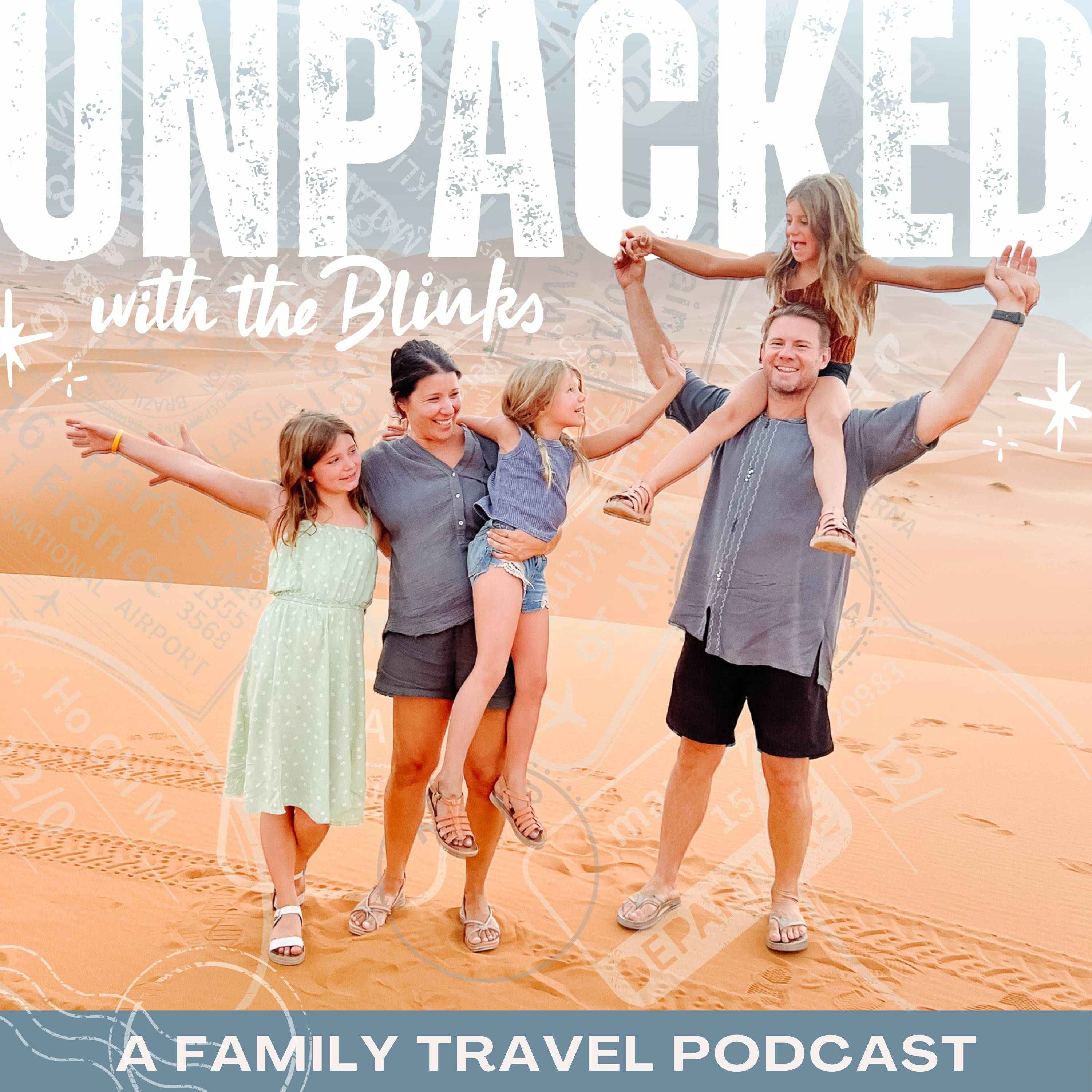
02. How we afford to travel to over 20 destinations in a year with our 3 kids
41m 48s
In this episode of *Unpacked with the Blinks*, the family tackles their most common question: how they afford to travel extensively with three kids. They clarify that they are not wealthy but are "travel rich," prioritizing experiences over material possessions. Their approach involves three steps: planning a budget, executing it, and finding creative ways to save or earn money. They started small, saving $50 a month and paying off minor debts to free up funds. Automating savings and making lifestyle sacrifices, like keeping a decade-old couch, helped them redirect money toward trips. They also discuss gifting experiences for Christmas, such as a Hawaii trip with themed small gifts as hints, to align spending with their travel goals. The family emphasizes that this lifestyle requires consistent prioritization and sacrifice, but it brings them joy. They encourage listeners to define their own priorities and start with baby steps, noting that their journey took 15 years to reach their current travel frequency.
[MUSIC] Life is an adventure and now we're taking you along for the right. We're the Blinks family and you've probably seen our travels on Instagram or TikTok. After traveling to over 30 different countries with our three kids, we've learned a thing or two about how to see the world without losing our sanity. Welcome to Unpacked with the Blinks, a podcast where we'll unpack what you didn't see on social by sharing an in-depth look at what it's really like to travel as a family. From finances to flight hacking, sightseeing to sleep habits and everything in between, we haven't been everywhere, but it's on our list. [MUSIC] Welcome to episode two of Unpacked with the Blinks. We are so excited for this episode today and we're just so excited that you're here hanging out with us for our second episode. Thanks for coming. So today, this is a big one. We kind of give you a teaser at episode one about what we're going to be talking about because this is answering a question that we get all the time. Probably our most asked question on social media. And so what better way than to spend a whole hour answering that question for you? And that is how we afford to travel this way. >> That's true. I thought it was going to be something a little more off the wall. Are we going to have more kids or do you have more than one car, those type of things? But no, it is always how do you afford to travel? And I used to ask this question all the time when we first got started, how are we going to do this? Like do I have to quit my job? Do we have to take out a big loan? Like how are we going to do this? So yeah, it's a big question. >> Yeah, and I think people who don't know us in real life and who are just looking at our page on social media, they might look at us and think, hey, this family is just super rich. That's how you're able to do this. And we just want to kind of pull back the curtain a little bit and let you in on what we actually do because spoiler, we are not rich. You know, we're pretty blessed. We feel like we're really lucky that we have this privilege that we're able to do this. But at the same time, we're not rich. And so we want to show you exactly- >> We're travel rich. >> Yeah, I- >> Some people are house rich, some people are car rich, some people are really rich. >> Yeah. >> We're travel rich. >> That's right. Let's redefine what it means to be rich. >> Yeah. >> Because we are rich, okay? Let's just break that down right now and just instead of saying, hey, we're not rich, we are rich. >> We are. >> We are rich full of experiences and all of these amazing adventures that we've been on in the last couple of years. And so pretty much, if you're watching our social media and you're looking at us you're seeing that we're taking anywhere from 20, 25 different trips a year, you're probably thinking to yourself, how does this family do that? Right? That's the big question. Not only is how we afford to travel, but how do we afford to travel as much as we do? I think that's the bigger question here that a lot of people want to know. So Scott, do you want to kind of like get into the basic gist of how we are able to execute? >> Yeah, sure. >> So any trips? >> Yeah, without getting too deep into our personal expenses and things like that, basically breaking it down into three different parts. Let's say, three different segments. Creating a plan, that's something that I've been pretty good at in my life is always having like a plan for like a budget, right? Planning for rainy days, saving for this, saving for that. That all comes into play with creating the plan. So having a plan, whether it's good, bad, fits for your family, just having one that you can stick to kind of a play by play, I think is very important. So that's the first that we'll kind of go through. Second is executing that budget, so kind of making that plan come to life. So whether your budget is $50 a month, $50,000 a year, whatever it may be, taking that budget, dissecting it, and making sure that you can use that budget to optimize your travel dreams. So whether it's one or two trips a year, whether it's one or two trips a quarter, in our case, whether it's 25 trips in that year, whatever it is, just making sure that you execute on your budget. Keep it in mind, keep it in front of you, and we'll show you some ways to do that. Some tools to kind of help out. And then the last is just how can you make money or save money in unique ways? Right. So whether it's a game for the family on how to save the swear jar or whatever it is that you collect collect some savings, or in our case, how to use your business model or things to your advantage on how to make money to stretch your budget a little bit more. Yeah, and I think that's when I've listened to podcasts or I've read articles or I've seen social media content about executing a budget. They talk a lot about the plan and they talk a lot about the budget, but everyone forgets to realize that you actually need money. Like, money doesn't just appear out of nowhere. And so I think you would be doing it to service if we didn't talk about the money element. Because obviously we're able to do this because you know, you can have the best budget, but there is no budget for zero dollars. So you need to have money. So we've been really lucky that we found unique ways to make money. And so we're not only going to talk about the way we make money, which I think is a big question, but also ways you can think outside of the box for your own family and make money so that you can fulfill these dreams of wanting to travel more with your kids, right? That's right. So I talked about the planning and kind of saving. And I remember we sort of started slow. Yeah. When we first started traveling, you know, our budget was much less. And I think we were saving 50 dollars a month, something like that. Yeah, whatever you can. Yeah. And we actually set that aside. So sometimes, and this is this is kind of my methodology, um, change it, um, make it your own. But I always paid myself first. So like whenever whenever I got to paycheck, um, I would have an automatic draft come out of my checking on the same day and go into savings. And that could be regular savings account, your travel savings account, whatever way you want to do that. If if you're taking that money right away and it's going right into that account, you technically aren't really seeing it. So it feels like you're getting 50 less dollars or whatever the case, but it's really just going into to that account. So that's a that's a way that I've always felt was sort of easy to put away some some extra money because then you don't even think about it. You're not feeling the loss of the money when that's going out first, right going in first. And so I think another part of it, too, um, that we have to kind of discuss because this was a big part of our plan in the beginning was paying off as much debt as we possibly could because in the beginning, we couldn't save a whole lot. We didn't we weren't making a lot. I think that transition from two incomes to one income when our oldest was born was challenging and we were trying to navigate what that was going to look like for us. And we, you know, one of the big things that we did was really focusing a lot of that extra, the little bit of disposable income that we had into paying off as much debt as we had because the logic there was that if we had less debt, less monthly obligations, then we could allocate even more into our travel fund, right? That's right. So just focusing on looking at the debts that you have and trying to pay those down as much as you can. And by no means are we financial experts? So please take all of these tips with a grain of salt. These are just what worked for us in the beginning. And if you missed our last podcast, you might not know our whole story. So I would encourage you to go back and listen to that because in there, we'll kind of talk about our journey and how it took us essentially 15 years, almost to get to the place we are now. So you have to remember this is baby steps, start little by little, even though it might not seem like it's moving very, very quickly. We're talking about this is years in the making of us paying little by little, paying down our debt, putting $20 here in a travel fund, $50 sometimes in a travel fund. So I think just keeping that perspective of this doesn't happen overnight. Yeah. And just to go back to the paying off the debt, doesn't have to be big debt. We're not talking about paying off like your entire student loan or the first car or whatever, things like that. We're talking about small stuff. So maybe you have an American Eagle credit card, right? Maybe that's like $5,000. But that's an easy one to tackle first. And a lot of financial analysts or whatever will tell you to do that first, right? You pay off the small ones or the high interest rates first or whatever the case. So yeah, if we did that, if we were paying $50 a month to, you know, said credit card and you do pay that off, then you do have that $50 a month that you used to paying that you just again automatically send the savings and then you've got an additional then now you're up to $100 a month and so on and so on. So that's the methodology in the planning and saving side. Some of that comes along with lifestyle changes. So not not only are we going to put away what we can save slow start, you know, knocking off the small debt, but just just making those small changes as far as, you know, spending on Starbucks or, right, you know, not going to an expensive salon for your haircut, you know, having them having
a friend that does hair come into the house. We did that many a times. I'm sure there's some other examples. Yeah, I think it's just a mindset shift. As someone who loves to shop and loves to spend and is constantly tempted by TikToks that I watch or Instagrams, that I'm seeing all these things that I want. I think it's especially hard now as we have the holidays coming up. It's just constantly reminding yourself your priorities. Our priorities are to take trips with our kids. When I feel tempted, I see this really cute outfit that could be 200 bucks. I just remind myself, "Do I want this outfit? Do I want the joy this outfit would bring me?" There's nothing wrong with that. If that brings you joy, we're all for allocating funds to things that bring you joy. We're not saying to not spend any money at all on anything. We're definitely not in that boat. But to remind yourself, "Okay, what's my priority?" If your priority is to travel more, these are the tips that we use. Really reminding yourself in those moments when you're in the aisles of Target and you're seeing all of these beautiful things that you want to decorate your home or for the holidays that would might be just to say, "Okay, what do I need and what's really going to keep me away from my ultimate goal, which is to travel more?" We still have the same IKEA couch. We do that. We drug into this home. Eight, nine years ago when we moved in and it's white. I don't know how that thing's still going. But every time we go to look at buying a new couch, it's so hard because we constantly say, "Oh, this is like a round trip light for the five of us to Europe." That's right. We'll make do. We'll wash the cushions. We've got to back up like an exchangeable cover. Cover, yeah. We've got two of those. It's not the prettiest couch. It serves its purpose. Right now what brings us the most joy is our trips. That's where we prioritize. But I think it's also important just listening to this whole thing and us talk about it to remind yourself that there's no right or wrong. So if you're in a season of decorating your house, that's great. I'm so happy for you. If that brings you joy, that is amazing. But the only thing is you can't look at us and think, wow, look at all that they have because what we have comes with a lot of sacrifice. Right. Yeah, it's sacrificing one thing or the other. That's right. We're choosing to sacrifice sort of the, I don't know, like you said, the lifestyle on the off-season. That's right. For the travel season. That's right. And I think social media can be really beautiful because it's going to be inspiring. But you just have to remind yourself that not everybody has everything like the people that have this perfectly decorated house. You know, they're probably not taking 20 trips a year and the people who are traveling all the time probably have 10-year-old has a 10-year-old like the account and hasn't really done any major things to their house in the 10 years they've been living there. So like everyone prioritizes what brings them joy. And I think when we're looking at social media, which is a need to remind ourselves of that, that we're looking at each individual person's highlight reel and where someone else's strength might not be a strength for someone else. And so what we're hoping here in sharing and giving you an insight into what we prioritize and what we do to budget is that we can inspire you if that is the path that brings you the most joy. Yeah. So that's part one of how do we afford to travel. So, you know, if you want to accomplish 20 plus trips a year, you have to have, you know, you have to have those times. Christmas included, which is coming up right now. Yeah. Where we just, we either gift one another something about that travel trip. Yeah. I don't think we're going to devil jet today, are we? Yeah, we can talk about that. Yeah, just some. What our plan is for this year? Yeah, well, you know, we're constantly brainstorming. We're constantly, I think that's a big thing to talk about too, is that what we enjoy to do on our free time is talking about traveling. So even when we're not traveling, we're talking about traveling, we're planning for travels, it is constantly consuming. And I think it just, it just shows that it brings us that much joy. So I was talking with Scott in the car the other day and we were talking about this idea for Christmas because Christmas is an important holiday to us and we definitely don't want our kids to feel like, hey, there's nothing to open under the tree, but we still want to align with our values in delegating our funds towards travel and these experience type gifts versus little things they might play with for a week and totally forget about. So I've been thinking about ways that I could implement that and one of the things that I'm really excited about is this idea of gifting each of the girls a bucket list trip. But it's the execution of how we're going to give them the bucket list trip that I think is really unique because we still want to have that special experience on Christmas morning of them opening gifts under the tree. And so what I'm planning on doing right now is kind of creating gifts that match with these particular trips. And so we haven't like worked out the details of it yet. That's why I think you're kind of hesitant to share. But the idea behind it would be, let's say for example, you know, a trip to Hawaii. So they might open a bathing suit or swim cover up or a pair of sandals. So like practical type gifts that would kind of leave clues to that final big gift, which would be the trip, which is something that we would allocate in our budget anyway. So they would still get that feeling of opening up things. And we could incorporate different toys. Maybe it might be pool toys or something they could play with on the airplane or things that would really match that theme of the trip. Maybe a floral hair clip because you know, Hawaii and the flowers. And so like all the things that would kind of lend itself and make it kind of a game starting with like the smallest gift to the biggest gift and see if they could kind of guess what that big gift would actually be in. It would be this like big surprise. So now we have to keep this podcast in the episode before Christmas. Yeah. Well, it's from our girls anyway. This will go live before Christmas from our girls anyway. But the other idea about doing it that way is that it is a lot of small things. And that's kind of what we've tended to do since we've started traveling so much is things that are able to be brought with us. Right? Number one, number two, things that are not so costly that were like, oh my gosh, we can't leave this here or we really just can't justify the spend. And then third, like you said, just having it a little bit more themed to what's upcoming rather than make it sort of Christmas themed or kind of go with something that's trendy for the season of Christmas. Right. That they could be tired of in two weeks. You know, it's like that trendy toy that they'll play with. And then they forget about it. Yeah. You know, and the thing too that I really love about this idea is that essentially this keeps the spirit of Christmas going on longer. Sure. Because they get that tangible gift that they get to open and it's kind of exciting right at the moment. We didn't want to lose that. That was something that was kind of important to us too. Because I think the ages that our kids are, I don't know if like as adults, we would kind of understand, hey, okay, we're not opening anything on Christmas morning, but it's okay because in the long run, we're going to get this big, amazing trip. But as kids, I don't know if they would fully comprehend the benefit of waiting. So you kind of get the best of both worlds, but the beautiful thing about it is that this belongs that gift of Christmas. So maybe you're not going on this trip until April, you know, in April, they're like, yay, our Christmas gift that we get to celebrate in all of the little trinkets that we got in the clothes and the things that we got we're getting to use right now. Yeah. Which is kind of fun. So you heard it first. Second, Christmas. You heard it first. This is the idea that we're putting out there in the universe. Hopefully we can exit. Keep this in the next. Yeah, we will. In the next couple weeks. And then next year, here's another little forecast next year. We're going to be saving up four Christmas as a Christmas trip instead of doing, gifting and celebrating at home. We're going to be celebrating a broad somewhere. Haven't made that choice where that is yet. But we're going to be celebrating somewhere fun with lots of Christmas markets and different cultures. Yep. We hope so. That's something that we're kind of trying to manifest right now. And that just speaks to like what's going on here behind the scenes. We're just talking about traveling all the time. We're budgeting. We're speaking about like real life things that are happening. Our finances right now. And how we can allocate our funds in a way that still fit our goals. That's right. So yeah, you know, make sure that whatever budget you put out there is right for your family is the right amount of money and right amount of time. Just so that it's right size for your family. Again, we started slow. Our budget is not that it's increased that much, but we'll share here how we've kind of supported that. And make sure you do things in advance like renew your passports, submit for visas. Make sure you're incorporating all of those costs ahead of time. That's a big part of the planning and budgeting so that you don't leave some of those unforeseen travel costs till last minute that are dealbusters, you know. Yeah, and I think to there's a I don't know if there's a right or wrong way in regards to do you set the budget first and then plan the trip or do you plan the trip first and then set the budget. I think that if you're just constantly thinking with the mindset of this is a priority and this is where I want my money to go and you're just out.
allocating that money towards the budget and creating kind of like this little travel fund I think then from there is when you really want to implement Hey, this is the kind of trip that we can afford based on what we can budget at this time and for us If we talked about in episode one those were small things But that's what we could afford and that's what we could allocate for so sometimes we were Saving for a particular trip like our big our first big Europe trip We were saving for two years to because we wanted we really had our hearts set on having enough money for that particular trip But sometimes it's just Constantly saving not sure what that's gonna look like and what you're saving for but allocating that money towards your travel fund So that you will have the funds when the good deal presents itself. So I think that kind of Takes us into the next part which is executing that's right this this budget that you've created So you have this money you saved you paid down your debt now what now what searching for deals in fact We just put a new post out. It's all about Christmas deals How how you look for Christmas deals how you consider you know where to go? What are some of the the family friendly and budget friendly Locations to to kind of consider so this this comes right along with that research We spend a lot of time researching comparing different destinations Looking at pricing looking at how how we're gonna get there right? Yeah, is it by are we gonna do a cruise? Is it by boat are we gonna you know or is there are there flights? Are we gonna do round trip? Are we going to a different place? You know multiple destinations in one trip all of those things are considered in in our planning What fits in the budget whether it's you know the one destination by itself this year or you know how we want to do it Yeah, and I think there's a couple things to look for because everyone says like research make sure you're doing your research But we wanted to definitely give some tangible ways that you can research to find the best value for your money That this harder money that you've spent all this time budgeting for so like how are you gonna use it? To get the most bang for your buck and I think a couple of things that come to mind right off hand are Being flexible with your travel dates. So we all know that if you're traveling during school holidays That is the peak travel season. So if you have flexibility there That's going to help you find the best value Also looking at what destinations are popular in those months So if you're looking to go to Disney World during summer break school break you're gonna spend a pretty penny Not to say that that's not something you should do if that's really the only time And that's what you've budgeted for definitely go for it But if you want to make the most of your funds you want to be flexible with your travel dates and really looking at Different destinations and different dates So the one of the ways that we do that is we utilize Google flights and we will start to look at the map and just show Let's say you're up for example and then we'll say within the next six months And we'll just kind of look starting there and see what the map shows us and it'll show us hey You could get to London for $200 round trip if you travel on these dates And that's where we start can we travel on those dates? Maybe it's not reasonable so let me look at the next deal and then we can see okay We could go to Italy for $500 round trip. Okay, that's a little bit more, you know So that's kind of we going we're constantly going back and forth trying to figure out okay What works? Where's the deals? What dates do we want to travel and trying to be as flexible as we can to find those Really inexpensive flights because honestly and we work on some budgets here that we're going to share with you about some of our past trips The flights eat up a big majority of your budget, especially if you're looking to go international Yeah, especially times five right yeah, so I mean, you know, there's a lot of times where you see a round trip flights to Europe right now for three four hundred dollars, which is crazy It's it's it's more than I'm gonna excuse me less than than round trip here in the states to some places right but still times five It's still it's still a big, you know, factor in your in your budgeting So that's something that we spend a little bit more time on and we probably book most in advance is our flights Because when you get that piece it's it's really helpful So setting reminders or not reminders but more like you know flight alerts Using like sky scanner We google Make sure there's a few others that we that we typically use you know like scouts cheap flights, which is now going And so on so if if you go in there and you're you've got multiple destinations in mind and you've got a few A few places that you're considering and you go ahead and put those alerts on As you get that you know the influx of uh of the deals you can kind of compare and say hey listen up You know we've got this ahead of us. We weren't really considering this. This was kind of number three But the flight deal is almost too good to pass up That might make your consideration for the cheers travel and maybe put the other destinations a little further down the line Yeah, and you'll notice the trend that you're finding the best flight deals for specific destinations When those regions are an off-peak travel season So if you're going not in the height of summer Let's say you want to visit italy or grease if you're looking more in the fall You're going to find a better flight deal because those airlines don't have as much demand for people wanting to go to Greece in the fall Versus going to Greece in the summer So just keep that in mind as well like easy google google search for a destination you want to visit And just put in there What is the peak travel times for this destination and what is off-peak and then just start narrowing it down to those off-peak dates To really help you figure out those flights because I really firmly believe that once you have those flights If you can get a good deal on the flights everything else can kind of fall into place Because if you're getting a good flight deal because it's off-peak travel you're also going to get a good hotel deal because it's off-peak travel So just keep that all in mind right now are there advantages of traveling to a destination during peak times? Sure, there's more things open probably the weather's warmer. It's nicer But it's also very crowded and I'm much more prefer to go and off-peak time when I am not shoulder to shoulder with people In the streets of Italy. So there's a pros and cons but yeah, that's how we that's how we ended up in Iceland this year It is right so we've always wanted to go to Iceland most of the time we consider going to Iceland are the the peak times right Either when we have more time available when the kids have more time available or When it's more desirable for temperatures. Yeah, we took a leap of faith and went in April March March March April let's say Which is pretty cold and it was phenomenal. Yeah, maybe we shouldn't share this on the puggies We want to go back during that time, but yeah, but it was it was very doable The the temperature was very doable. Yeah, we we were able to hike we were able to do things outdoor and enjoy ourselves But the crowds were super low. Oh wow. I thought shocked me actually. Yeah driving down the street And not seeing any other cars like I I I'm still speechless about it because I was just in shock. It's such a beautiful destination It was a bucket list trip of ours And I think we were just always looking Like we had it in the back of our mind. We had the deal alerts like you said earlier And we just saw a flight deal that we just couldn't pass up We just couldn't pass up and then we everything else fell into place and we put it together pretty last minute Which we did say in the beginning planning advance, but also be open if your schedule allows if your work Would allow for pto or your kids school that sometimes you can find those last minute deals They come into your inbox and they're like next month you can fly For $300 a person. Yeah, and that's that's kind of what's what's nice about the um put in the flight piece ahead of the rest Yeah, if you do find a great deal on flights. It's mostly because Travel is down to that area at that certain time So one of the things that's probably not a shock to anybody about how we save money when we're traveling is by packing light like we're just going to Continue to say this even though people are probably sick and tired of hearing it Because it is true. It's such a big part of how we travel and How we're able to save so much money when we travel and so What that really includes is saving on baggage fees Traveling with carry on Okay, a lot of people might be mad about this this might be a little controversial, but Spending that happens before you go on a trip I'm down on that a lot. Hey, I've come a big way a long way. I've come a long way. You have good news as you can only fit so much in in the back pack So yeah, you've come a long way. Yeah, that's right, but you know what I mean like I just an excess. There's like over consumerism about having a whole entire new wardrobe to go on a trip Hey, if that's you and that's what you love that's great But if you're looking to do to travel more and to fit in even more travel into your budget That's really where you have to try to cut as much cost as possible, but honestly Girl math. Yeah girl math works If you do purchase a capsule wardrobe With a good brand with good clothing that lasts a long time You can kind of you know, notch that in your belt too because if it is purchased Let's say last year at the end of last year you got it for Christmas or whatever the case And you can travel with it for the majority of the following year Then that is essentially free, right? Yeah, that's the best kind of girl mask ever and the thing about a capsule wardrobe
if you do it correctly, you have all of these versatile pieces and you're mixing and matching constantly. So you're getting all of these new outfits out of it and you can add to your capsule wardrobe. The fun thing too is if you cut off the spending before the trip, then you don't feel that guilty if you find something really unique and special while you're on the trip. Yeah. You know, like that's my favorite thing to do is to find souvenirs that are like practical items that I can use. Like I try to find like a nice piece of jewelry. My ring that I wear all the time, my necklaces. Um, or I try to find like a nice piece of clothing. All right, you're not really, you're getting away from the budgeting. Okay. That's true. This is like a, this is like a, let's talk about my wardrobe. Well, here's the thing about budgeting. Okay. It doesn't mean you do not spend money and it's, it's just being smart about your money. Like we're not here to say, don't, you're not allowed to have anything that brings you joy. It's just prioritize what's important. And cut back on the things that really, you know, aren't as important. Yeah. And but the real thing to this is the packing light. It really does add up because if you, because if you just, just from the home alone, right? Yeah. From, from home to destination. Think about packing light. So when you order an Uber, right? Yeah. You have to order an Uber per the size of your family plus the size of your baggage. It's true. Okay. We would have to up the size of the Uber for additional bags. That's right. Okay. There's cost savings there. You get to the airport. There is carry on fees. There's check-in fees. There's over bag, I mean, oversized bag fees. Yep. Right? Yeah. So that, that's another savings right there. Then you get to the destination and you say, Oh, you know what? I think we're just going to take a quick weekend trip while we're here for three weeks over to another, another area of Italy or whatever. You go to a budget airline and you qualify for one carry on bag. That's it. Like personal or one person. Yeah. Yeah. That's right. One person. One personal. Yeah. So there's really no, you, you don't have that option. So it's basically, I mean, they're, I mean, they're flying with, you know, one of the budget airlines where I'm not. And so there's just a whole bunch of things to go with it. So again, if you can pack light, it's really going to stretch your, your travel budget for the year. So that's that's kind of what I'm going to say. There we go. Yep. That is the hill that we stand on. We are not deviating from the, this is our mission statement. Even though I don't know if you would ask me five years ago, this would be our mission statement. I wasn't a per packer. So if I could learn to pack light, I think anyone can learn to pack light. You know, and there we go. We'll plug a future episode because we will definitely be talking about packing and all of the packing hacks in a future episode. That's right. So you want to go over some, some other like really viable travel tips for the fur families, just to just to kind of touch on some of the things that besides packing light that we, we really do well. Yeah. So I think we, we touched on using your money wisely, right? By finding good flight deals, which eats up a big portion of your budget. So we talked about that. We talked about, you know, packing light to save you money on those baggage fees. Those like extra, in my opinion, unnecessary fees. So we have that. And then I think it's just looking at how you travel big picture before we get into like even more of the specifics. And that's really a personal preference. So this is just something speaking from our own experience that we prefer. But what we didn't realize is traveling this way ended up leading to us saving money. And that's this idea of vacationing versus traveling because those two things are not the same. And if you use those terms interchangeably, you are incorrect because they are not the same. Vacationing is essentially going to a resort, laying around by the pool, doing nothing, drinking your peanut collada, right? Like does that sound correct? Vacationing is truly stepping out of the, the scenario that you live in and doing something different that, that really fills your cup and brings you joy, but really is focused around relaxing. Work traveling is not that, right? Like the way we travel when we take these 20 trips a year, yeah, maybe two or three of them are more vacationing because they're more relaxing. But we are pushing ourselves out of our comfort zone. We are hiking every day, walking 20,000 steps a day. We are exploring sites. We are trying, trying different things that we've never tried before, which was a goal, I think a couple of years ago, was to every trip get out of our comfort zone and try something we've never done before. That's right. For Edith, it was trying some type of food she'd never tried before. She's our picky eater. Yeah. For me, it was like trying, you know, some, some type of adventure that we've never done before. Yeah, or I feel like for you, it'd be like meeting new people because you really love that. That like fills you. Yeah. So not saying one is better than the other. That's not what I'm saying at all. I'm just kind of wanting to differentiate between the two terms, was I hear it use interchangeably all the time and they're just not the same. And so you really have to look at what you want to get out of your trip, out of your time off. Do you want to be laying by the pool, which I absolutely love. So I am not speaking against, but or do you want to have this experience immersing yourself in a different culture and going to museums and walking on cobblestone streets and that sort of thing, which is two totally different experiences. And so looking at both of those things because those can directly impact your budget and how you allocate your finances. And for us, like I said, this is a kind of speaking to our own experience. What's important to us really is giving them that cultural experience, that cultural immersion. And what we found is that when we leave the resorts and we leave these kind of luxurious expensive hotels and we're kind of going off the beaten path a bit, not only we're getting these really beautiful cultural experiences, but we're saving so much money by doing it this way. Yeah, I think it and it all starts, like you said, with the mindset of here's what we're going into. We're taking a vacation, which to me already sounds expensive. Yes. Right. Because and you said you said before it's relaxing, it's different. It's something different for everybody, but vacation is basically like close your eyes, float off to wherever land and do whatever that is, you see yourself doing for for Edith, that's just literally tumbling, tumbling down the beach, floating in the water and eating copious amounts of sugar. Yeah. Right. Yeah. For Lucille. Yeah. For well, for Lucille, it's a bit different for Hazel. It's a bit different for you and I. It's a bit different. So it may not just be laying drinking peanut clota, but it, but it's doing the thing that you want to do most. And if you're doing that by five or whatever your family is, that gets expensive because you have to basically take a trip to a destination and experience those things separately, waltz together. And then that that's kind of tough to do without spending quite a bit of money. Right. When you're traveling, I think that the best thing about that is that you can kind of you kind of throw that all out the window. It's not really just about us anymore. It's about us entering someone else's world. Right. Right. So let's go to Columbia. I want to see how, how they live. I'm going to learn about the coffee plantations. I want to learn about what their typical cuisine is like. I want to listen to their music blah, blah, blah. We're going to do all of that. We're going to we're going to go into their their zone and we're going to kind of let let their culture dictate our travel experience. But it also can be very affordable because you're living like the locals, right? You're doing the things like them instead of trying to just go to a place and and just it relax into what you want. That makes sense. Yeah. That's exactly. I think you hit the nail in the head in regards to how they're so different. And I think speaking to this idea of saving money and you know, you're no longer kind of feeding your money into this big tourist attraction, right? Which is what you usually go to when you vacation. And I think they're going to take advantage of the fact that they know that you're there as a tourist and you're paying tourist prices. Yeah. Right versus like we said, going kind of off the beaten paths a little bit and you're living more of a local's lifestyle, which is going to be more affordable. Your meals are going to be more affordable. Your accommodation is going to be more affordable. And honestly, in our experience, we find that the people like just we're enjoying the company of the people better because they're not so jaded by the tourism industry as much. And they're just genuinely happy to have people come and experience their culture and learn from them. Yeah. So not only are you saving money, but you're getting this overall in my opinion, more enjoyable experience because you're getting to learn about people's culture and you're getting to go face to face with people in their everyday lives and just to see the joy in their face when you're there experiencing these really unique experiences with them. And and forming these relationships with these people, even if it's just for a short time, I think that's really special. So what we're trying to provide was was a tip, but the tip really is if you're open to keeping the vacations to a minimum and in traveling more,
It can be advantageous financially as well. Looking at the destinations, maybe that aren't the most popular, and going to maybe a lesser known destination, like if you have the stream to go to Italy, maybe you're not going to Rome. Maybe you're going to a destination that's not as popular as those big cities that you hear about in Venice, Rome, Milan. Your experience is going to be just as beautiful, even more special because it's not going to be like anyone else's experience. You're going to save money. You might discover something new. You might discover something next head jump. You never know. That's one of the tips I think that's important and for you to think about when you're in the planning stages as well, is to think about this idea of occasion. This is traveling. Okay. We've shared so much about how we're able to travel as much as we do with our kids, but believe it or not, we have so much more we want to share. You will be talking even more in depth about how we afford to travel with our kids. See you next time. Thanks for tuning in to this episode of Unpacked with the Blinks. We hope it inspired you to step out of your comfort zone and finally book that bucket list trip. If you liked what you heard, please hit that subscribe button to get notified when a new episode hits the tarmac. And be sure to leave a review wherever you listen to podcasts. If you have a suggestion of something you'd love to hear on a future episode, please send us a DM on Instagram, @withtheblinks or Mrs. Blinks. We'd love to hear from you. And don't forget, magical memories are within your grasp. See you next time.
Podcast Summary
Key Points:
The Blinks family addresses their most-asked question
They emphasize a three-part strategy
Key tactics include paying off small debts first, automating savings (e.g., $50/month), and making lifestyle sacrifices (e.g., keeping old furniture, skipping trendy purchases).
They prioritize experiences over material gifts, such as gifting bucket-list trips for Christmas with themed small items as clues.
The family redefines "rich" as being "travel rich" in experiences rather than financially wealthy.
Summary:
In this episode of *Unpacked with the Blinks*, the family tackles their most common question: how they afford to travel extensively with three kids. They clarify that they are not wealthy but are "travel rich," prioritizing experiences over material possessions. Their approach involves three steps: planning a budget, executing it, and finding creative ways to save or earn money.
They started small, saving $50 a month and paying off minor debts to free up funds. Automating savings and making lifestyle sacrifices, like keeping a decade-old couch, helped them redirect money toward trips. They also discuss gifting experiences for Christmas, such as a Hawaii trip with themed small gifts as hints, to align spending with their travel goals.
The family emphasizes that this lifestyle requires consistent prioritization and sacrifice, but it brings them joy. They encourage listeners to define their own priorities and start with baby steps, noting that their journey took 15 years to reach their current travel frequency.
FAQs
They are not wealthy but prioritize travel by saving, budgeting, and making lifestyle sacrifices. They started small, saved $50 a month, paid off debt, and redefined being 'travel rich' over being 'house rich' or 'car rich'.
Creating a plan (budgeting and saving), executing the budget (optimizing it for travel), and finding unique ways to make or save money to stretch the budget further.
They set up automatic transfers to a savings account right after each paycheck, paying themselves first. They also focused on paying off small debts to free up more money for their travel fund.
They avoid expensive purchases like new furniture, salon haircuts, or trendy items. For example, they kept a 10-year-old IKEA couch and compare costs to flights, choosing experiences over material goods.
They give practical, travel-themed gifts (like swimsuits or sandals) that hint at a future trip, along with the trip itself as the main gift. This keeps the holiday spirit alive and aligns with their travel values.
Start small with a realistic budget, pay off small debts first, and make travel a priority. It took them 15 years to reach their current lifestyle, so patience and consistent planning are key.
Chat with AI
Loading...
Pro features
Go deeper with this episode
Unlock creator-grade tools that turn any transcript into show notes and subtitle files.
 PodcastTranscript AI