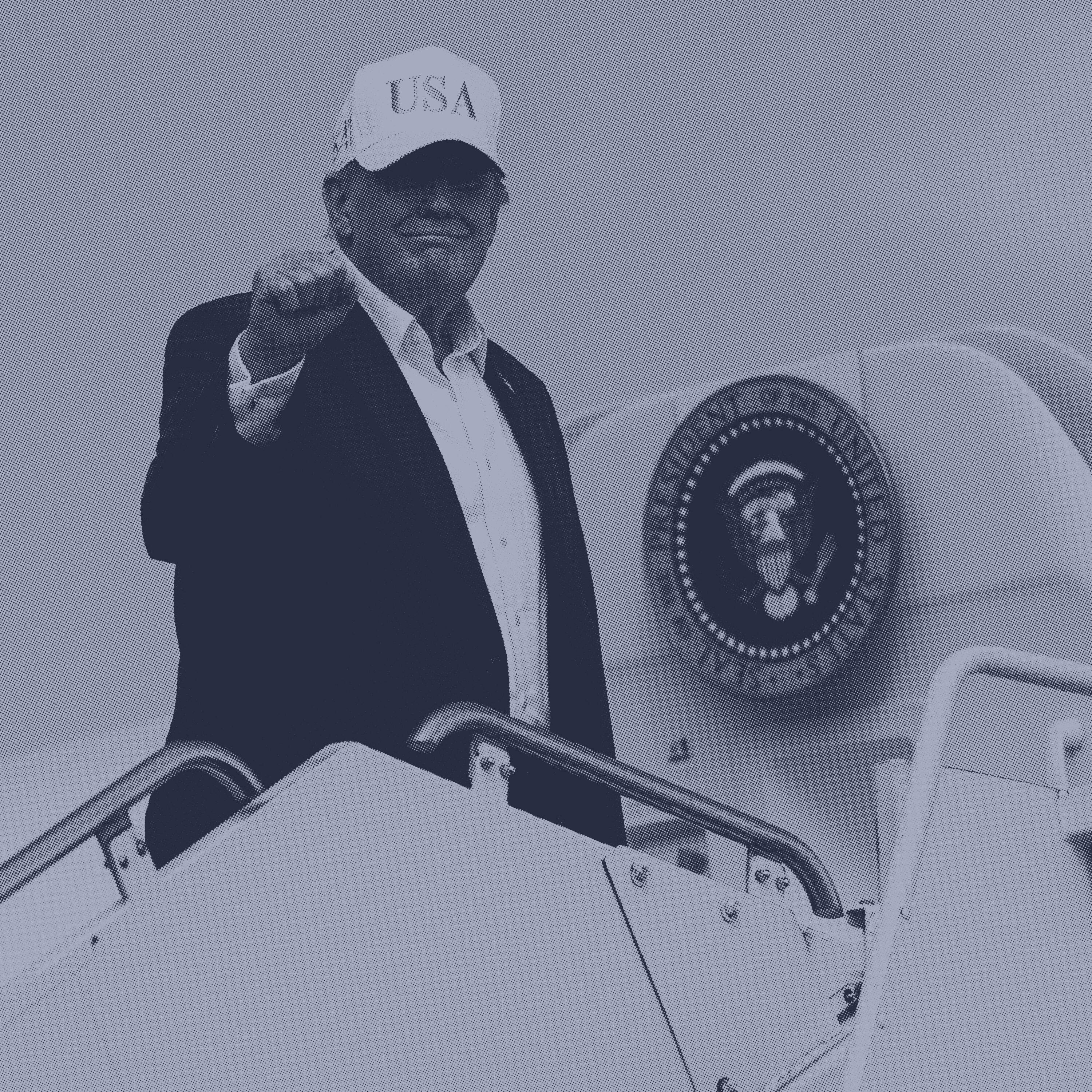
How Trump's focus on his legacy drives his decisions
from The NPR Politics Podcast
25m 29s
The podcast discusses how President Trump’s obsession with his personal legacy shapes his decision-making, particularly regarding the ongoing conflict with Iran over the Strait of Hormuz. Iran continues to make harsh demands, including war reparations, and controls access to the strait, while Trump has shifted from promising a quick agreement to downplaying negotiations, hoping economic pressure will force Iran to back down. Iran, aware of Trump’s political vulnerabilities ahead of the midterms, is dragging out the conflict to wait him out. Trump’s fear of being compared to Herbert Hoover or Jimmy Carter—presidents associated with economic and foreign policy failures—drives his urgency to avoid recession and prolonged war. Beyond Iran, Trump is actively trying to shape his legacy through physical monuments, such as renaming buildings, adding his name to institutions, and redesigning White House spaces and Air Force One, reflecting a focus on personal branding rather than policy achievements. Unlike past presidents who built legacies through legislation, Trump’s agenda is limited, relying on reversible executive actions, making his physical stamp a key strategy for lasting remembrance. The discussion highlights how Trump’s age, mortality awareness, and desire to rewrite his post-January 6th narrative influence his actions, setting him apart from other presidents who typically prioritize policy over personal monuments.
This is no secret, but President Trump is obsessed with his personal legacy. Today on the pod, we'll explore how that colors his entire decision-making, including on the War on Iran, where the President's thinking seems to have shifted again just in the past week. [Music] It is the MPR Politics Podcast. I'm Miles Parks. I cover voting. I'm Frank Oredonia as I cover the White House. And I'm Tamara Keith, Senior Political Correspondent. And Franco, let's start with the conflict with Iran. It feels like for weeks, for months now, we've been talking about being close to some sort of agreement that would reopen the straight-of-hormos, but it is still closed. And over the weekend, there was reporting that indicated that Iran's list of demands for reopening it included some pretty harsh conditions in the United States. Things like paying war reparations, for instance. Can you just get us up to speed on all this right now? Yeah, I mean, it's such a moment of flux where things are just kind of up in the air. I mean, the straight-of-hormos really has become or gotten to be the center of this conflict. Iran continues to make more demands about controlling the straight. The White House has basically made a red line that it cannot control a straight that it needs to continue to be an international waterway open to all cargo traffic. But that's been kind of the crux of this challenge right now. That's what blew up the MOU that was signed in June to kind of have a cease fire. Iran wanted control the straight. And the US said no. Remember that Trump was saying all week that we're going to have a agreement to clear the straight-of-hormos very soon. He said at multiple times at the beginning of last week that obviously has fallen apart. And now he's talking about some kind of low-keying of discussions. He talked to Axios on Sunday. He gave a brief interview where he said they're looking at the economy and waiting for Iran to kind of back down saying that they're having so much inflation that he thinks basically economic efforts are going to do with the military has not so far. Yeah, and he's talking about Iran's economy. The president was saying, oh yeah, we're going to just low-key this for, you know, no more of this hyper focus on negotiations. We can just let this go on. Then just moments ago he posted on truth social again. Well, if the Iranians want reparations, we need reparations for all of the people that have been killed by Iran over all the many years of the Iranian regime. It was interesting to me though. The reporting about the potential agreement that was being drafted between Oman and Iran would potentially end up with Iran having more control over the straight-of-hormos than they had pre-war, which to me as somebody who hosts this podcast and every week, I feel like we talk about how President Trump wants to, you know, claim wins every chance he gets. That feels like if that is the case, that could be a tough thing for Trump to sell, no? Oh, absolutely. I mean, I've been talking with Republican strategists and Iranian experts who are very concerned that essentially the US and President Trump is going to have to accept something that is below the status quo in order to end this war. I mean, just like I was saying earlier, the straight is what this conflict is about. Every single demand that Iran makes is about control of the straight. And this again is a red line for the Trump administration. But Iran is not backing down. I mean, Trump has thrown almost every single thing militarily at Iran trying to get them to cave to his demands, and they have not entirely cave to their demands. And they continue to threaten ships that go across. And despite what the President says about the US controlling the straight, Iran continues to essentially determine whether most ships can go through and continues to make these maximalist demands. I mean, it does feel like Iran, Franco, understands the straight of Hormuz as their biggest piece of leverage. Tell me a little bit more about how President Trump is thinking about that. And also just how he's thinking about this entire war more broadly now. Basically six months into this thing. Yeah, I mean, this has just become such a political battle for the President. You know, he is trying to get out of this as soon as possible, trying to move on. We have the midterms around the corner. American families are feeling so much pressure on their pocket books because of the war, because of the straight of Hormuz. Gas prices continue to surge, energy prices all around are surging. That means grocery prices are also high. Any type of shopping is pretty high. There is so much pressure on the President to kind of do something to take action to kind of relieve some of this pressure ahead of the midterms, which will have dramatic impacts on the rest of his administration going forward. And frankly, Iran knows all this and they're taking as much advantage of they can of that kind of trying to stretch this out, kind of push this further and further into the midterms. I mean, our colleague Hadil Shalchi spoke about this earlier today about how the Iranians are here to be taking advantage of those political pressures by trying to drag this out. I was just looking reading up on an Iranian parliamentarian advisor who was saying that there is no way that Iran will agree to any deal with Trump this term knowing that they can just wait him out. Okay, and just for context, I want to hear President Trump talking a little bit about this at the G7 summit in June. And you know, I've studied presidents, some good, some bad, some great, not too many are great, and some really bad. We had warned just recently. And the one president I did not want to be was the late great Herbert Hoover. I didn't want that. Let who knows what would have happened. This is not the first time President Trump has mentioned President Hoover, Franco, right? And you had some reporting this week kind of focusing on this very specific seemingly kind of random fixation the president seems to have had. But can you tell us a little bit more about that and how that plays into all of his thinking? Yeah, President Trump has talked about Hoover quite a bit. He's, you know, he mentioned him even before he took office when there were some economic challenges that Biden was having. And Trump actually at that time said that he hoped if there was a recession that had happened then so that it wouldn't be under his watch if he was reelected because he didn't want to be associated with Hoover. I mean, this goes way back. This is definitely something that Trump has been afraid of for so long. I mean, Hoover who is just so well known of being kind of the epitome of the challenges of the economy. And this is something that Trump has, you know, kind of talked about quite a bit because he's clearly thinking about his legacies, thinking about what makes a good president, but also about what's going to be written about the history books. I mean, what do you make of this, Tim? It's worth noting also I want to jump in here for our younger listeners who maybe don't remember, Herbert Hoover, don't remember history class, Herbert Hoover, president 1929 to 1933 early in the Great Depression is kind of the politician who is most attached to the America sinking into the Depression, right? Yeah. And you don't want to be that president. She's obvious, but yeah, I mean, makes sense. Yeah. And I think President Trump is, he's, he's very fixated on Hoover. He's also fixated on another president who I would argue has even more parallels, which is Jimmy Carter. President Carter ended up caught up with Iran. There was the Iran hostage crisis. It really just dragged down his one term presidency. There were energy shocks, there were all of these issues, some of which were having like minor versions of already. And Carter could not recover from that. It really dragged down his presidency. And President Trump, on more than one occasion, has also mentioned President Jimmy Carter as being like a terrible example of a president you wouldn't want to be like him often in reference to his Venezuela mission where he was like, yeah, that could have gone bad. And then we would have had a Jimmy Carter situation. But instead it was perfect. And, and you know, I think that President Trump's view that the mission in Venezuela was a success really paved the way for the next thing to come along, which was the war with Iran. And that obviously has not been a quick success. You know, President Trump and others are so scared of any type of association with Hoover. Like you said, Miles, because of his association with the Great Depression. It was a time when the stock market crashed in just a few months after Hoover had taken office. And he was widely considered of not doing enough to take action. He basically kind of stuck to his Republican principles at the government shouldn't meddle in the economy. And that decision is something that many political observers see as one of the worst political mistakes of the 20th century. Trump is not the first president to mention Hoover, first Republican president, right? I mean, George W. Bush, I think mentioned when he was thinking about how to respond to the financial crisis and the 2000s. But I'm wondering how real the fear is, I guess, that 20 years, 30 years down the road, we are thinking of President Trump in the same way we think about Herbert Hoover. Yeah.
I mean, look, I mean, I think the risks of a recession are real. And they certainly are higher today than they were prior to the war, and they get higher the longer that inflation persists. When I talk to economists, they note that inflation has persisted for five years. And if it continues that way, those risks just get higher and higher. I will note that they also tell me that the conditions are very different, that this is not Hoover's economy. You know, there's not so much weight put on the stock market. There's a lot more diversity in economic resources and investments. The US government learned a lot in the, you know, the proceeding or the next decades after it. I mean, there's a lot more protections. There's a lot more regulations. There are just so many tools that the US has right now in comparison to how they were under Hoover. But I will say this is the politics podcast and politics, you know, it doesn't necessarily change the narrative. If jobs continue to go down, if gas prices continue to go up, if grocery store prices continue to be high, and people continue to be more and more concerned, those kind of comments about Hoover, about Carter, they're likely to be a little stiguer. All right, let's take a quick break and more in just a moment. And we're back. So, Tam, I feel like this idea of President Trump's legacy really being front of mind and affecting how he's thinking about things extends beyond the war in Iran. Do you see it that way? Yes, I mean, it's interesting because earlier this year, he was asked about what he thought his legacy would be. And he said, "My legacy is going to be a peacemaker. That's going to be my legacy." And clearly at this moment, that is really hard to see through the fog. I don't know how he gets there from here. And so he has done a number of other things that I think are quite literally about cementing his legacy. And what I'm talking about here is the White House ballroom, is the Trump Kennedy Center, though his name has since been removed, is the Donald J. Trump Institute of Peace that his name was added to. It's the Donald J. Trump International Airport in Palm Beach, Florida. It is newly gilded statues around Washington, DC. It's the completely redone Rose Garden in the White House that now closely resembles his Mar-a-Lago patio. Like, he is literally trying to put a stamp, a physical Trump brand all over Washington, DC, and anywhere else he can. And frequently he talks about these building projects. Let's just say especially the ballroom. He's like, "President have needed this for 150 years, but I'm the only one who can do it." Which interestingly is the same way he talks about Iran. This has been a problem for 47 years. No other president can do it, but I am the one who's going to do it. That's how you know he's looking at his legacy. That's how you know he's trying to write his history. It's something he couldn't do after his first term. He lost. He left in some amount of shame or disrepute because of what happened on January 6th. He did not get to write his story. He ran for office, again, re-entered the White House with a single-minded focus on writing his story and making sure that he is remembered not as a loser-one-term president, but as a two-term president who is consequential. And only consequential people have their names on buildings. Yeah, I mean, it's just like such as M.O. I mean, just go back to his pre-political career. I mean, all of New York, the Trump towers, Trump golf course. I mean, there's so many things that have his name on it. It's very clear that he's looking for those kind of similar type of things that can't be torn down. That where his name will be in the history books and he's doing whatever he can to help shape how that is written. It's so interesting, though, 'cause I feel like a lot of these things are most of the things you just listed, Tam, are literal physical things, whereas when other presidents, when you think about their legacy, that's not really what you, I know I think of Ronald Reagan's legacy, for instance, I don't think about his name on the airport in the DC metropolitan area. I think about the policies and the policies that happened under him and things that happened in global history under other presidents. Yeah, I mean, first off, presidents don't typically try to get things named after themselves while they are still in office. Usually it is an honor bestowed upon them after death by someone else, but Trump is leaving nothing to chance. But I think there's something more important here that you're talking about, which is that he does not have an ambitious legislative agenda. He has signed executive orders, presidential memoranda, but he knows full well that many of those things can easily be reversed by the next president that comes along because he literally just reversed all the things that Joe Biden did. And the only way to have things locked in is to have them written into law. And the only way to do that is by working with Congress, but President Trump's agenda for Congress is really limited. And I think this is actually a problem for Republicans in the midterms, is that other than talking about passing the Save America Act, and obviously they had that one big beautiful bill tax bill, like what are they campaigning on saying they're gonna do for the next two years, other than protecting President Trump from investigations? - Right, or like the Save America Act, I think is a good example of that too, where it's like the thing that President Trump keeps bringing up over and over and over again, but is that a thing that you can really get voters excited about about a thing that's going to impact their day to day life? - Voting. - Not a sexy thing, not a thing that voters are like thinking about front of mind, right? - Well, it's not only that it's not sexy necessarily, but it's also he's hitting a brick wall over and over and over again, every time he tries to get Congress, or also often when he's trying to get Congress to do things like the Save Act. He is running against the challenges of getting legislation through. It's just so hard to work with Congress period, but Trump is finding it even harder because some of the extreme legislative efforts that he's going or trying to make. So I think what Tams talking about, all the buildings, all, you know, Iran, you know, these are ways where he can kind of, you know, have a little bit more control, especially when it comes to the buildings, when it comes to the reflecting pool, the, you know, the monuments, you know, these are things where he can put his stamp on history, potentially. - He's putting in a hella pad with the presidential seal. He has glued little presidential seals on the doors around the West Wing. He really is trying to make it his own. - Yeah, I flew with the president this weekend to New Jersey and he's, you know, not only does he have the new, you know, Katari plane that's been repainted and, you know, darker shades of red and blue, he's also repainted at least some of the original Air Force ones in those colors. I'm very curious what a Democratic president changed back the color schemes of the planes. I feel like the paint job on the plane probably could be done. I do think that this is not only president Trump trying to put his stamp, his, make his legacy permanent. He is also trying at least on some level to erase other presidents. The Kennedy paint job on those planes is iconic. Trump is replacing it with the Trump color scheme. It happens to be red, white and blue, but it is Trump's version of red, white and blue. - Yeah, it's very close to his campaign plane. - I mean, big picture, I want to unpack a little bit more of this concept of president Trump thinking about his legacy because it does feel like every decision he makes. I mean, we just spent so much time talking about Iran and him mentioning Herbert Hoover and like the way he thinks about himself in relation to other presidents. But I also am like, don't all politicians think about legacy to a certain extent, especially ones who are getting up there in age? I guess I'm just trying to draw some level of distinction or play devil's advocate to the thing that I feel like gets brought up all the time, which is that president Trump is so obsessed with his legacy. I just assume aren't all presidents to some extent, even if they're not as open about it, aren't all presidents to some extent obsessed with their legacies? - Absolutely, Miles. I mean, there's a certain type of person that, you know, that runs for president that takes office. There's a bit of narcissism, I think, in all presidents. I think you kind of need that if you're gonna run the free world. And clearly, especially when it comes to second administrations, you see presidents kind of starting to think more about the legacy, the talk of like, what will their library look like? Where will it be? What will be in it? Those kind of things are often part of those administrations. But kind of like, just to a point that you were talking about earlier, I think what's different between Trump and other presidents is a lot of times those, the signature accomplishments are just different. What they're trying to achieve, Obama and Obamacare, what is like the equivalent of that for Trump? I mean, we're talking about buildings, a ballroom, a monument, and these are things that are strictly for, that are strictly kind of seem to be painted towards his own personal legacy. So I do think there's a different in how they're looking at it or what they consider to be kind of like their signature issues. I think with many of these other presidents.
those signature issues are more related to policy where Trump has, in many ways, these are physical, physical structures, physical monuments that he is hoping will be erected in his honor. President Trump has been targeted with multiple assassination attempts. He's also 80 years old and he is acutely aware of his mortality. He jokes about whether he's going to go to heaven or not. In your 80 years old, you have a different way of thinking about life and legacy than you do when you're 65, which is, you know, how old a lot of presidents have been when they leave office though, not recently. And so like Biden, Trump is not going to have a huge amount of time to reshape his legacy once he's out of office. Jimmy Carter had decades to reshape his legacy because he left office young and he had a whole after presidency life that changed the way people thought about him and his presidency. So did Hoover, by the way, Hoover also did a lot of things for other presidents as well and chaired all these bipartisan commissions. So I think it's a good point. And Trump isn't going to have that time. Even if he lives to be a hundred years old, he will not have as much time as Jimmy Carter had. Joe Biden similarly is not going to have that much time. I think partially that's why the Biden folks knowing that Trump was coming into office worked so hard to push out funding for their programs to try to get those programs locked in. Well, Trump came in and both through executive action and then through legislation undid a lot of that. But that was a policy focused push. And Trump really is more into aesthetics, as he likes to say. So I guess to be fair, the two things I would bring up as counterpoints to that is the big, beautiful bill tax cuts were something that I guess I, well, I'm a little unclear on how that's going to resonate long term, but that is a legislative accomplishment that did occur under his watch. And then the second thing, I guess, is just immigration. There's just a sense that the border has been closed or that there is some level of border security that did not exist prior. Are either of those things, I guess, could those fall into things that could be legacy defining for Trump? So I'm just going to devil's advocate your devil. Please do. Because I think that the one big, beautiful bill, those tax cuts, they're polling poorly. Like people don't feel that grateful at this point. And if they, if people don't feel it and love it now, then 20 years from now, they're definitely not going to remember it. And when it comes to immigration, this is another place where he's doing all of this through executive authority. Yes, a lot more money did go into ice, immigration and customs enforcement and also the border patrol. But in terms of like actually cementing changes in immigration law, those changes have not been cemented into law. Those are simply enforcement shifts. The next president could come in and say, well, actually, I think we should have TPS for people from Haiti and Venezuela and completely reverse everything that Trump just did. I mean, it's also about like just how do people feel about those things? I mean, what are, what are the emotional connection that people have to these issues? I absolutely think immigration is going to be a legacy issue for Trump. But it's obviously a very complicated one for his supporters. They love all the aggressiveness, the, the clamping down on the border. But for, for critics and even many moderates, they're very concerned about the tactics that were used and the concerns about how much enforcement people died in these enforcement actions. US citizens died in these enforcements. And just to continue kind of like the emotional connection, I think it all really, so much of those going to be what, what happens to the economy and how are people going to think about the economy under Trump? I mean, I would argue one of the main reasons that Trump was reelected is because they had a feeling the emotional connection to the economy was so much better during the first administration before COVID, obviously. I think today Trump is really struggling with that. I think his legacy is going to be really damaged unless he can get the economy turned around. All right. Well, we can leave it there for today. Before we go, I do want to give a plug for our friends over at Sources and Methods, PR's National Security Podcast. They are hosting a live show at MPR headquarters in Washington, DC on Wednesday, September 9. I know a lot of our listeners attended our live show at MPR last year. It was a blast. You guys should definitely attend theirs as well. Host Mary Louise Kelly and former top intelligence officials will discuss the 25th anniversary of 9/11 and why that day is still shaping global events should be fascinating. Let's go on sale tomorrow, Tuesday, August 11 at mpr.org/sourcesliveshow. All one word. MPR.org/sourcesliveshow. You'll find that link in our episode notes. I'm Miles Parks. I cover voting. I'm Frank Rodonia as I cover the White House. And I'm Tamara Keith. I cover politics. And thank you for listening to the MPR Politics Podcast.
Podcast Summary
Key Points:
President Trump is highly focused on his personal legacy, which influences his decisions on the Iran conflict and domestic actions.
The Strait of Hormuz remains closed, with Iran making maximalist demands (e.g., war reparations) and the US refusing to cede control; a June ceasefire agreement collapsed over this issue.
Trump has shifted tactics, downplaying negotiations and relying on economic pressure on Iran, while Iran exploits US political pressures ahead of the midterms.
Trump frequently references Herbert Hoover and Jimmy Carter as cautionary examples, fearing economic crises and foreign policy failures could define his presidency.
Trump is actively cementing his legacy through physical symbols—renaming buildings, repainting Air Force One, and adding his name to landmarks—unlike typical policy-focused presidential legacies.
Trump lacks a broad legislative agenda, relying on executive orders that can be reversed, and faces challenges with Congress, limiting his lasting policy impact.
Summary:
The podcast discusses how President Trump’s obsession with his personal legacy shapes his decision-making, particularly regarding the ongoing conflict with Iran over the Strait of Hormuz. Iran continues to make harsh demands, including war reparations, and controls access to the strait, while Trump has shifted from promising a quick agreement to downplaying negotiations, hoping economic pressure will force Iran to back down. Iran, aware of Trump’s political vulnerabilities ahead of the midterms, is dragging out the conflict to wait him out.
Trump’s fear of being compared to Herbert Hoover or Jimmy Carter—presidents associated with economic and foreign policy failures—drives his urgency to avoid recession and prolonged war. Beyond Iran, Trump is actively trying to shape his legacy through physical monuments, such as renaming buildings, adding his name to institutions, and redesigning White House spaces and Air Force One, reflecting a focus on personal branding rather than policy achievements. Unlike past presidents who built legacies through legislation, Trump’s agenda is limited, relying on reversible executive actions, making his physical stamp a key strategy for lasting remembrance.
The discussion highlights how Trump’s age, mortality awareness, and desire to rewrite his post-January 6th narrative influence his actions, setting him apart from other presidents who typically prioritize policy over personal monuments.
FAQs
The Strait of Hormuz remains closed, with Iran making demands like war reparations and control over the strait. The US has rejected these, leading to a breakdown in the June ceasefire agreement.
Trump mentions Hoover due to fears of being associated with an economic depression, as Hoover was during the Great Depression. He wants to avoid a similar legacy, especially with current inflation and economic pressures.
Trump's focus on legacy drives him to seek a quick resolution to avoid being compared to presidents like Hoover or Carter, who faced economic or hostage crises. This pressure influences his strategy, including trying to wait out Iran's economy.
Trump has renamed buildings, added his name to institutions like the Kennedy Center and an airport, and redesigned spaces like the White House Rose Garden. He's also repainted Air Force One in his preferred colors.
Unlike many presidents who focus on policy achievements, Trump emphasizes physical monuments and buildings with his name. He's also more direct about legacy, actively trying to shape his historical narrative while in office.
The midterms pressure Trump to resolve the war quickly to ease economic burdens like high gas and grocery prices, which affect voters. Iran is aware of this and may be delaying negotiations to influence the election outcomes.
Chat with AI
Loading...
Pro features
Go deeper with this episode
Unlock creator-grade tools that turn any transcript into show notes and subtitle files.
 PodcastTranscript AI