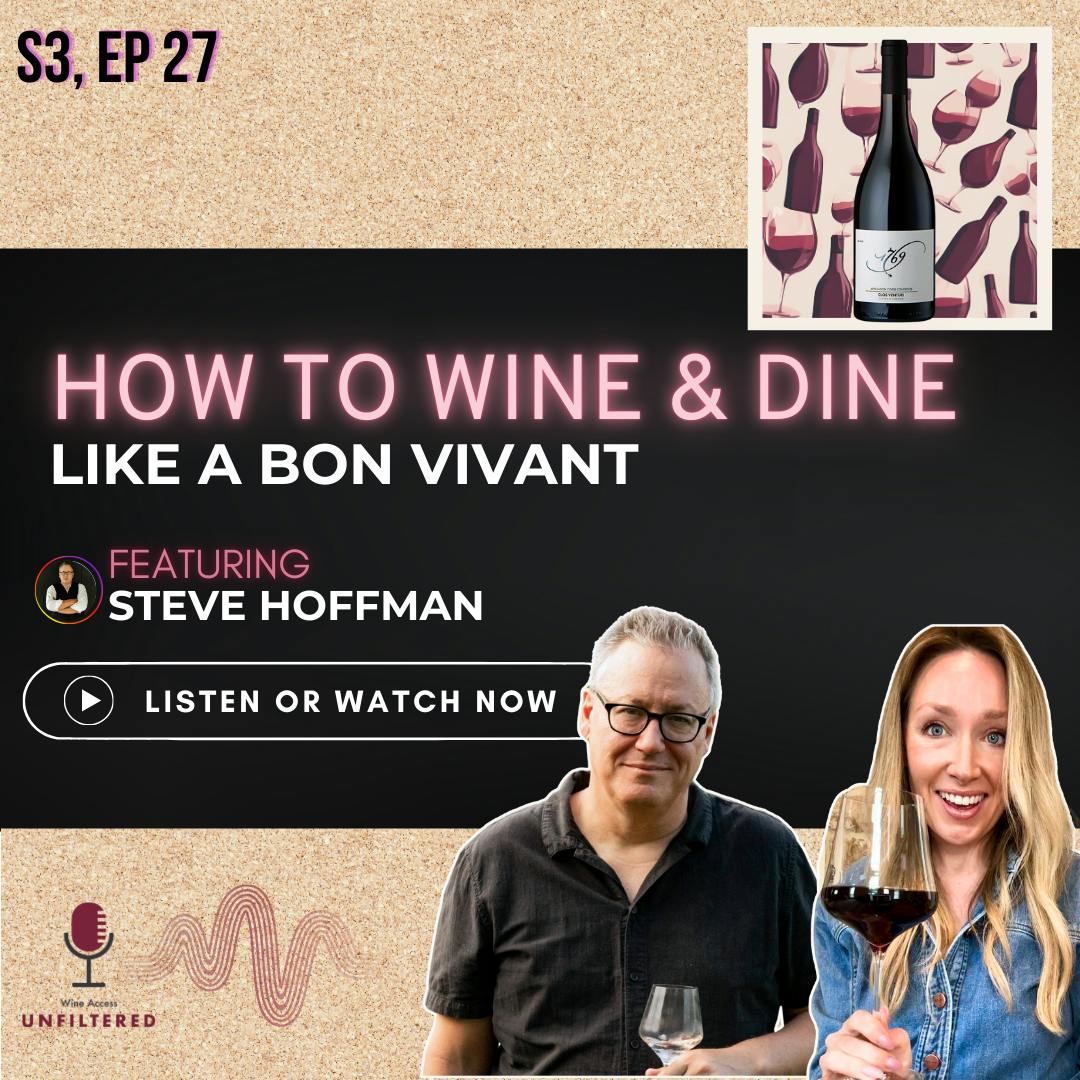
How to Wine and Dine like a Bon Vivant featuring Steve Hoffman
55m 20s
In this episode of the Wine Access on Filtered Podcast, host Vivond (a sommelier and bon vivant) discusses the joy of wine as part of life, not just as a subject of technical analysis. Guest Steve Hoffman, author of "A Season for That," shares his family’s six-month move from Minnesota to a village in the South of France. Initially struggling to integrate, Hoffman found his entry point through wine—joining a grape-picking crew during harvest and eventually befriending local winemakers. A pivotal moment was cooking coq au vin with an eight-year-old Burgundy wine, which united his family and taught them the French rhythm of life: prioritizing meals, wine, and community over productivity. Hoffman emphasizes that wine in rural France is humble and agricultural, woven into daily routines like farming and family dinners, unlike the sometimes pretentious connoisseur culture. He advises that anyone can enjoy wine more by finding trusted relationships—with local wine shop owners or winemakers—and forming emotional connections to specific bottles. The episode also features a Corsican wine (Cliven Sherry 2022) as an example of a Mediterranean wine with vibrant fruit and spice, highlighting how location and terroir matter. Ultimately, Hoffman argues that most wine drinkers are like those in wine regions: they enjoy what they love for personal reasons, not for status or expertise.
[MUSIC] Well, hello and welcome to the Wine Access on Filtered Podcast. Many of you may know me on Instagram as some Vivond. But what many of you might not know is why I strung those two wits together in the first place. I'm sure some of you have gathered that, of course, this is a combo of Somalia, which is my profession and Vivond. But what some of you may not also know is what a bond Vivond actually is, which is a lover of life, someone who enjoys food and wine and the pleasures of such. And it occurred to me in sort of putting this podcast together, this particular episode, that we don't really talk about that enough. We break down wine and all of its complexities. But we don't often talk about what it means to enjoy wine, how to enjoy wine and all of the pleasures that that can often bring. So I decided that as a little homage to my side of doing what I do on Instagram and the opportunity to sit down with my guest today, who documented his own journey to finding his inner bond Vivond when he upped and moved his family from Minnesota to the South of France for six months. It was just sort of the perfect combination to do this episode. So please welcome to the show writer, author and text preparer, Steve Hoffman. Thank you. And yes, my text preparation season just ended. So I'm feeling free as a bird. Yes. And I now I get to drink wine in the morning. So it couldn't be better. Congratulations on that. And yes, thank you for literally two days, three days after taxes were due on April 15. So I'm you're looking great. How much wine did you drink during that entire process? A little yes, I will. That was my reward at the end of the day was my glass or two of wine on the couch with my wife. So that's our evening routine as we sit, kind of play Futsi on our couch. And have a glass or two of wine talk over the day. So yeah, wine is even integrated into my into my weird tax season. I love that. Well, for those who haven't read or even listened to your book, because it is available in audio format. I've actually had the pleasure of reading and listening to it. I did. And you do the narration of it, which is actually really wonderful to listen to because your French pronunciations are obviously perfect. And it's actually really nice to hear them out loud and hear the intonations with that. But the book for those who are curious is called a season for that. This is lost and found in the other southern France, but you refer to the Languages. Which is actually the Languages. Which is actually the very first wine region I ever visited as a professional. Yeah. And I had as not a similar experience, but this idea of what it means to be a bone-be-von and how that culture really embraces food and wine and weaves it all together really was what kickstarted this idea of like, oh, like wine isn't just in a vacuum. And food doesn't have to just be enjoyed and dependent of other things. Like you can have this very holistic experience with with L3. But you did a very unique thing, something that I think a lot of people aspire to do, which is often moved your family. And you guys spent six months there. You spoke French fluently as you talked a lot about in the book. What was that process like? And we're in 2025 now, this I think took place in 2011. 12. Yeah. 12? Yeah. Take me back to that impetus, that start of that time. Yeah, absolutely. So, I've been a French speaker in a francophone for most of my adult life. And as a result, we put our kids into French immersion school and say Paul. So they had grown up with French as their primary language in school. And it involved a lot of driving. We were driving them across the city. And my wife and I at some point looked at each other. We'd love to travel. We both love, you know, France and Europe in general, but hadn't spent a lot of time in southern Europe. And we thought, okay, well, we're in Minnesota. It's a fall semester because of my tax preparation career. I have very intense early in the year work season where I get almost all of my work done and where I make most of the money that we make for our family for the year. So if I play my cards right, I can create some space in the second half of the year to not have to work. And that was the idea. Let's go to southern France and be warm instead of in Minnesota and be called. Let's put our kids in local schools as a way of basically cementing this French language acquisition that they've been working on for four or five years. She and I, I think, didn't think it through very much because the rest of it was, well, what do we do? What we ended up doing was in some sense, you know, fighting because I got there and really had this, I think, immature notion of what it was going to be like, which is not immature as in, you know, not emotionally immature, but more an undeveloped, underdeveloped idea of what this was going to be. We were going to get there. We spoke French, but you know, our ice spoke French, the kids spoke French. We were going to get through somehow. It was going to be beautiful. We were going to be in southern France. Of course, it would be beautiful. And I was just going to have to, all I had to do was just kind of display my pretty French for the for the local villagers and everything would fall into place. And of course, it didn't do that at all. But for the purposes of sort of this conversation and this wine, you know, that your sort of emphasis more on wine, through a lot of trials and tribulations, the sort of turning point of the book is, is I've reached this low point of feeling as if, you know, I've been asked to make our family a part of this village and I'm failing in every way that I try. And the harvest season, the bond knowledge is is just around the corner. And I finally essentially begged to be put onto a wine picking crew, a great picking crew. And that is kind of the turning point between us being viewed. Even though we were putting our kids in school, we were still very much viewed as outsiders. We were Americans. It's an 800 person village. It's like an extended family. They really didn't have any particular reason to reach out and gather us in as part of themselves. And we had to earn that. And so going out every day in the fields, working with these crews, and eventually getting invited into a winery in the village itself that was shared by two wine makers that we eventually became very, very close to and have actually afforded one of their wines into the Twin Cities area. That wine journey for lack of a better word from harvest to the end of our stay suddenly took us from being these odd, ball, outsiders who spoke French well, but who weren't making it happen to being very much on the inside, not just of the village culture, but of kind of the wine making world of that part of the country. And it was a very, very deep education, in a very, very concentrated, very short amount of time. But I left feeling very connected to wine, but wine at the production end of things. The rustic, unpretentious, agricultural, semi-industrial, and of wine making, not what happens above a glass of wine when you swirl it, but very much people with muddy boots and tractors and knowing about the vines themselves as much as knowing about the grapes that they produce that eventually turned into the wine. And that part of wine, wine and wine making just really spoke to me. I've been a nature lover and a hunter and fisherman and a kind of forager outdoors guy for much of my life, or much of my adulthood. And that also that end of wine just really spoke to me and I felt very, very hard for it. What I thought was so beautiful was just the way that wine really brought you guys together, both as a community and as a family. One of my favorite scenes or passages in the book is the the Cokovon. When you go into the shop and you know she reluctantly sells you the bottle of Cotson and the Burgundy. And you come home and it's just this really beautiful scene where the family, your family, your two kids, you know, had sort of been resisting this, you know, very provolous style of cooking. It was nothing like the idea of experiencing at home. And then suddenly this dish, you know, was on the table and everything just sort of came together both for you gastronomically. But also, you know, as a family emotionally and I thought that deep connection was just it really stuck with me in that moment. Can we go back to that a little bit and break it down? There's an initial scene in the book where Mary Jo basically says it's early in the trip. I'm not getting out of my comfort zone, you know, way that is going to end up in six months with us being a part of this place. And we both wanted to avoid this sort of shallow toe dip into this experience where we just kind of drop in, we do our thing, we leave, kind of leave no trace. And so, you know, early on Mary Jo kind of says, hey, you need to step up, you need to get out of your comfort zone. This isn't working. And if this isn't going to work and you're not going to put it in any effort to integrate our family into France, well then why are we here in France? You know, we could be anywhere else in the world. And so my initial effort to try to accomplish that was to cook my way into the region. And as you know from having read the book, there are any number of comically bad cooking stories from early on, including a completely incinerated rabbit that ends up hitting slightly torrentous. And that my daughter calls a chihuahua. So, but the kids are resisting. And so we decide, okay, let's try making a cuckoo vah. I've got a cookbook that I've been working through. It sounds fun. We don't really know what we're doing. We end up in the local larger city that we're that's just adjacent to this village that we're living in. And by sheer chance, on a Sunday, which is often impossible in France, we find that the market is open and then just next door a our wine shop is here.
open. And so we get our materials for the Cocoa Van. Eventually we get our ingredients and then we end up in the hands of this wonderful wine shop owner who just cares so deeply and she's so earnest and she wants this to be right for us. And she is, you know, terrified that she's suggesting a wine that's too expensive because she has a four-year bottle of wine to put into the Cocoa Van. Eventually she says, "Would you possibly be willing to consider this eight-year bottle of wine? We go home, we make the dish, and my daughter just sort of loses it at this dish, you know, that she just didn't imagine that French food could do this to her. And then Mary Jo and I each have our first sip of pretty good burgundy. We had tried, you know, burgundy sort of over the years, but this was good burgundy. And we're like, oh damn, what now? Now what do we do? Like this is ruined our economic lives. But it was, as you said, the first, I think, experience of really good food and beautiful wine, or at least wine that goes with the beautiful food, all coming together at a moment where we're around the table as a family. And that became, I think, what we learned about how to be a family together for the rest of the trip. You know, as much as, you know, I can appreciate that you said they take food so seriously because they do. But it's also just so intrinsic for them. You know, when I went to the South of France, it was just like, it felt so natural. Like it was like, as you said in the book, of course we're going to break for lunch. Of course, and not finish harvesting the rest of these rows. Of course we're going to sit down for dinner and have a glass of wine. Even when the rainstorms are coming, right? You know, you just simply, you do not mess with lunch, lunch happens. Right. And there's a rhythm to this. And if we miss a few rows because it rains this afternoon, that's already baked into the rhythm of life here. Right. And the other thing about it, especially, no, I think it's maybe less true in, although I'm not even sure that's true, I want to say this maybe less true in higher end sort of wine regions, right? Like a champagne or a bordeaux or a burgundy. There is a, you know, a preciousness and a, and a, that you just can't argue with how much money is involved. Yes. But even there, I think the people who live there think of wine as a part of every day. It's, they don't think of it. They don't think of themselves as a destination. And certainly in, in the long a dark, they don't think of themselves as a destination. They know they're a wine place. They know people come to drink wine here, but it's so much about why it can be so douchey. So it can be so like English major. I'm better than you. I know more than you. I have this experience. And I'm, you know, and you'll never have that. It can be really, uh, unfortunately douchey. And there is this sort of humbleness about wine in the places where it's, where it's made, where it's just a part, it's just another agricultural crop, really. And it happens to enhance all the rest of it. But it's, it's a beautiful relief to be there and not have to think about whether it's okay for me to love this wine or whether it's okay for me to serve this wine at the table. It's just integrated. It's just unspoken and assumed that that's what's going to happen. But I wonder, you know, for people who maybe don't want to go to the South of France and have that in discovery, like, is it just going to your wine shop and going to your local grocer and trying to figure that out for yourself? Like, where would you recommend someone go or do? I would say ultimately the answer, the answer that overarches everything is that it's about finding relationships. And so if that relationship is with somebody you trust at a local wine shop who will introduce you to the, the beauty and fun of trying different things and finding your way to a wine that you love that becomes a part of your, your daily routine or your life in some way, that's a great relationship. But it can also be that literally for one weekend, you went to Napa or for one weekend, you went to Sonoma or for a week, you went to New Zealand or Australia and you drank the wine there and you met the wine maker and you have an emotional connection to that wine. It's so doesn't matter whether that is supposedly a great wine or not. What it's so important that you have an emotional connection to the wine and its story. And I think you can, you can create a story that makes that connection with a wine that is from the shelf of a wine shop in your, in your city, that's still a story. There's still something you found it. You got introduced to it. It spoke to you in some, for some reason, you had heard of the grape and wanted to try it and suddenly it all blossomed in front of you when you had your first sip of that wine. And the reassuring thing, I think, for people who aren't necessarily really deep in the sauce, you know, really deep into the world of wine and you can get infinitely deep. Like there's no bottom to the deep of yet you can get into the world of wine. But if you don't want to be that way, if you don't have the time or energy or or willpower, but you still are interested in wine, there are always these relationships that you can establish. And the reassuring thing is that is actually how people who live in wine regions really relate to wine. Right? The people who live in places where wine is grown, they're not often collectors of wine. They're not often people who scan the world for the best vintage of this producer from this slope in Burgundy. They're quite often people would mostly drink their own wine or wine from very, made very near them. And they drink it because they've learned to love it. It's their sort of home team. And it's made usually to go with the food that is also grown and served in that part of the world. The whole, you know, if it grows together, it goes together. Fleché is still very, very true. And so if you just want to have a relationship with it with a particular wine and you love it for your reasons, you're actually doing it the way that people who make wine and who live in wine regions also do it. The collector and the connoisseur is the 1% addol really in the world of wine when you think about how it's consumed and enjoyed for most people in the world. Yeah, that's a great point. I think a lot of people think of wine drinkers as that 1% the wine collector, the connoisseur that's got the crazy collection. But the reality is the majority of the drinkers are the ones that you talk a lot about in the book, the ones who just live in Breed wine who you're out there farming during the day or who are even like you and I, you're tax-repairing during the day. I'm doing God knows what in my garden when I'm not making wine videos. I do feel bad that we've gotten this far in the in the podcast and have not had a sip of wine together, which is completely my fault. Yeah, that's unacceptable. So an appropriate of me. One thought I did have when you were just speaking was if you want wine to be more a part of your life, I think when you're shopping for wine and I always say this about the quality, but I think also it also speaks in this instance is look for a specific location on the bottle. Certainly there are great wines out there that you know don't say that or maybe you really resonate with the animal and the label, but specific to see of ways cannot be overestimated. Right. Right. And I think this one is a great example of that. So the wine if you are drinking with us and part of the wine club, this wine is from Corsica. This is our very first Corsica wine that we've included as his Cliven Sherry. 2022 is the vintage, it's biodynamically farmed. The two grapes that are in here, I'm not going to butcher and try to pronounce. I'm just going to put them on the screen and let you have a go at it. Two grapes that are very much native to Corsica. I have not had a lot of Corsica in wines in my life. The ones that I have had I've quite liked. Me too. Part of the reason that I haven't had a lot is they've traditionally been more expensive. Like I remember when they first, her mid-lynch first started importing, Dumine Appetucci into the US. Exactly. We actually probably right around when you were in South of France because I was living in New York. And you just don't see them that often. So when this came my way as a possibility, I definitely jumped at it because there is this very like Mediterranean sensibility. They're described as we're France and Italy have a baby. I would maybe venture to say like we're France and Sicily have a baby a little bit. But they smell very vibrant and very fresh and very fruity in the way that you might expect from a warmer climate. But there's also something there that's kind of dark and brooding and spicy and a little like. Kind of black fruit and and spice and pepper. What's your background with Corsica in wines? Do you have you had many? No, in fact I discovered them through Cormorant Lynch to be honest and really love the he imports two rosés from Corsica that I absolutely love. I've had one of them other it's delicious. Yeah, absolutely delicious. What I'm finding as I'm as I'm sipping this is a surprising. So normally in Mediterranean wine because it's such a hot region. When I talk about this in the book a little bit, you tend to get a lot of sugar baked into the grapes because it's a long, hot growing season. And so the grapes get fully mature and then quite often that leads to a lack of acidity. What replaces the acidity is often alcohol. So the bite that you would get from like a large valley white wine that that green apple kind of acidic bite where you're your your salivary glands start releasing. You know when you have a mouthful that's replaced usually with higher alcohol and that's and that and then tan it would structure a southern wine as a rule whereas acid will almost usually structure a northern wine. And what's interesting here is that you know Corsica is even farther south from where I was and this is a remarkably acidic wine. It's light and acidic in both it's light in color and body and it's acidic which is interesting and fun because sometimes if there's too much alcohol and not enough acid, it can get kind of viscous and flabby. Yes. And that's not happening here. This is beautiful. It's really, really light and approachable. Yeah, this is it's it's grown at a
So this is at about 1,300 feet. So that would partially explain it. So it would be much cooler than, yep, sure, sure. Exactly. Yeah. I was actually-- I was just on a trip in the Pacific Northwest. I did a National Geographic cruise down the Columbia and Snake Rivers. Oh my gosh. It was really fun. It was really fascinating. I think I'm going to talk about it more in another episode. But what was fascinating is it was a food and wine, sort of not sponsored thing, but food and wine partner with Nat Geo. And so it was a combination of drinking wine and going on hikes and boating. And so you really felt the elements. But what was so fascinating-- because I'm not somebody that often hikes is, as I was climbing this particular beacon rock and going up to the top of the mountain, so to speak, I was like, oh, this is a great way for people to understand why elevation matters so much when it comes to grape gering. Because you're literally feeling it on a day that we were there. You could feel the temperature start to shift as you moved up. But you also felt the intensity of the sun and depending on which side, as we were swirling around the mountain going up, you could really feel how that would change, how a grape would ripen. And it was a great example of that. And I think this is really a wine. You feel the lightness of it. You feel that freshness, that acidity. But there's still this warm, sort of like sun-kissed element. We're also kind of coastal, which is cooling this place down a little bit as well. I'm not totally sure where we're at in terms of soil. I think they said sandstone. Sandstone? Oh, yeah, sandstone hill. Yep. So yeah, I mean, there's just so many things I love that you talked about, you know, the how close you are to the equator, which is so true. And then you throw in all these other elements, like, is it an elevation? How was it exposed to the sun? What kind of soil is it sitting on? What is the grape? Is it naturally predisposed to acidity? Or is it a grape that really wants to increase in ripeness, which in turn is going to increase in alcohol? How much did you learn about grapes when you were harvesting? Because I love sort of your breakdown of like Sera, Mordegi and Grinache, and sort of your explanations for each as you were discovering them. You know, those grapes are such a part of life there that you get to know them almost like friends. They have personalities. They have character. They can be like moody. No. So it's the five that predominant grapes in the in the appellation that we were in, which is called fujer. It's a long-aduck appellation, very small, but highly respected. Half of it is on the Mediterranean plane, and half of it is at elevation in the first foothills of what eventually becomes the mesiscentral. The more you're in the field with these grapes, first of all, you get to know because of the order of the season, you know, you start with sense so, and then you move on to Sera, and then you move on to Carignon, then you, et cetera. So they ripen in order because the season itself can shift up or, you know, forward or backward based on the climate that you're the, or the weather that year. But the grapes themselves ripen in the same order every time. And so late ripening grapes can often be good in Mediterranean grapes because they can handle that long Mediterranean summer. So both in the field where you realize, you know, like Sera is easy to pick because it's small, long bunches. And there can be other grapes that are actually hard to pick. And you get kind of learn to hate them a little bit because the great bunches tend to wrap around the vine branches. And you know, you learn that I was there in more of a drought year. And so you learn that, you know, the Sera that year was going to be tricky because there's small berries. And if there's not enough liquid from rain, it's a very high proportion of skin to juice. And you get these highly alcoholic, very, very tannic wines. And then in that kind of year, then you would love to have like a sense of, or a carignon to balance that out. It's sense of, because it's essentially a big juicy sort of floral, approachable grape. The carignon because it is meant, it was grown, you know, it's indigenous to the region. It will, it will maintain its structure, but still, you know, be able to balance with a certain fruitiness the very alcoholic Sera from that year. And so you start, you start talking about these grapes. Like I said, as if you sort of know them. And they do definitely have personalities, both in the field, on the vine, under the soil, and then also in the glass eventually. And the other way that you get to know them is-- and this is one of the things that we did while we were there-- that I described in the book-- is at some point, usually the year after they're harvested, which are the red wines, you go in and you do what's called the Assemblage, which is the blending of these wines that have come from all these different parts of your domain that have been treated in different ways, that have been made in oak or not, that have been traditionally fermented or done with carbonic meseration, that have been left on the leaves for longer, that have been done the pea-ja's, or haven't done the pea-ja's. And that again, there are five different grapes treated in many different ways. And you've got this incredible variety of options. And each of those grapes is going to add its little bit of personality to the final blend. And that was just an utterly fascinating experience to be in that laboratory and watch that process happen. I loved listening to the blend. When you guys were blending, because you had all of the revelations that I had when I first sat in a blending session, which is like kind of like how hard could it be? Or it's kind of great-- you taste these components. You're like, no, no, no, no. This is like great as it is. Don't do too much to it. Absolutely. Absolutely. And then you start seeing-- you see the more that it's done in all these different ways, whether it's new French oak or single-use French oak, or if it was done with some carbonic masseration. You see how these variables can play, and then how they can play with each other. And it is a fascinating process to see. It really opens your eyes to all the different variables that can exist within why-making. And I love that you really chronicled all of them. I think it's one thing that living in Napa Valley for as long as I did really helped me to understand why and in the way that you so eloquently put in the book, which is through all the seasons and through all the different parts of the season, ranging from harvest all the way through blending. So it was really fascinating to listen to that. Did you have a particular standout moment where something really clicked for you in that season? The one magical moment that I also describe in the book is an afternoon where I'm just working, just kind of doing media work around the winery. And one of the two wine makers that we become friends with Andre Bali-Joni is there. And he's hosing something out. And it's very much a factory floor setting. And then suddenly he says, we need to do something. So we go into his cast room, basically, his Shay. And he shows me, he basically has me taste two wines that have been aged one in New Oak and one in Oak that had been used several times. It's the same wine from the same parcel, exact same grapes, exact same conditions, treated, fermented the same way. And as I had been standing there filling this oak cast before we went into the room together, I had been standing in my job that day with the basically top off a bunch of oak cast. And the moment for me was leaning over that that wooden cast with air and the char on the inside of the barrel and the spicy oak wood scent. Plus that sort of dark fruit, it was a-- I believe it was a revender that day-- that dark black fruit and juice all swirling around and kind of breathing out the top of that barrel was something that it was like-- it was an impression that I never have been able to shed. Like that's always there when I have a sip of bread wine, much of the time that experience is there because I had those elements were so distinct and we're just starting to blend. And in a finished glass of wine, they're all together and they could be intertwined in a way where it's hard to pick them out. What is the char from the oak? What is the spiciness of the oak? What is the spiciness of the serrat itself? And there it was just a brief moment where I could identify all of them at the same time and knew that they were all going to contribute later, but I was getting them in their raw state. And then we went into the barrel room and he basically had me taste. This one that was going to go-- it was a new oak. That was very wild and untamed and very tannic and almost unpleasant to drink. But that over years in a bottle was going to smooth out and become-- it had huge structure and lots and lots of tannin. And that was going to make his very best wine. And then there was this other barrel where it was very drinkable at the-- right at the time it was only a few years old that it was still in the bottle or still in the barrel. And I was like, oh, I actually prefer this easier one. And he was like, well, yeah, that one's fine. But this one over here, this is going to make a great bottle of wine. Well, I love that. You are now-- so this was 2012. When it took you a little while for the book to come out, I think you even acknowledged that in your opening acknowledgments. Yep. It took 10 years. 10 years. It took 10 years to write. OK. This was based on-- well, Mary Jo was writing the blog. You had-- did you have intentions of writing something out of this? No. I had been a French ancient Greek English major in college. As one does. As one does. And inevitably, that led to a career in real estate and tax preparation because nobody wants to hire a French English Greek major for anything. Impressive as it may be on a train or in a dinner party. except in academia, which I would have.
had to slip my wrist to go into academia. So what happened was I kept a journal while we were there and I had kept travel journals before but this one was much more intensive and I was and I had I was just so into this experience and so so wanted not to forget it. Then I started writing almost every day and that turned into eventually the the the base of the manuscript that that would become the book. But it was early on it was a much more sort of lighthearted kind of Peter male style kind of romp in southern France. It was you know it's funny and I think the the book is funny. There are some very funny moments in the book itself and I wanted it to be funny. I didn't want it to be earnest and sort of sweetsy but the original manuscript was really taken from that journal and it was it was kind of lighthearted and and a little bit shallow I guess I would say. It was a travelogue but it wasn't a memoir and what took those 10 years were I think two things. One was it took me that long. I knew when we left it something important and sort of a little bit like changing it happened while we were there but I felt like I didn't want to be premature in writing a book publishing a book about it. I wanted to do the experience justice and it took me that much time I think really to just digest what we've been through and what it had done to me. The other reason that took 10 years is just simply I was a good natural writer of thousand to two thousand word pieces for magazines and newspapers and that food writing career also came out of this experience. I had never published anything about food before France in 2012. I submitted three of my journal pieces as articles to the start Tribune while we were there. Those ended up winning a national food writing award the next year and I and now it's just something that came naturally to me but writing a book length long form manuscript with intertwining storylines that has to be sustained over 300 pages. I just didn't have the skills. I kid myself that I had the skills but I didn't have the skills and it took me 10 years to finally acquire them in a way that I could write a book that I could feel proud about. And did your family feel okay about this? About this experience being public? As you know Mary Jo you know I'm the narrator of the book but Mary Jo is the hero of the book and in part by by pushing me out of my comfort zone in a loving but firm way. And so actually when we got back home and I was going to go to New York for the ceremony for the book writing award for the food writing awards she's like well if you're going to go to New York you need a book proposal. So she suggested it and then for 10 years regret it having suggested it because I took her so seriously and I'm such a perfectionist that I refused to let it go. I wouldn't do it at anything less than my own standards but I didn't have the skills to do it and publishing is a difficult world to get into and I had no background. I wasn't an MFA. I hadn't published much if anything before and so yeah Mary Jo got, she was done for at several points with me writing this goddamn book and the kids I think I would say the kids it just sort of you know I was working and whether I was working doing tax preparation for one part of the year I was working right working on my book on the other part of the year it was just that dad was working so I don't think I mean there are some regrets looking back that I spent so much time on it and that I missed some parts of the kids lives but we're also a very you know we're a very close family and we spend a lot of time together and you know we don't have a TV we we really focus on being together as a family when we're there and so yes I in theory I could spend more time with the kids but I also feel as if in retrospect doing a big creative project like that and seeing it through is a way of kind of living the example rather than trying to teach kids by telling them what you should do I totally agree I don't mind having served as that example even if you know and they saw that it took a lot out of me and it took a lot of perseverance and it took some getting over myself and finding humility and some failures and then at the end there's this wonderful thing and similarly with Mary Jo and her photography project her still blog project you know that was a 10 year process and she did it every single day and yeah in theory some of those that time could have been spent being mom and dad but I also feel like I really believe this is just has nothing to do with wine but I really do believe that nothing that you tell your kids ever matters in terms of how their character develops it's all what you do it's all the example in the modeling that you that you present to them you know how you live your life and I'm not that upset about having lived that as an example of of how to consider living one part of your life I couldn't agree more I am not a parent I am a child of two parents who worked very very hard and that was the example that I used and I continue to use as I have my own career path and were they around all the time no absolutely not but they tried to be while also still maintaining their own career path and I think that's so important I think showing versus telling is is truly the way to go not only with career but also with what you're doing in terms of how do you want to live your life you know going to the South of France having everyone sit down for dinner in joy opening a bottle of wine I assume the kids are now getting close to you if not of age to be able to drink wine with you guys right yeah Eva 26 now living in San Francisco in jose 21 at NYU in in New York and they both love to sit with a glass of wine yeah for sure for sure so what is that what does that look like when they come home what do you cook what do you open you know my emphasis tends to be French sort of French country or French Mediterranean which not everybody even now still always loves I always love it but not everybody in my family always yeah Eva as I describe in the book really wishes that I had taken Italian in college so that we could go live in Italy because she loves pasta and pizza and not and not in a shallow way but she really loves it like it speaks to her like Italian food really speaks to her so when you know when she's home she'll make like Marcella Hazans you know simple bean dish with onions and like you know broth and it's and it's wonderful and my Joe as you know from reading the book is this kind of intellectually curious deep diver and in the book he's into insects in the natural world and bugs and and praying mantises and frogs and now he's into actually he loves cooking and he loves he's fascinated fermentation right now so he's we're doing a lot of like lacto fermenting of vegetables but also like creating our only curves and and cordials and so he's like he got he got really into Creole and Cajun cuisine so he'll make you know he'll make red beans and rice or dirty rice with and doy sausage and then we'll all sit down and and have dinner together but it's it's great you know the point is that they're willing that they're interested in enough in food to cook and that they're cooking in in the spirit of inquiry and curiosity and adventure and the fact that they don't make me and show be toast I can live with because they're doing it their way which was always the point right you know they're gonna do it his way and what you're hopefully teaching is the spirit of how you engage with your life do you think they would be that way or be inclined to do that without the experience that you guys had I would say much less so you know we were interested in food and cooking before this but this this changed a lot because it was so comprehensive in part because they went to school and so it wasn't you know it wasn't just mom and dad forcing them to eat weird food every night like they were in school there was an hour and a half for lunch every day and those school lunches in France were really challenging you know they had you know pan fried fish and they would have literally like mutton stew and they would have lentils and you know all kinds of fruit and they would have a different cheese every day as a way of like learning about the cheeses of France as part of eating their lunch and you know lunch was an integral part of the education process and you were learning about what it meant to be French by eating well during the lunch hour and what that also did then is taught the kids well all my friends are eating this and so it's not weird and they tried some things that they never would have tried if I had put it on the plate in front of them and said eat this right so yeah I don't think I don't think they it would be anything I don't think food and wine would be anything like as integrated as it is in our lives now if we hadn't had that experience together for sure yeah well that was one of the questions I had for you because I'm sure a lot of people as they have kids and hope that their kids to some degree become more adventurous eaters you know maybe more akin to what they're enjoying I have a nice and enough you who we definitely make a concerted effort to broaden their palettes they're both caviar lovers at the ages of two and four which people can have their own opinions about but you know Mary Mary Jo a lot in the book you know says don't be a bully don't force it you know are do you think outside of going to this out the France and integrating them that way are there ways to get kids or just get people interested in exploring other cuisines and you know sometimes I think it's it's wine right sometimes people like oh I don't like sarah I don't like this but then you pair with the right dish and feelings change and people's opinions of things change do you have any suggestions or comments on that it's like what I say about hospitality you have to love it and if you love it then I think it's just another way of leading by example like a passion bigots passion yeah yeah it's another way of leading by example if you love it they're gonna find a way to love it eventually or even in you know like okay you like a really really smelly cheese right and they may never find their way although it's surprising how much they can find their way I think but they may never find their way but even [BLANK_AUDIO]
then becomes part of your relationship where it's the headbutting, you know, "Dad, I'm not going to eat that stupid cheese." And, oh, yeah, I'm going to be, you know, it's still a part of that, that, that sort of banter then becomes part of your relationship. But I just think you have to love food to teach somebody else to love food. And if you don't, it's going to be really hard because you're teaching again. You're, you're telling them that you're, you're introducing sheds into the conversation and one of the rules of our families that there are no sheds. And because sheds are again, it's, it's that, I think I'm being a good parent, because I'm telling my kid what, how, how life should be living and telling them what's right and wrong. And that just goes, I just know that goes in one ear and out the other. It just does, it doesn't, it doesn't stick because it feels, doesn't feel like a relationship. And so, I, you know, this isn't a great answer, but I think it is the answer that I believe in, which is if you love food and you revel in food and you spend enough time with food to prepare it in a way that's flavorful, you know, at some point your kids are going to love that food too. Although I, here's one thing, other thing I would say, this is a very long answer to your short question. You know, one other thing that happens in the book really is, there is that turning point with the mother of the grocer in town, where I've been trying to, you know, learn how to cook French and I get, I start off really, really complicated. And it's clearly at some point my cooking is about my own ego, right? It's about presenting somebody with something that looks really fancy. It looks like I put a lot into it and looks like it took a lot of skill, but it's not necessarily flavorful. And it's often not what they would want to eat. So there was also this turning point where I am in the grocery store with the grocer's mother, who's kind of been this mentor figure with me. She's taught me, you know, how to make certain things. She's taught me how to make that, you know, how to make my own vinegar. And I have this insight where she's telling me about this dish called the macafonad, which is a very indigenous to the southern coast of France, to the city of set. And I'm like, I don't want to hear about macaroni. I'm here in France, right? This needs French food. And she, but she talks about how her family loves it and they, she, they regale themselves as the expression she uses in French. And I have this insight, this is somebody, this is a serious French cook. This is somebody who's made dishes two or three times a day for 60 years for four generations of family. And the reason that she's making a macafonad is yes, partly because it's local and has a reputation, but mostly because she loves her family and she loves to see them love her food. There's a humility in that, even though she's very skilled, she's, you know, she can make everything from scratch. She's, you know, she could be ego driven if she wanted to be, but really that what really drives her is that her family regales itself around the table, that they love what she eats and she gets to share her love for them by giving them food that they love. I think that is also an element of this and it's maybe a little bit different motivation for what I started with. But being aware of, like, being getting outside yourself and being aware of what your family would love and then providing that to them is a beautiful way of being engaged with food and of serving food. It's a beautiful way of doing it. I think it, when you, not to be cliche, but when you cook with love and you, you make food with intention and it's not necessarily an afterthought. I think that's when the paradigm shifts a little bit and I've noticed that even at home, like, you know, my family has always been very into food, but we look at it slightly different now. Now it's, it's got a wider lens because there's more people and there's more palettes to please, but there's also a thoughtfulness behind it. And we all kind of like think of each other and we look for recipes and the other thing is it doesn't have to be complicated. I think people think of wine and food is this very complicated going back to what you said before, you know, this generational thing that requires a fancy tablecloth and sure those things do exist. But in my home, like, you know, a block of cheese and a great piece of bread and a glass of wine like that constitutes a meal. Absolutely. It's a really good one. Absolutely. Don't underestimate it and don't underestimate just how, how soul-fifilling that can be. Everybody gets busy. We all have lots of things to do, but, you know, just having little things in your fridge, I think, can really elevate or change the mood of an entire day, is stopping at your local bakery to get a fresh loaf of bread can change the way that we have a day. Are there little things like that? Are there provisions that you have in your fridge or stops that you'll make along the way to do that? We love cheese as a family and, you know, Wisconsin gets, you know, a little bit mocked as the, you know, the home of cheeseheads. But there are some Wisconsin cheeses that are among my favorite cheeses in the entire world as somebody who loves French cheese. And so that's one thing is, you know, we like to have really good cheeses around, but it's fun to be letting, you know, local cheese makers show you that they can make cheese that that as an unworld class. But otherwise, yeah, I have, you know, I have my little larger with, you know, my secret ingredients and they include anchovies for sure. They include, I love to work with capers. I really love pima despa-let, which is the slightly spicy, but not super spicy red pepper from the the pieradies. I really love different kinds of really good salt. Like, you know, the flaky salt to finish a dish with sea salt from different places. And it can be fun to just have, you know, just like slice of a get dunked in really good olive oil with a sprinkling of salt. You know, yes, it's just salt, but it's also a little bit elevated in a fun way. So those are the ones that come to mind right away. I also obviously I have lemons around all the time. I really like to have to jur around two other things that I work with more and more lately would be a lepo pepper, which is another kind of mild cooking pepper. And then sumac, which is, it's used a lot in sort of 11 teen and northern African cuisine and it provides an acidity where if you don't have like citrus or something. And quite often like a sauce or a soup or something feels a little bit flat, you know, and then a little bit of sumac gives it a little bit of acidity. And so yeah, I'm yeah, no, I can keep going. But yeah, those are those are the ones that I most have the most fun with right now. They're great. And, you know, to your point, like, there's not much that a piece of bread all of a ounce of salt doesn't go with on the wine front. So like there again, if there's, you know, you just want like a snack or like if that's dinner, which won't be honest. Sometimes it is if you were drinking this wine at home, is there something that you a dish you might prepare or a snack that you might like to have with it? I'm speaking of the course again. Why not? Of course. Honestly, I think like a duck breast, like, you know, a migrae or some kind of duck breast sauteed in its own fat, then sauteing the sauteing like some some diced or chopped potatoes in that same duck fat with a sauce that either was a red wine sauce using some, you know, using a Mediterranean wine as the base of the sauce or maybe something with like cherries or sour cherries in it to go over the duck. I feel like that would go with the red fruitiness here, but the meaty almost steak like bloodiness of the duck breast would go really well with the, there's some deep fruit in this. Yeah. But also there's enough acidity and tanning in here that I would cut through the very fatty skin that normally comes with the duck breast. So my first thought would be duck duck with potatoes sauteed in duck fat. Oh, yes, that sounds, I mean, you're welcome. I'm not like I'm a plane right away. Come over. I'm ready for you. I'll have everything ready. I unfortunately have no electric stove, which is not the best to navigate. What do you think about that? I love a good duck breast, but if I'm being realistic, that's not going to happen on a weeknight for me, but I've been really into these modest lentils that are done with like tomato and curry that you. They're like very unique and just some like rotisserie chicken. So some like replantals and rotisserie chicken. So again, like it can be this, you know, this formal thing. And if you wanted to take the time to make a meal, bio means I highly recommend doing it. At least once a week, just finding the time and like that is my unwined period. Like, you know, I will all go work out, but then I'll also I will find time to cook a meal because it's the one time that I can't be on my phone. I can listen. I can turn music on. I can have a gossip. Why am I doing it? And the meditation is real. It will turn your day around. Absolutely. There's I mean, there's a there's an important sort of breathing in and breathing out over the course of the day and do it. You know, activities of activity and periods of rest. And I really feel like cooking is one of those periods of rest and a lot is happening psychically, emotionally in terms of, you know, letting processing the day, all kinds of things are happening, even though you're really just staring, you know, stirring skillful of vegetables. It does more than just put food in the table. Yeah. And you're creating something. You're watching this like sort of metamorphosis take place as well, right? You when you brown something and especially as a writer where they end up, I could do really good work of the course of the day. And have nothing to show for it. That actually honestly is a really important thing with cooking is at least at the end of this, there's going to be something. It might not be good. It might not get eaten, but there will be something to show for this effort after a day of, you know, pounding my head against my desk and not getting anywhere that I want to get when I started the day. Yeah, the tangibility of the results is a really big deal for me too. Yeah. When I back before when I was still working, saw him on the floor in in Napa Valley, and I was creating videos. People used to say like, you know, what's your dream? And I think everyone expected like, you know, I want to get to a million dollars. My dream was to create something new every day. My dream, which, you know, I could do at any point, but like to have the time and for that to be my full time gig is like, if I can create something new, start to.
finish every single day like that to me is the dream. And that can be, you know, a feasible thing with cooking. I absolutely absolutely finishing a dish for sure. The million dollar question is it's been a while since this journey happened have have you gone back to the South of France? We did we actually went back to the same village and lived in the same house three more times after 2012. Okay. So we went to 2014 2016 and then 2019 and 2020. Okay. Uh, the kids went back to the local schools. They moved their way through the local schools. Joe started elementary school went to middle school eventually in 2019. He went to high school in Beseon nearby. Uh, took the bus in the morning and hung out with his buddies at cafes and probably snuck some vodka. Uh, and cigarettes at that point, Eva was in college. So we she wasn't with us for that last trip. But then unfortunately the last trip 2019 into January 2020. I had to come back from my tax season of 2020. We came home to COVID. Right. We all sheltered in place together, which was kind of weirdly wonderful. It was kind of a magical time, even though it was a horrible time. But for our family, we're all together. Kid, the either with her boyfriend, Joe with his girlfriend, like we're all together in the same house for a whole year. After we thought we kind of set the kids off on their on their journeys and it was it was cool. We got to know the boyfriend and girlfriend well and kind of fall in love with them and kind of already consider them part of the family if they ever do become part of the family. So we came back to COVID and then Joe started at NYU, which is eating all of our travel budget for and well for another about year and a half. So, I'm not been back in a significant way. I've taken a little kind of surgical strikes to write a couple of articles and to visit some people. But we haven't been since 2020 and I'm really itching. I feel as if being there is a way of expressing a part of myself when I'm operating at my best. You know, there's a challenge of operating a foreign language. There's there's how different it is from life here and how congenial it is to my to how I think about how life should be lived. I love being a minister and we love it here. It's it's a beautiful state. I love the cold actually. It's very very it's that there's tons of woods and forests and lakes and rivers. I really love it here, but I also there's a part of me that's never fully fulfilled here and that fulfillment comes from living in some way or another in France operating at like I said at at kind of at my peak performance. And I really I really miss that. I miss that just daily sense of adventure from being somewhere that's not home. You know, that's not my native country. Well, that's what the wines for it. It takes you back when you can't physically be there. It does. Yes, exactly. Yeah. And I mean, literally there's a connection because we're still close to those two wine makers and that's in part why I would go back is to visit them and sit around a table and drink their wine with them. Yeah. There is there is that really very emotional friendship connection every time I open one of their bottles of wine. I you know, so many memories are are released. So much emotion is released when you have what we talked about early in this conversation. An emotional relationship with with the wine. The reason that you love it a reason that you connect with it. Every time you open that there you get to re experience that that connection. It's a beautiful book was really a pleasure to both read and to listen to you. If we can have everyone just go buy a copy so we can help refill the coffers so that you can get back to. That would be great. I would appreciate that. Yes. Yeah. The book is called a season for that. I have it here in front of me. You can see it. Thank you. Anything else that's happening in your world that people should know about? I'm working on a second book. I don't know what it will be. I'm also hoping to do some ready for food in wine magazine coming up in some really fun topics. And then otherwise no, I'm really active on Instagram. That's probably the place you can find me the most easily. It's just at SJR Hoffman, Steven John Raymond Hoffman. And my website has a lot of my other published work. If you like the book or curious, I've written a lot about both northern Great Lakes by a region food and French and southern French food and wine. And so the website is just www.sjr Hoffman.com. And I'm very findable online. I love to get inquiries. I love to answer questions. So anybody who is curious or just has a question or just wants to check in and connect. Don't ever hesitate to send me an email. Well, we will certainly link everything below. It's been one of my favorite reads of the last decade. It is a wonderful way to learn about wine and immerse yourself in a culture that we don't often get to immerse ourselves in. And just I think the wine making process, you know, the way that you take us through harvest and all the way through blending is a really great lens into a world again that we don't often get to see. And I think you describe it so beautifully. And it's easy to enjoy. And it's just a really a really lovely read, especially as we're heading into summer months and pining for warmer weather. So thank you so much for taking the time. I'm going to let you go into the weekend that I'm sure you've been very much looking forward to. I was text season and I look forward to your next work. Thank you. Thank you so much. It's a great joy. Cheers. Cheers.
Podcast Summary
Key Points:
The podcast explores the concept of "bon vivant" (lover of life) and how enjoying wine and food is a holistic, everyday experience, not just a technical analysis.
Guest Steve Hoffman moved his family from Minnesota to a small village in the South of France for six months, integrating through wine harvesting and cooking.
A turning point was making a coq au vin with a special Burgundy wine, which brought the family together and deepened their connection to local culture.
Wine in rural France is unpretentious and agricultural, part of daily life, unlike the connoisseur-focused wine world elsewhere.
The key to enjoying wine is building personal relationships and emotional connections, not expertise or collecting.
The episode features a Corsican wine (Cliven Sherry 2022) as an example of a Mediterranean wine with vibrant fruit and spice.
Summary:
In this episode of the Wine Access on Filtered Podcast, host Vivond (a sommelier and bon vivant) discusses the joy of wine as part of life, not just as a subject of technical analysis. Guest Steve Hoffman, author of "A Season for That," shares his family’s six-month move from Minnesota to a village in the South of France. Initially struggling to integrate, Hoffman found his entry point through wine—joining a grape-picking crew during harvest and eventually befriending local winemakers.
A pivotal moment was cooking coq au vin with an eight-year-old Burgundy wine, which united his family and taught them the French rhythm of life: prioritizing meals, wine, and community over productivity. Hoffman emphasizes that wine in rural France is humble and agricultural, woven into daily routines like farming and family dinners, unlike the sometimes pretentious connoisseur culture. He advises that anyone can enjoy wine more by finding trusted relationships—with local wine shop owners or winemakers—and forming emotional connections to specific bottles.
The episode also features a Corsican wine (Cliven Sherry 2022) as an example of a Mediterranean wine with vibrant fruit and spice, highlighting how location and terroir matter. Ultimately, Hoffman argues that most wine drinkers are like those in wine regions: they enjoy what they love for personal reasons, not for status or expertise.
FAQs
A bon vivant is a lover of life, someone who enjoys food, wine, and the pleasures of such.
Steve wanted to cement his children's French language skills by putting them in local schools and to escape Minnesota's cold for a warmer climate, taking advantage of his flexible tax preparation career.
By joining a grape-picking crew and later getting invited into a local winery, Steve earned the villagers' trust and became deeply connected to the wine-making culture, transforming from an outsider to an insider.
It was a turning point where the family enjoyed a beautiful meal with good Burgundy wine, creating a deep emotional connection around the table and teaching them how to be a family together in France.
They often drink their own local wine or wine made nearby, enjoying it as part of everyday life with food, rather than being collectors or connoisseurs.
Focus on building relationships, such as with a trusted local wine shop owner, and look for a specific location on the bottle to find wines with a story and emotional connection.
Chat with AI
Loading...
Pro features
Go deeper with this episode
Unlock creator-grade tools that turn any transcript into show notes and subtitle files.
 PodcastTranscript AI