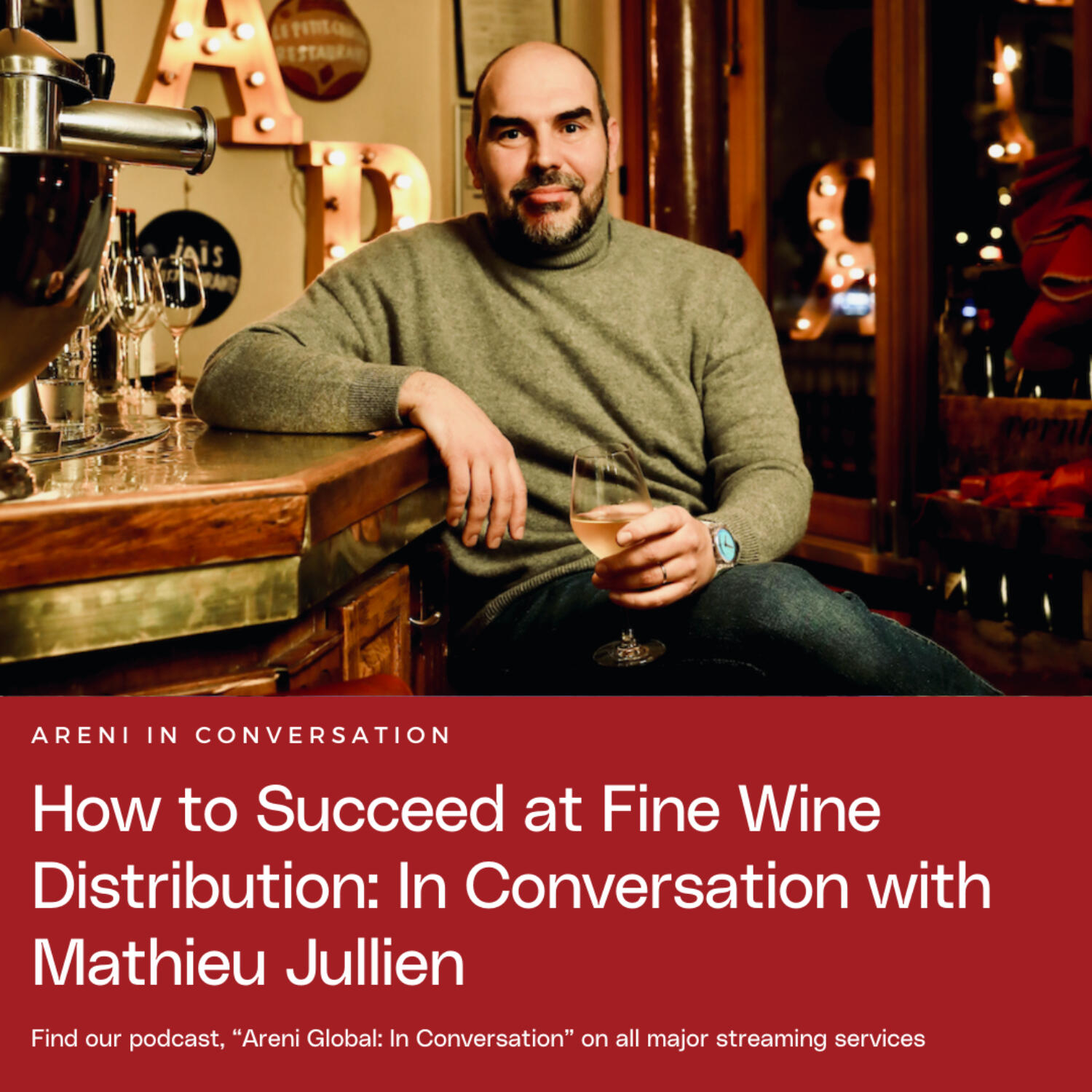
How to Succeed at Fine Wine Distribution: In Conversation with Mathieu Jullien
72m 50s
In this episode of the Arrini Global Podcast, host Boulin Vigard interviews Mathieu Julien, marketing and sales director of Van D'Exception, an LVMH entity overseeing four top wine estates: Domaine de Lambray (Burgundy), Château d'Yquem and Château Cheval Blanc (Bordeaux), and Colgin Cellars (California). Julien explains that Van D'Exception was created to manage these exceptional terroir-driven estates with a focus on preservation and quality, not growth. Each estate employs a unique distribution model rooted in regional tradition: Domaine de Lambray uses exclusive importers, Yquem and Cheval Blanc rely on La Place de Bordeaux (with Cheval Blanc sold en primeur and Yquem bottled), and Colgin sells directly to consumers, primarily in the U.S. Julien defines successful distribution as creating desirability through managed scarcity, ensuring wines appreciate on the secondary market, and avoiding oversupply. He emphasizes that Van D'Exception respects heritage but continuously improves operations, preparing for releases up to a year in advance. The conversation highlights how distribution is integral to terroir and the challenges of balancing tradition with evolving market dynamics.
Welcome to the Arrini Global Podcast. Arrini is a global research and action institute for the future of Fine Wine. In this series we bring you conversations with thought leaders in and adjacent to the Fine Wine world. To discuss how we as an ecosystem can ensure the collective future of Fine Wine. Welcome to the Arrini Global in Conversation Podcast, where we discuss what's installed for the future of Fine Wine. I am Boulin Vigard, Director of Arrini Global, and in this series we bring you conversation with thought leaders in and around the world of Fine Wine. To discuss how the world is changing, how these changes impact the production, distribution, consumption of Fine Wine, and how that creates risks to be managed and opportunities to be seized. Today I have the pleasure to host Mathieu Julien, the marketing and sales director of Van D'Exception, the entity that unites the four top wine estates owned by the LVMH Group, so that's Domain de L'Ombre, in Burgundy, Chateau de Cam, and Chateau de Chevalblon in Bordeaux, and Gorgingsellers in California. I sat down with Mathieu back in March 2024, with the original goal to talk about Amprimer, as part of our series on La Plasse de Bordeaux. But Mathieu works with four estates, each with their very unique distribution models, so we ended up talking about so much more than the blasts that we decided to release the full interview as a standalone episode. What does successful distribution mean for Fine Wine? And what does it take to be and remain successful at Fine Wine distribution? Are the keys and measure of success different, whether you are releasing your wine on Primer, on Vrable, through exclusive importers, or direct consumers? What are the main advantages and limitations of each system? And what if distribution was actually part of the terroir? Let's dive in. Hi, good morning, Mathieu. Thank you so much for being with me today. Two French people speaking English. It's always a bit weird. I'm very much looking forward to that conversation with you. And my very first question is always the most basic one. But can you tell us a bit about Van D'Exception and why it was created? Good morning, Pauline. And thank you for having me today. Van D'Exception is the home of four exceptional estates that belong fully or partially to the LVMH group. Those four estates are Domaine de Lombardé, in Burgundy, Chateau de Cam, in Bordeaux, Chateau Chaval blanc, also in Bordeaux, and Colguin Célar's in Napa. And Van D'Exception was created because those estates are exceptional. And they are treated in a specific way by the family behind the LVMH and the LVMH group. They have a different objective, they have a different management, and they have a dedicated unit to support them. Can you tell me a bit more about the different objective? Because in the wet-hennessey portfolio, you have exceptional wines as well, like Coug and. Of course. There's also many, many beautiful wines on the other side. Only joined four and a half years ago now. And I was never under the impression that the distinction between wet-hennessey and LVMH van Exception was done on the quality of the wines or the power of the brands or anything like that. It's more a question of size and capacity to grow. Because on one hand, as we put it, there are wines based on brands and styles, and that's wet-hennessey. And on the other hand, there are some vans de crue, vans from Théroir. And this is the van Exception side. It doesn't mean that there is no great Théroir within wet-hennessey. Of course, there are. It doesn't mean that we don't have a brand or a jig in van Exception, but the priority is not the same on one side and the other. So when you said it's a growth objective, does it mean that van Exception properties don't need to grow? They can grow, but it's not really what we are tasked with. The objective is to make as much agriculture output out of the size of the estates. But you know, Claude Nombri was 8.66 hectares 700 years ago, and it will remain 8.66 hectares in the future. So there is no room for growth there. Of course, as the market will see, actually, very soon, there are possibilities for small growth by adding some plots, some vineyard alongside the core, for example, if we speak about Nombri, but it is not the main objective. The main objective is to look after those most exceptional Théroir, which belong to private groups, but who are almost considered as part of universal patrimony, in a way, to make sure that they don't stand still, that they keep research and development, and always try to improve what we do and how we perform and how we look after the land, and also the final result of the product, how good wines are, as well as preserving our fair and heritage, and that's the main and transmit to the next generation. That's the main work of the students. Yeah, that's really that extra dimension of protection, and curation, and transmission, and that being, well, do whatever it takes to make sure that those estates go through time in the best way possible, right? Yeah. Just just to precise, because that's a question I always have. They are not the property of Bernhard Neuhe himself, right? They are still part of the group of the image. Yes, absolutely. Each of those four estates are owned, as I said, fully or partially by LVMH group, and not by the Arnau family. Yeah, and so what's interesting also for people that are less familiar than me with the LVMH group is that you don't share an office with the people of wet Hennessy. It's like two different structures, you know, two different offices. Yeah, I think it's part of the logic or the organization. I don't report and the estates don't report into wet Hennessy either. There's a lot of, of course, respect between, you know, the huge structure of wet Hennessy and this microscopic entity, which is Van AXEPTION, we talk to each other, we support each other every time we can, but we have very different path and those path, if they cross, we are happy to see each other, but most of the time they don't cross. And so what's your role in all of this? And when was the exception created? So I was in part of the group. I joined the group in September 2019. I was based in London at the time, so today I'm talking to you from Paris, my office, but I was working in London at the time. And so we can trace back the creation of Van AXEPTION because I was hired to set up the entity on September 2019, if you like. I think the ID came a bit before that, but I was in part of the ID, of course. I think that for a long time, because LVMH both, Chateau-Schwell-Blanc in 1998, Chateau-Dique M in 1999, and nothing as far as Van AXEPTION are concerned, nothing until 2014 and Domaine de Longre. So I think that for 15 years, there was no need for van AXEPTION and Pierre Lureton, who is still today president of both Chateau-Dique M and Chateau-Schwell-Blanc, was running both states. I think it's the arrival of Domaine de Longre and soon after in 2017 of Corguine, that gave rise to the idea of creating a separate unit to manage four states that operate differently, but under one roof. And so what's your role in this? What do you do? My role is commercial and marketing director of Van AXEPTION, which is really towards managing the distribution side. There is not much marketing going on as opposed to other brands within the group, but our marketing is the way we project our ones into the market and what time we release, what volume we release, what pricing structure we put in place, how well we prepare, with our distribution partners, who are all third parties, which is really the key to understand, is that our van AXEPTION wines, we interest third parties with no capital link to them to do the promotion and distribution of our four states. Yeah, you're not a distribution structure. Yeah, and so I manage that side, which means that I work in very close partnership and constant communication with the management of each of the four states. And together we come up with commercial and distribution plan that we get very neglected by the owners. Yeah, it's a back-of-ish kind of marketing in some way. So that's the perfect question to ask you then, because one of the things that we look at are really what makes fine wine distribution specific and what makes fine wine distribution successful. And you're in the exact right position to actually give me your opinion about this, which is how do you define a successful distribution? Because we'll talk, we'll go in details about the different systems that you use to
but all of your different wines in the market, you've got four different systems, but do you have a global definition of what the successful distribution means? - Yeah, the high level answer to your question is we want to make our four states as desirable for their commercial offer as they are already recognized for their product. We are lucky to look after some of the finest wines in the world and some of the finest examples in their own category. And they have been recognized for the case or even centuries as leaders in their field. And we want to put as much effort, as much detail and create as much this reliability on the, let's call it, it's not at all a dirty word, the business side than for the product and heritage side. - So you want not only Shetou de Kem to be a shiny star because of how it tastes and how fantastic it is of a wine, but because of the distribution that you put in this place as well. - And we need to create this, I use a very simple image, good vintage, bad vintage market, the professional line, even the final consumer, expect Dom and the number of Shetou de Kem, Shetou Shou of the call again, to produce one of the best examples of that vintage, hot, dry, wet, whatever strong weak vintage, we should be expected to produce a finest example of that vintage. And same thing regarding distribution and business, whether we are in a fantastic business environment, like we've been through a few years ago or more challenging business environment, like today. - Right, today. - Still the market, I mean, and we don't have the same truck record. So I'm talking, I'm not saying that the market is already expecting a great, even though I hope the market is but a great release every time from us. But by earning respect and by earning the confidence of the market, release after release, the market should come to a point to expect always a great commercial release from our states. - What can be the metrics of that? What's the metrics for a good commercial release? - Several ways, but one is the premise is that it's always more difficult to access our wines and always more expensive to access them. If you miss the first release, the first initial release, whether you are on-premise or not, whether you are through Plasagordo or not, it doesn't matter. The first commercial release of the wine is always the best time to buy it. The other metrics, so it means that it goes very far into the distribution chain because the final consumer knows that he shouldn't miss the initial release to secure the case or two of this wine. So it's the engagement to add the final, at the end of the chain, that's one. Second is that a price should go up on the secondary market. We are very careful about not going into the overhitting speculative mode, but because of the low of the market of demand and supply, we believe that a wine in our league should go up as its quality increases and its supply diminishes, should go up in value and secondary market. And I think another metrics would be how much quantity is available to the final consumer because a great distribution means that, at the end of the line, this distribution line, there is not a lot of stock available. There are a few cases maximum available for each client who will hopefully cherish them and share them and drink them, where we see potential risk for speculation is when actors in the market have access to way too much stock that they more than they can drink. And then there is, sir. Okay, I see. So we've talked about managed scarcity and I was wondering what would manage availability means, but I guess that means that it's actually making sure that the people that receives the boss will have got just enough, that they don't want to separate themselves from them. And as I'm hinting at the beginning, I spent the first 17 years of my career in the British wine trade. So I'm not one against the, I think, trade and secondary market is part of our ecosystem is actually important to the wine world. That's how you get the valorization on the secondary market. You couldn't have that if you didn't have a secondary market. Exactly, exactly. I'm not at all fighting the secondary market. Or, you know, I think it's a healthy part of any market and my experience of the London British wine trade really taught me that. And it's also way to bring new clients. You know, if you were not born with an allocation of PRC, you need to find the wine somewhere on the secondary market. So, if you want to find them with a bit of age, or, you know, if you don't have a big stock capacity, there's many reasons why I won't be able to access those wines. Exactly. You know, at the first release, for example, and that I still need to find them somehow. Absolutely. So this is an important part of our ecosystem, but there are excesses, like in any of the market. And those are the ones we're trying to regulate and to eliminate the excesses, not the secondary market. That's fascinating. So, I guess a good release, which is appealing to the market, so that means a lot of work on the price, I suppose, on the prices. Then the second part is valorization. And to have valorization, you also need to have the control of the final consumer. So that's a kind of a circle like that. Thank you. So you mentioned the first day that you're working with, who will gain shetu tijam shetu d'ablant, a domende l'ablant, they fall properties and you have four distribution systems. You don't put these lines through the same system at all, and they don't find their way to the consumer the same way. Can you tell us more about this? How is each property distributed? Of course. So domende l'ablant is distributed through not exclusive partners. It depends on the size of each country, but we are distributing in about between 70 and 80 countries with direct importers in each country. Some time only once, most of the time a few importers in each country. And they receive allocations from the domain. Actually, today when we are talking, we have a couple of days before the release of the Vintage 2022 from the estate. So that's the model for a very traditional in Bergen D and to have distributors and portals and distributors around the world. For Ikem and Chevrolet Blanc, we rely on the same network of the negocon that together with Courthier form La Place de Bordeaux, with a big difference, though, because Chevrolet Blanc is released on-premise, while Shattodicam is released-- As a livrable. Yeah, exactly. So the difference, typically, would be that this year this spring, Chevrolet Blanc will release its 2023 Vintage that will not be available for another year's physically. While Shattodicam, this month, will release its 2021 Vintage that has been bottled in September last year, ready to be shipped and ready to be distributed. And Colgan? And Colgan is rely mostly on direct consumer system, where private individuals will purchase directly, just really free, sometimes six bottles, if they are lucky in a way, from the estate. They will purchase them from the estate. The estate will ship to their door. And this is very much a domestic market, in the sense that Colgan sells more than 90% of this production into the US and a large share of that into California, actually, and the record. So it's really a domestic market. All right. So we'll talk about this a bit later, because I'm very much-- I really want to ask you about the future of those systems. But there seem to be the reason why they are distributed. Definitely seems to be that they're just a heritage of what the classic distribution systems are in those regions, right? Absolutely. It's very much-- and I think it ties with what we're trying to do overall with an exception. We are very-- we know in quite high level of details, each of the heritage and the history of each of the estates. And we are really trying to preserve the essence, while always trying to improve, of course. And that's very important for me to convey the sense that Valexcepcion is not a museum where we put those wonderful jewels and there are, you know, nothing change. And you know, we don't want to touch anything. We don't want to break them. Yeah. We are not putting them under, you know, a cloche, a glass cabinet. No, no, no. They are very much alive and kicking. But we have a deep respect for heritage. And he doesn't mean that-- and I'm sure you're going to ask me the question-- but he doesn't mean that it's future proof, because-- but remember, Valexcepcion is still quite young. It's only-- and we started just when COVID happened. So we had the kind of a slow start, I would say. Basically, the idea is that we need to improve our operation within--
a system and we're finding to the maximum before we could even consider a change in the system. Yeah, being excellent and not creating a new paradigm. But that's fascinating to me because you know, one of the things that you see straight away having those four estates is that, you know, when people talk about tarois and sense of place, often they ignore the market and the people that not just make the wine but sell the wine, but that that's, you know, crystal clear from what you are saying, that, you know, the regional traditions are still very much alive in how, you know, the wines are getting to the consumer and I'm sure that there are some nuances in those systems that means they're not exactly the same and you can't have exactly the same results with different systems. So that's fascinating. I want to take a very practical angle. You mentioned that the Claudine Embrae 2022 was going to be released in a couple of days. All right, so we are on D-Day and Claudine Embrae is ready to be released. What happened next, you know, what's your day going to look like on that day? I think we need to, yeah, it's a very good question. I think to answer the question we need to rewind a little bit because we are in the lucky position where we sell for each of the four estates, we sell the entire production or the share of the production that we want to release within a, I'm not going to say a couple of hours. Yeah, yeah, it's a few hours, but what you don't see if you only look at, you know, we sent out the allocation at 9 a.m. and by mid-day everybody confirmed is that in fact it's 12 months. We started prepping for the 2022 vintage release almost the day after we released 2021 vintage a year ago. What takes so long? Why? That's the real luxury of our operation is that we are not under time pressure. And because we are not under time of financial pressure, we look carefully. You know, it takes so much effort and attention to detail to make those great wines that we need to apply this in principle to distribution. And from the next day, we start collecting, you know, I mean, the next day it's an image of course, but from a few weeks after the release of a vintage, we will start looking at how we improve our distribution for the next vintage release. And we ask, we meet Acer at the estate or in the markets with our distribution partners, we ask of what can be improved. And there is a very good element of having van acception representative in the market because we represent of course the estates and the interest of the estates. But we make it clear that we also represent the interest of the market within the estate. So the van acception represent the interest of the estates within the market and the interest of the market within the estate. Okay. Because there is at heart in our category, there is an incentive to tell almost the truth, but not always the truth from the market to the estate. Because what has a lot of value, if you are a distributor, is to renew or increase your allocation year after year. And the human threat to try to share the good news and not so much the bad news if you want to keep growing your relationship and with your supplier. So as van acception and our representative data again, fully employed by us and fully dedicated only to those for estates. And we have no sales incentive or they are really here to help us gather data and find understanding about the markets. They will always seek to understand what didn't work. We are not so interested in what worked well, we are interested in what we can improve for the next time. And usually is it the price that wasn't fitting the market at the moment? It was the logistics that didn't go well because the container got stuck two weeks in a port or is it the packaging that wasn't leaking or whatever. What kind of level of things can go wrong? Of course, we listened to the market for the price as well, but this would be a lot closer to release actually. It's not so much because we wouldn't change the a's of the packaging or anything by listening to the market. It's a product led and not a market led the packaging. It's more identifying if the release go all the way to the financial client. And you know, this metrics we are talking on earlier, like how many clients did have access to our wines and how much on average did they get access? How much goes to on trade? How much goes to private individuals? And as the on trade put the wines on their list right away, are they going to store them for 10 years and keep the old vintage and all that? Maybe a few years ago, but we could consider that the job was done when we sold to either the negotiating board or the distribute in the importor in the. Yeah. But for us, no, the job is not done once the first line of the submission has bought from us. It's done almost when it's been drunk by the financial client. Well, I was going to ask you, is your job done when the final client has bought the bottle or was drunk the bottle? No, I mean, we don't have the resources to ensure that each bottle gets drunk, but in the spirit, no, our job stops when the bottle is drunk and the bottle is open. And actually, that's the way we think that's the way we engage with our distribution. That's why we support so many of their initiatives to organize wine dinners and occasions. Okay, so yeah, I was smiling because when we did our study on fine wine and the on trade after COVID and we wanted to see what had changed in the restaurants and how that impacted the wine list, that's one of the things that we've heard from distributors in countries like the UK is that because there was less and less staff on the floor, they were actually starting to see their job as not just you know, finished when the bottle is sold, but when actually the corkscrew is pulled out and the wine is bought in that what it means for them is that they were starting to have allocations of staff to go and help people for the restaurants for wine events because the Russians didn't have their own staff anymore. So now it was their all those distributors to have almost like an event's team that would go to the restaurant and open and pour. So that's you know, not exactly what you were saying, but that's an interesting change of mindset is really to be here to support the clients until the very end. As part of the building this entity van acception, we wrote manifesto and the first line is in French as circuit, voile butte, or slated into those who will the corkscrew in English and that's the very first line. Very powerful as circuit, voile butte, I like this. Correct me if I'm wrong, but the way I imagine it, so we are released day for the Claudine Opera, but for actually I wonder now if it's not exactly the same for all of your four wines you're on release day, what happens is you send a massive email to like all of your contacts and distributors and you say this is the price and this is how much you get and then people confirm if they want it or not. Is that correct? Yeah that's correct. The technical difference is that for the share of Collgien that goes to distribution, I didn't mention but the small part of the Collgien distribution that's not direct consumer is very similar to Domendell Amaret through importers and distributors. Through importers in market, but for Domendell Amaret Collgien they will get the email directly from the estate. The difference in Bordeaux is that we would use Courtié to give them the list of the negation, who are those who will be purchased and distribute the wines for us and we give to Courtié the details of the volumes and the price that they would share. So it's the same email but it goes to different audience. Yes. That's the difference. It's there's a step more. Big difference is what happens next because in each market if we take you back to Domendell Amaret there will be one key importer in each market. There will be a leader in each market. Yes. A user exclusive or leading and they would have the responsibility to managing the good release in their market. For Bordeaux it's completely open market. So there is no responsibility for each country. There is a global open competition because all the negations, let's call it, I mean there's less than one hundred of them on each side. E.K.M. and Antioch Alblanc. But big 30, 35 on each side would make a big chunk of the business. And those negations will be free from the moment we release to offer the wines to who they want in the quantity they want in the market they want. So it's a lot more competitive system. And there's different cobwebs. Does it happen that because an importer that's based in Germany can actually end up distributing Cogin through the L'Ambrae by the direct importing. And then also the Bordeaux ones through the plants, right? Does it happen often that you actually end up with your four wines at the same place? No.
The four wines is quite rare, especially because Colguin is. Yeah, Colguin doesn't have a big name. But what happens very often is that the leading importer for Lombardet would also be involved in buying from Negothion, it can't be sure. But that's very often the case. Does it change anything for you, whether or not it's the same importer? No, it doesn't change anything. I mean, it doesn't change anything. Other than our deep gratitude for their. Maybe you spend a bit more time with them. We really. It's one of the fundamental principles of an exception is that each estate, the current four estates and tomorrow, I hope, the fifth estates, they stand on their own feet. We don't give access to Lombardet because you buy Chaval or you don't get. It can't be because you buy Colguin, or there is no link whatsoever within. And you don't do. Like, you were talking about dinners, for example. You don't do dinners cross property dinners where you're going to go with your importer in German hand-do. No, that's another conversation. Because it's true, we don't do dinners. Because we get a lot of very often that request, can we do a dinner where we start with a glass of crude and then we move to maybe white from a pinion marshae from the Mendelombri and then Lava and we finish with. I can see it's nice. I should add that crude is not part of an exception, but it's. Yeah, yeah, yeah. When you had the need for bubbles at the start of dinner. It's often proposed as a champagne when we do our dinner. But the point of doing those dinners is really to deep dive into one estate and its history and its specificity. And I think that if we want to do that, we need to dedicate the dinner and the night to one estate. Rather than, you know, chop it, changing each course and doing a small. And also, frankly, what we love is to have the estate representative hosting the dinner. And you wouldn't ask Jacques De Vosge from Claude Lomboy or Domaine de Lomboy to present Schoenblanc and vice versa. You know, it's not the way it works. But more importantly than that, this is just for the dinner side. More importantly, the business is not linked. And it's not because you purchase one of the wines that give you rights or credits or whatever to get that. So is there any synergies, though? Because I would. I understand why you want to have four different independent entities. But the fact that you hear as one person like, over-viewings or four, what kind of synergies can that create then? I think it creates a deeper understanding from our distribution partners of our own logic. And so when you are in business and that you understand your supplier or your client needs, you are more likely to answer those needs. So it's true that those distributors that are involved with us on several properties, they tend to have a more frequent conversation with us and to have a deeper understanding of what we're trying to achieve. But yeah, so that's a plus, I would say, because they are. they understand what we're looking for, but it doesn't give them access to more wine or to. 20 things. Well, it's a share of information that you just spend two weeks in Asia and that feedback and the insights that you get from your presence in Asia for two weeks were then fee-dise, I suppose. Some insights, those insights are relevant to the four properties. Yeah, exactly. All of them, four needs, to understand what's happening in Asia at the moment. And you know, we got into the habit of sharing kind of business newsletter two or three times a year from a van acception site to all our distribution partners, which mean that we share this later with nearly 1,000 recipients today. Of course, a fraction of them are distributors or for Clodel Ombrae, for example. They all have a link with us in some ways. They're all wine professionals that trade wine, but. But they do not trade the same wines. No, they don't trade the same wine, and many of those who receive the letter, because I mentioned Clodel Ombrae, because on the last letter to the trade, there was the information and preparation to the release of Domandel Ombrae 2022 vintage. We consider that the trade, as a whole, should be aware of the release of Domandel Ombrae new vintage, whether or not they have a direct allocation. Okay. I want to focus a bit on Laplace for obvious reasons, being that we are doing a tea dive in Laplace, and you've got two wines there. And so we understood from what you said earlier that basically you follow the same steps for all of your four wines. But when you press that button on that email, that will go for the release of the chem and for the release of Chavad Blanc, the next step are a bit different. I want to start with a very conceptual question and ask you, what is Laplace for you? How do you define the Place de Bordeaux? Interesting question, because when I was in London in my first part of my career, I had no interaction with Laplace. So I really discovered Laplace over the last few years. You have no contact with Laplace because you were buying through Brokers? No, it's because I was a user not at the beginning in the buying position so I had no interaction. I was in the sales side so I had no contact with the supply side. Okay. And then when I was in a more senior position, our business model was to, we were importing wines and not buying from the open market. So most, the organization, the pain, the California and Italy. So when I approach Laplace, I approach it really with a curiuse open mind because I was part of Laplace de London. Even if we don't create Laplace, you know. That's a good call. Hey listeners, just interrupting the conversation for a few seconds. First, to let you know how grateful we are that you are listening to this episode. Thank you so much. And also to kindly ask you to subscribe to our podcast channel on whatever platform you are listening this episode on. And to give us a cool rating. It's such an easy way to support us and it really makes all the difference. Thank you so much. Now back to our conversation. And it's very, it's very different. And how are they finding it? Well, very diverse number of fine wine merchants who use to specialize in border wines only and know all of them or the vast majority of them by and sell and stock wines from all around the world. And they interact with estates through Courtié, which is an interesting aspect that we don't have in the London model. And they buy the same wine at the same time at the same price. And they sell pretty much the same wine at the same time at the same price. So they try to find a niche by having very different route to market and they tend to specialize in some channels or some geographies or and to really hone that competitive advantage and develop it. So it's very interesting to see that from outside they all look the same, I would say. And from inside, actually, they all have their really strength and their specific channels or markets. What was surprising for me as well is how those edge and differences are very much based on the quality of relationship. Is that in today's age, you know, that the relationship part is so important in life? That's true. So you mentioned you worked with a hundred negotiations approximately, 35 of them during 70% of all. Yeah, yeah. Yeah, that there is a big difference between the number of negotiations and the number of negotiations that make up 80% of our business. It's your 80/20 kind of relationship. And you mentioned Courtié being your first point of contact during the release. People that will get the email at the release. How many Courtié do you work with? We work with Lesden. I mean, not exactly the same between Shobal Blanc and Ikem because I was so there that there is a heritage in place and a relationship as you were just mentioning. But it's Lesden 10 on each site. With some crossing over between the two states here. How would you describe your relationship with Laplace? It's a good relationship. It's a relationship based on respect and trust. And it's all very much a human factor, as you said, because the negotiations and the Courtié, most of them, there are multi-generation and multi-centuries. So they know that management comes and goes. And they always tend to take the longer view and to remain faithful to a state that they really admire or they want to keep being allocated. And they know that the states will come through maybe sometime a dry patch. But it will change. And so at the same time, they look beyond the management to look at the fundamentals. And they also invest a lot into the personal relationship. Because they think it's the right moment to increase their allocation or to they would really be active.
and engage and so it's a very interesting dynamic. - Why is the courteer the first point of contact for you? Because people don't really understand, you know, the role of brokers in courteer. And one could imagine that it, you know, now that we send emails to people, you could send directly your emails to your hundred negotiations and not to your ten courtee. Why do you keep working with them in this day and age? - And it's not because there are courtee that we don't speak to negocent. So in fact, it's very much the same principle that we want to engage with the final client, but we don't want to supply the final client. And we want to engage with negocent, even if the transaction goes through the courteer. - What's the need for you to work with courteer when you could easily work directly with the negocent? - First, in my specific position, which is recent creation of a new entity with no background of working with plus the border, the courtee are a great resource to deep dive into the past and they have their archives. And more than their archives, they are the deep memory of the plus border. And they were there with a friend's sixty view with the last downside of the market or the last upside and they've seen it before and they are able to give you their insights. And if you speak to it enough of them, I don't know, three, four, five, you gather, even if it's sometime an endotical evidence or it really helps to take a step back and trying to make sense of the current environment by using the past, in fact. So I find them personally very useful. And this is because of the, as I said, the lack of experience of dealing with the plus but also what you have to underline is that it's not just the decision of the shadow to keep working with courteer, it's a two-side decision because the negocent don't want to get rid of the courteer either. They, in fact, the courteage is paid by the negocent. The cost is paid in negocent. And it's part of the way the function and-- It consolidates, I guess, also. It avoids them to speak with 100 producers and just have one point of contact. How much the courteers are involved in you setting the price? How much do you rely on their information to set your price? Well, the price is set by the owner. So it's not set by the management of the estate. We make proposal and the owner decide. So within making those proposal, we need to support them with evidence. So when you say the owner is at Berna Arne, who decide the price? I mean, there is a conceding. There is not only Monsieur Arneau, but it's the owners. As far as shadow brings concern, we also have the-- OK. 50% is owned by LVMH, but 50% is owned by the frair family. OK. Owners, it means that the LVMH and frair agree on the price of the release. But as part of collecting the evidence to support our strategy, yes, of course, we speak to Porti. OK. Is there still a role? Because when you read the archives of, for example, with 1855 competitions and how the wines of Bordeaux put themselves outside, there was very much the ball of the Courthier to be the bridge between wine makers that wanted to sell their wines for the most money possible and negotiate that wanted to buy the wines for less money possible, of course, because we can understand the tension between those two. Do you still feel that it's the case today that the Courthiers are here to ease the different objectives from the property and the negas? I don't know. If they really act as-- I don't fully agree on what you said about the negation trying to buy cheaper and estate trying to sell higher price, at least as far as we are concerned. We see a great alignment of interest within the deception chain. And it's not a struggle of can we get away by sending a bit more expensive or can they get away by buying a bit cheaper? If we price it right, it should fly out of our door, of their door, of the door, of their client, and find it way directly to the cellar of the final consumer. We have a fair margin and reward for their work within the deception chain. That's why I was asking you about today, because when you read again 1855 and the ball of the Courthier in putting together the classification, that was very much because they were considered to be in that neutral position. But my point-- I agree with you. It seems that today, the class is very much in a more collaborative space than it was before. And everyone wants it to work in the right flow of things. And I think that today, the power is in the end of the top estates, with power comes a responsibility. And if we want the system to function, there is no need to look for weak operators in the Courthier community or the Negotiations community. The system relies on the signal that is sent by the estate. And if the signal is well-calibrated, is clear, is consistent, chances are that Courthier will do a great job and Negotiants will do a great job, and everything would go fine. When the signal is either not well-calibrated or not clear or not consistent, then-- So a consistent signal would be, it's been a near vintage, but we still have a huge increase in the pricing. Yeah. OK. For example, consistent means we are in business vintage after vintage, release after release. And that's what I ordinarily-- where there is-- you were asking earlier, if there is any synergies between the four estates. This is one key synergy. Is that as far as I'm aware, there's only one vintage released every year by each estate. But we have four releases with the global distribution each year, because we release one vintage from normally, one vintage from weekend, one vintage from Shabarim, one vintage from Colgan. And each of those interactions give us your opportunity to prepare well in advance, to ask questions, to ask distribution report, to test pricing scenarios, to do all those kinds of different things, and then release, and then show a fully-- each time that we get a sense of the market. And this will build a reputation and confidence four times as fast as you've only released one year. So the major difference between Ike and Shabarim you mentioned earlier is Shabar goes through the Young Primer system, and Ike doesn't. Can you tell me why? And when did Ike stop being in the Young Primer system? Ike was only briefly part of the Young Primer system between apparently it was something initiated with the turn of the millennium for year 2000. 1999 wasn't so long-primered. The idea of, oh, OK, it's a new millennium. Let's try something new and do on-primered. But it stopped with the last vintage so long-primered, but Ike was within 10. So it was like already a 10-year-- it's true that it was a bit of a crazy time for Bordeaux on-primered. Do you think those vintage is, yeah? Yeah, with the O5 or 9 or 2010, it was pricing went very high. I think it was maybe difficult to be on the kind of the sideline and watch what was happening on the on-primered side. But of course, that wasn't part of that. Fundamentally, why we don't today-- because there was the opportunity to put-- it came back into the Young Primer system when we were working on releasing the 2019. Vintage 2019 is the vintage that marked for the free French states, Charles Blanc, Ikem and L'Ombre. 2019, well, released at three different times. But the time vintage can be seen with insight as the new strategy implemented. There was the possibility to put Ikem back on-primered. And actually, there was some calls in Bordeaux asking us to do it. But we resisted together with Pierre Gerton and the management of Ikem and of course, the owners. So we came. Resisted that call because we thought that Ikem is unique. Ikem is unique and it deserves to remain so. From the way we make Ikem is unique and the way we sell Ikem doesn't really fit the narrative of the on-primered. Because on-primered is all about how was last year vintage. Is it more right bank or left bank vintage? And who is a star performer, a bit of ratings and work at the price release. But it doesn't give-- I think it's a blessing to have so many actors from the industry focused on one region, one vintage. Yeah, I was going to ask you that's one of the big things of on-primered. Is that collective movement? That's fantastic.
But if you have a slightly different message to share with the world and it is a different message from Souter because 2021 in Souter is not the same vintage than 2021 and I'm not saying that it's exactly the same vintage from Santa Stef to Pesacrignon but there is a global consensus on red for vintage released in Primer. We believe that I came deserve to have its own voice, its own moment and tell maybe a different story about and actually 2021 that we're going to release in 10 days is a good example because we're about to release an amazing vintage from I came and from Souter, a very difficult one because sadly the first in 2021 meant that very few bottles of Souter were made, it came as a bit lucky on this side but it's a completely different story and as you said I just got back from Asia sharing bottles of I came 2021 with merchants and we could tell the story of which they already and I'm not saying we said that they forgot about 2021 but I could see it times and times again I had several meetings a day of course and every time was like yeah 2021 not a great vintage for Bordeaux. Well first we can discuss that but also we can discuss let us tell you the story about 2021 so tell. Is that also because I was wondering tasting sweet wines on Primer must be a different kind of expertise than tasting red wines right and then maybe people would less use them that and less able to project themselves in the vintage. Yeah that's a fair comment that's a fair comment and even going beyond that we really believe at I came and that's specific I came but that the drinking window became is exceptionally uniquely vast because I came will stand the test of time and age gracefully for decades if not centuries but you can also drink it from and I'm not saying mean taste it and spit and drink it and enjoy it share it as soon as we release it so today 2021 is a variable by the glass already into a few restaurant partners and could be drunk if you if we have the chance to welcome you to the estate for a meal you will see that the first wine we serve is 2021 and next year will be 2022. I'd always told me that after bottling it takes a week for a red wine to be in back to its normal you know to be as good as it was in the tank because bottling moves the wine shakes the wine a bit and then for a white wine it was two weeks but for a sweet wine it was more than the months as well so you know it takes more time for the components to all get together and fit together I was just thinking about that also of the ultimate effect. So you were saying that you know I came got out of the entrepreneur system because you wanted if I understand correctly a bit more control about the narrative and the possibility to make it unique and to have it so in store we're telling outside of the vintage one in Bordeaux why is Cheval still in the entrepreneur system? Cheval is still in the entrepreneur system because it does part of the heritage belongs to the entrepreneur system we are very lucky to have thousands of visitors every year during the entrepreneur week official and before that and after that and people who interest in our wines and it's true that it's not the same process you know with Cheval Blanc not a single sample will be tested outside of the ground of the estate entrepreneur it's too fragile we don't send samples of them in the world. Can you not part of the you know the concrete testing or any kind of negative kind of testing you only receive people at the estate? Only at the estate I mean entrepreneur after I want to buy this in Bordeaux it can travel like a new server but yeah of course. And so to be able to welcome the world to the estate for them to taste and compare and and get the messaging from the estate is a very very very efficient system rather than what I've just been taking part in doing taking bottles of I came and going around the world meeting with the final product you know not sample the final product meeting but I think beyond your question is is more than that is that as long as we collectively the leading Bordeaux estate look after the entrepreneur system Cheval as it's belongs to the entrepreneur system. The problem is that if the entrepreneur system itself is not taken care of or is not look after well enough so it can remain the attractive proposition that it should be to the to the whole the entire industry and that's the only reason why Cheval no longer be part of the entrepreneur system if it's the entrepreneur system itself is not in the longer relevant. Okay. Well actually how did the plans react when you decided to take game out of the entrepreneur system? Well, it came left entrepreneur system with vintage 2011. So I wasn't there to be part of this decision or to witness direction but you have to remember that it was a very difficult time after the release of 2010 vintage which was widely across the board mispriced by Bordeaux and there was a big price drops and crash and the and else that been chased. Yeah. Yeah from the entrepreneur. So I don't think that there were bigger issues than he came living the entrepreneur system that it's been part for a short period of time. I wanted to ask it because we've talked about the entrepreneur and the livrables for he came but how much of your job is managing the release of all the vintage and library wines and you have that for all four states? Well, it's part of the job. We have no bad vintage releases at Colgain. Actually, we had to do one last year because we had no 2020 vintage. Because of the fires. Whatever small stock that the state had managed to build over the last decades, we had to use it last year to compensate for the lack of a 2020 vintage but hopefully that should be a one off. We don't have a structured bag of vintage release calendar at either of the other three states where we do have commercial stock, different depth, especially the most valuable stock is the richest and the deepest stock is at Shatou de Kemme, called the cultural inherited from the Gursalus family of putting wine aside to prepare. In the knowledge that there will be some vintage missing in the production of the Kemme, but we don't do organized release. We work with our distribution partners according to their needs. Do you generally keep more and more stock for aging yourself? No, actually quite the opposite because vintage 2019 was very small in Sotern and in Morris and the NIE. We couldn't keep any of that stock. So we had no commercial stock for later industrial states. Not true of short-blown where we had the bigger harvest. In 2020 we had, again, the lowest harvest on record that he came, no stock built there, no stock built at Longre, very little stock built at short-blown. 2021, there will be a bit. No, in fact, no, we are not able. Because we are making smaller rest, we are not able to put wine aside in stock because we want to give priority to our distribution. Well, that's what I was thinking because we are wondering who's going to carry the weight and the cost of aging wines because restaurants use to do that a lot and have those wonderful sellers where they would keep wine for 20 years and just put them on the list when they were ready. But, well, which I suppose there's a bit less pressure today because the vintage is our ready-year sooner. But it seems that everyone is like, well, the estate should carry the weight and the estate should be responsible for building that stock. I agree. But it's a very big tension with your current distribution. No, I agree with that. The estate should be carrying the. for many reasons also of authenticity. Yes, safety, authenticity, quality, yes. And we have put in place this logic at Shabalblown, which is by far the biggest production of the four states is that we commit to releasing around two-third of the production on Primer. Because it's well, it's all fine to do a good pricing structure for on Primer. But if you release a fraction of your production, almost irrelevant. So, release at least two-third of the production on Primer. And then what the third we keep, we forget it for long term.
more than 10 years, 12, 15 years. And we make this commitment not to interfere with the market. So if you purchase your own entrepreneur, you know as a professional or even individual that you have more than 10 years ahead of you without a new release from the estate. - I have the same vintage. - Okay. - Of the same of that vintage. And I guess you would do the same thing with the other wineries if you had more volume, but then there's a risk. - Yes. - The fine line is like, how much we keep versus the risk that we have losing part of our distribution if we can't supply them of this year's vintage. - Yeah, we are in a small production game. So to be relevant, we, you know, if we produce wine and we just make it disappear in our cellar, it's not going to make us more desirable or more visible or more consumed. So we really need to think first about the consumer, the fine consumer and the road to rich him and nurture that distribution. And whatever we can keep, yes, it's our own stability to carry the cost of keeping it. - All right, we've gone in depth through your four distribution system and actually I'm surprised at the end of that conversation to realize how similar they are in the way you work with those routes to market because again, the people you are talking to are different, but you follow the same process and structure, right? - You know, I give you an anecdote. The first thing I did when I joined, I took my position, was to travel around the world, meet distributors and write report back to base and present this report to my direction and then present this report to the author for States. And the States were quite surprised to learn about the distribution system of the author. - Yeah, you don't really communicate. (laughing) - Because as you know, there is a lot of heritage. And so I remember very clearly that meeting where they were asking question cross to each other, I know we were in just us in the meeting room and that's, "Ah, that's how you do it." And in fact, the end of the meeting was a realization that even if we use some time very different routes, we end up, you know, our bottles end up in the same cellars and drunk by the same people pretty much. - And the vision is the same. I mean, what drives zero through those four different channels are a very similar process of what I realized. But if you had to take your four distribution system, what would you say are the pros and cons of each of them? - Well, it's the pros and cons of Monopoly versus open market. So if you interest the distribution to someone specific, it creates kind of a double way dependency because you grow especially with personal relationship, but even without the personal relationship element, you can grow more and more comfortable in the relationship. And there is this saying in the trade that, you know, the exclusive distribution rights for DRC doesn't compel you to work harder for the estate, you know. So I'm not, you know, saying that there is not enough effort going into that distribution, but it can lead to complacency while the open market distribution by its own nature can be very dynamic and always exploring new avenues and new clients and that, but can also on the downside destroy some of the value because there is less commitment. - And also as opposed to collecting data through the open market system is harder than collecting data from. - It's true. I mean, I think we get the same level of that data from the open market than from the distribution. We get them in different ways and actually, but that's another conversation. But the plus the Bordeaux has become very used to providing data sometime more so than historic distribution partners in established heritage partners. We, themselves have maybe less sophisticated ERPs and so it's not really as simple as that data. It's more that the market will treat the ones differently. So there is no incentive to discount or to destroy value in the distributor and import relationship. While in the open market, if you misprice your release, very quickly someone will discontinue and start the discount also. - Yeah. And you have less level of control. I mean, you don't control your distribution anyway fully, but I guess there's even less level of control when you go through the. - Yeah, you're more exposed. - Yeah. And my last question is going back to the very beginning at, is that we realized very quickly that your full distribution system are based on heritage and legacy of those regions. I mean, you distribute your burgundy, the way burgundy has been distributed for, you know, that's how the distribution system got built there. And same thing for the DTC in California and for the blast of the border in border. So you are operating within a legacy system and how wine distribution developed across decades. But looking forward how important is it for you to maintain this legacy historical system? Can we imagine that you won't keep them? Are they, you know, the core of that? Like, again, because you mentioned that van de Exception was here to protect the heritage of the estate, doesn't include the heritage of the distribution system. - In some ways, it does include the heritage of the distribution system. The idea is to project van de Exception, which is again, a very new entity, as a reliable, trustable operator and custodian of those magical states. And I hope that tomorrow we will have the chance to welcome another member of our small family and the current owners that will pass on the ownership to LVMH, the management, whether it's staying place or it should be comfortable in the knowledge that we are not disruptor, you know, for the sake of disruption. We are true, passionate people of this industry and we know it intimately and we respect it deeply and we don't change things for the sake of changing things. We have too much respect for what has been done previously and we just want to carry it forward and to improve where we can. - I was wondering if there's a scenario in the future where you would distribute all of your four wines the same way and maybe even doing it yourself. I mean, people always wonder why you need to go through all those. - You mean doing it yourself, you mean using van de Exception to dispute? - Yeah. - No, it's not part of the plan because I think we would have done it already. I admit that when I joined and I told you earlier that I started to meet the people in Bordeaux when Laplace and the distributors in the countries, there was this initial reaction of, are you my competitor? Are you going to take away the distribution from me? Or and the point is that we are too small, you know? We are too small to take care of our own distribution. If we want to do it properly and if you are serious about what are the metrics or distribution and having as many people all around the world getting their hands on a few bottles or few cases of this wine with all the logistics implied and all the regulatory and the customs and, you know. - People don't realize that when they're like, "Well, let's get the intermediaries." Like, "Let's go direct." I'm like, "Really? Do you really want to carry that on your hands?" "Do you realize the team that you want me to have in turn to do that?" - And in fact, in fact, if it was the end game, there would be no van exception. There would be more attention. And my tendency is more than capable of doing direct distribution to the end. And this is because this is not the road we want to take that van exception was created. So that's why we need to nurture the relationship with those experts, independent experts that we call "fine wine merchants" that are our ambassadors all around the world. And that's why we also need to make sure that we look after their, they make a good living by carrying our wines because we need them. We need them to, because of their knowledge, because of their knowledge of our product but knowledge of their clients. They have a role to play in the future of the reputation of our wines and the desirability of our wines. - What's the role of Laplace in the future of fine wine? How do you see them changing? - Laplace is in flux right now. And Bartovit is linked to the wine.
the influx of wines not from Bordeaux, which has a deep impact because when you are in the business of selling wine, you sell also advice. And when you are merchants from Bordeaux, you can give very insightful advice to your distribution about the wines of Bordeaux. When you start dealing with wines from all around the world, of course, there are smart people that train their staff, but I don't think that you can give the same quality advice from wines grown thousands of kilometers away from your base. And where you don't have the interaction well, like you do for Bordeaux production. So I think the quality of your judgment and the quality of your advice that you in the way sell to your distribution is not as relevant. So and in long term, I think that business are reminerated for their added value in the chain. And it's for Bordeaux to prove that there is added value in that involvement with wines not from Bordeaux, where there is and I was the first witness of that. There is great knowledge about the wines of the world in places like London. Of course, it's not it's open. Nothing is lost or lost. Nothing has been won yet. It's in process, but it remains to be seen as far as the concern. And again, the number one decider of Hola Plas will perform in the future is what will be decided within the estates, the shuttle that offers the wines through a plus. And if the shuttle or serious about making a plus work, a plus will perform. Thank you so much, Matieu. It was amazing. Thank you so much for your time. Thank you, Pauline. Thank you for all your questions and your deep interest into our industry. Thank you for listening to this episode of a Reeneglable in Conversation. A Reeneglable is a thing that dedicated to the future of fine wine. And when we're not podcasting, we are publishing reports, white papers, articles and markets insights. So if you are interested in the global conversation around fine wine and what the future holds in terms of adoption, distribution and consumption, add over to our website www.reeneglable. That's A-R-E-N-I and subscribe to our newsletter. All the links are in the show notes, because whether you are producing or selling fine wine, you need to know what's happening in the world so you can make informed decisions. Until next time, cheers!
Podcast Summary
Key Points:
Van D'Exception was created to manage four exceptional LVMH wine estates (Domaine de Lambray, Château d'Yquem, Château Cheval Blanc, and Colgin Cellars) with a focus on terroir, heritage, and quality over growth.
Each estate uses a distinct distribution model
Successful distribution is defined by managed scarcity, secondary market price appreciation, and ensuring wines are harder to access and more expensive after initial release, avoiding speculative excess.
Van D'Exception prioritizes long-term planning and continuous improvement within existing regional distribution systems, balancing heritage with adaptation to market changes.
Summary:
In this episode of the Arrini Global Podcast, host Boulin Vigard interviews Mathieu Julien, marketing and sales director of Van D'Exception, an LVMH entity overseeing four top wine estates: Domaine de Lambray (Burgundy), Château d'Yquem and Château Cheval Blanc (Bordeaux), and Colgin Cellars (California). Julien explains that Van D'Exception was created to manage these exceptional terroir-driven estates with a focus on preservation and quality, not growth. S.
Julien defines successful distribution as creating desirability through managed scarcity, ensuring wines appreciate on the secondary market, and avoiding oversupply. He emphasizes that Van D'Exception respects heritage but continuously improves operations, preparing for releases up to a year in advance. The conversation highlights how distribution is integral to terroir and the challenges of balancing tradition with evolving market dynamics.
FAQs
Van D'Exception is an entity within LVMH that unites four exceptional wine estates: Domaine de L'Ombre, Chateau de Cam, Chateau de Chevalblon, and Gorgingsellers. It was created to provide dedicated support and management for these estates, focusing on preservation and quality rather than growth.
Van D'Exception focuses on terroir-driven wines with limited growth potential, while Moët Hennessy deals with larger, brand-oriented wines. They operate as separate entities with different objectives and management.
Mathieu Julien is the marketing and sales director, responsible for managing the distribution of the four estates' wines through third-party partners, without a capital link to LVMH.
Successful distribution means making the wines as desirable commercially as they are for their quality. Key metrics include wines being harder to access and more expensive after initial release, price appreciation on the secondary market, and limited stock available to final consumers.
Domaine de L'Ombre uses exclusive importers in each country. Chateau de Cam and Chateau de Chevalblon rely on La Place de Bordeaux, with Chevalblon released en primeur and Cam as a livrable. Gorgingsellers uses a direct-to-consumer model, mostly within the US.
The systems are rooted in regional heritage and traditions. Van D'Exception respects this history while aiming to improve operations within each system before considering any changes.
Chat with AI
Loading...
Pro features
Go deeper with this episode
Unlock creator-grade tools that turn any transcript into show notes and subtitle files.
 PodcastTranscript AI