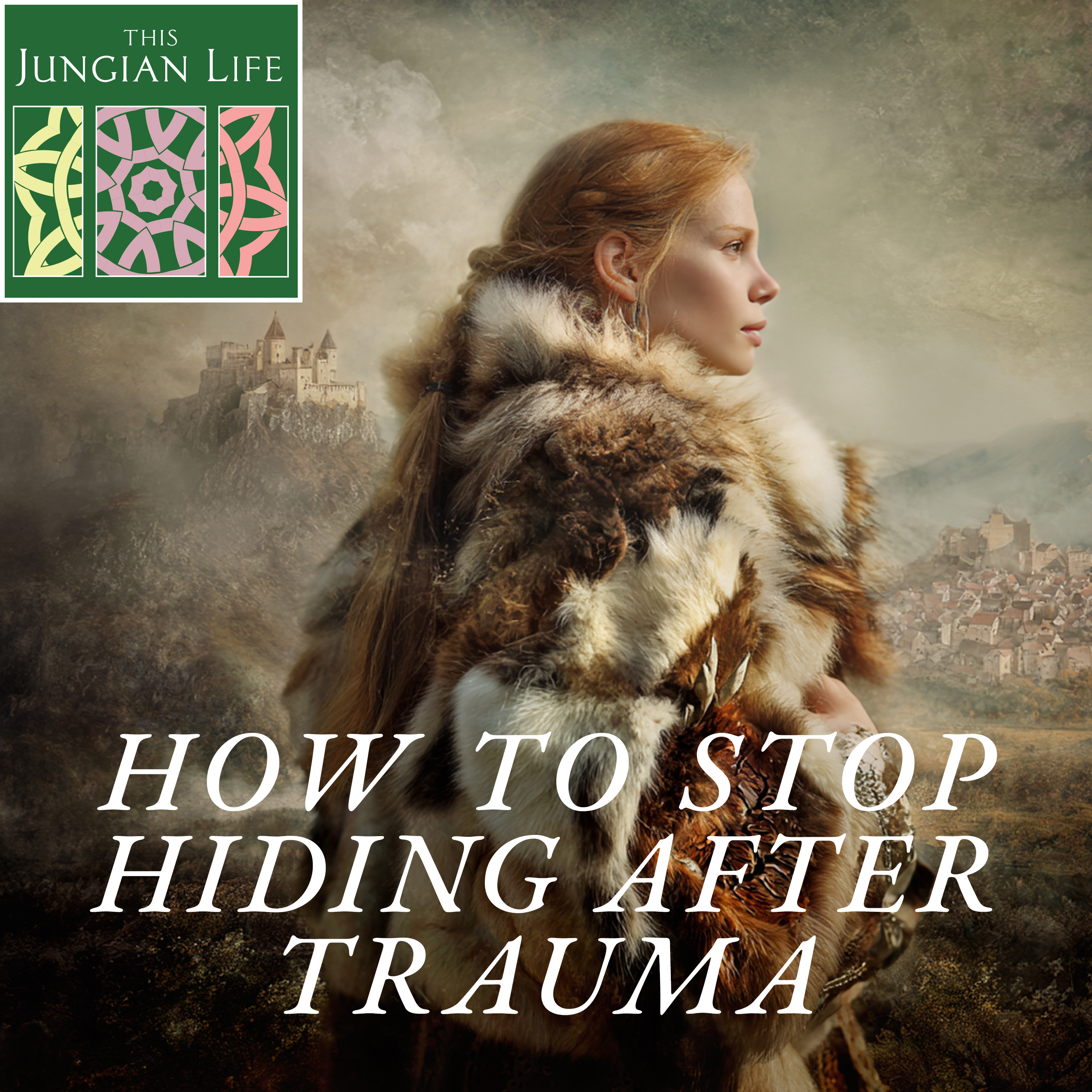
This transcription from "This Jungian Life" explores the fairy tale "All Fur" (Allerleirauh), focusing on its psychological depth. The story begins with a king losing his beautiful queen, who extracts a promise that he only remarry someone identical to her—an impossible condition that prevents grief and renewal. This leads the king to desire his own daughter, who escapes by demanding three symbolic dresses and a fur cloak. She flees, is found by another king, and works as a kitchen maid. Through three balls, she secretly reveals her true identity via gifts in soup, culminating in her marriage to the king. The analysts discuss the tale as a metaphor for trauma, dysfunctional covenants, and inner prisons. They highlight how the dead queen’s demand traps the king, reflecting how people make rigid promises in distress that hinder growth. The daughter’s impossible conditions mirror this, but her cleverness and gradual revelation symbolize the ego’s need to confront and integrate shadow aspects. The tale underscores the importance of mourning and renewal over static attachment to the past, offering a path from trauma to conscious transformation.
And this is part of the discipline of working through a fairy tale. We could just stare at the lurid part of the fairy tale and then just not look at anything else. But if you really, we're just in the first few sentences, you're really sinking in. This is about trauma, the inability to move on from trauma, strange covenants. There are conditions. There are prisons inside of people that they can't get out of. Welcome to this Jungian life. Three good friends and Jungian analysts, Lisa Martiano, Debra Stewart and Joseph Lee, invite you to join them for an intimate and honest conversation that brings a psychological perspective to important issues of the day. I'm Lisa Martiano and I'm a Jungian analyst in Philadelphia. I'm Joseph Lee and I'm a Jungian analyst in Virginia Beach, Virginia. I'm Debra Stewart, a Jungian analyst on Cape Cod. Today Lisa's unavailable to Debra and I are going to handle the podcast and we're going to talk about a really powerful intense fairy tale called "Alor Lio", which translates loosely into all kinds of fur. I'll start by reading the fairy tale and then we'll jump into the symbolic meaning. As a bit of orientation, Jungians are interested in fairy tales because we believe that they are the vestigial stories that human beings have created and the reason they've kept them alive and told them over and over again is that there's some kind of unconscious wisdom. That the collective wisdom of humanity is solving for certain problems and that fairy tales and myths for that matter are the artifacts of figuring out what to do. Many Jungians like Von Franz saw them as vestiges of archetypal events that the archetypal world has its own evolving life and that fairy tales are glimpses of things that are changing in the archetypal world. Of the theoritions had different perspectives and we'll be talking about it from a number of different ways. Fairy tales are one way that we out picture archetypal images, archetypal energies and events. Otherwise they would not have survived for thousands and thousands and thousands of years. They have in their brief form, usually without named or well developed characters. There's a princess, there's a goose girl, there's a king, there's a dumbling. They embody energies that we all recognize and they teach us. These are life events, these are energies, these are things that happen and here's how you can handle it. On Sunday, January 18th, we are hosting a special free seminar called Dreams for Change, a Dream School Taster. One tells us that our dreams are an expression of our inner life and they can show us which false attitudes have led us into a blind alley. Perhaps you're feeling stuck navigating a big life change like finding a new career, facing an empty nest or trying to figure out who you are after having children. If you're navigating something like that, your dreams can help. Dreams offer a medicine that is precise, personal and attuned to your deepest truth. Knowing their symbolic language will help you home in on the information that truly matters in your moment of change. At this session, we'll discuss doing dream work in times of major life transition. You'll be able to ask us questions and we'll also invite you to send in a dream for analysis during the seminar. These free seminars have proved really popular so please do book your place soon so you don't miss out. Find the link to sign up in the show notes for this episode. The essay is Chester Tinn wrote, "You don't have to convince children that dragons are real. They know dragons are real. Fairy tales tell them what to do about it." Oh, that's great. So what does this story with the impossible name, Al or Lio, have to tell us Joseph? Well, we'll jump in. I'll be happy to read the story and then we'll see where we take it. Okay, so sit back, let yourself be read to and we'll take it from there. Once upon a time there was a king who had the most beautiful wife in the world. Her hair was pure gold. They had a daughter together and she was just as beautiful as her mother and her hair was just as golden. One day the queen became sick and when she felt she was about to die, she called the king to her and made a request. If after her death he wanted to marry again he should only take someone who was as beautiful as she was and who had golden hair like hers. Once the king promised her that, she died. For a long time the king was so distressed that he didn't think about a second wife. Finally, his counselors urged him to remarry. So messengers were sent to all the princesses in the world but none of them were as beautiful as the dead queen. Nor could they find such golden hair anywhere in the world. Now, one day the king cast his eyes on his own daughter and when he saw that her features were very similar to those of her mother and that she also had such golden hair he thought, "Hmm, since you won't find anyone as beautiful in the world, you must marry your daughter." And right then he felt such a great love for her that he immediately informs his counselors and the princess of his decision. The counselors wanted to talk him out of it but it was in vain. The princess was totally horrified about his godless intention. However, since she was smart, she told the king that he first had to provide her with three dresses, one as golden as the sun, one as white as the moon, and one as bright as the stars, and then a cloak made of a thousand kinds of pelts and furrows and each animal in the kingdom had to contribute a piece of its skin to it. The king had such a passionate desire for her that everyone in his realm was ordered to work. His huntsmen had to catch all the animals and take a piece of their skin. Thus, a cloak was made from their fur and it didn't take long before the king brought to the princess what she had demanded. Now the princess said that she would marry him the next day. However, during the night she collected the gifts she had received from her fiancé from another kingdom, a golden ring, a little golden spinning wheel, and a little golden reel and the three dresses all of which she put into a nut shell. When she blackened her face and hands with soot, put on the cloak made of all kinds of fur and departed. She walked the whole night until she reached a great forest where she was safe. Since she was tired, she climbed into a hollow tree and fell asleep. She continued to sleep until it became broad daylight. Because it so happened, the king, her bridegroom, was outhunting in the forest. When his dogs came to the tree they started to sniff and run around it. The king sent his huntsmen to see what kind of animal was hiding in the tree. When they returned to him, they said that there was a strange animal lying in it. They'd never seen anything like it in their lives. Its skin was made up of a thousand different kinds of fur and it was lying there asleep. Then the king ordered them to catch it and tie it on the back of the wagon. The huntsmen did this as they pulled it from the tree. They saw it was a maiden. Then they tied her on the back of the wagon and drove home with her. "All fur," they said. "You'll do well to work in the kitchen. You can carry wood and water and sweep up the ashes." Then they gave her a little stall beneath the steps. You can live and sleep there. So she had to work in the kitchen where she helped the cook, plucked the chickens, handed the fire, sorted the vegetables, and did all the dirty work. Since she did everything so diligently, the cook was good to her and sometimes called "All fur" to him in the evening and gave her some of the leftovers to eat. Before the king went to bed, she had to go upstairs and pull off his boots and as soon as she would pull off one, he would always throw it at her head. And so, all fur. Let him miserable life for a long time. "Ah, you beautiful maiden, what shall become of you?" At one time, a ball was held in the castle and all fur thought, "Well, perhaps now I could see my dear bridegroom once again." So she went to the cook and asked him to allow her to go upstairs for a while to see the splendor from the doorway. Evidently, the princess had never met her fiancé, her bridegroom. "Go ahead," said the cook. "But you can't stay longer than half an hour. You gotta sweep up the ashes tonight." So all fur took her little oil lamp when into her little stall and washed the sit off her so that her beauty came to light again like flowers in springtime. Then she took off the fur cloak, opened the nut, and took out the dress that shone like the sun. When she was fully dressed, she went upstairs, and everyone made way for her for they believed that she was nothing less than a distinguished princess who had come into the ballroom. The king immediately offered her his hand and let her forth to dance, and as he was dancing with her, he thought, "This unknown princess resembles my dear bride." And the longer he gazed at her, the more she resembled her, so that he was almost certain that it was her. When the dance ended, he wanted to ask her. However, as she finished the dance, she curtsied and disappeared before the king could speak. Then he asked the guards, but nobody had seen the princess leave the castle. She had quickly run to her little stall, taken off her dress, blackened her face and hands, and put on the fur cloak once again. Then she went into the kitchen and started to sweep up the ashes. "Let it be into mourning," the cook said. "I want to go upstairs and take a look at the dance, make a soup for the king, but don't let any hairs fall in it, otherwise you'll get nothing more to eat." All fur cooked a bread soup for the king, and then at the end she slipped the golden ring that the king had given to her as a present into the soup. When the ball came to an end, the king had his bread soup brought to him, and it tasted so good that he was convinced he'd never eaten one so good before. However, when he had finished he found the ring in the bottom of the bowl. As he looked at it carefully, he saw that it was his wedding ring and was puzzled. He couldn't grasp how the ring came to be in there, and so he had the cook summoned, and the cook became angry with all fur. "You must have certainly let a hair fall into the soup. If that's not true, you'll get a beating." However, when the cook went upstairs, the king asked him who had cooked the soup, because it had been better than usual, so the cook had to confess that all fur had made it, and the king ordered him to send all fur up to him. When she came, the king said, "Who are you? And what are you doing in my castle? Where did you get the ring that was in my soup?" And then she replied, "I'm nothing but a poor child, his mother and father are dead. I'm nothing, and I'm good for nothing except to have boots thrown at my head, and I also know nothing about the ring." Upon saying that she ran away. Sometime later there was another ball, and once again, all fur asked the cook's permission to go upstairs. The cook loud her, but only for half an hour, and then she was to return and cook the bread soup for the king. So all fur went to her little stall, washed herself clean, took out the dress as silvery as the moon, and cleaner, and more sparkling than fallen snow. When she peered upstairs, the dance had already begun. The king offered his hand to her again and danced with her. He no longer doubted that she was his bride for nobody in the world except her as such golden hair. However, when the dance was over, the princess had already departed once again, and despite all his efforts the king couldn't find her, and he hadn't even spoken a single word to her. Indeed, she was all fur again with blackened hands and face. She stood in the kitchen and cooked the bread soup for the king while the cook went upstairs to watch the dance. When the soup was done, she put the golden spinning wheel into the bowl. The king ate the soup, and it seemed even better this time. And when he found the golden spinning wheel at the bottom, he was even more astounded, because he had at one time sent it to his bride as a present. The cook was summoned and then all fur, but once again she replied that she knew nothing about it and she was only there to have boots thrown at her head. When the king held a ball for the third time, he hoped his bride would come again and he wanted to make sure to hold onto her. All fur asked the cook again to let her go upstairs, but he scolded her and said, "Yoo-rooo-witch!" "Yoo-rooo-witch!" "You always put something in the soup, and you can cook it better than I do." However, since she pleaded so passionately and promised to behave herself, he let her go upstairs again for half an hour. There upon she put on the dress that sparkled as bright as the stars in the night, and what upstairs and danced with the king, he thought he had never seen her more beautiful. As they were dancing, however, he slipped a ring onto her finger and ordered the dance to last for a very long time. Nevertheless, he couldn't hold onto her, nor could he speak a single word to her, for when the dance was over she mingled with the people so quickly that she vanished before he turned around. All fur ran to her little stall and so she had been away longer than half an hour, she undressed quickly. In her hurry, she couldn't blacken herself completely so that a finger remained white. When she went into the kitchen, the cook was already upstairs, and she quickly cooked the bread soup, and she put the golden reel into it. Just says he found the ring of the golden spinning wheel. The king also found the reel. Now he knew for sure that his bride was nearby, for nobody else could have possessed the presence. All fur was summoned, and wanted once again to avoid the king and run away. However, as she tried to run off, the king caught sight of the white finger on her hand and held her type. He found the ring that he had slipped onto her finger and tore off her fur cloak. Then her golden hair toppled down, and she was his dearly beloved bride. Now the cook was richly rewarded, and the king held the wedding, and they lived happily until their death. And this was the ring. He had sent to her as a gift. Breaking the fourth wall there was some of those comments, that's interesting. So it's a long story. It is a story that Jungians are curious about. It shows up in anthologies and commentaries as Jungians try to find metaphors to talk about certain, very complicated, internal dynamics, archetypal, and sometimes very sad outer realities. But we begin with a daughter who's tied to her father, the anima-animus projections, and then a very complicated conjunctio dynamic that's kind of in the air. Kind of influences her father, and of course it's present with the young king that she's going to eventually marry. So we have a problem. This is a dead queen, and she demands a replacement as beautiful as herself with the exact same golden hair, which basically is impossible and invites the problem into the story. I'm thinking of a couple of things right here at the outset of that just like a dream. What is the presenting problem? You know, so the presenting problem is the king who has the most beautiful wife in the world loses her, she dies. So it's stress for the trauma. Starts with the trauma and then
a strange request to say, "Don't marry anyone else." Ever, unless she looks exactly like me. And that's a setup. Exactly. That's exactly it. That's a setup. But what does that mean psychologically? If you can replace me with somebody who looks just the same as I do, it will be okay. So there's something here about persona and beauty and this whole golden hair stick and all that stuff. I have to wonder about the queen who, in her dying moments, thinks about making this a condition. And whether my question is the queen protecting her daughter, knowing that even though she's the queen's daughter, this is impossible. I'm going to protect her because no matter what she's not going to look just like me, or do we have a narcissistic queen who believes that she's so special and her beauty is so special that that sets a standard for anyone that would follow her? I think all of that can ring true. And I'm also imagining that on her deathbed, she's setting up the impossible condition that I suspect is going to leave the king unable to ever remarry, which means he will ever remember her and pine for her that she'll never be forgotten because she can never be replaced. Right. It's the first, however, of the impossible conditions that keep being fulfilled. Exactly. Oops. Like, oh, this can never happen. Oh, yes, it does. The daughter does look, as it turns out, just exactly like the queen in every respect. And then it falls to the daughter to make her own impossible conditions. She's resorting to what she thinks is the trickster in saying to her father, oh, okay, Dad, I'll marry you, but I need to dress as bright as the sun and a moon, one like the moon and one like the stars. He'll never be able to do this. So there's something about setting a condition in itself and of itself that doesn't address the real problem. Right? The real problem for the king and the queen who's dying is this is terrible, is unbelievably sad. The queen doesn't want to die and her life and have her daughter be motherless. But the queen cannot grieve that. And neither can the king, because that impossible condition has already been stipulated. But unless, of course, you could find somebody who looks just like me. Exactly. So for years, the king is now alone. He's lonely. He just have a paramour. He doesn't have a partner. He doesn't want to betray his promise to his deceased wife, who has trapped him into this crucible where attention is building and building and building and building and building until frankly it kind of makes him crazy. And then he suggests something that's kind of crazy. This impossible condition thing reminds me a little bit of those fairy tales where there's something that is forbidden of like in the Bluebeard story. I see this little key right here. Make sure you don't use that one. Well, of course, you know what you know what's going to happen. Cinderella is forbidden to go to the ball. But of course, you know what's going to happen. This is the flip side of it. Of it will be possible if you can do this and it sets up a desire in the king that maybe I can't find somebody as beautiful as my deceased wife. And then it gets passed on to Alalara. Oh, I will never master that name. It's a very unusual name, isn't it? It's German, I think. But at any rate, it sets up the condition for her that she can set up impossible conditions. But once you do that, you know they're going to be met because the real issue, which she's going to engage, is this is an awful thing. And she is repulsed by it. And she wants out of there. Yeah. So the king might represent an ego that is trapped in a kind of bizarre inner contract that is unworkable is it cannot be achieved. And there's a kind of inflation that he is going to keep the queen Anima inside the royal ego forever and ever and just keep finding substitutes for her even if it's his own child rather than mourning and renewing. Because if he could just have woken up and said that was a ridiculous thing for my wife to ask and a ridiculous thing for me to agree to, I'm not going to hold as a ridiculous contract. But he can't, he can't let go of the unfortunate promise. How many of us in moments of great distress and maybe trauma make a kind of covenant with something inside of us that later on impairs our ability to feel and grow. And sometimes that sounds like I will never trust this kind of a person again. Or I'll never date again or all of the extremes that we find ourselves declaring when we've been in the field of a trauma. Some of those things we outgrow but sometimes we don't and those people find their way into our analytic rooms. You've got some strange rule in there that's kind of skewing your game. And a lot of times they don't remember the covenant if they can find the wrong covenant and look at it now from an adult perspective. Often they can let it go but if they can't find it it's like a little weird computer virus that just keeps working in the background. The king wants the replacement for his dead wife and it has been set up for him that it might be possible. He scours the earth. The tale says every princess everywhere has been inventoryid as it were and found wanting. And then he makes an ecotistical decision. Yes he does. He's a king. I have the power to decide. I went looking definitely going to marry my daughter. That's my decision and that's final. How many people have made that bargain? And he's divorced from any empathy for his daughter because she's horrified but he can't feel it. His ministers have the courage to say don't do this. This is not a good thing but again he so he's inflated and also locked into this impossible covenant and can't give himself permission to renegotiate the contract. So it's her or no one. So thinking about how many people have goals and aims in the real world to satisfy a desire perhaps for status or wealth. You know whatever the thing is that symbolizes the treasure. We could also say well it's psychic treasure that those things symbolize but how many people chase you know what we might call just worldly treasures. How much money is enough money? What about you know cars and and seeking to fulfill something that can never be fulfilled because what is inside is radically different from questing for something in the external world. So there's something about literalizing something that should just be a metaphor or a be symbolic but also he's not moving forward in life. He wants to move backward. So he wants to go backwards in time, reconstantly the marriage to the queen which is an impossible and horrifying way about that rather than move forward either make peace with being a celibate, being a solo king so to speak, or suffer the internal turbulence of finding a queen that the old queen wouldn't have approved of.
to just break the rule. He's gonna spin backwards in time, regress. - Right, I want it the way it was. - Exactly, the good old days. And whatever the cost is to other people, not important. 'Cause restoring the good old days, that's the thing we should be doing here. - You know, I can feel a certain kind of sadness in this, you know? Here it is, it's a quote, it's a fairy tale. And yet this is so poignant and so incredibly sad. And everybody, you know, listening to us or who's ever read the fairy tale would have this exact same place of like, you can't do that? - Right. - You can't have that. You know, or the thing like in Rumpel's Still Skin, Rumpel's Still Skin wants the first born baby. And sort of like, you can't have that? - Yes, who? What kind of a person asks for a hat? - We all recognize, you know, how deeply wrong this is psychically and psychologically. - Yeah, it's really a tragedy. And if we can, and this is part of the discipline of working through a fairy tale, we could just stare at the lured part of the fairy tale and then just not look at anything else. This is about trauma, the inability to move on from trauma, strange covenants, children left behind. There are so many complicated dynamics that then give rise to this perversion. And as it is true for everyone who wants to doing something dangerously, damagingly perverse, there are conditions, there are prisons inside of people that they can't get out of. And then the terrible option begins to feel like the only option. And that winds up being deeply, deeply tragic. - Yeah. - So our princess decides she has to get out of there. - And she's got to get three dresses first. And dresses are a big deal in fairy tales. - I love the dresses. And I also love the thing that comes a little later that she can put all of these things in a nut. - In a nut, she'll, she's got magical powers right from the beginning. - Absolutely. Of, sure. And this willing suspension of disbelief is like, oh yeah, that's no problem, of course they would fit in. After all, they're sort of magical dresses. So why not? But this introduces the theme of persona. The queen was very, very beautiful. Now the daughter, the princess is also very, very beautiful. She's going to have these gorgeous dresses like the sun, the moon, and the stars. And then she has these little golden gifts from the fiancee to whom she was promised before dad decided he was going to abrogate that. So with these beautiful things, and then we have her awful feeling, I mean, it looks like it's just gross this cloak. I mean, all these a thousand little skins from every kind of animal it would look weird. And yet a lot of trouble is not just a skin from one animal. It has to be from every animal. And there's four of them. And four is a very interesting number for unions because it represents the quaternity. And it kind of points to something larger than they, some of the parts. So she's got a sundress, a moon dress, a star dress, and a fur dress. And the fur dress is the one she wears most of the time. - Yeah. And I think about this as a cloak, but she must look like the weirdest, scruffiest, patchworky, chaotic little animal that ever walked the earth. But what is she covering herself with? Maybe a way of saying instinctual, animalistic, lowly realities, not just from a donkey, which is a variation on the tail, but from squirrels and bats and rabbits and antelopes. And you name it as base level psychologically as you can get. - So this is something that happens to all of us when we are in impossible situations that we will regress to an instinctive level to save the core of the personality and to camouflage ourselves, which doesn't really cure the problem. She can kind of see that she keeps returning to the camouflage that the young king needs to kind of rescue her from this trauma cycle that she finds herself trapped in. Because it's traumatic to have this terrible situation with the father, in origin she's lost her home, she's lost her security, she's cast out into the woods with little to no resources. So she camouflages herself in this multiplicity of instinct, but she's also escaping the sterile court of the old king. Because that's a sterile place. There's no feminine principle. There's no fertile principle left in the kingdom. So she goes back to that archaic level inside of herself and that does have a saving process. And the dress is all represent different attitudes as well. - Yeah. I am thinking though of this, it's such a big question of what does this cloak represent? Of regression? - Yep. - Absolutely to instinctual base level access to life, sources of life. And persona of, she must look like some sort of awful scruffy animal, which is exactly what they say that they see it's this weird animal and tie it on top of the wagon. They don't even think she's human. The sky is so successful. - Right. And it seems to maiden, but it represents and then she gets to the kingdom and they say, well, okay, you know, you can work in the kitchen, I'll send a rela cleaning the scholarly and doing all the dirty work of a persona disguise and a willingness to be lonely like Cinderella. And yet she has hidden treasures. So sort of sets up the divergence between appearance and status and character. The smart cookie, she's very smart cookie. I'm out of here. I thought about these dresses. I'm taking the gifts that I was given from my fiance and I'm ordering this covering that is kind of really weird and gross looking and I'm leaving. - But it's good for camouflage because it works. She's able to move through the forest, looking like a creature of the forest, which affords her some protection in this wilderness of the unconscious where she's seeking rest. - And then, you know, people see the persona of these animal, the animal skin cloak. And they set her to work in the scholarly and then when she has to go up and serve the king, she has to take his boots off and he throws one at her because after all, she's just a worthless scholarly maid. - So the camouflage has worked. She's convincing everybody that she's not worth anything more than just scraps and boots and menial labor. - You know, I always want to jump in here, not just this fairytale, but others of like, oh, you know, and then when later on when I showed up in my dresses and with all these special treasures, then you liked me, but what about when I was cloaked in animal fur and you threw your boot at me? Makes me kind of wonder about the character of the bridegroom, but never mind that now. - It's not an appealing thing to think of this powerful person throwing stuff at the head of the servant. It's an ugly moment for sure, but I want to also take a moment to think about the kitchen because kitchens are alchemical laboratories. They take raw things and they cook them, and then something better comes out. And when she's given the opportunity to display her own ability to transfer.
Form the premium material into something delicious, low and behold, she's quite skilled. It's also quite an unusual skill, I think most princesses probably weren't cooking in the kitchens, but she has some talent that she can call upon. So she's carrying all of this instinct inside of her healthy instinct, like it was the instinct that said, "Run, get out of here. That's a good instinct." She's got a camouflage that works, good instinct. Just an instinct, how to cook, good instinct. So she's cooking all this instinctive stuff. And she's doing a good job, but kind of takes good, and she's got a relationship with the cook, and even though he's garless and rough. He also kind of likes her and takes care of her a bit. He's just not terribly refined. Yes. Much like her coat. Yeah, exactly. He sets a limit on it and kind of, he's kind of growly, or at least you were growly. But he lets her go. And she has another good instinct of, and this goes back to Cinderella. And a lot of our fairy tale heroines, Cinderella wants to go to the ball. And this princess wants to go to the ball. She does not take on a belief in or an identity with herself as the scullery made, covered in by this time a dirty cloak. She knows who she is. And so she goes to the ball in fairy tale motif, the golden dress, the silver dress, the star-like dress. And she drops little hints in the king's soup of "I bet you wonder where this came from." Yes. She's definitely wanting to be discovered, even as she tells him to throw a booted her head. So this conundrum of being trapped in her trauma, really, these heritels don't use psychological language. It's for us to try to understand. Exactly. She's found herself her way to someplace that looks like it might be helpful, but she still uses her defensive technique, even when it's probably not the best thing to do anymore. And that's exactly what trauma does to us. Maybe as a child, we're subject to terrible conditions. The brain learns how to dissociate, to keep us away from fully experiencing it. And then 40 years later, we're nowhere near being treated like that ever again, but we still, or at least the psyche, still revives this dissociative defense, even when it's not necessary any longer. So she keeps returning to the instinctive camouflage, even when it is no longer necessary. And that's a real statement about how we need to kind of be, we need some help to work out of our trauma-based defenses and protections. I want to talk a little bit about the nut, though, because-- Okay. Well, a nut is a seed. Yeah. And inside of seeds, if you plant them, they sprout and they become trees. So inside of a nut is a microcosm. And she places these celestial objects, sun, moon, and stars, the cosmic order is put into this little secret microcosm. That's where her potential is hidden. That hasn't sprouted yet. And it's kept safe. And that's a theme that happens over and again. She's safe in the shroud of the fur. Her potential is safe in the seed box. She's also safe because she's cunning and smart. She kind of knows how to keep herself safe. I also am appreciating the theme here where she drops hints of herself. And when one variation of the tale, they sort of merge it with Cinderella that it's a shoe that she leaves. But the next part of the story is that the king has to come looking for her. The king has to get it. The king has to say, you know, who was that wonderful creature? He can't just hold on to her. So he puts a ring on her finger by which he can later recognize her. But the king needs to activate. He needs to become interested and questing. Strops all these hints. And of course, we're talking about, I think our listeners probably know by now, we're talking about one psyche. Yes. A Jungian orientation to a fairy tale is that the various situations and characters in the tale are like different parts of one person's, yours and my psyche. Something else in the psyche, imaged as the king, has to be activated. And there's this wisdom in her returning the artifacts of his affection. Yes. Back to him that rouses some, it's uncanny to him. It's startling to him. But it's the thing that gives him this energy to go on the search to figure out this mystery. And they're all gold, golden, the eternal, incorruptible like her hair, like her hair at the metal. What is everlasting is interesting that there's a ring, a sort of like, okay, I get that. You put a ring in there naturally. Sure, do your fiancee send a ring, a spinning wheel and a little golden reel. I got intrigued with the idea of spinning wheels. So this has got to be this little miniature spinning wheel, but that has been the classic occupation of women for millennia. It was always women who did the spinning, who turned the plant material into thread that could then become clothing and other objects. It's another image of transformation like like the kitchen transforms raw material into edible and the spinning wheel transforms plant material into fabric into thread and then into fabric. The golden reel I have to say stumps me. Are we talking fishing rod reels? Will we ever know? It's like what the heck is a sea hare in one of those fairy tales. I'm not sure exactly what it means, but they're gold and that has to do with incorruptability. So, even though she has swabbed herself and soot and dirt and fur, she smells bad and all of that, something underneath all of the outer seaming is incorruptible, which is a symbol of the self. This is a very important attitude that I think as a Jungian, I hold. Is there a matter what trauma somebody has survived and they come to work something out? There is something incorruptible, pure and undefiled at the center of every human being that the worst, worst, worst terrible circumstance still cannot reach. And I think that the fairy tale is suggesting that. I do too and I also think this tale offers such a vivid image of a theme that's present in many fairy tales of the need for both suffering, which the original king and his queen really couldn't do. But Aller Lio, if I get that right, can do. She humbles herself. She's a scullery mage. She's covered with soot. I'm sure there's no shower in her cubby under the stairs. And she endures. And many a fairy tale heroine and prince. This is the part of the story that you have to go through the suffering, the humiliation in order to have your treasure, the incorruptible gold, golden hair, union with the inner opposite. It is a long and grueling process. And you need to keep your wits about you and not be discouraged. And it's a timing to everything that's. also a little bit of candy. That, I mean, he's interested in her. She seems interested in him. She could have just kept the first sundress on and just kind of get moving forward as well. Just stay there, tell him our story or something. But she needs to go through these cycles of showing who she is and hiding she is, showing who she is, hiding who she is, showing the incorruptible and the going back into the new grado, the suit, the kitchen. Why is that? And what I would suggest is it reminds me just a little bit of trauma work. That trauma works not just as, you know, a straight 45 degree angle. It's you do it and then you're back in it and then you're working on it and then you're back in it. But each time it is a little bit different. It's the solar dress and then the moon dress and then the stars dress. So each time she gets out of the trauma, it's a little bit different. Until finally, there's enough tension built in the psyche and then the prince who I think represents the new healthy attitude can really justly hold over and say, come on, enough of this, enough of this suffering. Let's get back into life. Right. That's the king. This is a young king, a revitalized king and an appropriate love object for the princess. This is the classic theme in fairy tales of third times, you know, we have a saying, third times charm. Jack goes up to the beanstalk three times. You know, it's always three times. And partly, we want to say, okay, we get it. You know, she's going to do the the golden dress and she's going to do the silver dress. Just cut to the chase. Just just go ahead, get to the conclusion. But it does really image the work of development, of psychic development that we can't just do it in one fell swoop, just as you were saying that we have to approach with one thing. Then we fall back. Then we try again until the fourth trans is the transformative thing that after three tries, it changes. The situation changes. The king puts a ring on her finger and manages to identify her. The prince seeks out Cinderella and discovers, you know, he tries first one step sister than the other. Third times charm. That's what it takes to do the transformative process. And that's the endurance theme that I think, this fairy tale and many others really give us an image of. But this one is very, well, because of the theme of incest and, you know, apparent rejecting a child and yet wanting her for exploitive purposes, it really highlights the need for endurance. And these things play out subtly without that same shocking level. How many parents are very ambivalent about their children going away from home? How many dads are ambivalent about their daughter starting to date? It doesn't mean there's something deferious in it, but there's something on that archetypal level that makes difficult to let go. That's another theme in this tale. The king at the outset can't let go and constructs the false hope. So there's the holding on and the letting go. And then luckily, there is enough life for us because the danger always is if we've experienced a major betrayal in a trauma that we may collapse under the burden of the wound and that either barely survive or just stay hidden, stay marginal forever. There's something inside of her that is strong enough to keep venturing outside of the costume. She still wants to remember who she is despite her diminished circumstances. And I would suggest that there's little forays. There are only 30 minutes. Let me just, let me look beautiful again for 30 minutes. And then I'll go back and put the sun on my face. Can I just remember? This is very interesting to me. When Jung was caught in the unconscious, he's playing in the mud. The shores of Lake Zurich, very much like the soot-covered Alalera, he's covered in mud he's been doing these figurines and as he's walking back to that, his home in office, he has to repeat to himself who he is. I'm Dr. Jung. I have patients, I have children, I have a wife, I have responsibilities that Jung understood that forgetting who he was would be very dangerous. And there's a wisdom in the fairy tale that even though she's not, it doesn't feel safe enough to really claim her status as a princess, she needs to dip into it at least three times so it doesn't disappear completely. And of course that makes all the difference because if she never went up for those three 30 minutes, Prince never would have found her. She just would have spent a life in the soot. And that I think is one of the great gifts of fairy tales is they do end happily ever after. The treasure is found. It might be a magic cup. It might be a magic elixir. It might be the prince or the princess of whatever symbolizes the eternal, incorruptible prize and good psychic good. And that it is attainable of hanging there. Don't give up. And like Aller Lio, it is essential to keep your own knowing of your worth, your your princess or prince like qualities, your golden treasure, your your affinity with sun moon stars, the transcendent. Never forget that. Don't don't identify with in this case the cloak of her. That's not who you are. And to allow someone to at least get a glimpse of who you really are, even if you can't tolerate living in that space, but to give yourself and the other person even just a glimpse. And that can be a place that things are built upon for the new life. Yep. How do we hold on to and honor our truth? So with that, we'll make a transition into a dream and in a sense I would offer to people. Every night, the dream maker, tailors of fairy tale, puts you in as one of the characters and it plays out. Yes. And it's giving you a solution to something that is so intimately true for you. One of the sayings is that fairy tales and myths are dreams of the collective and our personal dreams are our own personal versions of fairy tales and myths. This dreamer is a woman who's 44 and she is a speech and language pathologist and here is the dream. I found myself in complete darkness. I opened my eyes as wide as I could hoping to find light. There was none. I realized with her that this made me very vulnerable, I could be attacked and not see it coming. I knew what I had to do. I needed to grow fur. I concentrated hard on getting fur to grow on my legs. A soft fuzz appeared. I then held up my hand and noticed there was the smallest bit of light now as though the sun was rising but I couldn't see the source. As I made out the image of my hand, I saw my flesh bubbling like a thick liquid. I was pleased. Hair would soon grow there too. I focused on my back, trying to wheel hair to spring up from my flesh but it was too hard to make a connection with that part of my body. I was worried. I needed that fur on my back for protection. So for context, she says, "I've been thinking a lot about which relationships in my life to give energy to.
my sister and her family are moving across the country soon and I find this change heartbreaking. There are two unhealthy relationships I have taken a lot of space from in the past few years, one with a friend with whom I felt enmeshed and one with my own mother whose presence retriggers my psychic wounds. Though I have my own family, a husband and two children and we're happy, I have a sense that without my sister here I will be all alone. I'm afraid I will let this old friend or my mother back into my safe space. The main feelings in the dream she says was fear being attacked in the dark, relief and awe that I could grow protective fur, hope that I could make contact with all parts of my body so that I could be completely covered in this fur and for additional contact she adds. My mother was not well when I was growing up. She was physically violent and to my knowledge does not process her own childhood wounds. She continues to blame others for her past behavior and is generally unaccountable. I do not permit her to be alone with my children though I have fostered something of a relationship between them. I feel a lot of guilt for the ways I withhold myself and my children from my mom even though she does not seem very interested in others human beings anyway. At this time I only see my mother about twice a year for holidays and always with my sister present. I'm scared to be the only kid out there responsible for my mother's care when she becomes old. So the first thing I want to impress upon people is look at how alive these archetype of themes are. Yes. I just did a survey of the dreams people had submitted and I was like wow you know this this protective fur theme this people get it it's in that deep deep deep level of the psyche. This is such a poignant dream. I can just sometimes I want to say to our listeners of really pay attention to how a dream affects you. Some dreams don't carry a big charge and we work with them and so on but other times a dream just comes in with such power that we really feel it and there's a bodily reaction to it and and that that's my experience first off with this dream and how poignant it is like the fairy tale we just talked about that she will have protective fur and here we are you know I get it you know we are these naked hominids without claws or particularly sharp teeth or wings or anything else but the fur can protect us shield us and keep us warm that she needs to grow the fur. So she's in complete darkness she's stretching her human eyes is wide as she can trying to see if she can penetrate the darkness yeah and she can't and then she has a realization that she is really vulnerable that whatever else might see better than her in the darkness could easily pick her off. So what we're dealing with here is called an atavistic impulse and it's wonderful world because atavism or atavistic energy is pulling her back to an earlier phase of evolution so that she can access something that her modern psychology has broken her away from. So really she wants to see into the dark and some instinctive part of her nose while I've got to regress back into my animal nature because if I had animal fur and animal eyes like a cat or other creatures I could probably see and is kind of successful because she gets that fuzz on the legs and then she can see a bit of light. That's right exactly so and Jung is forever and ever and ever talking about how we need to be in touch with our instincts of those based level of feelings that the fur symbolizes that there is something inherent that is protective and warming as she feels herself alone in in the dark but this doesn't quite work our dream maker says oh she's now she's got this idea that I can make this happen and there's a place on my hand and I'm making it happen because it's thick and liquid and I can feel it coming but uh oh she can't do it for her back. She's trying to will her to spring up from her back too hard to connect with that part of the body and she's I needed that fur on my back so I think the dream is really picturing some things that our dream ego can do and what cannot be she cannot grow fur all over her body but she does have this transmutational capacity that her will is really remarkable that she can will herself to change and create his bubbly mutability on her skin which is the precursor to a transforming into a pelt that's very exciting for her to see that her pure will can get her to acclimate to the complete darkness she finds herself in but as you said at least by the end of the dream we don't get the feeling she's gonna turn fully into a wolf or whatever it is it's a bit of like a a werewolf kind of story except that she's not cursed she's a shapeshifter and shapeshifters are part of for instance Native American mythology or they call them skin walkers yep that are shamans that can become animals and then return to being human again she's she's trying to figure out her skin walker energy her mojo around that and she's made progress but it's not fast and it's not easy but I think more importantly through the association she has a trauma history yeah and I think what the psyche is doing is it showing her how she survived her childhood problems that she was able to regress into an instinctive place in any of us with a trauma history recognize that when you've got a dangerous parent in the house your instincts are very awake you are hearing for the footsteps like even the cadence of the parental footsteps can tell you what's gonna happen you're trying to see the secret signals so you can like a creature of the forest run or fight or hide or the things that creatures do I think the dreammaker is telling her something about her coping mechanisms and her defense and if she could become clearer about them then she could ask herself do I still need this adephistic defense in the world I inhabit now or does it just break open suddenly and I'm kind of growling like a great beast but is that called for just because the piece of delivery guy was an hour late is that the right place to use it and I think the dreammaker is also telling her I agree with what you've said that you do have this power but that's not what's needed now yeah she's got a lovely just a spouse and children is sounds like she's got a lovely life in a career right she's able to to tell her mom listen you know let's not do this and leaves her alone yeah if she wants to hang out once twice a year okay the danger has passed can that be okay and I think you know as our dreamer already knows very well of the the loss of the supportive family connection with the feminine that her mother could not provide but the sister could and the fear that she expresses of of regressing that she's a fragile let Some what?
unhealthy relationship resume with the old friend that she'll regress to that or that she'll let her mother back into her safe space. And I like that the dream maker gives her a lot of credit for being able to grow this fur and then also say, "Look, you can't grow fur on your back." And it may not be necessary actually either. You really just need your eyeballs to see in the dark. Exactly. Exactly. It's a poignant dream and I'm wishing this dream are well. And of course, these separations are hard they call up so much from the past. But that was then, this is now. That's right. And it's understandable when we've been subjected to really terrible things that we can learn how to growl and bite and swarrel and bear our cheese. Like circumstances can force us into that much like the fairy tale and now this person who survived the violence of her mother. But, yes, you can conjure it again if you need it. But you probably don't need it too much. That's a nice, exhalation to grant yourself. Yeah. Yeah. Thanks for listening. To submit a dream, suggest an episode topic or join our mailing list. Visit our website, thisyongiandlife.com. If you enjoyed this episode, give us five stars and a good review on Apple podcasts, Spotify, or wherever you get your podcasts. Subscribe to our YouTube channel and make sure to click the notification bell to be alerted whenever we upload videos. And keep up with all things TJL by following us on Instagram, Facebook, X, and TikTok.
Podcast Summary
Key Points:
The fairy tale "All Fur" (Allerleirauh) begins with a dying queen who makes her king promise to remarry only someone as beautiful as her with golden hair, an impossible condition that sets up trauma.
The king’s inability to move on leads him to desire his own daughter, who escapes by demanding three impossible dresses (sun, moon, stars) and a cloak of a thousand furs.
The daughter flees into the forest, is found by a neighboring king, and works in his kitchen as "All Fur," enduring hardship and boot-throwing.
She secretly attends three balls, wearing the dresses and leaving tokens (ring, spinning wheel, reel) in the king’s soup, leading to her discovery and eventual marriage.
Jungian analysis interprets the tale as exploring trauma, impossible covenants, inner prisons, and the need to grieve and renew, rather than cling to static ideals.
Summary:
This transcription from "This Jungian Life" explores the fairy tale "All Fur" (Allerleirauh), focusing on its psychological depth. The story begins with a king losing his beautiful queen, who extracts a promise that he only remarry someone identical to her—an impossible condition that prevents grief and renewal. This leads the king to desire his own daughter, who escapes by demanding three symbolic dresses and a fur cloak.
She flees, is found by another king, and works as a kitchen maid. Through three balls, she secretly reveals her true identity via gifts in soup, culminating in her marriage to the king. The analysts discuss the tale as a metaphor for trauma, dysfunctional covenants, and inner prisons.
They highlight how the dead queen’s demand traps the king, reflecting how people make rigid promises in distress that hinder growth. The daughter’s impossible conditions mirror this, but her cleverness and gradual revelation symbolize the ego’s need to confront and integrate shadow aspects. The tale underscores the importance of mourning and renewal over static attachment to the past, offering a path from trauma to conscious transformation.
FAQs
The main theme involves trauma, the inability to move on from loss, and the psychological dynamics of impossible conditions and internal prisons.
The queen demands a replacement as beautiful as herself with golden hair, which may reflect narcissism, a desire to never be forgotten, or an attempt to protect her daughter from remarriage.
She uses trickery by asking for three impossible dresses and a fur cloak, then runs away at night, blackening her face and hiding in a forest.
The fur cloak symbolizes the princess's hidden identity, her descent into a lowly state, and the protective covering she uses to survive until she can reclaim her true self.
This act represents the king's unconscious aggression and the dehumanizing treatment she endures while hiding her true identity in the kitchen.
At three balls, she wears the magical dresses and leaves gifts in his soup—a ring, spinning wheel, and reel—until he spots her white finger and recognizes her.
Chat with AI
Loading...
Pro features
Go deeper with this episode
Unlock creator-grade tools that turn any transcript into show notes and subtitle files.
 PodcastTranscript AI