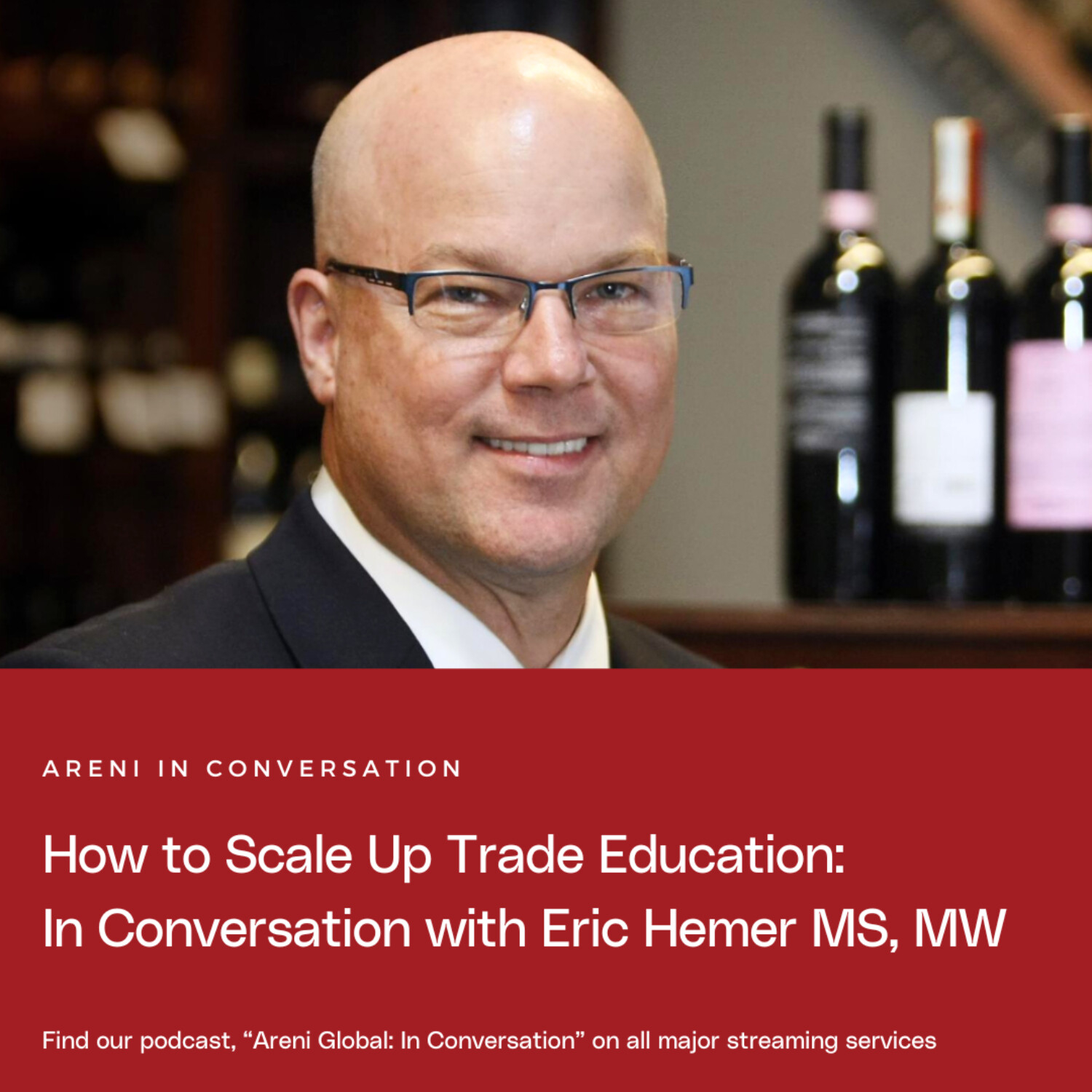
How to Scale Up Trade Education: In Conversation with Eric Hemer MS, MW
55m 46s
In this episode of the Aurene Global Podcast, Eric Heamer, a Master of Wine and Master Sommelier, discusses wine education at Southern Glazer's Wine & Spirits, the largest US distributor with 23,000 employees and $26 billion in revenue. As Senior Vice President of Wine Education, Heamer leads a team of 11 educators to ensure the salesforce is the best-educated in the country. Employees must achieve WSET Level 2 certification within 90 days and continue through higher levels; since 2014, over 14,000 certifications have been earned, including 251 Level 3 and 11 Diploma holders, making the company potentially the largest WSET provider in the US. Education is 80% focused on wine due to its complexity, covering diverse origins, styles, and sustainability issues like greenwashing, while spirits require less training. Heamer emphasizes that a well-educated salesforce provides a competitive advantage, but wine knowledge must be balanced with sales skills; the company provides separate sales training and recruits talent with existing expertise. The goal is to equip salespeople to guide consumers through an increasingly vast and complex wine market, promoting new regions and combating misinformation.
Welcome to the Aurene Global Podcast. Aurene is a global research and action institute for the future of fine wine. In this series we bring you conversations with thought leaders in and adjacent to the fine wine world. To discuss how we as an ecosystem can ensure the collective future of fine wine. Welcome to this new episode of the Aurene podcast in conversation. Our guest this week is Eric Heamer, one of the only four people in the world to hold both titles of Master of Wine and Master Summilya and arguably one of the most influential wine professionals in the US market. Eric is Senior Vice President Director of Wine Education at South and Glazer's Wine and Spirits of America. The US 10th largest private company clocking at 26 billion dollars revenue in 2023 and the number one distributor of wine and spirits in the country operating in 44 states plus Canada and distributing over 7,000 brands. So tuning in from southern glazers headquarters in Miami Eric discusses his approach to professional wine education and what it actually means to scale it up for more than 23,000 employees. How does a company so big? Leaver education as one of its number one competitive advantage. What are the processes and the resources needed? What are the wine knowledge and skills needed to equip such a vast team and of course what are the most efficient ways to deliver wine education? I am your host, Pauline Vicar and I hope you enjoy this fascinating episode as much as I did. Let us know your comment on social media. Welcome Eric and it's such a pleasure to to have you and as I said in the introduction you are Senior Vice President Director of Wine Education at South and Glazer's Wine and Spirits. That's quite a long title. I'd like to start by unpacking it and if you can tell us a bit about your company we've all heard about Salvin Glazers but what kind of role in plays do they play in the in the American wine market and in the global wine markets as well maybe? Yes I'm happy to talk about it Pauline. So as you know and I'm sure many of your listeners know United States has a rather unique system, the creature system and we are a wholesale distributor in the United States. We are the largest wholesale distributor. Now we are founded in 1968 so we play that key role here in the American wine market as the middle tier between producer and retailer restaurants so we do not sell directly to consumers. We have to go through that third tier in the link so we've grown quite a bit since our founding we started off in one state Florida and today we are in almost all markets in Canada and we also recently have purchased a brokerage in the Caribbean so we're not covering all of the Caribbean as well. So we are truly North America and Mexico and nothing on the horizon for Mexico possibly Cuba someday. Oh wow okay that's interesting. Yeah the political winds change we will probably be in Cuba we have many many expats that would love to go back to Cuba working. Yeah and you just you just a short swim away anyway from Florida so. Well it's not that short and it's shark-infested and asked Diane and I had how it easy that swim was. Can you give us an idea because again as I said we've all heard about your company but it's sometimes difficult to see how big it is and like how big its influence has on the US distribution side of things. So as I mentioned we are in 44 states plus the District of Columbia so we are almost all of the United States. We also when we joined with Glazers Southern and Glazers merged back in 2016 we automatically moved into the Canadian market as well and recently the Caribbean. We have 23,000 plus employees and we are estimated to do approximately 25 billion dollars in sales for 2023. That's for both wines and spates. It is both wine and spirits and that covers about one third of all US wine and spirit sales so we're a pretty big organization. Is it a 50/50 business-wise between wine and spirits in terms of dollars of revenue? More or less I think it probably shifts slightly more towards spirits but don't hold me through that it's I'll just say it's roughly 50/50. And so in all of this as I was saying you are the Senior Vice President Director of Wine Education and before I ask you more precisely about your role I wanted to understand globally you know the share of resources that's dedicated to education so how big education is for Southern Glazers in terms of people in terms of percentage of revenue if you can give us an idea of how big education is for the group. Yeah I don't have revenue numbers on that but I can tell you that I have a team of 11 dedicated wine educators that cover the United States and we have a lot of resources back of the house in terms of graphic design in terms of content creation that sort of thing so we managed to cover most of the US with just 11 people in myself we use a variety of educational tools these days as new most companies from classroom education to online education so we're fairly efficient as a relatively small group but again that's our full-time job so it's amazing what one person can do say in the state of California or Florida when their education is their only responsibility. And so what is your role what is your it's your main objectives as Senior Vice President of Education and your main responsibilities. My main objective is to simply simply to ensure that we have the best educated most certified sales consultants on the street in the country period. So when you say education for Southern glazes just to be 100% clear you just doing internal training you training your own Southern glazes staff or to also train people from outside of the organization. At 90% of it is internal training and we do some external education as well and we're also involved in you know various organizations outside the company that are related like the one in spirits education trust the Institute of Masters of Wine of course and the Court of Masters of Lawyers Society of Wine Educators so we use a lot of external certification companies to certify our people but we have our own internal training material as well you know with 23,000 employees it's more than a full-time job just training our personnel and the idea is nothing new it's the trainer idea make sure that our people are capable and qualified to go out and do staff trainings and restaurants and retail shops that sort of thing. How many people because you've said 23,000 people is a large workforce and there's 11 of you so if I were a better at math I could do it straight away but how many people do you train or do you educate a year roughly? Yeah I might say we it's in hundreds and it varies from year to year since I started this job in 2014 our personnel have achieved over 14,000 wine and spirits and sake certifications and so next year we will easily surpass 15,000 total certifications so it just it really ebbs and flows and we've been adding on new certifications as we go along for example WSET finally released to level 2 sake which we've just started on so that's not just wine certifications we do spirits we do sake we have some beer certifications for markets that sell beer so any beverage that we sell we've got an educational program for. And so 14,000 certifications is your goal to have 14,000 individuals or are those certifications held by you know just a small group of people but because as they go up and up they add certifications. Most people hold more than one certifications and of those 23,000 employees they're not all sales and sales marketing you know I'd say 16,000 or so are on the streets or say selling in some capacity whether it's management fine wine consultants etc. And then we've got to you know a huge massive back of the house operation but it's interesting a lot of not all of the people that we certify are in sales and marketing are back of the house people are very very much interested in learning about the products that we sell as well so some of our most enthusiastic members come from other jobs other than sales you know we always have a few people from accounting or you know even merchandisers who don't necessarily sell anything but just got set up product displays we've got many merchandisers that have certifications and it's great because it gives them a clear job path you know sort of an outline to follow they may start as a merchandiser and then go into sales and and move up into other positions throughout the company so we really believe in in educating our people giving them all the tools that they have to be successful in a sales position but we don't exclude other people and keep it just for sales we want everybody to understand and know about the products that we sell and merchandises you can that can give you some creative angle I suppose when you understand different things about the product that might you know influence your creativity and your inspiration so if we go back to the sales people I mean what kind of level do they have is there a requirement of level of certification or knowledge when entering the group so is there a requirement to enter and do you have like a minimum certification for them to achieve while they are in the group is there a given path yes there is we have fairly clear parameters
First of all, I should mention that my team of educators are all very highly credentialed. We have master similar A's, we have WCT diploma holders, we have certified one educators from the society of one educators, which is fairly unique to the North American market. So they're all very highly trained and educated themselves. And we expect salespeople to achieve at minimum within 90 days of employment certification and outside certifications, minimum requirements, WCT level two, wine and spirits. We don't use level one. We have our own internal material that covers the same topics that their level one materials do. So we do expect everybody to have our own online training. We have an introductory course called Wine Basics, which they have to take within 90 days of employment. And then within two years, as long as they're employees in good standing, we start them on the WCT path. And then the other optional organizations that we do use, including the court of master similar A's, society of one educators. So WCT is our main outside certification body. We have over 10,000 WCT certifications, including 251 with level three. And we have 11 diploma holders. And we've really just started working hard towards getting more diplomas. We've got several hundred now that have level three. So we have a lot of people that want to start the diploma track. So that makes you the biggest WCT provider in the US. Because I mean, those are very big numbers. Yeah, it probably does, although we only use only for our own employees. So we don't have any. Yeah, yeah. I guess it would be. I'd have to check with them, but I'm pretty sure you're right. So it's either you've got the level two already when you start the company, or if you don't have it, you expect it to pass it in the first 90 days of employment. Yes. All right. So if you take a step back, I'm going to ask you a lot about your teaching program in a minute. But before we take a dip dive into this, I wanted to take a step back and ask you about globally speaking, even outside of Southern Glazers, when you think about wine education today, what would you say is the purpose of wine education and what should wine education achieve in a global sense? Looking at it from the perspective of those that are in the trade in some fashion, I think it's more important than ever before, just because the world of wine has grown so much over the past several decades. Today's consumers, there's just such a huge selection of wines to choose from. I think that all tears, the wine industry, whether you're a winery, whether you're a importer, or a distributor, a person, I like Southern Glazers, we have an obligation to become educated. As much as we can to help guide our customers. So I think when I first started the industry, choices were so limited, we didn't even know that one was made outside traditional Western European countries, basically. And California was the only new world region that we had for sale. We've never seen Australian wines, New Zealand wines, or anything South America. So over the past 30 years or so, it's just become overwhelmingly diverse when you look at the wine choices. So I think it behooves all of us to have as much education as we can so that we can properly guide the consumer. And to help promote new wines and regions, if you didn't know about Bulgarian wines or some of the other central and Eastern European wines that are coming to our market here in the US, I know in London, those wines have been better established for a longer period of time. But here, we need that education to help promote these new regions that are coming to our shores. So it's more important than ever. I was thinking when you were speaking, trying to find other industries where the choices has exponentially grown for consumers, but where they don't spend that much time on education. And I was just thinking about fashion and how the fashion world has changed with new designers and so many different origins for fashion from the tea bend to the high end. But I guess for Salesforce, the difference is that the 10 to send only one brand and not have one thing which is unique in our industries. We sell brands from all over the world. We don't we don't specialize in one. If you look at our inventory, we have tens of thousands of SKUs and stock units of different wines and spirits. I mean, the choice just from our book alone is staggering. And then when you throw in all the other encoders and the distributors around the country, there's so many wines that choose from all price levels, all styles. I mean, nobody ever heard of orange wine or petnats or any of that are trendy and fashionable and popular today, 30 years ago. So it takes, and I have to say the whole booming organic, biodynamic, sustainable wine movements. So there's so much misinformation out there and disinformation, so much greenwashing that you really need an educated Salesforce to help guide our customers who can help guide their customers as well. I read the interview of you for the time of your city, I think, where you said, education is critical to success as a wine and spirit distributor today. And that was the big quote of the interview. I was wondering if you could tell us a bit like why in bit of detail what makes education so critical in terms of being able to sell wine. Yeah, just from a simple sales aspect, because the well-educated Salesforce gives us an advantage over our competitors. Do you have any data on how much of educated Salesforce versus a non-educated Salesforce for achieving terms of results? Now, it's more anecdotal and what we see in the industry, we are the biggest, we consider ourselves the best in the North American markets. And we definitely have a larger Salesforce and more certifications, more education. I think we put more of an emphasis on education than our competitors do, not to disparage them. Everybody knows education is important, but we are out of the box pretty quickly on education 20 years ago or so. I've been an education for seven for two thirds of my 35 year career. So we had dedicated educational posts before any of our large competitors did. And I think if you look at our growth over that time, a lot of success can be attributed to having the best Salesforce period and the best educated Salesforce to boot. So we definitely spur and we believe from the ownership of the company all the way down through the ranks that a well-educated Salesforce definitely gives us a competitive advantage. So it's something that I'm really trying to crack the code of is, a good Salesforce is a Salesforce that knows wine. It also knows how to sell. And as your empirical experience, you need to know about wine, but you need to know about selling as well. And how to balance those two things. >> Yeah, absolutely. It's a double edged sword. You can't just have wine geeks that have no idea how to say. >> Yeah. >> It's very true and a valid question. So we actively recruit employees that come to us with a decent level of wine knowledge, especially for our fine wine divisions. We have many different divisions within the company. Some that are exclusively dedicated to the very finest wine out there. So we actively recruit employees that come to us with a good level of knowledge. And then we'll evaluate those employees so that we can sort of fine tune their continued wine education path while they're working for us. So we do, we spend a lot of time and effort on recruiting the right people to come to Southern. In terms of company education, do they have educational skills development in terms of selling as well? In the pure skills of commerce and trade. >> Yeah, absolutely. We have talent management and talent development personnel that's, make sure that everybody is extremely well equipped. When they hit the street, we recruit a lot of bright young talent from universities. We do job fairs, we attend a job fairs. We hold our own internal programs like fast track programs to identify those that will be successful in all the, not just sales, but all of our various departments at Southern to make sure that we have the best. And that we continue to train them and hone them. So before a salesperson even goes out on the street, they go through quite a bit of intensive sales training and training with all of our different software tools. It's very complex these days. That's one of the things that started the idea of having a white paper on wine education because there's so many times where we can see wine education being limited to wine knowledge when actually now to be good at your job knowing about wine is just not enough. And so it's really interesting to see that you've got those, those double tracks that actually an education program or the company level is of course about the product. But also about the skills that you have to have to succeed at your role. And I wanted to ask you because you manage wine and spirit is the need for education the same when it comes to selling wine or when it comes to selling spirits to do spend more time teaching one or the other with it the same. No, no, we spend more time teaching wine for sure. I had to come up with a number. I'd say 80 80% of its wine education 20% spirits other. Including sorry, it's just spirits just aren't that complicated. Certainly there's many, many more brands these days and ever before seems like every day we've got a new flavor vodka or a new single barrel bourbon to sell. But it's just it's less complicated. Wine is just so complex that it really it's intimidating to even knowledgeable people. So we really spend a lot of time on wine education because it requires it. You know, certainly being able to sell it doesn't matter really what you're selling, whether it's wine spirits or widgets or manhole covers, you know, sales and sales and it's a hard job at the end of the day and you have to be good at it and have to develop those selling skills to be successful in our industry most certainly when it comes to wine education. You've mentioned a couple of things you mentioned, you know, the diversity that it increasing in terms of origins or style you mentioned, you know, pet that and orange wines and all of this. But you also mentioned topics like re-nwashing and sustainability.
and new methods of farming. So my question to summarizes, what do you need to know in order to sell wines because you've mentioned topics that are very, very different? How do you build your teaching program? And how do you focus education? 'Cause you can't know everything. And yet you need to know a lot of things. So how can you narrow that down to programs that give people in a nutshell, when bite size, things that they need to know as large as wine stars and what's happening in the world of wine today and big trends and consumer trends, which I assume are also very important in your education program. Yes, well we certainly try to stay up to speed with contemporary issues and what's trending and we incorporate that into all the classroom training we do. Plus we have our own learning management system online, Southern Blazers University, where we post all kinds of educational seminars such as these contemporary topics that you're mentioning. We just completed a new alternative bit of culture, certificate course. It's on our website that all employees are urged to take. We don't require them to take it because they're required to take so many online classes already for suppliers, for brand education, for HR training. There's been so many new things that developed over the past few years that are certainly important to society, in a diversity and tolerance and all the other things that are sort of under human resources. Our employees have to be up to speed with all of this. It's a very complex world that we walk in these days. So trying to find the time for the Salesforce to continue to improve their knowledge through contemporary issues, it can be challenging. We try to make it easy for them. I do a podcast of myself that's, we do it twice monthly, I keep them short to a half an hour, just so people when they're driving from a capital account, we do a lot of driving here in America. It's not one that we can't take the tube everywhere. (laughs) When they've got 30 minutes of downside, they can listen to a podcast. And it's almost exclusively devoted to brand education. I interview wine makers and proprietors and just teach them about these different brands. So anyway, we can. We're fortunate to have the wherewithal to invest in the best technology, and we certainly try to utilize it, especially when you're reaching a Salesforce, as widespread as we are from Alaska to Florida, Hawaii to New York and everything in between, it can be challenging. So we try to make use of the tools that we have to continue to train people on that recent certificate seminars that we have online include alternative viticulture, which also covers orange wine and petnets and some of the other trending wine categories. - How tailor-made are they for Southern glazes? 'Cause you decided to develop them internally, but there are some other initiatives that are doing similar things. Are you doing it specifically? We force at Southern glazes to using some of the brands you represent or trends in your own market and local things. - Yes, predominantly. We always, we create this material ourselves. And so, we tailor-make it for our employees, for our brains, et cetera. But they are applicable to customers. We do share some of our resources with our customers, both on and off-premise customers. And we have something called proof, which is our platform. It's a very interesting and sort of the latest technology. So, customers can come online and place orders and without having to talk to us an actual salesperson, which is good for the customer. It's certainly very efficient so we're doing business. But it's also a good method for us to provide education directly to our customers too. So we have several different methods of education delivery, some for our customers, some for installing employees. - I wanted to talk to you about the gray zone of education or the part of wine education that you thought was lacking resources and those were the resources that you had to develop in priority. - Well, I think, you know, the trouble with, you know, printed material, those it's absolutely as soon as it's released, right? So the world of everything is changing so rapidly today. I mean, you can look at technology, you can look at medicine, you can look at all the things that, you know, it's like lightning. One moment there's something new and what you were talking about yesterday is now, you know, obsolete. So it's kind of the same thing, you know, obviously, not as important as medical breakthroughs. But wine and the world of wine changes so rapidly that we have to keep up with it by developing our own materials and not, you know, being dependent upon WST or-- - So it's more the resilience I see more than the, you know, the topics that was in coverage. - And we do create things to need. Like management will come to us and say, look, we don't have any educational material on sustainable, you know, viticulture, we don't have anything on orange wine, natural wine. What's biodynamics mean anyway? And so we'll create materials based upon, you know, a need from our customers and our Salesforce. - How do you work with the Salesforce to actually enrich also the educational program based on what they learn on the floor? They walk the streets and meet the suppliers and is there a way you manage to integrate what they see in education? I mean, you diffuse information and education to them. Do you have a way to bring back what they see and include this in new trends, education reports or new consumer segmentation kind of thing? - Yeah, and that's a good question. Yeah, we do. You know, people, well, everybody's, our suppliers as well, you know, we represent a lot of very large importers that also have their ear to the street and our tunes to the latest trends. And so yes, of course, when people come back and say, look, you know, we've been seeing a lot of this particular category out there, what do we have in terms of education that we can go out and talk to our customers about? So we do create material based upon feedback that we receive from the Salesforce, certainly. And we also have, you know, management personnel that go out and analyze business and we've got a lot of analytical tools, obviously, that we utilize, technology is a wonderful thing. They can help us pinpoint trends by demographics, you know, it's amazing, the analytical tools that we have today that we didn't have 30 years ago. So it's a lot. I mean, and you can only do so much, you know, the other day you can only do so much with the feedback that you get. So you really have to be careful and win out through, you know, what you're getting to determine, you know, what the next project should be, what's our next educational priority? So it's a constant shifting landscape, if you will. - So what would be your next education priority or project? - I can tell you, I'm working on a new program that's designed to be given classroom format. It could be an online thing, but it involves so much tasting that it's easier to do classroom. And it's really less of a focus on geography and more of a focus on the most important grape varieties and the styles and ones that are made from them and how to sell them. That's a key component that's missing in a lot of outside certification programs. You get all the foundational education that you could possibly want, but much of it is missing that next key step. How do you apply the foundational knowledge to sales? And I know that's, you know, that's a topic that a lot of people talk about. So we're really trying to focus on that. Okay, great, you know, this grape is Verdechio and it comes from this part of Italy. You know, where do you sell it? How do you find a home for Verdechio and a wine list? Where can you, you know, go out and promote this wine in what avenue of trade will you have the most success promoting this particular grape variety? So we're trying to take a different angle on traditional wine education and get away from Appalachians and European Union, you know, rules and regulations, which as you know can be mystifying and complex. And just get down to the basics. Hey, is this wine tastes like this now? Go sell it. We're going to sell it. Let's give you some tools to go out and make new placements for this. Or in terms of price as well, do you have education material on, you know, this is in terms of pricing, those are the wines that you can propose on by the glass program or that could work, you know, for those kind of promotional events or things like this. Does it part of your education as well? Oh, yeah, absolutely. Price categories are, you know, super important for everybody to understand and, you know, obviously, there's not a one-size-fits-all out there, but we do have something for every price category. You know, we have a very diverse book. And even in categories are becoming so expensive, they're almost unattainable to many, like Bordeaux or, you know, top-bordeaux, top-burg. And we do make sure that our sales people are aware of maybe lesser-known appellations that, you know, fill the bill for somebody that can't afford to buy 100-plus dollar bottles of wine. There is something for everybody. So, you know, we're very cognizant of brands, pricing and category pricing as well. So you mentioned at one point that, you know, salving lasers spent a lot of time in recruiting talent and then, you know, talent acquisition and talent management. I was wondering, we hear a lot about the unlicensed restaurants at hospitality having a lot of problem to recruit people and to retain talent for many different reasons. Is it the same thing in your part of the wine world in terms of distribution? Do you find it harder to find talent notably on your sales team and has the profile of people that you employ now has changed a lot compared to, you know, the last decade, for example? And that is dramatically as the on trade. I mean, it's amazing the Exodus, you know, away from the on trade just using that one phrase, an example, because I think people realize that there are other things that they can do and make a similar amount of money. We're all kind of mystified. Where did all these servers go? What are they doing? Every restaurant has-- - Do you know-- - Did you think-- - Yeah, maybe, I guess that's it. At the end of the day, restaurant work is hard work. You're on your feet for 12 hours of shift sometimes and work in 60, 70 hours especially, you know, and find dinings, you know, sort of an-- - Thanks, Al's happy.
sometimes. So every restaurant here I know from the finest establishments in the land to those that are less so are having staffing problems and it creates a new opportunity for us and a challenge for us too because we have a whole new set of people to go out and train. There's a lot of Somalia's have left the profession and aren't coming back a lot of restaurants that used to have a dedicated Somalia position have decided they can make do without it so it's sort of a good and bad you know it means we have to kind of start over and you're constantly training new customers and you might have people with less knowledge in front of you as well and they're with a higher turnover as well. Oh exactly. Far less it can be dangerous dealing with some of you has a position of buying responsibility that knows nothing about wine. Is that an expectation then from your customer that you will help them with that staff problem? Oh yeah it's certainly education you know it's is a key part of what our fine wine consultants do they not only go out and you know make the presentation make the sale but then they're expected to help the restaurant train their wait staff onto how to sell these these ones too so it's a key part of education you know right there on the street level and that's why we work so hard to make sure that our people are the best trained on the street so that they can go out and turn train their customers and help sell the products that we have sold to them. I had a conversation with a wine brand that was very inspiring to me there was saying to me you know before our job as the sales force of that wine brand was stopping when you know the contract was signed the wine bottles were shipped and they're like we are actually we're thinking our job to now our job is going to stop when the bottle is empty because when they do all those on-stage activation sometimes the on-trade doesn't have the staff anymore to pour the wines and to serve the wines and you know you don't just need a ambassador to talk about the wines when the rest of the you know restaurant's staff is doing the job of pouring and bringing the glasses and everything and now they're actually thinking about building an event's team that could go along with the wine ambassador to actually serve the wine pours the wine drink glassware you know manage all of that because the staff restaurants might not have that anymore and I thought that was interesting to think about you know your job as a distributor or person that sells wine doesn't stop when the bottle is sold but when the bottle is empty and I thought I was in a nice thought and so you were saying the distribution it's not that hard it's not that difficult to acquire talent to recruit people it's always challenging but it's it's less difficult now because we've dedicated the resources to going out and getting the best people you know like I said we have whole divisions that we never had in the past like talent development talent management recruitment you know not just from college campuses but you know and job fairs but once we have them in house we continue to develop their sales skills you know as they become sales consultants and find wine consultants so the the job certainly doesn't end once the employees hired we got to recruit the right people then we have to continuously fine tune their education so that they are as effective as they can be on the street do you have an idea of like how many people come for the wine and how many people come from the rule so you know they're just interesting in selling and they could sell whatever or they're just coming to the wine side I think if you look at the typical new employee in this coming to our fine wine side they tend to come from a restaurant background a lot of a lot of our people and so I guess that answers my question too where some of the servers are going they're coming to work for us yeah but yeah we do recruit a lot of people from the restaurant business and that can be good and bad because sometimes they come with baggage it's not good so it's nice to have malleable people that we can you know train and turn into the type of employee that we want them to be so it's really an ongoing you know effort to not only recruit and attract the best people but to continue to mold them into even better sales consultants so instead of a print where wine education gets in the way of sales performance or in other words the more you know the less you sell yeah that's a good question and I think it really varies from person to person you know sometimes you do see I don't want to say more seasons employees but sometimes employees with a you know a high level of wine knowledge tend to only promote the type of wines that they like to drink because they feel that they shouldn't have to sell wines that they wouldn't drink that they feel are beneath them or don't appeal to their personal taste so you know we we try very hard to dissuade them from that notion you know the best sales personnel regardless of their level of wine knowledge can sell everything and find a way to do it. Well how do you counteract this because that that's you know some of the stories that we've heard as well like I used to push my my staff to go through the WSIT level and then when they reach level three they start being efficient because they just want to sell expensive burgundy and that the wines that people want to buy anymore that's a big package of course but how do you actively discourage that? Well I mean through you know communicating with the employee you know everybody has performance goals that need to be achieved so you know at the end of the end of the day if you aren't selling what the company requires you to sell then you're not you're not performing your jobs like any any job employees get reprimanded disciplined etc so the individual targets I suppose in terms of sales and in terms of which you know yeah it doesn't matter what you're selling like I said from wine to widgets you always have sales performance goals is distribution goals there's case goals etc etc you know it's it's very complex topic we can spend a whole different podcast talking about that but you know let's stick with wine education I was talking about responsibilities and we are also looking at the responsibilities that comes with teaching as a teacher or as an educator what would you say your responsibilities are towards your students? Well you know back to my original principal primary goal is just to make sure that they have the tools they need to be successful on the street selling wine so that's foundational education and it's sales application too so I think just by focusing on those those sort of twin goals you know we accomplish pretty much everything we we need to accomplish when it comes to education and there's nothing wrong with the word teacher I pride myself on being a teacher and educators just a you know five dollar word yeah do you talk about wine and health and how to equip people that work surrounded by our little everydays that part of the education programs are it's not something that you know obviously we we all talk about it we all promote responsible consumption whenever we do any type of tasting informal or formal everybody is required to spit and to use a crash wall to use a spittoon you know everybody's very much aware of over consumption not just from a health standpoint but from a safety standpoint you know we have salespeople gonna go get in their car and drive somewhere so we're very very careful to make sure that people are not drinking wine they're just tasting wine and of course we have all types of HR training when it comes to that and that includes you know responsible sales and service but also for yourself you know responsible consumption of alcohol how do you measure the impact of your training programs do you have a framed way of measuring the results the impact how successful your trainings have been you know it's kind of an intangible thing unlike you know sales performance goal of you tell something they have a team has to sell a hundred cases of brand X you know in a 90 day time period you can track that those sales daily education is a little bit harder to track it's a little more of a long term because you don't always immediately see sales and distribution increase so it takes time as sales consultants go out and conduct their trainings with you know which staff and retail trainings so it can take some time but certainly we are able to you know measure success at the end of a 12 month period for example you know we've been talking about Italian wine you know in the third quarter and we go out in the fourth quarter and look at sales on the brands that we were promoting you know obviously we've seen increase in sales and it's really just a confidence factor I think the sales force if they're not comfortable or unfamiliar with a particular brand or category they're not gonna go out and promote it they're afraid they're gonna embarrass themselves that they might mispronounce something or give erroneous information so once you've educated them on that particular category you definitely see the confidence level come up and that's when you see the increase in sales they're gonna go out and push something that they've been avoiding because now they they feel comfortable selling it is confidence something that you also teach or develop outside up so I understand the more you know the more confidence you likely to be you know talking about something but I've also had some friends because I'm on the MW program and I've also had some friends on the MW program that are already MSS and when you ask them why you doing the MW because you're with the NMS which is a fair question to ask you as well but they actually use the confidence and so he's like well then I will have more confidence to talk about it and like well if being an MS doesn't give you the confidence the MW might not give it to you well is big educated enough to be confident and if not how do you work on this with your sales force? Yeah it's a great question and sometimes you can have very knowledgeable people that are just a little bit afraid to do public presentations don't like to speak I remember you know very well you know when I first started I you know I came from a restaurant background myself I had a good level of knowledge I was fortunate enough to work for a restaurant where the manager was just a total wine aficionado and we did weekly training classes that were mandatory on Saturday mornings which most people hated but for me it just sort of lit that passion you know lit the candle the flame of wine I just really was hooked from that moment on but also daily's pre-ship tastings we would do so I had a high level of confidence I sold a lot of wine in the restaurant business so I knew how to come out and talk to customers about wine and why
this particular category is not on their one list and it should be so I was fortunate enough to have those skills and it's something that you can teach and it just it comes with working with them, you know, practicing effective public speaking. We work on that on clarity of communication, you know, when you're in a classroom setting with people and they're not being distracted, you know, online education is great, but it's only great to a point because you can't really control people's attention. But when you're in a classroom looking at somebody face to face, then you can work on it, you know, say, okay, let's, now you present, you know, we'll do some role playing and you're the customer, you're the song, you know, that sort of thing and go back and forth. It's like anything with practice, you get better. I won't say it makes you perfect, but it brings proficiency and you learn how to have a system of mentorship or shadowing people as a way of seeing how things can be done. When we hire people, that's part of the training program. They do work with mentors, they do shadow and go out and see, you know, how it's done. And we try to continue that, you know, through management, scene of management, does a lot of coaching and working with their sales personnel. And it's, you know, some people are just natural born salespeople. Others have to be taught how to be successful and how to be effective when you're out there speaking to customers. So, you know, there's a lot to it. The advantage is apparently from what I take from working for such a big company is that regardless of your profile from the beginning, whether you are already a one deep knowing everything, but you don't know how to sell or you're a very good salesperson, but you don't know much about wine. You are able to balance your skills and to go and pick what you need to to ameliorate your craft, basically. Yes. Yes. And we spend a lot of a lot of time analyzing that and analyzing people's strengths and weaknesses. And here's the areas that we want you to improve upon. We're very much in tune with personal management. You don't just hire people. It's okay. We're done, you know, next, what's next on the list? How applicable is this for a smaller company? Because, I'd say it's great that you have it and you're the number one in the US. But how applicable are some of that, you know, if you talk about smaller distributors and I'm not just, you know, speaking about the US market, but are some of those tools applicable for smaller people that have maybe 30 sales force, 20 sales force that they can actually accompany that way? Or is it really the realm of being company to be able to develop people like that? No, I think I don't think it really matters, you know, how big or small you are. If you want to be effective and successful, you have to do whatever is within your means to ensure that you have the best trained, best educated personnel, regardless of size. The trouble there is, you know, having enough people to do that because with smaller companies, people tend to wear many different hats. And often that job falls to a manager who's already overworked and has too many tasks to accomplish in a day's work. So, you know, scale is one thing. We're very fortunate that we have massive overhead, part of that overhead is to have, you know, the right people in education and human resources to, you know, manage people and to do our best to ensure that our people have the skills set that they need and that they don't know where to go to get it. So it is pretty much a smaller company because, you know, at the end of the day, where do you fit that in? You know, what's the most important of our 15 different goals? Things to do, yeah. And that was also why I started with the question, what's the resources that Southern dedicates to education because, you know, money talks and it's interesting to, to know, you know, the resources that are allocated specifically to that. You mentioned a couple of times that, you know, we have to develop our own programs. The wine world in the world is changing so rapidly and we always have to be resilient in the tap. In what major ways do you see our industry changing in the next decade? Like, where do you see us going? And, and then narrowing down to education, what kind of education tools or technique for that require to adapt to those changes? Yeah, it's a good question. I wish I had a, a, a, a, that's a good answer. You essay question, isn't it? As I said, I think I've answered this in paper five a couple of times. But if you look at how the industry has changed over the past two, three, four decades, I mean, after years of stasis, they're really not that much new things happening. It's just changing at warp speed now. So I think it's, you know, a lot of the trends that we see today are going to continue, I think consolidation at all levels every year in the wine industry will continue. But I think at the same time that creates more opportunities for smaller, specialist wholesalers and retailers, because there's, there's that growing awareness of wine here in the States right now. We've sort of a plateaued, I think on, on sales, but I think that's going to change again. And as people become more and more savvy and more interested in all the new emerging regions and styles and varieties, wine education is going to continue. And in fact, grow in importance. Yeah, I think much like the English market has grown. I mean, you've got a few hundred years head start, or maybe a few thousand years head start over the US market, which is still a nascent market. But I think regardless of whether in the US or elsewhere in the world, you look at emerging nations that are now developing a taste for wine, you know, in Asia and South America and elsewhere, that need for education from the consumer level all the way up through production level is going to continue to increase. So it'll create more opportunities, I think, for smaller, specialist companies that are nimble and can go out and and fill niches and needs in the marketplace. So the big will get bigger through consolidation and you'll see more, I think, specialist retailers, etc. at the other end of the market. It's interesting what you said about, you know, because we're not a mature market, we need more wine education. It made me think, you know, everyone says that the wine consumption is decreasing in the US amongst the younger generation. And I'm wondering how much that is linked to people in the trade, like if we have more educated people, where we have more consumers, if there's a, there's a relation kind of relationship between educated sales sports, whether in restaurants or in shops and more consumers. Yeah, it's an interesting question. And I'm not sure what the answer is, but certainly we're seeing, you know, the latest generation of adults, new adults, drinking less, a lot of, I think a lot of it is health, you know, they're about their health. That's probably with the key facet. It's given rise to low and no alcohol categories. It really were just virtually nonexistent prior to this. Now we're seeing a lot of interest in low and no alcohol categories. So it's good because, you know, we're able to shift to meet the needs of the latest generation of consumers, whether that's an alcohol product or a lower, no alcohol products, you know, a lot of companies are experimenting with CBD products. So, you know, we, we're not saying, you know, we only have to sell one spirit spear, et cetera. We sell a lot of water and a lot of other non-alcoholic products. So, but I don't think it's a matter of education. I think it's a matter of choice, whether it's personal lifestyle or health choices for this newest generation, or they're, you know, they prefer to drink, you know, ready to drink cocktails, cocktails, sellers, all the other categories that are out there. There's a lot of choice these days. And people's tastes change as they, you know, develop more wealth and get older. I know when I was 21, I could only afford cheap, blogger beer. I didn't drink much of anything else, you know, when I came to alcohol. But when I hit my 30s and started to be more successful, and of course being in the wine business different for me, it opened up a whole world of opportunity. But I think you see that in a lot of consumer groups as they get a little bit older, wine still viewed as a sophisticated product and maybe something that's more nuanced and complex and interesting, you know, at the end of the day, not the beer and spirits. Isn't interesting, but, you know, nothing is as complex and fascinating as wine. So, second liquid, the most complex after blood apparently. Perhaps, yeah. And there's something that I took in, because everyone says you need to be resilient in the world today because everything's changing so quickly. And I was wondering how you can teach resilience, because that's a big one, because we don't know the type of knowledge or, you know, that we will need tomorrow in order to talk about wine to the consumers. But we can learn to be resilient to the depth and acquire new skills. And I like how you mentioned the new project on linking wine knowledge and sales knowledge and actually going back to, all right, what do you know about a vertical and how can you position it into a wine list, you know, how you can play if you don't have that wine and how you can replace it and actually not just focusing on 100% knowledge or 100% sales skills, but really building bridges between both, which is a way of teaching people how to think by themselves and be resilient in the future. Yes, yes, that's very true. And I think that's just keeping your eyes and ears open and understanding the changing marketplace and reacting as quickly as you can, you know, two of these changes so that you can continue to meet the needs of the consumers and remain relevant. It's a challenge in any industry, but certainly one that's where landscape changes as quickly as it does in wine and spirits, sales, you got to maintain an open mind. I think don't get closed in and say we can only sell this core group of products. There's a lot of different things that a company like Southern Blazers can do to continue to be the biggest and the best in service our customers, you know, as they deserve to be served going into the future. So I had one more question. It's a big thing for us, of course, at the rene. The rule in place of fine wine in wine education. How important it is to know fine wine in order to be a good salesperson. Well, I think it really depends on who you're selling to. Like I mentioned, Southern has many divisions. You know, we have our ultra premium fine wine division where a high level of knowledge is absolutely crucial to selling the products that you have because the customers you're dealing with are at least as knowledgeable as you are at that pinnacle of the industry. But when you get down into the more high volume tiers, I think it's less importance because you're not necessarily selling those categories. And in some instances, you're not doing the selling at all that's done by management.
and you're just basically making sure that the supply chain doesn't get interrupted that you always have plenty of product on the shelves. But I think even at that level, and as I mentioned early on, we have merchandisers who are many are aspiring up and coming find one consultant someday, who knows that wants to know and have a thirst. And I think when you get into a company that includes education as one of its basic pillars, one of its basic foundational elements, then it's contagious, whether you're a merchandiser or a truck driver, warehouse personnel, back of the house accountant, whatever, you get that passion, that fire. And then you want to know as much as you can about one education. We want everybody to know as much as they can about the products that the company sells, whether you're doing the actual selling or not. But taking a step back from South England lasers for a moment as a master of wine and a master of some really aid. How much do you have to experience fine wine in order to be a complete taster? As some of those wines are more and more difficult to taste, are they still so important to look for and to search in order to be sure that you've got the complete benchmark? I see what you're saying, though. Let me take my distributor hat off and put my MW hat on here. Yeah, that's an interesting question, which could also be an MW essay question. And I think that just because of the available or lack of availability, sadly, many people will never get to taste. The great wines that we all grew up with. So I don't think it's absolutely necessary to have a personal knowledge or background on fine wine. But I think you can still get an idea, like Burgundy, for example. There's only a few Broncrube vineyards in Burgundy, but you can taste a bill of jappelation wines. Give you a general sense of it. And the thing about very fine wine is that you have an experience that haven't tasted it and don't understand the complexity and the nuances of it. It's kind of hard to explain that to customers. So I think having that personal experience is invaluable. It's kind of like talking about a place that you've never visited. You can talk until the cows come home about, tuskety, but you've never been there and looked at the soil and experienced the climates and the viticulture and everything else. It's very hard to paint a complete picture when you're trying to sell. And you surely can't use emotion, which is an interesting way to convey messages as well and making it personal with your own emotion and if you have an experience in it. Exactly. Do you see any risks in some of those fine wine disappearing and not being accessible anymore to key members of the trade? Yes, I definitely see that. And I think with the challenges, the climate change has been giving us almost every year in places like Burgundy with a marginal climate to begin with, the availability is almost nonexistent these days. And people that used to sneer at village appellations or regional appellations or say, hell, take whatever you have. Because you just can't get top quality Burgess. So you know, parceled up around the world. It's very, very difficult. So I think it's going to create opportunities for maybe more up and coming or lesser known regions that are capable of fine wine. I like to use the Longadoccus in example. You look at not all that longer, you thought about the Longadoccus just the land of inexpensive wine. Yeah, so now if you look at producers that are making wonderful biodynamically produced to state wines, producing age or the complex wines, I think it'll open up the opportunities for these great wines from the Longadoc, from inner Boat, et cetera, et cetera. And we'll create a new set of classics. I think the world of wine is always evolving. And what we think of classics today might be very different than what one years from now or whenever. So yeah, it's sad that we talk to younger consumers and younger customers about, you know, Grand Croube, Burgundy, and Croube Classet, Bordeaux, and they have no reference point because they've never been able to get any taste any. And the likeness of them being able is small and small that almost every day. Exactly. And it also reduces their need to have these wines. The big deal I've never had them. Who cares? Let's talk about-- Not your wine. Yeah. Right. So I think there's always going to be a consumer group. I think these wines will be more and more reserved for the top tier of consumers that can afford such wines. But I think it opens up a lot of opportunities for other wines, which is great. I mean, we've got plenty to choose from. Tomorrow's Somaliers never got the opportunity to taste Grand Croube, Burgundy. Well, it's a shame, but there's so many other opportunities out there. So that's the beauty of wine. It's a shifting, changing landscape. And it's the quality of wine, even just basic. Every day of wine has gotten so much better that there's really no excuse for not selling great wines. You know, at all price levels. Thank you so much, Eric, for your time in four. Being generous for your time as well. Thank you for listening to this episode of O'Reilly Global. If you are interested in the global conversation around fine wine and the opportunities for the future of education, head over to our website, www.O'Reilly.global, and become a member. This is not only a great way to support us, but the best way to unlock all of our analysis, reports, and articles on the topic, including our next white paper rethinking education that will be live in the spring of 2024. Because whether you are producing or selling fine wine, you need reliable specific data to make informed decisions. And we have just that in store for you. Until next time, cheers. Thank you for joining us for the O'Reilly Global podcast. If you liked what you heard today, please give us a positive review and share this episode widely. Stay connected with us and join our conversations via Facebook, Twitter, or Instagram. And visit our website at O'Reilly.global to find out how you can take action to ensure the future of fine wine.
Podcast Summary
Key Points:
Southern Glazer's Wine & Spirits, the largest US wine and spirits distributor with 23,000+ employees and $26 billion in revenue, uses extensive internal wine education as a key competitive advantage.
Eric Heamer leads a team of 11 dedicated educators, aiming to have the best-educated salesforce; employees must achieve WSET Level 2 certification within 90 days and continue advancing.
Over 14,000 certifications have been earned by employees since 2014, including 251 WSET Level 3 and 11 Diploma holders, making Southern Glazer's potentially the largest WSET provider in the US.
Education focuses primarily on wine (80%), due to its complexity, with spirits and other beverages making up 20%; topics include diverse origins, styles, and sustainability issues like greenwashing.
Balancing wine knowledge with sales skills is crucial; the company recruits knowledgeable staff and provides separate sales training to ensure effectiveness in the market.
Summary:
In this episode of the Aurene Global Podcast, Eric Heamer, a Master of Wine and Master Sommelier, discusses wine education at Southern Glazer's Wine & Spirits, the largest US distributor with 23,000 employees and $26 billion in revenue. As Senior Vice President of Wine Education, Heamer leads a team of 11 educators to ensure the salesforce is the best-educated in the country. Employees must achieve WSET Level 2 certification within 90 days and continue through higher levels; since 2014, over 14,000 certifications have been earned, including 251 Level 3 and 11 Diploma holders, making the company potentially the largest WSET provider in the US.
Education is 80% focused on wine due to its complexity, covering diverse origins, styles, and sustainability issues like greenwashing, while spirits require less training. Heamer emphasizes that a well-educated salesforce provides a competitive advantage, but wine knowledge must be balanced with sales skills; the company provides separate sales training and recruits talent with existing expertise. The goal is to equip salespeople to guide consumers through an increasingly vast and complex wine market, promoting new regions and combating misinformation.
FAQs
Southern Glazer's is a wholesale distributor, acting as the middle tier between producers and retailers/restaurants. It is the largest distributor in the US, operating in 44 states plus Canada and the Caribbean.
It has over 23,000 employees and estimated sales of $25 billion in 2023, covering about one-third of all US wine and spirit sales.
His main objective is to ensure Southern Glazer's has the best educated and most certified sales consultants in the country.
Within 90 days of employment, they must complete an internal Wine Basics course. Within two years, they are expected to achieve WSET Level 2 certification.
A well-educated sales force provides a competitive advantage, helping guide customers through the vast and diverse selection of wines available today.
Yes, but about 80% of education focuses on wine because it is more complex, while spirits and other beverages make up the remaining 20%.
Chat with AI
Loading...
Pro features
Go deeper with this episode
Unlock creator-grade tools that turn any transcript into show notes and subtitle files.
 PodcastTranscript AI