Speaker 1batteries are the near-term available solution to bring down power prices and stabilize the energy system reduce waste like curtailed production of renewables and it works completely without subsidies
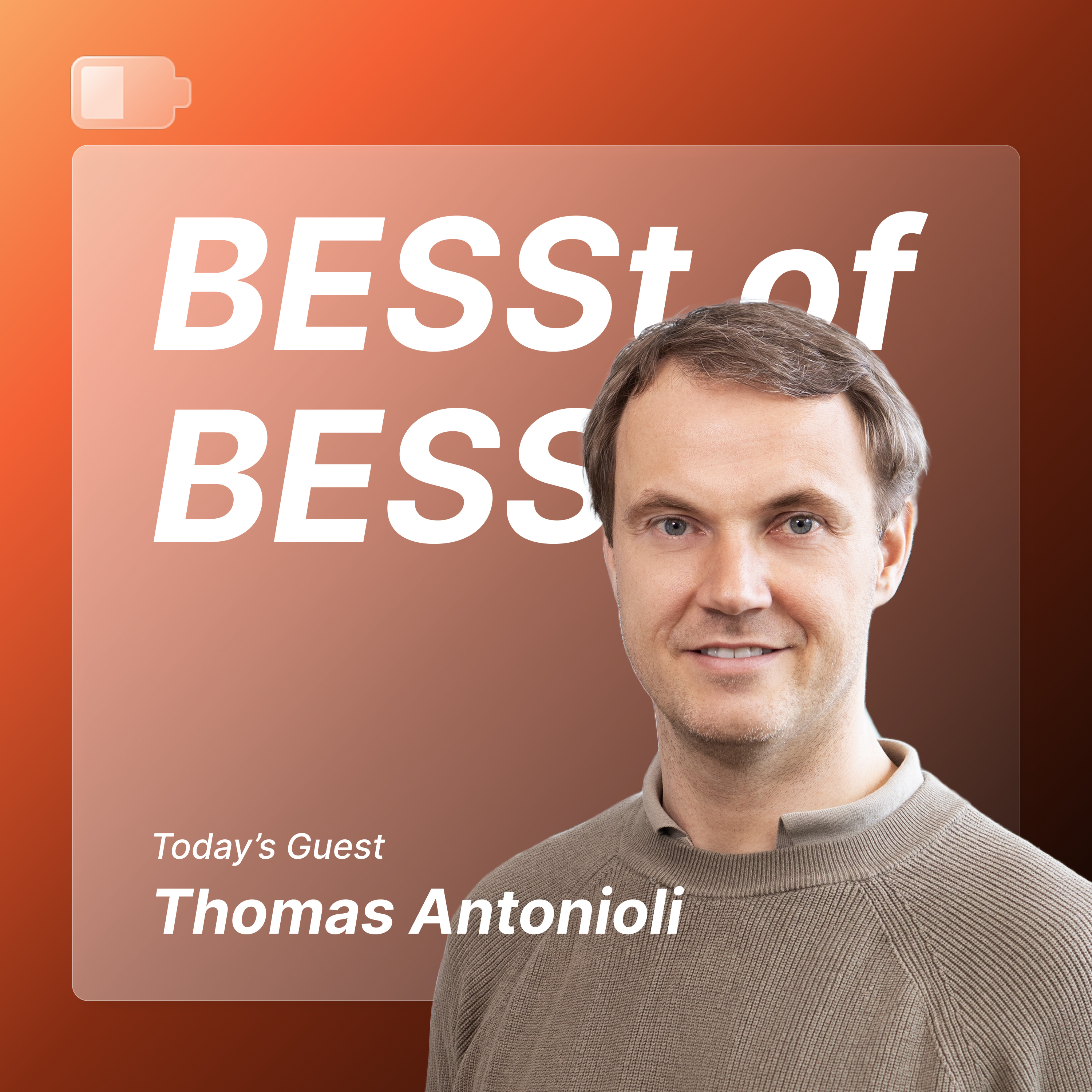
Speaker 2my guest today is thomas antoniolo co-founder and cfo of terra one a berlin-based company that develops builds finances and trades its own grid scale batteries
Speaker 1the projects get bigger a 50 megawatt project you can take a different risk on that as a bank than if you have a 200 megawatt project and a much bigger chunk of that so if you go into these territories it's natural that they want to have some sort of downside protection a lot
Speaker 2of banks don't do merchant financing anymore or don't do it at such high senior debt ratios i'm pretty curious how you see the current landscape so hello and welcome thomas it's really nice that you took the time first question write in who are you and what do you actually do
Speaker 1hi max thank you for having me on your podcast very excited to be here my name is thomas antonioli i'm co-founder and cfo of terra one i'm a i'm a banker by training so spend first five years of my career in london doing financing huge ports airports uh motorways etc and selling and buying companies that was very exciting when i was 26 jetting around the world doing big deals etc really cool over time a desire grew to actually do something build something rather than work for clients so after six spending six years there i went to the startup world first was a fintech startup in hamburg called credit tech where basically we scaled the company to 50 markets internationally raised 300 million sold the company to process in the end and i then moved on to a circular economy startup based in berlin called grover was at seed stage at the time 30 people and over the next six years as a cfo i had scaled that company to 800 people at the top we raised one and a half billion in equity and debt and the company became a unicorn what it did was renting out laptops smartphones anything electronic on monthly flexible subscriptions great company uh great double impact something i was always very passionate about so that was my experience really scaling up companies to several hundred million euros revenues and um yeah i left there in the beginning of 2023 the company wanted to ipo they brought in a experienced ipo cfo and i basically uh had some basically had opportunity to look for something new and i went on a trip around the world with my wife that was pregnant at the time so we so went to japan australia hawaii etc and um just while i was sitting at the beach in hawaii literally i received a long email from my co-founder who i've known for years and he explained to me the idea of building tarawan and why it would fit well that i joined him on that uh on that journey and um yeah i was immediately intrigued we started talking and i joined straight when we returned from that trip and it's been three and a half years now so i'm enjoying that maybe i should say for a few words about what everyone does yeah um so basically tarawan is a player in the german best market we take a slightly different approach from of the the usual market structure where an ipp on the one hand with our own route to market and our own development so we develop our own greenfield brownfield projects to ready to build we have an in-house epc team that basically contracts the external epc which currently fully wrapped we go together with the project financing then execute the project and importantly afterwards also have our own route to market uh platform it's called one graphic and optimizer platform so we have all the balancing groups we have the exchange connections we have the pre-qualifications for ancillary services and so we basically provide the full stack from from end to end which we think is the is the right approach for us so we have the first project live since the beginning of the year we have three more under construction at the moment five more that are close to final investment decision that we want to get in before year end and overall we have a very very sizable pipeline i won't won't go into the kind of breaker what's uh topic now but we are scaling up very rapidly um are well funded we raised the 150 million hold co-financing from a uk insurance company called aviva last year which helps us fund the the build out and um yeah we're 50 people based in berlin very active also offering the offering the optimization for third-party customers we currently have 60 cast third-party customers on our platform mostly renewables so pv wind but also batteries uh co-location is a big uh big topic and um yeah scaling rapidly enjoying the right uh with all the challenges that the german best market uh provides uh which we'll go into more detail later on in the
Speaker 2podcast first of all like i think many many of the listeners will probably already know terra one and uh i myself i also really follow what you do and it's uh like a really interesting approach um like the vertical integration upwards so we will talk about this later on i wouldn't like first take a moment and uh do a deep dive in in your cv uh at the at the start because um one may may wonder like how this transition flows from investment banking into the startup world how was it from your perspective and maybe how did you evolve through the different cfo positions in early stage startups to now financing bass as a cfo in in terra one like how was your process and how how different was it from investment banking into the startup world and then to terra one
Speaker 1when i made the transition from banking to the setup world i joined as vp corporate finance in the startup that has a had a slightly more complex capital structure than a typical sas company that only needs a little bit of equity for developing software and and and market expansion etc uh credit tech was a consumer finance company so they needed a they had a balance sheet of money that they lent out to customers so that could not be funded out of equity so there was more complex capital structure and that is something that i knew that i had experience with and where i could provide value and it's a similar story for ed grover where we basically finance these electronics basically laptop like like this one with big asset-backed facilities so somebody would lend us 90 95 percent of the of the purchase price of these of these devices so we wouldn't have to fund that from equity because we had some like a almost a billion and worth of of devices at some point right and you couldn't fund that just with equity because the the returns on an individual device are not high enough for to justify financing this with venture capital which has return requirements of more than 20 per year but uh ir requirements so you look for cheaper source of funding on the same at the same time it's also not as risky as a venture investment right because this kind of this laptop or battery will always always has a residual value at any at any moment so you can use different layers of capital that are cheaper have different kind of properties and then equity and um that's kind of my specialization and it's also the same thing now with slightly different with slightly different instruments but a similar thing at one here it's project financing so it's not many many small devices in one big pool right which you have i had at grover it's similar at npal for example where many kind of smaller smaller assets grouped into one big pool but here at one we were project by project financing um which is more similar to the airports and ports etc that i financed in my banking career but also kind of it it's intermediate because the the assets are more uh typically at least in our case the revenue is not fully contracted for 15 years but a little bit more volatile so it has has properties of different financing instruments and yeah it's very very much my my specialization and um what i enjoy doing providing the capital of to make the energy transition happen in a way if you want to if you want to put it that way and um there's a lot to be done in that space i think a lot has developed over over the recent years i mean we've seen many big financing rounds also for for startups that build camp that have cabex or built kind of hard physical infrastructure i mean from rockets to uh now riverian yesterday etc so it's great to see that to see that transition or development because a few years ago kind of vcs were not like would have big reservations to touch asset heavy business models right just because they saw there's a lot of capital if this goes well we will need a lot of capital and this is more capital than we can provide from our funds i mean you know how big most pc funds are um so you need different pockets of capital and that this is opening up is very positive because to some extent at some point you can only affect change in the real world if you have real assets you can only go that far so far on the software layer and um yeah facilitating that very much is
Speaker 2my mission in a way that's honestly super exciting because it's such an under communicated topic how the venture capital world evolved over time and for us internally i can say we argue a lot about whether infrastructure in itself a plain developer for example or an IP can be a VC case like is that is that really a thing like doesn't IPP have the potential to be worth VC ticket at the end of the day I think what you mentioned about Grover like hits the nail right right on spot because you had to leverage those laptops 95 percent in order to meet the IAA expectations that a VC would normally have on its equity how do you think like because you would not reach 95 percent on a best asset most of the time right especially if you decide to go merchant so how do you look into that is best a VC case and you you raise venture capital like this plain best ownership and development VC case and if not what do you need to add like in your case maybe the vertical integration upwards so so your one craft work what do you have to add to make it a VC case that's like a really interesting question I guess yeah in the
Speaker 1in the renewal space the model exists in a different way from from wire so there in the VC world basically you start a company and you raise you raise money and you give away maybe 20 percent of your of your cap table or your shares in in the round and you know basically you have different milestones and you do another round once you've reached the next proof points you give away 20 percent yeah etc and then once it scales at some point hopefully at exit you have to add to make it a VC case that's like a really interesting question I guess yeah in the as a founders you have somewhere between by about 20 to 50 percent of the company left maybe less if it doesn't it didn't go so well and you had to raise it lower valuations at some point um in the in the infraspace they're similar funds but they work differently because they say the main kind the money is so fundamental to this um so they basically ask they give you the money you need but they get 80 of the company from from day one basically and then but then they fund your expenses going forward so you can't do that you can't do that you can't do that you can't do that so yeah you can do that but you're in you're basically an employee in your company from day one right um it's um that's because there's no real technology technological uh kind of differentiation in in that right you can be a good developer and you're able to develop a few good projects it can be very profitable and you cannot do it without the capital at some point you need to like in batteries at some point you need to pay the the grid deposit or you need to pay the or or something so it's uh the numbers get big very quickly then you have to put a seven digit deposit etc so that's the established model in that space for like very very early stage it's available how much how many shares you you retain in the beginning depends on your track record as a kind of in this industry so if you're maybe we have one uh one advisor who who successfully exited a big company and he basically got got 500 million allocated from big infrastructure fund from the from the get-go he doesn't have to concern himself with raising money which is a big kind of it's a big part of my job and kind of slows down also the rest of the kind of the other the operational deployment but obviously he he gives away a lot of shares for that um so that model exists what we have decided for us um tony my co-founder and and myself we come from the more from the tech world software world so pure infra model without a tech technology layer wasn't not that was not that kind of fascinating intellectually fascinating for us so with that and also we wouldn't have a differentiation in that space so we said we will we want to build a the tech side as well and um very early on we essentially built a company from two from two pillars that are growing towards each other so i started with a with a very ambitious and hard working team developing projects from greenfield and as you know yourself that takes a while right you need to get the land get the permits and and then you need to get the land and and then you need to get the grid connection then need to need to mandate an epc then there's a construction period so it took us around two years to have the first project live which was still fast like we got the first project from greenfield to our to ready to build and in under a year and then and build it for for a year and was live um so that was fast but still two years time before the first revenues from battery come in and you can really see whether your optimization platform works on a we build the trading side on imperial um so get all this like the full we say regulatory infrastructure so we have balancing groups so with all tso's in germany we have a balancing group also in austria netherlands uh some other countries we got the exchange memberships with with epax nordpool we got the pre-qualification for ancillary service so um with the with each tso you need the pre-qualification both both for the company and then for the assets so there's a 500 million behind it you still cannot do it faster right because the people take take time to reply etc the whole process and then we built this in the the the trading execution platform so so um we had the um the luck of winning one of the earliest employees of openai matthias who was their employee number 30. he helped us build our own proprietary llm architecture for trading signal generation and we also had steffen who used to run the algo trading side the next cafe the biggest renewable optimizer in germany um and those together with tony's developer skills so he he's been coding since he's 10 so he's very amazing and has a team behind him from his previous ventures so we built that platform we started initially so we had no batteries we have a trading platform we want to see how it works so basically we started prop trading so non-physical trading just trading in and out of positions to trade in and out of positions to trade in and out of positions training algorithms in a way and and i always think about that like the formula one to kind of regular cars right if something works in prop trading if you make money in prop trading then it's very easy to make money in in in kind of regular assets asset-based trading and um and so we did that until the first battery went live we did this uh this kind of non-physical trading traded more than five terawatt hours across millions of trades made money uh learned a lot trained the algorithms etc and then um when the first battery went live we did this went very smoky basically so it worked work from day one some things take a little bit longer and so resource pre-qualification for the asset etc takes some time but it um that's how where both pillars came together
Speaker 2i have a lot of questions on this but uh just to make sure that we like uh uh also like get the whole view on your founding story as well uh i would go back to how you met tony you already mentioned that you knew each other for a long time so i'm really curious how you met your co-founder and then maybe how you build up your first employees and then uh land like also lending employees like you mentioned the the one of the first employees of open ai so like how did that evolve
Speaker 1over time yeah so well i've known tony socially for about five years before we before we started channel one together and he had done several other ventures before and he also started channel one with a different idea was a trading platform for carbon credits and some point he pivoted he got this idea somebody offered him to buy a battery project and that kind of set off his thought process uh for that he had also done some work for rwe and eon etc with his with his it consultancy so he was was um innately familiar with the with the german power grid and and power market and um he had just as he as he had done some work for rwe and eon etc with his with his it consultancy so he was he always says when he when he realized that we will have to move a lot of capital one way or the other he basically thought that um kind of he thought of me and um we got along really well and and started the company then we had this obviously we had the situation that none of us knew anything about how to build infrastructure so we went out and hired our first bpec um charles gilmore a great guy who had been at next era energy the biggest renewable ip in the u.s for long time so he built he built batteries since when they basically welded the racks themselves and put the put the modules in so he is really kind of an an a veteran of the battery industry and we brought him like we could win him he came from bywa at the time he was at bywa re and um he helped us set up this whole function basically the development and epc part and that was kind of priceless for us in our in our in our given our setup and backgrounds and um then we had a very kind of ambitious hardworking young dynamic uh development team which came more from the software side so the so the two protagonists there um worked together at one of the big german uh like berlin sas startups or would say and where we're busy sales people and they had a sales team and they thought about project development in a sas uh kind of sales way right so they built funnels they really optimized the process as much as you could streamline that um made it repetitive etc so we could develop a lot of projects in parallel rather than kind of the kind of established industry way of like picking one two three projects and and putting your entire focus on on moving along um yeah and and and basically so a lot of projects came through others also didn't come through of course right and if you do it that way not every project in the end. Um, but we get product relatively quickly, um, and, and start construction. And then you have to do a lot of things for the first time, which is hard. So negotiating first, so doing the first EPC tender, selecting the supplier, negotiating the contracts, getting the first project financing was very hard for us because obviously we wanted to optimize the battery ourselves in merchant without having any track record and actually optimizing a battery. Um, and, uh, but we managed to pull it off. And, um, and, but it takes time to get this, do this the first time. Now kind of the, there was asset one asset two, three, four, five, where basically copy and paste very quick. And, and, and that's basically where the model becomes scalable. So you have the zero to one part, which is hard and takes time. And then, and then once you have it, you can replicate quite quickly. And on our software platform on one graphic, adding another asset is basically comes at zero cost, right? There's a little bit of onboarding work, obviously to get in your asset life. But, there's no incremental cost from adding assets and that's the beauty of it. And that's why we also think that we are a technology company with some assets.
Speaker 2Super interesting. And, um, can you share like some numbers on your partner? Because it's always like, people are curious about like how much is currently in operation. Uh, how much do you plan on building like within the FID timeframe? Um, so like where the investment decision is taken this year and where, uh, it will. We go live in, uh, before, um, end of 2029. Um, can you share like a few, a few rough numbers on that?
Speaker 1Yeah, I can. So I can share the first asset. That's an operation is 50 megawatt, two hours and went live beginning of this year. Now we have four more of the same. So four more 50 megawatt assets and construction, two of them are two hours. Then we, uh, busy migrated to four hours. Now we build for her. So the, the. Second, second to our, uh, four hours system, 60, seven megawatt hours. And we, we have two more of the small ones, which are ready to build, which we want to get on the way before year. And, and then we're currently working on a, on a portfolio of four high voltage assets. So combined 350 megawatts, 1.4 gigawatt hours, where we've basically signed the score limited notice to proceed. So it's a, it's a pre EPC contract for, to secure long lead items. We signed that on two projects. And on the other two where we're in the tendering process have kind of selected the, uh, the partner with whom we want to build it. And are now in the process of raising project financing for these and, uh, uh, getting some form of offtake, which we'll, we'll talk about in a, in a minute. So we're really ramping up, right. Going from, from smaller projects to bigger projects. Um, I think it's a, it's a natural, uh, kind of learning curve in a way. And, um, it's very cool. Like since, since April. We've kind of brought a project on the way every month and want to keep that pace basically going forward. Right. Um, in terms of pipeline, we have around, so now, you know, the market, like everybody, I guess, the listeners also know the, the kind of the complexities of dealing with German grid operators and the, and the things that had happened over the last year is kind of changing to from, from unrestricted grid connections to FCAs to delaying or retracting reservations. I mean, there's like, uh, to anybody you talk in the industry, everybody has their kind of war stories about unbelievable things, uh, happening from, from grid over it aside.
Speaker 2Yeah. Resizing of reservation capacity is also something that really annoying that could happen.
Speaker 1Yeah. So, um, we have experienced that as well, but we have 500 megawatts where we have real grid contracts now. And here, uh, those we hope are, are basically. Yeah. Really safe, right? Uh, we have another 750 where we have reservations that we turn to turn into, into grid contracts and, um, and then there's a big pipeline. So we apply for several gigawatts and the, and these, uh, maturity based, um, application program of the, of the TSO. So we learned in December how much of that came through. Um, and, and we have also a big pipeline of medium voltage, high voltage projects where now it seems that many of those will also enter, like kind of be reassessed. Um, and we have also a big pipeline of medium voltage projects where now it seems that many of those will also enter, like kind of be reassessed. And a maturity based, um, program by the, by the DSO. So it's still, the market is still evolving, but I think it's important to get stuff built and the, the kind of now we see some more certainty coming into the market with this, for example, this Agnes, the grid fee, uh, um, program in the end. It's costly, but it's not a kind of, it doesn't destroy the business case. It's, it's kind of the, the way in a structure they defined with a kind of a flat predictable annual fee. It's good. You can put that into your financial model, uh, upfront, right. And, um, so I see that there's some sort of market, um, wouldn't say shake out, but kind of, kind of the new, the new rules are becoming clearer and we can operate in that, uh, in that space. And also on the, on the DSO side, we see there was a kind of, uh, almost like a pause in issuing new grid connections while everybody. Like all the DSOs who are figuring out their FCA structures, right. So is that, oh, we can't give you a good contract because we're, we need to write this contract, need to determine the rules. But, um, since kind of over the last couple of months, a lot kind of many of them are now done and they start issuing grid contracts again. And, um, so the, the kind of the movement is, is, is accelerating.
Speaker 2For, for anyone that is not quite familiar, like with the whole, uh, Agnes scheme and, uh, what would actually happen. Uh, it's about like the German grid fee structure and, uh, it has been pending for a while because there has been a grid fee exemption that, uh, was stated to, uh, um, to, um, be in place for all assets in operation before, um, August, 20, 29. And this year, uh, like there was a lot of discussions around whether this grid fee exemption should be. Uh, yeah, it should be just moved from the table. Um, and luckily this year the market, uh, got like the security, um, like, and, uh, we now know that the FID for a certain amount of the project expenses needs to be fixed, uh, within this year. So up until end of 2026 and, um, the projects itself need to be built. So we'll have their COD ready in, uh, August, 20, 29. And this is a good thing, as you mentioned, because, uh, now the market knows what rules are in place and nobody discusses it. Um, and, uh, even the, the grid fees that are currently discussed, um, do not destroy the business case. Just move it, uh, one to 2% in IRR, depending on how you leverage the project. Um, super, super. Super interesting. And now I, uh, like I wanted to, to, uh, give you one, one question that I'm actually really curious about because we thought about it at 8energies for a while and, uh, it was like, uh, um, yeah, a decision we had to do right at the start. Like, uh, if you integrate, uh, a technical layer, if you integrate upwards, uh, and integrate a technical trading platform or whatever and develop it internally. This is what you did, um, with One Kraftwerk, we always thought about it in a way that we could go to Inspired or Entrix, like very, like, uh, players that have a lot of batteries in, in operation. And, uh, then if you have some assets live, uh, you, they have like this, uh, trimble down effect. So at the beginning you maybe have to, let's just choose some random numbers and the beginning, maybe you have to give away several. 7% of the revenues. And if you have, let's say 200 megawatt life on the platform, you have to pay 5% of the revenues. So we always thought about if I can just choose like a player that has a lot of batteries already in operation. And like, as for example, Inspired also publishes the data of those assets. So you can be really sure about the revenues. If you can choose those for price of 5% at the end, if you have a lot of, uh, a lot of assets live. You would at least need to benchmark internally with your own trading platform, 95% of the performance of those players. And in the 96th percentile, you begin to refinance your own tech stuff, right? So I was always wondering just from an outside perspective, it's really ambitious that you can benchmark those numbers. And it's really impressive also, also at the same way from your side. I'm just wondering, like, why did you take this decision? And can you already see the numbers? Is it just that it paid off, like that you can benchmark, benchmarking against those players that already have some assets live? Where do you benchmark? That would be super interesting to know.
Speaker 1First of all, I'd say it's correct for you to look at it, right? It only, it only makes sense to do that yourself from a certain scale, right? It's probably 500 megawatts or so on once where basically what you, the money that you spend on your fixed cost base, developers, et cetera, data sources, et cetera, and so on. as our capacity that it is. cheaper to do that if you assume that you're not going to outperform the others yeah right and we try to get there faster and we get there faster by offering the platform to third-party customers right so the the the factor is approximately one to ten so one own asset to ten one megawatt own asset to 10 megawatt uh third-party assets so we have other kind of customers also contributing to the platform and the platform also gets better by renew like optimizing both renewables and and batteries because you have more more information can trade better etc um and we have this bad tracking so far our i alluded to that earlier for our first project we had to raise project financing before we had traded a battery today so so basically what we did to make their work is that we introduced the concept of a backup optimizer so we have a standing contract with one of the known optimizers and they're basically if we don't perform well the the bank can switch can can swap the the optimizer out right and um of course we don't want that it happened and um so there's always a benchmarking and we're did that happen no it didn't it didn't it didn't happen and it tells you something so yeah we're confident that we're performing at the at the level in the end what we also learned in the first year it's not the kind of outperformance is to one extent like the excellence of the algorithm decision deciding which market you're in and series service intraday and etc but it's much more mundane is kind of uptime of the system right if you if you're the dso uh um kind of does some refurbishment on the on the on the on the substation and your asset is offline for five days that it has a bigger impact or or some battery modules kind of go go offline for a while because somebody like something happened that's kind of that's kind of a revenue impact that is hard to make up by uh by kind of excellent algorithms right so it's more it's kind of a revenue impact that's hard to make up by uh by kind of excellent algorithms right so it's more kind of a revenue impact that is hard to make up by uh by kind of excellent algorithms right so it's more i would say um before we had the asset life i was always a little bit skeptical people saying yeah operations is really asset management is really uh a key a key profitability driver but it actually is right because in i would say in with the algorithm maybe you can get 10 50 outperformance right because in the end the the the the workhorse or like the biggest revenue driver is basically the the delta between the cheapest and the most expensive hours plus some plus some and serious services but that's in the asset like everybody unless kind of you can do a little bit buy the power a little bit cheaper and sell it a little bit more expensive and trade trade in between to optimize your positions but the kind of the the bulk of the revenue is from from that uh volatility in the in the day ahead prices and um that that's what we see we're happy with the like very happy with the performance of our algorithm at the moment also customers see that and are also happy with with the performance that we deliver so you it's not easy and it takes a while i mean it took us well almost two and a half years or so to build build this whole stack but it's it's running well and we think that we're confident that we can perform at or above the level of other
Speaker 2optimizers quick pause and i promise it's short for this show i try to bring the best possible guests and shoot the striking questions behind every episodes are hours of research and preparation because i want you to walk away from the fact that you have learned something real if you want to support that there's one really easy way hit the follow button and share this episode with one person who lives and breathes energy like we do that small step makes a huge difference for the show and honestly thank you for listening and for every comment you leave your feedback shapes where this podcast goes next so keep it coming okay back to the show now you mentioned that there are four more projects on the high voltage level which are generally like involved as as many as possible may know but if not on a high voltage level you have to buy a substation you have to build it it's a long time scale do you plan to bring those for all to fid within this year so to get the green fee exemption and to build them before 2029 or is it like uh not
Speaker 1planned we're pushing for it but i think it's going to take a while i think it's going to take a while for it definitely yeah yeah it's on the final it's on the final stages the the the pc contracts are there right uh we need to raise when the process of of financing the like finalizing the project financing and let's see if it's going to be uh two or three or four we'll see we want to hit that deadline we also i also don't think they or basically the definition of the cutoff or what you have what you have to have to benefit from the exemption is also a little bit more of a it's still in debate in the consultation phase right because for example if you buy the project right and you paid so you paid the project price and you paid the bkz you already have a big i mean you invested a lot like maybe it was sprained in the in the in the regulation uh in the draft was for the components but um we and other industry participants think that's not really fair because we may have invested already 10 million into an asset even though we didn't sign the pc contract right so and we'll see how the final wording comes out i'm would say i'm positive that we get all of them to benefit from good free exception but if not but if not it's also not the end of the world i've also heard
Speaker 2from other projects on a high voltage level that they took the final investment decision prior to the uh uh agnes reform yeah and therefore they didn't fix half of the of the component price yeah which like just does not trigger the fid condition yeah and therefore they now need to restructure the whole process like the whole um they need to do all the work with the banks with the equity investors with the uh with everyone again just because there's just not enough uh of the whole component price locked in in the fid which is also like a really interesting problem and i i guess at the end it costs a lot of money uh to to solve this
Speaker 1issue in time yeah we didn't have
Speaker 2that quite lucky so you already mentioned that uh that there need needs to be probably uh more more financing in place you raised already 150 million mezzanine financing i guess for equity part in in those projects so is it now that you uh also financing the projects with senior debt and uh mezzanine or is it
Speaker 1only structured so the the correct terminology is hold co-financing so basically we have the we have our tarwan company under under which there's a separate holding under which the the individual project entities yeah and so we so basically the aviva financing is a loan on this holding level which provides part of the equity contribution to the to the project so the way we finance the the project and the way we do the offtake we get around 70% gearing on the uh on the on project um level and then this facility covers currently 80% of the remainder so 80% of 30% and the remainder comes from equity that we bring as tarwan okay nice which is a kind of an instrument that enables us to deploy roughly half a billion in capex with a relatively modest equity uh ticket at that point because equity is more expensive in the beginning uh then then once you have the fleet built out that's a way of how we went
Speaker 2about it so talking about the financing landscape in bass it has evolved over time um and uh in the beginning there were a lot of banks uh not in the beginning but uh last two years there were a lot of banks that financed merchant projects also with a lot of senior debt so like 70 percent as you mentioned 75 percent and i've even seen uh that and this shifted a bit i heard from a lot of ipps that a lot of banks don't do uh merchant financing uh anymore or don't do it at such high senior debt ratios um so i'm pretty curious uh how how you see the current landscape uh you already mentioned that you plan like some sort of off-tech structure maybe some tolling i'm curious for your high voltage projects so generally i'm really interested in how how your communication flows with the banks
Speaker 1at the moment i wouldn't wouldn't call it more kind of growing risk aversion but it's more the projects get bigger like yeah like a 15 megawatt project you have don't know like 10 million of debt you can take a different risk on that as a bank than if you have a 200 megawatt project right and a much bigger chunk of that so if you go into these territories then banks it's natural that they want to have some sort of downside protection for so looking how merchant revenues have developed in some other markets that matured etc so i wouldn't say kind of there's a there's a strong trend in banks to demand more tolling i think it's actually for the same size if you look at the same financing amount the demand for tolling is coming is is has come down i would say before they would say we need 100 percent tolling on a hundred bank about Acid now, we're happy if certain proportion is contracted. And we see more banks getting more comfortable. I would say we also have to look at the history. A lot of the German project financing banks in the renewable space for the past 20, 30 years have been kind of spoiled by government-guaranteed feed-in tariffs. So there was basically essentially zero risk. You would underwrite the asset and you could underwrite 95, sometimes over 100% of the capex with senior financing because you only had a volume risk and the price now turns out it's also not the case because now we have many negative price hours and then the capture rates go down. But that's the mindset there. Many of the land-sparing or project financing banks come from in Germany. The same bank, maybe super conservative in Germany, they do merchant battery projects in the UK. It's kind of the teams and the market, etc. But I think overall the understanding for batteries is growing on the financier side, which is good. It's also the space where there's volume, there's business, right? Because now in wind and PV, kind of the deal volume has come down or projects are kind of borderline comfortable or not financeable at all. So batteries are kind of a place where, kind of a segment where they can deploy capital. So you need to find a, also a little bit, find a way to make it work, right? Because in the end, what do you do as a bank? You deploy money for interest. And if you don't, you can also avoid all risks by not giving out any loans, but then why are you there? So you need to find a way around it. And this growing understanding, we see that now. So we run a structured process for our project financing for these big projects. And we've received several, or actually double-digit number of term sheets negotiating with a few lenders. And the off-date structure that, that we decided for, for our stock, for our kind of company set up is a so-called day head swap or TB structure, meaning that we retain full operational dispatch control of the battery, all the upside from ancillary service, intraday optimization, future revenue streams, like dynamic crypties and capacity market, et cetera. While at the same time, logging in on hedging ourselves against the compression in the day head, spreads, right? So, so that is a, and that's a pure, pure financial swap, if you will. So we get a, we get a fixed amount of euros per megawatt per year for a period of five or seven years in return for giving the, giving the off-taker the, the Delta, like the actual number between the cheapest four hours and the most expensive four hours.
Speaker 2It's basically, oh, sorry. It's basically what all those like, like players, like Andriik, Svena, and all, like all of them, they, they cannot offer tolling. So, so they also like do those swap structures, as you mentioned. I've spoken with a lot of, of them, but I'm quite curious and maybe to listeners, like I've spoken with Steffen Schultz in last, in the one of last podcast in the, to this topic in detail. I think it's for like an outsider that does not know much about trading is how to understand at the beginning why such a swap product actually works some sort like a tolling. Like this is at the beginning, it's hard to understand. So maybe if you're interested, just look into the episode and there you can get like more, more details on this topic. But in your case, I'm really curious for, for those projects that are coming up, how much of the capacity are you planning to use for like fixed swap products? And how much for, for merchant trading?
Speaker 1So you can compare the percentage to a regular toll where you basically give away, basically hand over the keys to the battery, like full dispatch control to an off taker here. We retain in the, in the day and swap, we retain the dispatch control and we do the swap on that 80, 200% of the battery, right? So we, we, we basically, we essentially buy a hedge against a compression in, in the, in this, in the spreads.
Speaker 2Okay. Got it.
Speaker 1Head market. And it doesn't interfere with our operations. Yes. Of course we have to drive these numbers. Like we have to drive these hour, like buy and sell these hours to replicate the, the swap structure, but we can optimize from there on that. We can do and service, et cetera. So we basically based on our simulations, we retain the same merchant revenues, but we essentially get a getting kind of get to get a fixed stream for part of the part of the scraps. And if something happens, like, don't know, like the hormones thing, then they had spreads may go up super wide and we don't benefit from that, like from that as much. But if they go down, we also get our study.
Speaker 2And that's super interesting. Just, just just I'm wondering, is it because in your case, there's no separate optimizer. Is this a reason why those revenues are still comparable to two to merchant revenues? Like, because
Speaker 1it's a, yeah, I would say so. But even for, even if a third party optimizer optimizes the battery, it depends how you instruct them. As you tell them, we have to do, um, there are also different, different forms of day head swaps, but there are some where you actually have to trade these hours and there are some where you just have a pure financial instrument and you can do, basically you can drive the battery as you want, but you have to make the payment as if you had done it the way.
Speaker 2Okay. One topic that everyone is talking about, and, um, I'm really curious what your experience with it is, is the FCA topic and how it evolved over time. Um, I know from a lot of developers and has been publicly discussed as well, uh, that, uh, there are sufficient, uh, RAM rate restrictions that the grid operators require recently that, uh, have the potential to destroy the ancillary services, uh, operation. Um, at, uh, at some locations. So I'm just curious, like, how do you generally see FCA structures evolving over time and, um, how it's evolved in your projects specifically, and did it have an impact on your ancillary services, uh, yeah, optimization.
Speaker 1Um, so yes, FCA are becoming the new standard, right? Uh, this is, uh, almost, uh, important. It's possible that you get a grid contract for a battery to in Germany today without some sort of restrictions and can be, you mentioned a few, but can be, uh, restriction on, on ramp rates. Um, it can be restrictions on import or export at certain times. It can also be a limitation on the provision of ancillary services, like with how much of your capacity are you allowed to participate in the, in the FCA, AFR markets and some other mechanisms that, so as many will know, we have more than 800, um, DSOs in Germany, uh, plus four TSOs, everybody is making a little bit is coming up with their own rules. Um, it's also because this has not been yet regulated by the, by the German grid authority. So there's a legal basis to, to issue flexible connection agreements, which are in a way, mostly flexible for the DSO, not for the, for the, uh, for the connection taker. Um, and we need some regulation around that. Right. There needs to be rules. I think in general, it's understood, um, grid operators need guardrails, uh, to maintain a stable system. That's their kind of their primary responsibility to maintain system stability. So they have to improve or introduce guardrails that, um, ensure that this is still the case with a large amount of batteries on the grid. Um, what I would say is that D things are, are not. In a, like, they're not given in bad spirit. It's really, um, grid operators look at their systems and they introduce things that they believe they need, um, because they don't know how the battery is act and how they act at scale. So you'd rather be a little bit more cautious and strict rather than having issues later on. Um, what we've seen, and we've worked very closely with several DSOs on the development of their FCA structures. Because we, um, because we have the, uh, route to market capability and we can backtest individual rules, et cetera, quite quickly. Um, we've been able to kind of improve the structures for the, for the batteries, because in the end, what we've seen in the DSO wants to achieve something, but they don't really know what it means in each case for the, uh, for, for the battery. Right. And, um, I think there, there's a room for, for, uh, uh, communication for alignment where, where the batteries are able to accept restrictions that the DSO needs, which avoid unnecessary revenue cutoffs. So you mentioned ramp rates as one example, um, that is for example, and we have 800 DSOs, but many of them are still owned by one company in the end, right? Which is, which is Eon and, uh, Eon, uh, introduced a company wide ramp rate of. Around 6%. per minute, which means the battery has to uh kind of run up or down over 15 ramp up or down over 15 minutes which is kind of unheard no other connection taker has that right no no gas power plant no coal power plant no solar farm no wind farm but they just made this a rule for every battery because they're worried that if 20 gigawatts of battery kind of fire on the same millisecond that they the grid will basically melt down um so it's kind of we understand where they're coming from but still would say the ramp rates are this are the kind of the most harmful rule for battery revenues because the battery benefits from exactly that capability that it can change basically ramp up and down very quickly and fill little windows so it's quite it's quite painful and i hope that at some point the the regulator already announced that they will look into fca rules that they will at some point put some guardrails around what can be asked from the grid operators and in the end they would be grateful for that because they're currently operating in a vacuum and come up with their with their own rules so i think it's well as a battery operator i don't like them i'd rather have an unrestricted firm connection but i also accept if that's a way to get more to bring more batteries online faster it's fair still a question of whether these are permanent restrictions or to at some point make the connections unrestricted right different debates um it's also a question of whether you have to pay the full grid deposit if you have a restricted connection because i find it discriminatory if i have to pay the same hundred thousand per megawatt in in in bow cost and socials as some with an fca which leads to 10 15 percent lower revenues as someone who has an unrestricted grid connection right so this is something where the regulator needs to come up we've seen certainty as well as the regulator needs to come up we've seen certainty as also also reduce the deal the the bkz if they give out an fca which i think is not only fair but warranted right um others are more kind of reluctant to that and um and then the business case may become borderline if you have to pay the full bkz while at the same time having a 10 reduction in revenues and have to pay grid fees right then then kind of the the the project irs of these projects take quite a significant hit and that kind of prolongs the ramp up right uh delays the ramp up of batteries which are of course super important for the entire energy system for the for the capture rates of renewables for affordable power prices for industry and consumers etc so batteries are the kind of a near-term available solution to bring down power prices and stabilize the energy system reduce waste like curtailed production of renewables and so on and so forth and so forth and so forth and so forth etc and it works completely without subsidies so we should not put more stones in the in the in the in the path of the ramp up than necessary right we should find a look for ways to make this um kind of keep it investable while giving the the grid the stability and and protection that it needs um
Speaker 2generally like on your existing projects uh first maybe do you have like fcas in place on those projects and how did they influence your business case
Speaker 1so the first project so we have around out of the the 500 megawatt of grid connections around half of it is under fca half of it not just to maybe clarify what means
Speaker 2not because like many may may wonder like what this then at the end means like no no fcas just means no restriction but a general ramp rate of 40 i guess was it right i
Speaker 1mean there are ramp rates um provided by the um bd bdw or something like there's some technical a technical body that defined what the ramp rates should be for kind of connection takers yeah right um now this uh this kind of the eon six percent deviates from that by a mile right but but there there are these restrictions in place which always apply which don't kind of don't interfere with with operation of the battery right that that's what this is what what we're used to working with and what we would like to have as well but uh um anyway so so we have that but we have basically unrestricted classical grid connection agreements right for part of it and for the other part we have fcas in different shapes and forms and we don't yet have operational experience um what we see is that that they're always um these all tend to cut themselves a lot of headroom there right so for example we have one with one dso they basically have up to 800 hours per year where they can restrict import so charging of the battery they gave us historical data and it was only 100 hours per per year historically but they want to have a buffer for if renewable penetration gets higher etc um and 100 hours are perfectly fine at 800 hours if it's the wrong hours can be painful but we've also seen that it's mostly the time i mean the battery even if it only operates so say um driven by market forces so not not um the net steam list on an mark dean list in 98 of cases the the battery works in the same like basically balancing the grid right we charge when power is cheap and we discharge when power is expensive that's the natural way the only thing the only point where this differs is because we have different power price zones right so it might be the power prices are really low because there's a lot of solar in bavaria but there's no there's no little power at the at the baltic sea right and and vice versa then yeah but these are like two percent of the cases in 98 of cases the battery charges when also when there's too much power and and um and so that naturally works without the guard like without strict requirements uh only by the battery optimizing and and maximizing their revenue okay interesting
Speaker 2and so you on the projects that are currently live there's um no fca based there's no there's no restriction and how how do you expect to like can you give me like a rough like scale of uh from x percent to x percent like how do those fcas that you currently have on like future projects how heavily did they influence in your calculation the business case because we've seen a lot of white papers yeah i think green flexibility published really nice white paper on how certain fca restrictions impact the business case but uh you will definitely uh have made those calculations attorney so it would be really interesting to to get a view on that so we've
Speaker 1seen between two and 17 18 percent of revenue reduction yeah um we have not accepted we also have not accepted some right when the project is not viable if you for example there was this famous thing in in in bavaria and the bayern verco was this hill curve which forces you to charge and discharge at certain times where i have a problem like as a kind of with my property rights if somebody forces me to do something i mean it's it's for me a qualitative difference between you cannot do certain things at certain times between and you have to do certain things at certain times right so i don't think that's legal right that that's the other that's the other thing um but um anyways that the kind of the position of the grid operators is if you don't take the connection somebody else will happily accept it so we're in this um in this kind of run on grid connections and grid connections will remain scarce for the foreseeable future right so that that's um that's also clear um so we've seen what i said 3 to 17 it's hard to calculate because you don't know how much the kind of curtailment will evolve ramp rates you know for sure what it what it means um in the this kind of restriction on import or export it's hard to tell um it's dependent on each individual grid grid point and you typically here you get the day in advance you get kind of notified of the hours when you cannot charge or discharge um and can vary by year which makes it a little bit hard to predict
Speaker 2okay so quite a right range uh in between exactly yeah exactly exactly and can you maybe like give me uh an example of how a two percent fca looks like and how a 17 fca looks like so
Speaker 1well two percent is only the one that i alluded to earlier where you only have import restrictions on certain hours and these hours are mostly the the peak load hours in the evening when the battery doesn't charge at all but no ramp rates no restriction on the n-series surface etc and the 17 percent is ramp rates restriction on n-series services to 20 percent uh 25 percent and and strong kind of import export restrictions based on renewable production in a radius of 20 kilometers which is in itself also crazy like we we are forced to then monitor wind and solar production in a radius of 20 kilometers around the connection point and have to kind of uh uh switch off or on the battery depending on on on how the wind is blowing i mean that that's kind of externalizing the without without uh remuneration the task of the of the grid operator in in my view and that i i don't think it will kind of persist uh once the regulator looks into these rules makes
Speaker 2sense super interesting insights and then i wanted to come to to another topic that i thought would be super interesting to discuss with you which is the topic that i covered a lot in the podcast but it's really interesting to talk with someone that actually does this in practice which is co-location um there there is this idea i think it started and was like legally possible two years ago uh where you can use existing solar parks um and then like just use their inverse revenue structure or their inverse solar production structure and then place a battery next to the solar farm and operate it as gray energy storage system um and this this idea we also like uh wrote a white paper on this topic and i thought it is really interesting and exciting challenge but we found out that it's quite hard to find the right ipps to work with that are not willing to invest in batteries themselves and um so i'm really interested in your just general approach on co-location um i described gray local co-location now of course there's also the option the most classical way to place a battery next to the pv park and operate it over the same grid connection and do not apply for it in in betzooks grant um so yeah how do you generally position there i've i've read a lot of stuff uh and and you uh kind of did some some pioneering in this area so i'm quite curious how you do you position generally and how do you approach
Speaker 1it so i would put it a little bit in a two by two two by two metrics with the with the axis being one is retrofitting an existing park versus building a new park and the other is pure green stores so no import from the grid versus a gray storage basically with kind of co-located but with import from the grid so building a new plant today like a new pv or wind park i don't i don't think people can make the economics work without without some form of battery because the capture rates at the at the time especially for solar all solar produce at the same time are just too low to to do that so it's it makes a lot of sense to add a battery if you build a wind a new solar farm today right and um it's also kind of on the macro level we need to turn renewables into a reliable base load and that's what kind of co-locating these saves on infrastructure right you only need one kind of one transformer one copper cable etc so it's much more efficient to co-locate it at the place where it's generated if you can uh then kind of building a standalone battery 50 kilometers away from the solar farm and then every the power has to go through the grid first to go to the battery and then go to the grid afterwards so that part building new sites co-located hybrid is is a no-brainer if you haven't if you have a existing plan then you it gets a little bit more complicated because you might have different owners of the battery and the pv the the solar park may be 15 years old so it has like 10 years left to kind of to run but the but the battery has 20 years life so what do you do afterwards kind of how do you agree all of that gets a little bit more fuzzy and then getting import from the grid is quite so as long as you stay behind the meter purely green storage is relatively easy from to get a permit from or kind of get that permission from the grid operator they still sometimes introduce ramp rates for that which is kind of completely i don't understand it the solar plant doesn't have ramp rates but the battery then has one um but if you want to get import so far we have not been successful in getting import right the the kind of the strategy is do a green search first and you apply for import and at some point you get it it's a little bit like having a little these scratch lottery tickets if you get that if you get the import then it turns into basically it has the same economics as a standalone battery if you don't then it's a green storage it's still kind of for a long time it was for us not not really investable because the because the curves were were were low so of course we need for for financing we need curves from aurora baringa moto etc and these curves for behind the meter storage were very low because the curves for solar were too high right because i mean also we're now not getting into that too much but of course the the solar industry is a big customer of these people and they want to finance projects so they have high curves more than what you see in reality and then kind of if it goes into the whole ng market model then of course the the the kind of capture rate of the battery is low if the power price of the of the of the pv so but we've seen that in the latest updates green search became much more profitable so now the investment case works and we have a couple of projects that are fully permitted etc where we want to start building quite shortly so it's very positive i mean not just positive for but it's positive for for i think the energy system that this co-location is now is now working and um in the end there's almost 200 gigawatts of renewable generation already installed and that's kind of the placing batteries with these is is kind of the no-brainer thing that we have to do
Speaker 2as a country yeah yeah okay they're super interesting because i've spoken with a lot of people about this topic and uh always everyone was uh just oh the the the green the green uh green uh best business case is already there but not yet yeah and uh everyone was waiting for the moment when the ir lived up until they're bankable basically um so did you like uh did you already uh do the fid decision for those projects so is it like really that you were able to secure financing and and stuff like that because we ourselves we also like calculated a lot um if it if it works uh just placing a battery next to an existing pv park and then owning just the battery and then operating it um so yeah like i i did did you do the the the bank financing and is it already on a construction or where you're
Speaker 1standing exactly yeah so we have several ready to build projects and we're currently working towards the fid okay yeah so but the the business case works which is um which is important i mean we have a we have a project hurdle rate for our holdco financing which needs to fulfill and with the new curves um the the behind the meter project or green search project fulfill that and um we're we're on the way there the beauty of it is if it works it's much faster than a standalone storage right because you don't need to have to build a good connection etc there's a substation etc so you basically just build the battery site which can be done in nine months right from from get go so it's um um it's quite interesting and we are confident we found a way to make it work it's kind of the i think the the the crucial part is in the in the in the grid sharing and the kind of the relation the contractual relationship between the asset the the the pv asset owner and the battery asset owner if they are separate yeah right so we invested a lot in in kind of designing a contract a grid sharing agreement that um that kind of is bankable and um so we're we're looking forward to scale up this part a lot because in the end it's also uh we say it's always for us a wedge around the grid queue right we came i know you posted something yesterday about the the big project being built as as gray brownfield right so i think that's the kind of the first wave was small standalone projects now there's a there's a wave of big brownfield sites where where people who were had had the foresight secured uh big and and foresight and connections secured big uh big uh old industrial uh power plant etc grid connections and um and then but that will not nearly be enough to satisfy the demand for for batteries so now there will be some on the on the transmission grid hopefully quite a lot when we see this the tender tender process but then eventually this 200 retrofitting these 200 gigawatts of existing renewable is a is kind of the kind of a a project that is has a lot of potential because it circumvents the the main bottleneck in this whole thing which is the grid right so um i'm very hopeful for that how do
Speaker 2you structure a green uh green green bass uh colocation contract because uh i've looked into this in a white paper that we wrote and uh it's always the question as as you mentioned who has priority so who has priority in a green bass uh colocation contract because you both want to feed at in the capacity at some point right uh to to earn money so the question is when there's incentive for both to feed in yeah who has priority and who does not have priority and uh like is it the case that you compensate for the losses of the pv when you decide hey i want priority or is it that the pv generally has priority and you work around that like a hook whoever um so
Speaker 1i can't go into too much technical details of that but what we typically do because we're we're the optimizer as well so we we add the battery and we then optimize the whole plant as one right so it's coming out of it's it's it both assets are on one graphic and we optimize them and the priority rules are basically set in a way that the the solar plant makes at least as much revenue as they would have without battery right and then they get the share of the of the of the surplus that we generate with the battery so if anybody's interested in that sorry for the advertising please reach out to us we we we have a we have a big uh first transaction with concilium earlier this year for retrofitting 200 megawatt peak of solar across a number of different projects with 150 megawatts of green storage so we have that experience also with regarding the contract etc it's tested and it works well because so why can we do this because we also have the route to market capability so we can do everything out of you one hand basically okay super
Speaker 2interesting yeah i also saw the the concilium deal so it's basically a deal where you um place batteries at the existing parts of concilium exactly exactly so we do
Speaker 1the sizing we do the technical engineering we bring part of the capital etc and then we optimize the whole um the whole plant the whole hybrid plant which also for us obviously is important because we want to be a technology company as well as an infrastructure company and um it's for us attractive attractive also to to have this optimization business that
Speaker 2could become quite an exciting growth scheme i guess uh yeah um i'm definitely curious like uh when once you you've reached the the financial close i'm really curious like uh of the terms and and stuff like that and um now what is the next market that you have an eye on if you would need to expand from germany today what market would you expand
Speaker 1to so well we are in berlin which as you know is kind of 50 kilometers from the border to poland which is a is a a big country with a lot of coal currently in the in the energy mix and renewables are growing batteries are growing we have a and we think this is kind of the natural next step we also looked at austria we looked at netherlands we also have some time we have pilot projects in the netherlands that we're developing with partners and we're also looking at latin america but we currently think that poland is quite interesting we have a we have a project developer agreement there with a with a local developer to kind of shorten the time to to having the first projects rtb and apart from that we are looking at larger european growth markets it's it's also one experience from my previous startups where in the first one we expanded to 15 countries very quickly and the other we expanded to five countries very quickly is that as a as a small company as a young company adding an additional market adds a lot of complexity and it should be big enough so that if it works out it's transformational like um it it have not offending any european countries but like being being good in luxembourg compared to germany will never get management focus etc and our business is very it's highly regulated right there's lots of local regulations every time maybe within europe you also have different currencies which makes it makes it harder on the financing side etc so one has to be quite deliberate about which countries to go to to both make it potentially kind of impactful on the overall company and not create too much complexity and and destruction and kind of detraction and scaling up super
Speaker 2interesting and then there's one question that i always ask at the end of the podcast which is what do you believe if you had to place a coin and bet how much capacity in the utility scale best area in germany will be live end of 2020 30. i would say between 10 and 15 gigawatts okay i'm taking it thank you so much for your time thomas was a pleasure having you here thank you thank you
Speaker 1max was a pleasure
 PodcastTranscript AI