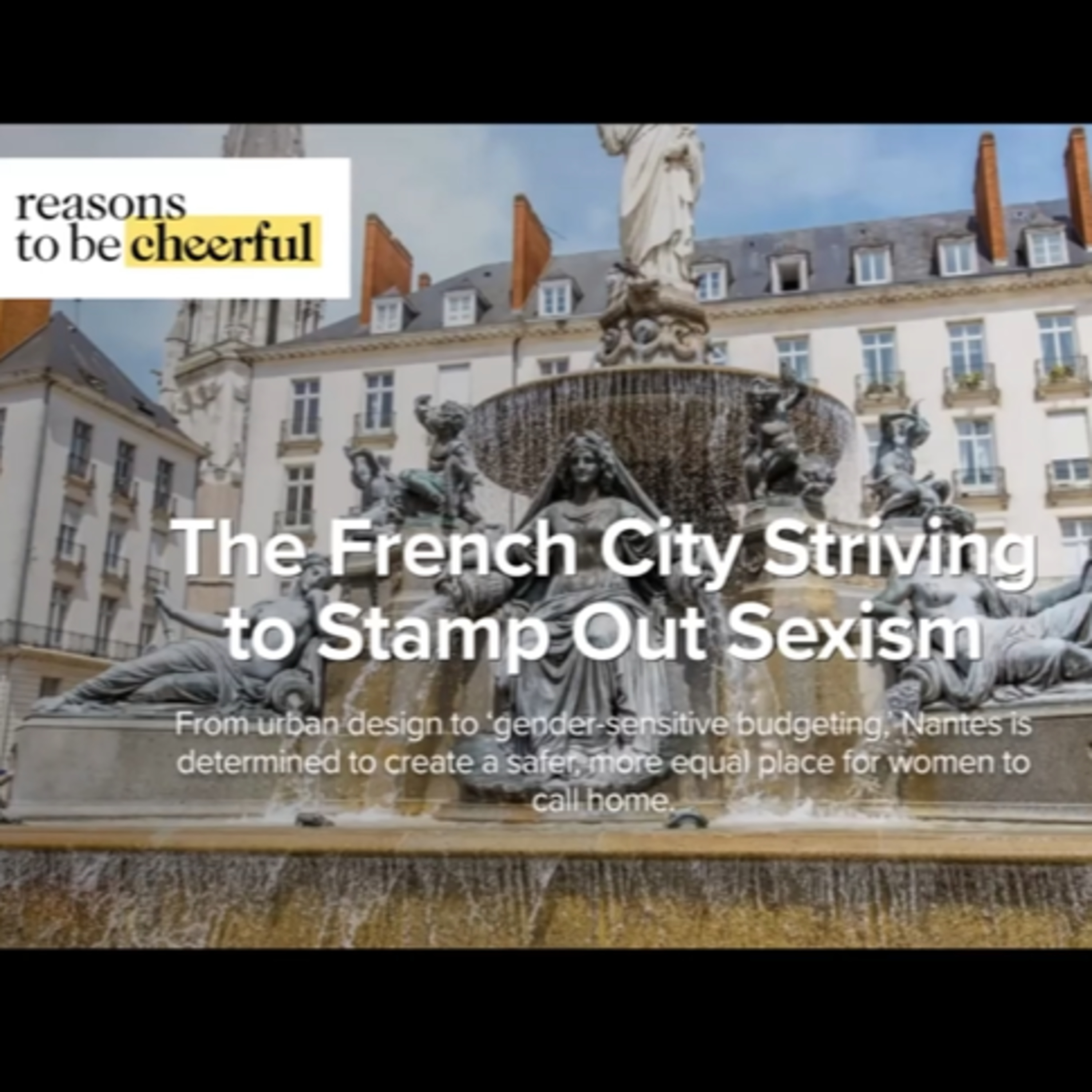
Peter Jung, a solutions journalist based in France, presented his reporting on Nantes’ ambitious goal to become a "non-sexist city" by 2030, a project launched by Mayor Johanna Rolland in 2014. Solutions journalism, as Jung explains, focuses on how communities address problems, requiring detailed context, evidence of effectiveness, and acknowledgment of limitations. In Nantes, the city first tackled a lack of data on gender inequality, discovering that less than 4% of streets were named after women. This led to symbolic and practical changes. The Citad'elles center, opened in 2019, centralizes care for women experiencing violence, offering a safe, thoughtfully designed space with relaxing lighting and child-friendly areas. The city also renamed streets after women like Josephine Baker and Frida Kahlo, installed public benches for breastfeeding, and redesigned schoolyards to include green, calm spaces, reducing male-dominated play areas. To address period poverty, dispensers were placed in public buildings, achieving high demand, such as 2,000 products distributed monthly at one library. Public campaigns, including feminist tours, aim to reduce taboos. Jung emphasizes that while these initiatives are innovative, they face limitations, such as ongoing studies on schoolyard impacts and the need for broader cultural shifts. The approach, including municipal budget analysis, is inspiring other French cities, but Nantes serves as a leading example of integrating gender equality into urban planning.
Welcome, everybody. This is the Rotary E-Club of Silicon Valley, and every week we bring
you the story of people who are making the world around them better. We're part of Rotary
International, 1.2 million people in 36,000 clubs around the globe, all dedicated to the
idea of service above self. So this idea of service is something that we believe is what
puts joy and meaning into one's life. When one understands that opportunity to address
the needs of others in really powerful ways, that is something special. Our club has had
a special focus on innovation, entrepreneurship, and education for a long time. We are a hyper-flexible
version of Rotary. Our club is both online and asynchronous, and you can find out more
about us at rotary.cool. That'll get you to us. If you're curious about Rotary generally,
rotary.org is the right place to be. But if you're curious about solutions, journalism,
and some especially interesting. Interesting things happening in the French city of Nantes, then I think we have exactly
the right person to talk to us today. His name is Peter Jung. He is a solutions journalist
and an award-winning one at that, and we are really excited to have him giving a message
to our club. Peter, welcome to the Rotary E-Club of Silicon Valley. I hand the mic over
to you.
Great. Yeah, thanks so much for inviting me on today, Rushton. And yeah, great to have
the opportunity to speak a bit about my work and also some of this reporting, as you mentioned
before. A brief summary is basically I'll tell you a little bit about myself, about
solutions journalism, very briefly, and we can maybe speak a bit about that more in the
questions. And then I'm going to take you through a bit of a case study of some of solutions
journalism reporting that I did in Nantes and how they are looking to build, or in the
progress of building, what they call a. a non-sexist city. So it's quite an interesting case. And I think, yeah, from there I'll just
jump straight into my presentation. We don't need to stick around too long, so I'll get
around to sharing my screen. And there we are. I need to move this out of the way into
a slideshow. And so, yeah, here we go.
So yeah, as mentioned, so we're looking at this case study in Nantes, where I was doing
some reporting.
And I'm a journalist at the end of last year. So yeah, a bit about me, as mentioned, so
I'm a journalist based in France. And yes, I do focus on solutions as that last point,
but broadly things, climate, environment, global health, human rights, all of these
things listed here. Also being based in Paris, Croissant, so I have previously been a judge
for the best Croissant in Paris competition. Fun fact. I tend to do, personally, on the
ground reporting. I've done a lot of reporting in the global south, in Western Central Africa,
in Latin America, in Asia. And that tends to be there with my camera and my drone and
going to remote places to do my reporting. This case, I guess, in Nantes, in France,
wasn't too much. So even though it's not as a heavily reported area, it was still a good
place for me to do my reporting.
It was a good place for me to do my reporting. And I think, you know, it was a good place
for me to do my reporting. I think, you know,
it was just a couple of hours on the train for me. And yes, and so I, yeah, a few things.
Just I try and be non-extractive and trauma-informed and low carbon and this kind of thing too,
but moving swiftly on. And so just to give you a quick primer about what solutions journalism
is, because I assume most people won't know, even though it is much a growing field these
days. And there has been, yeah, so I suppose in the
last decade in particular, maybe 15 years in particular, been a huge sort of explosion
in the use of it. And now you're seeing sort of places like the New York Times creating
their own specific solutions sections, the Headway part of New York Times, Washington
Post, well, it's been up in the air now after their troubles, but the climate solutions
section there too, I think everyone's really getting on board.
But yeah, so briefly to explain. So the Solutions Journalism Network is a US based
organization and they are kind of, I mean, they don't want to be seen as the arbiters
necessarily of what solutions journalism is, but they've done a lot of work to help define
and, you know, roll out the concept.
And so they define these four pillars of what a solutions journalism story should be. And,
and in order for them to be sort of effective and valuable to the public good, I suppose.
So with the response, you know, I guess it's kind of defining what the problem is. And
in terms exactly of, I suppose if there's a difficulty of, well, we'll go into the example
of non-straight after this anyway, but maybe it's rural healthcare and why exactly that's
a problem, how it is impacting people's lives. And you go into detail explaining that. But
I think it's really important to have that kind of insight into the context of how they went about
doing that job. So details into things like funding and, you know, how many employees
were involved in this kind of thing. Very important is then evidence to show,
yeah, to what extent that this is working or isn't working. I think I see a lot of reporting on so-called
solutions where it's right at the beginning, the launch of a project, and where it's clearly
too early to show whether things are working or not. And I think that's a bit of an issue broadly
in the media industry. And yes, and, and limitations, of course, in saying, you know,
what this can achieve, what this can't achieve, if there's specific sort of geographical contexts,
or the contexts that mean that this solution works here and maybe not in other places.
So that's, yeah, briefly what solutions journalism is. There is also a similar sort of linked,
but kind of parallel, constructive journalism approach that's taken more kind of Europe based,
and they see it as a bit more holistic, including everything practically of solutions journalism,
but then also, as I mentioned here in the text, sort of multiple perspectives. As part of that,
sort of, yeah, they insist on that. So, yeah, I think it's really important to have that kind of
on that being part of the reporting to always have that in there. But anyway, yes, I won't
linger too long on this. So to this story that we were discussing before then. So yeah, it was
the end of the year, last year that I went to Nantes to do some reporting to get some insights
into how the city is going to try and make itself so called non sexist. I think I'm one of I couldn't
even in the French media. I think I'm one of even in the French media, I think I'm one of I couldn't
even in the French media, I think I'm one of even in the French media, I'm not even sure if I could
find sort of on the ground reporting on this story. And it's certainly the only English
language publication that's been done on that. So yes, I suppose the idea of a non sexist city
might be a bit of a strange one to contend with in the first place. Because your natural reaction
might be more, how can a city be sexist? It's just a city, you know, bricks and mortar and that kind
of thing, too. But I think it's really important to have that in there. I think it's really important
to have that in there. But basically,
anyway, so in the case of Nantes, so yeah, the sixth largest city in France, its population of
about 700,000. So for podcast listeners, I've got a map of France, and it's kind of Central Western
to the southwest of Paris. And so here the the Mayor Joanna Rowland,
so she was initially elected in 2014. There were actually the municipal elections,
a month ago, just over a month ago in France, and so she was re-elected, now serving her third term.
And, but at the start of her mandate, her very first mandate, she declared that this goal of
creating a non sexist city by 2030. And well, that's almost going to that should take her to
the end of this mandate, actually, as well. So no excuses for her policy pledges. And, and basically,
she began with one of the main issues that they can kind of contended with was the lack of
data on the problem. Because they found when it came to gender equality, or inequality,
so to speak, that they simply the city itself had not done enough research,
even though there were some significant data points to point to that broadly,
things like surveys, about the amount of women who suffer street harassment and this kind of thing. And
and not is not a particularly, I suppose, sexist city in terms of the experiences of women.
I think it's Yeah, it's very much within the average. But this was really something a
political decision. And so they began to do research on things like poverty levels of women,
the use of public spaces, and things like as I'll go into later analysis of street names,
which you might not normally think about, but I think that they found initially that
of around 3000 streets in the city, I think less than 4% were named after women.
But over a third, you know, 35%, I think it was were named after women.
men and the rest sort of not related to people. And so, yes, they were establishing this problem,
getting data on the issue, and that did take quite a few years to help establish. I think
one of the main things that they wanted to address, though, was when it comes to violence
against women. Obviously, sexism comes in many ways, but this is understandably one of the main
issues that they, main priorities that they wanted to target. And so, as part of my visit,
I went on tour with some of the city hall officials, and the first place we visited was this
place called Citadel, which is a bit of a French play on words. So, obviously, Citadel,
I guess you understand, is kind of like a fortress, and then Del being sort of of women,
of their, in the feminine, so a place, Citadel of women. And I get, this was a response,
basically, to the problem that they did realize that many women, many mothers,
or simply, yeah, victims of violence and sexual violence, often had to travel all across the city
to receive various services that they required. They often had different,
opening times, some weren't open on weekends. And so, they found that these women were traveling
across the city for a long time, and often weren't able to get everything that they needed.
And so, basically, I believe it was 2019 that this center was opened. It was the first in France,
so this centralized care for women. And yeah, it's basically proven very, very effective,
um,
and essentially, an over-demand of the amount of women that are asking to use these services.
When I visited it, too, it was very interesting in terms of the design of the architecture
and the layout of the spaces were very well thought through. The lighting was, they actually
sought sort of advice from experts on how to create lighting that is relaxing as possible.
They had insulation within the spaces.
Um, so that it was, you know, as quiet as possible in terms of sound, um, and even that there were
parts where so often some of these women would have children that need to come with them, and
they created sort of spaces where even if a mother was being seen by a psychologist, for example,
in a space that there were some glass windows connected to, um, children's areas, so that the,
the mothers and then the children could always, you know, constantly see each other, um,
throughout that process.
And so, um, yeah, just keeping it as, as, um, as a safe space as possible.
So that's one of the, the, the main projects that they had.
Um, so yeah, elsewhere, there's the, the street names that I mentioned before.
Um, this obviously more of a, a symbolic, um, kind of, kind of project that they'd taken on.
Um, and so this analysis that I mentioned before, and it was something like 3000, um, streets and,
and tiny proportion of, um, of those being named after women.
So they had sort of a public open call, um, really just from any, any proposals for, for names
to be suggested, um, to then start renaming these streets and, and, um, public, uh, services.
So, um, this, some that you might recognize quite well already of the examples I give here,
Josephine Baker, um, Frida Kahlo, and, um, and then Clemence Lefeuvre, who, um, might be a bit,
bit less known.
But, um, if you're aware of Beurre Blanc, which I'm, um, if you've into your fine dining, um,
well, she is the one who created this, um, source and I, she's relatively little known.
I, I didn't actually know that she was the one who's behind this now, but if you go to
any French culinary school or pretty much any culinary school in the world, I imagine,
um, you probably have to learn how to make this, um, classic source.
Um, and so, yeah, it was, it was very interesting and you can see in the photo that I have a company
in, um, there are also kind of descriptions a bit about, um, who these women were.
And so, uh, we have the Boulevard Gisele Halimi and she, um, yeah, she was a lawyer and, um, a
political figure and, um, yeah, always basically fighting for the rights of women.
And, um, and so it's just changing, I suppose, the physical visible landscape of, um, uh, of
the city and, and how that can have an impact on people from day to day.
Um, another, another one, which I, I found very interesting too, was, um,
very much changing of the public space and, and, um, I suppose how, uh, yes, it interacts,
your interactions with it day to day, and it was this decision to, to create, um,
what might even, yeah, might be difficult for some people to, to even, um, uh, accept these days,
but benches in public essentially made for parental services. But, but I, I think, um,
broadly for breast feeding, because I was told actually during this visit that I, I did, um,
that it was linked to a case where, uh, a woman who was doing some breastfeeding
with her, uh, newborn in, in the train station in Nantes. And, um, she was actually reprimanded by
one of the train station, um, employees, uh, who wasn't, wasn't a municipal worker, but
nonetheless, um, regrettable decision because often, you know, women, mothers,
mothers have to, uh, do breastfeeding. Um, but there still remains sort of a big taboo about this.
So the, um, the city decided to invest in these new kind of, um, quite innovative,
some might say radical spaces for breastfeeding. Um, it was actually initially inspired by
similar projects in, in Barcelona, Spain. And, um, again, so the idea is just to say,
look, this is, um, you know, this is an essential sort of activity that women need to do.
When we're going to put these in central parts of the city and, and allow them to be,
to be used, um, without sort of taboo. Um, so yeah, there we go. Moving on another, yeah,
a major one that, that perhaps isn't thought about enough too, but, um, across the city,
yeah. Schools and day-to-day as you're growing up. Um, yeah, huge amount of your childhood is
probably spent in, in the school yard sort of before and after school and, and, and your
recreational sort of break. Um, yeah.
And, um, and so, but they realize that often these spaces are dominated or, you know,
geared towards, um, boys basically. So you, you often have soccer pitches, um, in, in France and,
um, yeah, during the breaks, the entire space is filled by a match, uh, maybe some basketball, um,
teams too, but it, you know, physically, and I, I suppose symbolically it sort of marginalizes the,
the girls and, and the activities that they like to do. Um, so the city basically went about sort of,
uh, reworking the school yards and, um, basically trying to create some more spaces for other kinds
of activities, some more reflective activities, um, calm activities for, um, things that, yeah,
might be more creative as well. So often introducing, um, uh, yeah, bark,
quite simply tree bark on the ground, um, to, to create a different kind of,
uh, vibe, more vegetation, um, in the, uh, images that I have here on the slide too,
on, on the right-hand side, I've got, um, sort of a before and after of, uh, some before some
of the work was done and it can be quite simple, straightforward, but the top quite clearly shows
sort of, uh, um, a yard filled with, uh, tarmac and, uh, looking very gray. You can see sort of,
uh, basketball nets in, in, in the background. And then after the work has been done, I, I
think what we've got like five or six sort of tree plantations, um, as I mentioned before, some,
some bark, some, some places to sit down, some shading. Um, and it really brings quite a big,
um, difference in, in the, um, the way that, you know, the school children are interacting with
the space and making it a lot more, more equal. And, um, and I have another picture there showing,
um, a much more sort of green looking space too. Um, unfortunately I don't have the before of that.
Uh, but yeah, so, so far, as I mentioned,
I mentioned in my slide here about 60 of the, um, 160 schools, um, yards have been transformed
already. And, um, they are, this is part of an ongoing study to, um, sort of this municipal
employees that are following the progress of this and how the children were reacting to it.
Uh, but this, I think it only began last year, the specific project. So it's still, uh, fairly early
too, but it's, it's quite interesting. Um, and so, um, this, this case here of the, um, sanitary products, I
think it's relatively well known in comparison, but, um, basically it's, it's looking at addressing
period poverty and basically the, the lack of access that many, um, women and young girls have
to, um, sanitary products. And so, uh, it's basically the city has been leaning on its
access to these public buildings, whether they be libraries, swimming pools, gymnasiums,
that sort of thing, and installing dispensers, um, that can be, yeah, just access very easily.
And, um, and so the, the goal is for, um, every woman in Nantes to be able to access one of these dispensers within
a 15 minute walk of, of their home. Um, and there's just, there's been a huge, huge sort
of response to that and a huge demand. Um, and so I think here, yeah, uh, in, in the Jack Demi
library, um, that I visited with the team, um, there's been a 30% increase in the demand and,
and yeah, you know, as many as 2000 products being given out each month. Um, it's not a huge
investment, but it's clearly a way of, of, um, addressing that inequality, um, and, and getting
to the, um, the problem. Uh, and then, and then broadly as, as well, there's just been an approach
to, because, um, trying to address public information and understanding about, um,
sexism in cities, because, uh, even though this case where this project has been running
for quite a few years now in non-see, even when I was going there, um, there are still,
I mean,
there was, you know, several people who didn't know much about the project at all. There was some
Citadel was very famous, but, um, other projects are still quite new and that kind of thing too.
Um, so anyway, so it's been involved in a broader sort of information campaign as well as, you know,
as long as, as well as e-services, um, to not only open up the dialogue, but then also just to, um,
also invite outsiders to, to help understand this too. So they have these guided feminist tours of
the city, um, a few every year.
Um, these podcast campaigns too, things talking about things like periods and, and aimed at young
women, but also, um, young adults, um, or even older adults perhaps. Um, and, and so, yeah,
I think that's definitely an important point of, um, their work to just addressing the public
discussion about and taboos around, um, this, uh, more in terms of, of, of paperwork and analysis.
It's something that there's also been,
um, done across France in quite a few cities now too. And in Paris, they're looking at it in,
in the South, in Grenoble, um, many cities, but basically, um, taking this approach to, um,
studying specifically municipal budgets and, um, seeing how that spending is benefiting
men versus women and, and trying to come to, um, a balance from that and, um, reallocating resources
and if, if necessary. So, um, yeah, yeah. In the case of the, uh,
of nonce, one, one example that they did give me was looking at the, uh, music conservatory and,
um, and basically putting more of that towards women's based activities. Um, they created this
Sen Vagabond cultural festival for music performances and, and trying to, um, I guess,
showcase, uh, women musicians as well as I suppose some of their focuses is sort of, um, LGBTQ,
um, communities as well. Um, and yeah,
I think that's an important aspect too, even though the other projects do involve
investment, um, looking, you know, following the money as investigative journalists, um,
say sometimes has also been, um, yeah, well, very important aspect too.
Uh, and yeah, I think important to notice, uh, that, uh, you know, this, this work hasn't gone
without, um, difficulties to, um, currently in, in, in the context of, of France, especially in
recent years, but it also, um, I, I guess across the, the globe, um, well, when it comes to
humanitarian funding, but broadly, uh, money for, um, these kinds of causes, um, in France has been
on the decline, um, when it comes to the national government, um, investing in it. Um, in the case
as well, there was, there's the city itself, which is, um, under, you know, not in necessarily
American terms, but what we call a socialist government here in, in France, which broadly
means sort of, um, you know, left wing liberal, um, kind of government too, but in the surrounding
area, um, the, the communes as, as that the districts are known, um, tend to be more right
wing leaning, um, in the case of the national government as well, that's been changing quite a
bit, um, over, um, to the, the, the mayor's time, um, in office. And that's, that's proven quite
difficult when, you know, not, not everyone is, is seeing the, the same, um, going in the same
direction. And, uh, and you get that lack of awareness, as I mentioned, you know, quite a few
people that I spoke to in Nantes were still not aware of this, um, and the work that's being done.
And so that outreach is constant. Um, and, and yeah, this backlash against feminism too, I think
there's been a lot of talk about the, the manosphere recently. Um, and, and there's, yeah,
no exception in Nantes and the area too. And, and, um, yes, critics trying to suggest that,
uh, it's, it's, yeah, it's a conspiracy and it made up these kinds of inequalities and sexism
too. Um, so sorry to have a bit of a, um, a negative turn, um, despite some of those
positive achievements. Uh, so I think, yes, hopefully I, I'm,
I'm not running too much over, but, uh, that's, that's my presentation for now. Um, I just got my
email address. If you have any questions, my website, if you want to see some more of my
work, um, so this story itself, I'll briefly say was for, um, uh, an outlet called reasons to be
cheerful, uh, which is a solutions journalism focused, uh, media outlet that was, um, founded
by, um, musician, um, Renaissance man, extraordinary, uh, David Byrne.
Um, uh, but yes, I, I just freelance for them. And, and so do write for a number of, um,
international us and, um, European outlets too. So, um, that's about me. I think we can stay
sharing that. Great. Thank you. Thank you. I want to do a quick intro and I want to dive in to get
a little Q and a in as well. Um, so in addition to our speaker, Peter, uh, we have, uh, you know,
longtime friend of the club and colleague in the space of, uh, solutions service,
the club's speaker space. Uh, that's Heather Edwards. She's up in Oregon. Good to see you,
Heather. Uh, I'm Russian Hurley. I'm based in San Jose, California. So, so Peter, let, let's,
let's start first with the, the general idea of solutions journalism and something I just alluded
to, uh, in, in what I had to say moments ago, which, which is there, there are groups that
are focused on solutions and there are groups that are focused on political solutions, right?
So, so you can imagine that,
people for whom, uh, the idea of solving a problem means moving in a political direction.
Uh, and then there are those who are, are more in the space of what's possible and are we properly
factoring in the needs and concerns of those for whom any given problem, uh, is, is affecting them,
right? Um, and so you, you talked a little bit about the politics, uh, you know, kind of towards
the end there, but, but I'm curious what other spaces,
uh, in addition to kind of your work as a solutions journalist and the work you've done
for reasons to be cheerful, uh, fix the news is another fantastic space for, for solutions
journalism. Um, but other than the journalistic spaces and of course our club today, um, what,
what kinds of encounters have you had with people who are really innovatively looking for ways to
address issues that, that are plaguing communities in different places around the world?
So just in terms of kind of, do you mean nonprofits or any, these kinds of organizations
that are working towards this? Yeah. So, um, it, it could be the subject of one of your,
one of your stories. For example, um, we, we did a recording with the leader of the world food
program innovation accelerator, uh, some months back, uh, and that they are, are really putting
in place a structure that allows people to say, here is a far better way of dealing with the
issues related to hunger is something really fascinating to us. And you've probably run
across highly innovative social benefit efforts of some kind in your work. Yes. I, I, I, I wouldn't
really know where to begin because it's just, I, so many constantly all the time. Um, I, I,
I'll just begin by giving off some examples. I, there's, um, well, it was a year or two ago. I
was at the skull, uh, world forum. And so part of the skull foundation and every year they have,
um, yeah, basically I'm a bit loath to use the description, the word change makers. Um, but they
had some really amazing people, um, they're looking at all kinds of things, but, uh, one of
them, uh, was looking at this school's feeding program in, in Nairobi, Kenya. And, um, and so I,
I interviewed, um, this, uh, organization called food,
education, um, which I think is a rotary, um, well, at least educational, um, subjects. And,
uh, and unfortunately a few months later, I was able to, I happened to be going to Kenya to do
some reporting. So I went to Nairobi and, um, they've managed to create this scheme of, of
feeding school kids on, um, on a mass scale, like hundreds of thousands of kids, um, using
healthy local produce. That's organic.
Um, and source created within this, um, like central hub, amazing hub full of, uh, it was
kind of like an industrial space, um, but, uh, for good. And, um,
and how you know when it comes to malnutrition and young children in in kenya is a huge problem
just not being able to eat enough foods um to you know properly benefit from being at school
and so it's really transforming huge amounts you know hundreds of thousands of kids lives every
year um so that's one example but yeah i could really give so many um i let me see i i recently
well no actually a couple of years ago i did some reporting um in the ecuadorian amazon uh
rainforest about um there's an indigenous community that's based there uh and i suppose like
many across the world now are facing problems when it comes to urbanization development and
as they often live in areas with huge natural resources whether those be the forests themselves
or the um you know things like gold and mineral resources
in the ecuadorian amazon rainforest um i did some reporting um in the ecuadorian amazon rainforest
and as they often live in areas with huge natural resources whether those be the forests themselves
whether those be the forests themselves or the um you know things like gold and mineral resources in
the ecuadorian amazon rainforest um i did some reporting um in the ecuadorian amazon rainforest
in the ground um but one thing that um and this this organization carolus solar had managed to do
is to um create because often the you know the growing amounts of population coming through and
going back had been um based on petrol boats petrol gas powered boats and it would create a
lot of pollution in the water a lot of noise that disturbed the the wildlife they created these
solar-powered boats um and so i managed to visit this place it's a little bit different from the
it's a bit of a long story but it was just amazing to be able to go along along the river on on boats
powered by the sun and um almost silent um in the yeah the remotest part of the the amazon basically
um and so you could see all this incredible wildlife and and how it get created this sort
of self-sustainability for um for these yeah local indigenous communities um themselves they
did not need to rely on outsiders um so that's just yeah one other example but as i said i
could i could continue talking about that for hours so i probably wouldn't go the the idea of
floating along the amazon without the interference of a a boat motor engine uh like uh messing up the
experience sounds sounds pretty pretty amazing um now when when we look at the idea of solutions
uh and and i want to tie this to a something specific you said about the city of not which
um which which you referred to at one point is not a
not a
heavily reported area and that that idea that that any given topic or any given location may not be a
focus uh becomes an opportunity it's an opportunity for a journalist looking for amazing underreported
stories it's an opportunity for a service club that is trying to inspire people to see new
possibilities for their communities um that seems very exciting to me um but is is there a is there
a method you have for for searching out underreported stories you know i mean i can
imagine solution journalism generally being contrasted with sensationalism uh clickbait
you know and and and what happens in in all kinds of stuff in the in the standard media
but uh but you personally as a journalist is there an approach you take to getting to
underreported stories yeah just was a very good point you make in terms of solutions journalism
because often i'm not a journalist i'm not a journalist i'm not a journalist i'm not a journalist
As through the basis, the pillars of it that I was speaking about before, we're often looking for signs, evidence of things working.
Often these come with exclusive data and findings themselves and therefore a new angle.
And often these findings are the most compelling things for readers themselves about these huge changes in what's been able to be achieved.
In terms of finding stories, right, it's a mix of things.
I have this very much in mind.
Sometimes I am, because I am, in fact, next week I'll be going to Kazakhstan, which I think is fair to say is another fairly underreported region.
And so, yes, but it's always a bit of a balance between time for preparation and, you know, sometimes I have more time than others.
And really it's a mix of things, too.
I suppose there are some very broad cases that I do look for when I go to a new place for the first time.
Maybe just looking at data and seeing how, I suppose, whether a place is a pioneer for something in particular.
So I think about Vienna's famous for its public housing as a leader in that kind of realm.
Or Norway, I remember I did a story in the past about its heat pumps and how that's a world leader.
When it comes to, yeah, identifying.
So I honestly like to, I mean, the one quite straightforward thing is looking at previous media reporting.
But obviously you don't want to be reporting on stories that people have already done.
So just reaching out to, you know, even if it's grassroots organizations to have phone calls.
In this case of my Kazakhstan trip, I've been speaking to local reporters as well ahead of time.
To field ideas from them that they think might be worth reporting on.
And then I'll go and, you know, collaborate with them on these stories and, you know, pay them very fairly for this and give them credit, too.
And then often, you know, when it comes to my reporting, it's, I suppose, you can be finding stories on the ground as well.
I think, as I mentioned before, I tend to go on fairly slow, long.
Long trips, generally.
And so I think it is important to, like, keep your eyes open to stories that you hear on the ground that you would never be able to have discovered through a Google search, such kind of approach.
But, yeah, more practically for the members of Rotary, I think it's, yeah, just important to try and have conversations with real people.
Because often, yeah, just within a conversation, something will come up.
That they maybe did not think was important, but actually can lead to, in my case, a whole other story.
But in their case, maybe a whole new approach at tackling an issue or the like.
So making time for conversations, I think, and not overpacking your schedule.
Peter, I had a question about this non-sexist city in particular.
What has the reaction been after you reported about this?
Have you received positive feedback, negative feedback?
Yeah, only positive feedback, too, thankfully.
Because, well, at least in the case of our readership, Reasons to be Cheerful people, we have a very engaged readership.
And they're accustomed to our solutions approach.
And we try and make it as balanced as possible.
So we don't tend to have too inflammatory reactions from them.
But, yeah.
So, since I published that story, well, it was republished by maybe five or six times by other media outlets.
As I recall, I did receive a few emails from professors.
And, in fact, actually, I think one person that I was in contact with during the story reporting phase as sort of an independent expert
then asked me to put them in contact.
So I was in contact with the non-city authorities to then, hopefully, organize their own visit, too.
So that was quite nice coming full circle and seeing maybe if they can learn personally.
That is exciting.
And I think that's part of the ripple effect that I didn't know the term solutions journalism.
But I think that's some of the power that you have to leverage those kinds of that growth in networking.
Because that's how those conversations happen, right?
Right.
Have you had. Have you had negative feedback to any of your stories?
You know, you did address some backlash.
So I'm wondering if any of that's directed at the messenger.
I guess negative impact.
I did a story recently when I knew it was going to be a. We don't tend to have stories on. Not necessarily intentionally, but they don't tend to be too controversial in terms of issues.
But there was one story a few months ago.
I was in. Well, it was in January.
I was in Morocco.
And I reported a story about how in the past there used to be a very large Jewish population in Morocco.
And for various reasons, there is no longer a large, very small population that remains.
But still throughout the country, there is a huge amount of namely Jewish, Moroccan Jewish land.
So cemeteries and burial sites and this kind.
And so an organization called the High Atlas Foundation that I met wanted to put. Well, try and encourage this land to be reused because often it's a huge amount of land in Morocco they're suffering when it comes to a lack of farmable, fertile land.
And so this organization was working with some of the last remaining Moroccan Jewish community leaders to gain permission.
And from them to use the land and then working with local villages of Moroccan Arabs to. cultivate um mostly fruit trees as well um fairly high value crop and and sending the the crops
around to um local villages that were suffering from uh malnutrition um and so i can't go into
the whole details of the story but basically um some responses and i think that well this is mainly
on social media with the sense that um yeah and this is uh a case of moroccan arabs being
anti-semitic against um uh moroccan jews uh given the complex situation um around the world and it's
a shame because it's precisely the opposite um intention i think of of this uh project to it was
more about sort of religious co-harmony and and often they would have um jews from outside of
morocco
coming to to visit these sites and um some really beautiful things like the
there's a lot of background but there were some local women weavers who were arab who began to
incorporate um jewish iconography so like candelabras and things like that into their rugs
too um and so yeah very nice story but unfortunately yes um some people well i think it was more a case
these social media people didn't actually read the story and and maybe saw the headline and
um won't happy so that addresses the the difficulty of bringing up complexity when there are many who
are striving for simplicity so if if what you want to do is to help people appreciate complexity
you know i i look at something like you know having the breastfeeding benches in public
uh having the the new schoolyards as a way of of a community
tapping the talents of all of its members. So you can imagine an argument for diversity being
the kind of thing that is picked up in political terms very quickly, an argument for economic
empowerment as being something that may land a little differently. When we look at Nott in
particular, is there something that the mayor and her team have done that has been effective
politically for getting people on board with the idea of protecting and empowering women?
Right. I think, I suppose when it comes to the most unequivocally, well, I guess in American
terms, sort of more bipartisan, but yes, less politically divisive,
I think there's a lot of work to be done. I think there's a lot of work to be done.
Wonderful. Thank you, Peter. And thank you, everyone. We will see you next week.
Podcast Summary
Key Points:
Peter Jung, an award-winning solutions journalist based in France, discusses his work and a case study on Nantes’ initiative to become a "non-sexist city" by 2030.
Solutions journalism focuses on responses to problems, emphasizing context, evidence, and limitations, rather than just highlighting issues.
Nantes, under Mayor Johanna Rolland, addressed gender inequality by first gathering data, revealing that less than 4% of streets were named after women.
Key projects include the Citad'elles center, a centralized care facility for women victims of violence, designed with calming architecture and child-friendly spaces.
The city renamed streets after notable women, created public breastfeeding benches, and redesigned schoolyards to be more inclusive, with 60 of 160 schools transformed.
Nantes installed sanitary product dispensers in public buildings, aiming for access within a 15-minute walk, with high demand (e.g., 2,000 products monthly at one library).
Public awareness efforts include feminist city tours and campaigns to break taboos, with similar budget analysis approaches spreading to other French cities.
Summary:
Peter Jung, a solutions journalist based in France, presented his reporting on Nantes’ ambitious goal to become a "non-sexist city" by 2030, a project launched by Mayor Johanna Rolland in 2014. Solutions journalism, as Jung explains, focuses on how communities address problems, requiring detailed context, evidence of effectiveness, and acknowledgment of limitations. In Nantes, the city first tackled a lack of data on gender inequality, discovering that less than 4% of streets were named after women.
This led to symbolic and practical changes. The Citad'elles center, opened in 2019, centralizes care for women experiencing violence, offering a safe, thoughtfully designed space with relaxing lighting and child-friendly areas. The city also renamed streets after women like Josephine Baker and Frida Kahlo, installed public benches for breastfeeding, and redesigned schoolyards to include green, calm spaces, reducing male-dominated play areas.
To address period poverty, dispensers were placed in public buildings, achieving high demand, such as 2,000 products distributed monthly at one library. Public campaigns, including feminist tours, aim to reduce taboos. Jung emphasizes that while these initiatives are innovative, they face limitations, such as ongoing studies on schoolyard impacts and the need for broader cultural shifts.
The approach, including municipal budget analysis, is inspiring other French cities, but Nantes serves as a leading example of integrating gender equality into urban planning.
FAQs
It is a hyper-flexible, online, and asynchronous Rotary club focused on innovation, entrepreneurship, and education. It is part of Rotary International, which has 1.2 million members in 36,000 clubs worldwide.
Peter Jung is an award-winning solutions journalist based in France. He discussed his reporting on how the city of Nantes is working to become a non-sexist city.
The four pillars are response, evidence, limitations, and context. A solutions journalism story should define the problem, show evidence of effectiveness, acknowledge limitations, and provide detailed context.
The Citadel is a centralized care center for women, opened in 2019, the first of its kind in France. It provides services for victims of violence in one location, designed with relaxing lighting, sound insulation, and spaces where mothers can keep children in sight.
Nantes analyzed its streets and found less than 4% were named after women. They held a public call for name suggestions and began renaming streets after women like Josephine Baker and Frida Kahlo.
Nantes is reworking school yards to be less dominated by boys' activities like soccer. They add vegetation, bark, seating, and shading to create calmer, more creative spaces, with 60 of 160 schools transformed so far.
Chat with AI
Loading...
Pro features
Go deeper with this episode
Unlock creator-grade tools that turn any transcript into show notes and subtitle files.
 PodcastTranscript AI