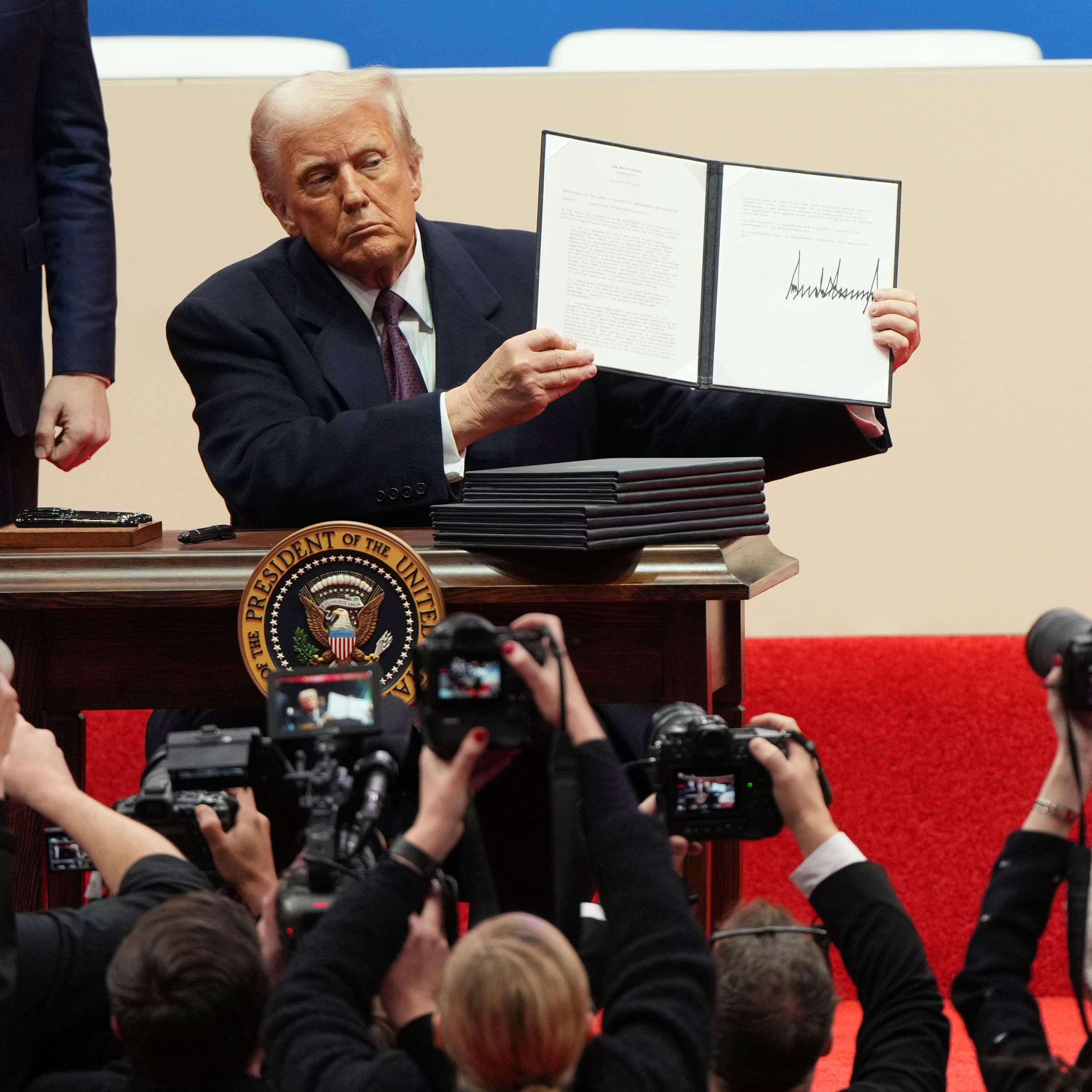
The year 2025, as reflected by The Guardian's editor-in-chief, was characterized by conflicts, crises, and the overwhelming influence of Donald Trump. Significant events included proposals like changing the Gulf of Mexico's name, crackdowns on diversity and inclusion efforts, and notable political shifts. The rise of the right and challenges experienced by the Labour government were observed, along with impactful investigations by The Guardian, such as exposés on figures like Nigel Farage and investigations leading to policy changes. Amidst the political darkness, moments of hope were seen, including a fight back from the left and the emergence of leaders like Zora Mandani. The year also highlighted the importance of rigorous journalism in the face of threats like litigation, with The Guardian securing decisive wins in legal battles. Hopeful instances like the fight for social causes and wins in investigative journalism provided glimmers of light in an otherwise politically challenging year.
Transcription
4795 Words, 26622 Characters
This is The Guardian. Today, The Guardian's editor-in-chief looks back at 2025. 2025, a year of conflicts, crises, crackdowns, a sprinkling of hope, and a lot of Donald Trump. We're putting America first and we are making America great again. So it's we're going to be changing the name of the Gulf of Mexico to the Gulf of America. I ended all of the law is so-called diversity, equity and inclusion bullshit. As editor-in-chief of The Guardian, Catherine Viner has watched it all unfold from the humiliation of Zelensky in the Oval Office. Soldiers on the streets of U.S. cities. And the bombing of fishing boats in the Caribbean. I think we're just going to kill people that are bringing drugs into our country. Okay, we're going to kill them. The U.S. President has cast a long shadow over, well, pretty much everything this year. And we have three more years to go, at least. At home, we've seen the Labour Government languish while Nigel Farage in reform rise to the top of the polls. We are all ships rising on a turquoise tide. Headed ever closer towards winning the next general election. The world got itself a new Pope. A tenuous and uncertain cease-fire in Gaza. Terrorist attacks reverberating around the world. A deadly attack on a synagogue in Manchester. On the holiest day in the Jewish calendar. It is Australia's worst mass shooting in nearly 30 years, after 15 people died, including a 10-year-old girl. During celebrations for a Jewish festival in Sydney. And fires, floods and hurricanes wreaking unprecedented havoc. It's like Armageddon. I'm surprised all of us got out of there without burying up ourselves. But it hasn't been all bad. We've seen a fight back by the left. An amazing year for women's sport. And record-breaking renewables. Renewable energy has overtaken coal as the world's leading source of electricity for the first time. And the maybe futile hope that 2026 will give us all a bit of a break? Maybe? From the Guardian, I'm Annie Kelly. Today in focus. The Guardian's editor-in-chief reflects on a year of Trump, tariffs and turmoil. Catherine Viner, you're the Guardian's editor-in-chief. And this is your 10th year in post. Congratulations on the decades. Thank you. We can't start a review of 2025 without starting with Donald Trump. This time last year, we were bracing ourselves for the start of his second term. Have you been surprised by just how much of a seismic shift he has made this year? Even when you just said that, I thought that must be wrong. It can't be just this year that he was inaugurated. It's been so overwhelming and I think the story of the year for America and the world has been Donald Trump's first year and the shadow he's cast over politics everywhere, politics, society, culture everywhere. If you look at things like the ice raids and people being kidnapped off the street by men in balaclavas and their families not finding out where they are, you look at the National Guard going into cities in sort of full riot gear. You look at the attacks on the environment, on Somali and Americans, the degradation of the discourse. A lot of men are country, I'll be honest with you. Somebody would say, "Oh, that's not politically correct. I don't care. I don't want them in our country. Their country is no good for a reason. Their country stinks." This is such a comprehensive shift. It's very redisturbing. Yeah, it's kind of seems that you just would never have imagined unfolding this time last year. When you think about some of the images that you see, as you said, people being dragged out of cars, people being sent off to prisons in El Salvador without any recourse to justice, they are contastopian scenes of an America that maybe we just wouldn't have recognised this time last year. It's really important to try and take a step back because Trump is very good at kind of throwing millions of things at us all day, every day. And it is important now and again, quite often to take a step back. Try and look at it with the eyes of yourself from 10 years ago or even from Trump's first term and to realise quite how dramatic the shift is. What about the shadow that he's cast over geopolitics? Yeah, it's an interesting point because I think there's the first aspect which is how he's literally casting a shadow over everywhere. You see, all politicians, all political leaders in every country in the planet are having to adjust their behaviour, behaviour in different ways, try and get him on the side. It's all can be quite embarrassing. Which that you have used when talking to Donald Trump has been notable because of its flattery. Today you called him daddy. Is this the way that you feel that you have to act when doing business with the US President? And doesn't it make you look weak? No, I don't think so. I think it's a bit of a question of taste, but I think he's a good friend. Yes, so this is let it from as much as the King. It's an invitation for a second state visit. This is really special. This has never happened before. This is unprecedented. And I think that just symbolises the strength of the relationship between us. So this is a very special letter. I think the last state visit. It's a pleasure to be here and it's a very important moment. Indeed we are here Europeans as friends and allies. We heard a fantastic name. But then I think there's how he sort of shifted the culture in quite sort of subtle ways. I mean, you'll just be listening to a news programme on the radio. And I think I just know that a year ago you wouldn't have have framed it like that. You wouldn't have asked a question like that. You know, I think he's absolutely shifted the discourse much further to the right. This year has also been a massive year for politics in the UK. This time last year Keir Starmer had already experienced a little bit of difficulty in his first six months of government. This year we've had the first full year of a Labour government. He's now officially, I think, the least popular Prime Minister on records. What have you made of Labour this year? I mean, I'd start by saying I think doing politics is very hard these days. I think political leadership is very, very difficult. The economic circumstances are difficult, but political conditions are difficult. However, there was a particular moment this summer where I think there were five Mondays in a row. We did a report on it, five Mondays in a row, in which Nigel Farage and Reform did a press conference stating their position on issues such as immigration and the economy. Today we're going to talk about illegal immigration. In particular, the boat crossing, but there's more, of course, to the story than that, and perhaps it's appropriate. And Labour responded to none of them, and it felt like a whole summer where a former had the run of the country in terms of the narrative, and it really frightened me. Even though Labour have definitely done some good things and some things that the Guardian editorial line would agree with, I think the way they talk about them, the sort of political aspect, this idea that they're not very good at politics has become very stark. It's really hard not to feel a bit bewildered about the sort of misopportunity to think that it was only last year that they won a landslide election. And you talked about misopportunities. Can you think of any, for you are the most significant blunders that you think this government might have made this year? Rather than blunders as such, it's a sort of absence, right? It's an absence of an alternative story. There was a moment when there was the far right march through London. Look around you, feel your strength. You are part of a tidal wave of patriotism they're sweeping across this country. And people were very, very upset about it and there was just this absence of a response for a long time. Tell us that we're proud to live in a multicultural society. Tell us that that's what this society is built on, that's what the NHS is built on, that's what our cultural scene, our creative industries are built on, talk about how proud you are to live in that kind of society. And I think eventually they did. Politics is about timing. And I think a lot of those opportunities were missed. There was that kind of vacuum, wasn't there? With that narrative took hold as well. And you know, as you've just said, all of this is happening this year, we've seen the kind of inexorable rise of reform and Nigel Farage. What do you think is behind this? And also like how should we as the Guardian be reporting? There's something genuine that reform is tapping into. I think there is a genuine sense from a lot of people that their lives are worse than they used to be, at worse than their parents' lives perhaps. We have this sense that always you're going to pass on a better life to your children and that's clearly not the case anymore. And I think reform have been clever, cynical in tapping into that and sort of saying the reason for that is because of this mass immigration. Rather than looking at what I think is the real cause which is this fast inequality and then I think you add on to that Farage who is good at politics. He comes across as authentic perhaps, not quite as authentic as he used to do. People like him, he's sort of funny, ish. He's extremely effective on TikTok, far more effective than all other politicians, I think, in the country put together. Do you want to laugh, Keir Starmer? The most boring man in Britain has joined TikTok. He wants your generation to embrace his brand of being really rather dumb. It's going to go nowhere, but do tune in, have a look, have a look at what he does. He is boring, boring, boring. I would say though, we've done a series of stories this year about what Farage was like at school and right until he left school at 18, what he was like in terms of how he spoke to fellow people who were Jewish or who were black or Asian and we started off with a couple of stories. And through our reporting, now more than 30 people have made allegations about school behaviour. And I think some of what he did at school was pretty, pretty blood-curdling to me. Now look, obviously, childhood is a different time and I think there would have been a way for him to talk about that time, which showed that he regretted this kind of racist language or he'd grown out of it or whatever. And he was sorry to upset these fellow pupils at the time. I'm sorry about the impact since, but I think what was really surprising to me, because I do think he is generally good at politics, but Farage has given lots of different responses to this. You know, he was sort of saying, it's a non-story or it's a political story and then Richard Tyce came out and said they were all lying. And I think there's something about these stories that have got him rattled. And I think that's quite interesting because that's journalism that's really got to him and shows that it's not inevitable that Nigel Farage is the next prime minister. Yes, and that story is broken, of course, by Daniel Boffey along with Henry Dyer. It's interesting when he said about rattling because he almost looks surprised that he was being held to account like this. And I remember when Daniel came and spoke to us and stayed in focus. He talked about, you know, if Nigel Farage wants to be prime minister, he has to expect that he is going to come under scrutiny. His conduct is going to be looked at, is going to be examined, and also the way that he responds to it should be examined. And that's very interesting, isn't it, that he almost looked like he was wrong-footed by coming under such scrutiny and then not knowing how to respond to that? I thought that was a great podcast and it was a really good point that Dan made. You know, you can't expect to be prime minister and written and not be held accountable. Perhaps he thought that he could be a bit trumpy and about it, but I don't think he's sufficiently trumpy and to get away with it. This year also, we've seen these conflicts that have devastated the world, Ukraine, Gaza, Sudan. They've continued to rage throughout 2025, really dominated the the news agenda and how we've reported on global affairs. One thing that's been really notable across this year is just how much these kind of rules of war and peace that we all almost took for granted have been changed. There's now open talk of assassinating world leaders. We've seen war crimes being committed with apparent complete impunity. We've also seen things like, you know, attacks on neutral countries like Israel's attacks on Qatar. How significant do you think this seeming collapse of rules-based order is? I mean, in many ways, that is the biggest story of the year, I think. And again, it all comes back to Trump, as you mentioned. It's such an important area for the Guardian. Many years ago when we made big cuts at the Guardian, the area we didn't cut from was the international reporting area because I think that's such an important place for us to stay committed to. But yes, I mean, I think Gaza, we're in this situation now where we have a sort of ceasefire in name only in any other place. You'd still say we're in a war with the number of deaths and so on. No sign of phase two, Trump seems to have lost interest. In Ukraine, nobody really believes Putin wants peace. I'm sure even Trump can't believe that. Maybe he doesn't now, unless it's by giving over territory that's so completely unacceptable to Ukraine. And it was an existential threat for all of Europe. We're not planning to fight Europe. I've said a hundred times, but if Europe suddenly decides to wage war against us and starts it, we're ready right now, he said. Sudan is extremely difficult to report on. We really try focus as much as we can on the human stories. And then also the political influence from the UAE. I mean, I think there's a really interesting story as well about how so many of the threads of all these stories lead to the Gulf. Yeah. Trump's relationship with the Gulf, I think is crucial. It's becoming a kind of new center of gravity for the world. It's extremely interesting. It's extremely unsettling. Europe, which I didn't mention, is left completely at sea. I think the European Union is looking just sort of bewildered as a unit, not really knowing what to do. And it just feels like Trump has shifted the world order in a matter of months. It's also having consequences, isn't it? We talked a little bit about the collapse of rules-based order. The war crime's being committed with impunity. It's been the deadliest year for journalists ever recorded. I think 126 killed the vast majority in Gaza. We've seen Trump himself launch attacks on press freedom, both in the US. Of course, now with this 10 billion dollar lawsuit against the BBC announced, how difficult is it for the Guardian to operate in this kind of increasingly hostile environment for the press? I'm glad you pointed out that the vast majority of those journalists who've been killed are in Gaza because we did a lot of really strong reporting this year about how journalists have been specifically targeted. Because if you don't allow international journalists in, then Israel pleaded doesn't want guards and journalists doing their reporting either. So that was a very alarming period for us. And there's something very unsettling about how Trump sees the media. It's how all authoritarians see the media. They know that it's a thought in their side. It's very disturbing. These recent attacks as well, the sort of Trump trivialising women reporters specifically and trying to humiliate them, I thought was pretty low. I think all you can do is prioritize safety. I always think that's the most important thing. We have to keep our reporter safe, but you can't hold back. I mean, you mentioned the lawsuits. You have to fight them. You have to stand up for your journalism. You have to stand up for your journalists. Talking about that, you were in a court this year doing just that, defending the Guardian's journalism against a lawsuit brought by the actor Noel Clark, where we had exposed these allegations of sexual misconduct against him in a series of articles. Also, it's a down focus episode in 2021. The Guardian ended up really decisively winning that case. It's been called a watershed moment for both press freedom and mutual journalism. Why is it so important to you that we continue to report out these tough stories even with a threat of litigation? It really was an extremely decisive win. As you say, we won on both truth and public interests, which is pretty unusual. The Judgment was extremely powerfully praising the Guardian's approach to the story. It was a really responsibly reported piece of work. The best way to behave is to do journalism. That is really rigorous. It's to take extra care to make sure in this new world with authoritarians and people wanting to use the courts to silence us. We'll just make sure that our journalism is as watertight as it can possibly be. We had more than 20 women in our stories about Noel Clark. We had more than 20 people coming to court to be cross-examined voluntarily in defense of our stories. That's how strong the reporting was. And I think that is the best protection. But we have to do it. That's what we're here for. As times are dark, we're in a challenging era and people need organizations like the Guardian to stand up for the journalism, to do great journalism, and then to stand up for it. Can you think of any other investigations this year that you're particularly proud of? I mentioned the Nigel Farage exposés. We've done a fantastic investigation recently, and a great podcast series about how influencers radicalise pregnant women around the world into having sort of no medical interventions whatsoever. Two members of the House of Lords. One of them, the former head of the Army, quite a significant figure, have been suspended from the Lords for several months, following our undercover investigations into their content. That was a big series. We did a really fantastic global investigation into how Microsoft technology was being used in the Warring Gaza, which culminated in Microsoft stopping the practice, and thanking us for alerting them to it. I'd also mention we did a popular series on former Prime Minister Boris Johnson's lobbying after leaving office, and how much money his raise. And that led to him being reprimanded by the watchdog, so yeah, it's been a great year for investigations at the Guardian. We've been firing on all cylinders. Also, some of them have led to a policy change. One of the most important investigations, I think, was the carous allowance investigation that we did led by two of our reporters. This is a big story in the UK, and this was about how if you passed a certain threshold of earnings, a very low threshold of earnings, you then would lose all of your allowance for caring for a loved one, and obviously, as in many countries, the social care in Britain is sort of held up by volunteers, by people who love someone, and that they were sort of punished for it. It was an absolute scandal, and our series on that, which we pushed that day after day, as won some big awards, and yes, has led to a change in the law and delighted to say. Coming up, moments of hope that stood out this year. [Music] Amid the rise of the right, there have been some stories of hope. There's been a bit of a fight back from the political left. We've seen the Greens' new leaders' acplancy here in the UK. We've also seen Zora Mandani in New York. Has this felt like a bit of a glimmer of light in such a politically dark year? Well, I mean, Zora Mandani actually is one, so yeah, that's definitely. And I also think he won in an interesting way by really focusing on economic issues and the cost of living. Every politician says New York is the greatest studio in the globe, but what good is that if no one can afford to live here? I feel this sort of hope in anything that gets back to what really matters in politics, rather than broad cultural questions, not just cultural wars, but just fighting on vibes. This is fighting on concrete issues. He also is very good at vibes, though. He brings both, doesn't he? He does. And obviously, Polanski bringing some life again and focusing on some of these issues. I absolutely think there's reasons to hope. I do think it is just extremely challenging, and we've got to give politicians a bit of a break, because it's a really hard arena at the moment. But it's nice to fill out energy, isn't it? It is. It is. And the end sort of charm and fun. Yes. Something to get excited about, maybe. Yeah. Kath, one story that does feel particularly close to us at its own focus is that of Malak A Tantesh, our 20-year-old former Gaza correspondent. Many listeners will remember her really powerfully recounting the story of fleeing Gaza City in September. Since then, she's basically won every journalism award going. Can you tell us a bit about her and her work? Yeah. Malak is a sort of wonderful person and a wonderful reporter. She did absolutely vital reporting for the Guardian. When we couldn't get our Jerusalem correspondent in, we still can't get our Jerusalem correspondent in, but we have Malak. And she really is a brilliant reporter. She goes and talks to people and she finds out what's really going on. And it was absolutely vital to our reporting. We understood what was happening in Gaza because of Malak. And as you say, she's only there. She's just 20. Working now in the street. I am saying goodbye to every single coordinate here in Gaza City. I know very well that we will never come back here. We cannot find any transition. She's now living in London and she's studying journalism. But you know, it's very hard when you've won all these huge awards, getting standing evations from the entire British journalism industry. But she has got her head screwed on. She's sort of inspiration really. But I do also want to protect her a bit because she's got a great journalistic future ahead of her and I want to make sure that she sort of has a normal life as possible. 2025 is marked one decades of you being our editor-in-chief. It's been quite the decade as well, hasn't it? So I wanted to ask you, what has it been like steering the organisation through such a tumultuous time? I mean, it's interesting the timing because I came in in June 2015 and so Jeremy Corbyn was elected almost immediately and that was followed in 2016 by Brexit. And I would say all hell has broken loose ever since and it is every year I do this summary of the year podcast and every year we go, well, that was an intense year. But I do feel it's ratcheting up. It feels like everything's at stake. The change in technologies over that period is what's behind the shift. I think the absolutely vast inequality, the small number of tech bosses and everybody else is driving dramatic shifts. We should be prepared for anything. And I think it's very, very demanding for Guardian Journalists, but it's also a privilege to be doing our jobs in this moment. That feels like a real privilege to me that you can try and shape the coverage, give people hope, help them understand the world and help them, you know, feel that they can maybe influence it because they understand it. I think it's an honor to be editing the Guardian in such a period. And looking forward, do you expect times to keep kind of accelerating forward into these kind of unknown landscapes that we maybe can't even imagine right now? And next year is going to be really chill. I'm afraid I don't see any end to the intensity though. I wanted to end the interview with maybe asking you about some of your cultural highlights. I mean, I don't want to be too Newsy, but we did a brilliant extract from Virginia Trephrase book. Yes. And the extract was so impactful. I actually think it really led very directly to Prince Andrew losing his titles, including Prince. And I read the whole book. It really is a sensational book. And I thought I knew a lot about Edstein. It's a very powerful story. It's a really shocking story. So I really recommend that. I've had some great novels. My favourites were "The River's in the Sky" by Elif Schaffer. Yes. That's wonderful. Yes, that's amazing. I thought no other land, the also going documentary about the West Bank was magnificent. I enjoyed Amanda Land. Of course. Yes. Who didn't? And there's a Christmas special. Yes. And Albert is not normal. Did you watch that? I haven't seen it. Oh god, watch that. It's hilarious. But also very emotional. It was one of those shows where you're crying and laughing at the same time. I enjoyed Seamats album. I enjoyed Pops album. I'm slightly retrospectively. And then I want to read. I haven't read and I'm desperate to read Helen Garner's Diaries. So I'm hoping somebody who's listening to this will send me that for Christmas. It will give me that Christmas. Kiran Desai's novel. I thought it looks amazing. A very long, but maybe I'll have a bit of time. This is the first Christmas I'm taking off since in my decade as editor. Wow. Yes. The first Christmas in 10 years. Yes. I always volunteered to do Christmas, but I've decided I'm not doing this yet. So yes. So I've got time to read Helen Garner's Diaries and Kiran Desai. So this is what you're going to be doing. Putting your feet up and getting through your reading list. I didn't watch baby girl. Right. Which I want to watch. Didn't watch the substance. Didn't watch pillion. So yes, it's got lots to do. I was going to be shutting family out. Well, yeah. I'm going to come and join in if they like. Yeah. Thank you so much. This has been a great review of 2025 and happy Christmas. Happy Christmas to you too and happy new year to all of our wonderful today and focused listeners. And that's it for today. This episode was presented by me Annie Kelly and produced by Elmer Biggs, Gem Talbot and James Tindell. The sound designer was Ross Burns. The executive producers were Hama Khalili and Sammy Kent. And that's it for today and focus this year. If you're listening for something great to listen to over the holidays, we will be bringing you a couple of our best interviews and also our amazing birth keepers series, a six-part investigation into the free birth society, a business which promotes a radical version of free birth. And we will be back with brand new episodes for you from the 5th of January 2026. From all of us on the team have a lovely Christmas and a happy new year. This is The Guardian.
Podcast Summary
Key Points:
2025 was marked by conflicts, crises, and the dominance of Donald Trump.
Notable events include a proposed name change for the Gulf of Mexico, crackdowns on diversity and inclusion, and significant political shifts.
The year saw a rise of the right, challenges faced by the Labour government, and impactful investigations by The Guardian.
Summary:
The year 2025, as reflected by The Guardian's editor-in-chief, was characterized by conflicts, crises, and the overwhelming influence of Donald Trump. Significant events included proposals like changing the Gulf of Mexico's name, crackdowns on diversity and inclusion efforts, and notable political shifts. The rise of the right and challenges experienced by the Labour government were observed, along with impactful investigations by The Guardian, such as exposés on figures like Nigel Farage and investigations leading to policy changes.
Amidst the political darkness, moments of hope were seen, including a fight back from the left and the emergence of leaders like Zora Mandani. The year also highlighted the importance of rigorous journalism in the face of threats like litigation, with The Guardian securing decisive wins in legal battles. Hopeful instances like the fight for social causes and wins in investigative journalism provided glimmers of light in an otherwise politically challenging year.
FAQs
2025 was marked by conflicts, crises, and political turmoil, with significant events such as the rise of Donald Trump, conflicts in Ukraine, Gaza, and Sudan, and devastating natural disasters.
Donald Trump has cast a long shadow over global politics, influencing leaders worldwide and shifting the discourse further to the right.
The Labour government in the UK has struggled with political leadership and faced criticism for not effectively countering narratives from figures like Nigel Farage.
In 2025, the Guardian conducted impactful investigations, including exposés on Nigel Farage, influencer radicalization, and the use of Microsoft technology in conflict zones.
Despite the challenges, there were glimpses of hope, such as a fight back from the political left and the emergence of new leaders like Zora Mandani in New York.
The collapse of rules-based order, marked by war crimes and attacks on press freedom, has significantly impacted global affairs and journalism, leading to increased challenges for organizations like the Guardian.
Chat with AI
Loading...
Pro features
Go deeper with this episode
Unlock creator-grade tools that turn any transcript into show notes and subtitle files.
 PodcastTranscript AI