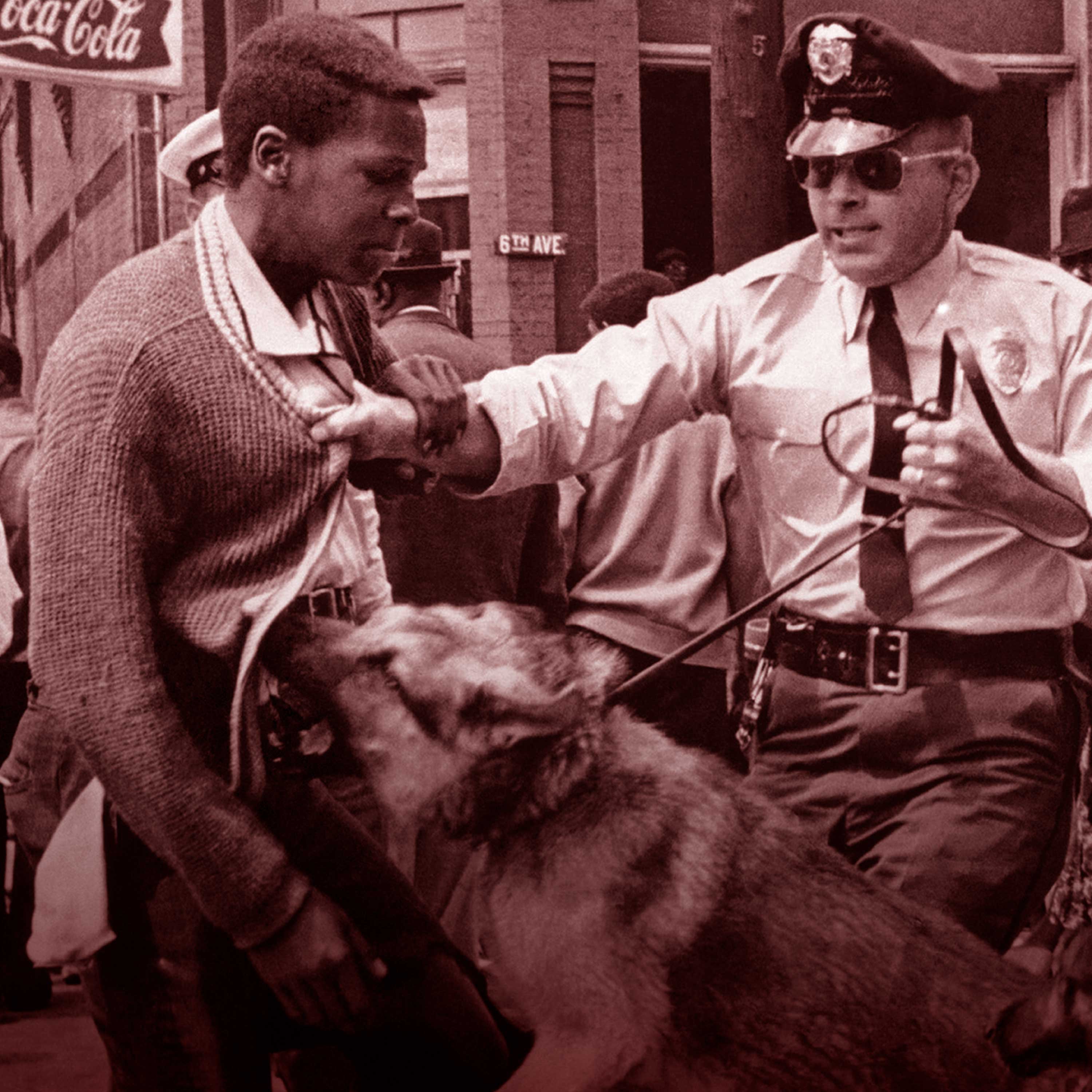
The transcription centers on the historical significance and origin story of Martin Luther King Jr.'s "Letter from Birmingham Jail." Written during his incarceration in April 1963, the letter was a response to white clergy who urged patience and criticized the protests. King's lawyer, Clarence B. Jones, secretly smuggled the letter, written on newspaper margins and scraps, out of jail. Initially published in small outlets, it was largely ignored until a month later, when national outrage erupted over images of police using dogs and fire hoses against child protesters in Birmingham. This violence made the country receptive to King's message, elevating the letter to a defining document of the Civil Rights Movement. It articulates the moral imperative for immediate action against segregation and the psychological toll of systemic racism. The episode also highlights Jones's parallel role in securing a substantial, anonymously repaid bail fund to support arrested demonstrators, underscoring the logistical and financial efforts behind the movement.
I happen to think that you can book end Martin's life in this country. But the letter from the Birmingham jail is I have a dream speech in March on Washington and to April 4, 1967 speech, time to break the silence, speaking about Vietnam. Now I know he's given a lot of passionate speeches, but the letter from the Birmingham jail, the letter from the Birmingham jail is really the 20th centuries magnet-cater for freedom and liberty and justice. I think it will endure forever as part of the American experience. I think it will. Hi, I'm Jonathan Capehart and welcome to Voices of the Movement, a series from Cape Upsharing Stories and Reflections of some of the leaders of the Civil Rights Movement and their lessons on where we go from here. Dated April 16, 1963, letter from Birmingham jail was written by the Reverend Martin Luther King during the eight days he spent in jail for marching in a ban protest. A nine-page lament by the leader of the Civil Rights Movement to his white Christian counterparts that explained to them and the nation why African Americans could no longer wait for equality and justice. In some ways, letter from Birmingham jail is a relic from another America when segregation ruled, yet the document's lasting power is revealed in just how relevant King's words are in today's America more than 50 years later. And this episode is the unlikely story of how it came to be because the man who helped it come into existence will be the first one to tell you that he couldn't have cared less what was being written. He had other things to worry about. That man is Clarence B Jones. Dr. King was arrested on Good Friday, April 12, 1963. Clarence Jones is currently the co-founder of the Institute for Non-Violence and Social Justice at the University of San Francisco. He's also the person who convened the Civil Rights retreat at Sunnylands in California this January that inspired this series. But back then, he was Martin Luther King's lawyer and occasional speech writer. I went in to see him the next day on a Saturday and the purpose in my going into see him was that the parents of the children who had followed Dr. King and the local leaders in this first demonstration of Birmingham, they were yelling at us to get their kids out of jail, bailed them out. King and the others were in jail because they had led a march in protests of the segregated city of Birmingham, Alabama. Alabama's governor was George Wallace, who famously said segregation now, segregation forever. And that played itself out in Birmingham in all aspects of life, from stores to restaurants to public transportation. Blasts and whites were kept separate by law. Members of the African American community in Birmingham began picketing and leading marches, so the city government got a state-circuit court injunction against the protests. After a tense meeting with his advisors, King decided to go against the court order. So on Good Friday, April 12, 1963, King led some 50 marchers in a protest. They only got a few blocks before being arrested. King was put in solitary confinement and the only person allowed to go see him was Clarence Jones. So when I went in to see Dr. King, this was this was urgent. Jones told me that whenever he went to the jail to see King, the parents of the kids who were in jail were waiting outside asking, what are you doing to get our kids out? Remember, these are poor people. They don't have the money to bail their children out of jail. I had this plan in my mind and saying, Martin, I want you to give me the names of some people I should call many of whom I probably already knew, but some of whom I did not know, because I wanted to dramatically be able to call them and said, listen, I just visited Dr. King and jail a few hours ago and he asked me to call you because we were trying to raise money. That's the way I was figuring this out. He wouldn't have any of it. Jones didn't get to have that conversation. He'd have to bail those kids out without King, because when he arrived at the jail, King had something else on his mind. He was frustrated about something he had seen in the local paper. And then he said to me, he said, well, have you seen this? I said, what are you talking about? And he shows it pulls up a full page ad from Birmingham Harald, and in that full page ad was a letter from a group of local white clergymen who were critical of him for having come to Birmingham and stirring up the people, as they said, and the protest. And he was really upset. Those white clergymen were telling King that he was wrong to protest, that he should be more patient, that he needed to wait. They told him, first of all, he should get out of town, he's an outsider, second of all sort of lecturing him. You know, these things take time, Dr. Kim. Wait, we just said, wait, we can work on these things, but you know, you have your own patient, you're an outsider, and your agitation is not helping a situation. When Jones got to King's cell, the Baptist preacher had started writing. Writing all over that newspaper, all in the margins, in between the ads, lots of writing, all over the place on every scrap of paper he could find. There's nothing I could say to him about any other subject other than take these what I've written. I said, what is this? He started to write on anything that was a blank paper. The blank part of a dirty newspaper, where the cop in the advertising wasn't, you know, whether it was blank space, paper towels, paper napkin. That time I stuck them in my pockets, and under my shirt because they were in different piles. But over the next few days when I was bringing him paper and taking back what he had written, I would take them and put them under my shirt, I wore a shirt in a tie, and I had a t-shirt on under my shirt. And this procedure was repeated over the course of the next four to five days, twice a day. Every visit King asked Jones to bring more paper, and Jones would dutifully smuggle in blank paper and smuggle out the filled-up pages. Normally, I mean, they knew the authorities knew who I was. And I had to go through the pro-fungtery. They never pated me down. I mean, this is not just four, nine, eleven. Four, nine, eleven. They just know. They knew who I was. Nobody came over and pated me and didn't do any of that. They just said, okay, Mr. Jones, you can go in. I would take the written, his handman notes, and I would take them to Wyatt Walker. And then I would bring him in blank sheets of paper the next time. And that went on for several four or five days. I never looked at it. I never even looked at it. First of all, it was hard for him to read my writing, his writing all the way. Could never look at it. I was more preoccupied with anything. They never, never looked at it. Wyatt T. Walker was King's Chief of Staff. Even though Jones is the first to admit that at that moment, he couldn't have cared less about what was on those scraps of paper. He brought them to Walker anyway to have them typed up. King had provided instructions with arrows showing how they should be assembled. Walker sent it out to several publications to try to have it published. And at first, it was only published in some small publications. And the first time I ever read the completed version, the completed letter from the Birmingham, J.A. was about six weeks later. And that occurred because I was in Atlanta, in his office. And Dora McDonald. Dora McDonald was King's personal secretary. Martin was out at some meeting. And Dora said, "Oh, I'm so glad you're here, Mr. Jones, because Christianity and crisis, they want to republish Martin's letter." And I told them, they first said to check with you, copyright matters. So forth. And I said, "Okay." So, where's the copy of the letter? She says, "Oh, there are a couple of emigraph copies over there. Sit down and read it." But when I sat down in his office to read that letter in the form of a typewritten, maybe a typewritten pages, I said to myself, "Oh, my God, I couldn't believe it." I mean, it was incredible. Nonviolent direct action seeks to create such a crisis and foster such attention that a community which is constantly refused to negotiate is forced to confront the issues. It seeks so to dramatize the issue that it can no longer be ignored. Seven Ferguson, a Martin Luther King impressionist, read sections from letter from Birmingham, J.A. for the crowd at Sunnylands. I read it a couple of times, right there, for the first time. And the section that was so moving to me is when he was
responds to the minister's characterization of him as being impatient. And he says, "Why wait?" For years now we have heard the word "wait." It rings in the ears of every Negro with piercing familiarity. His weight is almost always meant never. We must come to see with one of our distinguished jurists that justice too long delayed is justice to not. He wanted to anticipate every objection they might have to them. He wanted to be as sophisticated as learned as patient as he could but tell them why they were wrong and why they were on the wrong side of history and his movement and those kids who marched into the dogs and firehoses were on the right side of history. So the letter from Birmingham jail became a mortal from this combination of very odd circumstances. That's Taylor Branch, who spent years interviewing members of the Civil Rights Movement for what would become parting the waters. That Pulitzer Prize winning book and two others comprised Branch's authoritative trilogy that chronicle the birth, growth, and consequence of the Civil Rights Movement. I spoke with Branch at the Civil Rights retreat that Jones organized. And as Jones says, "Taylor is an encyclopedia of knowledge on the movement. If Taylor didn't write about it, it probably didn't happen." So I asked him about letter from Birmingham jail, why King wrote it and what its importance was in society at the time and today. But it's important to remember that even when the document was done regardless of the accidental circumstances and they had it printed out, nobody was interested in it. Nobody recognized it as significant. What changed the letter from Birmingham jail and flipped things was what happened in Birmingham a month later when they had the big demonstrations and they brought out the dogs and firehoses on small children in Birmingham. I've argued, and I think many people agree now, that this was a great psychological watershed for the country, that the photographs of dogs and firehoses on small children went all around the world and broke the emotional resistance that the country had to doing something about segregation. It was in the wake of that that not only was the demonstrations broke out all over the country, I think there were 750 demonstrations within the next few weeks. It was that ferment that changed the world and made people receptive to what the message was. This document then became the go-to document from where did this movement come from that has finally taken hold of the country. They could have grasped for anything to explain this. One of Dr. King's sermons, one of Dr. King's speeches or anything, but instead they happened to grasp for this letter which has such great breadth and resonance. One of the things that Clarence Jones says, he likens letter from Birmingham jail to the Magna Carta. What do you make of that? The Magna Carta was revolutionary in the sense of trying to organize a whole different framework for philosophy and politics. Basically put limits on an unlimited monarchy, right, to move things in the direction of democracy. The letter from Birmingham jail, I don't think is analogous in that sense because what the letter from Birmingham jail is doing is saying, you profess to have the ideals, the democratic ideals, that unite this country. But I'm trying to show you that where black people are concerned, you are blind to the fact that you don't live up to your own ideal. So it was not proclaiming a new standard of power or a new standard of justice. It was a creed occurr telling people that they were hypocrites to their own system of values. Your system of values is good, you need to pay attention to it. People did end up paying attention to it. Like Taylor Branch said, after the eight days King spent in jail, the Birmingham campaign ramped up. And as images of police dogs attacking teenagers and children being pinned to walls by the force of water from fire hoses spread across the nation, it was King's letter from Birmingham jail that the rest of America turned to to understand what was driving these protests. When you solidify your tongue twisted, your speech stammering as you seek to explain to your six-year-old daughter why she can't go to the public amusement park, which has just been advertised on television. And CT is welling up in eyes when she is told that Funtown is closed to college children. The ominous clouds of inferiority beginning to form in her little mental skies. And see her beginning to distort her personality by developing an unconscious bitterness toward white people. When you have to concoct an answer for your five-year-old son who is asking daddy, why do white people treat color people so mean? When you take a cross-country drive, finding necessary to sleep night after night in the uncomfortable corners of your automobile because no motel will accept you. When you are humiliated day in and day out by signs reading white in color. When your first name becomes nigger, your middle name becomes boy, I have old you are. And your last name becomes John. Your wife and mother never given the respected title Mrs. and you are harried by day and haunted by night by the fact that you are negro living constantly at tiptoe stance, never quite knowing what to expect next. I play with inner fear and I are resenting you are forever fighting a degrading and degenerating sense of somebody. And you will understand why we find it difficult to wake. There comes a time when the cup of endurance runs open. There comes a time when the cup of endurance run over. There is one more thing I would like to share with you about Jones's role in Birmingham in 1963. Throughout the Birmingham campaign hundreds of protesters were being arrested. As you may recall from the start of this episode, Jones said a lot of people turned to King and the Southern Christian Leadership Conference for help with bail money. That's why Clarence Jones said he was so fixated on fundraising. Harry Belafonte was a big supporter of the civil rights movement in general and Martin Luther King in particular. He lent his considerable celebrity to the cause, including raising money. So when the famous actor called Clarence Jones and told him to come to New York, Jones went. Once there, Belafonte told Jones to go meet with an official from the Chase Manhattan Bank and Jones didn't meet the guy just anywhere. They met in the Midtown Manhattan Bank's vault. What did you walk out of that vault with? With $100,000 in cash and $100 bills. In a briefcase. They'd actually given me a briefcase with a chain. After they gave me the money, they said, "Mr. Jones, you know, bank regulations require us. You have to sign. You have to have a sign piece of paper. So I figured, "Okay, shall I understand or sign a little bit I know?" And what I was signing was the demand promissary note. The demand promissary note, which was payable, the demand whenever they asked me for. In fact, when I left the bank and I called Harry Belafonte, I said, "How did everything go?" I said, "Everything went fine except you didn't tell me I'd have to sign a demand promissary note for $100,000 in Harry's reaction. Better you than me." And I said, "But you got much more money than I do." So I take the money down to Birmingham and I come back. And I'm in my law office on Tuesday morning. There's a messenger from the Chase Manhattan Bank. And I said, "Yes, Mr. Jones, yes, you have some identification. Showed my identification. It gives me an envelope marked personal confidential. Now it's me Jones. I open it. And inside the envelope is the promissary note I had signed, demand promissary note I had signed, and marks paid in full. I didn't pay it. I didn't repay it. In the next episode of K-Pop, the March that became known as Bloody Sunday, and the annual event that commemorates the struggles that led to some lasting legal victories. When it comes to the big questions, who you ask matters. From breaking news to politics that impact your life, to advice you can trust. Get answers you don't have to question with ask.
Ask the Post AI, trained exclusively on Post Journalism with clear sourcing. And if we don't know the answer, we'll tell you. Ask the Post AI. Find it on WashingtonPost.com or in the app.
Podcast Summary
Key Points:
Martin Luther King Jr.'s "Letter from Birmingham Jail," written in April 1963, is framed as a foundational document for freedom and justice in 20th-century America.
The letter was drafted secretly in jail on scraps of paper, smuggled out by his lawyer Clarence B. Jones, and initially overlooked before gaining prominence after violent crackdowns on protesters in Birmingham.
It was a direct response to white clergymen criticizing King's protests, arguing against waiting for justice and explaining the necessity of nonviolent direct action.
The letter's national significance surged following the widespread publication of images showing police brutality against child protesters in Birmingham, making it a key text to understand the Civil Rights Movement.
Clarence B. Jones also played a crucial role in securing a $100,000 cash bail fund for protesters, facilitated by Harry Belafonte.
Summary:
" Written during his incarceration in April 1963, the letter was a response to white clergy who urged patience and criticized the protests. King's lawyer, Clarence B. Jones, secretly smuggled the letter, written on newspaper margins and scraps, out of jail.
Initially published in small outlets, it was largely ignored until a month later, when national outrage erupted over images of police using dogs and fire hoses against child protesters in Birmingham. This violence made the country receptive to King's message, elevating the letter to a defining document of the Civil Rights Movement. It articulates the moral imperative for immediate action against segregation and the psychological toll of systemic racism.
The episode also highlights Jones's parallel role in securing a substantial, anonymously repaid bail fund to support arrested demonstrators, underscoring the logistical and financial efforts behind the movement.
FAQs
The 'Letter from Birmingham Jail' is a nine-page document written by Reverend Martin Luther King Jr. in April 1963 while he was imprisoned for participating in a banned protest in Birmingham, Alabama.
He wrote it in response to a public statement from local white clergymen criticizing his protests, aiming to explain why African Americans could no longer wait for equality and justice.
King wrote it on scraps of paper, including newspaper margins and paper towels, which his lawyer Clarence Jones smuggled out by hiding them under his shirt during jail visits.
As King's lawyer, Jones smuggled writing materials into the jail and smuggled out the handwritten pages, later delivering them to be typed and assembled, though he initially did not read the content.
It gained prominence following the violent events in Birmingham a month later, such as police using dogs and fire hoses on children, which shocked the nation and made people seek to understand the movement's motivations.
He describes it as a key document that exposed the hypocrisy of American ideals regarding race, becoming a go-to explanation for the Civil Rights Movement's rise after the Birmingham protests.
Chat with AI
Loading...
Pro features
Go deeper with this episode
Unlock creator-grade tools that turn any transcript into show notes and subtitle files.
 PodcastTranscript AI