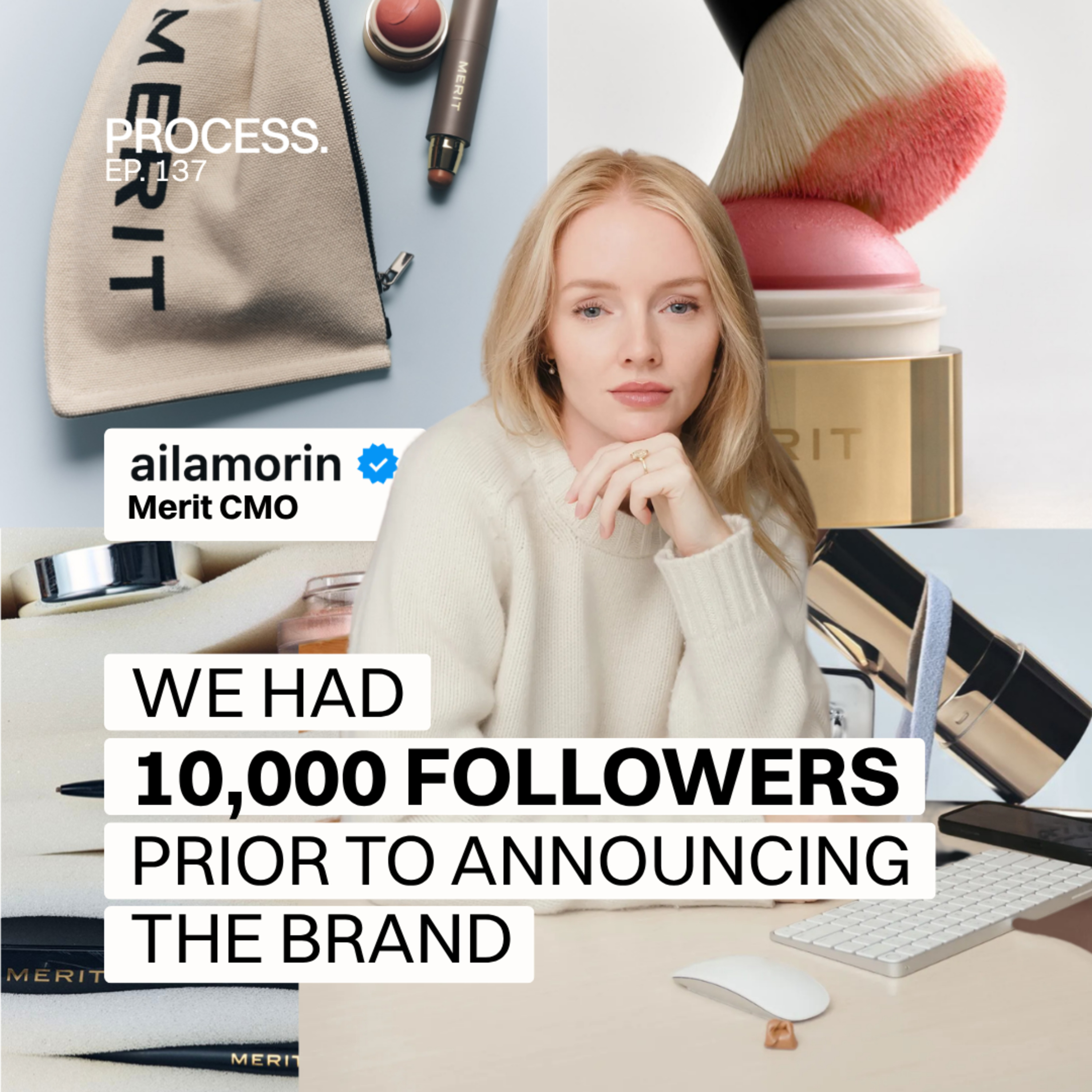
How Merit Built a Cult Following Before It Had a Name with Aila Morin
from Process The Podcast
58m 23s
Aila, founder of Merit, discusses the brand’s origin and philosophy on "Process the Podcast." She started conceptualizing Merit in 2019 while working in jewelry, driven by frustration with makeup’s complexity—products requiring manuals and excessive options like 50-shade palettes. After signing her contract, COVID delayed the launch, giving her a year to study consumer shifts and rebuild the brand’s identity. Merit launched in January 2021 with a focus on solving everyday problems: easy application, non-triggering formulas, and skin-like finishes. Aila emphasizes building a lifestyle brand around a belief system rather than a personality, using tools like mood boards, vintage references, and old products for inspiration. Her retail background in commission-based sales taught her the importance of listening and building relationships, which she applies to marketing and community building. Pre-launch, she used an Instagram mood board (@mood) to test content, growing 10,000 followers before flipping it to @merit. The launch had no paid spend, relying on PR and gifting as a focus group, where participants tested products for three months before sharing. This approach drove $100,000 in first-day sales and insights for new products. Challenges included stock shortages, but Aila sees failure as inevitable and values iteration and long-term sustainability over virality. Marketing, for her, is listening and understanding consumer needs, not just selling.
So much of figuring out work as a marketer is to not associate your work with whether or not a consular. The way we build product is by solving a problem. For us, it needed to be easy to apply. It needed to be non-actually triggering. It couldn't be drying. Couldn't be cakey. We needed to look like skin. We launched the product on maribide.com, and we did $100,000 in the first day. Tell me about something that has not worked. Oh my god, a million things. I'm very comfortable with failing. I can't think you get everything right for everybody all the time, right? Make up is very subjective. And you have to have a sense of humor about the fact that not everybody's going to like everything. Building an authentic brand is not honest, because we understand that making promises you can't keep affects the brand. Welcome to "Process the Podcast," a meeting of creative minds. Let's dive in. So, Aila, I am a huge merit fan. I was actually doing my full face of merit this morning. And you know how the New York Knicks one, and they-- that thing came out in the guy. I was like, my mayor is Muslim. My bagels are Jewish and my Kristen is dear. This morning, I was like, my hair is blow-waved. My makeup is merit. Like, what is mine? Like, my legs are single. I am such a true fan. So, thank you so much for joining me on process. I'm really excited to jump into it. I'm happy to be here. I'm pleased with chatting with the gals. And I got put on the webinar as well about the new mascara launch. And we'll talk about that for me, like, and and everything as well. But when you did that, so many ideas came to mind about questions that I have for you. And I think you did it sitting in the exact same spot that you're in right now, whether you need to mind you. Which is like, "Process the Podcast" is a show about-- we literally talk about the actual process of how you go from what to go. And like, no, no, no, wait. Don't just like gloss over it. Like, what did you literally do? So, when you came on screen and I saw your mood board behind you, I was like, "Oh my god, I want to zoom in." Like, what's on that? So, let's start at the very beginning of merit. How did merit literally come to be? It was 2019 when I first started about it. It was working at Missouri, a direct consumer or a fine jewelry company. I met Kath, ran that summer, and kind of chat with her about doing beauty and what that would potentially look like. It didn't feel that compelled at that time that there was something super interesting to do. It felt like beauty was so incredibly saturated. I wasn't really sure what would be a net new idea. And it wasn't until six months later that I was shopping around the holidays that I felt like for me, it really crystallized. And the way my brain works is always kind of through living, so through experiencing things. And when I was shopping, I was just really taken aback by how complex makeup was. I had worked at a beauty counter for 10 years and was like every single product I looked at required a manual on how to use it. It was the age of excess as I like to call it. So, 50 shades in an eyeshadow palette, Nisu Case was a very standard thing you'd buy. And I just felt like this huge disconnect to me. So, I started working pre-brand. There was a deck in 2020. And then I signed my contract and COVID happened. And everyone stopped wearing makeup. So, it was amazing timing in many ways because I think what was a consumer shift we were already seeing rapidly accelerated during that time period and behavior really changed very quickly. I was so fortunate because Merit came to be because I had a year to study. We delayed the launch. I got to see how consumer behavior was changing. And that time, I just got to be a student of seeing what brands did. It was the first time my career had that time. And we kind of re-delt the brand completely in terms of the identity and how it would resonate. And then we launched it in January 2021. So, even a half years ago now. What did it look like? What were the pillars that you were so compelled in the story to tell at that point? It's not that there were pillars at first that were that compelling. I think what was interesting to me is Catherine had seen this white space essentially that had come out of who were surveys on a consumer demographic that was millennial and Gen X. I think for me, it was much more lived experience in that when I worked at the Beauty Counter, I mean, I did it starting at age 15. So, you're talking about like almost 10 years. There was just this huge disconnect between what people asked me versus what I was seeing brand so. People would come in and be like, oh, I'm looking for a mascara that doesn't clump or can someone shade match me for concealer? Or, you know, what's a good SPF for my skin type? Like, they were very straightforward questions. It wasn't, how do I do a cut crease? And how do I do an eye shadow look with four different shades? Like, that was never something anybody asked me. So, what I was very clear on is that the product market fit wasn't there and a lot of what was being done. And as someone that had worked in makeup for 10 years, it was kind of crazy that I felt I didn't have the skill set when that was quite literally my job. So, I think we spent a lot of time developing the brand over that time period, working with our VP of Creative who I still work with to create a new brand book and to figure out understanding this problem, right? This white space consumer and the problem is that we're not actually creating products that she uses every day. How do we sell for that? And how do we build for that? And a lot of that became both a brand philosophy and a business philosophy because as you watch the mistakes that people made during COVID, the primary one being at that time, all beauty brands had a hero that was 60 to 80% of their business and during COVID, if people stopped wearing it, like a mat liquid lipstick or a foundation, your whole business was at risk. So, developing routine, developing diversified channel strategy, those things were business reactions. But also, there were brand reactions too. Can you look at a beauty brand and identify it outside of a product? If you took the products out of the image, would you know what brand it is? We did a lot of that exercise because at that point that didn't really exist. And we were always interested in building merit as a lifestyle brand that was a little bit more holistic as opposed to a beauty brand with a hero and a certain aesthetic. So, when you say you were really interested in trying to build a brand that if you'd literally remove the product, the brand would still exist. How did you literally do that? Were you in the trenches of mood boarding? Being like, I see it. This is the vision. Like, this is what it is. So, I always say the hardest thing in brand creation is it's very hard to know what you like and what a brand likes, especially in the early days, right? So, so many of the references that Lola, who's really my creative partner and I would, would sit in pull would be water images that feel really resonant for us for us. That was a lot of 90s. It was a lot of very simple. It was pulling a lot of fabrics watches, a lot of book references. I don't just pull from the internet. I find that it's super limiting. If you do that because the algorithm just serves you things. It serves you everybody else because it serves you as trending. - Sishing from the same pond kind of a totally. So, even back then it was like pulling out vintage print. Like, I keep huge stacks of old Vogue magazines. Just pulling from every place. I call upload save images all of that because it's so much cleaner to organize things in a way that's less influenced by traditional social algorithm. And then things like palette, like a lot of its gut in those days, right? Like, there's no big brand guide on like consumers like this color. So it becomes like what feels like it's expressing the feeling that you wanted to have, what feels like the gap that we see. And that's how it developed and came together over time. And in terms of the ethos, I think time was always what we kind of built it on. I think that almost every beauty brand has a front facing founder who's a makeup artist or their celebrity. And that's an amazing way to build a brand. But it's a very specific way to build a brand. You're building a brand around a cult of personality. And for us, we wanted to build it around a belief system. Those are two very different things. So for us, it was a diesel problem in an elegant way. How do you make people feel seen that you understand what they're going through every single day? And how do you translate that in a way that's still aspirational and comfortable, but also something you use every single day? The actual manifestation of that, yes, is midboarding. It's a ton of writing, ton of reference pulling. I buy a ton of old products on eBay that are no longer usable because they're expired, but give me great ideas. Because a lot of the things that live in my head are things that I was exposed to working in store. So you're talking about over 20 years ago, or even like childhood references. Like, we'll remember a certain product from like 1994 that we'll buy. It's a very interesting way of like pulling. It's a little bit more nostalgic, I think. I had a conversation with my mom the other day. She was like, what are those pants you're wearing? And I was like, aren't they? So like Donna Karen, 1998. And I was born in 1992. And she looked at me and was like, you weren't there. And I was like, no, but you were there. So I was there. Like, I was a sponge. And she was like, looking at me like, you're immediate. Like, it's so interesting. I was on the shop floor, a really prolific Australian brand. And that's where I sort of like learned to sell. And now I work as a video director. I can move product because of my time on the shop floor. And I understand the consumerism, like, it's so important. So whenever anybody asks me where they should start or what experience they should get, I might get your ass on the shop floor. Like learn what people, what questions people want, like what they need. It's so interesting how is women like that South Foundation, but we don't even really realize that it's our foundation. Totally. And more than that, I was paid on commission. So I didn't hourly rate, but I also made a commission, which was super important for how I learned to build relationships with clients, because it's not dissimilar to building LTV digitally. Because I always knew, for me, first of all, I grew up in a very small town. So where I first started working like, very small pool of people that are buying land comp, there's one store with more high end makeup. That time it was a town of like 10 to 15,000 people. So you're talking about a very, very small group. And it was very clear to me from the beginning that it was about building a relationship. I was never pushy. I was never upselling. I was never like, there's no do. But I think it was at a shoppers' restaurant, Martin was so different about that to what you see in the US is, you know, it was land comp, smash box, clearance, benefit. But across the aisle is a then La Roche Pauzae, your French pharmacy, and then also, mass makeup, like, Mabeline, L'Oreal, Revlon, all made back then. So when I would meet someone, it was much more about building a relationship and understanding their concerns. And they would buy things from all three sectors. And I was never that upset about how much is in a first order. I was very much like, ought to build a relationship with you. How do I make you feel like I'm going to answer the questions that maybe you don't feel like you can get the answers to. And then eventually, that would build into a long-term relationship which would have a much longer LTV. And I'd make much more commission over time. It's really funny because that experience, for me, is very front of mind. Even, you know, I learned how to do a lot of makeup techniques from Wayne Goss on YouTube, because there was no formal training. Wayne Goss is now part of the panel of merit and is someone that consults on our products and our campaigns. So it's very much, almost everything I do is a reference to that time. I could never market something that I didn't love, but also I can't market something that I don't feel this deep at personal adjacency too. For me, it's so much a, so much a marketing is listening. And I think it's the thing that most people forget. It's listening, it's pattern recognition, it's understanding concerns. It's the exact same thing as sales. It's, to me, they're completely connected. - Yeah, absolutely. So take us back to the moment when you guys had to launch, because also you do things a little bit slower than most from the way that you spoke to some of the formulations, the pacing and that it doesn't seem dead.
line oriented it seems like you guys are doing things when you're ready and when the market's ready and when you guys think it's right. I guess with that in mind, where did you literally start for Merit on the consumer side? Like what was the first piece of content you put out? Now, most people wipe the decks of something is coming on their Instagram and archive everything like they figure it out. What did you guys literally do? Where did it begin? So we actually had a handle that was called @mood and it was a midboard. We launched it in October of 2019, so three months prior to launching the brand. We didn't say it was going to be a brand. I used it to test content. So we would post like repost with writing about sustainability or about everyday routine and then I would look at sentiment, comments, likes, what do people repost, what did they engage with and then slowly over time. I got tighter and tighter on what the positioning was because I was testing it all every single post. And then in by early January prior to announcing the brand, we had 10,000 followers from the midboard. We actually flipped the handle overnight before we launched it from @mood to @marit and then announced it was going to be a brand. So we had built this kind of community based on a way of thinking and I think that's a very different way of building. There was no face. It was very much like, what is the ethos that we're building towards and what is this thing that you're feeling an emotional connection to and then announced there was a brand. And then two weeks later we launched the product on maripedia.com and we did $100,000 in the first day. Those 10,000 followers, I thought it was just a midboard. And then it ended up being the initial converters who became brand fans. And again, that's the difference between building just product versus building a way of thinking or a lifestyle. That's really what people came for and that's ultimately why they converted. So what other pillars did you prop up in those moments? Like was it just the 10,000 and it was an organic launch or was there a lot of paid spend or was a whole lot of other gifting and seeding that went out? There was no paid spend at that time. We did gifting. But I treated it much more like a focus group than I did like traditional gifting. So we actually had a Facebook page that was private that we added people to. And we did not pick influencers based on following size. We picked them based on what we thought was they'd be interested in it. So they were people who were saying like beauty was really overwhelming or having a position on that that we added and sent product. We asked them not to share it for three and a half months. That's really unusual, right? There was no like nailer on opening stories. It was just like, here's this product. Please try it for three months. If you love it, please share it when we launch. If you don't, that's totally fine. And we used it to get feedback. It would get comments even before we launched about like, oh, I wish you made this shade or I wish this existed. We were already working on new NPD before we launched the brand because we were already having this conversation. To me, that is, you know, community and influencer marketing, I think it often be phrased. It's being unimportant to me. It is simply building relationships like you would with clients and learning from people. And in that way, we had so many insights before we launched and also had such a great understanding of what was working and not working. And then that plus PR was really our initial launch. We didn't turn on paid marketing for the first four months. And then actually we launched in Sephora a month after we launched our direct consumer and we sold out in like a month. So the first year, the hardest part was we just didn't have product. We kind of came back into stock seven or eight months later. So I would love to say there was some grand plan on what we were talking about in year one, but really it was like, well coordinated and then we were just talking about whatever products we actually had available. So we were a lot more limited. But there was a lot less intentional than I would like to be able to say it was because it was whatever we had available. Yeah, wow. So it feels like there was so much trust from the get go for you to just not be a slave to a PNL, but really to work out what this is and how this is going to take shape. Yeah, yeah, absolutely. I think what's so special, frankly, about working with people that have built a lot of businesses before is you can see the forest for the trees, right? You know what's a big deal and what's not a big deal. And I think so much of what we did prior to launch was let's take the time to do this, right? And that was definitely a gift. I'm not sure if I was able to do that, but also I think I think every investor had the understanding that launching something in 2019 and 2020 was pretty challenging. Yeah, it ended up being a great time to do things slowly, but also great brands are not built on immediate virality, right? And I think what everybody's looking for is a long-term sustainable business that grows over time. Was there anything that happened back then that you would do differently in the rollout? You know, I'm not a big hindsight 20, 20%. I try not to go back and re-editorialize things only because for sure through my, I guess, my 20, 26 lens. I'm like, "Oh, I wish we did this a little bit different or this could have been a little bit better." But honestly, at the time, I felt such relief when we launched because we worked so long without talking to people about it. I had left this amazing job at this growing company and really been like, "Okay, I'm leaving a rocket ship and took a big chance to do this." And then I signed my contract and COVID started. So I was kind of going into it a little bit like, "What does this mean for me and my career and is this going to work and are people going to connect with it?" The first day was what solidified it for me. I think the immediate response. What it told me right away is that there was product market fit and there was an emotional connection beyond everything else that I could have imagined. In that way, there was some fortuitous timing, absolutely. But I also think it just immediately struck a nerve because it was the right positioning. But I think so much of marketing is iteration and testing that it can be really weird to just launch, right? Because day one is like, "There's no iteration. You're just going. It is what you thought of in the background and you're getting the immediate response." But I also think back then, people gave new brands a lot more grace than I see now. There was more of an understanding for that. Like, all our shipments were late because we did. That was half the year forecast we did in the first day. Under that to consumer. So that I'm emailing people being like, "I'm so sorry, your shipments late. We're a brand new brand." There was just a high degree of kindness and trust, frankly, even from the audience that I think doesn't necessarily exist to the same extent today because we see so many brands launching all the time that we assume that they're so well-capitalized and planned. And I always joke with the team, like, "We're experienced operators. I had great forecasts, but all of it's fake math before you launch." You can be as experienced as you want and really think you know what's coming, but ultimately you've got to roll with punches. I mean, building business is full of surprises, right? No matter how many times you do it, you get the reps in of being surprised, but the surprises never stop. I also think back to that time, like, 2019 of when you would have jumped into this. Like, reals only came to be in 2019. Like, the landscape was changing as we were moving as well. Like, it was a crazy time. And like, even, like, we were still rolling on IGTV. Oh, yeah. TikTok, I don't think it launched yet. No. It was like, right after we launched the brand. Yeah. Yeah, look, it's crazy to think about what the literal landscape was back then. So let's talk about entering a brand new category because you guys do that so, so well. And one of my favorites is the Complexion Stick, which is kind of a hybrid foundation and a concealer all in one. It's literally a stick. And you just draw on your face like a crayon or you can obviously use a brush and just do whatever you want. I'm obsessed with it. It is my favorite product. I have a lease in both cities at the moment in Sydney and Melbourne. And my merit kit in both cities is like, and I accidentally forgot the, I'm not sure what the name of it is, but it's the, basically, the bronzer stick, that complexion, like, contour stick that you guys have. Like, and I don't have one in Sydney right now. And I'm the panic that I felt. The way that you guys have built that, that I didn't know I needed into a routine is the most insane thing. So talk to me about how you firstly approach a category when it's brand new. Like, how do you tell people to draw on their faces now? I mean, I think so much of the story of merit if you look at our heroes is that we reinvent UX. And I think if you look at, look outside of beauty, if you look at successful businesses, they're usually not creating something totally in that nail unless you're in tech. It's usually a UX change, right? It makes something easier and more intuitive. I think beauty in many ways had gotten incredibly complicated and non-intuitive, like everything required of video. I don't know if you remember when products that queue our codes on the boxes, you could understand how to use them. Yeah. Just tutorial. So it's always been much more by making something domed, for instance. It's very clear you apply a drink from the face. It's why bronze bomb, day glow, flush bomb, the minimalist all have curves. Because then you intuitively feel that by making something in a stick format. First of all, it means that you can easily pick it up and use it directly on the skin. So you're not doing like a putting liquid foundation down the back of the hand using a brush. So it's really tightening up that UX. But more than that, I don't think it was ever really clear at the time, especially back then when I was working at the beauty counter what the difference between foundation and concealer was. Back then it was like, okay, concealer has more pigment than foundation, right? I mean, now today you see a million different formats, but there wasn't that much of a difference. And we weren't doing the thing where we use a lighter concealer and then we use under painting and put foundation over top. That didn't exist. So I think in many ways combining the two into one gesture made sense for our client, right? Like, he's really using one complexion product in the morning is what we're seeing most of the time. So it made sense to combine them. I think that switching UX sounds like it would be something that takes coaching, like to your point, putting it in a stick isn't this so different. You have to teach the client, but I always find the most interesting thing that I see is people tag us some stories. I always watch them. And if you watch people's kids, they'll pick up flashbomb and do this like two year olds, three year olds. You can see them playing and they pick it up because they know intuitively to put it on the cheek. So there's a really interesting, almost fine brain reaction to product that has the proper UX. So we didn't have to teach that that's how you use them in less people just instantly understood how to use it. I think we formulated it around concerns. So the way we build product is by solving a problem. For us, it was, it needed to be easy apply, easy to apply, it needed to be non-acme triggering. It couldn't be drying, couldn't be cakey, needed to look like skin. So once you solve all of those problems, it's a lot easier to market it. I think the bifurcation of product marketing is really interesting. Marketing used to own product in most organizations, right? Used to be like product creative, even, you know, what store is it sold out? Used to be under marketing. That's actually quite bifurcated now. So you'll see like a chief creative officer sitting beside a chief marketing officer, sitting beside a chief product officer. What that does though is there's inconsistency in the total story. So our marketing is very intuitive because once we solve the problem with the product, I already know what the campaign is going to be because I started with the problem. Whereas in a lot of companies, you have, I'm starting with the product and now come up with a campaign for why people should want it. It's a very different way of working by having it all in one cycle. So when you are looking at UX like that, how involved do you personally in that process? Because I, from what I've heard on the webinars and stuff with like you talking about it, you're incredibly entrenched in all of this. Really? So first of all, ideas come from everywhere on our team. You know, the funniest thing.
thing about doing press on behalf of a brand is you only see me talking, but it is many, many people involved. Certain things have been my ideas, many things have come from other team members. So it's very much how do you teach people to think in the way of the brand so that other people also have amazing ideas and you can get inspired by them? Some of it is super intuitive. Bronzer, for instance, Bronz Bombs that shape was inspired by a dioderant in my bathroom. Because I always had a problem with Bronzer being way too big. I could never get crop or contouring and then my whole face just was a darker shade instead of feeling like I got that kind of free shape around the side of my face. So it's actually if you look at the mechanism, it looks like a dove dioderant stick because that's what was on my bathroom counter. So you can see a little bit of that. What's so fun, I think, and different about beauty is that our team is really representative of the client. It's a bunch of women in their late 20s, 30s, 40s, 50s, 60s and sit together and go, how do we solve problems that we have? And I think what's so powerful is often the things that we are struggling with internally are the things that connect most in marketing. So for example, we are working on a great skin serum campaign this March. We were kind of all pulling apart our feelings on aging, which are complicated, right? We work in beauty. So we see all the time, the procedures people are getting done, the claims products make, what isn't, isn't possible. And I think it's, you feel such a level of responsibility when you are the client to talk to yourself and also a kind of way. So one of the posts that did the best for us in Q1 was us saying like talking to editors and talking to other people involved. And in the caption literally saying like, aging is really complicated for us. And it's complicated for everybody we know. Here's what we know skincare can actually do. It's not like a global anti-aging claim. It's like, here's what it does for retinus. Here's what it does for laxity. But it's specific because we understand that making promises you can't keep affects the brand. So I think so much of building resonance is having the internal resonance, right? And like listening to each other as you're brainstorming and having the client be the creator is very important. Yeah, totally. So the literal like for context of for the listener, the complexion stick is, you can just draw on your face. How does the team work to have those conversations of like you begin it? You're like, okay, so we have we want to do a complexion something or other. How do we do that the merit way? Is there like months of testing? And then someone's like, uh-huh, a crayon. Like how does it literally work? Yeah, yeah. The biggest thing in like my greatest belief is I think the fundamental problem with beauty is that everybody is looking at market reports. Okay. So if you think of how big brands are built, they have a consumer insights team. And that team looks at reports of where is the volume? What's growing? What's not growing at this retailer and what do I understand from the sales and what are the categories that seem like they're scaling quickly? All that tells you is what people are already doing, which is not that helpful, but it's also why you'll see brands all of a sudden all launch the same thing because they're all looking at the same market report. So for us, so much of it is everybody's looking out. We're very much looking in. So I'm always telling the team like, I don't care what other brands are doing. I really don't. I don't care to serve what a market report says. I care very deeply on what the consumer says. So we are looking down at data. So all the time we're reading Instagram comments, we're reading DMs, we're reading emails. Every time someone returns something, we get a reason for why and it's all logged. So for example, like when we do shade extensions for the minimalist, we start at 20. We're now up to 30 and we're working on another extension. Every time that's not guessing or looking at what other brands are doing, it's all the feedback that I couldn't find my shade. And then we even look back and say, okay, what shade are you wearing? What works for you? And then we log it. We end up with massive amounts of data because we have a large direct consumer business on where are the gaps? Where are people not finding what they want? What's not working? What's the main feedback we're complaint? And then beyond that, we ask people what else they want to see. We're constantly running focus groups, sending emails, doing Instagram surveys, all different formats to be like, what's the product you want to see next? Oh, we developed the product itself is actually much less form based. It's problem based. So if I think of, let's talk about clean volume, right? So that one's coming out. That started from very simple premises, which were as I've been aging this part of my lid is dropping by upper lid. Every time I put on mascara, it's hitting this. And if it's not waterproof or tubing, it's smudging here. That didn't happen in my 20s. So we started talking about mascara going over like, what are your problems with mascara? What are you running into? And I was like, okay, well, I guess it's smudging here. I don't any volumeizing mascara is just making my lashes point down straight instead of looking more open and awake. And I think especially as, you know, you hit your 30s and I'm sure into your 40s and 50s, you want to look more awake. So we really started with a list of like, what are all the things that mascara's are not doing for us? And then we started talking to labs. So having conversations like, why do you use a really big brush for volumeizing mascara, which was one of the funniest conversations that we were having because they're almost like, well, then people think it's volumeizing and we were like, so from a technique perspective, it's not actually really not important at all. And then we start testing a million different things. So we were very clear it needed to be tubing. Our first mascara was also tubing, which is what we knew people liked about it. And then we'll take those sentiments and we'll put together a brief with our product development team. So we also down to kind of go like, what does it need to do? What are the problems that means to solve? How is it different? That gets briefed out. We get benches back. And then from there, we try a million different products until we find something that's slightly interesting. Sometimes that takes years, by the way. Like, and this is also why it's non-linear. Sometimes the technology doesn't exist. Sometimes we just can't find the right vendor. I mean, in the case of clean volume, it's a Japanese tubing formula. The majority of mascara's from Italy. It's very uncommon. It just took us time to find the vendor that we could work with, that would make it in the way that we wanted to, that would give the look that we wanted and solve the problems. So everything takes so much longer than you'd think. And for us, it's like, I don't approve the product until we've solved the problem. That's fundamentally the gap, right? So to me, you often hear about brands. You'll start a workback schedule, right? Or a simple product, it's 18 months for a complex product, it can be up to 36. We have a workback. But a workback tends to restrict the number of rounds. And I just don't believe in that because I don't believe necessarily that you land the plane in three rounds. There's some products that we land in three rounds. There's some clean volume. I don't even know how many hundred until it is done. It's not done. It's very much my belief. And the other thing I think that people get wrong is that they launch products for a launch. We launch products for 10 years of core performance. That is what we're looking at. The products that we launched in 2021 are growing year over year still. That is a hugely different way of looking at building a business than what most brands are doing. I don't really care about day one. I don't even really care that much about year one. I care about can I grow this five years from now? Do you as a woman, this is not in the question, so feel free to put your back on this. Do you as a woman find it hard to be like, "Am I going again?" Because of the values that you have there, rather than people being like, "Oh, hello, I got it again. God, can we not just get this approved?" Because I know that my own experience with product development and even friends that have had to do it, they've got other kind of project management people around them that poo poo are attitude of, no, no. It's not perfect yet. My job is really interesting, right? Because I'm also in charge of scaling the PNL. I am at the end of the day responsible for revenue. It's a balance because on one hand, I'm in charge of delivering great product, but I'm also in charge of hitting the KPIs for the year. So I'm saying no to a product, it's because I'm making the revenue trade off, and ultimately I'm going to find another way to deliver it. So in that way, there's less of that because I'm responsible on both sides. Usually, you see kind of left-brainer right-brain for me, I sit across both, which is different. But also, I work with a group of people that love to be excellent. I think that so much of building a great brand is obviously your team and who you surround yourself with, and I've been the best part of doing it, honestly. I'm so lucky to get to work with our teams. It's not usually just me saying it's not perfect yet, right? Because it's also not a, as much as this, it's a singlety sign off. It's not like I'm sitting in your room looking at it alone, right? I were always panel testing. I'm asking other people's opinions. We're sending it to customers. Like, you're always getting a ton of viewpoints because I believe so much that the strength of the brand is not by having one lens, but by having as many lived experiences as you can. And what's interesting is almost everybody kind of knows when it's done. When it's really good. If we don't have that, then I have no problem making a hard decision. Because again, yeah, revenues, my KPI, but the long-term strength and building of the brand and business is also my focus. Is there opportunity in merit products to kind of go out with one thing and then be like, "Ah, we'll tweak it." Like, in the next kind of run of product? I try not to have that feeling right when we launch it. The problem is we usually finish products a year to six months prior to launch, right? There will be times when we're relaunching something and I already have changes. Yeah, for sure. And we have Kiesend. Absolutely. I mean, you look at the minimalists, we launched it in 2021 and a year and a half later, we relaunched it twice to fill weight and we fixed the engineering on the inside. But the same price. So we absolutely are not scared to go back and make things better, which I think is a huge part of building with the consumer. We did the same thing on Brown, 1980. It was really funny. We made it to handle longer than the base that had the product in it so that it would be easier to leverage. But what happened is it made people feel like they were being ripped off. Because the part with the formula was smaller than the handle. All we did was make it even on both sides and a new component and increase the fill weight and sales went up more than 100%. Wow. That was all we changed. So I do think so much of it is you try your very best to get things right. That doesn't mean it's always perfect, right? Because again, you can't have every single opinion when you first land the plane. And I believe very deeply in taking the feedback that people give and updating and redoing. So we've done it three or four times, I think, down our history. We will continue to do it. With an edited collection, you have to willing to go back and kind of adjust and redo because we're not going to launch infinity products, which means the products need to be really good. And technology is always changing. So sometimes new things come out so we can make a product better and then we do that. To me, it's just you put out the best product you can at the time. You take the feedback, you continue to approve. That's how you feel, trust, right? Is listening. Yeah, absolutely. So talk to me then about some of the decisions that you made with Clean Volume and creatively. There's both assets that are the wand of the brush. And then there's assets. Are there assets of it on somebody's eye? Yeah, all of them. And how do you kind of decide all of that? Is there like a merit spreadsheet that we need? E-commerce, we need campaign of it in situ with like a beauty, kind of still life. We need it on a person. And then we need it obviously with shades and stuff like that. You can go how long is a piece of string. But is there kind of like an internal,
that you guys think about content when you launch? - So we change it almost every time. There are always gonna be standard things like you need an e-commerce hero shot or you need a swipe of product, sure. The same thing doesn't work for the same products, right? Also, we don't launch newness that often. It's been 10 months since we launched a net new product. That's a long time in beauty, right? The last new product we launched was cleanser, which was last August. So it's been a long time. And skincare is different than fragrance, is different than makeup, and mascara is very different than complexion, is different than lip. Because lip is a product that is much more, you wanna see it on skin tones, it's emotional, you wanna have, it described the texture. Eye is actually very like before and after. You wanna see what it looks like. So you can decide if you want that effect or look if that's what you're looking for. It's much more proof-point focused. So I think with this one in particular, as we talk about the medium and the message, this gets really important because what are you trying to show people on eye? For us, we're trying to show that it lengthens, that list has great volume, and it works on all eye types, which most mascaras don't. So then that means that we need to show people on all eye types, that that's what happens. And then it wears all day, which means you need people to try it. So I think as to today, we've had 50,000 people sample it. You can have them out some bolts on what is needed, but ultimately it's, as a consumer, what do I need to know? And I think we forget so often, you get so close to things that you forget. If I'm a new person looking at this brand, what do I need to know about this product to make me feel like I will or will not like it? Part of that, by the way, is honesty. Part of that is telling people what they won't like because you don't want people who aren't gonna like it to buy it. Again, I think that's where like being both the client and the creator becomes so important because you actually understand the concerns and what you need to see to believe too. - How involved do you in the literal contents go up of a roll-out plan when you launch a product? - Very involved. - Like in like the social media calendar, are you like great? So we have this campaign imagery and then we follow up with proof points and then we're doing some like, it's on different, everyone's different type of eye. Like how are you navigating that? Because if you think about the literal trenches of a listener's day to day and they, for example, are either at the desk having to launch a new product soon for their team or they're trying to launch a new product themselves, I think I'd love to hear how you think about that because it's something so literal as well. - I think so much of being in an organization like this, I have a very big team now, but I am very clear on what my value is. And for me, it is very time. It's uniting everything together. It's making it one cohesive thought. I think when you have a lot of people working on different things, it's easier for them to get disconnected. And I often have a very clear vision in my mind of both, what does this look like and how does it move into market? That being said, I have a lot of team members that I've worked with for a long time. So if we talk about social specifically, everything is led off of social. So we're not looking at like what campaign images do we put into social before we shoot a campaign? We're talking about social. And email follows social. So everything comes from there. And actually we don't even really start in a grid anymore. We start with what is the story we are telling? And then we literally bullet point it. And I'm in those meetings up like, okay, we need to explain what tubing is. We need to show how this wears in steam or in humidity. We need to show this on different eye types. We need to show video application. Like it is a long list. Then what everybody does is they go back to their corners and I'll pull like hundreds of references of ways of doing things. None of them are in beauty. It's always like, here's an IKEA commercial from 1994 that I think is such an interesting way of showing this. And then we sit down and we go through all of them. We go, okay, what are all the different ways we tell the story? And we match every story point we want to make to the type of content. So we're gonna make this a text post or we're gonna work with a creator on this or whatever it may be. And I'm involved in all of that. That story then goes into go to market. And the brand and creative teams present the art direction boards, the claims boards, the social and storytelling to the overall marketing team. Marketing team then comes back and pitches back panel plans. So based on what I learned for paid marketing, we're gonna focus on these assets that you're making and I'm also gonna brief out these 25 things. Emails gonna say we're picking up these stories but we also need these incremental stories that you don't have. It's very much a collaborative process. And I think for me, I trust my team to be the subject matter experts, but the thing that I am very, very deeply involved in is the exact details of the stories before they go into the channels. And then as it all starts to come together, I look at everything together on Figma. Every email, every social post, every facet of the story is looked at so that you make sure it's consistent. 'Cause what you'll often see in big brands, I don't know if you notice this is like, you'll see on social something is totally different than what influencers are talking about which is so disconnected from email which doesn't look the same on site. You mean consistency is so much of it? And especially in beauty language is a lot. Enguages, everything. Because the way we talk is so important because we talk to our client like she is smart because she is but also like she doesn't have time because she doesn't. There's no like fluffy fake language of like, you know, you read a product title and you have no idea what it is. There's none of that. That becomes really important and then everything from shade names, the naming products. Like all of that has to be in the same muscle. I'm really fortunate that I get to work with everybody with people that kind of, we kind of share a collective brain at this point because we were working together for so long where like it's a way of working that I think we're all very used to but it's very untraditional. Talk to me about content specifically, the one with Whitney Levitt on the trampoline. Let's unpack that. Because that is a feeling. A woman jumping on a trampoline is 100% feeling led which ties back to literally everything that you're talking about. When you start with that. Actually, that campaign was Whitney Levitt and Karen Pittman and those came from my TV obsession. I love reality TV. At the end of the day, like I don't want to watch a smart thriller. Usually I love real housewives. I love to secret lives of warmer lives. I thought it was fascinating. I had watched all the seasons prior with Whitney and I thought it was so interesting that so much of the vilification of Whitney in the early seasons was based on her advocating for boundaries and making decisions for herself which I thought was fascinating. And I think so much of her story that I was watching was of someone stepping into their power in a really interesting way. I mean, today, we made that cast in call mid-year last year. So long before the announcement of Broadway or even the change in her story arc. But I had the sense that she had this really compelling story and had found a way to find joy in a very unapologetic way. So on that season, she talks about her cast mate's accuser of only coming back on the show to go and dancing with the stars because she wants a career. She goes, yeah, exactly. I want a career. And I just thought that was-- They were refreshing. So powerful to see someone that was so unapologetic, but what they want and going to get it. And then Karen was more of her fictional character story arc in the morning show where I thought it was so interesting that you watch Maya be passed over from motions repeatedly. And the day of her promotion, she doesn't have the co-workers that she's been supporting for all these years, show up and advocate for her. And then you see this shift in her character as she starts asserting boundaries, but also changing her hair and makeup. And this is one of those really subtle things about hair and makeup that I think is so interesting is that it's armor, right? It's how we express ourselves. It's a choice and how we want people to perceive us. And she started changing her hair, changing her makeup, changing her wardrobe in a way that was very clear that it was no longer conforming to the expectation of what she was supposed to be because she wasn't going to win it that anyway. But again, it was a story of stepping into power. So the casting for that-- and then when I ran about Karen Pittman, by the way, she was like NVC and Finance prior to going into acting incredibly accomplished, just phenomenal background. That's where the casting came from. It was this idea of, I mean, lip is a lip. It's not a product that you need to understand a ton of context on. But to us, it was, lip is joy. Like, I put on lip balm because I'm like, I'm not like, what am I fixing? I'm like, mm, I'm in the mood for this color. I'm in the mood for that. Or like, it's a nice little pick me up. It's something you toss in your purse. Usually I have a few. It's an accessible price point. So how do you tell a story of joy? Ultimately, a lot of our casting comes from that. We're women that are telling interesting, and compelling stories. And Pampleen was just-- she was on Dancing with the Stars at the time. At end, she was phenomenal. I mean, it's the fact that she was the best dancer and didn't win right at the end, which is just the same arc that she's been experiencing. I'm sorry. Anyway, it was-- he just looked so happy in movement that one of the ideas was that bring on a trampoline and just film her moving. And how do you capture that? And with Karen, Karen's filmed eating popcorn. And we said to her, like, what do you love to do to eat compressed? And she was like, oh, I'm obsessed with this certain brand of popcorn. So we brought that popcorn onto set and filmed reading the popcorn. Right. OK. Do you ever put pressure on yourself like that to be like, oh, I hope this lands? Because you say it with so much confidence. But that's not necessarily how the industry does it. Obviously, like, selling a lip, having somebody that's on Dancing with the Stars jumping on a trampoline. They're not adjacent necessarily. But they are. So adjacent when you break it down. Do you ever have self-doubt in that moment around like, oh, god, I hope this works? I mean, my team will tell you, I'm famous for a week before a campaign because I've been like, I don't like it. I don't like it. I like it. OK, good. We need to do this. We-- at the moment, the way that you explain these things is like, you're a full marketing merit superhero. And we need to hear the real, like, oh, god, oh, god. You know, but I think so much of it. Like, first of all, we have things that don't hit all the time. Yeah. Like, you only remember the things by brands that hit of 10 things you put up, probably, to hit. So that's the theory of the game. And I think so much of it is about understanding the lot of its out of your hands, right? Like, Whitney's campaign went live the same day she started her Broadway run. Did I know that when we shot her all those months prior? No, that was luck. So there's so much that's out of your control, especially in the cultural cycle of like, who will be relevant when? I do think, though, as leaders, our job is to understand what our value is. And if I am always questioning and unsure and refusing to take up space, it takes away permission for everybody else to be the same. And I think there's this interview with Martha Stewart. I saw where someone was like, do you have a poster syndrome? And she was like, no. And it's something that for my whole career, I felt like I had to say because you feel like how it's possible that I have this job where I get to do this work. Like, I feel so unqualified. But I think when we as leaders don't take up space, then you make it uncomfortable for everybody else because it also means you're not taking the responsibility. So just like I sound confident that it might hit, when things don't hit, it takes that and stride too. There's no high, high for me, and there's no low, low. It's all like this. So as much as it looks like it's a string of winds,
So much of figuring out work as a marketer is to not associate your worth with whether or not it goes viral. But beyond that, I think I'm very clear that my work is for consumption, but I as a person am not. So I also have very clear boundaries around my personal life and what I will attribute KPIs to because I think you have to be so careful to not allow your sense of self or your emotions to ride on whether or not something works because it's about if he's the content we create a year, right? Most of them are not going to work. Yeah, that's so true. I want to do a show and tell moment around the dusty pair. You guys have an Instagram post about a scent that says it's like being hit in the face with a dusty, unright pair. What? So here's the thing about retrospect. It's polarizing. All good fragrances are polarizing, by the way. We moved into this weird time where everything is designed for the widest possible common denominator. So everything's vanilla with some kind of fruit that everybody likes. Yeah. So when we made retrospect, we knew that people would love it or what they would hate it and to me, that's a sign of success because in fragrance, you don't actually wear the ones you are so, so towards you, where the one you love. So it has to be something that certain people are obsessed with. That being said, one of my favorite places on the entire internet is for a grant to go, which is where that quote comes from because for a grant to call is full of people who write reviews in the most thoughtful, graphic way, right? And some of them are so rude. Some of them are so glowing. And I think so much of brand honesty is sharing both. So that post is sharing some of the ones that, like, once as it smells like their grandma's couch, once as it smells amazing. Like that's the spectrum of perception on scent. So why not show that? I think so much of building an authentic brand is being honest and also having a sense of humor. Like you can't think you get everything right for everybody all the time, right? Makeup is very subjective. We make products all the time that I friends that are like, it's not good. And I have other friends that are like, oh my god, this is my everyday essential. I have to use this. And you have to have a sense of humor about the fact that not everybody's gonna like everything. And I've got one of the most powerful TV segments as mean tweets when they read them out loud. Like, there's also something so powerful about owning negative feedback, being willing to say it out loud instead of feeling like it's something you should be embarrassed of. Because the me feedback is either we're actioning it because we need to do something about it and it's constructive. Or it's an opinion on not everybody's gonna like everything. I love that. We have cancer products before that didn't hit our quality expectation that, you know, we tested and we were just like, we're not gonna feel proud of this. Had they already gone in the market or not yet? And you guys pulled it. Now we pulled it right before it went to market. So did the consumer know it was coming and then it just never showed up or did they not it just kind of left the group? The editors knew it was coming. So I had to explain to some people why something's not coming. So that's happened. I mean, at Missouri, I built this entire functionality on same day delivery for Valentine's Day, but we realized that we never figured out how to market it. So like three people used it. It was a huge dev cost, right? Like, didn't work. But I think the thing for me is I'm very comfortable with failing, but we try and feel small. We test everything a million times. Like on an ad, if we have like a concept or a tagline when we're entering a new market, we usually like split test everything on meta ads first. I kind of know something's gonna hit, at least have a sense of it. Or we'll test things on social media before we do an out of home buy. Yeah. So it's a lot of like, how do I see what the sentiment is and how do I double down on that and how do I learn instead of like, I'm going to be like, I'm going to be instead of like, I'd like to come out with something that might be a total miss. The other really undervalued thing is really honest feedback internally. One of the things I'm the most proud of about our culture is it's very kind, but it's very direct. Like if something's not good, someone on the team goes, no, this doesn't sound good because of X, Y, C or like you're missing this totally in the positioning. Or I don't like that the product does that. And that's what makes our products great. So I always say like it can pass the gauntlet of everybody on our team thinking that it's great and giving feedback and weighing in. Then I feel pretty good about it. It's that like if you see something, you need to say something, something's not right, if something's off, if something, you know, isn't hitting like we have those conversations. And it's one of the things that I value the most in the team is those can come from anywhere. Yeah, true. What is your day to day looking like? Because the way that you shape your role is so entrenched in so many different areas of everything. And when I guess you've got a brand like I know just from Knowing Merit, you guys are building this is a legacy brand. And how to develop that like the world's you're always do you could be doing so much. But I know that within that you would have to be saying no to so much. So how do you develop daily schedule, I guess, and how do you look at what to focus on? I mean, the very unglamerous reality of them spending usually around nine to 10 hours day in meetings. Okay. A lot of time. So I spend so much time talking and connecting things. I work a lot. I think that's always something work life balance to me is really funny because work life balance for me is actually much more social media related. It don't have social media on my phone. I don't look at my phone after work, but I spend a lot of time thinking. So the joke on the team is I get up really, really usually work out that I'm working for hours before I come into the office. I'm like processing. I'm like taking a million notes. I'm like organizing things in my brain on like what is the future and then usually by the time I'm meeting I have a pretty clear view of like where we're going. Because I oversee everything from you know, what's our five year strategy to what is product to what channels of the product going into to creative to the actual marketing. There's always something I'm like more zoomed in on than something else. There'll be like a few months. I'm like really in one vertical really focused on like improving one specific thing and then I'll kind of zoom back out once I feel like that's in the right spot. That'll be elsewhere. I try and not think that on the day to day but ground more on a more global level. So we do strategy once a year. I really look at the brand once a year and we do kind of a brand update. We make sure everything feels really aligned. We you quarterly look backs at both performance and branding. We look at what we were proud of and what we aren't proud of. What worked and what didn't work and we have those conversations openly and I spend a lot of time in data. So understanding where should we be investing more or where should we be investing less. So the very end glamorous thing is I'm my own assistant because I have to have control over my calendar because it shifts all the time based on the needs of the business. I spent a lot of time thinking about work outside of work and I get all my best ideas on vacation of the weekends. So the team I'm famous for like a particular week long vacation. I said a massive email and I get back like 50,000 ideas. That's one I tend to process. But I think there's often this idea of like they're being like balance and I think when you're building something and you're kind of obsessed with building, there's a way to manage burnout for sure. I'm very careful and like sleep and exercise and eating properly in all of those things, but I'm thinking about it all the time. What do you think is different about the way that you operate working on a brand that you've got such a big trajectory for even when you're making decisions around? Like are you familiar with the brand Emelowisham, the skincare brand from New Zealand? Yes. He's so good and was like Emelowisham will be here in a hundred years. She was saying that it was so freeing when she mentioned that because being able to say that just kind of every decision is like, well, of course, or absolutely not. Like it just kind of shaped it in a very different way. Is there a way that you specifically like challenge things when you have to say yes or no to, I don't know, everyday decisions? So I try and always frame it as like we make brand decisions first. Oh, there's a lot of quick hit things you can do, right? You can be like, oh, we're a new 50% off on tip dock shop tomorrow to hit a revenue goal. And we're really operating like that. We have very clear guidelines that kind of drive long term brand equity. Like we don't discount for once a year. Like we have all these rules that help us to keep that in mind. I think I don't think I started with the confidence to be like, well, be here in a hundred years. I think I was like, I really hope this work. I think over time, you know, we shared the last year we did over 200 million in sales. And I think over time it's shifted to a level of responsibility. And I think that's also what I'm saying about imposter syndrome. The feeling at the beginning is proving that the brand can work, right? Like, how do I make something of value? How do I make this work? It's kind of shifted in the last five years to really being of in service too. So I very much feel that my role today is, we've clearly established what the brand is. I have a very clear vision of where this can go, but it has to be in service to the client that we've already got. And we have to continue to build in a way that feels aligned with the ethos that we've outlined. But I think so much of what works about merit is we've been deadly consistent, which makes every marketer lose their mind, by the way, because everybody wants to like redo the brand once a year. So Cap's such a clear North star in what this is and what this isn't. And that doesn't mean over time it doesn't change. But I think how do you continue to serve the needs of the client is such an active thought in my head at all times. How do we make it better? How do we improve this part of our life? You know, for us like the mission is to simplify what it takes to get ready. So that means that every day I'm thinking about how do we make that easier? How do you make that less stressful? Am I improving that life? Plarity on mission. I think it's incredibly helpful so that everybody can align to that. But also, I think there's this thing that happens where people are always focusing on new customer acquisition or like the next frontier. And I'm also very focused on new customer acquisition. But I'm also really clear that the existing customers generally are who drive the new ones. The word of mouth and referral is still the number one way of marketing and beauty, right? A great review from friend to friend is going to do a lot more for you than an ad. Again, it comes back to that like listening function and being humble enough to know when you got it wrong and allowing the team to feel great when they got it right. But it's continual iteration. It's a very unglamorous part of it. It's work every single day. Yeah, what is something new that you're doing in this new mascara drop that you haven't done before? So because mascara is seedable, like I said, we, yes, we sent it influencers, but also we sent thousands of samples to customers. So had people just try it so they can see if they like it before they buy it, which is quite unconventional. If you think of beauty marketing, usually it's other than fragrance. Usually it's like buy it and tell us if you like it. So you made someone for free or baby versions of it or the real deal. Exactly. But they have the right brush. So they're the exact same experience, they're just shorter and we ship those with all orders in the month of June on our website. So everybody got to try it and get feedback. All of the reviews and so forth are common from customers. It was quite different because usually people are doing it through influencer platforms or something like that. I think for us, again, leaning into customer has been such a big part of who we are and what we continue to do. And every campaign has like a different medium. So for example, like a billboard of eyelashes is not interesting to me because I have to see what they look like before. video is huge for this one because I want to see you all by it so I understand.
and how it works. So we did a lot more seating for this than we would for other launches because I think so much of it is testimony. And I think for us again, that we really take our time between launches. Like 10 months might actually be the longest we've gone without newness. - That is a long time. - I mean, that's a long time. Just wasn't done yet. It wasn't always the plan that it was gonna be 10 months but it wasn't done yet. I think in that way, we have such a higher degree of trust when we do come with newness 'cause you'll know that we've put the thought in and taken the time. - So what about the landscape at the moment with like marketing, socials, consumer, all of that, what are you really excited about? But I guess the new kind of financial year that we're about to hit and just in general, like what you obsessed with. - I've obsessed with what is the future of social and influencer for sure. - Yeah, do you say that? Instagram is gonna launch long form to compete with Netflix. I was like, oh. (laughs) - They launched everything to compete with everybody last week, forget. I think the changes in the algorithm have been really interesting in the last few months. And I think what you're essentially seeing is that the page, I mean, if you think about how Instagram works, nobody posts the feed anymore, right? So if nobody's posting in feed, then you don't have content when you go to the feed, which means Instagram is now putting suggested content in your feed, but then there's also the explore page which is kind of the same thing. I think also if you look at consumption, everybody's moving to reels. And the only thing that gets served in the explore page is either things with music or things with reels. So it's becoming this 360 sensory experience instead of stills. I was reading Rachel Carton's newsletter, which was such a reflection of what we're seeing in social, which is like stills that used to drive all this engagement, no longer drive any engagement 'cause they don't serve in the explore page and nobody sees your content or following you 'cause it's all explore page. What is so interesting is, how do you continue to make content that feels high value when it's not necessarily gonna serve to your followers, but it's serving to someone that knew and there has to be a hook for us. You contend with AI. I think there's so many brands that are doing it ton, AI created. It's not something that we've really explored or are open to right now. I think we've leaned much more into censorship and art and showing how things are made by hand 'cause that feels really grounding today. I also think we're just seeing a movement away from how algorithms make us feel. I mean, for me, I don't have social media on my phone because it makes me anxious. And I think you're seeing a movement of consumer starting to understand like what used to be an app for connection is largely now an app to sell you things and it sells you things by making you feel like you need them. That's a really tough place to be as a consumer, especially as women where we're told that all the time. I feel like I look a lot at my own life, I look a lot at my friends and what I see more and more is people limiting their time on apps, spending more time offline, engaging more in long form content to your point, watching more long form things, putting the seconds freeing down and developing hobbies outside of their home. There's a very rapid shift happening in marketing because of the algorithm that I think is really interesting, but it's also that I think people are taking back what it means to enjoy their time and spend their time and I think that's really exciting. A final thing that I want to let you in on, which is so irrelevant, but I think very relevant to wrap up, I was in Austin, Texas at the start of the year. And I'd spent two months living out in the suitcase. I was in New York and I was going to Austin to see a friend of mine and it was a difficult adventure. He's one of my oldest and best friends and I hadn't seen him properly and really spoken to him since COVID. We had like a little semi-falling out, slash misunderstanding and that day of getting up was hard for me and I was staying at Soho House and I walked out onto that walkway thing that's in that random little shopping strip. And as soon as I walked out, I looked to my right and there was an enormous two-story merit out of home poster and I felt relieved because I felt like, oh my people are already here, this is fine, like this day is going to be okay because it was there. Like it did something to me that I didn't really think that a brand would ever do, but because you popped up in the most unexpected place. I didn't even really think a brick wall would be out of home real estate, but it was, like obviously they were like, that's a great place for a billboard, but it was huge and because merit is so powerful in the fact that you're enough in terms of layering makeup and all of that, like you guys aren't a brand that empowers women to necessarily cover up, I would say you're a brand that empowers us to emphasize. It was a really incredible moment for me because I was lonely as fuck. Like I was like, whoa, like I'm in Texas, what am I doing here? Like it makes me really emotional because I was like, I'm trying to make up with my friend like what am I doing in Austin? And just seeing it was so strange, but I just want to say thanks because I think you have, I didn't, I really didn't expect to get this emotional about it, I'm so sorry. (laughs) - But it's not a project. - What you've created with the girls at Leif as well, they're so beautiful that when I looked at it, I was like, oh, my friends are here. And it was so weird. So it has this layer of what you've been able to do in Australia has so much positivity. I think obviously in D to C, I know that there are so many statistics about us being one of your like biggest sellers or whatever. I'm so embarrassed that I'm crying how awkward. But like, this is like, it means so much to me please. - But it's like, but I really think that you've done such an extraordinary job. And I just want to say thank you because it was like a little, a thing that I needed. You know how there's like all those Instagram posts that are like, if this is sign that you needed, this is for you on Instagram, you're like all of a sudden you're like, I needed that, you didn't try to get needed. It was the algorithm gave that to you. - It was honestly something that Merit has this thing about it. I think it also comes on a personal level because I know the girls at Leif, the way that they've run events, it feels so welcoming and it feels so like we support you. So maybe it was Merit/Leif Combs doing the universal job. But it honestly changed everything, just from a glimpse of a billboard. And I know that that's so weird in theory, but in the moment it was everything. Well, it means a ton. I think, but that's what we do, we do. Right? I think, you know, it's really funny. I wasn't allowed to wear makeup in high school until I started working in makeup. And I remember my mom being like, but it's all about how you have to transform yourself, right? 'Cause that was really understanding. 'Cause it's about not being enough. One of the things that I've really had to thread the needle on in my responsibility or feeling like I am doing good in the world is that we adjust the relationship of believing that beauty is something that we have to change about ourselves. It's a very fine line in marketing makeup on that relationship. And I think one, it's how do we unpack that into what you said earlier? It's not about transformation, it's about enhancement. That's the first thing. But two, you know, I see in so many female-founded businesses, especially surrounding beauty. How much of it is about shame versus belonging, right? Because that's the spectrum that beauties on. And I think one of the things that we've always been very clear on is how we treat people. And I'm so glad to hear it extends to Leif. And I am always so proud of our team because what I like to believe more than anything is that we prioritize the feeling but also we prioritize in that bit code, frankly. Of how we treat people. Because that's what makes a brand, right? Is it like a greater belief and a reason for buying in? And so much of that comes down to the people that you get to interact with and work with and how you make people feel. Yeah, it's honestly the best. It's so nice as well to just know that it's growing and it's not going anywhere. You know, like you guys have been so consistent. And I think it's a part of that, like everything in this world changes and we don't as people have much of a foundation of what is going to stay the same but to know that our beauty bag will thank, honestly, thank God, like, uh-huh. (laughing) - How much is going on? - Or get better. We're always working on getting better. - Yeah, I mean, yeah, but sure, but like you're not going to change the color palette or you know, I mean, it's always, I hope it'll always be blue and gold. And I hope the logo doesn't change. Like we don't need any other changes. Please just leave us alone. It was something to believe in and depend on. - I don't know if algorithms change and all the time I think we're good. - So everyone can shop merit data C, right? - In Australia. - Yeah, yeah at merit.com. - And clean volume is the newest launch. It's the mascara that we were talking about today. What else is coming? What else will people keep their eye out for? - I don't know, anything. A million things that also not that much because we're merit. We have some really exciting, we have one really exciting launch in the back half. - I don't think I'm allowed to fill anyone what that is, right? - Not yet, unfortunately, but lots to share. It is a personal one, so I'm very excited about it. - Okay, amazing. Well, thank you so much for spending the morning with me. It has been an absolute pleasure. I'm obviously obsessed with the brand. I just cried low. (laughing) - Thank you for the time. I really appreciate it. (upbeat music) - This podcast is a Tom Production recorded on Aboriginal land.
Podcast Summary
Key Points:
Merit was founded in 2019 by Aila, inspired by the complexity and excess of makeup, with a focus on solving everyday problems like easy application, non-triggering formulas, and skin-like finishes.
The brand launched in January 2021 after a COVID-delayed year, using the time to study consumer behavior and rebrand, emphasizing a lifestyle ethos over a cult of personality.
Initial marketing involved a mood board Instagram handle (@mood) to test content and build a community, flipping to @merit and launching with no paid spend, achieving $100,000 in first-day sales.
Aila’s background in retail sales (commission-based) shaped her approach, prioritizing relationship-building and listening over pushing products, which she applies to marketing and community engagement.
The brand used gifting as a focus group, sending products to non-influencers based on interest, asking them to wait three months before sharing, and using feedback to develop new products pre-launch.
Challenges included stock shortages in the first year, but Aila views failure as normal and emphasizes iteration, testing, and building long-term sustainable growth over virality.
Marketing is framed as listening and pattern recognition, not just selling, with a focus on understanding consumer concerns and building authentic relationships.
Summary:
" She started conceptualizing Merit in 2019 while working in jewelry, driven by frustration with makeup’s complexity—products requiring manuals and excessive options like 50-shade palettes. After signing her contract, COVID delayed the launch, giving her a year to study consumer shifts and rebuild the brand’s identity. Merit launched in January 2021 with a focus on solving everyday problems: easy application, non-triggering formulas, and skin-like finishes.
Aila emphasizes building a lifestyle brand around a belief system rather than a personality, using tools like mood boards, vintage references, and old products for inspiration. Her retail background in commission-based sales taught her the importance of listening and building relationships, which she applies to marketing and community building. Pre-launch, she used an Instagram mood board (@mood) to test content, growing 10,000 followers before flipping it to @merit.
The launch had no paid spend, relying on PR and gifting as a focus group, where participants tested products for three months before sharing. This approach drove $100,000 in first-day sales and insights for new products. Challenges included stock shortages, but Aila sees failure as inevitable and values iteration and long-term sustainability over virality.
Marketing, for her, is listening and understanding consumer needs, not just selling.
FAQs
Merit was founded in 2019 by Aila, who saw a disconnect between complex makeup products and what consumers actually needed. She developed the brand over a year during COVID, focusing on solving everyday beauty problems, and launched it in January 2021.
Aila created a mood board Instagram handle called @mood to test content and build a community without revealing it was a brand. This allowed her to gauge sentiment and refine positioning before flipping the handle to @marit and announcing the brand.
Merit built a community of 10,000 followers through the @mood mood board, who became initial converters. They also did gifting to a private Facebook group, treating it as a focus group, and relied on PR with no paid spend for the first four months.
Merit selected influencers based on interest rather than follower size, asking them to test products for three months before sharing. This was used as a focus group to gather feedback and insights, which informed product development before launch.
Merit sold out quickly after launching in Sephora a month after its direct-to-consumer launch, and it took seven to eight months to restock. The first year's marketing was limited to discussing products they actually had available.
Merit is built around a belief system rather than a cult of personality, focusing on solving everyday problems and making people feel seen. The brand emphasizes simplicity, routine, and building long-term relationships with customers.
Chat with AI
Loading...
Pro features
Go deeper with this episode
Unlock creator-grade tools that turn any transcript into show notes and subtitle files.
 PodcastTranscript AI