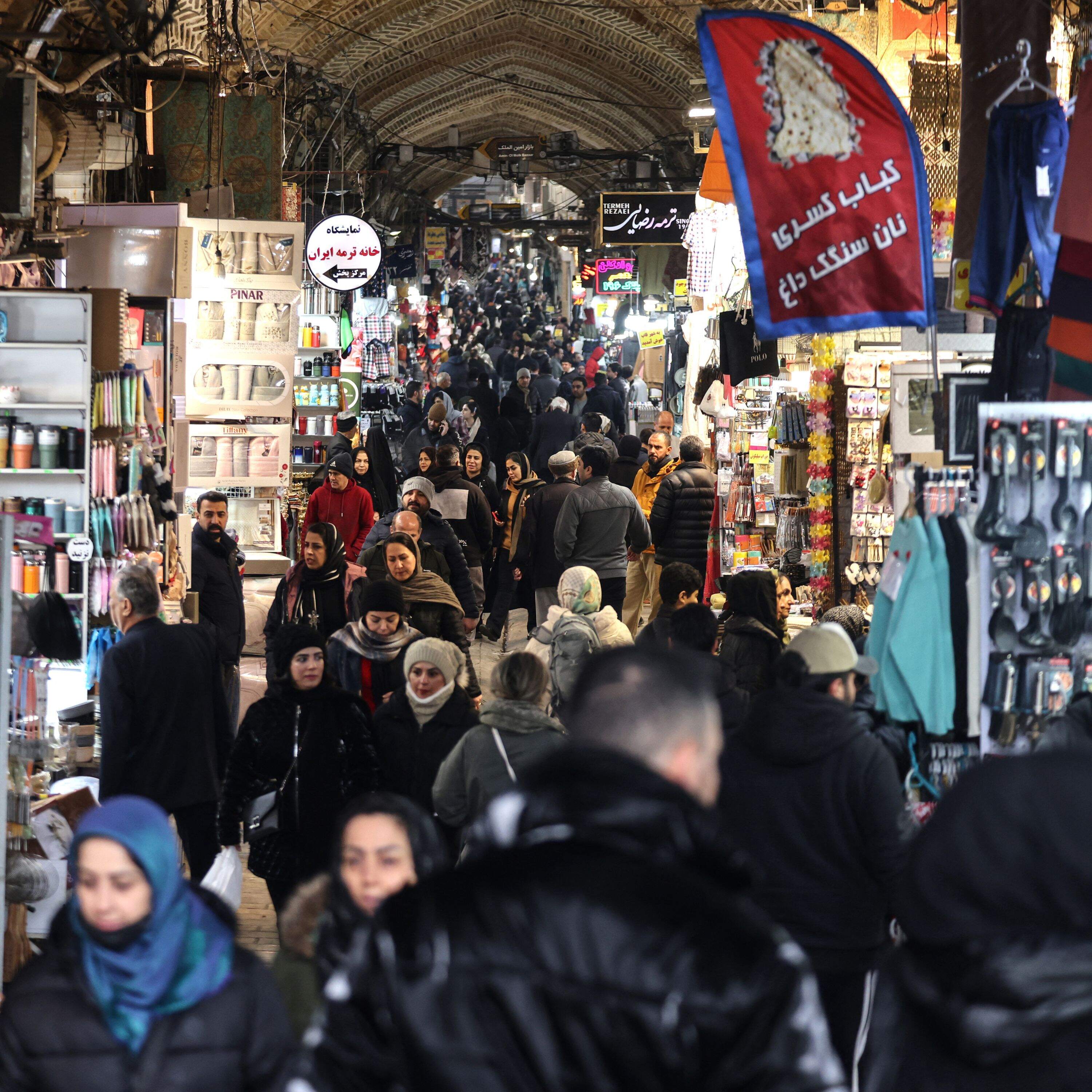
The transcript discusses the economic roots of recent protests in Iran and the broader geopolitical context. It begins by noting increased U.S. naval presence in the Middle East as President Trump pressures Iran on its nuclear program. Within Iran, massive protests initially erupted due to economic distress, including 50% inflation and a collapsed currency, starting with shopkeepers in Tehran's Grand Bazaar. These demonstrations quickly spread nationwide through the interconnected networks of the merchant class (Bazaaris), who have historically been a political force. The protests expanded to encompass other issues like water shortages and civil rights, leading to a severe government crackdown. Analysts explain that while U.S. sanctions exacerbated the crisis, Iran's economic problems are deeply structural, stemming from long-term mismanagement, corruption, and inequality. Despite the severity of the unrest, there is pessimism about immediate political change, as the economic downturn has made even basic commerce difficult, with only the food industry remaining relatively active.
NPR As we speak, US Navy troops are in a state of waiting. They're telling their husbands, wives, and children that they're going to be away from home for more months. That's because last week, Newsbrook that the US government told a second aircraft carrier group to go to the Middle East. President Trump is imploring Iran to make a deal on its nuclear weapons and missiles programs. Iran's leadership is in a vulnerable position. This comes off the back of massive country-wide protests that swept the nation around New Year's. They've mostly been called for now because of a bloody crackdown by the Iranian government. So far, activists say that at least 7,000 protesters were killed. There are many reasons for those huge protests. The leadership, religious discrimination, corruption, but the initial seat of these protests was economic. It started with shopkeepers frustrated with inflation and a currency collapse. This is the indicator from Planet Money. I'm Whalen Wong. And I'm Darien Woods. Today on the show, the economic roots of Iran's protests. We speak with a small business owner in Tehran, and we learn why Iran is in such an economic mess. This message comes from the BBC with its new podcast, The Interface. Every Thursday, three leading tech journalists explore how tech is rewiring your week and your world. Listen to TheInterface on BBC.com or wherever you get your podcasts. If you had dropped down from the sky onto Central Tehran, you might find yourself at the grand bazaar. The grand bazaar is a gigantic marketplace of interlocking corridors. It's where wholesalers and retailers sold shoes and fabrics and cleaning supplies. And just outside the grand bazaar, you might find a workshop owned by Ali and his family. My parents, my grandparents, as much as I know about my background, they were all from Bazaar. Ali, SMP are not to use his full name because he fears retribution from the Iranian government. And we were actually lucky to be able to speak with him. We might have cut out because Iran's internet has been restricted off and on since early January. Hello again. Thank you for your patience. No problem. Ali's family business makes interior decorations that shop owners in the Bazaar sell. Ali says business has been bad recently. He traces his back to the 12-day war between Iran, Israel and the US last summer. He told us what his business managers have been telling him. They could use, but it's very difficult for Dr. Sel. They are only producing, not selling. Inflation in Iran is running at around 50 percent, 5.0. That means by the time the Bazaar is, the shopkeepers buy their products and then go to sell them, they're having to mark up their prices a lot. And then the customers are refusing to pay such high prices. The Iranian currency, the Riyal, has also lost extraordinary amounts of value. That means it's harder for Bazaar's to import their goods from overseas. In late December, a handful of shop owners just outside of the Bazaar had had enough. Iran Keshe Avasian is a Middle Eastern and Islamic studies professor at New York University. They simply shut down the shops, close the metal curtains. Sometimes in some cases they stayed inside the store as a symbol of their unglai, unless they're open and sell their goods. In other cases, they took to the street. Shop closures, sit-ins and rallies have a historical significance. This is the same sort of repertoire of actions that merchants and Bazaaris have used for well over 100 years, whether it was the constitutional revolution at the beginning of the 20th century, or the oil nationalization movement in the 1950s, or the 1979 revolution. In fact, Bazaaris were a driving force of the 1979 revolution. They helped fund demonstrations that led to Iran establishing a Theocratic Democratic hybrid government, one that's suspicious of Western influence. The humble shopkeeper has a huge amount of political power in Iran. As a general rule, the Bazaaris, since 1979, are viewed as a strong pillar of the regime, the generally socially conservative. And one way to see that is that when these protests started in December 28th, the government was actually quite conciliatory. It acknowledged the legitimacy of the concerns of these shopkeepers and merchants and so forth, and it tried to actually negotiate and sit down with them. But it was too little too late. The protests were spreading to Bazaaris all around the country. All Bazaaris really have nationwide networks, whether it's lending networks or supply chains networks between wholesalers and retailers and so forth. So part of the reason that protests in the Bazaar could actually spread and take on national scope is that if there is a kind of a disruption in the Bazaar, that information that news quickly spreads through shopkeepers and other brokers and intermediaries very quickly. And that's what happened within the first couple of days in December. We saw protests all across the country in other commercial centers in Bazaaris and other cities and even small towns. Soon the discontent was about more than just the exchange rate or inflation. Water supply has been a big issue, for example. Farshid Fahedafad is a professor of civil and environmental engineering at Tufts University. For the past, I would say, past few years, past five, six years, the whole country has been struggling with a severe drought. This has meant power cuts from dry, how-japoured dams and even water restrictions in cities like Turan. Farshid says the water problem has its roots decades ago, when the new Islamic Republic of Iran got a bit carried away building too many dams. Building new dams kind of becomes a kind of sign of independence and sign of development. In fact, Farshid used to design these dams in Iran himself until he moved to the U.S. in 2007. He says they were as big as the Hoover Dam. These dams would extract more and more water from natural sources so that Iran could grow more of its own crops. And after several decades, worsened by climate change, excess to water started to become a real problem in Iran. Water was just one other pent up issue. And while you professor Aran Kashvarsian says university students were concerned about civil rights. By the third day, it included universities and university students in Tehran, as well as other major cities as Fahana and Yast. After enormous demonstrations around the country, there was talk that this could be existential for the regime. There could be some sort of new revolution. That's when the government started shooting protesters in the street. The truly brutal crackdown of January obviously has hit Iranians very, very hard. This has kind of reached a scale that I think most Iranians did not expect. In early January, President Trump said he would come to the protesters' rescue. But that hasn't happened. The White House's main focus in negotiations with Iran is still preventing it from acquiring a nuclear bomb. That's one of the big reasons why President Trump put extra sanctions on Iran last year, limiting its oil sales. This is a major cause of this economic crisis. It said, as much as lifting sections would help Iran's economy, the problems go deeper than that. The Iran economy has been basically for the past 10 years, 15 years, been in recession. This is a combination and an kind of vicious cycle combining sanctions, as well as mismanagement of the economy, which has generated lots of negative outcomes. Most importantly, from my perspective, a lot of corruption and development of oligarchs and monopolists and so forth. I'm connected to that is a lot of inequality, right? So this is in the background. A ring is not optimistic about real change in the short term. That's because the inflation and currency collapse last year was just the spark. The country had long been sitting on bone dry tinder. Right now in Tehran, Ali says people aren't buying much of anything at the Bazaar, with one exception. The only market which is still working in the normal ways that food industry. You still have to eat? Yes. They think that if I can't buy a new ethnic error, why shouldn't I spend it for a good restaurant? Maybe I wouldn't do that, but everyone do that.
Podcast Summary
Key Points:
The U.S. has deployed additional naval forces to the Middle East amid tensions with Iran over its nuclear program.
Widespread protests in Iran, initially sparked by economic grievances like hyperinflation and currency collapse, have expanded to include issues such as water scarcity and civil rights.
The historically influential merchant class (Bazaaris) played a key role in spreading the protests nationwide through their networks.
The government responded with a violent crackdown, but underlying economic problems are deeply rooted in sanctions and long-term mismanagement.
Despite the severe crisis, fundamental change is seen as unlikely in the short term due to systemic corruption and inequality.
Summary:
The transcript discusses the economic roots of recent protests in Iran and the broader geopolitical context. S. naval presence in the Middle East as President Trump pressures Iran on its nuclear program.
Within Iran, massive protests initially erupted due to economic distress, including 50% inflation and a collapsed currency, starting with shopkeepers in Tehran's Grand Bazaar. These demonstrations quickly spread nationwide through the interconnected networks of the merchant class (Bazaaris), who have historically been a political force. The protests expanded to encompass other issues like water shortages and civil rights, leading to a severe government crackdown.
S. sanctions exacerbated the crisis, Iran's economic problems are deeply structural, stemming from long-term mismanagement, corruption, and inequality. Despite the severity of the unrest, there is pessimism about immediate political change, as the economic downturn has made even basic commerce difficult, with only the food industry remaining relatively active.
FAQs
The US government deployed the carrier group as part of its strategy to pressure Iran, with President Trump urging Iran to make a deal on its nuclear weapons and missiles programs.
The protests began with shopkeepers frustrated by high inflation and a currency collapse, rooted in economic grievances before expanding to other issues like leadership and corruption.
Sanctions, particularly on oil sales, combined with economic mismanagement have led to recession, high inflation, currency devaluation, and increased corruption and inequality over the past decade.
Bazaaris, with their nationwide networks, initiated shop closures and rallies, spreading protests across Iran due to their historical political influence and economic discontent.
Protests expanded to include concerns over water shortages from drought and dam mismanagement, civil rights, and government repression, reflecting broader societal frustrations.
The government initially acknowledged the protesters' concerns but later conducted a brutal crackdown, including shooting protesters, to suppress the widespread demonstrations.
Chat with AI
Loading...
Pro features
Go deeper with this episode
Unlock creator-grade tools that turn any transcript into show notes and subtitle files.
 PodcastTranscript AI