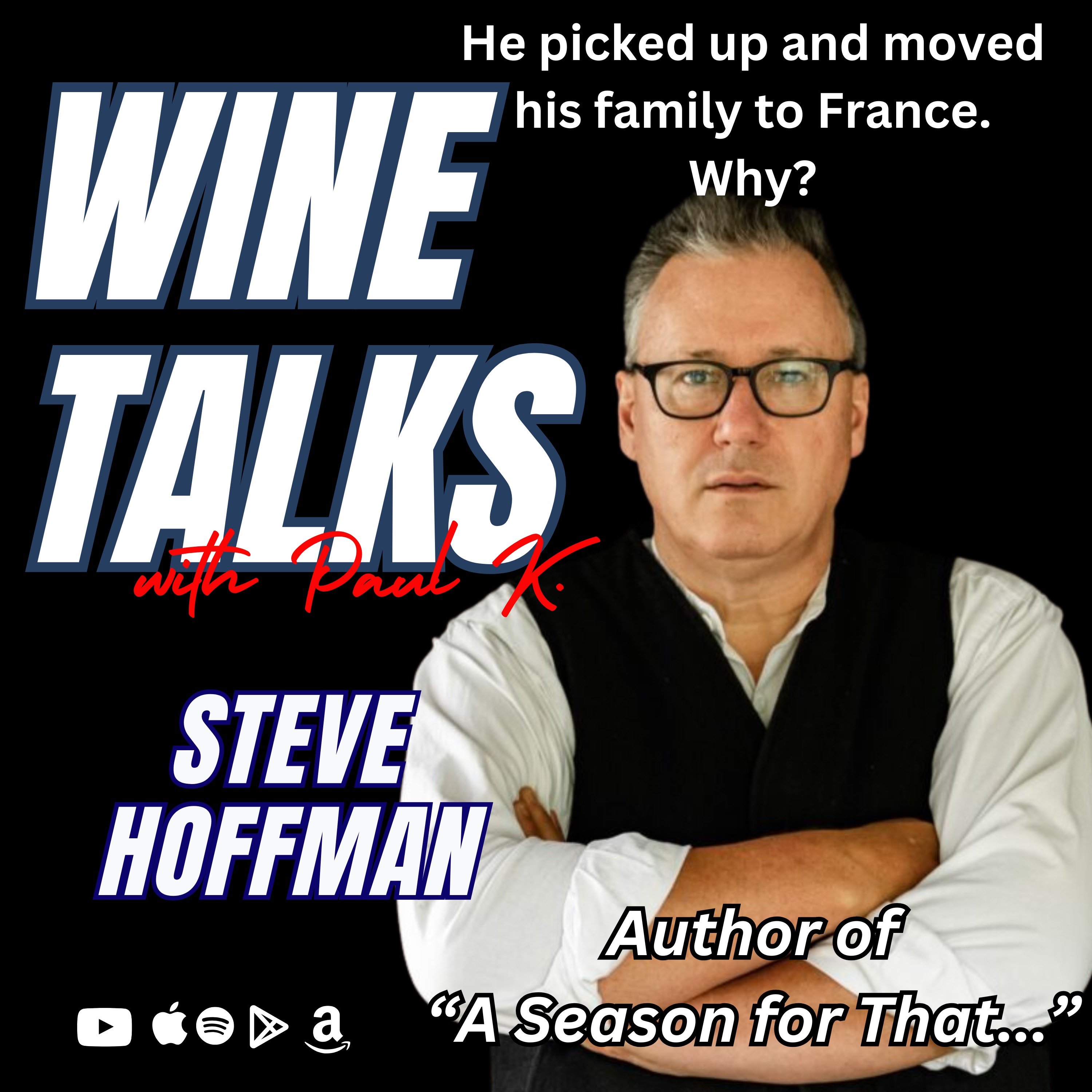
How French Village Life Changed the Hoffman Family's View of Food, Wine, and Culture
59m 37s
In this podcast episode, host Paul K. interviews Steve Hoffman, a tax preparer and author of *A Season for That*. Hoffman describes his unconventional career split: he works intensely on tax preparation from January to July, funding his creative writing for the rest of the year—a system he calls "self-patronage." The transition from tax season to writing is challenging, as it requires shifting from a linear problem-solving mindset to a reflective, introspective one. Hoffman emphasizes that creativity demands rigor and practice, much like any skill, and that the best creative work happens in a state of productive discomfort, where one is not quite comfortable but not overwhelmed either. He critiques modern content churn and AI, arguing that genuine writing stems from a unique life perspective that AI cannot replicate. The core of the conversation centers on Hoffman's memoir, which details his family's move to rural southern France. This adventure was a joint decision with his wife, Mary Jo, a former aerospace engineer, born from their shared love of challenge and a desire for their children to become fluent in French. Although the move initially went poorly, it ultimately built confidence in his children and deepened the family's bond through shared struggle and discovery. Hoffman reflects on the value of stepping outside one's comfort zone and the tension between seeking adventure and needing stability.
-File of wine is a time capsule to some extent. It is the embodiment of what happened in one given year. And you could push that a few, you know, one way or the other a little bit, but ultimately, it's a good vintage if it captures exactly what happened in that year. -Sit back and grab a glass. It's Wine Talks with All Ks. -Hey, welcome to Wine Talks with Paul K. And I am in studio today, sort of a blustery day after a huge storm here in Southern California. About to have a conversation with Steve Hoffman, tax preparer and food and wine author. But have a listen to a show that I just put out. It's an incredible conversation with a gentleman named Greg Lembrek and Greg Lembrek and a nuclear physicist who invented the Coraván. It's an incredible, incredible conversation. But not over here. You're going to talk about Steve. Welcome to the show. Thank you. Thank you, Paul. I'm going to read this thing from CHAPGTP since everybody's using AI and I certainly do too, but it's rather, rather magnanimous. Today on Wine Talks, we sit with the Steve Hoffman author, journalist and a man whose life story reads like a map of curiosity. How about that already? -I'm in. I'm-- -Yeah. [LAUGHS] Hoffman's path has swung through kitchens, newsrooms, and French markets. Each chapter is sharpening the way he observes people, culture, and the seasons that define our lives. His book, A Season for That, isn't just a memoir. It's a precise, unvarnished look at change, identity, and the quiet truths we only see when we slow down. Wow, that's awfully impressive. Oh, yeah. I'll take that. I mean, I mean, it's almost better than natural intelligence. [LAUGHS] It's certainly mine. You know, I got this-- I think a PR agency, our PR person worked, reached out to me and asked if you wanted to be-- I wanted you on the show. And I sent a book, and we read most of the book, all the listeners. It's-- it was really struck home for me. But let's go back to your career for a little bit. Just-- that's not what you do every day, or at least you would just mention six months of the year. What's your regular vocation? Yeah, my job that actually pays the bills is tax preparation. And I've been doing that for almost 25 years. I was a language and literature major in college, studied French, English, and ancient Greek. And my wife was an aerospace engineer. And so she went to work, and I raised our kids for obvious reasons. And then at some point, we were having trouble having baby number two, and we thought it was a stress effort job. So we started tag team. She jumped out of the ring. And I inherited my mother-in-law's tax business, which sounds like one of the worst ill-fitting careers that you can imagine for a language and literature guide. But I ended up loving it. And so I've been doing that for 25 years. And only really added my writing career on as a midlife resumption of an early love of words and books and writing. And over those years, it's gradually evolved to about a half-and-half proposition where I worked the first half of the year at tax preparation. I do about five or six hundred tax returns. That pretty much funds us through the end of the year. I consider it sort of a form of self-patientage. I'm kind of my own grant program. So I don't have to go out and make money with my writing with every assignment I take on. I can kind of write with some creative freedom because the bills are paid by about July, or for the most part paid by July. You know, it says something interesting. You inherited your mother-in-law's tax business. And I deliberately stayed away from my mother-in-law's business, which was she was there in trash. And so-- [LAUGHTER] They wanted me to do this. But my father had gotten an offer for the one of the month club and said, son, I think he made out, come check this out. And of course, it paid the way for my career. But this is kind of interesting because your wife is-- she's from-- Slava country, right? She is half-remainian. Yeah. So her father was 100% remainian. And so yeah, we-- She's an aerospace engineer from trade, from Romania, or here. She went, no, no, no. She was born and raised in St. Paul, Minnesota, but from grew up on the-- on Rice Street on the East Side of St. Paul, where there was a little Romanian enclave. And so her dad was named John Lapidat. And she grew up Mary Jo Lapidat. We met in 1987. But she was-- she was born and raised in the Twin Cities. And studied as an aerospace engineer at-- she got her engineering degree at Madison. And then got her aerospace engineer at Masters at Stanford. And then worked for Honeywell for a bunch of years. And she's since-- we both have this weird, sort of, right left brain thing going. She's since begun a career as an artist. And so she's an artist photographer. I'm now a taxpayer, a food writer. But she is a former-- I literally did marry a rocket scientist. So that's-- This guy-- Yeah. You can imagine how often that joke gets told in our house. It doesn't take her-- I'm sure. You sort of bring it up on the book in the beginning about how you met her in this whole dichotomy. Is irony between their two lifestyles and your rearing. And it's fascinating. It's kind of a drew us into the story in the first place. But it's interesting. I consider myself a creative person that's kind of-- you know, not the organized structure guy. If you saw the rest of the studio, I'm sitting in and you see how-- what a mess it is. And my wife is that structured accountant type. She's an accountant. How does that balance in your lifestyle? I mean, particularly when you sort of have a hard line to stop in six months, April 16th. And it's like, well, now we're going to start the creative side. That seems like-- That transition is hard. The transition from the writing season into tax season is really easy now after 25 years. It's very linear. My time is blocked off in one hour increments. My clients all sign up for their appointments ahead of time. And so that doesn't no longer take as much of my brain as it used to, as much sort of psychic space. But the transition out of taxes into writing is very hard. It takes much longer. It's getting into that place where you're not just solving problems in a world that you are already more or less a master of. But you're always asking questions about what does this mean? Who am I? What is important to me? What are sort of my foundational goals at values? And that fuels the writing. But it's very hard to dip in and out of that mentality. You've got to kind of be in there. I call it big ship. You can't turn a notion line very fast. And it takes a long time to get started on a long time to stop. That makes a ton of sense. Because the writer's blocking itself is a hurdle that we all have. And here you have to shift gears, not just sitting and sitting at Starbucks on the Wi-Fi, trying to write something. But you come out of a completely different environment. Absolutely. I think that is. The creative process is so interesting to me. And I've always wanted to act. And I'm using this platform and other platforms in the wine trade to foster that creative spirit that I think I have. But why do you think that exists? This ability to create when you really on a role. And then the ability to just be completely stymied when you're trying to figure something out. Yeah. Well, I think two things. First of all, I think a lot of people think that you can just be creative and decide that you're creative and then start being creative. And I don't think-- I think creativity requires a set of skills that any other activity does. You can't just step onto a tennis court and be a good tennis player. You can't just decide you like a glass of wine and be a wine expert. It involves repetition and iteration and being in that world for enough time and doing the same thing over and over so that you actually establish skill sets. And I think a lot of people underestimate the amount of rigor is involved in actually being creative. But then the other part of your question is just sort of like, why do we get lost in creativity? And why does it take us so long to get into that mindset? And I just feel like creativity is usually asking us to be slightly better than we are. A lot of times, our jobs, we more or less understand everything that needs to be done for our job because we've done it. We're there relatively straightforward activities. Creativity is always asking you to be a little bit better, to think a little bit beyond what you've thought before, to be a little bit better than who you are. There's a David Bowie once had a really good image for what that's like. He said, it's like being in a pool where you're dropping down into the deep end at some point. You're not over your head, but you're not touching bottom either, and you're kind of bobbing up and down at the edge of your physical size. And I feel like creatively, that's what happens when you're doing it right, which is you're not quite comfortable. You're a little in over your depth. You're not drowning, but it's not easy either. And I just think that's where the best creative work happens, and it's a really hard place to reach and stay in. You know, it's interesting. I don't know the words of that suffragisticity don't get in. [LAUGHTER] You know, why you're saying that is reflecting on the access to creative tools these days, with, of course, the internet and now AI and all the other, even prior to the AI, there was all kinds of wonderful things to do and to having to be on TikTok or be on Facebook, Instagram, and continue to create. And now it's created this burnout feature of, I think, a generation that doesn't understand what you just said. The crux of what you just said is really important.
It's been around since creativity, humanity. - Absolutely. - And all of a sudden now access to creativity and displaying your creativity is creating a burnout in this because you can do it so fast. If you don't do it fast enough that somebody else is doing it ahead of you and you're clamoring for attention on the social networks. And I think that's created a whole different generation of-- - I do too. And I think some of the, the encouragement to just churn out content has really, it looks like creativity, but it actually gets in the way of creativity. It's more like a grind, it's more like a marathon. Creativity is about sort of sitting still with yourself and finding a way to be comfortable with that or at least make something out of that. And that's why I think that AI is going to, it's going to be a very long time before AI creates writing that really means something because all good writing comes out of a perspective. It comes out of a very specific set of life circumstances that can't be recreated by anybody else and you write out of that the very unique weirdness of your life and everybody's life is weird because everybody's life is unique. And I don't know how AI is ever going to recreate that, that sense of writing out of a single perspective and you're looking at life through this little keyhole of your own experience. And that's where writing happens that means something to me anyway. I don't think AI's going to get there for a while. - I completely agree. I don't know how it could ever. - Because it hasn't ever let a life. - Yeah, it just, you know. - And it literally has no common sense in those kinds of pieces. There's a lot of people on the web, you know, there's one person I won't call it any names, but I listen to podcasts and they don't make any sense. Their English is average at best. She's not native English, she's not her native language. But then she writes this amazing stuff that's really thoughtful. And I'm thinking myself there's a problem here because there's no way your brain can create what was written on a post, but because the way she presents herself on a podcast is just the English time. - Well, I'm a different person live and I am on the page. I'm a better thinker and a better expresser of myself on the page than I am live. So I can kind of see that. I can see somebody who would be sort of tongue tied in front of a microphone, but then, you know, alone in a room as an introvert, the work start flowing. They get in touch with some place in themselves that they can't access when they're in front of other people. I can see that. - I'll buy that. I'll buy that. Well, it's just kind of creates a lot. This is a person that creates a lot. I do envy that. When I filled the wine of the month club, I thought I wanted to be an actor and realized that like you just said earlier, that creative process takes a lot of time and energy to foster and to find the chasm in your brain that make it better and practice it. Just like you have to practice anything. - Absolutely. - You have to put time into it. Your book, A Season For That, Lost and Found in the other seven France, I'll hold it up in case somebody's watching. - I see as my baby. - You know, it drew me in immediately. And I'll tell you why, my father spoke five languages. He came from Cairo, French was one of them. I didn't or spoke French with him, but I set out about five, seven years ago to learn to speak with him before he passed away. And we had a great exchange as he was life with his body was fading. And I always thought it was fascinating that he could correct my grammar when he learned it in high school in 19, '48, not even. And, but the idea, this goes back to your creative idea thought process. This is a very organic story about your pursuit. Maybe it's for an alternative lifestyle. Maybe it was to dig deeper into your franco file needs. Maybe it was a curiosity to your, to picking up and moving like you did. Tell me how this, like how you convince your Romanian wife that this was gonna be an idea where you're gonna take your whole family and move them to the south of France or in a small village, no less. And try and recreate a lifestyle or create a lifestyle. - Yeah, there had always been a sense of adventure that we embraced. We liked even from early on in our marriage. In our 20s, she was doing well at Honeywell. She was already a manager. And we took three months off and lived in French Polynesia and just kind of showed up and lived for three months on refish and breadfruit and mangoes and papayas. And it started off almost as disastrously as this French trip did. We didn't know what we were doing. And now it's part of the fun. This sort of screw it. We're just gonna give this a try. And we are partners. We were looking at the world, shoulder to shoulder. And we like being in that position. We like kind of testing our wits and seeing what the world had to throw at us and overcoming as a team. So it's not quite as crazy to imagine that we would do this thing. And it really, it derived from our kid, from ultimately way back from my, taking my junior year at college off, living in Paris learning how to speak French, falling in love with French language and culture and literature. But then the travel bug and the interest in looking outside, you know, in trying to combine both a comfortable, more or less bourgeois middle class existence. And then also having these tangents where we try to figure out something a little less ordinary. That, the tension between those things has sort of animated our marriage for as long as we've been married. So we both like making enough money to pay all the bills. We would have trouble being peer bogeaniums where you don't know where the next paycheck's gonna come from or sleeping on your French couch. And sometimes that can be a very creative place that just wasn't how we were wired. So we're always caught a little bit between this longing for adventure and this need for certain about stability and predictability. And so this was after a period where we'd done the kid raising thing, those busy middle parenting years. Our kids had both gone to French immersion school in St. Paul, so their curriculum had all been in French. And one day Mary Jo was sort of like, you know, I've commuted these two damn kids. To St. Paul, for 45 minutes a day, five days a week for nine years, they better speak to pretty good French by the time we're done with all this. Why don't we go to France and put them in school and let them actually really submit that language. So while it was my love of France in the French language and my fluency that was the sort of, you know, the energy underneath this, it was also very much Mary Jo's decision. And this was gonna be another one of those times where we throw a dart at a map, see where it lands, and get there and start figuring it out when we get there. And as you know from reading the book, it doesn't go very well. When we first arrived, you know, we were under, we were very much underprepared. And with the difference being that we had kids this time, and the kids who were at the edge of their capacities and something needed to be different this time. And that's kind of, that's where the book really starts is in that moment of her saying, "This isn't working." You're not doing enough, you're the one who speaks French, you're the one who loves this country. You're not doing enough to bring us along. And I don't want this to be another trip where we just sit and watch you speak beautiful French. Something more interesting has to happen this time. And that kind of unleashes the whole series of events that make up the narrative of the story. So funny, I just got back, but not just back last year, it took 12 people, which the trip didn't start out that way. It was just, I wanted to go do some podcasting and we were gonna be in Monaco for the Grand Prix and then we had the Bordeaux, whatever. And I was very cognizant, and my French is okay. I can hang, I have a hard time hearing it, which is probably common, but I couldn't have a conversation. I walk into wine shops and I discuss my shop here in America, whatever. But I was very aware of the fact that I didn't want my guests sort of speak, my friends to think, Paul's show boating with these people. And so I was very cognizant of that when I was going through the daily tasks and trying to communicate with store vendors and things that I wasn't acting like that person. But I mean, actually this question, Americans are very focused group. American history is short. The American personality abroad, you know, if you understand what the French think of Americans, what the Italians think of Americans, what the rest of the world think of Americans, you get a clear view of who Americans are, which is its own culture and has its own peculiarities about it. So what do you think the value to your kids and your marriage and your lifestyle, the value of this trip was? - That's a great question. And I don't know that anybody's ever asked that question before. And what I think what I would say is, yes, there's the easy sort of, well, the kids got to think of themselves as world citizens. And so they weren't stuck in the mentality of being American and looking out for it.
out of the rest of the world, the way most Americans look out. But I don't know that that was the most valuable thing. I think a couple of things, I think it gave them confidence. It has nothing to do with the fact that we were in France. It had to do with the fact that they were challenging themselves to the edges of their abilities at a young age being asked to really step up and be, meet kids in a strange land. There was no English, we were in a very sort of backwater part of rural southern France, and they had to find some resources in them. And I think it was really scary when they went through it, but when we got back, we could see a new confidence at both of them that I don't think they would have had. You know, you could find that elsewhere, but that was one of the biggest things. But for me, the biggest thing was, because we were this little island of Americans in our house, because we were challenging the kids so, you know, they were being challenged at such a level during most of their days, we created this little refuge in our house where they could come back and they could throw off their backpacks and they could watch friends if they wanted to, and they didn't have to be on at home. And one of the beautiful things about living in France is that, especially in rural France, I think, is that the tradition of family and even grandparents being at the table together twice a day, really. The kids had an hour and a half break for lunch, and you could see all the grandparents, you know, taking their kids home from the elementary school, holding their hands, they're gonna go sit and have lunch together, and they're gonna go back to school. At the end of the day, they're gonna go back and they're gonna have dinner together. And that tradition gets sort of romanticized, but it had a very practical effect for us, because we entered into that, and what it did was it taught us to be a family. We even to this day, we can fire up the stove, we got a bunch of wrong gradients, we get together as a family, we put something together, we sit down and talk with the TV off, we actually don't own a TV. But we, that experience and being in a cultural setting where that was really important, taught us really, how do you be a family together? How do you interact together? How do you spend lots of time together? And I feel like we got to know our kids better than average, because we were in there on their wavelength for so much time during that trip, and then that trip fed that kind of habit over many of the years afterwards as well. - That's a great explanation of some of the value of this. I mean, I know that even with you, French not your primary language, you'd still probably had those moments where you got home and you just, "Oh, okay, you know, I can speak." - I'm a little embarrassed. - And you're trying your brain, but it's so good for your brain, it's so good for the kids' brain. Let's lay the land a little bit for the listeners. This is, you picked up and you moved to France, and you moved to this little town, but you call it the other Southern France. What do you call it, the other Southern France? - Yeah, I think because most people think of Southern France as the proviance in the Riviera. You know, they think of it as the glamorous. - Central pay, right? - Yep, Central pay, and yeah. You know, the Luba Roe Mountains, a Peter male, and you know, there's, that's why I think most people think of it as Southern France, and that's east of the Rome. So, you know, the Rome River divides the country in half, not dissimilar to the way it Mississippi divides the US, south of coast in half, and on the east side of the Rome is proviance and the Riviera, and you eventually get to Italy, and west of the Rome is Longaduc, and then eventually turn itself and get it a Rousillon, which leads eventually to the Spanish border. So, go ahead. - No, I was just gonna say, it's the other Southern France in that sense. It's sort of the forgotten sister of the glamorous, touristed, proviance, and Riviera, and you know, in some ways that was an advantage to us that it was a little bit forgotten, because we got to spend time in a place that didn't see many tourists, and there was an opportunity to integrate that I think would have encountered a much harder barrier if we were in a tourist hotel. I would agree with that. I think that kind of goes back to most travelers who go to France for the first time. They go to Paris, obviously. And the reputation Paris has had for many years, and I don't find it myself, is that they're not friendly to Americans, and they're very rude, and I don't find that at all. And it's generally accepted that when you go to the real parts of France and Italy, that you're greeted with much more congeniality and friendliness, and I suppose that would be true, but then there's less English. I mean, you go to Paris now, every speaks English. I mean, it's kind of disappointing, actually, 'cause absolutely, absolutely. And even in parts of rural France now, in some of the larger villages that are, you know, like the Clubeau-Village, where they have the most beautiful villages in France, those get very heavily visited, and you know, there's Gord, for instance, in some of France, with this beautiful vista out over the vineyards and the hills, and it was, again, it was mentioned in Peter Maill's books, and you know, we went there one day, again, feeling like our place was a little scruffy, and a little backwater, and we got to Gord, and it was magnificently beautiful, and everything was kept up, and the cobbles were, but then we went to our first restaurant, and there was a menu this big, and it was in, you know, English, French, Italian, Dutch, German, you know, and it's like, this is not, this is not what I signed up for, you know, so, but to your point, I think that the historical rudeness, quote, unquote, of Paris, is really just simply what happens when, they have been overrun for decades by America tourists, many of whom don't speak English, many of whom come with a sense of entitlement about what they have a right, the kind of experience they have a right to have, and they don't do really any research ahead of time, and don't really know what they're getting into, and that, if that happens once or twice in a little remote village, it's not a big deal, and you get to be the person who educates that, that, that American, if that's the hundredth American, you've seen that day at the cafe, and they've all been that way, without speaking your language, and coming to your country with expectations of privilege, it's not surprising that there's a little bit of rudeness. I also think though that the rudeness of France is also partly a culture of misunderstanding, and it's just simply that Americans tend to be friendly. We tend to make connections really quickly, and get kind of deep with each other emotionally quickly, and then there reaches a bottom where it can stay a little bit shallow, where this is kind of this Yucke de Yucke, hellfellow well met attitude about life, and in France, it just simply doesn't happen. Anybody in France, it takes a while to get in, to become a part of somebody's life, but then once you're in, quite often you're in for life, and that was one of the experiences we had there, to the very long time for us to feel part of things, but then now those people have remained friends for, you know, for the rest of our lives, ever since we've been there. - That's an interesting perspective. Being in the wine trade, I've had many, many, many French expats here to sell me wine. They come here for reason, the women, particularly the women, who kind of fled this patriarchal society of France, have a common thread among them. They're very strong, they work very hard, they're very shrewd, and they come with a purpose when they walk into this office to sell me wine, and they've all been there, and I've had a couple that would come, I had one woman and she was great, she's back in Champagne now, she grew up there, but she would come. She was one of the toughest people I ever dealt with, but it was clear to me that amongst them was this drive to prove to themselves, and the only way they could really do it was in America, and they didn't want to speak French, though a couple of them would stay, I had one woman who had booked the last appointment of the day, which was two o'clock, and then she'd stay and help me practice my French, we would just speak French, and I wouldn't let her, you know, buy wine from her, but it was interesting. But here's a pitch that I make when I talk to two people about wine, and if you were to define culture, you'd have to say a language if there is one, land if they still have it, certainly cuisine, the arts and wine, and that's how I tie the wine into that conversation. But I found it really important when I was studying French to understand the history of France, Napoleon, and Catherine de Medici, and the whole evolution of food there, and you have a section in the book where you're trying to create cuisine out of the local fish and mullets and all kinds of things, and the kids are like, you know, we're not having any of this kind of thing. No hamburgers in this town, I suppose, and so, yeah, was that the objective? It was like really the immersion, not only in the language, but wow, we were gonna cook what these people cook. Very much so. That was partly my response to that early little bit of a slap upside ahead from Mary Jo, my wife, when she said, this isn't working, you need to do something new, and one of my first efforts to try to integrate us as a family into this place was to cook my way into it. I'd always loved food, I'd always loved wine, but as an enthusiast, as a drinker,
I hadn't been really, I had had anything like a wine education until we got here and then I got a very deep one obviously. But yes, the cooking was an initial effort to what do you do? You know, it sounds great from a couch in Shoreview, Minnesota that you're going to go live in this village for six months and of course you're going to become a part of things. And then you get there and it's like, well, how does that happen? You know, you can't just walk up to people and shake their hand and say I want to be your friend. And especially at 800 person village, it's really more like an extended family than it is like a village. And they don't particularly, they're fine. You know, they don't need you. They don't need, they're living perfectly lovely existences without your presence in their village. And so there was no, one of the initial sort of hurdles was there was no inherent desire on the part of our neighbors to welcome us in. We had to earn that and my first effort to earn it was to get out there and ask questions of the local grocer and ask questions of the fishmonger who came every Friday and delivered his son's fish from the Mediterranean and the shell fishmonger and started to try to cook my way into the village. And eventually that ran up against exactly what you're saying, which is that I wasn't much of a cook and I wasn't getting better fast. And it's a very strange cuisine. I mean, we think of Mediterranean cuisine as the thing that we're all supposed to be eating for our health. But when you are in the Mediterranean itself, it's a very strongly flavored, very smelly, very, you know, full of unusual ingredients. You know, I mean, not yes garlic, of course, but anchovies and lots and lots of shellfish and lots of fish, but lots of small little oily fish and the meat traditionally has not been pork and beef. It's been lamb and wild boar and some wild game and yes, certainly chicken, but also duck. And suddenly I was, there was this whole new vocabulary of cooking that I had never been familiar with. And my attempts to cook eventually work out, but early on, especially with my, with my first attempt to cook the rabbit. I got from the local grocer that my daughter told me to look like a chihuahua and that she was never, she was not going to touch with a 10 foot pole. Yeah, exactly. So, yeah, it was an effort to integrate. It kind of failed for a long time. And that failure eventually led to, you know, my asking to pick grapes. We were there during the fall semester. We were there during the great harvest. And I realized at some point as I watched the vineyards around the village start filling up with people, that that's what was happening and that that was maybe that's what this place wanted to talk to me about. I arrived, I think, with some preconceived notions about what this trip ought to be. And I finally stopped talking and shut up for a while and listened. And what the place was trying to tell me is that this is a place that's surrounded by vines in the, you know, the largest vineyard in the world. And this is how people make their livings and this is this is the culture of this place. If you're going to be a part of this, you need to get out there in those fields and, and accept what it's trying to tell you. That's a whole conversation. I want to, I don't want to forget that. But I want to ask you this one question about, you know, the, I did a podcast with Frederick Castan who was an amateur. He wanted to, when he was a teenager, he won the amateur French chef contest in in Avignon and he, he came to America, became a famous chef. And he was telling me in this podcast that one of the criteria, what he won is that they go check the trash after the cooking contest is over because it's, they're so efficient with their, what they cook, they don't throw anything away. And I think it's part of the cuisine that Americans probably don't understand. And it's hard for me, sometimes the stomach, some of this stuff. I mean, you go to Paul Boucou's restaurant and you see this inflated bladder. Yes, right. Right. Right. Yeah. And you kind of think, wow, this is gross. And it does have unusual smells and it's things that Americans just probably aren't, you know, accustomed to. Absolutely. I mean, I think Americans think of smelly food as inevitably bad food, fruit that has gone off. And living in the Mediterranean, smelly food is what you crave. And, you know, like you're saying, the kids of our grocer in town, they're like Thursday night thing that they wanted was, was, you know, roasted, in a tomato and garlic sauce, like that was a family, that was a serious family meal. Wow. In this village of these kids who are in their teens, you know. So it's, yeah, it's learning that that, you know, strongly smelling food is not food that's gone bad. It is, it is something that you can learn to love. And we did eventually learn to love it. And it's changed really how I react, how I interact with food ever since. Well, thank goodness you're living in the apartment building where you make the stuff and probably probably the worst, my first exposure to that smell was, you know, in Southern California on a Friday night, where they're making Manudo for the next day. Oh, sure. Absolutely. Man, you walk into that. And I'll never forget the vision that the guys holding this big piece of trip up and he's whacking at it with his knife. And it's stuck the high heaven in the kitchen. Never get rid of that sort of gut smell, even when it's washed, even when it's in a soup, there's still that, there's still that intestinal sort of. Yeah, and eventually you fall in love with it. Absolutely. Yeah. I'm like, as I fall in love with anchovies, I didn't love anchovies. And now I can't live without it. Well, I have a lot to learn. Even when you go to Paris, you have Keesh, you know, in Quassons and, you know, Crepes and, you know, that's the American stomachable French food. Yeah, French hotel food, right? Even the five mother sauces you get into those and, you know, those are all palatable. Though the one I did try to make from scratch, which was the esponial, I couldn't, I almost threw up and I ate it really. So I don't know if I used old beef bones or real bones, whatever I was boiling down, but I was disgusting. So I couldn't eat it anyway. I do feel like I've mastered a few of three of them, but some are evading me. Well, I think it takes us back to earlier in our conversation where you're talking about creativity and, you know, sauces are a form of creativity. And there, there are something that you that you don't just follow an ingredient list and a set of directions and master. They require a touch and feel and flavor and tasting and working your way. I think it, you know, I think it takes you a dozen times before you can get really good at some of those things. You know, I've subject, but I'm going to get into this group culture thing, but we had a party lesson at a French house. There's a brunch. There's a new Orleans brunch and I, and I was in charge of the cocktails. And the same thing, you know, the recipes are in the book work. But when you put it in your mouth, you got to determine where you think that balance needs to be and where it is. 100% and sauces certainly are like that. 100% is part of the cuisine. You know, so there's an episode of the book where you, you take a day trip down to a winery and a vineyard and you, and for the first time, you're sort of on the hot seat to describe a wine or to talk about wine and to hear from the two locals that are making the wines for you. Was that the jumping off point into understanding the culture of wine making in that area. How you talking about the blending, the assemblage. Yeah. So that actually comes fairly late. That was, yes, before and after formative moment. I wouldn't say that that's where I felt like I, where I learned about wine was literally just out in the field picking grapes, listening to people who've done this, they're all their lives. And then following the grapes back to the winery where they would dump them and they would, you know, sometimes they choose carbonic masseration and sometimes they choose traditional fermentation. And, you know, and some other day that this, this huge vat full of grapes and juice would have been fully fermented and they, they empty that out and move that and you've got to do what's called the Deku Vaj, the, the, the polling of all the skins and seeds and, and, and, and I'll have to call it the stems out and press that and add that to another that. And just being on site, listening to people who knew what they were doing, talk about this, who'd done it all their lives and who were still in love with the process. That was the education. And what it taught me is how much wiremaking is still an agricultural endeavor. I think, you know, we have we have a couple of wine centers in the US, but we don't have a wine culture yet, I would say. Wine is still something that a certain type of person gets interested in. And there it's in the blood and it's in the soil and it's a part of every single day. And I really fell in love with that end of things with the production end of wine. It's very blue collar. It's semi industrial. It's guys that would be on a construction crew on a new construction project in a suburb in a city in the US. These are the same guys who are quote unquote making wine there. And I just love that earthiness and that kind of camaraderie that I felt being part of a team.
transforming this raw material that grows out of the ground, a very rocky, very unforgiving soil, and turns into something, you know, a little bit transcendent, but the process itself and being it getting to know the vines themselves, not just the grapes and not just the smell of wine in a in the square foot above a glass, was just a huge reeducation, reordering of my thinking about wine, and I really fell in love with that part of it. You know, it's interesting, you sit a lot just then, because I think wine is entirely transcendent. I think, and it's best put to me by Franz Floral's a courtyard of Smith-O-Lafit, and she owns a wine here in Napa Valley too, and she. I think I forgot the question I asked her, but her answer was, "Welcome to Humanity." Right, yes. Because I wrestle here with the business of wine, and there's obviously very important wine is during consumer driven, we have to sell it, that's how you, you know, stay alive just like you do tax-preparying, but it's deeper than that, and you nailed on the head, it's a very agricultural product, and agrarian lifestyle is completely different than any other lifestyle, and I had a young intern here, right here in the studio, that she went on to Cornell Eonology School, and she got an internship at Chateau Bayee this summer, and she almost didn't take it, then I said, you know, Lisa, what are you doing? She said, "Well, I don't really want to be in the vineyard." I go, "Hey, honey, you want to be a wine maker? You know, you're gonna be in the vineyard." Yeah, and I had the conversation with the director, recently, and she said, "I put it in the vineyard, and she fell in love with the vineyard." And that seems to be where the humanity occurs, you know, where this connection to the soil and the lifestyle and the earth is the transcendent part that when you have that glass of wine. And here you go. And I think, and I think the wine itself can be a transcendent experience, but the way that you get there, there's no magic really in it. I mean, if you look at all the steps involved from planting a vine to drinking a glass of wine, so much of it is just good husbandry. It's just good taking care of the place of the soil, of the plant itself, of the grapes as they grow. It's a huge amount of just sort of engineering and quality control and attention paid to this thing, but it's not like you wave a magic wand at some point in the process between when they arrive at the vineyard and when you bottle the wine and suddenly all the magic happens. The magic happens in just the craziness that fermentation releases all these esters and all these aromas. And that, you know, the very same species of a plant in 15 different places can produce all these different varietals of wine and each of those varietals can taste a little bit different. That's real magic, but there's no magic in the process. The process is just really hardworking, paying really close attention to this thing and making sure that nothing goes wrong. That you don't have disease, that you don't have mildew, that you don't have damaged grapes that come, you know, that get fermented. It's just this really careful attention to detail. And then the magic happens in the fermentation itself. And some extent I would say maybe in the aging, you know, in the, the judicious use of a certain amount of oak or the way that you choose to ferment, et cetera. But that was part of what I really loved about this is it brought what can be kind of a douchey enterprise back down to earth. These are just hardworking people who know what they're doing and they observe carefully all your long. He says something very defining and I've been discussing this at length recently. What you just defined was the idea that you're a steward of what the earth gives you. You're a steward of the vineyard itself to, that's for it to produce the best fruit it can produce. And what that means is if you do it right, if you do that exact thing, if you're expressing what that vintage that year, that location has to offer, then there are no bad ventages. There are bad wines because they're made that way. But if you're expressing exactly what you just said, then that's a good vintage. It may taste different than the previous year or the one after it, but that's what you got. And that's your one. Yes. I love that. And it's, it's that sense that a bottle of wine is a time capsule to some extent, right? It's, it is the embodiment of what happened in one given year. And you could push that a few, you know, one way or the other a little bit. But ultimately, it's a good, it's a good, it's a good vintage if it captures exactly what happened in that year. And that, that doesn't necessarily mean that it's the best wine. And then of course, there are some wines that, that are considered failures until they spent some time in, you know, in a cove. And 15 years later, we look back and decide that that was actually a remarkable vintage. So there's also this, just that the fact that it's always living, it's a living thing that keeps constantly evolving, you know, even after it's supposedly inert in a bottle. That's fascinating is I just had a taste. It was a margote, an angelus tasting in the 14, which is not considered a great vintage in Bordeaux. It was incredible. It was like the best of the show at that day when I was sitting there. But I remember 1989 was a very rough year here in Appavali. The wines are very tannic and they were just, and a lot of them wineries to release them. And the 1990 was a great vintage. And so they put the 90 on the shelf. And then I made a fortune selling '89 because they were sitting on the warehouse they wanted to release it. And I bought all the stuff and they turned out really good wines. But that's, and I'm not sure how much of the current industry, you stay abreast of and what's going on in the decline of sales and genus zines and all the things that are going on in market place of wine. But I think what you just described was the staying power of wine. The fact that a real wine, an honest wine, describes that year, that time. And we don't know sometimes as humans whether it's going to be a great vintage in the future. I'm not just like this 14. Absolutely. And the business side, when you go to the supermarket in Minnesota and you look at Josh and Apothec Red, these things that have been doctored up and sugar it up and it's, it's, it's, it's, it's, it's, it's, it's, it's, it's, it's, it's, it's, it's, it's, it's very interesting to me. Those wines never develop in the bottle. They can't. They're full of crap, right? And they just fall apart when time enters into the bottle. It, whereas an honest wine, like we just talked about, can actually get better. And we, we're not good enough to understand what's going to happen in the future because it's up to nature to tell us that. Absolutely. The other, the other thing I'll excuse me for interrupting, but the other thing that we really learned that I think is important is that I think again as Americans, we tend to want the best things and we think of wines that have that are age worthy and that have aged for a long time as the best wines. And one of the other things we learned is that there are some wines that are meant to be drunk young. They don't age well, but they're beautiful wines for what they are in the first three to five years after they're made. You know, a Gronache is not a long lasting variety as a rule, but a, but a young, fleshy voluptuous Gronache in the south of France is a wonder to drink. And it's beautiful to drink young. And there are a lot of, I think there are a lot of, you know, wines that don't make it to America because they're from little subregions and secondary regions around the old world. But in those places, people love their two-year-old wine that isn't overly tannic, but that's beautifully fruity that goes wonderfully with food. And they just, they just drink their friends wine from one village over and are perfectly happy and yet are not in any way defective as lovers of wine, as experts about wine, as people will understand what wine contributes to a good life. You said something interesting, too, that I wanted to touch on, that's the cultural aspect of wine in America versus Europe. And it's a very slow industry, obviously, it's only one time a year that it occurs. And so the evolution of the understanding of wine is, you know, vintage the vintage. The first time I went to Monaco for the Grand Prix, I'll never forget this, I have a picture of it somewhere. We're walking right after the race is over. They break, they start breaking that thing down like immediately. And they've put up these giant guardrails and these huge bolts that are trying to, that now being ratcheted off. And I took a picture, whoa, let's share this film. I took a picture of one of the construction workers dinner. And it was a bag of shoestring potatoes, a thing of olives or something, and a three-liter bag in the box of Bordeaux. I mean, he imagined O'Sha. That's pulling the spigot out there. You're taking a break having a glass of wine. Fantastic. That's really, really fun. But it is a, what do you think about the history of wine in America? That's just, it's young.
And it's a lifestyle that when you make a lot of money, you think this is a romantic lifestyle. You want to chase and you try to buy this chateau and nap a, you're paying the fortune for land and grapes and you have to sell now. Wine has to be a minimum of $150 to $2.00 a bottle, which is not the primary market spot. And I think so many people realize that this is not what I, it was cracked up to be. I love the lifestyle of being here and love being in the vineyard, but trying to make a dollar at it is completely different than the environment I came from. Yeah, and I think NAP has been its own worst enemy to some extent in that it's, you know, that's where it is. And it depends on, you know, on people be on the $40 million in acre for a vineyard in NAP. At that point, you can't just make good wine. And I think there's an extent to which in the 80s and 90s and early 2000s, it was pushing, trying to be extraordinary in a way that the that the terroir was not made for. And so it was, it was, you know, out of the bell curve, it was way out here, but it didn't necessarily mean it was a better wine. What do you think of this concept? I get different opinions. But since you lived it, then try to make some of this food and eventually it was successful at it. The idea that what grows together goes together. Yeah, that's a really interesting phrase. It's used a lot. I think, I think it's mostly true, but I don't necessarily think that that means that there's something, some magical chemistry that happens that makes the food that grows in a region go with the wine that goes in a region. I think it's more cultural. I think it's just simply that these, that there's a wisdom in centuries of culture and agriculture evolving. And over those centuries, human beings tried to make things taste the best that they could in that part of the world. And that, to the extent that it's true that what grows together goes together, it's because there's a certain inevitability that over centuries are working really hard every single day, every year, year after, year century after century, to make the best things that can be made, the most flavorful things that can be made out of these circumstance, this soil, this climate, this air, the aromatics that surround these vineyards. At some point, those start growing into each other. And there's just this history and this culture of this is what you drink, because this is what we grow here, and this is what we eat, because this is what grows here. And yeah, they go together in that way. I think it's, I think it's, I don't know. But I don't know. I heard one of your other guests is talking about pairing. And I think that's a fascinating topic. And I very much agree with him. I don't know that I believe as much in pairing as it's been cracked up to be. And part of that comes from our experience in French, which was you didn't make a red wine lamb stew and then think to yourself, in our part of the world in the long of duck, you didn't think to yourself, well, I need to go to the big city wine shop so that I can buy a burgundy or a California Cabernet that's gonna perfectly pair with this lamb stew. You drank the wine that your neighbor made in the village because that flavorful wine was what had evolved and that go with that flavorful food. And so, yeah, you know, I think, I don't think pairing goes well with how wine has been consumed and created over the centuries. It has generally been a relatively humble thing that you have on the table every night because it's part of the ritual of eating a meal together. - You know, it's so true. I think you're talking about Tim and I, the master of wine. - Exactly. I was fascinated with that interview. - Yeah, he's fabulous and I bring him on regularly 'cause he's so interesting. But I had a conversation also years ago with Jonathan Wax from the famed chef, he owns Barbuto in New York. - I just went to Barbuto in Brooklyn. - Oh, yeah, I was in New York. - I was in New York last week and I was there. - Well, that's great. So Jonathan, you were gonna show, and I was able to get him on the show because of a mutual friend named Melvin Masters who passed away recently. But he made a great comment and it's true. As even as we're sitting here talking and you brought up all these different varietals and regions of the world to talk about wine, because I come home and I decide what I wanna drink first, what I wanna open, what character of wine I wanna experience. And I think that a lot to do with the transcendent part of wine taking you to a different place and time. - Yep. - And then I open the refrigerator and see what there is that I wanna eat with it. - That's great. - And I go, that's exactly, maybe it's because we're seasons at this. And I think Tim is right, and I don't know if he says explicitly, but I think pairing, and I see so many show, even in LA, there's a restaurant. We're gonna do a pairing thing, we're out of chefs, so come in and we're gonna have wine. I think it promotes the aristocracy of wine. - 100% - But I'm trying to mitigate. And I still go to rent- - It intimidates people. - It intimidates people. - Yeah, 'cause they think they're not good enough to do it. - And so then they're intimidated by wine and then they don't want to experiment with it because they think they're doing it wrong. - Exactly, that's exactly what happens. And there's no formula for it. There is it. So, and really the formula is, what are you doing? You like to drink and what you like to eat. That's the formula. - Well, and here's, I mean, here's the other way of turning it on its head, which is, if you're making a particular dish, and you have a beautiful, perfectly aged, you know, 1980-something bottle of a great wine, are you really gonna try to go to the local wine shop and try to pair your dish with what supposedly the perfect pairing, or you're gonna drink that fantastic bottle of wine, whether or not it supposedly goes with this particular meal. I just don't think it holds water in the end, and I think everybody's, the experience of drinking wine is so subjective, it's so contextual. That the idea of having a formula that this goes with this is just really hard to back up. I just think, you know, every once in a while you just have a moment and it's beautiful and it's with the right people and the light is right and you're in the right place and the wine tastes beautiful. You can have that same wine a week later with different people in different setting, it would taste entirely differently. And I'm about celebrating those moments that come out of nowhere that are these, these just sort of beautiful instance where it all comes together, and I think, I do think that's one of the things that wine does better than almost anything else. Is that something about, if you did that around a keg of beer, it wouldn't be the same. But if you have the right people in the right setting with the right weather, with the right view, and the conversation is great. And then you also have a really nice wine. Like there's something that just turns the dial up another notch or two that's different from any other kind of experience like that. - That's the undefinable part of wine. And I think that's what makes it so special. That's the welcome to the humanity part of this. - Yeah, yeah. We're at a time where I have to tell you this funny story at Jean Nuel Formol, he owns a winery in Napa Valley. It was called Shetopotel when he came to America. And he went through some health issues and his wife divorced him and he was gonna die. And then all of a sudden he survived. And now he has a winery called VGS, which stands for very good shit. (laughing) There you go. - And he's very, very French. He's a good friend. And so I was listening to his podcast the other day. And he said, I didn't catch it the first time around. He says, you can have a bottle of wine that you fall in love with in an experience that you're with. You could be in France and you could be a little bistro in having this glass of wine. And he thinks it's so great. And he goes, do you think that wine tastes the same when you open the bottle after your wife just told you she was gonna divorce you? - Exactly. - Exactly. I think a while back, he was talking for experience, of course, but I thought why that was the matter. (laughing) This has been fascinating. I hope we can do it again because I think we have a lot more to talk about. We're already past an hour. - I'd love it. This has been a wonderful conversation. - And you're very good at what you do. - Thank you. You know, there was one episode in Armenia how shooting a show there. And the director goes, we gotta pull over and we've gotta buy some wine from that roadside vendor. I'm like, what? He goes, yeah, let's do that. So he films the whole thing. And then he goes, now you gotta taste it in front of her. I said, come on. He goes, no, you gotta taste it. I'm telling you, it was completely palatable. I mean, the fact that it was in a one liter Coke bottle was the only problem. (laughing) It was completely palatable. And I thought, you know, this is so indigenous. It's such an expression of location. - Yeah, yeah. - And this is what they make. This is what they make in this part of the world. It's like a radish or tomato. - Yeah. - Now we're gonna do it again. We're gonna talk about the second half of the book. I love it. And when I finish it, and then we're going to continue this discussion on the wine. It's really been a great, beautiful, great chat. Thank you for the time, Paul. I appreciate it. Cheers.
Podcast Summary
Key Points:
Steve Hoffman is a tax preparer and food/wine author who balances two careers
His book *A Season for That* recounts moving his family from Minnesota to rural southern France, driven by his love for French language and his wife Mary Jo's desire for their children to fully immerse in French.
The transition from tax season to writing is difficult because it shifts from solving known problems to exploring deep, introspective questions about identity and meaning.
Hoffman argues that true creativity requires rigor, repetition, and a state of productive discomfort—being "over your head but not drowning"—which AI cannot replicate because it lacks lived experience and a unique perspective.
The move to France taught his children confidence through challenging themselves at the edge of their abilities, and reinforced the couple's shared sense of adventure balanced with stability.
Summary:
In this podcast episode, host Paul K. interviews Steve Hoffman, a tax preparer and author of *A Season for That*. " The transition from tax season to writing is challenging, as it requires shifting from a linear problem-solving mindset to a reflective, introspective one.
Hoffman emphasizes that creativity demands rigor and practice, much like any skill, and that the best creative work happens in a state of productive discomfort, where one is not quite comfortable but not overwhelmed either. He critiques modern content churn and AI, arguing that genuine writing stems from a unique life perspective that AI cannot replicate. The core of the conversation centers on Hoffman's memoir, which details his family's move to rural southern France.
This adventure was a joint decision with his wife, Mary Jo, a former aerospace engineer, born from their shared love of challenge and a desire for their children to become fluent in French. Although the move initially went poorly, it ultimately built confidence in his children and deepened the family's bond through shared struggle and discovery. Hoffman reflects on the value of stepping outside one's comfort zone and the tension between seeking adventure and needing stability.
FAQs
Steve Hoffman works as a tax preparer, a business he inherited from his mother-in-law, and has been doing it for about 25 years.
He works the first half of the year on taxes, doing about 500 to 600 returns, which funds the rest of the year. The second half is dedicated to writing, which he treats as a form of self-patronage.
It is a memoir about moving his family to a small village in southern France, exploring themes of change, identity, and the challenges of adapting to a new culture.
His wife suggested it so their kids, who attended French immersion school, could fully immerse in the language and culture, turning it into a family adventure.
The transition is difficult because tax work is linear and problem-solving, while writing requires deep creative thinking and self-reflection, which takes time to re-enter.
He believes creativity requires rigor and practice, like any skill, and involves being slightly uncomfortable or 'in over your depth' to produce the best work.
Chat with AI
Loading...
Pro features
Go deeper with this episode
Unlock creator-grade tools that turn any transcript into show notes and subtitle files.
 PodcastTranscript AI