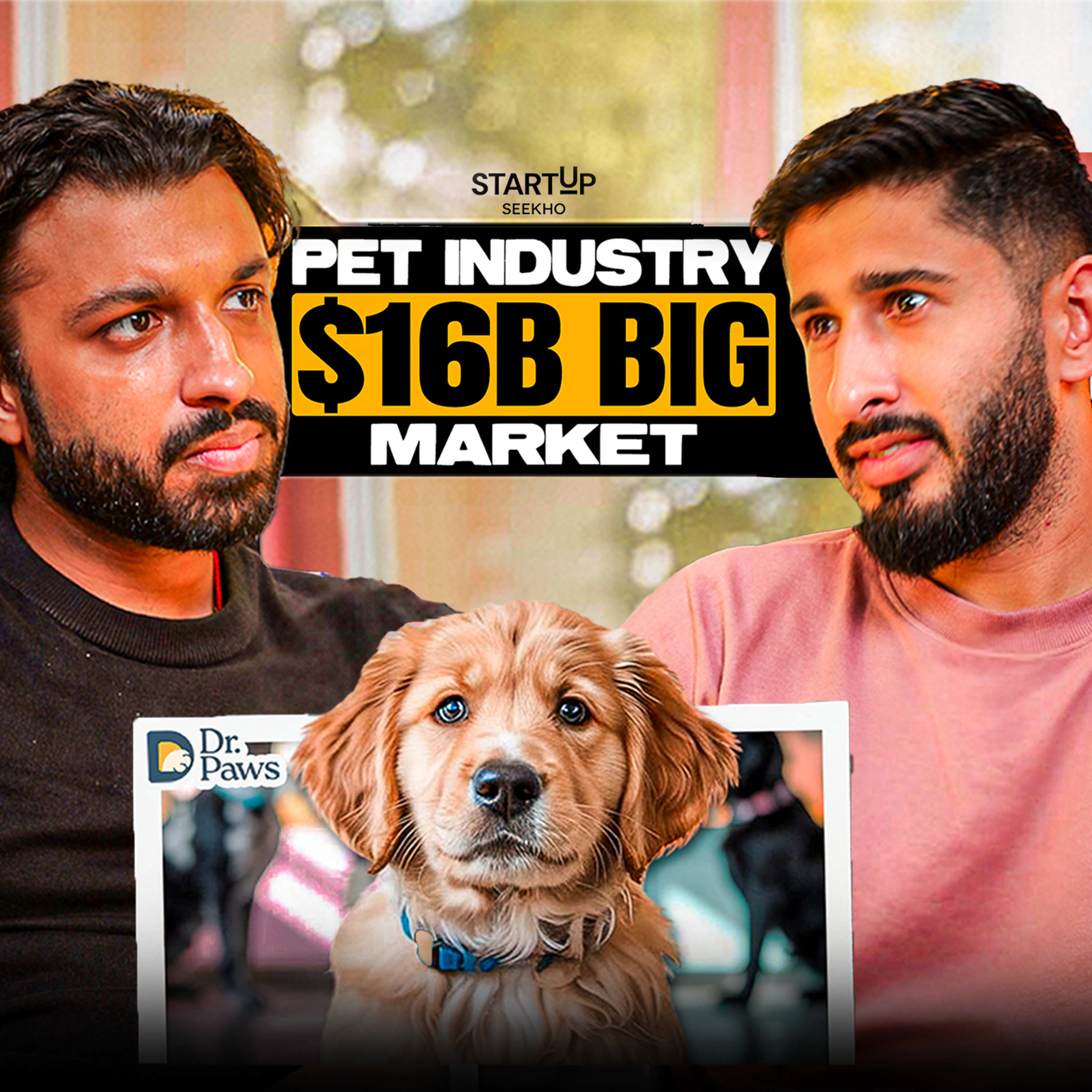
How Dr. Paws Disrupted India’s $3B Pet Care Market | Udit Gadkary
from Startup Seekho: Building Founders. Building Dreams.
71m 36s
The founder of Dr. Paws, a new-age veterinary hospital chain, was inspired after shutting down a SaaS company and reflecting on what he truly cared about—pets. While on a beach in Sri Lanka, he realized his passion for dogs and decided to build a business around veterinary care. He identified that veterinary clinics in India were stuck in the past, with poor waiting areas, lack of hygiene, and fragmented services. Through extensive research, including sitting in vet clinics and interviewing pet parents, he found that millennial pet owners treat their pets as children and expect a modern, convenient experience similar to human healthcare facilities like Rainbow Children's Hospital. The key insight was that while trust in doctors is paramount, the overall experience—including a clean, one-stop-shop for diagnostics, grooming, pharmacy, and surgeries—was lacking. Dr. Paws aims to provide a full-stack veterinary hospital with a customer-obsessed approach, starting at a premium but planning to scale to mass premium. The founder validated the idea by observing that customers valued convenience and a modern experience, and he secured funding, valuing the company at 48 crores. The MVP had to be a physical clinic with skilled doctors to build trust and deliver a superior experience, which has led to a 5.0 Google rating for all clinics.
Was the craziest case that you have seen in a doctor's? 13-year-old Labrador that had come, she had something called a pymetra and then it came to an absolute emergency situation, sitting with this dog 24 by seven, not leaving the room. I really did not think she was coming. He raised a million dollars in funding, getting your company valued at 48 crores. So I looked into my life, I said, "What do I really, really care about?" And ultimately it was, there was a dog next to me on the beach that I'd been playing with and I said, "This is it, there is nothing I love about." You know, there's no waiting area in the clinic. There's no booking system. Once in there being like, "Yeah, I just want to get out of here as soon as possible." That has to change. You seeing a lack of a one-stop shop was the inside that convinced you to move on. Pets, there are people's babies now. That millennial parent, it is their kid. Actually the experience, my competition is brain-watched at the hospital. And these have all changed. The vet clinic hadn't changed. This market globally is about 16 billion dollars big by 2032. Currently in India it's at $3 billion and it's going to double in the next three years. What are some validated problem statements that someone can go and build? Yeah, so I think. Oh, thank you so much for being here. Thank you for having me. You came up with the idea and raised $1 million in funding getting your company valued at 48 crores. Yeah. Do we also need to get a British accent start getting funded in India? Well, actually, I think if you only had a funded it probably would be easier to skip the British accent. Yeah. But can your team understand what you're saying? I think now they've got it. Oh, now they've kind of understood. Initially they do that. You do have these people who sort of lean in with one ear and be like, "What is this guy saying?" But they've got it now. No, I see one, I think one of our first angels, a great guy, being super helpful. I think he was a little bit spooked with the accent first. I think he was thinking, "Yeah, you have enough foreign siya. It was for Kuchata in India." I think he was just so stunned by it that he had to ask me, "Dude, I just need to check. Do you know how much I can nurse and do you know how much I can security guard salary is?" Just to say you can say you can say you can. So I think. In you with new ones? Yeah, I mean, yeah. I wouldn't have got his money without it. It's helpful in some ways, but. I think that. Has anyone asked you where you got it from? I think a lot of people do think that it's put on. It's put on? Yeah, yeah. So they're like, "Oh, he's gone for three, four years." And then I say, "No, no, I was there for 23 years." Yeah. And then like, "Ah, okay, we got it." But yeah, no, it. It has its pros and its cons. Okay, tell us about Dr. Paws. And then tell us how you got the idea. So Dr. Paws is, you know, fundamentally a chain of what we call new age veterinary hospitals. Very much a veterinary care brand centered around the healthcare piece. You'll actually see a lot of, let's say, players in the new sort of pet ecosystem who. They're called DNA as, let's say, retail. Their core DNA may be grooming or consumer products. Our core DNA as a brand is centered around healthcare and the vet. Okay. And when we say new age, I can get into that in more detail. But we basically think that the veterinary space was quite old-fashioned and remains quite old-fashioned. And, you know, making it something that is very natural for, let's say, the millennial pet parents. Someone in the late 20s, early mid-30s, who are getting their pets for the first time. That's where we see the growth. So it's vet clinics that resonate with them. Over time, we'll naturally play beyond the vet care space and clinics and hospitals. But it is a pet care brand centered around the medical side. So tell us about that moment when you got the idea. Oh, you saw a problem and you felt, "Kiss me, business, once again." Yeah, I think more than, let's say, the idea or anything, it was. I shut down one business. It was a SaaS company. Me and my co-founder decided that, "Hey, we're not doing this any further. We didn't care enough about the problem statement to really push through." And so I was sitting on a beach in Sri Lanka. I'd gone with another friend in a similar position. And we were guests trying to, like, decompress, find ourselves, find what we want to do next. And I think I was very restless within two days of doing that. And I realized, "Okay, I think I know what I want to do in that I want to be a founder still. I want to swing the bat at least once more." But I knew I needed to do something that mattered to me this time. So that whole thing of, "Do you care enough about the problem statement?" Would not. would not happen. Right. So I looked into my life. I said, "What do I really, really care about?" And ultimately, it was. there was a dog next to me on the beach that I'd been playing with. And I said, "This is it. There is nothing I love more." So if I can be lucky enough to build something that ties. Building a serious business, a business that we are expecting, you know, and we're aiming for a great outcome. But also something that I love is part of the journey. That's what I want to do. And dogs were there. Of course, then it took time to look into what can I do in pets, what is meaningful. But it was actually quite. the vet was one of the most obvious places to begin because for the last five, six years I'd been a pet parent in India. I experienced. I would say good doctors, but horrible experiences. And it was like that has to change. So that came naturally. Obviously, then there was a lot of validation research, etc. So you were solving a problem for yourself and you were solving something that you deeply cared about. 100%. Right? I literally. the minute that idea struck me, I was just going back to those days, inputting my dog. I found my dog lives in. put it with my parents. You know, there's no waiting area in the clinic. It would be one hour, one and a half hours in the hot sun, just stood there or sitting in the car waiting till it was our turn. Having to go every 20 minutes and sort of put a little bit of pressure. Can you see me? Can you see me? Once in there being like, yeah, I just want to get out of here as soon as possible. So I deeply understood that the vet was not great. Medically it was fine, but. The experience was horrible. Rakesh, my co-founder, had a very, very similar set of experiences. And yes, we both love dogs. He's had dogs all his life. And you know, he'll also tell you like the dogs he's had of shape two years. And in many ways I would say that is very, very true for me as well. So you're on a beach in Sri Lanka and you're like, okay, let me do something here. What happens from there? What kind of research do you do? Yeah. And what ends up building conviction? Got it. So yeah, it came back full of energy and I'm one of those people that an idea can come and you can be a real optimist. And you can suddenly think, yeah, this is going to work. Yeah, this is the next one. We're taking this to IPO and that's the. You can just feel that sort of thing. So obviously I had to tame myself in. I actually remember there was a group of friends really, really accomplished people. Some of them were XVCs. Some of them had also run pretty successful companies for whatever reason they had shut down. And we were like the fun employed gang. And I remember going on a trek with them one morning and I just had let me just seed the idea. So travelling is really working for you? Yeah, travelling is a lot of fun. So I just let me seed the idea with one of them. And I was expecting to be told, don't be stupid, this is ridiculous. And I should be got really. I got good feedback. I think there is another player in the market who is also VC funded. I think they evaluated them. And she kind of told me there's definitely something here. There's obviously a lot of complexity. You figure all of that out. But there's something here. That got me really going one week later. Where I was, you know, I said it wasn't just the optimism of sitting on a beach and thinking while I found it. But that kept me going. One of the big things was I knew I needed a set of partners co-founders. So that was a very quick part of the process that I had to get onto. Like I said, I could find the best market, I could find the best idea. But if I didn't have a partner, both on the let's say the offline ops, running our offline business, side, as well as the medical side, this probably wouldn't take off. So a lot of the validation was, do I find that person and do I, or that's set of people and do I, do they also share the same belief in passion? But of course there was, let's look at the market, let's see what it is. So we spoke to a bunch of pet parents. Before and after Rakesh. Because through that process, you know, how were you approaching these pet parents? What were some of the questions you were asking them and what were the insights that you were getting? Yeah. So at first I realized I should probably spend some time in vet clinics. Right. So I reached out to a bunch of vet clinics. One of them was my own vet in Pune. And then through the family friend network friends, where do you take your pets, etc. I reached out to a few vets. And of course, you have to give them some reason for you to be able to sit there in their clinic, observe their consults, see how they're doing. They're coming after your business. They were Pune, so I said, look, I live in Bangalore. But I look, I said to them, hey, look, whatever I find, I'll share with you as sorts of insights into what do customers want, how could you maybe modernize your business. And you know, that's what we definitely did.
And they were very kind to me. They gave me the chance to really understand the nuts and bolts of a veterinary hospital. So you were sitting in wet clinics? I was sitting in wet clinics. Full days. Full days. Where in the waiting area inside the doctor's room. That's nowhere. So I would, I was very lucky. So my own vet, he was, I did, Jobika Naikar, or like you have a free pass. Which was great. And even there was a family friend who said very similar things. I think there were a few, let's say, corporate chains where it was a little bit more structure. Yeah. But yeah, broadly, I would sit in the waiting areas and I would speak to customers and understand what they're looking for. Wow. Okay. So you directly went where they are and asked, yeah. Exactly. What do you like about this? If you could do anything differently, what would it be? You know, weirdly, that was a tough question for a lot of people. Because you could ask me if they-- They didn't know anything. Yeah, absolutely. Right. So like, for them, it was like, but this is-- You weren't faster versus, yeah. Yeah. Like, all the other care was like the vet clinic. And then I, to maybe gently seed what could be different and see if it resonated. You'd be careful there, right? Because a lot of people don't want to offend you and they'll just say, yes, yes, that sounds good. I don't know if there's-- if your listeners have heard of something called the mom test. But I would really recommend any idea you have. Strictly do the mom test. Yeah. Basically, it just goes to say, you're going to ask a set of people. They don't want to offend you. Your mom is going to always say, what a great idea. What a smart boy girl. You know, it's not real until you know it's real. So you have to be careful and not just get blinded by what they say. Because they're going to be polite generally. But I do that. I'd also be in the consult room. I would see how the doctors are communicating. I would see what questions patients are asking or pet parents are asking. I would also spend time with the administrative side of the business. So the receptionist, the technicians to really understand what is going on. My or the vet and the family friend vet, they even kind of showed me the software, talked about the P&L of a clinic, which was very useful. And inside the schedule, I think the main inside of the talk was the doctor is why someone comes. And especially let's say my doctor, J. Barat or Dr. Pradeshin Pune, these are great vets. They've been there for years, decades. So the trust that they have is insane. The customer love they have is insane. So that was one. Yes, you can build this fancy, wonderful, brilliant experience. But if you don't have good doctors, if you don't have doctors that instill trust, this is dead in the water. And I think that is a big part for Y. Rakesh and I was so keen on getting Dr. Girish. For the listeners, Dr. Girish, I think he's Bangalore's best vet. I'm going to put it out there. And he's just, he just instills confidence. He's such a calm person who gives it to you straight. He's not going to sugarcoat things. And he's obviously very medically skilled. So that was what I was talking about. Vortals. I think what really also resonated for me is that people definitely valued having things conveniently in one roof. For example, like what did you see? Did you feel that, okay, if I build on to this convenience, there's a lot of things. These clinics are even too, they were very small. Yeah. Right? One, two rooms. So if you need a diagnostic, what were the doctors, I think I'll be. Excerne caracagia, exactly. You know, five kilometers away, there's this clinic, you can do diagnostics, massive report like, yeah, I'll see this. And that was painful. Grimming was a whole separate thing. Oh, okay. Not everyone, grooming, grooming is growing as a category, but that's somewhere separate, buying your dog food or your medicines is somewhere separate. And I could see very clearly that people said, if everything is in one space, well, that would be good. And that was, that was a big learning for us. And that's why our first centers are full stack. You know, OPD care, which is the basic consults and diagnostics, x-rays, whatever, but you have an IPD care and surgeries, life critical surgeries can be done. But at the same time, you have your grooming, you have your pharmacy, you have your retail, you have everything in one roof. So can we say that you seeing a lack of a one-stop shop was the inside that convinced you to move forward? One of the insights as to where we can win. I think we also realized just generally the experience was bad. These clinics did not have as a waiting areas. And they were dirty. They were not, not because people didn't care, but it wasn't seen as an important thing. Yeah. The hygiene, the smell, it wasn't great. Like, honestly, the inside that I got in this talking to pet parents, right, I would ask them, forget vet clinic, how was your life changed in the last five years? Right? And I would ask them, okay, think about in the last five to ten years, where did you go out to eat drink on a Friday night? Where did you go to party? Where did you go to work out? Why is that important? Because my thinking was, oh gosh, the vet clinic seems like it's stuck in the 80s or the 90s. Okay. Right. And what I got from them, and I kind of nudged them to also see was, wow, the restaurants and bars that we used to think were good, five, six, seven years, but we don't go there anymore. The gym that we used to work out at, well, we don't do that anymore. Or the form factor of, you know, now we're doing Pilates, now we're doing bar or whatever it is, right? That didn't exist. The doctor that we go to for specific conditions, so a lot of young pet parents, let's say the IVF clinic, right? That wasn't some back of the, back of the city kind of thing. It's a very nice modern clinic. Right. Even the children's hospitals, I truly believe that, let's say pets, there are people's babies now, that millennial pet parent, it is their kid. It's nothing short of a kid. So is my competition actually that local vet clinic sure, like at a very tactical level, but actually the experiences that my competition is, Rainbow Children's Hospital, motherhood hospital, the best of maternity and pediatric hospitals. And the, you know, the vet clinic hadn't changed. And that was the insight when people said, yeah, I see that. That was when, hey, something has to happen here. There is something to be done. And something to be done at a premium? Or, look, I think it can start at a premium. But if we want to build a really meaningful nationwide brand, we're going to have to also learn how to not just be a premium brand. I think, but, you know, and what we've done with that is our pricing today is not the most premium in Bangalore. Okay. But the experience is the best. The experience, all three of my clinics are 5.01 Google. I am, and we are, I should say, as a brand customer obsessed in a service business, and especially in a healthcare business, where there are unfortunately sad outcomes. Pets die. It happens. We've not had touched with any, you know, problems, but there can be mistakes that are made. There are lead problems. 5.0 for any service business is, is, is, is, but where obsessed. So we're, with the best experience, we're not the most premium price. But yes, to grow this nationwide and scale, we will have to also learn how to create a clinic that works in less premium neighborhoods. It's kind of like my, my co-founder, Rakesh, she comes from cult. So if you see the journey of cult, you know, it started in, I think, Sarjapur in Bangalore, I think there was a few in Gurgaavit, was super premium. I remember, I remember coming in my consulting days to Delhi, and there was this cult thing. And people were talking about it like it was wow. And the experience was so much better. Yeah. Today, I think if you look at cult, super successful, great brand, it's changed how India does fitness. But I don't, I don't think you necessarily call it the most premium. Premium, yeah. It has learned how to be mass premium. And that's where we'll have to get to as well. So when you were doing your parents reaction, yeah, I was a little scared. Yeah, an animal doctor was, you know, back in Shilanka, and I said, "Okay, let me call dad." And I thought, yeah, yeah, you'll think I'm an absolute idiot. Yeah. Shut down one business. He'll say, yeah, go back to London. Do your job maybe reset for some time? This is what I was thinking. And my dad is my dad and my mom are super supportive with my entrepreneurial dreams and ambitions. But I think they also maybe in the back of their heads felt that, okay, you've come from London, you took some time out to work in someone else's startup, then you tried something, it didn't work maybe, take some time, reset and come back. And he's, that's the conversation that were happening in the family. Yeah. So I thought, oh God, this is what he's going to say. He's going to say, stop being an idiot. You know nothing. You're not a bad, what are you doing? Or you see the family friend that eventually I went and sat in his clinic, he's doing it, like why are you going to get into that business? No, he was a super supportive. Okay. Which was great. So now since you've gotten all these insights, what did MVP look like? MVP was honestly like, mean Rakesh Satin said, what can we do as an MVP?
It's hard because you need ultimately your veterinary case. You need doctors. Doctors are not going to join a MVP kind of situation. So the MVP really had to be on a clinic. A clinic. It had to be a clinic. And it had to be a clinic with doctors who are us who gave off that doctor pose experience. So the doctor pose experiences to kind of explain, we are obsessed with the customers, I said. But I don't mean, you know, from the minute you walk in, a lot of clinics will have, let's say, front desk stuff. Who are just front desk stuff? I think one way, but my front desk stuff love animals. It's one of the biggest things we do in our interview process. Do you like animals? They have to like animals. They have to greet you with love, with, you know, compassion, because sometimes you are very scared when you come to the clinic. The way the doctors talk to you. In India, one of the problems is with, I would say, some veterinary doctors is dogs and cats can't tell us how they feel. We have no idea. So there is a lot of asymmetric information and it becomes like preachy. Yeah. Our doctors have to explain what they're seeing, why they're seeing it and speak with compassion. So they had to be doctor pose trained to give that experience. And so the MVP, honestly, was our Indra Nagar clinic. So you had to start big. We had to start big. Okay. And I, you know, I don't think there's any other way of doing it. Of course, there was tactical things like, you know, you don't have to have all the facilities on day one in terms of like the fanciest ultrasound and then this and that. Or you do like a food truck equivalent or like a pop up clinic or something. It's hard because no doctors. No doctors are going to join you to do a pop up clinic or a truck. Yeah. So it was a fully phlegic clinic as the MVP. And how much did it cost to start? How much time did it take to set up your first clinic? So I think in terms of cost, right, for us, I think the first clinic would have come somewhere around one CR of, of caps, that's everything, the machinery and the interiors, etc. Security deposit. I think there's a, you have to make the judgments as founders of what's important for you. You can do this in half the cost. If you don't have certain equipments, if you don't focus that much on the design, we are very design led as a brand. Our clinics are made, are designed to make you feel great, make your pet feel great in the clinic. You can also sort of decide how much space you want, etc. Like for example, we've, we got a bungalow. It's an older bungalow. There was a lot more work needed to convert a bungalow into a clinic. A clinic? So now, you know, you're not going to get a bungalow everywhere. So, CapEx and we are going to series optimization program where that comes now down to some 70, 75 likes. Not good done that. And how long did it take to start? So this is, this is something that I'll really credit Rakesh, my co-founder with. So he came from cult and set up, you know, tens of, you know, 10, 20, 30 gyms. He knew exactly how to squeeze timelines. And that's really important because you've got your rent ticking and you want to go from taking the property to getting it, making revenue for you. Yeah. If I left to me, I probably would have thought, yes, six months is great. Oh really? No, we did it in 60 days. Oh wow. 60 days. Two months turning it around from getting the keys to the place, knocking shit down. That's fantastic. And he's very, very efficient on this. Okay. Which is, which is to start with the crore, you had to start with funding. Yeah. Right. How did that happen? How did you convince people to fund you on a pre-revenue? Yeah. So I think Rakesh and I definitely sat down on this, right? And, you know, it's, it's, we're blessed. I think we come, and we acknowledge that we come from, you know, privilege where we didn't necessarily need to do this. We could have probably bootstrapped the first two clinics through the helper family, but I'd worked in the UK for six, seven years. Rakesh had, you know, had a really great career before, before this. But we said, let us take funding. Okay. Right? Let us take funding so that we are not, um, scrapped for cash. Yeah, we're not strapped for cash. We're not skimping on things. Yeah. We're actually like, we're saying, look, we want to do this. There's a market here that has to be attacked. Let's put our best foot forward. So, let's get the best equipment. Let's get the best doctors, you know, even if you have to pay them that little bit more. Let's not be worried about these things. So we said, let's go for funding. If we get it, if we don't get it, we believe enough in this market, we will figure it out. Okay. How did we convince people? I think in general, in India, there was a realization that pets as a space is growing. So I think people were interested to talk to founders because pets was a space that everyone knew to the, you know, the pet penetration in India was some 10, 11 percent of households having a pet. UK, US, it's upwards of 50, 60 percent. The East Asian countries like China, Japan, Korea were where India was 20 years back. Today, there are 35 percent. Okay. So everyone can see that something is going to happen. Yeah. But yes, to convince people off to non-verts, um, inner-capics, intensive business, operation and any heavy business was tricky. Getting Dr. Girish on board was a big help. That gave them at least from the medical side credibility that is someone here. I think obviously, Rakesh and I were very passionate and we were very structured and we had done a lot of insights. And this is where, and of course, we got, we got passed on a bunch of times, you know, a lot of VCs will say, you're too early for us. We like what you're saying, but show us two or three clinics. And then you do two or three clinics, they show us seven or eight clinics. So there's a lot of VCs. How many people did you pitch to before you got funded? I would say, um, we, in the first round, we would have had like at least 30 conversations with people, um, you know, and to have 30 conversations, you probably reached out to some 100 to 200 people. I think their, Rakesh and I are pretty lucky where through our networks, um, most people want to speak to us. Sure. So I don't think there was ever really a case of we reached out something they didn't want to chat. There'll be one conversation in it's the end, but we had a good ratio for there. Um, and then we were introduced to source who, who did our, um, seed round and, you know, that I think there's some of the best consumer, if not the best consumer investors in India. I think we just, we just clicked with the manu and his team. Mm-hmm. It was very clear. It was, there's a good market here. You boys can do something. You've got a good doctor and we're believing in you as a space. Sure. And did you experience at BCG or being in a founders office role or having run your own company before playing to you getting funded now in which one probably has had the most amount of impact percentage wise? I think everything compounds and builds. Right. Um, so I think BCG, uh, I spent four years there. Um, it's a great place. I look back very fondly on my time. I'm very grateful to spend that time. Um, I don't necessarily think BCG maybe shapes you to be an entrepreneur. Actually, in many ways, what you see is I have a lot of friends who, super smart people, but they're quite comfortable in their jobs. They go to a golden handcuff. Yeah, exactly. So I mean, like you're paid really well, you get respect from the world. You do intellectually stimulating work. Why would you leave? Yeah. So I think there is one profile of person that can go down that path. Um, I think what BCG definitely gave me was, hey, I know what good looks like. Hmm. Be it an investor pitch and the deck. Be it how to prepare for a meeting with a doctor. Be it here, right? How do I prepare for this? Yeah. So I'm ready and I can be natural. That it taught me what the bar is and the bar is high. Yeah. Uh, I think that's one. I think it teaches you how to prioritize your time and prioritize your resources. Uh, because you're doing this project for a corporate, you have absolutely no idea about the industry. You are a 20 something year old and you're trying to give some gear until like someone who's been there all their lives. I think you realize how to quickly get up to speed. I think it also helps you just be a confident person because you are putting situations that are tricky. So it gives you confidence that you can, you can do something. Yeah. So I think, I think that I don't think it's going to necessarily help you understand an industry or anything like that because it just gives you the soft skills or the preparation to be a firm. But it's, it is a, it's a good place. But I think to be a founder, it's important to get out and get into the real world as well. So that's what I did. I joined Yashinakshade Open House to great guys running a, you know, very cool offline education business. And they were great for me. They're some of my closest friends now. They let me just come in as a chief of staff and run with some things. It was actually a tough time for the business when I joined. It was an edtech business going offline edtech going into COVID. So it was hard. But there I kind of really understood how hard you have to push. That BCG name is not going to carry through. You know, you got used to going to a boardroom and it was like, you know, BCG say, I had let's listen. And so I had going to like a school and like the facilities manager at the school was the gatekeeper. He was not impressed with whatever suit you were and whatever. How smart you talk, right? To get to the headmaster was like a big thing. Yeah. So I realized, yeah. And like even like, you know, just how to work with teams who are not necessarily trained in that BCG way or that very corporate way. I think that was important. And yeah, just real, how to deal with ambiguity. It was a it was an ambiguous time for offline ed education company. I should say going online, seeing how Yashakshay navigated that being around it was important. So let's talk about how you got your first hundred or so.
and customers. You know, now the clinic is ready. You need to start getting people in. Yeah. And wets are like family doctors. You can't just ask someone to switch because there's so much trust built. Yeah. So what was going on? Yeah. So look, I think that is a reason why we really wanted Dr. Girish from day one. We also had some other very, very, very, very popular doctors. Dr. Archena had come. So they had a bit of a fan following. Girish for sure had his first set of customers. And Archena had, you know, some, she's more junior than Girish, but she had enough customers who'd follow her. So I think that was an important way to start. We got our first customers there. And these are sets the ball rolling. And they got people in. Massage Urodi. Then you get your first Google reviews. Some people start talking. Then I think we realized, okay, we need to do a little bit more. And I think what we realized is also family friends. There's enough dog, you know, dog cat owners in family and friends. They're willing to come and try because, you know, they love you. Yeah. So I think these don't know channels say, I think first 50, 60 customers. I think this is. And these are the doctors are. Yeah. This is what I love. They're just using your space. Yeah. Then we'll commission the. No, no, no, no, no, no, absolutely. They're full time full time on payroll. So the doctor is a full 100%. Okay. Yeah. That's the veterinary model is slightly different from the human medicine. Okay. But that's also really important. So they're bought in. And that doctor post training is our secret. So I think that's how we got the first, let's say, 50, 60 from their word of mouth kicks in. And what coffee important? Like you have to make sure that when someone comes in, they tell three other people. And that's how we found on the next few weekends word of mouth. They look at it. Okay. Right. And that was really, really important for us. And that gets us to a certain thing. Then what you find is it's a much slower reaction. But we are a offline location based business. Yeah. So you then start seeing. Random footfalls random footfalls from I walked past your clinic. Wow. Okay. I'm woke by. Jarete. Nidekata. We wanted to see what is it. So that's why we came. Now you have like what I would say is your bubbling base. Right. There it's really important to then tap into it, making sure you are 5.0 on Google. How do you do that? You just have to be obsessed. Rakesh and I were in the clinic that first in the clinic every single day from opening till close. Talking to people. Talking to every customer, getting involved, managing every bit of operations that was going wrong. And things go wrong all the time. Yeah. It's not like we're perfect. Yeah. But you know, like apologizing when things go wrong, explaining what we're trying to do to customers, getting them bored in. Because then in a local business, what you find is local SEO is super important. People are searching vet, me and me. This market in India is growing very, very fast into the new pet parents. So they don't have an established base. They have to hook them. So I think through these channels, we would have got to, let's say that first 300, 400 was building. Then we did some big events, pet related events. Such as there's one called pet fed. It's a big carnival, not a brand's exhibit, e-commerce, DTC brands, even some service providers. And we were able to put up a stall. And we really brought a lot of soul. Dr. Bos is a brand build on soul. I have my head of brand tier. She just brings soul max to everything we do. She's a wizard. And I think she really helped us bring soul into the company, but also that pet fed stall. And people could see the difference here. And so we give them a reason to come back. There'd be a spin wheel, that wind starve, that wind of free grooming, these things. And then we are so confident when someone comes, we give them a tour. You have to give them a tour of things. Most of that clinics don't want to show you what goes on because it's actually not hygienic and not hygienic. We're on the other side, please. We want you to come. And people see that and go, wow, this place, oh, you also have life saving surgery. Oh, you have diagnostics. So like that, we got some people. And then you get to a point where, okay, the engine does need a boost because you have the base. That's when performance marketing kicks in. So that does help in bringing in people. Yes. And then, you know, like let's say in a newer clinic where Dr. Post brand is like their performance marketing can start more from day one. But there was no point in starting on performance marketing before exhausting all of these things. At least in clinic number one, two, when we were also figuring out our operations, etc. So that's how you get your clients or let's say we call them guests. We don't call them clients at Dr. Post. What's really important though in this kind of business is how do you retain them? Yeah. Right. Because like, the whole point of it, if you look at the economics of our business versus let's say a DTC brand or whatever, it's ours is all centered around lifetime value. Meaning we have 12 years on average with a new pet parent to, you know, build a relationship. And actually, it's more than that because people don't just have one pet. They have multiple pets. They will get a pet after the one pet sadly leaves them. And so you have to make sure they come back and come back many times. And that's what we really, really try and do with our customer experience, the feedback that we will get from them, the attention to detail on follow ups, reminders, etc. That's as important as new customer acquisition for a business like us. So what was the first big win? I think the first surgery. Okay. Yeah. The first surgery where I think someone said I'm not going to the big hospital that was there in Bangalore. I remember as a boxer, had a tumor. And money was not an issue for this client and they had come three, four times, had experienced us and they felt confident to give it to a doctor that they'd met for one month, right? At two more intervals. That was when I felt there could still be a surgery. People are seeing something that is different. They're feeling confident. Trust is happening. That was that that was the day when I said something is something is there. And you know, to build these kind of processes, right? And to maintain these processes, I mean, it's all human driven. How does one go about doing that? Because that's like the core problem of any service space. 100%. It's the hardest thing if you ask Rakesh and I, it's the number one challenge. If you want to make this nationwide, if you have to have set processes, which are fun. Let's say large but not good branch. And you'll get an indran, a good branch. Same one. Same one. How will you do it? How will you do it? How will you work on the same standards? You have to be clear on what you have to do. What is the base level of service and process that it should be? See, I see a lot of service businesses. Now I'm very high-pertuned to it. I don't think they're even aware of what the process should be. So one is very clear on what is that process to be. And Rakesh and I work really well on this, right? He comes from a very hardcore ops background and he looks after ops in our business. I come from a customer experience. And it's a really good maker-checker kind of relationship. I want to do more, more, more. He doesn't want to, it's not that he doesn't want to do more, more, more, but he's realistic off. I'm actually kya karsak there. So that is a good kind of puzzle push and pull where we then design what should the process be? That's the first most important thing. From there you have to work out how do you roll this out? A lot of it is training. So before someone hits the shop floor, how are they imbibed in your culture? So one, two months before a doctor's maybe needed, we hire them. And you let them go through the moosh. And we invest in that, right? Because you're paying, you're not getting anything from them, which revenue I add on doctor's say, but we are letting them experience. And that's the front desk staff, that takes it. That's how we operate. So training is important. And you know with some of my team, I have Shalini on my team who looks after customer experience, but it's been really instrumental in the training piece of things. We are clear there. But then monitoring, right? Where are things breaking? And a constant then LND. So what we have is like, for example, even we have like an incident reporting mechanism. Anything goes wrong. We had a simple customer complaint to something went wrong. It's reported, it's reviewed. And then the LND is rolled out learning and development that is rolled out for, why did this happen? And how can we prevent it from happening again? Right? And that is super important. And then I think the other thing that is crucial is, you always have to be willing to adapt your process. So like we had one doctor that came in recently and said, guys, you know, I'm following your processes in his whole document, but I think this could be different. We have to be open. So now let's talk about, you know, your customer acquisition channels. Just so if anyone else wants to get into health clinics, they can understand it better. What are the channels? And if you can rank them in terms of percentage of revenue. Got it. So look, your channels are firstly, if you're on a health care business, people who know your doctors at U.I. So doctor, they'll be there. That's the highest. That's the highest. That has to be. Yeah.
Second will be word of mouth. Maybe not the highest in terms of ultimately what comes but the most important. Because these customers will trust you more from day one. Right. Performance marketing is obviously one. Performance marketing in a healthcare business, you have to be a little bit more tactical. You have to give people a reason to come. Just saying I've got good doctors or I've got great hygiene or I've got this, that and the other is not enough. So what's enough? So for example, we're very blessed. We have some, I would say lower trust services we can offer like grooming. See someone is not going to come for a big medical procedure on day one. But they might come for a grooming session. So they'll try it later. Or they might come to buy supplies. Yeah. But even that is a lot of effort to win in a world of blinke and zeptoe. There's a lot of effort to come just technically. Grimming people, try it later. What can go wrong? Vaccinations. Right. Vaccinations are very commoditizing. All doctors can really do vaccinations. So we'll incentivize with offers, discounts for that. So you will run ads for that and find the coming. Exactly. Then that gives them a hook to come in. And then that's what I said. We give them a tour. Yeah. If they come for grooming, we give them a free vet check up with the doctor to build trust. All of these things to say, we got you, but you're coming back. See, that's why our retention rates are there. So performance marketing done properly is a good channel. Done wrongly is a complete sink. So you have to know how to bring them in, what to market them for. Exactly. And then how to convert upsell, convert whatever. That becomes an important channel. I would say events and stuff are, is an important one. And especially localized events. We are, as I said, a location-based business. Yeah. So there are enough events and things around that three, four kilometer radius of a clinic where you can sort of incentivize someone. These are the main channels, to be honest with you. Okay. So now let's talk about a little bit of unit economics. Yeah. How much is like an average order value? And where does the money go? Let's say it's two, K three K, whatever. Where does it go then? So our AOVs have consistently been around the three came up. Okay. You know, that's an average, right? So some builds obviously like close to a lack of surgery bill. And some, yeah. Someones come for some tablet or something. Mm-hmm. So essentially, it's a consult fee, right? It's like the family doctor's fee. Yeah. But typically people don't just come for a consult. We are trustworthy. So if it's, if everything is fine, it's just a consult. But typically they've come for a reason. There is some diagnostics that are needed to be done. Blood test or some, you know, urine test, whatever it may be. They might be x-rays, etc. And then people end up buying some medication if it's prescribed. And you know, toys, treats, accessories, food, whatever. So that's how it is. And obviously in surgery is an admissions, it's different. So let's say three Ks, like average. Now where does it go? Like how was the breakdown like? Was the, was the cogs was the gross margin? Like if you, yeah. So in that, then you have, our business is very clear. So there's a clear split between services and products, right? We have the retail and pharmacy, which is the product side. And then we have the services. Most services that are in-house, in terms of gross margin, where salary cost of a, of our staff comes one level lower. Yeah. So gross margin is really the cost of the consumables. Right. That's very high. Services, gross margin is very, very high. It's 90, 95% even more. Okay. Right. The most expensive thing will be, let's say, expensive suture thread in a surgery. Products, obviously, it's, it's a cogs model. And we can earn anywhere between, you know, 30 to 60% depending on the product and the category and, etc. After that in the PNL is all your operating costs. And this is, our PNL is a very simple PNL. Right. You have your rent of the clinics. You have your cost of your staff. And for us, that is doctors, veterinary technicians. These are like the nurses in a clinic. Your grooming staff. And then what do you call your front desk staff? So that's the clinic manager and the receptionists. Right. You've got that. You've got a little bit of facilities and housekeeping utilities. Insurance, the software that runs in the clinic. These are all relatively smaller costs. You'll have some clinic level marketing. We call it BT or below the line marketing. Right. These are very tactical, local things. I put up no parking boards. I put up flyers, whatever. That's the PNL. What money you make from the clinic has to cross this hurdle. And it has to cross the hurdle so much that it's contributing to your central costs. Your HQ team. That's, it's a very simple PNL in that way. And how much does it cost to open a new clinic? It's completely dependent on how much focus you want to put on your design, architecture, how much you want to put into the machinery and the services you offer. But for you, so we have basically, I would say, three kinds of clinics. We have a standard is roughly 2500 square foot. It's full-stack. So it has an inpatient, our patient surgery is diagnostics, grooming, retail, everything. I think we're getting to a space where we can get this down to now 70, 75 likes. We'll eventually do smaller ones, like, you know, two kilometers away from there. You don't need to then have operation theater ultrasound in that. I don't know. No, I'm going in for ultrasound surgery, whatever. So that will be done in 3035. And then we have a bigger, you know, one or two per city. Like a multi-specialty and then smaller. Yeah, which will have more operation theaters, dedicated huge IPD. Yeah. We'll get there one day, but that will be more expensive. So we're talking about mode because that's something that all founders, everyone worries about. Do you feel you had a mode when you started? And do you feel there's a mode today? So in our line of business, I'll be honest, right? The mode, if at all, is around, in the start, is around the doctors you have. But I'll be honest, right? Doctors that you have, it's not a permanent mode. Anyone can come and anyone can, you know, offer track on my doctors, be it offering more, whatever, maybe better, work, working hours, I don't know whatever it is. Right. They can. Yes, we do a lot to, one incentivize doctors to join and then incentivize them to stay because we show them career progression, all of this stuff. But I wouldn't say that doctors is a perfect mode. What I actually think and this will come over time is the mode, is the trust and empathy that we build with pet parents and we are known for. So I'll give you the example of like, I mentioned Charleney looks after customer experience. She came from Oberoi hotels to us. We're so focused on experiencing that. For me, at least Oberoi hotels is one step or two steps above every other five stars. Great. Great. And there's a reason for that. And I remember she explaining to me, she was like in their first, you know, trainings, it is taught the Oberoi way of hospitality has to be in your DNA. Right. You can't, so honestly speaking, any archlinics look better than most clinics, if not, you know, all clinics. Someone can pay a great architect and spend the money and they can do that as well. Yeah. Doctors we've discussed that level of obsession on the customer, that level of trust, that empathy, that is really hard to replicate. There's a, I mean, I was actually in the US last week and I woke up to one of the nicest messages I've had. There was a friend of mine and she messaged me saying, her cousin had gone to Dr. Paws and the dog was in a grave leal. It had something called a pyometra and everyone else and we even we had thought that the spleen was also had a tumor and it was very enlarged and it would need to be removed. Big surgery, this is like upwards of a lack of billing. And she went and yes, we had to deal with the pyometra but the doctor looked at the spleen and said, it is fine. We do not need to do this surgery. And that doesn't happen in other clinics. Yeah. They would have gone, the customer has agreed. 50, 60,000 of billing done brilliant. Wow. Yeah. We don't incentivize our doctors on revenue and some investors laughed at us. I said, you boys are naive. Yeah. Let's say they said, those things all about they cling. Yeah, you're going well. You won't do this. You will not stick to this. When I see something like this, we stick to this. That customer, why again, I'll say guest, will be with us for the entirety of her great parenting journey. No one can, that DNA, that obsession, that no one can copy. Yeah. Or if they have to copy, they have to work so bloody hard, they would love to them. Yeah. Wow. Let's also talk a little about why businesses fail in this space. Yeah. You know, so that if other people end up starting, they have some idea. Yeah. One of the reasons is that they're not able to convince senior doctors to come, which is something that you were able to do. Yeah. Right. Another one is that if they got the senior doctor, they walk away. Yeah. Or it could be that they don't understand the pain point properly. Yeah. I know you did so much research to understand the pain point. But how did you manage to convince doctors to come and stay? Got it. Yeah. So I think there is some element of luck in terms of timing. So Dr. Gares, if I take him, there was, you know, he was a very senior doctor in Bangalore's largest chain, but he was a number three behind the two founders. What more could he do at that chain? So timing was on our side. But you have to share with them the vision of what are you trying to do and how does this grow and that you're thinking about it sensibly. And of course, there's an avenue for him. So suddenly from being a number three or a unit head, he was now a chief veterinary officer.
for some of the, let's say, less seniors and girish that we've got, but who are still senior and have credibility. Look, we're building a pathway where in today, you might join me as a unit head, a branch head, but you can become a city head. You can, if you wanna open a clinic of your own one day, why don't we do it together? We've shared that vision. - Right. - Right. Even just things like, hey, 'cause there's a lot of now, there is corporatization going on in this sector. We're not gonna judge you on revenue. Right? People said, wow. I was at this corporate and I just mean this review meeting and it just be numbers, numbers, numbers. I'm a doctor. I like to heal. - Correct. - Yeah. - Numbers keep an eye on me. And we said, look, that's on us. We will fix it. So you've got them. - Yeah, you have to convince them. And then you have to, as I just keep them, you have to address their issues that come up. You have to make it a good place to work. - I think at some point, you should get into human medicine as well with this kind of mindset. This is, I mean, we'll see what it will be. I'm very good in my dog as well. - Sure. - So now for aspiring entrepreneurs, this market globally is about $16 billion big by 2032. Currently in India, it's at $3 billion and it's going to double in the next three years. What are some validated problem statements that you can share, which are not saturated where someone can go and build? - Yeah, so I think pets, there are a bunch of validated problems. There's a lot of areas that are going to come up. So many of our pet parents still give home food. - Is there better? - In moderation. - Okay. - I also give gargakana. But I mean, it's tailored with boiled chicken and stuff. I mean, people will give dal, rice, chapati, whatever exactly what Joe Kharit, either they, that's not good. - Okay. - Right? And the packaged dog foods or cat foods or whatever, they have nutrients and minerals that the dogs and the cats need. I'll say dogs are carnivores, cats are carnivores. They're not humans. So I definitely think that the trend towards packaged food is going to increase some element of that. - Interesting. - I would have guessed the opposite because I have seen dogs having very terrible experiences at packaged food. - Because there's a huge, see, a lot of people come to our clinics and say, can I have, you know, the very common brands, pedigree, - Whatever. - Biscuits, drools, et cetera. They're not good for your pet. Would you give your child, if he was a human child, just like biscuits and lays old? - They wouldn't. It's the same thing. So we stalk only brands that we absolutely trust. And there are some great brands out there that are very nutrition focused. So I think nutrition focus, pet food is definitely something that will happen. There are big players doing it, but, you know, I'm not gonna say that Indian brands are not gonna get there. - Yeah. - Great. They will get there. I mean, if you can disrupt all kinds of categories, you can do it here as well. So I think that's definitely something. - Okay. - And all form factors of food, dry food, wet food, and there, I think supplements and veterinary pharmacy is a big one. - Okay. Is that something that's not there today? - Yeah, veterinary pharmacy does exist. - Okay. - But again, it's like, I wouldn't say the branding around it. - It's fully disorganized. - It's quite disorganized. There are a few players, but a lot of it's contract manufactured, et cetera. I think veterinary pharmacy supplements, there's something that definitely can happen in there. I think in general today, where we are in India is, this growth in this market is gonna be driven by millennial pet parents, working pet parents. We call them Dinks, double income no kids. - Okay. - Dink wads, double income no kid with a dog. - Okay. - Right? So here the kid is either replacing the human child or there's a delay in having the human child. So these are busy working professionals. - Yeah. - They don't necessarily have the driver and the maid at home as they had with mom and dad. - Yeah. - So boarding facilities when people go on vacation. All of this stuff, these markets are growing. Now, these markets, I think you have to be a bit careful of if you wanna build a nationwide scalable business. They may be better suited to city, local, small businesses, but smaller, but there's opportunity here as well. Yeah. And then, yeah, just dogs in general, the consumerization of super specialty will happen. Very interesting. Actually, some fantastic ideas for people to build here. - This is a lot that's gonna happen. - Yeah. - Space. Let's talk about your personal journey, little world. - Yeah. - Yeah. - Yeah. - Yeah. - Yeah. - First, you're raising your own. - Okay. - Yeah. - So I'm gonna go to the doctor, boys. - Yeah. - Oh, okay. - Dr. Ponce. - Yeah. - Um. Yeah, Dr. Ponce is one year. It's, we had challenges, but it's been a, it's been a good year. And I was just reflecting because we had our one year of university on Sunday. - Oh, congratulations. - First year of the clinic. And I said, we've not really had that, oh my god, hairy moment. Okay, I think the ruckus and I had to learn how to manage cash better. That's a big learning for founders. You wanna do this, that another, but cash is king. So I think we had one small hairy moment on, we will be out of cash if we don't, 'cause you know, stop spending something, so we can figure something out till the fundraise. But I don't think I've had like a terminal moment in Dr. Ponce, but I've been there with, let's say, the HR SaaS that I was building. If we were building HR SaaS things, we're going well, funding will tire. - Yeah. - From getting, you know, 10 demos a week to people saying, no, I'm not wasting time chatting to you guys. - Yeah. - That was, that was crazy. And how has it been working with Rakesh? Like, you know, clearly you guys have done so well. What are some points of advice you would like to give to people to work with the co-founders? - I think we've done, we've done, we've had a good year, we've got a long way to go. I'm, you know, very cognizant of it's just the start. So I think, I think the good thing with Rakesh and me is, I think we're very aware of what the other is good at. And this took some time to learn, right? You know, you've barely worked with each other before you jump into this together. - Yeah. - But I know, you know, he will manage ops, he will manage sales and he'll do a good job, supply chain, finance, work, I don't have to like worry, you know, Rakesh, you know, you decision, Q letter, like I got it. Obviously, as a founder in the early stage, I have an opinion and he has an opinion on, let's say the customer experience, the design, the brand, the marketing that goes on. But I think we realize and we're very complimentary. So I'd encourage anyone to find a co-founder if you're looking or you're working with one, ask, are you guys really complimentary and then do you trust each other? And that trust comes over time. But I think, you know, we implicitly trust each other now on that, we disagree, don't get me wrong. And it'd be bad if we don't disagree. - Yeah. - But we trust each other to say, right, cool. And you have to be good at committing, disagreeing and committing. - Yeah, yeah. - And we've done that. And it's great when it works out. It's been good working with him. - Yeah. - What are some of the sacrifices that you have made as a founder that aspiring founders should be aware or should be prepared for? - Yeah, look, I think especially in our offline business. Yeah, I mean, Rakesh work seven days a week. And it's not a glorify working seven days a week on that. - Is just to set the expectations. - Yeah, it is that. It is just set the expectation. It is, let's say, and the business wherein your weekends are our busiest days. We're not people free. They're free on the weekend. So they bring their dogs and cats on the weekend. So weekend plans, et cetera. I'm a very social person. They have to take a side-like seat. Do I want that to be my life forever? No. Change whole girl, but at the start, we have to do that. And I have been traveling a bit for friends weddings and seven and then the business is running beautifully. And so I'm seeing that it's possible, but we do work hard. And we're trying to transition away from being in clinics to office, but weekends we try and spend in the clinics. That's one. - And what do the hours look like when do you start, when do you end? - I was like, it's, I mean, typically we'll be in the clinic by 9, 9, 30, 10, whatever it is. And maybe I work longer days in BCG, you know, pulling night shifts and so night out. I've done some night shifts because, you know, there's been no cover for the front desk or something, or emergencies. Come and I've done, you know, 24 by seven night shifts. But that's rare. - Yeah. - Yeah, I'm done by eight, nine, but if you know someone thing needs to be done, I'm not gonna say no at when I am to jumping on a call. But it's not that common. I think the other sacrifice is, and this hits home for me when I, let's say go to a wedding in Europe or the US, like I've just come from. My friends are all very accomplished people in the UK there, but they've kind of stopped to their straight and narrow of consulting, banking, PE, whatever it is. These guys are earning seriously, seriously well. - Really? - Yeah, I've found out in the early days, you, especially based in India versus the US and the Europe, you can't tell yourself that kind of money. And so you do have that shit, yeah, Kya Karo, yeah, like what is going on? - Yeah, actually Karnaja, yeah, should I go back and join the PE fund again? That happens. So you do need to have the confidence to get through that. And this works out, it will work out beautiful. But that is it.
I love what I do. I don't know if it's a sacrifice, but you have to be aware of that. Yeah. You're not going to in the short term and necessarily be as comfortable in your lifestyle as you would be if you were sticking in your corporate job. Sure. Okay. Moving on to people want to know some of the questions super searched on the I get Dr. Girish here because I think he'd be better. Yeah. Go ahead. We already spoke about paid food. Yeah. Like is it safe and if yes, do you have something to recommend to you? Yeah. Pet food is pet food is safe. As I said earlier, buy good brands, buy nutrition focused brands. Any brand you want to say? I mean, there's some like brilliant brands like Origin, Akana, Arden Grange, the Wies stock, which are the best of the best. But you also have brands like I really believe in Royal Canon is a good brand. Okay. And indeed, there are good brands out there. Anything you find in a Dr. Post Clinic, you can trust in terms of these are nutritionally sound for you. Someone can go to your website and see what you store. As of now, we don't we're not doing e-commerce right now, but you can call a clinic. We'll get there in the next one year or so or less hopefully. But yes, if you go to a clinic, you'll see top three questions to ask your vet. Wow. Okay. Definitely, what should I feed my pet because we see a lot of people giving gargagana and it's like when the vet hears it, it's like, it's a little change. So I think that there's a lot of misconceptions then. I would also say ask your vet to do preemptive diagnostics. Okay. Dogs and cats can't tell us either pain or a, a, a, a, a, a, they can't tell us these. They can bark, they can whimper. I have really believed in getting preventative diagnostics or just a checkup. So we have things like master health checkups, which will just periodically once a year, whatever you want to do, just test certain things and you can see parameters. I would, I really believe in, in that, I think that's, that's something to do. And the other thing I would really recommend and I, we see it a lot in this rainy season. Ask about taking flea prevention. Okay. You know, a lot of people are not aware of it or they see a tick gum medicine, or a mango lagreia, a 2000 catablet, con dega, do it because tick fever is so common. And I got tick fever all the time. You have a 50/50 chance. I mean, the dog, they, we have dogs, you know, but it's, we have dogs, we pass away. And then your bill is astronomical. Once it happens. Ask on tick and feed prevention. Is it okay if my dog eats my socks? No. Yeah, it's not a good idea. No. No, because it can obstruct. No, it says in like they just have it in the mouth. I can't choose. Yeah, choose it. It should be fine. I mean, give it, give it, replace it with the, with the bacteria and all is not going to harm them as much. I don't think it's too much of an issue. Best is a toy, but it's not. I don't think it's too much. If it goes down the, of course, that's a serious issue. Who's the most famous person that has come to Dr. Paz? Oh, wow. I actually think we've not actually had that much, we've not actually had that, that much of a famous clientele yet. Maybe when you go to Bandra in Bombay, we'll get all the the film says. I know that one of Dr. Girish's old customers was Rahul Dravid. So I know we definitely want to get his dogs back. So we're working on that. Okay. We'll have him soon. One common myth about pets that drives you crazy. I'm not going to talk about pets. I'm going to actually turn this question into animals and general and straights, Indies, community dog straight dogs, whatever you want to call them. Yeah, there is a general myth in India that these dogs want to attack you and are just, I mean, just today, waiting outside the studio, I was playing with one of the streeties and the guard I just looked at him and I went, this guy, they just want to give you love and they have a lot of love to give. Yeah, absolutely. Yes, you can trigger them. I'm not saying it's perfect. There are some dogs who will be more aggressive, but in general, in general, be kind, be kind, they have so much love to give. That, like, and like all of these residential welfare associations and on Twitter, you see this dog attack this. There are some badly trained dogs, some owners who are irresponsible do not get me wrong, but that myth gets created that dogs are out there to attack and especially streeties. I, well, that drives me up the wall. No, I think that's a fantastic one because I feel the same way. I think they just need to be looked after so much love. We have two in our first clinic. We just adopted them at the best. That's brilliant. Okay, dog three mistakes that pet parents make. Top three mistakes that they make. Also, it's a topic tick and tick prevention. They don't do it, especially in India. That's a big one. I think they do not exercise their pets enough. Okay. That's a really big one here. Dogs need to be walked and we see a lot of abuse pets in India. Or they say, "Yeah, I gave it to the driver, the driver could they do walk?" The driver is not interested in walking the dog. So it's not just about them peeing and pooping and job done. You have to exercise your dogs. So I see a lot of overweight dogs, which I feel bad about. It's walking the only exercise. No, you can run and you can take them out and there's other things you can do. But they need a minimum level of exercise. That is really, really important. Then I think a third thing is I think some people expect the dogs to be humans. Dogs, they are a man's best friend. But they, you know, like things like a dog, the body temperature of a dog is different. So a dog doesn't want to be under the, the, the reside in your bed. Because they get hot. And you're like, "Why is the dog not cuddling me?" Or, "Ghargakana, De De." Like, you know, some of it's okay, but the dog is different from the human and the physiology and everything is different. Was the craziest case that you have seen in a doctor pose? Crazyest case. Wow. Yeah, no, I think there was a 13-year-old labrador that had come. She had something called a pymetra. It's essentially where there's a buildup of toxic fluid in the uterus. Okay. I think the vets had kind of said that this is what's happening. The pet parent was, was traveling, was hesitant to go for such a big surgery. It's very natural. And then it came to an absolute emergency situation. The broad at night, my staff came from everywhere the surgeons and honestly, like we felt that Hachiko was going to, she wasn't going to make it. And I think we'd communicated that to the pet parents. They were prepared. But I still remember vividly, like Dr. Shravya, Dr. Pranah, sitting with this dog 24 by 7, not leaving the room for 24 hours just there, then recovery 48 hours and Hachiko made it. I really did not think she was going to make it. Wow. Like cats or dogs, your favorite animal. I'm a dog person through and through. I will say, being part of this doctor pose journey, my love for cats has really increased. So much. I was just with my cousin in the US, she has four cats and like the cat was sleeping in my bed and I was very, very happy. So no, I really have come to respect and appreciate cats, but I'm a through and through dog person. It was the best advice that you ever received. The best advice I've received is just go do it. Literally just go do it and put an MVP together, do whatever you can to just paralysis comes from, you know, should I, should I not, and if you're paralyzed, you're not going to do anything. So I think that's one of the best bits of advice I have been given. What's the worst advice you've received? Honestly, don't do it. Right? A lot of people tell you this idea is not bad. This idea is bad or this is, you know, too competitive or oversaturated. Whatever figured out, I think some other good advice I have been given is really align yourself with your co founder. Make sure your values and what you want out of the business. Be it financial outcome, be it, you know, how big do you want to make it? That should be what kind of team you want to build, what kind of culture do you want to have? That should be aligned. I think that's a really important thing that some people skip over. I also think really like validate things and the best advice I was given, I think I brought up the mom test, right? I was very guilty of it. Like I'd go and someone would be super happy and yeah, great idea. Coffee, I'd like to really question. It's only a good idea or validated when they're willing to pay for it. Yeah, absolutely. That's what's your most fun memory of building Dr. Falls? My most fun memory. Wow. I just, yeah, like,
I think there was this pet called, his name was Ramu actually, he was an Indie. This poor boy, he was a puppy of like four months, five months, and he was blind. You couldn't see a thing, and I think he lived in a house with other dogs, and I think he'd fallen from somewhere and had a little bit of a fracture. And this little puppy was giving so much love despite being in pain. And the pet parents were so happy that we were treating Ramu, even though he was a street or Indie or whatever, with as much love as anyone else. That was, yeah, I'm not meant to have favorite patients, but yeah, Ramu is probably my fear. Yeah, other than the two that we have in our clinic that are always with Dan Kajud. Ramu is the one I remember the most. Well, well, that's bringing us to us the end of the conversation. How did you like it? Loved it. You know, this is the first one of these kind of things I've done. So I don't know if I've done enough to pause in my life to give out the gun, but I hope it's been useful for people. You think you're spoken about something that's going to help aspiring entrepreneurs? I hope so. I hope the stuff around customer obsession, I hope the stuff around building trust, because these things go beyond vet clinics or this is applicable to anything. I would love it if entrepreneurs really keep that in mind, because that's how the best business is I think I built. Right. So if I can share that with them, that would be great. But it's been great. Thank you, having me. Great. Thank you.
Podcast Summary
Key Points:
The founder was inspired to start Dr. Paws after a personal experience with his dog and realizing he deeply cared about pets.
He observed that veterinary clinics in India were outdated, with poor waiting areas, lack of hygiene, and no one-stop-shop for services.
The key insight was that millennial pet parents treat pets as children, so the competition is not just other vets but modern human healthcare facilities like Rainbow Children's Hospital.
Dr. Paws focuses on a new-age veterinary hospital chain centered on healthcare, with a full-stack approach including OPD, IPD, surgeries, grooming, pharmacy, and retail.
The founder validated the idea by sitting in vet clinics, talking to pet parents, and learning that trust in doctors is crucial, alongside convenience and experience.
The MVP required a physical clinic with skilled doctors, as doctors are essential for building trust and delivering a high-quality experience.
Summary:
The founder of Dr. Paws, a new-age veterinary hospital chain, was inspired after shutting down a SaaS company and reflecting on what he truly cared about—pets. While on a beach in Sri Lanka, he realized his passion for dogs and decided to build a business around veterinary care.
He identified that veterinary clinics in India were stuck in the past, with poor waiting areas, lack of hygiene, and fragmented services. Through extensive research, including sitting in vet clinics and interviewing pet parents, he found that millennial pet owners treat their pets as children and expect a modern, convenient experience similar to human healthcare facilities like Rainbow Children's Hospital. The key insight was that while trust in doctors is paramount, the overall experience—including a clean, one-stop-shop for diagnostics, grooming, pharmacy, and surgeries—was lacking.
Dr. Paws aims to provide a full-stack veterinary hospital with a customer-obsessed approach, starting at a premium but planning to scale to mass premium. The founder validated the idea by observing that customers valued convenience and a modern experience, and he secured funding, valuing the company at 48 crores.
0 Google rating for all clinics.
FAQs
A 13-year-old Labrador with pyometra, an emergency where the team provided 24/7 care and the founder didn't think she would survive.
After shutting down a SaaS company, he reflected on what he truly cared about while on a beach in Sri Lanka, realizing his love for dogs and his poor experiences as a pet parent in Indian vet clinics.
Lack of waiting areas, no booking system, poor hygiene, and a dated experience that hadn't changed compared to modern human healthcare facilities.
It is a chain of new-age veterinary hospitals centered around healthcare, aiming to provide a modern, convenient, and trustworthy experience for millennial pet parents.
He observed vet clinics by sitting in waiting areas and consult rooms, spoke to pet parents about their experiences, and studied the business operations and P&L of clinics.
Pet parents valued convenience, as traditional clinics required separate trips for diagnostics, grooming, pharmacy, and retail, so Dr. Paws offers full-stack services in one location.
Chat with AI
Loading...
Pro features
Go deeper with this episode
Unlock creator-grade tools that turn any transcript into show notes and subtitle files.
 PodcastTranscript AI