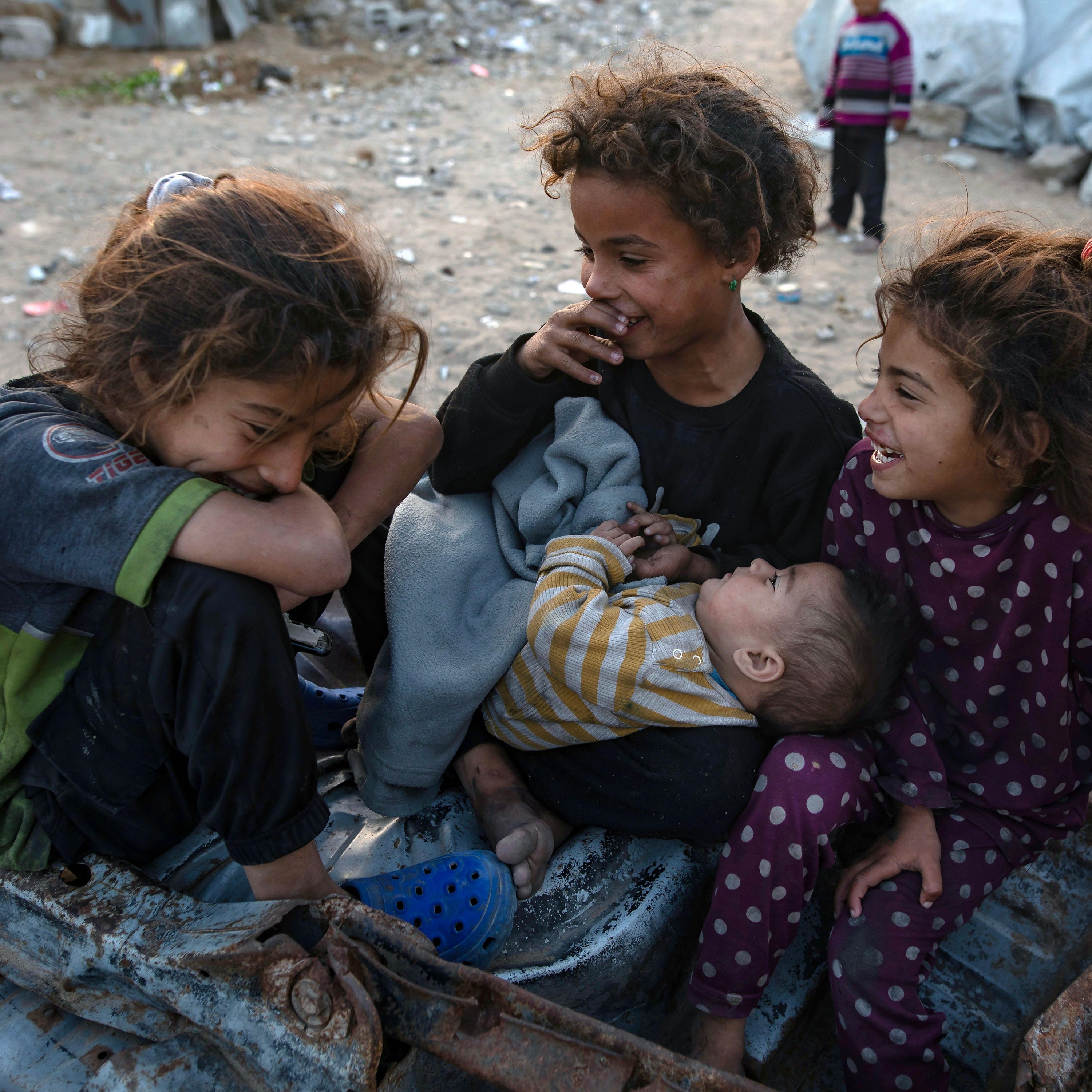
This BBC Global Story podcast features an interview with retiring war correspondent Fergal Keen, who reflects on decades of reporting from conflict zones. He discusses how covering events like South Africa's transition to democracy and, most traumatically, the Rwandan genocide, where he witnessed the aftermath of mass killings, left a lasting mark on his psyche. Keen explains that his own difficult childhood made him particularly attuned to the stories of children in war, who are often unheard victims. He wrote a famous audio essay after the birth of his son, contrasting his child's secure future with the suffering he had witnessed.
Keen reveals he was later diagnosed with complex PTSD, stemming from both his childhood and his work, and struggled with alcoholism as a coping mechanism. He highlights the current scale of the crisis, noting a staggering 520 million children live in conflict zones today. While knowledge on treating childhood trauma has advanced, focusing on resilience and the need for stable, loving environments for recovery, Keen argues that healing cannot begin while violence continues. He concludes by sharing the hard-learned lesson that maintaining mental health is a daily commitment requiring professional help and the support of loved ones.
This BBC podcast is supported by ads outside the UK. Hello, I'm John Bennett from the More Than The Score podcast. We're discussing the shock news of the Senegalese football team being stripped of its 2025 AFCON title with former Cameron Defender Sebastian Bassong. We bring you stories beyond the school line every weekday, search for More Than The Score wherever you get to your BBC podcasts. [Music] Before we start, this episode contains upsetting details of children's experiences in war. So please take care while listening. More than 1100 children have been killed or injured in the Middle East, in the two weeks since the war in Iran started, that's according to UNICEF. Children are often the victims of war, but they're also often the ones that we hear of least. For the last four decades, Furgle Keen has been one of the most familiar voices on the BBC, reporting from war zones around the world. And over the years, he's been profoundly affected by this story he's heard from children in particular. Now this spring, he's saying goodbye to the BBC, so we sat down with him to talk through the issue that has stayed with him throughout his career. From the BBC, I'm Asma Khalid. And I'm Tristan Redmond, and today on the global story, Furgle Keen on PTSD and how living through war affects children's brains. Furgle, thank you so much for joining us. Could you introduce yourself, Forest Police? Yeah, I'm Furgle Keen. I've been around a long time. It feels like forever. I love that as an introduction. And I'm doing what? In all that time, Furgle. I've been a foreign correspondent, war correspondent with the BBC for 37 years. Before that, I was a reporter in Palfaast in Ireland for Irish TV and Radio, and before that, I was a newspaper reporter. Always a reporter. And what are the stories that you've covered that have really marked you in your career? I think I was chatting to a friend of mine the other night who'd been there with me. And you know, I think the transition to democracy in South Africa, when I watched over a period of four years, this country moved from the brutality of racial separation, the humiliation inflicted on so many people, especially children. Moving from that to a point where I was standing outside the Union Buildings in Pretoria in May 1994 and watching Nelson Mandela, I mean, I was just 30 or 40 feet away from him, watching him with his hand on his breast being sworn in as the president of a non-racial democratic South Africa. That's the kind of thing you go through and you think I'll never experience that again. And it's true, you don't. It's a once in a lifetime experience. Very quickly after that, there was the other major story that marked my career and I think marked my personality and marked my psyche. And that was the genocide in Rwanda where you had, as many as 800,000 people killed in the space of 100 days. underlying intertribal tensions have again exploded into violence, apparently with thousands dead, as rebel forces from the minority Tutsi tribe appear to be fighting the army dominated by the majority of the troops. The Hutu forces pressured Hutu civilians to use machetes, clubs, blunt objects and other weapons to rape, name and kill their Tutsi neighbors and destroy or steal their property. And many of them killed by people who were their neighbors, killed with clubs with machetes and these neighbors egg-done by the government who basically taught people to entirely subvert the moral order. In other words, they told them that to kill your neighbor was the right thing to do. Altogether, it's estimated that more than a million people have been forced from their homes by a campaign of butchery that shows no sign of ending. They, over many years had pumped propaganda into the population, told them that if they didn't kill the minority, the minority was going to kill them. That's the Tutsi minority who were set upon by a Hutu extremist government. And I witnessed that and I witnessed the appalling aftermath of the slaughter, the mounds of bodies, the few petrified traumatized survivors and listened to their stories and driving around a country during the genocide while it was still going on. And on the one hand, seeing this vast emptiness, the smell of death, everywhere you went. And then meeting the genocide there, the people who had carried out the killing from ordinary peasant farmers on roadblocks listening to their rationalizations to the men who had planned it and given the orders. You don't shift something like that from your consciousness. We really wanted to speak to you today because you've written this fascinating article for the BBC website about how living through conflicts affects children in the short term and throughout their entire lives. Why did you decide to write that story right now? I've been sort of covering the conflict in Gaza since the Hamas attack on October 7. And it became clear to me that all of the trauma that I had witnessed being inflicted on children in the previous more than three decades of reporting as a BBC work correspondent. I've seen it again day after day. 12-year-old Leanne Halaf finds comfort in her family when the bombing starts. "My mom calls my brothers and sisters to hug them," she says. "And we hold each other's hands." And it kind of moved me to reflect on where we were now in terms of the kind of legislation that would try and protect children, the kind of care that should be available to them, and the consequences, principally the consequences of that kind of daily experience of trauma, where you had Hamas and the Israelis battling it out in a largely civilian environment. Where you had children suffering because of Israeli blockades which made drastic limits on food, which put severe limits on medical care, the destruction of so much of the healthcare system in Israeli attacks. The Israelis say that's because Hamas are hiding in hospitals. But whatever the consequence of these has been to create an environment where children have lived from day to day, so many of them wondering if they were going to wake up the following day. Today there are kids dying in wars, in Ukraine. There are kids dying of diseases in Gaza, and as I say many other parts of the world. And there are people, mostly there people who live beyond our concern in the West. It reared me to see this happening again. Frugal, what made you realize that there were these untold stories of children, children stories in particular that you wanted to tell, that you felt you know you ought to tell these stories of children being traumatized by experiencing war? I think that came from my own childhood. I grew up in, I suppose, what people would call a broken home. And that was a home that was disrupted by alcoholism, where I was traumatized by the presence of my father's alcoholism. And it was an environment where sudden disruption was always possible. Fear was constantly present, tension was constantly present. And where I learned very early to be quiet, not to speak up, you know, I was feeling ashamed because of how alcoholism was affecting my home. And it's a very common thing in the children of addicts or children who experience that kind of severe dysfunction in their home environment. And so I was conscious when I went into journalism of feeling a need, and later as my kind of social conscience developed a responsibility to tell the stories of those who could not readily find access to a media, who could not readily express themselves in a manner that that those were particularly children you felt. Yeah, yeah. In a manner that adults would stop and listen to, it's about listening to their stories and allowing them to be told with a very important caveat. And that is of course that in the telling of the story, you don't re-traumatize the child. And so for nowadays I will not interview a child without having carefully gone through the ground beforehand with their guardian, hopefully with a mental health practitioner. And when we finish the interview, we always now make sure there is someone there who was in a position to counsel the child and comfort them. Virgo, in the mid-90s, as you mentioned, you reported from Rwanda, in particular, this horrendous genocide where 800,000 people, including children were massacred, and then around the same time you had your own child, you wrote
A quite famous audio essay called "Let it's a Daniel" about your own son. My dear son, it is 6 o'clock in the morning and the island of Hong Kong. You were asleep, cradled in my left arm, and I am learning the art of one handed typing. Your mother, more tired yet more happy than I have ever known her, is sound asleep in the room next door, and there is soft quiet in our apartment. It was first broadcast back in 1996. Like many foreign correspondents I know, I have lived a life that on occasion has veered close to the edge, war zones, natural disasters, darkness in all its shapes and forms. In a world of insecurity and ambition and ego, it is easy to be drawn in, to take chances with our lives, to believe that what we do and what people say about us is reason enough to gamble with death. Now, looking at your sleeping face inches away from me, listening to your occasional silent gurgle, I wonder how I could ever have thought glory and prizes and praise were sweeter than life. And it's also true that I am pained, perhaps haunted, is a better word, by the memory, suddenly so vivid now, of each suffering child I have come across on my journeys. To tell you the truth, it's nearly too much to bear at this moment, to even think of children being hurt and abused and killed. And yet looking at you, the images come flooding back. I wonder if you could talk us through how did this essay come about and why was it so important for you to write about it? I wish I could claim the credit for having the idea, but it wasn't my idea. Yeah. Who's what's it? It was Tony Grant, a man called Tony Grant, who was the editor of From Our Own Correspondent, this wonderful programme on the BBC, which is all around the world. It's one of our oldest programmes. And it does a very simple thing. It says to the correspondent, "Right what you've experienced." And very unusually, sometimes what you felt, we don't express our feelings in the day-to-day news reporting quite rightly. That's not what we're there for. Tony Grant rang me and he said, "Look, you've had a kid. Would you write what it's like being a foreign correspondent, having a child in Hong Kong as I was living then?" And I kind of hummed and hoarded and I said, "I'm not sure. You know, is it really what I should be doing?" And then he prevailed on me and I did write it. And I wrote it in one sitting with the kid sitting in one arm and typing with the other hand. And I was absolutely blown away by the beauty of this child. I was just overwhelmed at what he represented at the possibility of new beginnings. And it brought up memories of the children that I had seen so many of them who didn't enjoy the protection that my child had in my arms in a nice comfortable apartment in Hong Kong, looking out at the dawn, knowing that his future was going to be one surrounded by love, care and security. And so it writing it got really, I was very, very churned up because it brought together so many different strands of my experience as a war correspondent of the previous decades for. "Frogl, you wrote that letter to your son in the mid 1990s and that's around the same time period that you were reporting on the Rwandan genocide. And that has been a huge focus of your reporting over the years. And while you were there in the region, you met a 13-year-old girl named Valentina who had lost her entire family." Back in Yarabuyye, the killers had finally finished their work. After four days they left, believing they'd killed all of their 1,000 to itsy neighbors. But at the end of this trail, next to the church, badly wounded but still breathing, Valentina lay hidden among the corpses. For days and nights she lay still, listening to every sound. "I stayed there for some time. Over a month. When I tried to get up, I would fall down. I figured that if the killers came, I would pretend to be dead." Her hand had been cut in half by militia men and it got so badly infected that it seemed that she would die. Yet you went back and in 1997 you found that she had indeed survived and you interviewed her about what she had been through. In Yarabuyye, Valentina and the other orphans knew nothing of what was happening in the world beyond. For more than a month they lived and slept among the rotting corpses. At night the dogs came. The dogs were coming and eating dead children outside and in the other rooms next to me. And after some time one dog came to where I was and started to eat a body. When this happened I picked up a stone and threw it at the dog and she got scared and ran away. "So when I first saw Valentina she was, it was during the genocide and she was with a handful of other survivors in an abandoned government building and there were some nurses from the rebel-rewandan panzerotic front who were trying to help her. But they had no medicine. Her hand was gangrenous and she also had a big gash in her head from where she had been macheteed. But she did survive. I went back three years later and Valentina was alive and she was living with her hand to it also survived the genocide." Did that trauma stay with her over the years? I can't imagine it didn't affect her in some ways over the years. It does. The expression that I absolutely hate is closure. You don't get closure on an experience like that. And if you witness massacre, if you see your family being butchered, you don't close a door and suddenly it's gone. And she had a dream where her mother came back to her in the dream. And she dreamed of that of her moment of being reunited with her mother. Of course that was never going to happen. But you know a couple of years after that, Valentina was back in school. She came to London. She met my own kid at my house. Oh wow. When was that for a girl? That would have been I guess. Maybe 1999 there are thereabouts. Okay so you stayed in touch with her over years? Yeah, I did. Yeah. I went to school and then she emigrated to the States. Oh wow. Where she now lives for there. But she's made her life and she has kids of her own. The big lesson is that given a chance, the human spirit and especially children are phenomenally resilient. I don't believe that anybody is doomed by what happened to them in their childhood. We're discussing the shock news of the Senegalese football team being stripped of its 2025 AFKON title with former Cameron defender Sebastian Bassong. We bring you stories beyond the school line every weekday, search for more than the score wherever you get to your BBC podcast. Fogel, you yourself were later diagnosed with PTSD. How and when did you start to recognise that you were also being affected by the conflicts you were reporting on? So if I'm frank with you, I think I had PTSD from a very early age as a consequence of the environment in which I grew up. And paradoxically, what that did was create in me a need to be in places where that sense of fear, that tension was recreated because I was perfectly formed to operate in war zones. I was hyper vigilant from the very earliest age. Obviously watching out, am I under threat? Is there a danger to me here? And that makes you very skilled at navigating a place like Rwanda or the streets of Belfast in the middle of rioting. When I came out of Rwanda in 1994, nobody was talking about journalists and PTSD. We went and we got drunk and talked about it in the bar and that was it. And I self-medicated with alcohol and ended up as a fully functioning alcoholic because that is such a common coping mechanism. Anything to take you away from the pain, anything to take you away from that void which is full of nightmares and bad memories. I kept running and I kept running into conflict zones until I had a pretty big breakdown in about 2008, went into hospital and was formally diagnosed with complex post-traumatic stress disorder as a result of numerous wartime experiences. But you know what? I came out and I was a good boy for a while. I didn't go to the war zones and then I went back. I mean that is the definition.
of insanity. And I went back again and again, until I crashed, predictably crashed once more. And then I remember that breakdown. It was about three years ago now. And I remember sitting in the psychiatric hospital at three in the morning looking out on the dark and thinking this is never going to get better, you know, really at the deepest low possible and feeling shame because of what I'd brought on my family. You know, trauma PTSD doesn't affect just one person. Addiction doesn't affect just one person. It affects all of those who love you, who live in fear about what is going to happen to you. And I was watching a TV program as you do in the dark hours of the night when you can't go to sleep. And there was an American psychiatrist on it and he sat down, he was talking to it and a celebrity and he said, number one, he said, life is full of pain. Number two, it's full of uncertainty. And number three, that if you're going to have decent mental health, you've got to work at it every single day of your life. And that's the thing that I came away with that I get of all the help in the world as a grown-up. But I absolutely had to take action myself. And what did that involve? Well, it involved continuing therapy, staying out of war zones. And it involved surrounding myself with as much love as I could possibly find. And this goes back to what we were talking about with kids. It's just as important for grown-ups, to be around people who love you and to give that love back. You've talked about how difficult it was to stop going back to conflict zones because of it's almost kind of compulsive nature of that kind of work. There are so many wars and conflicts happening in the world right now, places where children don't have the choice of whether they can be there or not, that they are there. Gaza, Ukraine, Sudan. What is the scale of the crisis for children around the world right now, Fugel? Well, the most recent figure we have is from 2024 and that talks about 520 million children living in conflict zones. 520 million children, an estimated 520 million children are now living in conflict zones. That's about one and every five children worldwide. I mean, that's a staggering number, right? One in five, 20% of the world's children. And so that makes me wonder that over the years of you covering conflicts has the knowledge of how to deal with children in war zones, it improved. I know you've been talking to experts about how to help children, children who might be suffering from PTSD. These numbers are huge. Has the knowledge base changed? Yes, the knowledge base has absolutely changed. Remarkable work being done. So, for example, you have doctors who have worked with children who went through the Bosnian Civil War and the genocide at Srebrenica. And again, they found that a key element was this question of a family stability of a community stability being created for children once the conflict had ended. I mean, they disagree about a few things, but on this, they're absolutely of one mind. And that is that you can't recover from war trauma if you're living with continuing trauma. But you also have research to children who are living with fears. And I mentioned a while ago the whole question of avoidance, people being terrified of confronting anything that reminded them of what had happened during the war. And so there's a new field of theory, well, I mean, relatively new field of theory, which encourages children to slowly and carefully try to confront, obviously not death and massacre again, but things like learning to sleep alone, not having to sleep with a parent, because that's what they did during the war, because they were so consistently terrified. Now, it sounds like a simple thing, but as anybody who's tried to put a child to sleep, who's had a nightmare, a child who hasn't been traumatized will know it's very difficult. But it's a kind of essential part of a child being able to mature, grow up, separate out ultimately from the family. Forgle, we made an episode yesterday here on the global story about the deadly strike un-in-elementary school in southern Iran. As we said here at the outset, UNICEF has reported that more than 1100 children across the region have been reported injured or killed since this war in Iran broke out just a couple of weeks ago. We look at Gaza, I mean, while, which we spoke about earlier, there is a ceasefire on the books, but it is difficult nonetheless to know how children and their families are going to rebuild their lives. How are you reflecting on all of this? What struck me when I saw the news along with everybody else of the air strikes onto Iran and other Iranian cities was what's it like for the kids underneath that, because we've established by now in this conversation that it's my preoccupation. And I can't speak to any children in Iran at the moment, but I have been able to speak to a young woman who said a phrase to me via an inter-majorie, which just has been going around in my head for the last few days. And she said this war, she said it has come into our homes, it has come into our families, it has come into our blood. And I don't know when we're going to be able to get rid of it. And she was talking about the fear that is constant. You know, I've just seen some footage which was sent out to us of the night sky and the sound of bombing and this really eerie sound of dogs barking when they hear the aircraft approaching. And you're thinking to yourself, what's it like to be an adult onward but to be a child? And who hasn't? Yes, there have been, there were air strikes, there were attacks on the nuclear installations in an earlier phase of this conflict between Israel, America and Iran. But this kind of bombing in cities is something the vast majority of Iranian children will have had no experience of. And I think it goes back to the entire thread of our conversation. When wars begin, no matter where they are, children are the ones who have least ability to protect themselves. And they're the ones who under international law, under all the conventions that armed forces are meant to operate by other ones who should be most protected. But that just doesn't happen. It never has. And you have to wonder if it ever will. Well, Fergal, thank you for bringing your insights and all of your years of reporting to us. Really appreciate it. Thank you. That was Fergal Keen, who sadly is leaving the BBC this spring after 37 years. And we want to thank Fergal for the incredible, sensitive reporting he's done over all those decades. And we wish him the best of luck for what's next. We do indeed. Today's episode was produced by Hannah Moore. It was edited by Bridget Hardy and mixed by Travis Evans. Our senior news editor is Trina Collins. And I'm Asma Khalid. And I'm Tristan Redman. Thank you very much for listening and we'll see you again tomorrow. We bring you stories beyond the school line every week day, search for more than the score wherever you get to your BBC podcasts.
Podcast Summary
Key Points:
Veteran BBC war correspondent Fergal Keen reflects on how covering conflicts, particularly the Rwandan genocide, profoundly affected him and led to his own PTSD.
He emphasizes the severe and lasting psychological impact of war on children, drawing connections to his own traumatic childhood and his motivation to tell their stories.
An estimated 520 million children—one in five globally—now live in conflict zones, highlighting a massive crisis.
While understanding of childhood trauma and PTSD has improved, emphasizing resilience and stable environments for recovery, Keen stresses that recovery is impossible amidst ongoing violence.
Keen shares his personal journey with PTSD and addiction, underscoring that mental health requires daily work, therapy, and the support of loving relationships.
Summary:
This BBC Global Story podcast features an interview with retiring war correspondent Fergal Keen, who reflects on decades of reporting from conflict zones. He discusses how covering events like South Africa's transition to democracy and, most traumatically, the Rwandan genocide, where he witnessed the aftermath of mass killings, left a lasting mark on his psyche. Keen explains that his own difficult childhood made him particularly attuned to the stories of children in war, who are often unheard victims. He wrote a famous audio essay after the birth of his son, contrasting his child's secure future with the suffering he had witnessed.
Keen reveals he was later diagnosed with complex PTSD, stemming from both his childhood and his work, and struggled with alcoholism as a coping mechanism. He highlights the current scale of the crisis, noting a staggering 520 million children live in conflict zones today. While knowledge on treating childhood trauma has advanced, focusing on resilience and the need for stable, loving environments for recovery, Keen argues that healing cannot begin while violence continues. He concludes by sharing the hard-learned lesson that maintaining mental health is a daily commitment requiring professional help and the support of loved ones.
FAQs
It discusses stories beyond the sports headlines, including recent episodes on the Senegalese football team and interviews with figures like former footballer Sebastian Bassong.
Fergal Keen is a former BBC foreign correspondent with 37 years of experience, reporting from war zones globally, including Rwanda and South Africa, and he has written about the impact of war on children.
War trauma can have long-term psychological effects on children, including PTSD, and it disrupts their sense of safety and stability, impacting their development and mental health.
Keen's own childhood in a dysfunctional home with parental alcoholism made him empathetic to traumatized children, driving him to share their untold stories with care to avoid re-traumatization.
Written in 1996 after the birth of his son, it reflects on the contrast between his child's secure life and the suffering of children in war zones, highlighting the emotional impact of his reporting.
It contributed to his complex PTSD, which he self-medicated with alcohol, and led to multiple breakdowns, underscoring the psychological toll on journalists covering conflicts.
Chat with AI
Loading...
Pro features
Go deeper with this episode
Unlock creator-grade tools that turn any transcript into show notes and subtitle files.
 PodcastTranscript AI