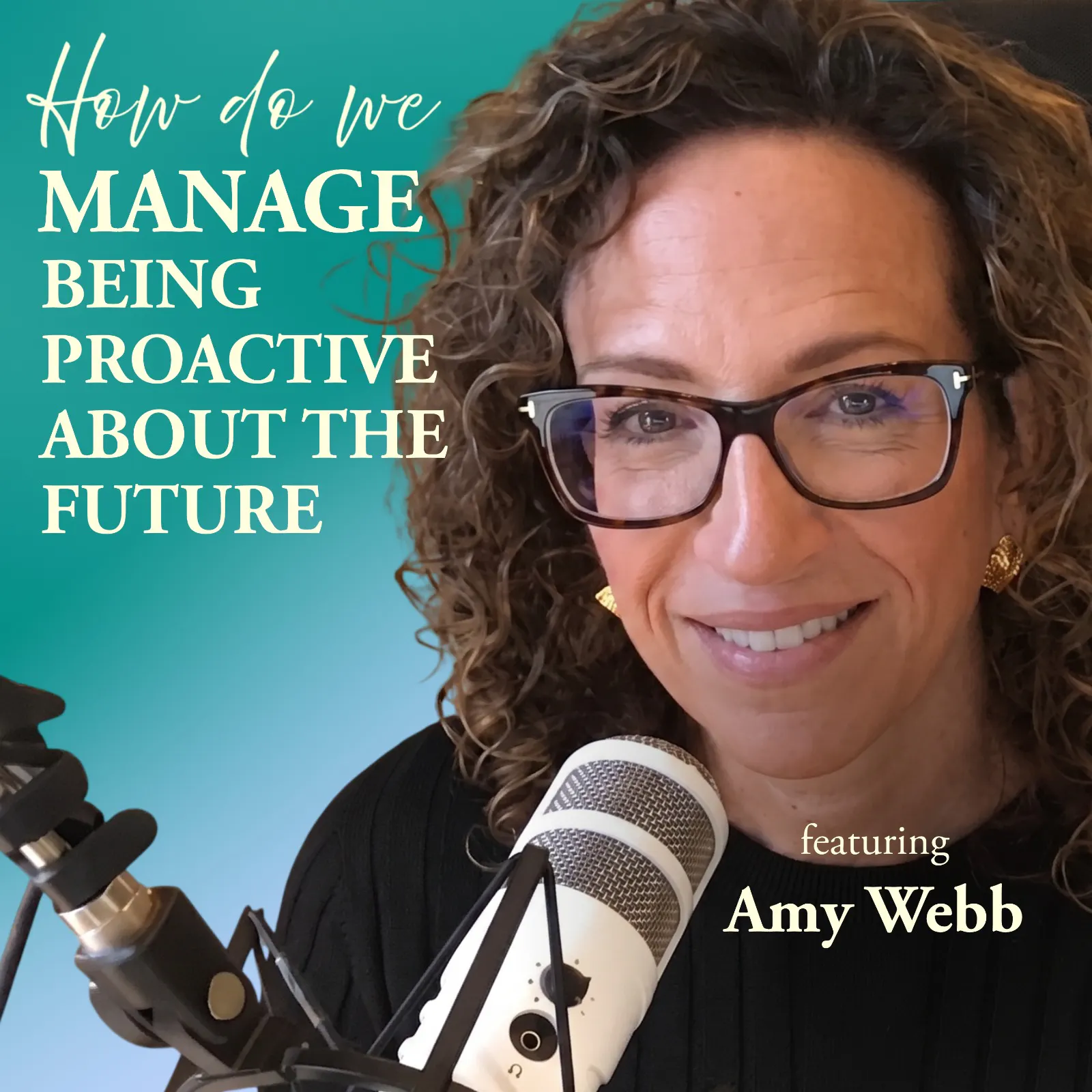
How Do We Manage Being Proactive About the Future?
36m 41s
In this podcast, futurist Amy Webb discusses navigating a rapidly changing world by focusing on the convergence of trends rather than isolated trends. She explains that while every generation feels overwhelmed by change, today’s challenge is unique due to AI and robotics becoming autonomous producers, potentially leading to mass job displacement without economic models to support it. Webb argues that leaders must proactively spot and prepare for “storms” like AI, as no one will rescue them. She advocates for a new economic system, including independent oversight (similar to the IAEA), financial incentives for ethical AI development, and long-term government planning for labor transitions. She criticizes current approaches, noting that regulation alone is insufficient and that countries like China and the Nordics are ahead in planning, while political polarization hinders progress elsewhere. Webb also highlights the dual nature of personal AI use: it can be beneficial (e.g., personalized training data) but risks hollowing out relationships if misapplied, as she experienced by using AI to analyze her own appearance. Ultimately, she calls for a collective, faster effort to build a future where AI augments rather than replaces human value, stressing the need for storytelling and tangible economic incentives to drive action.
The premise of this podcast is to navigate a fast pace changing world and for today's guests this is the very idea behind her job. The other thing that we hear is there's an apocalypse coming and the whole world will collapse. Those are the easy conversations to have. The hard conversation to have is what do we do about it? Amy Webb is a futurist. As the founder and CEO of the Future Today Strategy Group, she explores possible futures based on data, trends and what history has taught us to advise leaders. She used to publish an annual trend report but that has transformed into what she calls a convergence outlook. She says that trends are no longer enough and we have to look at how they are colliding and creating storms. Nobody is coming to rescue you. You have to as a leader become somebody who can spot that storm as it's forming and then be agile and make decisions. So what can we learn from a futurist vision of what's to come? Today on How Do We Manage With Me Stephanie Van Bismark, I'm talking with Amy about AI how to weather these upcoming storms and how to remain curious. How do we manage being proactive about the future? Amy Webb, what a pleasure to have you here. Thank you. It's great to be here. This podcast, so the entire premise of this podcast is how to find balance in a rapidly changing world in our lives as humans, which is a little bit also what you job entails. But question for you, are we really living in a much faster, paced world and then how do we determine that actually? Yes, Stephanie, that's a wonderful question because sometimes when you're in the middle of what feels like soul crushing change, you can find it. You feel quite alone as though we are the one, you know, it's happening to us. Actually if you go throughout history, every generation has faced the same feeling. In fact there was a fairly famous book written 1960s called Future Shock by a man named Alvin Toffler. And he lamented that the pace of change was happening so fast that it felt like a shock to the system. And of course, in the 1960s there was the Cold War, there was the atomic bomb, there was the pill. So it felt like everything was changing fast. So what I would say is I don't know that this time in history is truly any different than previous times throughout history, although I know it doesn't feel that way right now. Yeah. Okay, interesting. That's actually a good point. I mean, for anyone who's now listening and does not, you might have asked this question before who does not know what a futurist does. And in order for them to understand that is not sitting in front of the crystal ball, what does a futurist do? So a futurist's job is to use data and evidence and a methodology to determine plausible next order outcomes. So in a sense, we, our job really is to predict the future. Now the difference that I would argue is there is not a single future because with every decision that gets made, with every moment that passes, there are new variables. So in my world, prediction is what we do, but we are predicting multiple plausible outcomes versus a singular outcome most of the time. There is a way to do more probabilistic modeling for something very narrow, but the goal is to predict what might be next, but that's not enough. Our real job is to use that information to help leaders make better decisions in the present. I mean, you spend nearly two decades working on the so called the trend report that you released. And yet this year, you went on the stage in South by Southwest in the cloak to like funeral music and killed the trend report. That's exactly right. So, first of all, we still use trends. And in my world, trends are longitudinal. They're not trendy. And signals and trends are important because that tells us what you can know about the present. That does not necessarily tell you much about the future. Just tells you what you can know to be true right now. Once we combine that information with uncertainties, that gives us a sense of what those plausible futures could be. I think the thing that's different now is putting trends into a PowerPoint or a PDF for people to download serves almost as a crutch. And it means that you don't have to as actively pay attention to what's happening. And we've moved beyond the point where everybody can sit on their hands and rely on a trend report. You have to engage more. So part of this was our acknowledgement that trends are not useful on their own, which they never really have been. But it's the convergence between those trends and other forces. That's what really matters most for decision makers. So it was time to kill the thing that made us famous. Now there's another piece of this. There was a more macro side of why I did this. And that was because I think everybody is kind of stuck. Everybody is stuck. Either hoping things would go back to the way they used to be or trying to preserve the status quo. And so this was also my signal to everybody that you have to be willing to tear down at the right moment, certain things to make way for what must exist. And there's an economist from many years ago named Joseph Schumpeter who called this active destruction, creative destruction. It is making way for the new thing that must exist and clearing away what used to be there. And this is partially how he described capitalism as this relentless storm, this relentless cycle. I thought I would demonstrate that in real time for everybody. I liked how you talked about this because in the end, as much as I understood this, you were actually talking about that storm. You made that example. And it was more about the storms that are coming, that are inevitable. And talking about what is really coming and basically how to be best prepared because it's not going to be a question whether you like it or not, it's just there. If somebody told you the barometer reading, that on its own is not enough for you to make a decision. But if you have a much clearer picture of all of the different indicators, and also you can kind of see potentially a storm that's coming, that gives you enough information for you to act in advance. And I guess what I'm hoping our leaders will consider is not waiting until the storm arrives and then saying like, "What are we going to do?" Because in this case, nobody is going to be out there with a life raft for you. Like nobody is coming to rescue you. You have to, as a leader, become somebody who can spot that storm as it's forming and then be agile and make decisions. And I know that sounds like a clever metaphor or analogy, but the truth is artificial intelligence is one of those storms. It's a convergence. And it is a storm that formed over a long period of time. But everybody had plenty of warning on this one. And very few organizations made the right decisions in enough time. But you tell someone because one of those storms, let's put, you call them convergences, but I like the storm picture, is that unlimited labor. And that's where AI agents and robotics and all of it are basically taking over a large quantity of what is now done by humans and jobs. So everyone out there listening is obviously asking, "Is my job safe? What does it mean for me?" Right. So if we go back in time anywhere on earth, in any economy, the source of growth was always human labor. So the end result might have been some kind of currency, but the input was always people doing things to create value. And as technology has evolved, that has always augmented human labor. And productivity as a result of that rose up because people were just more effective. The problem is that because of artificial intelligence and robotics and new forms of learning, humans are evolving from just tools that augment what humans can do to instead autonomous producers, meaning they're able to create that value without a human in the loop. And that previous barrier that had existed is now starting to collapse.
So what this potentially means is that we could have a whole bunch of people out of work with GDP rising at the same time. And there's really no economy on earth that is set up for something like that. I think we're so fixated right now on exactly which jobs will go away. And there are so many, it's the wrong conversation to have at this moment. I was just at a big conference that's called the Milking Global Institute, it's in Los Angeles, that brings together the world's largest hedge funds and investment banks and technology leaders. And a fairly famous venture capitalist was talking about, yes, all of these jobs will go away, but so many jobs will be created. And that's kind of the standard thing that we hear. The other thing that we hear is especially from pundits, there's an apocalypse coming and the whole world will collapse and bubble-blog. The hard conversation to have is, what do we do about it? So what I was there doing was talking about what we do about it. I have a thesis for a new kind of contribution credit and basically a way to resolve this problem now. I think you can use regulation. I think we literally need to rethink our economy, which we have the time to do now. Every country does. But taking it further, so if one now says that the unlimited labor has been taking over us for us, we don't have to work anymore, let's say. But if you now know what work has done not only for money-wise, but also purpose, it has given people structure and purpose. I mean, this is a huge challenge for society if you imagine that there are millions of people potentially without structure and purpose regardless of the money. So what are they doing? Or what are we doing if we don't have that anymore? Well, look, I've spent, it's a good question. And again, I think some of what I hear out of Silicon Valley is, it'll be the renaissance. Everybody will learn how to paint or whatever ridiculous. Yeah, ridiculous. I think a couple of, there are a couple of examples that could be instructive here. So I spend a lot of time in the Nordics. And I've spent a lot of time in Norway, which is a country that I love deeply. Norway came into a lot of oil money late. And the country reinvested that money, I think, in a smart way. So rather than it trickling down to individual people, instead, Norway put some of that money into media. So like news, really good quality news and to other arenas. As a result of that, Norway has the highest per capita number of good quality news outlets, more than anywhere else on earth. So basically, people in Norway, Norwegians are more literate when it comes to news and balance. So there's not the crazy polarization than anywhere else. It's just an example of a different way to deploy value so that people still are connected to each other, you know, things like that. So while some jobs will go away, other jobs will be created, but there's all of this invisible work that will never go away. So these are like caregivers. Like at some point, you know, I'm the sandwich generation. I've got a 15-year-old and my father is in his 80s. I'm taking care of both. I don't get paid to do that. I'm privileged that I have plenty of assistance, but there are lots of people who don't. These people can have purpose and we can pay them for some of that work. Same thing for teachers. So there's different ways to do this. Typically, when we just give people a universal basic income, that doesn't work out well. Without, I don't believe in that. It's such. Right. Without, without something else. So the point being, some white collar jobs will go away, but the job of being a citizen in a place, in a city, in a country, that doesn't get replaced by AI. And in order to create those, to stitch back those social structures, there are ways to think about work and contributions in ways that we've not before. What do you do? Good future with AI look versus a bad one. And where are we now? Yeah, look, a good, where are we right now? Depends on what country you're in. In my country, we are not in a good place. What would good AI look like? First of all, having a agency that is charged with reviewing the data and the algorithms, making sure that what's being developed is in the best interest of the public and having some system to enforce. So think of like the, the IAEA, which regulates weapons. So I'm not saying that AI is a weapon, but it is useful to have a third party organization that has the responsibility and can be accountable because I regulation isn't going to work, but that system of accounting might work. Incentivizing companies using a credit system to make better choices, regulation is not going to work. Going forward. It's impossible. There's no way to regulate something that hasn't been developed yet. And so what's happening is all of these companies are just building stuff and they're asking for forgiveness later or they're winding up in court. We cannot keep doing that. So we need a completely different system to incent companies and I think financially to make the right choices and then to have some kind of enforcement mechanism. The other thing that I would say is in a perfect world, every single government on earth right now would be working diligently on a long-range plan for what to do when a lot of these jobs do start going away. And that is not happening. So there is no plan for a transition and like nowhere on the only place that's really happening maybe is China. And China is doing a very long like China is doing hard work, doing a long-range plan, not just for the transition of labor, but also how do they get everybody online? So there's not a gigantic digital have and have not. So these are big structural things that are going to take time, but that's going to what that will be what leads us to our best possible outcomes so that tools for automation are additive versus taking things away. The worst possible outcome is the road that we're on right now, which is we're just letting the companies make all the decisions. And in Europe, there's a lot of academic work on regulation. Great. You can put on paper all you want, all the regulations. So like what happened with GDPR in Europe is not necessarily going to work out well for AI. I'm in the minority when I'm saying this I know, but we all have to work collectively and much faster. Because by the way, it's AI is also it's not just about jobs going away. Artificial intelligence interacts with biology, artificial intelligence interacts with sensors and robotics. So there's going to be a drastic acceleration. And the worst possible outcome is that none of us are prepared, which is the road that we're on right now. Absolutely. I mean, I recently had a conversation on the podcast with Ilus E. Stopg She's a Disaster Planner. And we're talking about how extremely difficult it is to put in front of leaders, disasters that are booming and are coming, but they're probably 15, 20 years away. So how do you convince the leader is you're meeting to be somehow alert and to react now because it seems to be awfully difficult? So a couple things. First of all, storytelling is very powerful. And I'm not the one who figured that out. There was a guy named Herman Khan, who was a futurist in the 40s and 50s. He was trying to warn everybody about nuclear weapons. And so he had classified data from the Air Force and he was going to officials and he's like, look, if we drop up, you know, there's a bomb like here's what's going to happen. Here's the numbers and nobody cared. He had a friend in Hollywood. And so he's lamenting this problem. How do I get people to pay attention to this future disaster? Right? It's obvious to me. Here's all the data. And the friend said to him, what, this is boring. There's no story. You got to tell a story. And in moviemaking, they had scenes, right? There's a scene that tells a story. It's like, you should make scenes for these people to help them understand. And that was the birth of the scenario as it is currently, currently used. So some of this is telling a better story now, talking about like an apocalyptic hellscape when it comes to the future disaster, right? That's not the right kind of story. The story
And it's an easy to ignore story because leaders, 15 years in the future, it's very hard for us to place ourselves in a world where it feels very far away. So instead, you have to map all of that back to the present. So here, and again, I hate to be this person, but what tends to move the needle? Money. Show people the tangible loss and the tangible gain. And they tend to make the right decision. If you present the information the right way. Are there any countries that are doing a better job than others apart from you? We heard about your own country, but is there any other country? I think that the Nordics do quite well, or I guess Scandinavia, because I don't think Iceland is technically. There's a lot of consternation about who's included where. I think that in my experience, those countries have done a pretty good job of thinking ahead. While I don't agree with the politics of China, I would say that China as a country does a fairly good job of longer term planning and execution. Now, what they're doing, especially when it comes to privacy, I don't agree with. Countries where you see political polarization and radicalization are going to struggle over the next decade. And that includes my country. And that's because you wind up with policy, whiplash, nobody can do any planning. Decisions are all over the place. Things don't make sense. This is like the worst possible time for the United States to have an administration along the lines of what we've got right now. Because it's setting us backwards in time. And I'm politically independent, so this is. It's just a math thing. We're in a bad place. Another storm, which I briefly want to take up on, is the AI is moving not only into businesses and stuff, but it's also moving into the personal space. It's also going into relationships now. Where's that line between that it actually supports you versus that it actually can hollow out completely? That's a great question. So this goes back to data. So here's a great use case for AI when it comes to yourself. So I'm a cyclist. I spend a lot of time on my bike and I like to ride in races and whatever else. Look, I'm 51 years old, so I'm getting. I'm in very good shape, but I'm getting to the point where I'm not going to see improvements. The body. It just is what it is. So what I'm trying to do is to continue to do as good as I can until the moment when I can't. So this is a case where I can put all of my data into AI and say, "What are the. Because most of the systems and tools were not built using women's data. They were built using men's data." So. Basically, every time I turn on the computer on my bike, it's making suggestions for like a man who is six feet tall and probably 25 years old. So I'm training a system using my own data and learning small changes that I could make in order to make the improvements that are realistic for me at the stage in my life. So that's a really great use case for AI. And you could do that when you've got a lot of specific data and it's a physical activity, something like that. I will be very vulnerable and open with you about a stupid thing that I did with AI. I was at an event recently and I did not get the response at that event that I thought that I should get. Okay. And I was like, is there something about the way I'm dressing or the way that I look? Like, what's going on? Do I not look approachable to be unapproachable on fun? I mean, I realized on this entire podcast, I've like talked about apocalyptic doom. But generally speaking, I'm a fun person to hang out with. So I uploaded photos of myself from this event to an AI and I said, tell me what you think of this woman. Like, just what do you think? And it was like, oh, she's clearly very smart. And like, I didn't, she's smart. She's an executive. She's very powerful. She's probably very intimidating. And I was like, on what basis are you telling me these things? You know, my first reaction was like, go after yourself. Like, but, but, but, I'm insecure. So I kept probing and asking more and more questions. And I found, and I'm like, an hour later, I realized I was saying things like, should I change my glasses? Do I need to straighten my hair? Because it created a bunch of self-doubt. Realistically, why didn't I get the attention I thought I should get at this, at this event that I was at? I don't know because people were busy. Could have been a million different things that had nothing at all to do with me. Because I was feeling insecure, I, as anybody else might have looked at this and said, what are you doing? But that's the thing, right? Because there's no friction. It's on my phone. And while I was sitting in a car trying to get to the airport, exactly. You kept on digging deeper. And that's the danger of it. Absolutely the danger. And this was me starting with a, I'm feeling a little bit bad. And I don't feel bad on a normal basis. Now, put yourself in that, you know, if somebody is struggling or having a mental health crisis, none of these applications were designed to treat anybody in those situations. And yet, they've emerged as like the number one tool for mental health, which is insane. Yeah. But what would your recommendation someone who's listening is like, where do you find, why do we find that balance? Right? I would be probably the same as you. You're having a little time, a little insecure, and you go down a rabbit hole. And then that system tells you sorts of things. But where do you find the line? Do you just switch off? Do you force yourself and say, "Effet? I'm just done with it." Whatever reason I will probably never know. Or how do I find that balance? Yeah, again, I just, at this stage, I may as well just be very honest with you, right? Because I think that's the thing we were missing now. I struggle with that. It's just super easy. And anytime, look, I feel just as insecure as any other person. I just, I hide it well because I'm a public person. But I feel that way all the time. And I, it's just this stupid phone, right? It's too easy to click on the phone and ask a question to get the external validation that you might need. That I might need. I need constant external validation. So it's all of those things. Five years ago, we might have just put that intrusive thought aside and said, whatever. I don't know what's going on today. Or maybe we ruminated and we called a friend. The problem is this lack of friction and the immediate response. And don't forget, these AI tools are being designed to be sticky. They want you to stay in them as long as possible. So the best thing to do is to just not use them in those situations. At least be really aware because that's basically it's an educational responsibility, I think, is to bring out much more what it actually does to you and where the dangers are. Because yes, some elite audience has access to that and can think about it. But a larger population doesn't. And this entire awareness to know this is actually, if I continue this, this is not going to do me well because I think it's such a thing that we're missing on a, on an educational level. I think that's right. My daughter, my daughter is in a school, which in the United States, it's a private school, but they have a mandatory digital literacy and AI literacy class that they start taking in kindergarten, which is very, very unusual. And also, she did not have a phone until she turned 15. So these were, the school made a choice, which I think is a good one, to educate kids from a very young age. We made a choice as a family not to give her a phone. She is a very social and confident 15-year-old, which is very different from a lot of other girls' her age, who feel very, very insecure having some of these issues. How do you see this conversation around the future skill set? Because it seems to me, or you can read about it also, that that future skill set is very different to what it was when you and I went to school. And this entire conversation around is grades, is going to a university in the end going to be necessary. Yes, I know. What do we actually need to know? What is the most important of three skills? Let me break that up into a couple different pieces. So in terms of skills, I think that there are some non-academic skills that are going to be very important going forward that more so than they have been, and that's flexibility and grit. So one of the outcomes of having always-on devices and access to information at any time and access to answers at any time is that it has, it is making people less resilient. If you used to get stuck on a math question, you kind of just had to figure it out. We are having fewer opportunities to sort of figure it out.
And what's analogous maybe is GPS. So there was a time before GPS, when you had to learn how to read a map and get out and you know, figure things out. The GPS replaced that. But we still had opportunities to sort of get lost, if you will, in other ways. The technology that exists today is very different. We have very few points of friction in our lives. That means that people are less resilient. They are less flexible. They are struggling more. So the biggest skill that I think is going to be important is that resiliency, which is about agility, adaptability, grit. And that's not an academic thing. You just have to learn it by doing. In terms of actual skills, so plumbing, there are too many different types of toilets and sinks and bathtubs. And they're all installed in different ways. A robot, it's going to be many, many, many, many years before any single robot can like fix a leaky toilet. And I think that's important because in the United States, this is not true everywhere, but in the United States, we really prioritized college over trades. And I think that was a mistake. Skilled trades people, whether you're a Mason or a plumber, those are extremely valuable skills. They're extremely important skills. And we messaged everybody in society that somehow those skills are less desirable and less important. - I mean, a lot of your work is sort of coming up based on evidence and systems and knowledge of the past, but it also, in my point of view, anyway, it requires a lot of curiosity and imagination and open-mindedness. How do you fuel that part of your brain? - That's funny you ask that because I was just at a dinner Monday night with some awesome people. One of the heads of a toy company, one of the head's former head of the US military. I was telling everybody that I'd gotten them together because I am drastically underestimulated. And I was just, they were like, this is amazing. Why are you having us at this dinner? And I was like, well, I told you, it was so you could meet each other, but honestly, it was for me. So I have to work really hard at always finding ways to learn new things. I am super, super, super curious. I find myself spending a lot more time in person with people than I have in the past. - Isn't that great though? - Yeah, it's awesome. It's so great. It's like, what the hell was I thinking? Why wasn't I doing this before? - So that is helpful. I think that's actually the return of, as much as I appreciate that we're able to meet now and that's due to technology, right? But the in-person meetings, in-person conversations, where you can sense feel you come through new ideas and that's really what matters so much more in the end. Because it also gives back what we're wired for, that connection and the belonging and whatever else. - Can I ask you a question? - You're curious. Like, what are you doing to engage your curiosity? - Well, one of them is doing this podcast because doing this podcast, being able to meet with people like you and I come up with all these topics and themes, it is yes to bring it out. But it is also about my own passionate curiosity to learn always. I'm learning all the time and that gives me such joy. And I'm always up for new things. It doesn't matter whether I, you know, I'm completely useless at it, right? But at least I gave it a try. - Yeah. - Yeah. - So I won't shy away and I don't shy away from being childish or anything, doing silly things and stupid things if, you know, if it's, you know, fun or rewarding or enriching somehow. - That's great. And what do you do on a daily basis? Is there any ritual or any habit that helps you balance your day any better? - I tend to go to sleep and wake up at the same time every day. And I have since I was a kid. So I'm usually up between five and five 30 just 'cause it's my normal wake up time no matter what I do. I tend to go to sleep at nine. - Okay. - So those are unusual hours for the East Coast of the United States. I try to be active every day. I tend to be a kinetic thinker. So when I'm being active, my mind clears and it makes way for the new thoughts. - Yeah. - I try to schedule, if I don't schedule it, it doesn't happen. A 15 minutes a day to do something creative, anything at all. I tend to do this in the morning just because my brain is more active in the morning. And then I make sure that I have a couple of hits of dopamine. So I don't smoke cigarettes, but I definitely like dopamine hits. So a couple times a day. - Okay, so just. - Something like a two minute song that I really like or a video clip or something that I know is gonna juice me up. So I just make time in the day 'cause my day is tend to be pretty different. - For all of those things. - I love that. That's fantastic. Well, thank you, Amy, for taking this time. It was a wonderful conversation. - Thank you. - Thank you so much more to explore. And I hope we'll get the chance to do that at some point in the future. - Absolutely, thank you. - That was such an inspiring conversation and such a great reminder that we should always remain curious. Thanks so much to Amy Webb. We'll be back next Tuesday and don't forget you can get the episodes of How Do We Manage Straight To Your Device by hitting the follow button wherever you get your podcasts. You can also follow us on Instagram and How Do We Manage. Thank you for listening and we'll see you next time. (upbeat music)
Podcast Summary
Key Points:
Futurist Amy Webb argues that trends alone are insufficient; leaders must focus on the convergence of trends to anticipate and prepare for "storms" like AI.
AI and robotics are evolving from augmenting human labor to autonomous production, potentially causing job displacement and rising GDP simultaneously, which no current economy is equipped to handle.
Webb emphasizes proactive decision-making
A good AI future requires independent oversight (e.g., an agency like the IAEA), incentive systems for companies, and long-term government planning for labor transitions, which is currently lacking except in places like China.
Personal AI use can be beneficial (e.g., personalized training data), but it also risks hollowing out relationships if misapplied, as illustrated by Webb’s anecdote about using AI to analyze her own appearance.
Summary:
In this podcast, futurist Amy Webb discusses navigating a rapidly changing world by focusing on the convergence of trends rather than isolated trends. She explains that while every generation feels overwhelmed by change, today’s challenge is unique due to AI and robotics becoming autonomous producers, potentially leading to mass job displacement without economic models to support it. Webb argues that leaders must proactively spot and prepare for “storms” like AI, as no one will rescue them.
She advocates for a new economic system, including independent oversight (similar to the IAEA), financial incentives for ethical AI development, and long-term government planning for labor transitions. She criticizes current approaches, noting that regulation alone is insufficient and that countries like China and the Nordics are ahead in planning, while political polarization hinders progress elsewhere. , personalized training data) but risks hollowing out relationships if misapplied, as she experienced by using AI to analyze her own appearance.
Ultimately, she calls for a collective, faster effort to build a future where AI augments rather than replaces human value, stressing the need for storytelling and tangible economic incentives to drive action.
FAQs
A futurist uses data, evidence, and methodology to determine plausible next-order outcomes. They predict multiple possible futures, not a single one, to help leaders make better decisions in the present.
She replaced it with a 'convergence outlook' because trends alone are not enough. The key is how trends collide and create storms, and leaders must actively engage rather than rely on a static report.
It refers to AI and robotics becoming autonomous producers that can create value without humans. This could lead to job losses while GDP rises, and no economy is currently set up for that scenario.
Leaders should spot storms as they form by using data and indicators, then act agilely. Nobody will rescue them, so they must make decisions in advance rather than reacting after the storm hits.
It involves a third-party agency to review data and algorithms, a credit system to incentivize companies, and long-range government plans for labor transitions. This ensures AI is additive rather than destructive.
Use storytelling and scenarios, like Herman Kahn did with nuclear weapons, and map future impacts back to present-day financial losses or gains. Money often motivates action.
Chat with AI
Loading...
Pro features
Go deeper with this episode
Unlock creator-grade tools that turn any transcript into show notes and subtitle files.
 PodcastTranscript AI