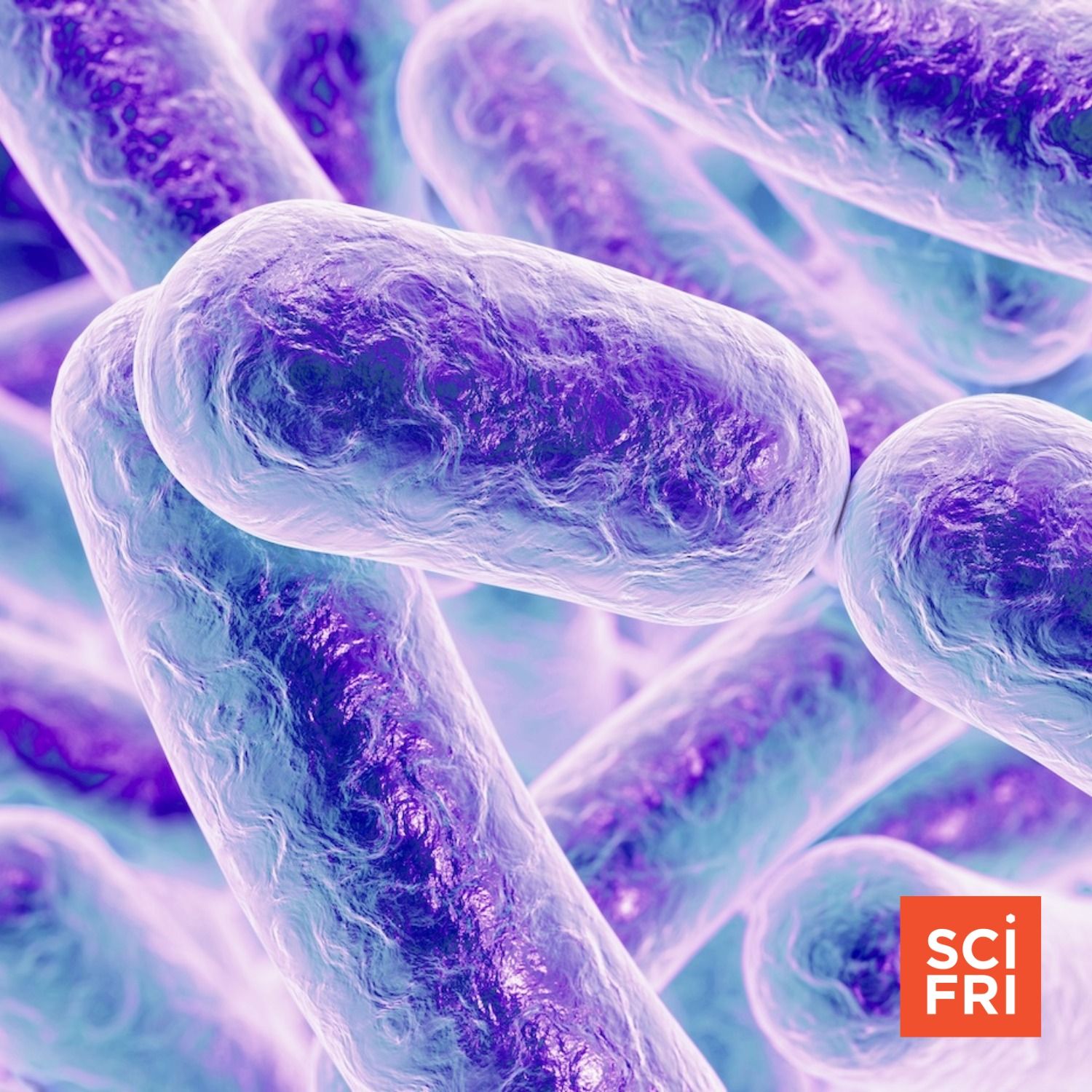
Dr. Bonnie Bassler, a microbiologist, explores the sophisticated communication and behaviors of bacteria. Bacteria communicate using chemical signals to count neighbors, differentiate between friend and foe, and make collective decisions. They exhibit group behaviors like sharing resources with kin and competing with rivals. Through quorum sensing, bacteria coordinate actions based on population density. Over billions of years, bacteria have evolved intricate communication systems. Research on bacterial communication has led to significant biomedical and industrial applications. Dr. Bassler's journey into studying bacteria began accidentally but sparked a deep appreciation for their simplicity and complexity, highlighting their vital role in advancing our understanding of biology and potential for practical applications.
Transcription
3976 Words, 22381 Characters
Hey, it's Flora Lichtman, you're listening to Science Friday.
On today's show, zooming in on the sophisticated secret societies living around and within
us.
They've been here for billions of years.
They do evolution on a much faster scale.
So they've had time to occupy every niche on the planet and to optimize.
As humans, I think it's tempting to imagine ourselves as the pinnacle of evolution.
I mean, we talk, we make art, we build cool and transformative things, and we've changed
the planet in profound ways.
But there are life forms that have been on this planet evolving a lot longer than us,
like way longer.
Bacteria go back billions of years.
What if they have come up with sophisticated playbooks that we just don't yet understand?
Did they have their own culture, their own language, their own complex societies that
were ignorant of, even though they're playing out right under and perhaps even in our noses?
Those are some of the questions my next guest has been looking into for more than 30 years.
Dr. Bonnie Bassler is a microbiologist and runs a lab at Princeton University.
She was awarded the National Medal of Science this year.
Bonnie, welcome to Science Friday.
Thanks, Flora.
I'm delighted to be here.
How did you think of that intro, Bonnie, about how much of what bacteria are doing do you
think we're unaware of?
I think a lot of what bacteria are doing we're unaware of.
We know a lot about the parts, the parts lists that make bacteria and other organisms, but
the behaviors, the sophisticated, magical, astounding things bacteria can do.
That's been the focus of a lot of work for the past few decades.
But in that realm, I think we're only beginning to understand the complexity.
What about language?
Is there an argument that bacteria have language?
Well, since that's my life's work, I would say yes.
And so of course, bacteria, right, so just to set the tone a little bit or set the stage
a little bit, of course, bacteria are microscopic.
They're single cells, right?
You can't see them with your eyes.
To see them, you need to look under a microscope, right?
So they don't have language the way you and I do.
They don't talk with words, but what the field has shown is that they actually communicate
with chemicals.
So they use chemicals as their words and they use those chemicals to count how many neighbors
are around, to take a census of who those neighbors are.
Are they friend?
Are they foe?
Are they relatives?
Are they not relatives?
And then they use the information, all of which is embedded in these molecules, to help
them make decisions based on whether they're alone or in groups and who's in the neighborhood.
How well do we understand how that chemical sensing works?
So we actually do understand a lot about that.
So this field is a very vibrant field.
The field is called quorum sensing, that the bacteria sense when they're in a quorum and
then they do things as groups.
And we understand some about what the molecules are.
We know some of the molecules.
We understand something about how they're detected.
We understand something about how the bacteria integrate the information and how they decode
the information that's embedded in these molecules.
And we know a lot about what they do when they're alone and when they're in groups.
I mean, that sounds like they're sending messages, but are they also conversing back and forth?
Does the relay go more than just one stop or two stops?
Right.
So it's not exactly a conversation.
Like, you ask me a question and I give you a different answer.
And then you interpret what I say and ask me the next question.
So far as we understand now, and of course, for sure, there's more to find out.
What we think that they're doing, the simple things they're doing is they're using molecules
that build up outside of the cells as the cells grow.
And so the molecules, the amount of molecules around the bacteria track with how many bacteria
are there.
So first they use it to count.
They say, am I alone or am I in a group?
Because they want to behave differently when they're alone and when they're in groups.
When they're alone, they carry out tasks that a single bacterium can accomplish, but they
don't bother to do tasks that it takes lots of bacteria acting together to make the tasks
successful unless they're in a group.
So the first thing they do is they say, am I alone or am I in a group?
And then they do tasks A, B, or C, or D, or F.
And those tasks become successful depending on how they get carried out.
And then the second, more sophisticated thing they do with those molecules, because there's
a blend of these molecular words, they ask, who is around me?
Is it my twin?
Is it my cousin?
Or is it the enemy?
And then they change the tasks that they carry out based on whether they're surrounded by
family and friends or the enemy.
So they share and they do nice group behaviors when they're surrounded by their siblings.
And then when they're in competitive environments, they try to kill the other guy or they try
to keep their goodies to themselves and they're not as available for sharing.
Give me an example of a behavior that they would do just with friends and family and
then a behavior they would do amongst foes.
So bacteria often consume solid food, so they need to take little bites out of it.
And so what they'll do is they will secrete enzymes outside of themselves that chew up
solids into small enough bits that a single bacteria can take those bits up.
But of course, if you put your enzyme out, it chews those bits up, the bits are floating
around and your neighbors can get them.
So those are called public goods.
Some solid substrate gets chewed up into all these bits and then everybody gets some of
the pie.
So that they will do with their friends and family because they're going to make an expensive
enzyme that they have to put out of themselves to chew up the solid food and then anybody
can get the products.
So you want to do that if you're surrounded by your family, it's like you're feeding your
family.
It's a group dinner, family style dinner.
Sunday dinner, yes.
We've all been there.
Yes, exactly.
Dig in.
So that's something, for example, public goods and sharing the effort of your work bacteria
will do when they're around their families.
But you don't want to share if it's your competitor that's eating up all the food.
So they typically won't do those kinds of behaviors like public good behaviors when they're
surrounded by foe.
And so in that case, they'll do other things like make poisons that they are immune to
and that kill off their competitors, right?
They put them out and then they try to outwit or get rid of their competitors.
And so those are all group behaviors, right?
But it matters who's in the neighborhood, which set of group behaviors get taken.
And are they sensing other bacteria?
Do they recognize viruses?
What do they know about who's around them?
Right.
And so that's actually the forefront of this field.
And so if I go back a little bit, we used to, in the beginning of this field, I should
just say it was astonishing 30 some years ago, or even more than that now, when it was discovered
that bacteria had the capacity for group behaviors.
It was always thought that bacteria were sort of asocial and dumb.
They divided in half and each bacterium did its own thing that they didn't have the sort
of genetic capacity to know there were others around.
And so in the beginning of this field, the first thing scientists thought was when they
realized there were molecules that these bacteria were releasing, the molecules were increasing
in proportion to cell number, and then the bacteria would do behaviors as a group.
The first thing we thought is that they know that they're around their siblings.
Then after that, we realized there's more than one molecule in this language.
Then there was a molecule that was for the cousins.
So first there was the species, then there was the genera, the family, and then there
was an interspecies molecule so they could talk across species boundaries.
And now what we've learned, and this is only in the last few years, is that they can actually
detect if they're in a host, so they can detect molecules made by human gut cells.
They can detect, for example, if they're in your digestive system.
And then also bacteria, just like we are, bombarded by viruses.
Bacteria are also attacked by viruses all the time.
And so in fact, these viruses have evolved the capacity to listen into these bacterial
conversations.
They're eavesdroppers, and they can recognize when there's lots of bacteria around, and
that's a good time for the virus, the predator, to attack the bacteria.
So now we're thinking that these quorum-sensing conversations span all domains, from viruses
to bacteria, to eukaryotes, to mammalian cells, right?
And so the field is still in its infancy in a way, even though we do know a lot about
the molecules and how they detect them and how they decode information, I still think
-- well, I need a job -- and so I still think that these bacteria, they were only at the
beginning of understanding the complexity and the capacity of these chemical conversations.
Well, what I'm thinking is, like, these bacteria inside me know more about me than I know about
them.
No question.
Right?
But they've had a longer time, right?
So they've had billions of years, right, to evolve in the recent history, and they
have been evolving in collaboration or in competition with higher organisms, right?
But yeah, so they're tuned in to all of this information.
They're sort of like little computer chips, right, that they're taking in all kinds of
information, and then moment to moment to moment, they turn on and off genes, which lets them
turn on and off behaviors, and that's how they succeed.
And it's very similar to what we do.
It's sort of a stripped-down version of us.
Well, yeah, that's the thing.
I mean, I'm not to be all big-thinky here, but, you know, I think we feel like we have
a monopoly on decision-making.
Yeah, we think we're these rarefied, you know, special organisms on Earth, and I do think
I'm charming.
You are special, Bonnie.
Yes, thank you very much.
But anyway, but yeah, so the truth is that we evolved from bacteria.
Every organism evolved from bacteria.
They've been here for billions of years.
They do evolution on a much faster scale because they divide every 20 or 30 minutes than human
beings or higher organisms do.
So they've had time to occupy every niche on the planet and to optimize, right?
And this sort of logical decision-making that you're talking about, Flora, in a bacterium,
they don't have brains.
They don't have consciousness.
They don't have feelings, you know, like we do.
We are special, okay, in some way, but in the simplest sense of the biochemistry and
the genetics that goes on in any living organism, these decisions are very analogous to one
another.
You know, information comes in and then bacteria and we behave, right, in a way that, in the
case of the bacteria, that allows them to succeed.
We're going to take a quick break, but don't go away when we come back, how Bonnie got
into this field.
It started as simply a question about how can a bacterium be part of a group?
They seem to be too primitive and too stupid to be able to do that.
I mean, do you think that my anthropomorphizing questions are problematic?
Like, where do you fall on that idea?
No, I anthropomorphize everything because I think it's an easy way to understand it.
They are communicating.
They are knowing friend from foe, family.
You know, they're making decisions.
I think thinking about bacteria and their language, which we've talked about, is chemical.
It's not words, it's chemical, but the chemicals are the words, you know, and being able to
extract from those chemicals not only how many neighbors are around me, but who the
neighbors are, I think anthropomorphizing that is a good idea because it is the progenitor
of our language and our ability to know self from mother, friend from foe, and to make individual
decisions and group decisions, right?
And so I don't think that's a wrong way to think about it.
It's the foundation for our own behaviors.
They are the foundation for us, so yes, I think, okay, I'm brainwashed.
I do think it is the foundation for our own behaviors.
And then when we really think about like what these bacteria are trying to accomplish, right,
by deciding can they do something alone, can they do something in a group, you know, we
make those kinds of decisions all the time, you know, like the behaviors did build on
one another through evolution, so why not think about them, use similar words to describe
them as we do for, say, humans?
Yeah, we need to bacterium morphize ourselves or something.
Personally, how much are you driven by practical applications, like, you know, that cracking
bacterial communication could help fight diseases?
Well, so that is a big theme of my team's work.
I am a do-gooder at heart.
And like, you know, if I really confess to you, when I started this, that's not what
I thought.
This whole field started in an obscure but beautiful bioluminescent bacterium that what
it did as a group was turn on light.
And that made the invisible world of the bacteria visible to the scientists.
And it gave us something to track.
We could see that they only made light as a group.
And so my question back then was, how do they know to do that?
You know, how can they do that?
This is how bacteria get any bang for their buck.
They know when they're alone, they know when they're in groups, and they act accordingly.
But back then, there was no biomedical or industrial or ecological significance to the
work.
It was just the example that we had.
And what we thought back then was, like, we wanted to understand how does any collective
behavior work on Earth?
How can organisms carry out tasks in groups and accomplish things that they couldn't accomplish
as individuals?
And of course, for me, working on bacteria, they're very—not that anybody believes this
after this conversation—they are much simpler organisms, right?
They're fast growing.
You know, they're clones of each other.
You can have a surprise in the incubator every eight hours to do your studies, right?
And so that was super attractive to ask questions about collective behaviors, just as what we
would call a model system for group behaviors.
But then, lo and behold, what was discovered in these bioluminescent bacteria ended up
being discovered in tens of thousands of kinds of bacteria, including pathogens, including
industrially relevant bacteria.
And we now know that being able to act in groups is critical for bacteria to be pathogens.
It's critical for them to do what they do in the environment.
It's critical for them when they clean up, you know, oil spills and pollution.
And so, you know, we kind of pat ourselves on the shoulder for, "Oh, weren't we smart
to be working on this glow-in-the-dark bacteria?"
Because it led the way to all these fantastic, fantastic biomedical and industrial applications.
And so now, I'm very into that, very, because I do want this all to matter, you know, more
than just in an academic sense.
Like now I realize, like it started as simply a question about how can a bacterium be part
of a group?
They seem to be too primitive and too stupid to be able to do that.
And it did, over many decades and many labs, change to this very, I hope, important biomedical
industrial question.
But I didn't know that at the beginning, you know.
But of course, again, that's what a scientist does.
The science takes us on this adventure.
You know, we started on this adventure, and then we're like, "Hey, these pathogens need
this to be pathogens.
Could we make bacteria that can't talk or can't hear, and those could be new medicines?
Could we beef up the chitchat in bacteria that are beneficial and help make the world
or make us healthier?"
You know, that is what scientists do, even if that wasn't the original theme that started
it all.
We're always looking for applications, right, for humanity or for the Earth.
And so I think we did always dream it would be bigger than that one bioluminescent bacterium,
but it took a while to get there.
Well, how did you get into this field?
I mean, did you set out to study bacteria?
No, that was by accident.
So my shaggy dog, checkered past, I went to college to be a vet.
So I always loved nature.
I loved animals.
You have to remember I'm old, right?
And so when I was young, I'd never met a scientist and girls didn't really become doctors, and
I loved these animals.
So my parents were always like, "You want to be a vet.
You want to be a vet.
You want to be a vet."
So I thought, "Oh, I want to be a vet.
I want to be a vet."
Right?
And so I went to college to be a veterinarian.
I only lasted a couple of weeks because there was a lot of blood and gore involved.
And I was like, "Oh, shoot.
I like live animals.
I don't want to cut them open.
I don't want to see them."
And so anyway, the real truth is I was completely lost right after I got to college, but there
was a bulletin board.
I liked biology classes.
I liked chemistry classes, and there was a bulletin board that had professors that would
let you work in a lab.
And so I thought, "I wonder what that's like."
And so I literally went to this lab, and the professor had a bacteria project and a cancer
project.
And so I thought, "Oh, I was 19 years old.
I'll cure cancer."
Right?
Sure.
Yeah.
Do something important, as you've sort of been discussing with me.
So I went to the lab, and he put me on the bacteria project, and I'm like, "Oh no.
This is the stupid project.
He's putting me on this.
This is a test."
And if I try hard, and I'm earnest, maybe then he'll move me to the important project.
Well, Flora, it's a few years later, and here I am, because I just fell in love with bacteria
as model systems to study things that are about human biology, right?
And about biology in general, right?
I really liked in some way this simplicity and the complexity, right?
And I don't know if that makes sense.
I hope that makes sense in the context of what we're talking about.
They are simple organisms.
They're single cells.
They don't have brains.
They don't have all these complex behaviors, but they have behaviors that are complex enough
to have captured my attention.
They do a lot with a little.
Yeah, exactly.
They have no fluff, right?
They are like, in some way, they're kind of perfect, each of them for their own niche.
And bacteria have been model systems.
I mean, that's how we know about DNA, RNA, and proteins, you know, and the molecular
biology revolution, it all came from bacteria and viruses.
And so the truth is, they're not solved yet, right?
And so it was thought sort of that the bacteria gave us the parts list.
Like I just said, DNA, RNA, proteins, and that higher organisms were going to give us
all the cool stuff, behaviors, appendages, body parts, development.
So there was sort of a point when bacteria were a little bit out of vogue.
That turned out to be right when I was starting my career.
Because it was thought that the good secrets that bacteria possessed had already been found.
But lo and behold, scientists kept at it, you know, those of us who loved bacteria.
And then we found out that beyond giving us the amazing parts list, right, of the parts
that make a living organism, they do have all these behaviors, the one we're talking
about, communication, collective behaviors, right?
They have body plants, you know, they put the right things in the right places, just like
you have arms, legs, head, you know, in the right place at the right time.
Bacteria, it turns out, they were just so small, you couldn't see that back then, you
know, and they do all of these terrible and magical things.
So I think, for me, they've given me, you know, a way to study those kinds of biological
questions but in this simple system.
That's a long answer for me wanting to be a vet, yeah.
Before we let you go, what is your top burning bacterial question?
Like what is the thing that you want to know above all else before you leave this mortal
coil?
Yeah.
So my gang, you know, discovered that bacteria talk, they showed that they're multilingual,
right?
They've showed that viruses eavesdrop, they showed that they can, that eukaryotic cells,
higher organisms are part of this conversation.
What we'd love to do, like the horizon for us now is to actually sort of come out of
the test tube, you know, with a single species of bacteria or a single virus and really gin
up somehow scenarios that are more authentic, like many species of bacteria together with
viruses, with higher organisms, you know, in space and time, not all shaken around in
a perfect environment because if we're really going to make applications, like either turn
on chit chat when we want or stop harmful bacteria from talking, it's not going to get
done in a test tube shaken around in a perfect environment in Princeton, New Jersey, right?
You know, we have to be able to learn enough about this, how this works in the real world
that we could safely and reliably and successfully manipulate it if we want to make applications.
And so going back to the first thing you said for us, it's all about complexity and trying
to think up ever more complex environments or scenarios to see how could this quorum
sensing and bacterial communication and group behaviors ever work outside of a test tube
in a lab.
It does, we know it does, right?
But yeah, that's our, I think that's our next 10 years.
I can't wait to have you back to talk about it.
Well, that would be a delight and I can't wait for that, I hope it's not 10 years.
Thanks Bonnie.
Thank you.
Dr. Bonnie Bassler is a professor of molecular microbiology at Princeton University in New
Jersey.
Today's episode was produced by Kathleen Davis and Shoshana Bucksbaum.
I'm Flora Lichtman, thanks for listening.
Podcast Summary
Key Points:
Dr. Bonnie Bassler studies bacterial communication and behaviors.
Bacteria communicate using chemical signals for counting neighbors and making decisions.
Bacteria exhibit group behaviors such as sharing resources with kin and competing with foes.
Quorum sensing allows bacteria to act collectively in response to population density.
Bacteria have evolved complex communication systems over billions of years.
Research on bacterial communication has led to biomedical and industrial applications.
Dr. Bassler's accidental entry into studying bacteria led to a lifelong fascination with their simplicity and complexity.
Summary:
Dr. Bonnie Bassler, a microbiologist, explores the sophisticated communication and behaviors of bacteria. Bacteria communicate using chemical signals to count neighbors, differentiate between friend and foe, and make collective decisions.
They exhibit group behaviors like sharing resources with kin and competing with rivals. Through quorum sensing, bacteria coordinate actions based on population density. Over billions of years, bacteria have evolved intricate communication systems.
Research on bacterial communication has led to significant biomedical and industrial applications. Dr. Bassler's journey into studying bacteria began accidentally but sparked a deep appreciation for their simplicity and complexity, highlighting their vital role in advancing our understanding of biology and potential for practical applications.
FAQs
Bacteria share public goods like enzymes with friends and family, but make poisons to kill competitors. They adjust their behaviors based on who is around them.
Bacteria communicate using chemicals as words. They use these chemical signals to count neighbors, distinguish friend from foe, and make decisions individually or as a group.
Quorum sensing is how bacteria sense when they are in a group and coordinate behaviors. They use molecules to detect group size and composition, influencing their actions.
Bacteria divide rapidly every 20-30 minutes, allowing for quick adaptation and evolution. This fast pace enables them to occupy various niches and optimize their survival strategies.
Studying bacterial communication can offer insights into fighting diseases and finding biomedical applications. Understanding how bacteria interact in groups can lead to new treatments and technologies.
Chat with AI
Loading...
Pro features
Go deeper with this episode
Unlock creator-grade tools that turn any transcript into show notes and subtitle files.
 PodcastTranscript AI