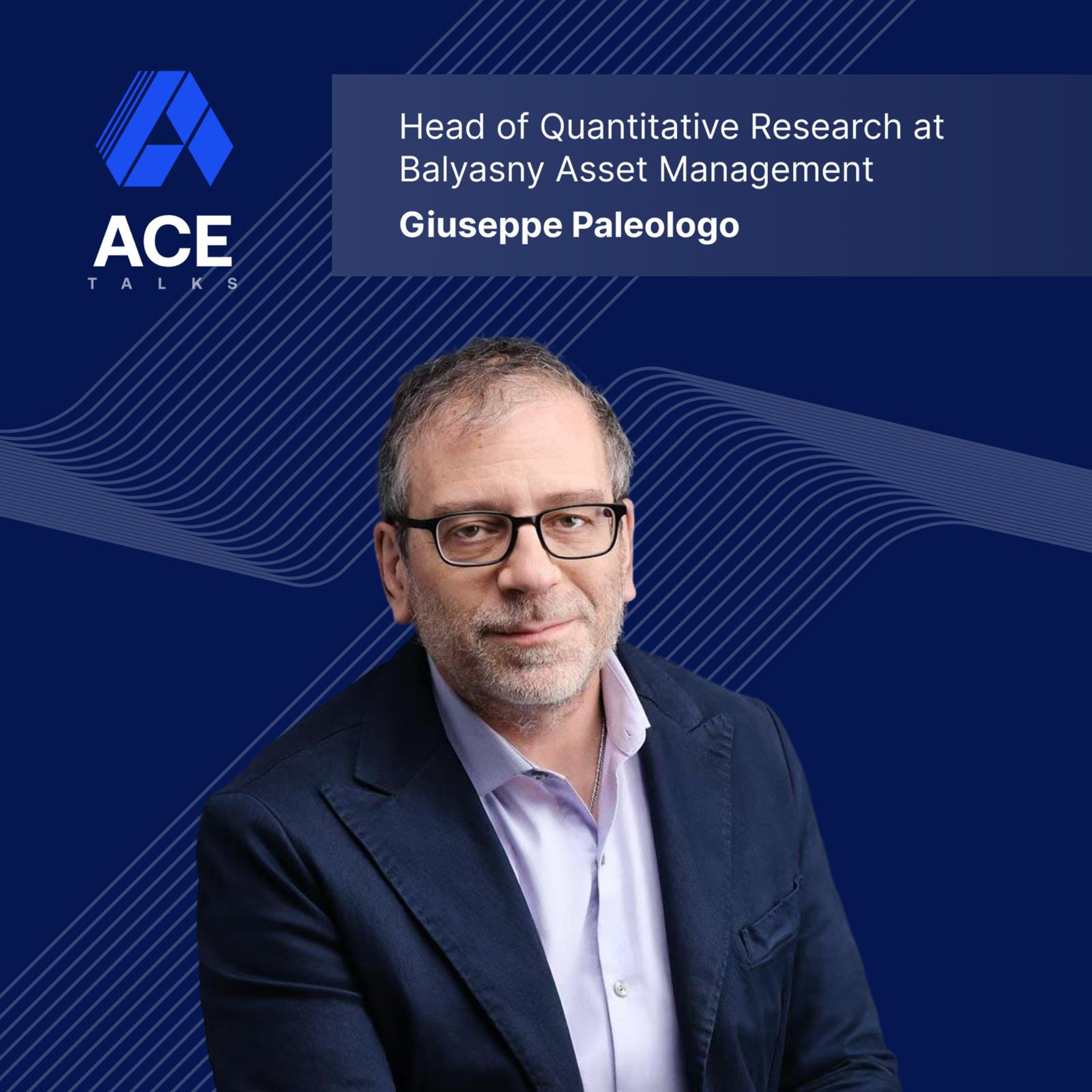
How Did I Get Here? Talking Quant Finance with Giuseppe Paleologo
from ACE Talks
61m 50s
Giuseppe "Gappy" Paliologo, a physicist-turned-quant, joined Balyasni Asset Management in 2024 after careers at IBM Research and major quantitative finance firms. He entered the field in 2009, following the Great Financial Crisis, drawn by boredom, the appeal of being an insider, and financial needs. However, he emphasizes that while compensation initially attracts many, long-term satisfaction comes from intellectual challenge and the industry's ever-evolving problems. Gappy advises students not to over-plan their careers, as success often arises from unexpected paths; genuine passion and adaptability outweigh perfect credentials. He outlines key buy-side roles—alpha research, portfolio management, execution research, risk management, and quantitative research—each with distinct focuses. In hiring, he values intelligence, creativity, humility, and communication over elite math competition wins, noting that strong fundamentals in linear algebra, probability, and stochastic calculus are critical. To enter the field, he recommends deep learning of core concepts rather than rushing into internships, and stresses the importance of being able to translate problems into appropriate techniques. Ultimately, Gappy sees quantitative finance as a field where curiosity and resilience matter most.
Thank you for joining me today for the first episode of the ACE Talks podcast. Today I'm joined by Giuseppe Paliologo, also short Gappy. He started his career out by studying physics and applied math in Italy and the US. After which he joined IBM Research, we worked for six years. Then he joined the quantitative finance industry in 2009. He basically worked at every big name brand quantitative shop that you know. And he joined Balyasni asset management in 2024 as the global head of quantitative research. And for those of you who don't know Balyasni or have not heard of them, they're one of the biggest multi-strategy hedge funds in the world. I also want to mention that Gappy has written two books and has engaged extensively with the community of students and practitioners alike. So if you think that the conversation today is interesting and you kind of yearn for more, there's definitely some material out there that might be interesting to you. And with that, thank you for joining me today Gappy. Hi Sam, thank you for having me. I already told the audience a little bit about your background, but you joined the industry after the first wave of physicists in the 80s and 90s that pioneer the quantitative finance industry. He joined right after the financial crisis, but a little bit before the flash crash that shaped the public opinion of quantitative finance. And one thing that we can say for certain is that the industry wasn't as popular as it is today, certainly among students. What was the draw of the industry at that point? I moved from semi-academia to finance in 2009. So as a way of background, I studied physics in Rome, so that's a kind of at the time was a master's level degree. You would do a thesis and then you would go straight into a PhD. Then I decided not to stay in physics, so worked a bit, did a PhD at Stanford, and then I moved to IBM Research. But it's still actually a bit longer, it's still about nine years in the math department that no longer exists. And this is actually one of the reasons why I and other people from IBM Research moved to either academia or to finance or to Google and Yahoo at the time. So as you all know, probably IBM Research was for the longest time a monopolist in tech. A few people know that in 1980 IBM was 80% of the market capitalization of the whole technology sector. And it was the biggest market cap firm in the world. And in 92, IBM had a major crisis, they laid off 40% of the workforce. IBM Research wasn't touched and I joined actually after 92. But in a sense, the seeds of IBM Future were seeded then. Like IBM stopped being the powerhouse that it used to be. By the mid 2000s, it was clear that research was not pure research any longer and researcher were spending some time doing consulting technical jobs for IBM's clients, which is perfectly fine, including some finance. And I did a bit of that. And at some point, I decided that it would not make too much sense to keep doing this as an outside or in a sense from IBM, from within IBM. So there were really two reasons for me wanting to move, maybe three. The first one is maybe a little bit of a boredom, which is fortunately a feature of my personality. I tend to get bored. Second one, I did want to be an insider and not an outsider when doing things. I went to IBM because it was actually a very good research place to do what I wanted to do. If I wanted to do something else, it made sense to do it in a place that was focused on that. The third one is a very practical concern. I was in my early 40s. I had a young family and New York is an expensive city. And there was the prospect of making more money. So why not? The career of the Quant career was at the time already actually quite well established. So in a way, things have changed a little bit since then, but not because the Quant path has been as changed. It has been in a sense, as consolidated over time. It has become more technical, more specialized. There are masters. There are feeding schools. The hiring process from the firms has become much more efficient, systematic, selective. So that has changed. But in a way, I joined the finance industry at the world's possible time. Because you could argue that the Quant career in finance started probably in the early 70s. Quantity-define and started a little earlier, you could say, with Markowitz and Sharpen Delayk. But Quantity-define and in industry studied, I think, in the 70s. And it kept growing until the Great Financial Crisis. And that was a major discontinuity point in terms of problems, techniques, growth. And so I joined during the aftermath of the Great Financial Crisis. But these are the motivations for me. I was interesting in the math, but we can talk about this later. But it's not the math in itself that interested me in finance. What's the problems? Yeah, we'll be for sure talking about more technical topics towards the end. But what is the actual motivator that kept you in finance long-term? And what do you think is the reason for most people to stay in that field of work? I always tell students whenever I admit them that if you're honest with yourself, typically you want to do finance primarily for the compensation. But you stay for something else. The people who want to get rich typically tend to be dissatisfied all the time. And they always feel underpaid. And when you have a pay problem, typically the problem is lies elsewhere, not only in finance. So the reason to stay in quantity of finance is that it's just interesting. There are always new problems. Almost nothing works out of the box. So that's good. That's a good thing, I think. It's a very miserable thing, but it's also a very good thing. And so you stay for other reasons for sure. Makes sense, it's kind of the intellectual curiosity behind it. One thing that you already mentioned, you are talking to students a lot. And it's something that I am asking myself sometimes. Do you think that students are worrying too early or too much about their career in university? I see, yeah, I get this question a lot. And I do not have a really great answer. I think so, first of all, I would say there is a lot of variation within the industry. Okay, so the most important thing is to say is there is a lot of variation. So I think that if you want to work for the likes of proc trading firms, there is definitely sort of a conveyor belt. And it's a relatively narrow path. Okay, and it's a very selective path. And you've got to go to good schools, you've got to be involved in some kind of finance activity in college. It used to be that you have to be a good programmer. I think that you still need to be a good programmer. That's I think not going to go away. But the modes of programming will change. You need to be good at quantitative stuff. And people get in. It's a very selective thing, but everything is selective in a sense. Exposed, everything seems extremely selective. You look at your life. And you think whatever whatever you have done is always how did I get here? Like in the you know, the talking heads song once in a lifetime. How did I get here? You know, this is not my wife. This is not my job. I think so. Exposed everything seems extremely improbable. It's one path out of a billion. But in reality, things are complicated. So maybe
you don't get into HFT right out of college, but you will get after two years working at a bank. You know, the head of the I-Frequency, the I-Frequency Algo Group in HFT worked for a couple of years at Goldman, if I'm not mistaken, Parker, correct me, correct me if I'm wrong, but doing mortgages, you know, modeling of mortgages. Pretty different from high-frequency training. And I work forever in research, but I know all sorts of people doing all sorts of crazy things. The same thing happens in fundamental investing, by the way. I don't know of almost a single person of the good ones who started in the right place. On the other side, I know a lot of people who did all the right things went to the right high schools, to the right colleges, did the right analyst programs in the banks, became fundamental analysts and then went nowhere. So in the long run, I would say this, right, are people worrying too much? I think the people are worrying too much in general. This is a broad, very aviuncular statement said by an old man to the young people this days. You guys worry just too much. You know, life is an adventure, so don't try to over-control it. But aside from this, from this aspect, very generic, it's a fact that things do happen in very unforeseeable ways. So I would encourage people not to do things because their parents want to or just because of financial considerations because in the long run it's not going to make you really happy. So yeah, the competition seems daunting though. I would acknowledge this. Getting a job in a competitive firm, in a good firm is difficult. Getting promoted within a competitive firm is also difficult and so on. But still somebody gets promoted and that's okay. So since this is our first episode, most of the people listening do not have as much exposure to the quantitative finance industry. As practitioners or other students you might encounter. So I did want to ask one question a little bit more about fundamentals. What are the basic roles in quantitative finance that you generally distinguish and the main ones you should know about if you start to get interested? Yes, that's an important question and it's something that people can educate themselves about before getting their first job and I will try to map it a little bit. Okay, somewhat incompletely but first of all there is a very big difference between by-side firms and cell-side firms. On the cell side, these typically at this point are the banks, the banks, the trusts like, you know, state street or bony, back of New York, northern trusts. Okay. It used to be the cool place to work, especially banks. So I won't speak too much to the cell-side because it's a little bit less interesting and I don't know it firsthand. So I'll talk more about the hedge funds, the pro-trading firms, to some extent the institutional asset managers. Now there are so many different jobs and people start and get assigned to something that they don't even know what they're going to do and that's perfectly fine and you can change during your career by the way. Okay, so that's important to say but you can work in a number of areas. So you can work in alpha research, everybody wants to work in alpha research because it seems the most glamorous job. It's not all that it's purported to be. You can work in general portfolio management, portfolio construction which is the area of investing that deals with in a way monetizing the alpha. There is still a broad separation of concerns. If you go down one level, portfolio management, managers, portfolio management determines what to trade if you want a democratic level, the sense of current orders and then there is one level down, there is execution, an execution research which is a mix of technology and applied math and modeling that deals with the micro structure of executing orders and there are many interesting problems in execution research. Then there is risk management which can be very quantitative. Risk management is probably the only area that comes to my mind where being older is positive. Okay, for many reasons, it means that you have survived, it means that you have first hand experience and that's the most important thing that you can have in finance is the baggage of your entire experience. It's quantitative, it's philosophical in a way, it's very strategic. Young people tend to dismiss it but it's actually very very important. Probably the zero is the second most important person in any firm or maybe sometimes the most important person. There is the role of QR, quantitative research. For example, in my team there is a bit of a mix of people. There are people who do factor models. These are models of returns that are used pretty much everywhere on the by side. There are people who do custom factors. These contain some return premium. There are people who do manage books, both hedging and alpha. And there are people who do portfolio advisory which means that they work with fundamental portfolio managers to make their process more rigorous. There is a lot of quantitative finance that goes into discretionary finance. A lot of people in finance do very broad quantitative research apply to the domain that they work on. Equities, commodities, and the like. They don't necessarily do alpha. Alpha in a sense is a very casual term but they produce the volume of information and eventually gets monetized. And so yes, these are the roles. But I already there are quite a few. They're not quite 10 but we're getting close. Yeah, there is some pretty good insights. You know, for somebody opening up a career website and might help them differentiate a little bit between the different roles. Now to get a little bit more into some actionable things for students, I want to talk about the hiring process and what you look for in an ideal candidate. And I think first of all, there's probably an ideal candidate we all can imagine. If you have won a couple of international math Olympiads and have done some internships and have good grades at a good university, then you're pretty likely to get a job. But obviously, that's not really applicable to most of us as students. And so the first question to start off in, you know, what is the main entry point for students into the industry? Is it still internships or other different touch points that are best for students? Okay, I'm sorry Sam, I have to go to a premise that you made because it's kind of okay. So first of all, and I'm probably, okay, probably I'm hiring people for a slightly different role than let's say an algorithm in a high frequency trading firm, right? So there are slightly different targets here. But to me, having an IMO model is a neither good nor bad. It's a very non-informative metric. Doing everything right in your life is definitely not a good thing, at least from my perspective. Okay, because you know what it tells me? It tells me that basically a 22-year-old who has always done the right thing is not a person who's questioning assumptions. I'd like to have people, so how do I select people? So what's the important thing to have in a person? You want somebody who is productive, so if you want us the IMO side of things, you know, you want the little genius who's coding perfectly, I know lots of outstanding coders in places where it worked. Okay, and that's great, you know, but I don't want outstanding coders, I want intelligent people. It's a very different thing, you know, as a matter of fact, probably being an outstanding coder is not that much the grade of a competitive advantage nowadays. So you want somebody who is intelligent and creative and passionate, and that's not somebody who a 22 has done all directing because he was basically
told to go for a job that pays well. OK, now, this is my personal take. I wouldn't even generalize to Baliansni. It's also important to have people who have throughput, right? People who know what to do when it boils down to writing a good piece of code. And it's become a little bit harder to determine. But I think that it's still not that hard to find out. And so, yes, we do look for people who have good quantitative training. We also want to have people who have good translation capabilities, right? Not just apply a technique to a problem, but to find the right technique for the problem. These are very different things. But I've been said that, yes, if you want to know, but you know what's the easiest way to or the master road to get. The Royal Road to Get a Job at a Propagating firm. That's definitely a beautiful message. I think oftentimes people stress maybe a little bit too much. It goes back to the question we had earlier. Obviously, you have interviewed a ton of different candidates. And you already just mentioned that there is something more than the perfect CV that you're looking for. So in these conversations that you have with candidates and potentially successful ones, what is something that you realize that makes you think this person might do very well in the space? Pairing people is very difficult. So I have interviewed a lot of candidates. I typically interview three or four candidates every week. And then I have to think about them and write something. So there is a lot of times spent thinking about this. In general, you look for people who are truly passionate. OK, you want people who are truly passionate, people who meet some standard of knowledge, right? And not necessarily math elites or people who in a Putnam competition. I have never hired somebody who won an Intel price or one of these research prices. Those would be more interesting to me in a sense. Because I know that what they did was to conduct research, not solving a problem and somebody gave you. It's a very different type of skill. A certain lack of anchoring bias is very useful in quantitative research and investment in general. So what does it mean? You can live with a mathematics problem for a lifetime. Famously, Andrew Wiles discovered Sir Matt's theorem in elementary school and solved it in his late 40s, I think, of 50s. You can live with that for four decades. And in a way, you can still live with the finance problems for decades, but you really have to be quick realizing that something doesn't work. And to let go of problems that don't work, accepting failure and being adaptable is very, very important. It's a mixture of humility and insight. So that kind of flexibility is a positive to me. Right? In general, whenever I interview somebody, I also ask them, what is the quality that you look for in the people that you yourself hire? And I get almost always the same answers that I'm giving you, intellectual curiosity, adaptability, humility, ability to let go. Right? Everybody is sufficiently smart in this industry. So that's not going to be the determining factor. And I would say that paradoxically, in the quant space, having good communication abilities is at a premium. It's good to be able to talk to people. It's good to relate to people. That totally makes a lot of sense. To close this chapter, one thing that might be interesting for the audience, obviously, we're now all incredibly interested in quantitative finance and definitely want to work in the industry. What's something to dip your toes in the space? So obviously not everybody is going to get an internship tomorrow. But what is a way to get to learn more about the actual concepts that you need is a way to approach it that you would recommend. So these are all difficult questions, because I am not a director of a master's program or the like. So it's a funny thing that I am discussing teaching again a course of quantitative finance sometime later this year or next year at Columbia University. So I'm thinking about this a lot with the potential culture. And at the very basic level, I just can't emphasize enough that people need to be very fluent in basic concepts. So knowing very well the linear algebra is surprisingly difficult. Many people stick to superficial things, right? But linear algebra, real analysis, some ODE is, some PD is, optimization, the ability to know stochastic calculus, probability, finally enough I will think about probability recently. I have not really used measure theoretic probability much in my finance career. But I still think it's important to have studied it because it's fundamentally for many engineers or physicists is one of the main beach heads into pure mathematics. So it changes the way you think. In practice, you will not use it, but it's useful. It opens your mind a little bit. So this is on the technique side. This is like to me the bare minimum. And I think that it's important to practice this stuff a little bit every day or every week. As a student, you think, oh, this is obvious. I know this stuff so well, right? But believe me, once you start working, it becomes a real commitment to practice your integrals, the way that you practice your kettlebells. But you have to do it. And I honestly think that now it's a matter of very fine. So now I spend a lot of time reading the math that basically codex produces for me. There are mistakes. There are things that don't make sense. This kind of literacy is very important. OK, the second thing that I would recommend to students is to also very much think about every problem in life as an opportunity to apply math. So the most important thing is the modeling aspect. It's not a technique aspect. You have your tools. But then the interesting part is to apply it to everything. And a lot of interesting math this past century comes from simple toy models. So I have several books. Actually, I see them from my current position on my bookshelves on mathematical modeling. One that is pretty good is called the Model thinker, which is very accessible. But there is another book by Gershonfield, the nature of mathematical modeling, Bender and interaction to mathematical modeling. Thinking about everything in life-- not really everything, but a lot of things in life as an opportunity to create models is good. It's cool. It's fun. And it's a lot of what we do in finance. It is a little problem. And I am not solving it with the latest algebraic geometry advance. I am solving it with applying a relatively simple tool, a wrench, a screwdriver, and making something that works. One thing that is of personal interest to me, is that you were thinking about teaching another course. And I know that you have taught courses in the past. Usually, the first lecture is at least that my university spent by professors going over a problem that motivates the rest of the material in the course. Is there a specific thing that you open up a quantitative finance course with? The one that I would present, if you ask me, OK, go to the whiteboard, the blackboard, and try to motivate an audience. I think that probably the simplest and easiest, apparently easiest question, but it's not a close problem. Is, well, I'm going to give you a set of answers.
I give you a set of expected returns and now you want to actually over time and you actually want to make money out of it. Okay, many people stop to stop at I.F.D. alphas. Maybe paradoxically I think that having the alphas is not necessarily the most interesting problem. I mean it's a very interesting problem, but alphas do exist and sometimes are pretty good qualities. But I have this vector and I have vectors over time. I have some kind of investable universe. Go and make me some money. How do you do it? And you'll be surprised of how differently people approach the problem and how different the performance in real life can be massively. So it's a very concrete problem. You can solve it and start training your PA, your personal account. I would start with that probably. Okay, everybody can relate to that. That is beautiful. Yeah. Now let's get a little bit more into the technical questions. You already mentioned this, but it's kind of central to all finance, the idea of alpha. Right? So is there an intuitive way to think about alpha from your view as a practitioner? So practitioners mention alpha a little bit indistinctively. So there is no concept of alpha as the regression intercept when you perform an arbitrage. An arbitrage works very differently. It's oftentimes a violation of a law of one price that you can take advantage of. Right? So basically I can I find two different products that are effectively the same, but they are selling at different prices. And the role of the arbitrage is to take advantage of these structural differences by trading them, the narrowest differences and make the markets more efficient. So this is definitely one large advantage of, and this is sometimes called alpha, but you know, of trading. The so-called I think Jensen's alpha, it's I think the Jensen who no longer go diet past the way, it's more related to the fact that effectively the alpha is a sort of unpriced return that you receive in a given portfolio, in a synthetic asset, in whatever you want. Right? So there is some return that is proportional to the return of another asset way back, it was the market, but then the perspective has extended to multiple sources of returns, sometimes visible, sometimes invisible, latent. And then there is whatever is left in the expected returns that does not come move with these so-called factors. And if it exists, it's a beautiful thing because effectively it's equivalent in some regime to having an arbitrage. If I have alpha in enough products, in enough assets, this is return that doesn't move with other returns, it's kind of a riskless return. And I can isolate it and I can make a portfolio that has very, very high sharp. So of course this is a bit of an abstraction, but to some extent there is some truth to that because it so happens that some strategies do have very high sharp. And they're not necessarily trading market imperfections in the way that an arbitrage strategy does. So that would be the idea of alpha. And nobody, nowhere I think in life, anybody has run a regression, looked at the intercept, say, "Oh, this is the alpha and now I'm trading it." It would be very beautiful, but that's not how we do things. For sure. I think it's the naive approach or maybe know how it first gets introduced in university or skill. If you're viewing it from that perspective, more esoteric numbers is a lot more valuable, at least if you're just starting out. And maybe following that natural approach, if you then consider trying to find the beta that the clients would be willing to pay for, you would continue the idea and find different factors that correlate with returns and most commonly value, momentum and size. Usually you arrive at the idea of this factor research, you build a factor model and give some values that a company incorporates that somehow seem to dictate returns. Can you introduce just in the way that you just spoke about alpha? How do you think about factor models? Yeah. So I would try to convey the way probably wrong that I see you can make money in markets. I think that there are really not that many ways. We can then discuss the sub classes. How do you make money in this particular way of making money? But fundamentally, I think that there are three. The first one is what I discussed is this arbitrage trade, the violations of the law of one price. We discussed this. What it boils down to is I have to ask that this should be the same but they're not. And so make money on that. Great. Imagine that these are typically relatively small capacity trades, but if you make enough of them, you can become very rich. Then take a little bit of a step back and have a lower resolution. These trades typically are very specific. They're very microstructural in nature. Take a step like upright. Fly a little bit higher. And now two assets, two, for example, two share classes, they look pretty much the same for practical purposes. I have to trade in larger amounts. I really don't see the difference for these small spreads. To me, that's one thing. Okay, great. Now, I model the returns of these securities without caring too much about arbitrage. How do I make money? Well, one is through risk premium, exactly what you're discussing. I identify broad portfolios. I pay a price in terms of risk for holding these portfolios, but I will make some more money. And then I can combine these portfolios with other portfolios to have even more attractive returns. Okay, this is risk premium. That's the second class. At the third class is informational. That's alpha. So this is the broad classification. Now, when it comes to factor premium, I just want to say something. There are the factor premium that you learn in school and the factor premium that you do at work. So the factor premium that you learn in school are sometimes there, sometimes not. They're marginal. We can discuss, right? But this is the bread and butter of institutional asset managers. What a quantitative investment strategy does is not necessarily that different. It's just that going back to the definition of beta that you know and beta that you don't know, they explore different betas. But they are somewhat betas. They still carry a risk. Almost nothing is a pure arbitrage. Even arbitrage is run a risk. It's not nothing is a pure arbitrage. But these signals that a one strategy trades are quite pervasive. So they apply to a large cross-section of the investment universe. And they do have characteristics of a factor. But they are not the factors that you read in the literature. Yeah, you wouldn't give the golden cow away probably. You know, you can teach a little bit the methods of how to do it to some extent. But even the methods require a lot of detail finessing. But definitely not. Oh, look at this data. Makes sense. Yeah, I kind of get the feeling sometimes that, you know, looking at all the papers on factor research and there are a ton of them out there. It feels almost like the space is solved because the factors get more obscure and you maybe start with a momentum factor and then you break that momentum factor down on every time horizon to squeeze out some statistically relevant thing. But a quick follow-up question on that. Why is there that divergence in academia? Why is it accepted to publish these factors in an academic paper where we would
not accepted in a practitioner's setting. OK, so I think that there are a few things that play. So the first one is incentives. Yes, academics have different incentives that practitioners. And therefore, there is no incentive to publish a negative result, for example. Nobody will publish it, actually. So that's a problem number one. A problem number two is the reason organizational conundrum, even if finance professors had tenure from day one. How do they know what the problems are? Well, the only way to know where the problems are is you join a hedge fund or you join a property firm. And I do get pretty regularly questions of portfolio managers, sorry, professors, who would love to consult for me. And smart ones. And I tell them, if you're interested in joining my group, we can discuss, but you have to leave your tenure position. And that's typically where the conversation ends. And unfortunately, you have to be an insider. You can't do this job from the outside. And yes, I think these are very fundamental problems. This is not to discount at all. I want to say the deep value that the academia brings to finance. So for example, many transformative ideas in finance came from academics. The idea of a passive investing really wasn't a practitioner's view. And that's some also. You could argue. You could argue that maybe options, maybe, but maybe not, originating academia. I think that the originated actually elsewhere. But academia made them a thing. And so many things. There is value. Yeah. I don't want to paint over the differentiation. You just laid out in the question before this. With the different ways to make money and quantitative finance. I don't want to use the broad brush, but looking at all of these different methods in ideal world where you would have perfect data, an infinitely strong computer, and enough time to create every model that you would ever want to. You would hope you can predict every price in the market. But obviously, that's not the truth. What is the aspect that is currently stopping us from reaching such a point? Can you point to a specific thing where people get stuck? Or is it more of-- So-- Yes, yes. OK. Let me spound on this topic. Like, these are the things that you talk to people at dinner after you've drunk enough. But OK, there is no objective reality in finance. So this is a little bit the windbag part of the cover. But I really do believe there is no-- there are no future prices. There is no such thing. Prices are not determined by God. They are determined by agents. And these agents interact with each other in a very game theoretic messy way, no rational, or with some bounded rationality. So if everybody knew the prices of tomorrow, the prices of tomorrow would be different. OK, because everybody would say buy at the same time, and the prices would appear. So there is absolutely-- And when it comes to using game theory in finance, you can do it a little bit in a very non-driggerous way. You can think about repeated games, especially strategies that are so called crowded and with a small number of large participants. But even if you have four participants, and you have all the parameters of strategy determined, it's still not clear what is the perfect strategy, the right strategy, the winning strategy. Because the games are very, very complicated, and game theory does not have much to say in close form on sufficiently complex games, or even relatively simple games, which is interesting. So if we had all the computational power in the world, and all the data in the world, we could probably predict whether, but I don't think we could predict markets. OK. And that's interesting to me. And even if we could predict markets, it still would be a very interesting problem to have, because there is still a large diversity of preferences in the participants. So you can still arbitrage or take advantage or manage the heterogeneity of preferences in the industry. So this is to say AI is great. Everybody loves AI. I use AI for everything. But it's going to make-- it paradoxically could make the markets even more complicated. Yeah. Makes sense. It's kind of like if you were to have a fortune tether, and the person could tell what happens in the next 10 years, people would start to try to mess with the future as much as possible. And if possible, they would change it even more than it probably would have changed otherwise. OK. Can I interject for a second? Because there is a beautiful short story, a beautiful short story by Horgel-Wisborgas, whom I think he learned is not original to him. I think actually-- no, sorry. The story comes from Cocktoe and Borges' recounts the story. But Cocktoe copies it from some Persian literature. So you know the story probably. But it's the story of a courtess and who goes to the king and says, oh, my king, please, give me the fastest horse. Because I saw death among your people, and she was hinting at me. And the king gives him the fastest Arabian horse, and he runs to his faham. And arrives at his faham, and there he meets death. And the death says, I'm delighted that you're here. I thought that you could have never made it. I expected to meet you. And there is another African proverb, which says, however early you wake up in the morning, your destiny has woken up one hour earlier. So yeah. I think that's an idea that is present in all different types of literature for sure. Now, accepting the world's limitations, and obviously you don't have infinite data or perfect, even you don't have the best computer at hand, and you don't have all the time in the world to model anything. So what's the compromises that you make to still build really good systems? The idea that I'm trying to get at is basically, imagine you know you have obviously an ETH student. And he manages it. Like the representative agent among the one. OK, that's DTH student, keep going. He ventures into quantitative finance, and he does really well. He accepts and realizes it was all a dream. Maybe, maybe, you know. OK, keep-- OK. All right. Yeah, maybe I wake up tomorrow, and exactly the story is up. But he ventures into quantitative finance. OK. And he has all the limitations of our world, and he develops the perfect factor model. Or he finds the perfect arbitrage trait. What does it look like? Is there like a characteristic? Is it one really good factor that just nobody in the world has thought of? Is it a bunch of factors that work together in beautiful magic? Is it two stocks where a collation has never been thought of that he magically, in his dream, maybe discovered? Well, in the magical world of financial economists, such factor exists and it's unique. A unique and it's called the stochastic discount factor. There are so many assumptions behind that that they would feel probably cargo airplane. You can't really use that. But it's still beautiful to think of, right? It's beautiful because it shows you how certain assumptions, typically fundamentally arbitrary portfolio, linear portfolio construction, no transaction costs, no shorting costs, no taxation. Results in a portfolio that eliminates arbitrage, right? And it's the portfolio that prices options is the factor, is the mean variance optimal factor, is a unifying concept in finance. And it's a good thing to know that it exists under certain conditions. In the real world, we live in a--
in a market that is actually not inhabited by infinite small price takers where T costs are real and so on. So there is no ideal factor model, unfortunately. To the point that you could make an argument that you need different factor models for even with the same investable universe. Let's say you just focus on the US. Of course if you have US in Europe you need different factor models right but let's focus on just the US. You know probably you want to have different factor models for different goals. A model that is good at predicting volatility is not necessary the same model that is good at trading. So there are many open problems when it comes to that and that's why luckily I still do have a job. I want to thank the world for being so complicated. Makes sense yeah maybe I have to maybe change up my dream tonight a little bit. Okay now one thing you already mentioned is the usage of AI and there is one thing talking to people who are not that much into quantitative finance or even I think sometimes in media you read that AI is the perfect tool for finance because it has the stigma of working really well with large sets of data and finding some patterns in that and with that you kind of get the feeling AI should solve quantitative finance but at the same time many practitioners would probably disagree heavily and you hear that what it gets used as a tool it's not really the system at the end of the day making decisions. Could you give your take on that? I think that the human beings have a wild tendency to generalize and see patterns especially when things get very quick very confusing you need an uncertain you need patterns right that's why having sooth sails in the good old days was a valuable thing to have right let's look at the entrails of this bird to know whether we should go to work with Troy. Now so I think the concern with AI very practically is whether it would solve me or my job but I don't think we should be too concerned about AI solving financial markets or pretty much everything this is a wild extrapolation. I very personally very personally so I actually refuse to make assessments or forecast but very personally I think that AI is going it's accelerating okay first of all it's not worrying it's accelerating I don't feel right now maybe in a year will be different but right now I don't feel worried at all that AI will take over my job or the job of my team okay in fact I think that if anything it will make finally the job of my team and of myself what I always wanted it to be really you know really exceptional or really effective there is I personally don't find that there is anything to be worried about okay I also think that the more I use it the more I have some kind of intuition or even say moral intuition of where AI is going to go and you know paradoxically you know I was mentioning how useful is it is to to know calculus paradoxically yes I will forget some of the calculus that I've learned but not necessarily but I will forget how to do calculus the way that I used to but AI forces me to think much more about the structure of a problem the problem that I'm trying to solve it allows me to iterate much faster on the problem formulation so before I had a problem and then it took me six months to get to a solution by the time I get to the solution you know the problem has been completely solidified in my mind now I have a problem I get the solution after two days and I realize no this is not the actual problem there is a problem behind the problem this is wonderful right it allows us to progress through problems structures much faster it allows us to become much more creative so I think it allows us to be paradoxically better humans so is it changing finance in so many ways that I can't even start describing right it's it's already very pervasive I don't think that I would I would like for repetitive jobs to be automated and for you know the firms to be more efficient for sure but I do think that a lot of the research work will benefit heavily from from from AI so and I don't think markets will become necessarily more more efficient yeah that makes sense I feel like in AI predictions that you make yesterday are completely wrong tomorrow the field is moving so fast that I think it is hard to give definite predictions for sure but seeing as as a catalyst matches what you see in other industries as well yeah and one last question to close this chapter out when thinking about quantitative finance I often think systems are far more superior than any human could ever be or at least that's what I thought in the past but recently for example looking at the numbers of 2025 funds that are you know mainly discretionary I'll perform actually quant funds quite a lot in some other years that might be different it's not a general trend but there seems to be something that discretionary traders do or a certain ability that quantitative investing can't really replicate is that true to have like a different perspective on that well I don't think that quantitative trading strategies will be arbitrage the ways away so that they just return an acceptable profit I think that there is still a lot of room for for improvement competition advantage but I am also completely convinced that discretionary investing will not be overtaken by systematic anytime soon the simple the there is part of it that has and then some portfolio managers who were effectively simple pattern matches and they were using relatively simple methods or heuristics and scoring these people have been effectively chased out of of the system but portfolio managers with true original process the way that they do think about inefficiencies and information is is so much more is so different than anything that a quantitative strategy or even an a current AI system could produce there is there is almost a level of artistry in in a good portfolio manager yeah it was a thought that came up but you I don't really think you can hold on to that thought very long just looking at the numbers and now for the last question you might have seen interstellar and there is a scene where the main character Cooper tries to send a message back to his past self and I'm wondering is there something that you would want to tell your let's say 21 yourself with the knowledge you have now with the experience you have gained is there like one tip or life advice that you would like to give yourself yeah probably yes but not the professional advice of course right so I'm not young anymore with age I think that you realize how important human relations are so I would have told my 21 year old self to apologize more to friends so not to lose any single of your good friends number one okay it's it's a pity to lose a friend over some misunderstanding so I would have told myself get over it go and and say what's wrong I did did I do something wrong apologize more okay there is I think it's a good thing ask for forgiveness more also I would have you know I think I'm pretty stupid in general
But that's definitely anyway. So I would have told people that I fell in love with, that I never told them that I was in love with them. I would have told them. I knew that he would have not gone anywhere, 100%, but this does not make the act worthless because there is this old movie called Adaptation with Nikola Skage's agreed movie. And at some point Nikola Skage plays two dual roles of two brothers. And a one brother who is super self-conscious tells the other, "But do you know that you were super flended with this group of people and they were making fun of you all the time?" And the brother who is instead completely honest and says, "I know that they were making fun of me." But you know, is something like, is it something, is not who loves you, is who you love? I think this is a great maxim to keep. So it's okay, you know, tell people you love them and make a fool of yourself. That's what I would have told myself. - And with that, that's I think a beautiful way to close it out. Thank you for talking to me today, Gappy. It was a pleasure. And one thing for the audience, there is a lot of material out there that Gappy has had pardon. There's a write-up on career advice, which is really good, just a couple of pages. And obviously there is the books that you have written. And if you enjoyed our talk today, I would for sure encourage you to seek out this material. And yeah, thank you. - All right, it was a pleasure.
Podcast Summary
Key Points:
Giuseppe "Gappy" Paliologo transitioned from physics and applied math (Italy, US) and IBM Research to quantitative finance in 2009, joining Balyasni Asset Management in 2024 as global head of quantitative research.
He entered finance after the Great Financial Crisis, motivated by boredom, a desire to be an insider, and practical financial needs, but stayed due to intellectual curiosity and the constant novelty of problems.
Students worry too much about career paths; success often comes from unexpected routes, and genuine passion matters more than a perfect resume or early specialization.
Key buy-side roles include alpha research, portfolio management, execution research, risk management, and quantitative research (e.g., factor models, custom factors, portfolio advisory).
Ideal candidates show intelligence, creativity, passion, adaptability, humility, and communication skills, not just coding prowess or competition wins; fluency in math basics (linear algebra, probability, stochastic calculus) is essential.
Entry points include internships, but hands-on learning and deep understanding of core concepts are recommended for dipping into the field.
Summary:
Giuseppe "Gappy" Paliologo, a physicist-turned-quant, joined Balyasni Asset Management in 2024 after careers at IBM Research and major quantitative finance firms. He entered the field in 2009, following the Great Financial Crisis, drawn by boredom, the appeal of being an insider, and financial needs. However, he emphasizes that while compensation initially attracts many, long-term satisfaction comes from intellectual challenge and the industry's ever-evolving problems.
Gappy advises students not to over-plan their careers, as success often arises from unexpected paths; genuine passion and adaptability outweigh perfect credentials. He outlines key buy-side roles—alpha research, portfolio management, execution research, risk management, and quantitative research—each with distinct focuses. In hiring, he values intelligence, creativity, humility, and communication over elite math competition wins, noting that strong fundamentals in linear algebra, probability, and stochastic calculus are critical.
To enter the field, he recommends deep learning of core concepts rather than rushing into internships, and stresses the importance of being able to translate problems into appropriate techniques. Ultimately, Gappy sees quantitative finance as a field where curiosity and resilience matter most.
FAQs
He studied physics and applied math in Italy and the US, worked at IBM Research for six years, joined quantitative finance in 2009, and became global head of quantitative research at Balyasni Asset Management in 2024.
He was bored, wanted to be an insider rather than an outsider, and needed better compensation for his family in New York.
While compensation is an initial draw, people stay because the work is interesting with constantly new problems, and almost nothing works out of the box.
Key roles include alpha research, portfolio construction, execution research, risk management, and quantitative research covering factor models, custom factors, and portfolio advisory.
He values intelligence, creativity, passion, adaptability, humility, the ability to let go of failing ideas, and good communication skills over perfect credentials like IMO medals.
They should become very fluent in basic concepts like linear algebra, real analysis, optimization, probability, and stochastic calculus, as these form the foundation.
Chat with AI
Loading...
Pro features
Go deeper with this episode
Unlock creator-grade tools that turn any transcript into show notes and subtitle files.
 PodcastTranscript AI