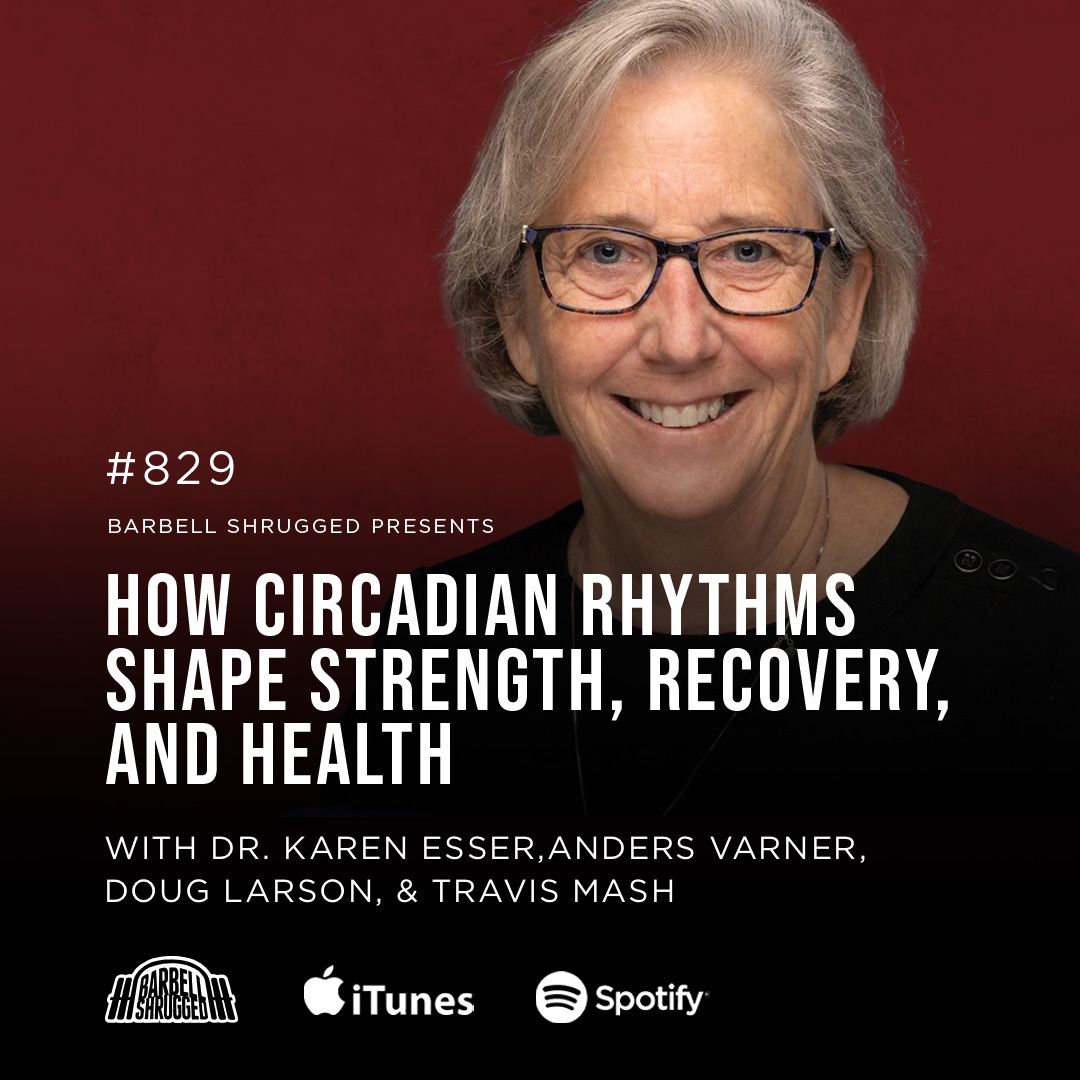
How Circadian Rhythms Shape Strength, Recovery, and Health with Dr. Karen Esser
51m 25s
The podcast episode centers on a conversation with Dr. Karen Esser, a professor specializing in muscle physiology and circadian rhythms. She highlights how every cell in the body contains a molecular clock that regulates daily functions, such as muscle repair and energy metabolism, aligning with natural light-dark cycles. This internal timing system significantly influences athletic performance, with evidence showing strength and endurance peak in the afternoon, offering a 5-15% performance edge. Dr. Esser discusses research indicating that consistent training at a specific time, like morning, can optimize adaptations by synchronizing these cellular clocks, even if absolute performance is lower initially. She also warns that circadian misalignment from factors like travel or irregular habits can impair health, elevating risks for metabolic issues. The discussion underscores the importance of respecting natural biological rhythms for both peak performance and long-term well-being.
- Shrug family this week on Barbell Shrug, Dr. Karen Essler is on the podcast, and we have a phenomenal conversation today about circadian rhythms and muscle tissue. Bananas had no idea this existed. Absolutely mind-boggling. How connected our body is to the sun and the spinning of this big rock we all live on. And there's very few things that I hear in the strength conditioning world or performance or health that catches my attention like talking to her today. Legitimately, it's so many things move at the speed of technology. And nobody ever just stops and goes, well, wait a second. Maybe we're still connected to this nature thing. It's the most important thing. But we just, we love to just move so fast without going, uh, maybe the sun's important. Maybe the time of the day. Maybe how our body interacts with night and day and the sun and, ah, this is awesome. She's the coolest mind-boggling stuff and very, very happy we got to meet her. As always, get over to rapidhealthreport.com. That's where Dan Gardner, Dr. Andy Galpin, doing a free lifestyle performance analysis. And you can access that at rapidhealthreport.com. Friends, let's get into the show. [VIDEO PLAYBACK] Welcome to Marvel Shrugged. I'm Anders Wander, Doug Larson, Coach Travis Bash. Dr. Karen Essert. We're going to be talking about all kinds of cool stuff, but none as important as the Jordan story you are about to tell us on super freak athletes. Because we just talked for 10 minutes about Chicago sports and how important they are to us. Take it away. All right. So I was a student working in my lab many years ago. And it turned out she taught swim class in the summer, some of the parks or whatever. And she had two of Michael Jordan's kids in her class. And the one thing that she noted with them-- so they were teaching them, I don't know whether it was breaststroke or backstroke-- but one of those strokes. And so they do that on the ground before they go into the water. And the one thing she noted is his kids had it like that. So the rest of the kids were kind of-- their arms were flailing in different directions and that kind of thing. But his kids, as soon as she sort of walk through what you're supposed to do, the sort of the coordination and the fact that they just would visualize it and then the body did what it was supposed to do, was just off the charts. And so the genetics were absolutely there. Yeah. What would it be like to be Michael Jordan's kids, man? What a thing to live up to. I mean, they're rough. Even if you're the best athlete ever, that's a rough go. I don't do it that way. I think-- I got you something else. I think you just grow up knowing you're supposed to lose it and everything. You never have an opportunity to win ever. So you just go, second place, guys. We did it. Congrats. You got to be second place to dad, but you got it. But dad expects you to be first place at everything else. My god. His athlete says it's got to be super high. But the regression to the means or whatever. If you've got really amazing parents, you're probably going to suck. You know, like if you have two average or pretty good parents, you'll be elite, but like-- Yeah. But it's an interesting-- On like an athletic side, no one knows who Jordan's kids are. I do know that they were very good. Yeah. I think-- I saw something with Bo Jackson. I'd be-- I'd say that like it, but they were pretty good, but like-- nothing like kids. I saw somebody interviewed Bo Jackson and asked him about his kids. And he was like, oh, Mike, two boys, like, they don't have it. But the girl, she dominates. She got a little bit. And she probably just-- whatever sport just walked kids for decades in sports until like college was over. Yeah. Look at James. What is LeBron James? LeBron is like, nothing close to him. What is the perfect chemistry that allows that freak of a human and then to have to repeat it by mixing somebody else's genetics into the mistakes or just sounds like a dangerous conversation. That's all I'm going to say right now. But yeah, I've been trying to show you. You were saying-- But since he's speaking like the actual man himself, like you were saying, watching Jordan, many years ago, grow up in Chicago or just being in Chicago when he was at his prime was just a phenomenal experience. Oh, it was. And I mean, and like most things, it's something to see it in person. I mean, I can watch it on TV, but to-- I don't know. It's just different. And it was beautiful, honestly. I mean, I think when you see that kind of athlete, it's just like seeing a beautiful dancer. I mean, it's just the control, the movement, all of that to me is-- And then, I mean, it's obviously a high skill center. It's real there. Impressive. Yeah. It's real there. Because you see on TV, it can be-- it's hard to-- when you see it live, it's like real. You see the human. It's more different. My favorite part about those people is everybody that you're watching on the court at that moment in time is the best they've ever met at whatever they do until that exact moment where they're around all of the other people that are the absolute best that they've ever met their entire life. And then, there's one guy that, like, if there was a league above that, would still be the best at the all-star league. Whatever the best of the world already are. And to, like, just that far above and beyond is-- I love to hear that Reggie Miller and those other guys talk about Jordan. Like, they just talk about how they did not want to talk junk to him because they're afraid to make him mad. Because if they made him mad, then there was no chance. But just to hear somebody who-- everybody else consider unbeatable, say that about him. It's like, wow. I'm terrified of what he was going to say. Now, I feel lucky to have had an opportunity to see him play in person. Watch this professional transition. Do you, at University of Florida, get to hang out with all the athletes that are also complete freaks? And-- Oh, like the swim team. And Katie Ladecki and those guys? Yeah. I thought she was different. Did you-- No, she's down here-- I mean, she's not in school. She's-- you know, but she cranes down here with the guys. Caleb addressed all those guys. City-- that's the difference. The best girls in the world, they have to show up to guys practice and still hammer them, too. But, yeah, I mean, it-- so no, I don't. I'm over in the medical school. I mean, it's not that far, but it's these days. I mean, it's different worlds. Yeah, it's too bad, though. It's too bad those worlds are more connected, you know? Yeah, well, I do, I will say. I'm not going to name names. But I do have a swimmer coming into my lab next semester. So I've been pretty excited about that. I enjoy having them in the lab. They know how to manage time really well. And they're dribbling. It'd be cool to have more of that. Yeah, I'm sure-- yeah. Well, this back up for a second for all the people in the audience who may not be familiar with you. Who are you? And, you know, you're a real scientist over here. What do you study? What's your lab all about? And what do you do at the University of Florida? Yeah, hi. My name's Karen S. Or I'm a professor in the Department of Physiology and Aging. I also serve as chair of the department at this point. I've been studying muscle my whole academic career. So-- and I've been studied-- so originally was-- and very interested in adaptation in response to physical activity. So initially, we studied muscle growth. So sort of fitting for barbell shrugged. But then what I love about science is, you know, we got this data back in the early 2000s. And there were these circadian clock genes in there. And I'm like, what the heck are these doing in here? And that sort of just, you know, curious and really kind of fascinated with the idea of this timer in cells. And so then have taken my lab off in that direction. We-- you know, at some point it's sort of overlaps. So-- but the whole idea that every cell in your body has got a clock in it. And it keeps time. And it affects the function of those cells. And it can affect performance. It can affect health, that kind of thing. So-- so yeah, it's kind of a wide mix. Aging's thrown in there, definitely exercise, exercise trainings in there as well. But when I think about circadian rhythms and whatnot, I don't usually think about like one specific tissue, like muscle-specific circadian rhythm. Like, can you tell us more about that? What does that mean? And how does it play into sport performance and training? Yeah. Yeah, it's super-- So, OK, so there's-- so I mean, most people know about circadian rhythms. So you think about, you know, rest periods or sleep activity. You think about, you know, especially if you live in states where they do, you know, fall backs, bring forward. That, you know, that period of time is-- is a, you know, where you don't feel great after traveling is a circadian disruption. So the basic idea here is that our cells have these little molecular timers. And it's not just brain. And it's not just like that modifies these things. And what these timers do is they're playing a role in managing kind of the health-- what we call refer to as the homeostasis of the cell. So the, you know, the ability of the cell to sense a signal or get stressed, but then deal with it, survive, and then sort of go back to, you know, a happy, healthy state. And it's-- so the reality is, your cells are doing slightly different things at different times a day. So if we take our muscle, for example, so these timers are working in muscle so that during the sleep phase, for example, things that are more directed towards fuel storage, like glycogen storage, like identifying damaged proteins, repairing, and replacing. So, you know, it sort of makes sense that when you're resting and your muscles are fairly quiet, that's when you want to fix stuff. And you want to store stuff. And so then, before you even wake up in the morning, what the clock inside the cell is doing is it's like, OK, let's get metabolic enzymes going. Let's start ramping them up before you get out of bed. So you don't have to think about this. This stuff just happens so that when you get out, you can go-- you know, it's easier for you to get up and going, all right? And the fact is, so the discovery of the mechanism that underlies this timer was awarded the Nobel Prize in Physiology or Medicine in 2017. And historically, they just thought of this thing working only in the brain, all right? But it was, you know, early 2000s people are like, "God, these things are in all of ourselves. They're in liver, they're in muscle, they're in, you know, your colon, they're everywhere." And so why? Why are these here? And so there's been a lot of work over the last 10, 15 years to try to understand what these think, what these clocks are doing in different cells, how are they organized? And at the end of the day, you know, I mean, I assume all you guys have experienced, you know, jet-like, right? Dr. Andy Galpin here. As a listener of the show, you've probably heard us talking about the RIT program, which we're all incredibly proud of. It's a culmination of everything Dan, Garland and I have learned over more than two decades of working with some of the world's most elite performers, award winning athletes, billionaires, musicians, executives, and frankly, anyone who just wanted to be at their absolute best. RIT is not a normal coaching program. It's not just macros and a workout plan. It's not physique transformation and pre-imposed pictures. RIT is something completely different. RIT is incredibly comprehensive and designed to uncover your unique molecular signature, find your performance anchors, and solve them permanently. You'll be working with not one person, but rather a full team of elite professionals, each with their own special expertise to maximize precision, accuracy, and effectiveness of your analysis and optimization plan. RIT isn't about treating symptoms or quick fixes. It's about unlocking your full potential and looking, feeling and performing at your absolute best, physically and mentally, when the stakes are the highest. To learn more, visit ritlab.com. That's aritlab.com. Now, back to the show. I assume all you guys have experienced jet-like, right? So if I go and I fly off and unfortunately enough to go to Rome, where it's six hours different, I'm going to feel a little off. I mean, I'm not going to die. But I'm just not going to sleep as well. All those kinds of things, that's purely a circadian problem. It's your clocks in your brain, or at one time zone, your guts in another one, your muscles are in another one. So they're out of what we call alignment. And so from a biomedical perspective, when your clocks get out of the line, you have higher circulating glucose. Your blood pressure starts going up. You start to see indices of sort of cardiometabolic disease, that kind of thing. So what we're learning is we have been going on about our lives, not really realizing there's this clock system in there. And that we don't care. We can get light anytime. We can go eat anytime. We can do whatever we want. But the reality is the offset of all those sort of lifestyle adventures can actually have negative impacts on our clock systems in our body. Now, from a sort of athlete performance perspective, there's quite a bit of data. Humans, men, women are stronger in the afternoon than in the morning. So if you go and you ask someone to do one rep max, and you do that at 8 o'clock in the morning, I mean, you can do it yourself, too. And then try it out at 4 to 5 in the afternoon. By and large, all of those people are going to be somewhere between 5 to 12% stronger in the afternoon-- Other beside that. --which is a lot, right? And people have tried to figure out why. Is it the ability of the brain to do this? And there's no indication that it's that. Is it temperature? Are these different things? And so I don't have a great answer for you at this. I can't say, like, beyond a shadow of a doubt. But there are some indications that actually the things inside the muscle can work better in the afternoon than they can in the morning. And this aligns with, when do you see Olympic records set? It's not 6 o'clock anymore. Later. And so there's also indications that endurance is better in the afternoon, as well. And so that's-- so there are some time of day variations. I mean, they're not huge. We're not talking full differences, but we're talking somewhere between 5% and 15% differences in a particular performance over time of day. And so-- That's huge, for athletes. That's a huge thing. And you talk about, let's say, college teams going-- so since our conferences are no longer restricted to regions, so you've got someone on the big 10 flying all the way east to play somebody on the east coast. I mean, that first day is-- that's not good for their performance. They're not going to be at peak. All right. There's actually some really interesting papers. They've dug in-- they've used major league baseball, because there's metrics on everything. There's speed of the pitch, batswing, all kinds of different things, beyond sort of wins and losses. And the data would argue that, let's say, if I'm the Dodgers, I travel to play the Metz. That first day that I get their athlete performance in some parameters-- not all, but some parameters is actually reduced. Now, let's say they're playing a three or four game series by the time they get to the end of the series, they're fine. But it's that first day that they tend to be less than optimal. Wow, man, it's big quick. Now, what if you train early at 8 o'clock, you're a force to, which is sadly-- like some colleges know that you don't have a choice. And you make improvements in the morning. Well, those improvements then equate to overall better, than if I were to go max out at 4 o'clock. You see what I'm saying? Yeah, I don't have a study to-- Well, I'll shift forward. Yeah, so you're on to what I think is going on. So we do have a study. Again, our athletes are furry. They're a little mice, OK? And so what we did-- so with mice, you can really have a good weight lifting. But we do have treadmill training, right? So if we give them a graded exercise test in their morning and then take them, let them recover and stuff and give it in the afternoon, just like humans, they have a much better performance in the afternoon than in the morning. So what a postdoc in my lab did, as he said, just that. OK, so I'm going to take you mice. And I'm going to train you in the morning. I'm going to make you get up and get on the treadmill and train five days a week for six weeks, all right? And then I also had a group training in the afternoon. And they were trained. And so now this guy was sort of a real exercise physiologist. So he said, OK, performance in the morning is less than the afternoon. So I'm not going to equate them based on the same amount of treadmill work. I'm going to make them train the same percent. So that makes sense, right? So if you can run six-minute mile, anyway, you've got what I'm saying. So I shook my head because someone walked in my office and I was kicking them out. If you were-- if I threw you, I'm shaking them down. OK, I just see a message. And I'm just like, no, don't come in here. Not down to you. All right, so what he did is he set the relative intensity of the workload the same. So the morning runners are running at 70% of their max. And then the afternoon runners, which have a higher max, are still working at 70% of their max, all right? And so he's going to train them running five days a week. So at the end of three weeks, he tests them. And I'm using this because I'm going to become the graph here. So the morning runners got better. They improved, which you expect. And the afternoon runners got better, but to the same amount. So they still had a max performance that was different. All right, so he said, OK, I'm going to increase your-- well, I'm going to adjust your training. So you're now doing 70% of this new max. And I'm going to train you for three more weeks, all right? And so he did. And then at the end of six weeks, then we had the morning runners, and we had the afternoon runners, and they were exactly the same, all right? So what that said to us is that-- and remember, I mean, so this is like, oh, great. I'm going to train in the morning. Because they trained at a lower absolute workload. But they actually, their performance adaptations were better than the afternoon trainers, OK? Got it. All right, now, you know-- I'm sure you say it, so they were able to travel full with-- I mean, they were able to train with less of an impact on their body, less-- Well, yeah, I mean, yeah. I don't-- so the point with this story is that we-- it took-- I mean, so if we had stopped at three weeks, we wouldn't have seen a difference. I mean, that both would-- Right. So exercise will improve, no doubt. But the magnitude of the adaptation really became different for that morning training group between the three and the six-week period. So we don't know exactly what's going on, but what we think is that what that's doing is it's adjusting that internal clock system. Because now your body's going, OK, I'm training at 8 o'clock in the morning. And so maybe the first week or two, it's like, OK, fine. But you're not going to stick with it, right? And so you keep sticking with it. So the hypothesis here is that the clock system is adjusting to that time. And so that adds an increased efficiency of the adaptation by getting that shift in the clock system. Wow. Oh, man, you just-- I mean, that's a big-- because there's a big debate. I'm sure you don't get up to Twitter, but if you get on or X-- I used to, but I actually have taken it off for various reasons. That's good. But people debate that-- the spit coach is that trained people say 6am, 8am, that they're wasting their time. Based on what you say, they might absolutely not be. But oh, this is great. OK, I can't wait to share this one. Yeah. Now, I mean, like I said, we're in the process of-- we've got this manuscript submitted. So it's undergoing peer review. But I was just really impressed with the data. I mean, it's just amazing. And the whole idea of time of training obviously has gotten actively discussed, as you said. Sir, all the time. Hold on, flash. When do you train? When do I? Whenever I have-- you know, like sometimes early. But today, I get to train in the evening. So it depends on the day. Doug, what do you prefer? So the question is more, what would you prefer? Well, I'm sorry. Sorry, I shouldn't have. Doug, you're a trained trainer, right? Yeah, I typically like to train right before dinner. It separates my work day. I was just straight from high school, straight from college, like the same program. Like, you go to school, you train, you go home, eat dinner, and then that's your day. Like that routine has worked for me my entire life. So yeah, I like to work in the morning, train the afternoon, and it's like a clean cut for family time and dinner and whatnot. And then if I need to get extra work done, then I work earlier in the morning or later in the evening. Usually later in the evening. Me too. I don't know what you're talking about. I'm 6.45 on the button. 6.45 to 7.15. Mondays and Wednesdays. I'm training long conditioning. I'm on the bike for dude. You guys want to hear big numbers, by the way. Any of the centers, any of your centers. - Any of them, yeah. Up at 5.45, coffee, those things. My numbers, not absolute strength, because it's too early to go and do crazy stuff like that. And it's don't have time to warm up like that. But in a linear progression, I never miss. And all I have to do is change. If I start to stall, but week over week. And it's been, I've been doing the same workouts for almost two and a half years now. And nothing changed in the morning once my body switched over and I love it now. Because I lift weights now that are like, I don't need to warm up. I just go and it's like 85% of like, it's heavy but feels good for eight to 12. And I don't need to think about it. But every week, I get strong. Or I don't even know if I get stronger, but I get better. - I do my morning, I have a 5.30 a.m. I do my cardio, I guess you would say. Like in the morning, like I have a slant. I do slant, reverse hypers, some isometric work that helps my hips. It's like my favorite. But like, my big time training goes on, either 8 a.m. which I hate or anything. - Yeah, one thing, you may have some insight into this. Karen, when I switched from an afternoon to a morning trainer, it took me six straight weeks of unfortunate feeling to actually be able for my like system to flip. And then once it did, now I, you want me to wake up at five and go hunting. Also, like I feel so good in the mornings. I actually have this like, like it just, I'm like alive. Like my, whatever it is, when it flipped, I became a morning person like immediately. But it took me a full six weeks to actually be able to jump out of bed and go, go do strength training or conditioning. - Yeah. - It's a long time. - It makes a lot of sense to me. I mean, I think the, I mean, there's like most things with humans, there are genetic aspects. So we talk, you know, in the field, we talk a lot about the morning versus the afternoon, the Larks versus the owls. And there's a genetic underpinning to that. But that said, you know, what you talk about is just, it takes time. So for you, it was six weeks for somebody else. It may be eight weeks for someone else. It could be five weeks. I don't know, but the way an end, again, I want to be, I tend to be very careful. Like because we don't know exactly why that is. But what I'm envisioning is there has to be some coordination. You know, I mean, your liver clock needs to know what your muscle clock's doing. I mean, it needs to know what your heart clock's doing. And it all needs to coordinate with the brain. Because again, for you to feel good, for you to perform the system itself as a network has to work together for the best performance. All right. And so I think it's just, you know, when I think about, you know, so circadian rhythms have are on literally everything on this planet, okay? Right? So it's in planets, it's in bacteria, it's in bugs, it's in birds. So these things are old. They've been around for, you know, virtually ever. And so, you know, I think that there is this. They are very intrainable from your environmental cues. And so in this case, your environmental cues are going to be your exercise. But, you know, when you get light exposure, you know, when you're eating, so feeding time also is a modifier of some of these things. And for you guys with your training routines, I assume you're very, you pay a lot of attention to all of those factors as well. Yeah. I even started Olympic lifting like two months ago. And I thought that was going to be like speed and power and athleticism. Like it's one thing to just kind of like sit on a, like a hammer strength machine, just knock out some chest, but to like snatch it 645 in the morning and feel good. But even that stuff now, like once you're, once, it's been really interesting because it's all, it's been my first year of being a real morning person. When I own gems, I would see the morning people like, you loony tunes, go to sleep. And of course, like the average age in that class is like 55. Like it's, it's all the guys that have been playing business for a long time or like they just got to get it done. But yeah, even adding Olympic lifting back into my program, like weights move, athletic, there's a tiny bit more of a warm up to what needs to be done. But I, going to the like the, the part that you were talking about of like the, the, the, the inability to like lift at maximal weight. I almost wish I could rewind the clock and go, hey, maybe your 23 year old self didn't need to max out six days a week. Like you didn't have to do all that. Maybe progressions even faster when you just do enough, which is completely the opposite of what I felt for the first 20 years. Oh, I mean, you know, I don't know. I mean, I can't speak because I, I, I'll be real honest. I don't like lifting weights. I, I know it's good for me and I know I'm, I'm, I'm a cardio person, all, all over the place. I was so your friend for a second. Star, I am so sorry. I'm so sorry. We do so like it comes together, though. So I know we still have that, I'm trying to be more like you now, though, like I'm trying to be more of the cardio person. So I think we share that like I'm being more or more. I mean, I think we've all had a lot of talking about aging, both as important, right? It just, oh, yeah, sure, for sure. You know, for, for content for context with all this research, you're talking about morning versus versus afternoon. Like if you're a, if you're someone chasing a gold medal or world record, like maybe these distinctions really matter. But if you're a regular person, like the most important thing is that you just find time to get it in and it's a, and you can, you can do it consistently day after day, week after week, month after month, year after year. And like you can, you just, you do it at all. It's really the most important thing at the end of the day for the, for the most normal people. I don't know if anybody on here is normal here, but that's. So I would say, yeah, I mean, I think the, the most important stuff is be, be active. I mean, for anybody that has, I mean, if you're thinking about, yeah, I mean, if you're an elite athlete, I mean, this is why the athletes go over to wherever they're going to compete ahead of time. So they can, you know, I mean, if it's get lag or eating cycles or whatever, you just want to get into that time zone. But I, you know, the, but even as you're talking about, you know, if there's that part of you that wants to see your performance improve, then there are things like paying attention to when you're training to, to support the potential for seeing that, right? So as you know, if you're talking about, well, okay, one morning, I'm at 8 a.m. The next time I'm at 8 p.m., then I'm, you know, if you're just sort of randomly switching around, I, again, the hypothesis would be the, the trajectory on your improve, you'll have improvements. But the trajectory will be less because you're flipping. Which means I love it there again. So if you could do the time and stick with it, that's going to be better for you. Is there like a, like the body is kind of like always seeking some sort of homeostasis for stability to grow until that stability becomes a deterrent because there's not enough like volatility in the system to adapt to? Is that, is that also with the clock? I mean, yeah, so, so I mean, I mean, to me, homeostasis is key, right? I mean, that's, that defines the ability to sell or your tissue, your system does sort of like, and I think a bit more from a health perspective, that, you know, you get the flu, you get broken leg, that your body can handle that or repairs itself and you're, you come back to where you were. So you don't come back to less to, but you come back to where you were. So in terms of an exercise response, I think, you know, I mean, you may have something there. It's the ideas you have these, obviously, exercise disrupts homeostasis a lot. And, and so, and in fact, you want them, you know, I, one would argue and maybe they do, that you want to make sure you're back to homeostasis before you go into that next bout is, is, is it useful at all to have exercise, not really recover, then go hit it again. That could be less ideal in terms of, you know, the adaptation, the response, the growth. Yeah, I don't know if that answered what you were asking. I couldn't, like, you were making faces again. So I just, I don't know, I'm talking for my team. There's, but anecdotally, I live on a farm. So there's a lot of people around here just doing stuff. I don't even know who they are. That one was my stepdad. He likes to come in and just walk around and, oh, yeah. Your early state, well, I just wanted to agree with her on one thing. So that upstate, when I was there, the people who trained early in the morning, there was a 5.30 a.m. group and like, I tried it once and quit right away. But I could, but like those guys, you know, even though they look miserable, when we went to, you know, when it was max out time, as a group, they seemed to do the best when it came to improvement. And so you're, it would have, that your hypothesis, I would say, that the anecdotal evidence there agreed with you for four years. It all over and over. The early groups seemed to, when it came to max out time, because then we would max out at the same time, we would all go to the evening. And then they would have this big bounce up. There might be an element there of like camaraderie where every gym I've ever been at, the 5.30 crew, it's the same people, it's the same people every day. So they're kind of, they're kind of like a little team. And so they train every day and if they're all squatting and maxing out every day, it's like, there's this, there's this team element that is not present at other times of the day. Yeah, they can keep it. He's like, I'm not going, I've got my own friends. I tried it once and it was the most miserable. Yeah, I mean, I think, you know, well, so when you think about these, you know, sort of, so I'm looking at you, Travis, and I'm saying, okay, so maybe you're more of an evening person. So morning for you, early morning for you, maybe more like eight to nine, rather than, you know, six to seven, right? So, so you just sort of have to, you know, that they're, I mean, I mean, if you want to do an experiment for me, give that a try and try, try your, try your, your 8 a.m. training, see how that goes and see how your progression goes. I do eight o'clock, I can do really, I can do not as good at four, but I can do it and joy and like, it's fine. And but then when I go, then when if I have a moment to go to the evening, to like to hit a bigger number, it's that normally is a really big, like jump up. So you experience that a lot, huh? Yeah, I do. Yeah, I normally have to train eight. And so every once in a while, like today, I get to go, you know, I'm excited. I get to train evening, but normally eight o'clock is my time. Good. So, yeah, five or eight o'clock. Real quick or earlier, you mentioned how, you know, different tissues might have different different circadian circadian clocks or circadian rhythms. Like, how would muscle tissue be off or misaligned from liver tissue or brain tissue or any other example that makes sense here or do I have a rhythm set? Yeah, do I have a wrong one I'm saying right now? Yeah, you're right on. So, so, so the reality is the clock itself, the sort of the components of the clock are exactly the same between the liver or the muscle, the heart, you know, the fat, fat cells have them every, every cell has them. Where the best recognized problem with this is is actually people that eat at night. So, it turns out what time you eat can be, can tell the clocks in your peripheral tissues like liver, like muscle, those kinds of tissues, that so if I spend more my time eating at night than the clocks in my periphery are going to shift just like we were talking about morning exercise, they're going to start shifting backwards, okay? So, the other direction. Now, the problem is the brain doesn't respond to this at all. So, the central clock or the master clock in the hypothalamus does only response to sort of when it gets its like cues. So, if I eat at night time, the brain's like I don't care. And so, what you end up having are some of the organs in your, you know, your body are sort of shifted with that night eating, your brain still is tied into when you see light and dark. So, you actually create sort of a jet lag effect without traveling. So, this is where, you know, when I talked to the students some time, it's like, yeah, you too can experience jet lag without going anywhere. You just have to offset your light exposure, your feeding. And this could happen with exercise as well. So, basically, you know, you sort of think about something like feeding and the response of insulin and the ability of insulin to help get glucose into your cells. That actually shows a time of day variation, right? So, it's not the same all the time. And this can become a problem when, let's say your pancreas is like, oh, I'm releasing insulin and the muscle's like, nah, I don't really want to bother with it. It's a different, it's the wrong time for me. And, you know, again, this is just sort of a very simplistic idea, but this is how you get sort of prediabetes when your clocks are disrupted. So, your pancreas is doing one thing, your gut's doing, your brain's doing something else, and your muscles just like, nah, wrong time. Because muscle stores, you know, most of the glucose. And so, if it's not willing to participate in this, it creates problems. So, this is maybe completely off, but that just blew my mind a little bit. That the circuit, the clocks inside your body, not talking to each other, creates the stress that's going to also be linked to diabetes. It's like night time eating is a big, no, no. It's a big, yeah, yeah. I know, I'm not even going to talk about weight gain or any of that, but just the metabolic stressors and what it does. I do too, dad. Yeah, I'm never hungry in the morning. I'm always hungry at night time. I eat dinner and then I dinner again and again. Well, you've been doing it a long time. I mean, there's sure. I'm like, I'm like, you brother, like night time all the way. Like, I'd be tired all day long and then nine o'clock hits, and I'm like, wide awake, and I'm like, dude, I keep going all night. I know that's like, when we hang out, we're like on the same page. Like, we'll be in the right all night. And I'd be asleep. Not me, man. It's like a wake up call. So for from like the most practical standpoint here, what is like the ideal kind of day with waking, eating, training, all the things in your mind as far as keeping like maximal alignment between all the different organ systems in the body? It's not hard. People. I'm sorry. What's that? It's based on the mice, the furry people. The furry people. Yeah. I mean, actually, there's, there are, there is quite a bit of data with humans on this one. I'd say, I mean, the one thing is, you know, when you, when you talk about the clock system, this is not a precision clock. So it's not like it's like, okay, it's 1035. I need to do this. So I think, I think of these behaviors like wake up, go to sleep. When you eat, when you exercise, you know, I think of them and sort of three to four hour chunks of time kind of thing. I mean, eating, I would say, again, I mean, when you guys are doing so, I mean, it depends on whether you're doing really extreme training, because with, with the hot, you know, high level of, you know, who's going to tell Michael Phelps when he should eat? No, not me. You know, I need one through the calories he goes through. But I, you know, for the sort of average person, I think thinking about, you know, a 10 hour window sort of, you know, whenever you have your breakfast, try to get most of your food in in that 10 hours. It turns out when they did some study with a group of people that's like, Americans eat over like a 14 to 15 hour window. That's probably, I mean, I don't, again, unless you're talking to somebody with extreme, with, you know, heavy duty training, I don't think that's probably a good idea. I agree. Yeah. And so, I can tell to you. Yeah. I mean, in terms of the sleep wake cycle, I think you really, you know, unless you do what Andrews did and sort of get himself flipped, generally, like I said, people have a genetic preference. And so as best as you can work with your preferences, it's going to be, life will be a bit easier. So I have always, as far as I can remember, been a morning person. And, you know, I can, there was, when I was a graduate student, I ran, I did a few marathon. So I did a lot of run training and, you know, that kind of thing. And damn, you know, I could run it three in the afternoon, but I hated it. I felt like crap the whole run. And, you know, I spent all this time, again, I didn't study circadian back then. So all this time thinking about, you know, when do I eat? What do I eat? What's wrong with this? And now it's just like, well, hell. Okay. I just, it was, it was just not going to be my time. And so, I think working with. When did you prefer to run? When do you prefer to run? Oh, morning. Like what time? Oh, well, I actually, so I do the, you know, five, so you get to have the coffee then, then, then, then let's go. I mean, I rolled out of bed. I didn't even have coffee. I just went rolled right onto the road. Even the morning life changing. I agree with you on cardio. Like, I love doing cardiovascular work. Even my, like, you know, I do a lot of circuit training in the morning, but like, I love doing that. I just don't like lifting heavy in the morning. Okay. It just seems like pure health to me. Here's the problem, mash. When you say lifting heavy, it's a lot, dude. It's not. It is getting more and more. Yeah. It's like, even if you hurt. Even if you were doing like 80% dead lifts, you got to do 135, then 225, then 315, then 405. And finally, at 4.95, you get to go to work. It's an absurd amount of weight that you have to lift to actually feel something. A storm of folk can just lean over 275. Feel good about ourselves and go back, go back home. You complicated the process into big. Trying to get in shape again, too. Yeah, I'm way past. It's hard. Yeah, aging doesn't help any of this. When he says having, it's just different. Yeah, but you're not trained though, it's not. Yeah, I agree. If you're trying to get a good sweat in, and again, you're not training for marathoners, you're not trying to hit PRs. You're just trying to get 30 minutes of moving in. You're going to wake up, and you're going to feel great the rest of the day. Exactly. That's my point. It makes me psych coffee. I didn't realize just how much it made you, and everything the rest of the day is better. I learned better. I love to train 30 minutes hard. Then go like study something, and like I retain all of it. I have. I've known this while I was in school. I have a completely out there question to ask you since we're talking about circadian rhythms and how important sun is to our body. If you are wearing like lots of sunscreen, which I haven't done in over a decade. Sun glass. Sun glass. Does that affect these circadian rhythms and that you're blocking? I was so hoping you were going to say yes, because in my brain, and I'm going to act like you didn't answer no and keep telling people that they shouldn't wear those things, but. I disagree. Did you just say I can't throw. No, I mean, the. Now, yeah. So, so I mean, the skin cells do have clocks for sure, but I mean, the skin that gets it. I mean, the skin that's on the outside outside is not really alive. I mean, you're. These are. All right. So, you. I mean, well, I shouldn't say it like that, but I. Like your eyeballs. They're like the. The absorbers of. They're like a muscle that needs to contract and relax. I don't really know where it's going. And in fact, well, in. In fact, actually, I should. Retract everything I just said that. I knew it did. Put the show. Not. Not everything. I was just talking about the skin cells. Damn it. I don't. But I, but it, you know, so in the skin cells, what they see is. What the clocks regulating is. DNA damage repair. And so there are time of days. Your skin cells has have more apparatus or more or more of the things needed. To both sense and repair demon in damage, which is, guess what, light induced. And so, so. So the clock is. So what the clock is doing in those skin cells is going to be. Besides keeping time, it's going to be different than what it's doing in the muscle cells. So that's the, I mean, it's the same mechanism, but it's evolved to do different functions in different cell types. Can't we all never heard of this? I mean, I mean, it's. It's amazing. Yeah, I'm. Yeah, I'm a massive excess physiology. We never once thought. Oh, no, they didn't know. They actually, I was. I can't remember one of my colleagues was putting something together. And so they are just starting to put some of this into the exercise. They need to put this in. This is great. Yeah. You mentioned at the beginning of this that you're not working with the athletes, but you're in the medical side of this. As far as. Where this would show up, you mentioned kind of like being prediabetic as something when the clocks are all out of sync. How far or like what other column like symptoms show up when you. Like, see this like on a medical side. I don't even know what the question is outside of like. Prediabetes is that the is that the down range effect like side effect of this or like is it cancer? Like, like, how do you. I want to know about anything like. Oh god. Well, so. Yeah. I don't know if you guys have a hard stop at two, but I think. So, so you're opening a Pandora's box here. So, so the most well known, you know, so if you take shift workers. Our shift workers are a great example of every day living people who are chronically messing up their clock system, right? Yeah. And and so. What's worse, higher probability of metabolic disease, higher probability of cardiovascular disease, higher probability of cancers. All these chronic diseases. But what you want second or third shift, like which is worse? Well, I mean, so so I mean, again, it's so the pro in theory, if you work, if you weren't lived and worked third shift. Okay, steady. So that so the problem is people work a shift and they go back living with their family on a regular day. Then they go back to another their shift. So it's this. It's a flip flopping. So. And so something like swing shift is just like the absolute worst, right? Got it got it. And so, so the seat, the Center for Disease Control years ago had made a shift work cancer risk. So you have higher probability of these diseases when you're undergoing this sort of you're sort of chronically messing with your circadian system. And I mean, they're and I, you know, there are things like, you know, people that work night shifts will have food preferences that are different, usually not things that are terribly healthy. High sugar, high fat, that kind of thing. So there's everything from what kind of food do you eat and when do you eat to, but to just the intrinsic biochemistry and metabolism of the body that get messed up with this kind of thing. What is, why does third shift, oh, okay, that's the first question. Why does third shift people crave more sugar? I don't know. I mean, there's, I know people have worked on this. I mean, so the, you know, there are circuits in the brain that. I don't know. Yeah. I've worked shift. I've worked that third shift. Well, I wake up midnight, I crave sugar and like, I try, I've been really good about not doing it lately. But man, I just want to like eat some sweet. What about mental health? Like what causes that? Well, again, I mean, this is, I'm a muscle person, but I, but I, so I'm just what I'm sharing with you is that there is no doubt that circadian disruption will have issues in terms of depression. Yeah. That's the most, most common, I think. Paul, because you're awake all night, scaring at your damn phone, putting sunlight in your eyes, read Twitter and TikTok. People being angry, telling you you're right about everything and why the world's all messed up and then you have to live with that forever with no sleep. Well, no sleep is, so sleep and circadian rhythms are related, but not overlapping, right? So, so sleep is absolutely important and fundamentally important. Your clock's going to be more about when you go to sleep, when you wake up kind of thing. And so if you have sleep issues, you usually have circadian issues, if you have circadian issues, you're going to have sleep issues, for sure. This has been phenomenal. There's so many times I feel like I hear something in the fitness after all of these years where I'm like, holy crap. This is like today. Well, I'll be interesting. You did it today. High five to you and your cups go cups go where can people learn more and find your research, all the things. So, I mean, you can just Google me and they'll be, you know, you can find papers we've published and things we've done. Again, it's easiest email me. You know, I do actually respond to emails in general. So there you go. Go try to smash. Naturally.com. That was fascinating. It's been a long time since the verse will be fast. Now I'm going to go on a super deep dive, but thank you. Well, the medical side next time we talk to you, sounds really awesome. Happy to. Happy to find her. This has been great. Yeah, cholesterol. All kinds of things. Oh, yeah. When do you take your statin drugs for those cholesterol people? You should take it at night. There's time of day differences. Yes. There you go. All right, as a cliffhanger. That's all right. That's all right. You can find me on Instagram, Dougasie Larson. You appreciate being here. I'll pair with these guys said you taught me many new things, which is exactly what we're here. So thank you for coming on. Okay. Well, thank you. It's been a real pleasure and go Gators. Okay. I'm Anders. I'm Anders Wanderer at Anders Wanderer and we are barbell strong department scores. So I can make sure you don't shoot rapid health report.com. That's we're Dan Gardner, Dr. Andy Galvin doing a free lab lifestyle and performance analysis. You can access that at rapidhealthreport.com friends. We'll see you guys next week.
Podcast Summary
Key Points:
The podcast features Dr. Karen Esser discussing circadian rhythms in muscle tissue, emphasizing the body's intrinsic connection to natural cycles like sunlight.
Dr. Esser explains that every cell has a molecular clock regulating functions such as repair and metabolism, impacting athletic performance and health.
Research shows humans are typically stronger and have better endurance in the afternoon, with performance variations of 5-15% based on time of day.
Studies on mice suggest training at a consistent time (e.g., morning) can enhance adaptations by aligning the body's internal clocks, potentially improving efficiency.
Circadian disruptions, like jet lag or irregular schedules, can negatively affect glucose levels, blood pressure, and overall metabolic health.
Summary:
The podcast episode centers on a conversation with Dr. Karen Esser, a professor specializing in muscle physiology and circadian rhythms. She highlights how every cell in the body contains a molecular clock that regulates daily functions, such as muscle repair and energy metabolism, aligning with natural light-dark cycles.
This internal timing system significantly influences athletic performance, with evidence showing strength and endurance peak in the afternoon, offering a 5-15% performance edge. Dr. Esser discusses research indicating that consistent training at a specific time, like morning, can optimize adaptations by synchronizing these cellular clocks, even if absolute performance is lower initially.
She also warns that circadian misalignment from factors like travel or irregular habits can impair health, elevating risks for metabolic issues. The discussion underscores the importance of respecting natural biological rhythms for both peak performance and long-term well-being.
FAQs
Circadian rhythms are internal biological clocks in every cell, including muscle, that regulate functions like repair and metabolism based on time of day. They help maintain cellular homeostasis and can impact performance and health by aligning bodily processes with natural cycles.
Athletes are typically 5-12% stronger and have better endurance in the afternoon compared to the morning. This is due to factors like muscle function optimization and circadian alignment, which can influence peak performance times.
Travel can disrupt circadian rhythms, leading to reduced performance initially, as seen in studies like those on Major League Baseball. Athletes may experience decreased metrics on the first day of a series due to misalignment of internal clocks.
Yes, training consistently at a suboptimal time (e.g., morning) can lead to significant adaptations over time by shifting the internal clock. Research in mice showed morning training eventually matched afternoon performance through enhanced efficiency.
Dr. Essler studies how circadian clocks in muscle cells affect adaptation to exercise, aging, and health. Her lab explores how these timers influence performance, recovery, and metabolic processes throughout the day.
Disrupted circadian rhythms, such as from jet lag or irregular schedules, can lead to higher blood glucose, increased blood pressure, and cardiometabolic risks. Maintaining alignment supports cellular function and long-term health.
Chat with AI
Loading...
Pro features
Go deeper with this episode
Unlock creator-grade tools that turn any transcript into show notes and subtitle files.
 PodcastTranscript AI