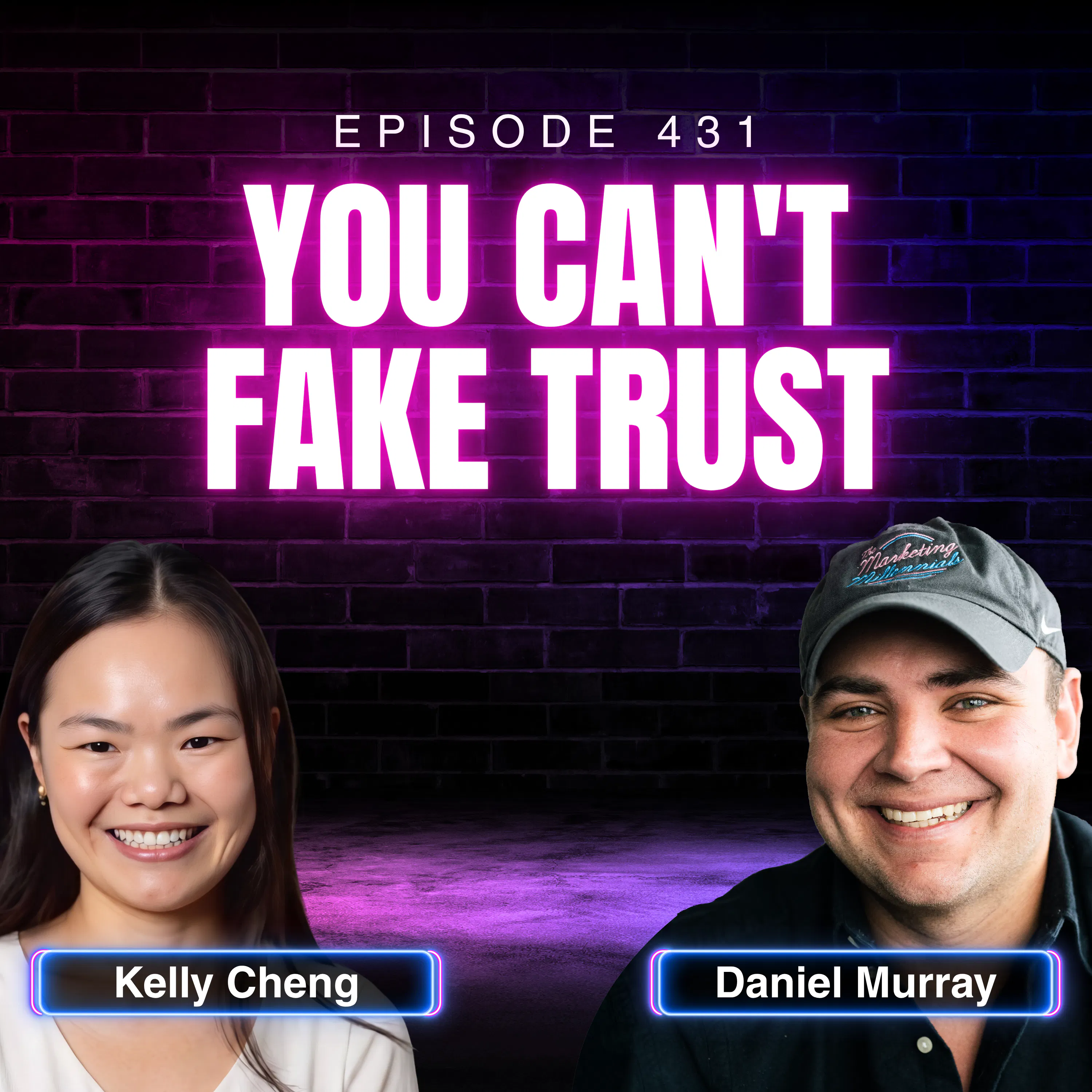
How Brands Can Break Through in the Age of AI with Kelly Cheng, CMO at Goldcast | Ep 431
51m 40s
In this podcast, Kelly, CMO of Goldcast, shares her journey from a childhood pitch for a dog to a career in agency work and growth marketing, emphasizing a growth mindset centered on experimentation. She distinguishes mind share from brand, noting that mind share covers the full customer journey, including post-sale advocacy. To defend brand investment to skeptical CEOs, she stresses educating stakeholders on marketing’s intangible value. Kelly advocates for video as a key tool for building trust in an AI-saturated world, because authentic human video—especially from events—can be scaled via AI repurposing. She highlights survey findings that many marketers use AI only at a basic level (e.g., chatbots), with low adoption for content creation or agentic workflows. Trust in B2B, she argues, is earned through human connections like events, influencer partnerships, and community, not through AI-generated content. Finally, she notes that AI empowers marketers to produce and distribute video independently, shifting expectations away from needing dedicated editors or large budgets.
Welcome to the Marketing Millennials, the NO-BS Marketing Podcast. I'm Daniel Murray. Enjoy me for unfiltered conversations with the brains behind marketing's coolest companies. The one request I tell our guests, stories or it didn't happen. Get ready to turn the fuck up. Welcome back to another episode of the Marketing Millennials Podcast. Today I have the CMO Goldcast, Kelly here, excited to chat. Kelly, welcome to the podcast. Thanks for having me, looking forward to the chat. I would love for you to go through your journey because I know you came through agency. You had a growth role and now you're a CMO. Could you give me the rundown of your marketing career? Yeah. So I would say that I've been a marketer from early early days. I think the first time I pitched an idea was when I wanted a pet, I wanted a dog. And so in order to do that for my family, you got to put a business case together. And so at the age of seven, I did a PowerPoint presentation and pitched, put it together, a whole narrative on why we have this pain point of loneliness and sadness. And that buying a dog will help fix that and solve for us. And so early days, I've been a marketer at heart, but I've always known that marketing was something that I was passionate about just because I was very interested in mass communication. And so that's what I studied in college. And while in college, I was in Boston and so I had the luxury of being on in a large city. So I did internships throughout the years in college and really, really got into the advertising agency space, both in account management. And then after I graduated, it was media planning was how I got into marketing specifically. So through media planning and strategy and coordination, that's really how I got into performance marketing. I've always been within the B2B side of things also while learning about the B2C side too. So I've always balanced some kind of B2B book of business on the agency side, but also working with consumer packaged goods, luxury, retail, etc. So really having that 360 view of marketing both on the consumer side, but also on the business side. And from the agency side, I bounced around here and there, small, medium, large size agencies and decided to go in-house because I really wanted to make bottom line impact. I think on the agency side, it's so easy to get tripped up on the vanity metrics of clicks and costs per clicks and costs per leads. But I really wanted to understand ROI and how to actually measure that in a very complex system. And so that's when I went in-house and really started really understanding more about the B2B marketers role. I wanted to go into this because I know you've held a lot of growth roles before you became a CEO of GoldCast. How does that growth marketer DNA shape how you think about brand building and mind share? Yeah, so when I think about growth marketing, the foundation of it is having a growth mindset. So growth is one thing that every business wants. So when you see there is a growth role, whether it's a growth product, growth marketer, growth, whatever position, it's always interesting because, of course, the any company wants growth. And I think when it comes down to actual growth marketing, it's operating in an agile way and consistently experimenting and hypothesizing and really, really being able to use experimentation to help move the needle towards what your hypothesis is on what you're trying to grow. When I think about growth marketing, that's how I think about it. It's really having a growth mindset. It is a very broad function. It could be within brand. You're doing growth within brand. You can do growth within your free trial product. You can do growth within your email marketing. So there's so many different ways that growth can show up, which is why I love it because it requires a lot of strategy and making sure that you're just not ripping and replacing something that you've done before. It's really unique to a situation that you're sitting in. And so that's the stuff that really lights my brain up and I get really excited about it. And so when I think about growth and how it kind of builds towards my share, when I think about my share, it's all tied with growth and brand. I think a lot of marketers think about brand as like the big flagship messaging logos that you see, but brand isn't just about capturing like the top funnel awareness. It's about continuing that journey throughout so even after someone who has bought your product, whether you're in consumer or you know, you know, B2B, you're going to have to consistently win them back. The market is way too noisy today for you to just stop doing marketing once you have that sale because you know in software, there's that annual recurring revenue that we're looking at every year. You have that renewal that you still have to work towards. And so marketing doesn't stop after the contract gets signed. It's every single touch point. It's the entire customer experience all the way through advocacy. And that's really how I think about my share. It's the consistent messaging that you see throughout the customer journey. And that's not just tied to like the awareness funnel. You said that you've made that presentation as a kid of like like to get a dog for your family. And I want to know like how you present to a CMO. I mean, a CEO that's saying, OK, Kelly, I don't really care about brand. I don't really care about my share. I just want pipeline. I just want to I don't care about those things. What is like your conversation to defend that long game marketing? Yeah. I mean, I think that's a very real thing. A lot of people equate brand to mind share in my mind. Mind share is the the bigger hierarchy and brand is underneath it. It's still a big category, but mind share covers the broad spectrum across the entire brand experience and journey. And it kind of bridges thought leadership as well. So it's really challenging to defend that because when you're talking to a lot of businesses that have really complicated BI tools that report out on attribution brand is often overlooked because it's difficult to track brand. And so it's hard to defend to the board. And so I think it's a lot of educating about marketing. So when you're going to get, you know, budget buy and like the CMO going to the board to going to the CFO. CFO may not understand how marketing works, the value of marketing beyond what you see in a spreadsheet. And so it's really on the marketing leader is to do that cross functional education. So all the stakeholders understands the impact of marketing beyond what you can track in terms of ROI. And I know you mentioned thought leadership. So I know you've also said in the past said you believe video is like one of the single best mediums for trusted scale. And I especially now that AI is like flooding everybody's feed. Why do you think video specifically is one of the best mediums to invest in that? So I'll take a step backwards. I think like in today's day and age, you and I are both probably just flooded with AI stuff, AI content, AI slop. AI is getting better. I'm definitely catching myself being like, is this AI or is this not AI? As in maybe a year ago, I would have assumed everything was real, but I'm getting like smarter now on figuring out if this is AI or not. I think with video authentic video is still hard to come by, especially in the B2B side of things. And so when I think about in the state of age of AI and you're getting bombarded with digital AI slop events is really key because events is still really, really that place that source of really trusted engagement signals for marketers. It's harder to trust engagement signals now because AI can take so many things. But with events, you can't think that handshake or that conversation or that person you got coffee with or had a breakfast or saw on a panel or had a discussion about. And so those are the most valuable signals that you need to put your your bet on in this year because of the AI paradox or experiencing. But video is really how you scale events because events historically has always been seen as like a one and done after you do your event, whether it's digital or in person, you move on to the next thing. But with AI, you can repurpose and really, really take your video content and repurpose it into small little clips across your YouTube playlist or your Instagram, reals or your LinkedIn, turn it into multimedia content like blog posts with both text and video. So there's so many ways to scale video and I think video is as a science and looking at the human brain and a lot of research around it, human beings process video like at like a such a much faster speed than they read text. And our attention spans are getting shorter and shorter so long form text and you know long form video is not getting engaged as much.
As a marketer, it is our responsibility to make sure that the pieces of content that we distribute meet our audience where they're at, whether it's format, whether it's destination, because it's not our choice anymore. The audience has the upper hand in figuring out where they're consuming content, and there's so many ways to consume content. So video historically has been very difficult to create. You have to have an agency, freelancer, like expensive specialized software. If you're looking to do a production, you may even need to have equipment. And AI has made that a lot easier to produce high quality of video where you don't need to invest in production, be able to repurpose it at it and produce due post production without the full team. So being able to scale video now is the opportunity for a lot of marketers, because I was scared of video before AI as well. I want to know also, I know you, and your team, and Goldcast surveyed over 500 marketers about this topic AI and video. So what do you use some prize most at the results that you got back from that survey? Yeah. What did not surprise me the most was how many marketers were already using AI in their day to day. But what did surprise me the most was the level of AI that they were using in terms of-- a lot of people would say they were using AI if they're just chatting with Claude. A simple question and answer type thing. And so the maturity, I thought, was not quite there. And especially with video, I think that there are a lot of tools out there. At least the survey results show that there are a lot of tools out there. Adoption is not quite there. And so I think that we are in the early stages of a journey right now, where we're going to be flooded with a lot of AI marketing tools for marketers to adopt. And that was surprising to me. That we were not quite along the journey on adoption. Could you define what you, in your mind, what is like-- what is like-- OK, the level of maturity is chatting with Claude as level one. What is the orgs that are starting to move past the chatting, doing, especially to go down the rabbit hole of video content creation marketing, what are they using AI for? Here's my takeaway. You need to have the will in order to build the skill. And so that's really where the growth mindset comes in. If you don't have the growth mindset to want to learn about AI, you're not going to make the time to do it. Because from what I know is that all marketers that have a full-time job right now, or even not a full-time job, they're slammed. They're so busy to do more with less. And so they have no time to fix their pet project with AI, unless they prioritize it. And that's really where that growth mindset comes in. So I think it depends on the person. I think it depends on the environment that they're in. So I've noticed that marketers at smaller and newer organizations versus larger, more enterprise organizations are more enabled to use AI tools and more empowered to do so, because they don't have a security implication that enterprise is typically also look at. And so the limitations of using AI is not so limited when you're in a small organization versus a larger organization. And so when you're looking at the maturity and the breadth, I think it's also important to understand the underlying opportunity that some marketers have more of an opportunity to explore these AI tools and therefore become more mature. And some just have more guardrails and restrictions where they actually don't have the access to try and learn these things. But if you're asking me about leveling in terms of maturity, I would say the baseline is using basic perplexity, GPT, claw to ask questions like a chatbot. I would say level two is actually using those tools to produce an artifact, actual production of creation of work versus getting information, extracting information. I think the third level is probably where you introduce the word agentic, where you kind of bring a few AI powered tools or softwares to be able to complete a job that needs to be done. And then I think the very, very mature AI marketers are kind of using agentic workflows across teams and not just on an individual job to be done. So think about a workflow for a account-based marketing, for example, where there's an agent that does the promotion and then automatically does the program set up and then automatically does the actual content and automatically does the post event. So it's like you remain that human in the loop, but the human in the loop has that much less responsible for the busy work. - I want to go into breaking through as a brand. I know you've like, you really care about trust and it's critical for B2B. So with the world flooded now with the content, how does a brand earn that trust? - Trust has never earned overnight. And so you do need to be set up for success where you have that stakeholder buy in, that executive buy in for this initiative of trust building to be prioritized 'cause it does take resources to do. It's not done overnight, not done by one person. I would say that for B2B companies today, it's tough because the buying journey for sales is completely changed. Whether your product let our sales lead, there are so many competitors out there for software companies, technology B2B, that there are unlimited options. So for example, if you're asking me, oh, I need a new chatbot. And in my mind, I'm like, all right, well, I'm gonna go look at drift, qualified, and you know, one at the intercom. Because those are the three brands that already have my mind share. And Forester has data that shows that even though options are getting larger and larger in volume, buyers, short lists are getting shorter and shorter. So from a few years ago, where a short list of software you might evaluate, it might be seven, today it's three. And so that fight for mind share is what's important. It's not fight for intent because when you have the intent signal and you see someone that's ready to buy and you reach out to them, that ship has already sailed because their mind share has already gone to the other three companies that do similar things that they've already known about. And so that's really where marketing comes in, where marketing's responsible is to drive that mind share and to drive and to help sales grow that pipeline at a scalable rate. So that's how I kind of think about mind share and how video comes to play because video's so impactful when sharing an authentic human point of view. And when I talk about authentic video, I'm not talking about AI generated video. I'm talking about video from an authentic source. That source media is so important. If you don't have good content going in, you'll have bad content going out, whenever you repurpose it. And so that integrity of an initial source is so important and events is the best place to capture that because that's where you have real people, real subject matter experts, real customers, on a stage talking about the thing that you as a company and a brand care about the most. And when you can capture that with video and then use AI to repurpose it, that's where you can get mind share at scale and build that authentic trust, putting that human first and in a very AI cluttered world where everyone's getting AI avatar videos, you get that human face who you know and recognize as that subject matter expert for whatever field you're in. And that's how you build that trust. - So what I'm getting from this is video is one of the best ways to break through an age of AI. What are some other ways you thinking of, like you're thinking like how does goal cast break through besides like doubling down on video? - So when I'm looking at my team today, it looks very different from maybe like two, three years ago in terms of what we're prioritizing. Just because I have limited resources, I can't just like scale and spend in every possible marketing channel we would wanna do. And so really, really prioritizing. And so for us, we are really focusing on video and events, like I said, which makes a lot of sense for Goldcasts and C event as video and events companies. But we're also really looking at community engagement. So really, really working on our influencer programming to build that authenticity and trust with brands through a proxy of a subject matter expert and their audiences. So using influencers, partnering with different communities in this space, so marketing millennials as an example, really, really, really prioritizing that engagement with the people versus producing like another ebook or another report that could just be generated by AI. If I just click type a couple words. And so really, really prioritizing those human connection moments because in a world where there's just so much digital AI slop, this is what it's breaking through. Is that human connection piece? - You know you said earlier that AI is really, in the age of AI, it's easier than ever to produce more video. Like what does it look like? Like actually using AI to produce video. Like what do you, but what do you need to do? Do you need to like have a long form piece of content? Like, do you need to have, [BLANK_AUDIO]
someone doing going to conference and getting a clip, like how are you thinking about using AI for video? - Yeah, so at Goldcast, we use Goldcast as our webinar solution, and so we run a lot of webinars and we record all those webinars automatically through Goldcast and we repurpose them automatically through Goldcast, so it's all through one system and I would call that like an agent on its own. And so what it looks like is if we had a virtual event, for example, it's a flagship virtual event, it's four days, we've got 30 speakers, I would then post event or even during the week of the event, go through the content and work on the content strategy of like distribution. So how do I want this virtual event to live on after the live experience? Okay, I'm gonna put together a landing page with a couple of videos on clips so people can go through and watch the highlights. Okay, I'm gonna build a YouTube playlist or maybe a couple of YouTube playlists that have a theme that threads, so people can go through and watch the video content and kind of binge it in a sort of short form way. So there's different ways that you can think about and strategize on how the video gets distributed and created after you process it with AI, but I'm a believer that in this day and age with AI, making videos so much easier, you have to, as a marketer, be curious enough and interested enough to figuring out on how to do it yourself. Gone are the days where you would be able to say, oh, I need a video editor, let me go find the budget for it. That's my prediction in the shift and how we work is that it's gonna be expected that you are able to do it yourself because AI is enabling it for the marketer. And so at Goldcast, that's how we're processing video, from every single event, we strategize the content and how we want that content to continue living after that live moment. - How does this weigh in your scale? Do you think brands that develop the best, like marketing teams that develop the best AI systems, when or do you think the brands that develop the strongest point of view, when or is it a balance between those two? - That's a good question. At the end of the day, I think for a business to win, you need to have product market fit and a message that resonates with your buyer, that's table stakes. Without that, any kind of AI structure or foundation or abilities is never going to make you get more buyers. - I think, yeah, that makes total sense because I think eventually, like now, AI systems is going to edge out a lot of help edge out marketing teams who don't use them. But I do believe that eventually, it's going to flatten in the best marketing teams, the best executed, the best creative people are going to, who use, have the best, those AI systems are just going to win because I think the human is going to eventually rise, I think the humans at the company, I think that's my prediction not now, but because I think that people, just like how people, like we're great at targeting, like five years ago, that I could target everybody with okay creative, still one, because they just knew how to target better than everybody else. Now, like you need that good creative, because the systems could target for you. - I think the same thing's going to happen with AI, it's kind of like flat and, and then someone who, the people who have taste, who use goalcasts for example, are going to win versus the people who are just like spitting things, like putting generic things out, and then like thinking they're going to win that way. - You make a very strong point with taste. Who knows what AI is going to do, are going to be able to do, like a month from now, you're from now, like it will probably be very, very, very impressed. As of right now, I don't see the AI has the taste for, like they don't have the benchmark for taste. Like AI is not very good at getting taste right yet, especially for like brand creative. So it'd be very interesting to see how things develop from here on out. - I want to also ask you, what's it that you believe about AI and marketing that a lot of marketers probably would disagree with you on? - I would say there is a scenario where you, as a marketer, are overusing AI and no longer having that human point of view. And I would just caution marketers for not falling into that lazy marketer trap. So making sure that human in the loop is still very, very strong. Because I think that there is a world where we have AI talking to AI. Like I'm doing some work and AI helps me create a document. I send it over to somebody and ask them for feedback and they have AI give feedback. And so we've got AI talking to AI and I think that's just not productive. - Yeah, super number, actually. Especially like agents giving feedback to agents. - Yeah. - Like you need a human somewhere in the process. I talked to someone the other day and it's just like, every agent needs a manager that's a human. - Absolutely. - And you need an, and someone who's coaching. Because AI can go and just like a human can go down a weird rabbit hole. And if you're not coaching it, it'll keep going down the rabbit hole. And if you don't catch it soon enough, it might be going somewhere you don't want it to go. So. - Exactly. It's like a very technically skilled intern with no context. - Exactly. I want to ask you like, how are you thinking about let's say like hiring and structure of your marketing team now that AI is in the picture? Like what's different than what you thought about when you built a marketing team four years ago? - I'm personally taking more of a crawl walk run approach. So I've seen very polarizing opinions out there about replacing complete roles with AI agents and maybe even getting rid of the marketing leader because it's really all agents. And so I'm more of a believer of crawl walk run where right now really like looking to evaluate and understand the teams like skill and will of AI as a general sort of theme and functionality. And then as we continue to grow our business and our strategy and our challenges continue to pivot and any opportunity to be able to hire somebody that has that built in AI understanding and growth mindset. That's how I'm kind of bringing in the AI talent and building the team out. So I'm not necessarily saying, okay, this function is going to get replaced completely by 12 agents and I'm going to need one person managing those agents. I'm not kind of going that far yet and kind of more watching the market and seeing the capabilities evolve and seeing how at least in a large enterprise organization like SEVENT how we are able to take advantage of some of the AI capabilities and structures without completely blowing everything up and having business impact for the sake of using more AI. - Yeah, and like I also, that's tough because I think like we just said, like you need someone who tastes to coach some of these people and if you create an agent for a say a role that's never been done by someone who had tasted or like experience and you use an agent, like how are you actually knowing what good looks like if you've never seen what good looks like in that, with that agent. I mean, the agent might be learned from a tool that someone who was a good, the sake content marker dead, but I think you can't completely replace that person because that person is like gonna tell the agent, like okay, this is better, good. I just think agents right now are like, hires for like people who are ready great on your team. - For exactly, and so you make it, it's an interesting kind of almost generational thought because I almost feel bad for new graduates coming into the workforce because I see that, AI really came into like at least my work day-to-day life maybe like six, seven years ago. I think like Chatchy PT first came out and it was like crazy. I remember that day very well. But before AI came, I had to be such a subject functional expert in my role. Like I have to know and really, really understand the steps of my job and what my job is impacting. And then I was able to build the agents because I have the context and the experience to really understand what this agent is supposed to do for me. Anyone coming in new to the workforce and is starting to learn about this, they're at being asked to skip steps. Like oh, you don't have to learn how to do it. We just have an agent and you just have to poke a couple buttons. And I think that's a mistake. I think you still as a human need to know the foundations and understand how it's done or else you're never going to really be able to learn like how is this impacting? How do I take it to the next level? How do I can do it?
to make it better because I think for those that don't know the foundations of a role that an agent potentially is replacing, you're losing that foundational knowledge, that tribal knowledge. Yeah, I think what you said, if we go down the road where graduates are only using AI tools to do their job, what is marketing really going to look like if those marketers have not really learned the foundations of great marketing, they just learned what AI showed them what great marketing is because they have already done trial and it's kind of scary to think about that we could lose some potentially great marketers because they just solely have depended on AI and not gone through that grind of not being with AI. I mean, I'll go there. I ask you one more question that I ask everybody in this podcast, what's a marketing hill you would die on? Marketing should be gold on pipeline. There we go. I totally agree. I totally agree. I always say revenue is a team sport, partner in the team sport, it's like not. So you can't do great marketing if you don't know the outcome. That's why you said you've been like thinking around like E-commerce, B2C and they totally own the outcome in marketing and say my wife runs marketing. I mean, the Chief Digital Officer for CPG brand and she is gold on the outcome of someone comes to my side for an ad, do they convert or they nod on what's the cat and what's the row ad. And B2B sometimes has lost that in some places have lost. Don't get that skill set and it's going to be a, it's a skill set at every market issue there. I also just think that like you said revenue is a team sport. A lot of teams that I see a lot of sales and marketing tension is when marketers are anchored on like MQLs or gold on MQLs and sales on revenue and they're not the same denomination of dollars. And it just, that's what creates a lot of tension because that's when the conversations of oh, the MQLs are garbage. That's why there is no revenue. And so really that's where you start the finger pointing and I think if you take that problem away where like the goals are have the same denomination, there's really no finger pointing anymore. Oh, I've seen it so much. The MQLs are bad and then the market goes back and says well, these three sales reps are converting like why aren't the six converting over there? Are they, do you have the bad team and it's like going back and forth instead of just playing the game to help level everybody up to get to the top level? Yeah. Yeah. Finally wake up people, find what you're doing or follow your journey. Yeah, my LinkedIn is the best place to find me. So I'm happy to connect and learn and chat with other marketers. Thank you so much for coming on. I really appreciate it. Thanks for having me, Daniel. Thanks so much for listening. Keep tuning in to hear more great insights from the coolest marketers from around the world. If you haven't ready, make sure to subscribe and follow the Marketing Millions Podcasts on Apple Podcasts, Spotify, YouTube or wherever you get your podcasts. And if you like what you hear, I would greatly appreciate you giving us a five star rating. It helps bring more marketers into our community. [Music] [Music] [Music] [Music] [Music] [Music] [Music]
[BLANK_AUDIO] [BLANK_AUDIO] [BLANK_AUDIO] [BLANK_AUDIO] [BLANK_AUDIO] [BLANK_AUDIO] [BLANK_AUDIO] [BLANK_AUDIO] >> Awesome, thank you so much for having me, Daniel.
Podcast Summary
Key Points:
Kelly, CMO of Goldcast, began her marketing journey at age seven with a PowerPoint pitch to get a dog, and later built a career through agency work, media planning, and performance marketing before moving in-house to focus on ROI.
Growth marketing is defined by a growth mindset, agile experimentation, and applying it across brand, product, and email—not just top-funnel awareness.
Mind share encompasses the entire customer journey, including post-sale retention and advocacy, requiring consistent messaging beyond initial awareness.
To defend long-term brand investment to CEOs, marketers must educate stakeholders on marketing’s value beyond trackable ROI.
Video is a top medium for trusted scale in an AI-cluttered world because authentic human video (e.g., from events) builds trust, while AI enables repurposing and distribution.
Survey results show many marketers use AI at a basic level (e.g., chatbots), but adoption for actual content creation or agentic workflows is still low.
Trust in B2B is built through authentic human connections, such as events, influencer partnerships, and community engagement, rather than AI-generated content.
AI allows marketers to create and repurpose video themselves, reducing reliance on specialized teams and budgets.
Summary:
In this podcast, Kelly, CMO of Goldcast, shares her journey from a childhood pitch for a dog to a career in agency work and growth marketing, emphasizing a growth mindset centered on experimentation. She distinguishes mind share from brand, noting that mind share covers the full customer journey, including post-sale advocacy. To defend brand investment to skeptical CEOs, she stresses educating stakeholders on marketing’s intangible value.
Kelly advocates for video as a key tool for building trust in an AI-saturated world, because authentic human video—especially from events—can be scaled via AI repurposing. , chatbots), with low adoption for content creation or agentic workflows. Trust in B2B, she argues, is earned through human connections like events, influencer partnerships, and community, not through AI-generated content.
Finally, she notes that AI empowers marketers to produce and distribute video independently, shifting expectations away from needing dedicated editors or large budgets.
FAQs
Kelly began marketing at age seven by creating a PowerPoint to convince her family to get a dog. She studied mass communication in college, did internships in advertising, and started in media planning before moving into performance marketing.
Growth marketing involves a growth mindset, agile experimentation, and hypothesis testing to move the needle. Brand building is part of mind share, which covers the entire customer journey, not just top-funnel awareness, and includes consistent messaging through advocacy.
Marketers need to educate stakeholders on marketing's impact beyond ROI spreadsheets. They should explain that mind share and brand drive long-term pipeline by building trust and influencing buyers before they form short lists.
Video is processed faster by the brain and cuts through AI-generated content. Authentic video from events builds trust, and AI makes it easier to repurpose and scale video without expensive production, meeting audiences where they are.
Many marketers use basic AI tools like chatbots, but adoption of advanced AI for video is low. The maturity level is still early, with smaller organizations more empowered to experiment due to fewer restrictions.
Level one is using chatbots for questions. Level two is using AI to produce artifacts. Level three involves agentic workflows for specific jobs. Level four uses agentic workflows across teams, reducing busy work for the human in the loop.
Chat with AI
Loading...
Pro features
Go deeper with this episode
Unlock creator-grade tools that turn any transcript into show notes and subtitle files.
 PodcastTranscript AI