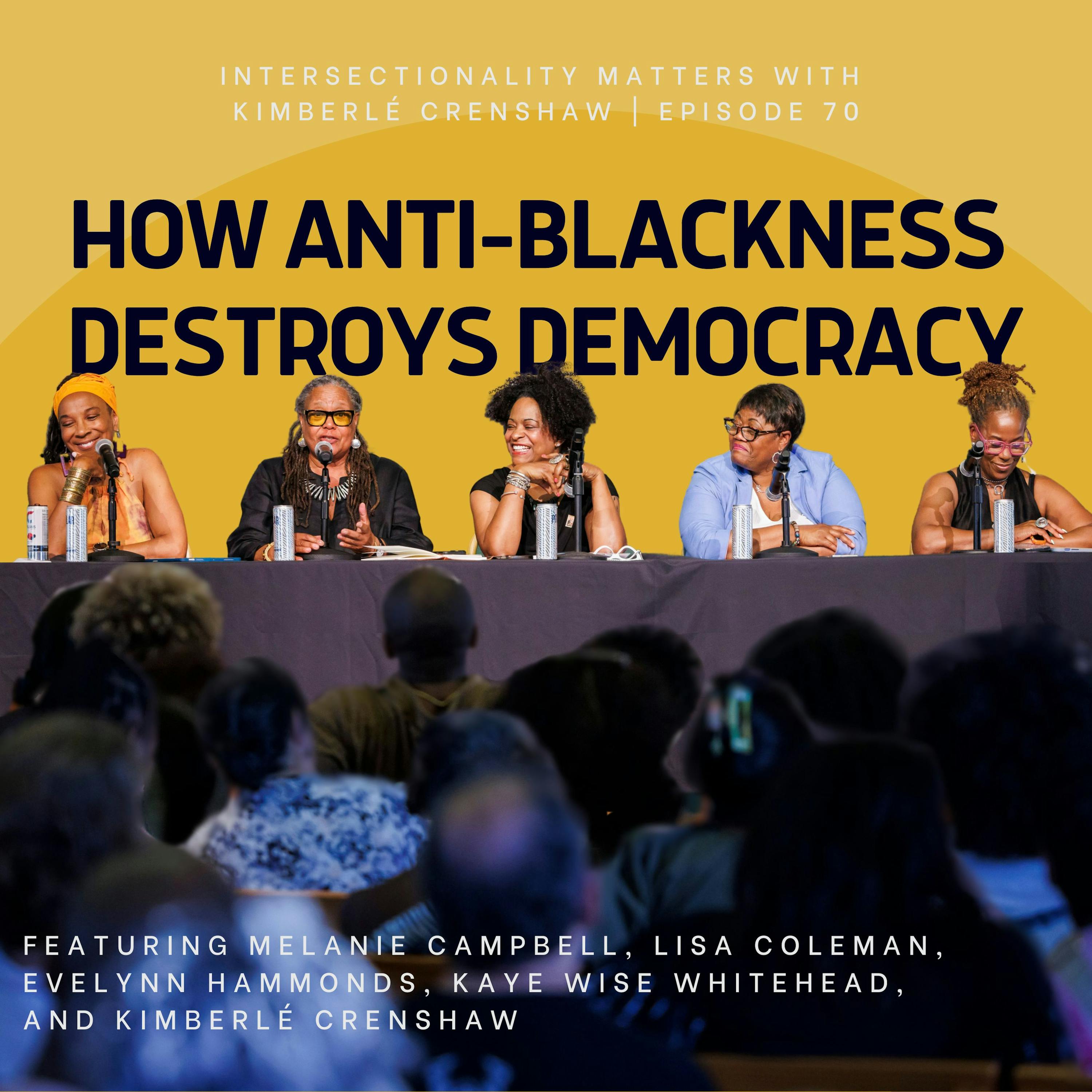
The text introduces the Liberation Calendar for Black History Month and features a podcast episode from "Intersectionality Matters," hosted by Kimberlé Crenshaw. The episode, recorded at an event on Martha's Vineyard, frames the current political moment as a democratic crisis driven by anti-Blackness, comparing it to a descent into fascism. Speakers detail systemic attacks, including the dismantling of racial justice initiatives, disenfranchisement efforts, and the targeted erasure of Black history and knowledge, such as through bans on the 1619 Project and Critical Race Theory. Historians and scholars draw parallels to past racial retrenchment, like the post-Reconstruction Nadir, emphasizing the continuous need to teach Black history as a tool for resilience. They argue that anti-Blackness is a foundational threat to democracy that must be named and confronted. The discussion also covers the resurgence of scientific racism and calls for collective action, using every available space to educate and resist, underscoring that the struggle for a multiracial democracy requires acknowledging and fighting this specific form of oppression.
Liberation Calendar is a new daily practice for Black History Month. Beginning February 1st, the Liberation Calendar will guide users through a daily intentional practice to build our personal and collective resilience. Sign up to receive daily emails with suggested rituals, opportunities for reflection, and calls to action designed to carve out a space for liberation in your day. Join us in following the 2026 Liberation Calendar, a Black History Month partnership with Black Heritage Academy and the African American Policy Forum. Sign up for free at AAPF's website, aapf.org. That's aapf.org. Happy Black History Month. I'm Kimberly Crenshaw and this is intersectionality matters. The podcast that brings intersectionality to life by exploring the hidden dimensions of today's most pressing issues. From say her name to the war on woke, DEI and CRT and the global rise of fascism. This idea travelogue lifts up the work of leading activists, artists, and scholars and helps listeners understand politics, the law, social movements, and even their own lives in deeper, more nuanced ways. For the last six years, AAPF has had a residency at Union Chapel on Martha's Vineyard every summer. That's me speaking to a crowd of mostly black women. At the first of two events we held in August. As you heard, the mood is so so. Of course, we're all happy to be on the Vineyard. It's the place we visit to recharge and reconnect with our friends and family. But there's a tension in the air. It's a tension that I've felt in every city I've been to this summer. And even here, on the Vineyard, a place many black folks consider to be a safe haven. It's hard to shake the feeling that things aren't quite right. We met at the chapel to talk about it. Have a listen. So in last year, we have witnessed the whole sale destruction of the very principles of equal opportunity, of racial justice, of inclusion. We've seen this being carried out by an authoritarian regime that has taken place in the White House. We've witnessed a regime set ablaze the federal bureaucracy. As we know it, we have witnessed American troops invade American cities. We've seen people being disappeared off the streets torn apart from their families taken away from their homes without any legal recourse. We have witnessed the passing of the big brutal bill, which covers tens of millions of low income Americans, including 4.4 million black women and nearly 2/3 of all births to black mothers. We are witnessing attempts by Republican legislators to disenfranchise entire districts and to Jerry Mander, Texas representative, Jasmine Crockett, out of her own district. Just think about that for a moment. Just Jerry Mandering her out of her own district. Now, I think we all know that this is a crisis, but I want to talk a little bit about what people are telling us about this crisis. Some people think that this crisis starts and ends with Trump 2.0 and that if we can just hang on for a few more years, things will return back to politics as usual. That's what some of the folks are telling us. Other folks are telling us that we can afford to ignore and not speak to the anti-blackness that is fueling so much of this slide. We see it playing out in front of our very eyes. And some people are telling us that it's premature or even alarmist to bemoan this moment as a descent into fascism. They tell us fascism is what happens over there. It's not what is happening here in this country. Here I want to quote the great Langston Hughes who said, "We Negroes in America do not have to be told what fascism is. We know it. We have lived it." In other words, we black folks here in the US know something about the tyranny that is unfolding in front of our very eyes. And we also know that we can't begin to grapple with its threat to our democracy without grappling with its threat to us. So the road to authoritarianism in the United States was in the past and continues in this present moment to be paved in anti-blackness. We need to be able to name that. That's why this is going to be an evening full of receipts. But here's the problem. Those who would destroy our democracy understand the connections between their project and anti-blackness better than we do. They understood that when they targeted the 1619 project, CRT, black studies, it was never just about targeting a few ideas, a few historical moments, or even a few legal scholars. It was about the entire effort to promote racial hierarchy as something natural and to generate all the consent that they needed to dismantle our institutions. Now, we call this the opening salvo in Redemption 2.0, just like what happened in the 19th century. It's a lurch to a post-democratic society that's to be run by the anointed ones, the wealthy, white men who presumably are naturally ordained to run this country. So once again, we are being led by those who would rather destroy this nation than to share it. And as was the case when that happened before, everybody suffers. So what began as a tax on black knowledge, black leadership, black history has now metastasized into the mass calling of women and minorities across the public and private sectors in the name of combating DEI. It's resulted in the gutting of billions of dollars of social safety net programs for working folks and the poor and the dismantling of every significant hard fought gain on the road to a true multiracial democracy. This administration has shown us a lot of things, but one of the things that they've shown us the most is their vengeance against anti-racism is not confined just to us. Instead, it's been transformed into a nasty cancer that threatens the very heart of our democracy. So what is this moment telling us that we need to do? One of the things that's telling us is that we can't afford to ignore what's staring us in the face, that if we are unable to address the corrosive role that anti-blackness has and continues to play in eroding our democracy, then we have no hope of saving it. Now, I want to be clear about something when I talk about anti-blackness. The focus on anti-blackness is not a claim that only black people are suffering. It's not a claim that there aren't other dynamics or isms in place. So what I don't want to hear is what about this? What about that? We're not saying that those things aren't playing a role. And it's also not a claim that once we address anti-blackness, our work is done. We're not saying any of those things. But what we are saying is that there are particular dimensions of anti-blackness from its founding role in the republic and the economy that was built around the theft of our labor to the exploitation of black people and the demonization of blackness. All of these continue to permeate our culture and our politics. They've too often been ignored and that ignoring has undermined our capacity to fight back. So when I say I want to give you receipts, we want to unpack all of this. We want to talk about how racism has been used to fuel the tyranny that is emanating from the White House. Now, this is a big, big journey that we're about to go on. And you know, whenever you're about to go on something that's serious, you want to surround yourself by your friends. And I am surrounded by my friends, my, my roadies, the people who are with me and have been with me through this entire moment. So first of all, please welcome Melanie Campbell, who is the president and CEO of the National Coalition of Black Civic Participation and convener of the Black Women's Round Table. Welcome, welcome Melanie. Second is Lisa Coleman, the first female and first black president of Adler University. Lisa is the former inaugural senior vice president for global inclusion and strategic innovation at NYU. Welcome Lisa. And Evelyn Hammons, who is the Barbara Gutman Rosencran's professor.
(audience applauding) Of the history of science and a professor of African and African American studies and a former dean of Harvard College Welcome Evelyn. And last, Dr. K Weiss Whitehead is the host of the award-winning radio show today with Dr. K. She's also the president of the Association for the Study of African American Life and History. All right, my friends, my sister girls, thank you so much for joining this conversation. So I'm gonna start with the historical part and in particular focus on the race retrenchment dimension that I've talked about. And of course that means I'm going to the president of Asala first. You know the story of the organization that Carter G. Woodson began, you are holding that baton. I wanna bring forward one of the quotes from Dr. Woodson in his most famous book, The Miss Education of the Negro. He writes that white supremacy rewrites history to paint a false picture of white superiority and black inslaivability. And since then black people have created entire fields of knowledge to disrupt all of those assumption. So I want us to think now about the lengths that this administration has gone to since our perspectives have been outlawed, our knowledge has been erased, our memory has been attacked. Can you name some of the sites where you've seen this process continue and connected to the larger project of writing us out of American history? - Thank you so much Professor Crenshaw. And it's a pleasure to be up here with you in these esteemed scholars, my sister scholars. So I appreciate that. I wanna go back to go forward because I think when we look at the long arm of history we have to help people understand that what we're seeing today didn't just start today. That this is just the next natural step in the building of white supremacy in this country. When Dr. Cardigy Woodson founded the association and it was 1915, we were in the midst of the nadir of African American history that started at the end of reconstruction and those some people are saying it has continued, we do mark the ending around 1940. It was during that time that the black community was in the midst of what I call a racial syndemic. We are all the way of a pandemic when one thing hits you at one time. A syndemic is when you have multiple pandemics coming toward a community. We were dealing with the ending of what was happening with all the advancements that had been made with Jim Crow. We were dealing with Jim Crow laws being risen up. We were dealing with lynchings at that time. On top of the grief and the despair within the black community with what was happening around this country. So as we were dealing with this, I don't think we talk enough about the ways in which we had to find survival mechanisms at that time. We find to find places to build community at that time. It's a brutal and bloody history of the American racial story. And part of the lies that are being told is you try to rewrite that history. You don't want people to sit with that history. When Dr. Carter G. Woodson launched Negro History Week, it actually wasn't for the entire world. And sometimes people get this mistaken. 'Cause they're all kind of cartoons. Oh, black history, mom, this for them, not for us. No, Carter G. Woodson said, we need Negro History Week. So we can teach our children about the richness of who they are. We need to make sure that our children have the weapons that they need to be able to fight in this society. And they only get the weapons by knowing their history. That's why we have to teach them through more than just a footnote in American history. I also go, Professor Krenshaw, to Mary McClaubba Foon. And Mary McClaubba Foon, in addition, of course, to launching the National Council of Negro Women, Mary McClaubba Foon belonged to Asala first. Because she's our first woman president of Asala. And she was often referred to as the first lady of Negro America. She talked about being a gardener. And she said as parents and as teachers, we have to plant seeds in our children to help them bring order out of the chaos that we see around us. We are in a chaotic moment. We are watching as a National Park Service, which owns many of our historic homes, a cartergy Woodson home, the Bethoon home, Frederick Douglass' home. They are now being threatened. They are now losing staff. And we're losing funding that helps to build up these places. We saw the attack on our beloved Black Sonian. And many of us were out there marching in the street saying, hands off our history. Trying to remind the world that when they go after our textual and material lineage, what they're seeking to do is number our days in the historical record. And we have to make sure that's not going to happen. I end with this. I think we have to do the hard work to remind the world that it's not just enough to say hands off our history. If you're not willing to go out and put your body on the line to protect our history. It's not just enough to say they should create freedom schools if you're not using every space you have. Now, there are a number of places in Baltimore where I'm kind of banned. Because wherever I go, if there's a line, then I'm going to teach Black history. So I'm saying, you know, give me my grind day. And did you know about Mary McClaubt of the-- people like Dr. K, stop turning every space. But that's what we should do to earn every space into a space for freedom school. We have to remind America that our history is not written in pencil. It's written in pen. And we have to have these hard conversations. So people are forced to remember. Thank you. And you all saw some of the images of our May 3rd action to defend the Black Sony. And I just always have to take a moment and say, these two sisters at the end here, they led the march with me. One of them decided that we were going to have some drums. So she brought a drum line. And the other one started just, why are we marching? We need to dance. So hundreds of people were dancing around the Smithsonian. Now that is a black protest, right? That is part of our culture. So I want you to hold the mic for one more moment. And I want to bring Tony Morse and into this conversation. Now Tony Morse gave a famous speech now that more people are discovering where she talks about the steps toward the descent into fascism. And one of the things that she says is that you create a pariah class. And you marshal resources, literary and others to sustain this pariah class. You tell a story about them that generates consent for their treatment. And once that treatment is consented to, then it becomes standard treatment for everybody else. So what can you tell us about how this process is unfolding right now? And why everybody needs to be aware and care and activated by what they're seeing? Thank you for that. Because we know that in order for white mediocrity to be rewritten and taught as white superiority, then they have to erase and dismantle the stories of black excellence. From music, to poetry, art, to literature. And I'm not just talking about the writer and the artist that we lift up. I'm talking about the creativity that just comes from the black experience wherever we move. I'm talking from the way we walk to the way we talk, the way we speak with our eyes without saying a word. You know when sisters get together. Sometimes all you need is a twist of the head. And you know exactly what I'm saying. That's the creativity. If sometimes a shock nature that black folks are surviving and thriving, we are crying and we are laughing. We are moving and we are growing. That we find spaces to create excellence. And that we cannot let our children forget that. You brought up Tony Morrison, Professor Crenshaw. I want to just mention about the white gaze, which we know is loosely coming from when W.B. Du Bois talked about double consciousness. Because Du Bois talked about that sense of always looking at ourselves through the eyes of others. Tony took it a step farther. She said the real problem for black people is white people. Because we have come to believe that we are nothing unless they are defining us. We are nothing unless we match it against them. I think we got to turn that a little bit. And I love Sister Morrison. I think we got to talk about the black gaze. Because I do believe that there's something in the psychosis of whiteness and white supremacy that everything we do has to be dismantled so they can exist. That's that idea. The king said that a man can only ride your back when you're bending over. That there's something that happens when black folks stand up tall. Now, I don't spend a lot of time studying the psychosis of whiteness. But I will say in this moment that if you look at the diversity and the equity and inclusion in this country, and then you watch someone spin an inordinate amount of time trying to tear this down, trying to replace the truth with lies, trying to erase us, you understand.
that they are rejecting truth in favor of their own opinion. They are rejecting the facts in favor of lies. Dr. King in his last speech, Professor Crenshaw, the last sermon that they killed him before he could give. And that sermon was entitled, "Why America might go to hell?" He said, "If America does not remove itself from the racial and economic path that's on, it is on its way to hell." Well, J20, I think, was a sign that we're already there. And so the question is, how do we get out of it? Dr. K, thank you. (audience applauding) So, I wanna go to our third theme race, reform and retrenchment and direct this to my scientist friend. You always need to have that friend who can explain things that you just do not understand. I was never a math science. I didn't get any of that stuff, but this one right here will break it down. (laughing) I want you to break something down. So you serve for two terms as the Obama administration's on the board of oversight for the National Science Foundation. And in that capacity and in your work, you've seen progress being made to grapple with scientific racism. Now we're in a different moment where the Trump administration has adopted to say it likely a radically regressive stance about race and science. Now part of me is not particularly surprised. They told us in 900 pages called Project 2025, all the things that they were intending to dismantle. So holding the line against scientific racism was one of the things that they were going to dismantle. But there is also a part of me that is shocked about how quickly the reemergence of this scientific racism, how quickly and how deeply it's happened. So the executive order against the Smithsonian, for example, holds it and dites it for, let me see how they put it, an improper ideology. And the improper ideology is the idea that race is not natural. The improper ideology is race is constructed. The improper ideology is that if race is not natural, then racial inequality is not natural. All of that is an improper ideology. And in case they think we didn't hear them when they said it, when they purged all the books from Annapolis, the Naval Academy, they took out, I know why the Caj bird's saying, they took out how racism takes place. They left in the bell cur. They left in mine-conf. And so this proper ideology seems to be embracing this idea of scientific racism. Give us some receipts about how this is retrenchment. We're going back to a period of time where science was mobilized to support white supremacy. - Thank you, Kim. (laughing) So good evening. I'm glad to be here with you all this evening. And Kim is raising, I think, a really, really important set of questions. And I want to start trying to explain one thing. Scientific racism never went away. So, I mean, those of us who study science, who worked on building programs to increase the numbers of African Americans and other people of color in the scientific and engineering and technology and medical workforce have been fighting an uphill battle for at least 50 years, if not more. And so, but we started making some inroads. We started making a little bit of progress. It's been too incremental, and that's something we should not do again, but we never really broke through the kinds of barriers that have been deeply embedded in the scientific enterprise in this country from its origins. So I want to start by making some remarks about that with what I do in my class. I teach a class called the Change in Concept of Race in America from Jefferson to Genomics. Because I want to start with Jefferson and end up with Genomics. It's a long arc. But the first thing I do with my students, I say, so what is race? Everybody raises a hand. It's a social construction. And what kind of social construction is it? And they started telling me about hair curl, eye shape, nose shape, differential susceptibility to disease. I said, those are social things. Who can run fast? What group can run fast and track? I'll just kind of start. I'm like, that's not social. Then you're talking about biological and physical characteristics and differences. So how is it a social construction? That piece is very difficult for Americans to get a hold of, because we live in this racialized society, where the natural and the social continue to be conflated all the time and racism. One of the major ways that happens. And so what we really do need this history of this link between science and the ways in which science, from the beginning of the republic was tied to the properties that were supposedly about black people that were naturalized. Jefferson writes in notes of the state of Virginia. The kinds of differences we see among these black people, they can't be citizens because they are different from us and it comes from nature. Those differences are given to us by nature. They are innate and they cannot be changed. So black people have different susceptibility to the pain. Feel pain differently. He went through a whole long and really difficult list of things that made black bodies different from white bodies that made those black bodies unfit for citizenship in this country. And you don't have to get upset about it. He's basically saying because it's given by nature. We didn't do this. God did it. It was given by nature. It's innate and it's not going to change. So we go forward from the 18th century into the 19th century. More and more observers, these natural philosophers who become scientists, continue to probe that question. Well, how are their ears different? How is their nose different? So we have a disgusting comparison of black bodies and white bodies and whose body is always the deficient body, the body that can't be responsible for leading anything in this country, only fit for slavery, for work, for certain kinds of labor. This goes forward in time. And so without knowing that history, I can still have students in the 21st century look at me and they don't know what race is. They couldn't define it walking in the classroom if they're alive, depending on it. But if they can't do it, then how are we going to undo what's just happening? See, this is what I mean. My scientific-- and just to then put the gloss of criticalary theory on top of it, what we bring to the table is the way the law basically authorize that stuff. So you have your scientists saying black people are unfit for freedom. And you have the Supreme Court saying, yeah, the Constitution backs that up. Because they were enslaved. What we did to them is a feature of who they are. So even the black person who's not slave or even those of us after slavery, we are never fit for freedom because of the enslaved ability. What was done to us becomes a natural feature of who we are. So this knowledge together is part of what critical thinking about race actually is. It's also the thing that they don't want us to do anymore. So let's take this resurgence of scientific racism and marry it with the attack on DEI. So now in the name of anti-diversity, equity, and inclusion, I always like to say that because I want people to have to defend being opposed to diversity, equity, and inclusion. Tell me the line of argument against these values. But in the name of it, this administration has gone after grants to better understand maternal mortality, algorithms that undermine black folks' access to particular kinds of treatment, programs that are meant to protect African-American communities from the kind of toxic exposure that happens because of the politics of putting toxic substances next to where we live. So all of these are concrete things that are happening on one hand. On the other hand, if you look about how these things are talked about, how DEI is framed, they'll tell you this is a culture war to make you think that people aren't dying because of it. So help us take forward from this all the ways in which the costs of this attack on science, on access in the name of DEI is not simply a culture war. This is the road towards creating a pariah class that has no power that is being impacted, and eventually this impact will affect everyone. So I think we have to start reading against the grain of what we're being told every day is one of the things we must do. So when they decided to in this last horrible eight month period, and they started shutting down pieces of the National Institutes
of health and national science foundation and other aspects of government agencies, particularly those that were involved in health and science. With respect to health, one of the first directors they close was the national minority health and health disparities. That's one of the first, why would they close that at first? But that's because that's the place where over time many African-American researchers and people who were concerned about the deep-seated racism that still existed in the medical enterprise and were starting to do a lot more rigorous, quantitative, stellar work on trying to solve the problems of the black people's health. That's where a lot of them got grants from. So that's when you shut down first. So again, you can then tell the story that seems more comfortable to America. Well, black people died because they're black people. Not because of the environment. And of course, I always say the father of health disparities work is W.E.B. DuPois. He writes the Philadelphia Negro. He writes the health and physique of the Negro American, all the the turn of the century, the 20th century. And he was one of the first people to say, you keep saying black people have these inherent deficiencies. We die of high rates of tuberculosis than anybody else, but we notice in Chicago, we look at these immigrants who are working in the stockyards and they have high rates of tuberculosis than we do. So is it race? Or is it working in the stockyards? Is that some other set of issues here that are not being seen by these disinterested scientific observers? So that's when I said early, scientific racism hasn't gone anywhere, but it has been consistently contested over the last century to now. And we were making some real inroads, more black professionals in the scientific fields, programs to support them, but we still were not getting above 9% of black people in the scientific and technical workforce. So we weren't breaking down a whole lot of doors, but the ones we did break down have been significant and important, but now when you flip the script and go back to, this is all natural, this is all some inherent inability of black people to live in civilization, which was a common refrain. And even in Science Magazine, not two weeks ago, a scientist said, you know, I don't understand why we were having to shut down our medical programs and research programs because of DEI, there's no bias in Science, there's no bias in Medical. I don't know what these people are talking about. And so that persistent belief that also that Du Bois called out in 1939 in this paper on the Negro Scientist, he said, there seems to be some people who think that black people do not have the quantitative habits of mind to do Science, even though he had met lots of black people who were trying to be Science in the 1930s. Okay, so we've been pushing at these barriers, these challenges, these ways in which we cannot do the work that we have talent for in how communities people, in a democracy, in a real one, if you have the ability to do Science, you ought to be able to do it. If you have the talent to do math, you ought to be able to do it. But that has not been the case for our people in this place. - Yeah. And that's why it's so important to them to naturalize the inequality. If they can say that the inequality is a product of who we are, then not only is there, no, there's not an imperative to change it, your effort to change it is seen as preferential treatment. Reverse discrimination, something illegitimate. On the question of reverse discrimination, preferential treatment and universities, I'm gonna come to you Lisa. (laughing) And all right, so let me just say, Y'all know I teach at Columbia University, and Columbia is in some ways on the front line. I'm gonna say it bending the knee, to authoritarianism. I can't call it anything else but that. So in the details of the bending the knee, there is the agreement to turn over data about admissions. There is the agreement to allow these monitors to oversee some of the departments, right? So we're talking about a wholesale, a tax on the university's autonomy and independence as we know it. This is another thing. I wasn't surprised that they came after it, but I was surprised at how completely any resistance to it actually collapsed. So now we're in the aftermath of the collapse. And I really wanna talk about what that means for Black folk. Now one of the things we know is that in the aftermath of SFFA, that's the anti-affirmative action Harvard case. We saw numbers of African-Americans plummet in some of the more elite programs to levels that we haven't seen since 1960s. So we are talking about retrenchment. I wanna be clear about this. I'm not exaggerating when I'm talking about the effort to really push us back. And so I want you to comment on how universities and university officials have now been deputized into being agents of resegregation. - Thank you, thank you, Professor Krenshaw, for setting this up. So let's talk a little bit about education first because to piggyback on the history and then thinking about scientific racism, education, even pre-born, brown versus bored, Black people were not wanted in the educational systems. So let's first be honest about that. Educational systems were set up for white elite, land owners, and that was the preferential treatment in terms of thinking about who would have access to education. Then we have cases and jurisprudence and law that were all the way up to brown versus bored. But what we know is that this idea of knowledge production which goes back to scientific racism and who owns knowledge. I have worked as a diversity equity inclusion officer for 30 years at three different fairly elite institutions prior to becoming a president. And what I would like to say about those experiences are that knowledge production has always assumed to be owned by an elite class, an elite class of institutions and elite class of people. And that production of knowledge is this reification of whiteness. So as we're kind of unpacking, and as you're talking about the re-segregation, I would say, yes, there's a re-segregation, but I'm not ever sure it was integrated. I think you had parallel tracks in many of these predominantly white institutions. And those tracks meant that you had some people, and we can talk about allies in a second, or not. And so you have these tracks and the way those tracks then mirror this idea of progression, but they really are tracks. And literally in K through 12, you have tracks. Like there are tracks. So again, I think to unpack the idea of education and then these hierarchies, they continue to not only exist, but as Evelyn was speaking, there is no rupture in the sciences, right? I wrote a paper about 20 years ago with a colleague and it had to do with a White House report. It was at the beginning of, it was at the end of the Clinton administration. And I guess I was longer than 20 years ago, I'm old. So, but we wrote a paper and we were looking at what was, talked about, there was a report about the evolution of education. It was a White House report, though Obama administration picks it up, blah, blah, blah. But what they were predicting is that higher education would shift. You were seeing more people of color come into higher ed. And we saw no shift. We didn't see shifts in leadership. We didn't see shifts in the kind of ways in which higher education was being done. So I'm gonna end these comments by saying at just a couple of things, because when you look at this re-segregation and particularly the attack on endowments, research, and loans, right? It's the trifecta. Lones are directly about black people, okay? Make no mistake about that. That is very much about pell grants and that is about private loans. Black people do not get private loans at the same rates. They do not have the same resources to leverage, homes, et cetera, so loans. Second research. And we're not gonna go into research 'cause Evelin has covered at least the scientific part. But when you look at research and the attacks on research, it's particularly the research and that's the knowledge production, right? To get rid of that knowledge. And then lastly, I do wanna say this about endowments because this is where the black alumni groups et cetera are being attacked. And this is very important because endowments are something that when you look at the taxes, but then who's giving to endowments, et cetera, we were seeing the diversification of endowments in higher education. And this is a way to limit that diversification, thus again, the reification of whiteness in higher education and particularly then in who gets to produce and own the knowledge. - Yes, thank you. (audience applauding) - So I wanna build on the connections that you're drawing out here because given the moral panic about affirmative action that we have been looking at, you would think that we'd taken over the university, that we were absolutely everywhere. And so your description of dual tracks and your discussion,
discussion about how we'll wait a minute. Some of this stuff, a lot of this stuff never went away. It does make us then think about, well, okay, so what was the panic about? And how do we understand the attack on the knowledge that we have produced? So I started with the attack on critical race theory, but of course, right now there's an attack on programs. There's all of these reviews of various disciplines. In some states, there's the effort to completely eliminate disciplines. In AP African American studies, there's a whole list of ideas that can no longer be taught in certain states, which is a product of our history and a product of our knowledge. So when we think about this attack, how do we put together the hollowing out of our presence and the hollowing out of the product of our presence, the things that we've done together, there's some people who actually theorize that you define meritocracy by the absence of us being it or the reverse. If we are there, they must not be doing things that are meritocratic. - Yes, so what here is where I would say, and this goes back to something that was talked about earlier, this panic is through the articulation through a multifaceted, so literature, art, science, labor, education. You attack all of those and you create panic. So you create this panic through the system. So the educational system is broken. Knowledge production is broken. Diversity is taking over. Woke is taking over, right? And what is happening is we're producing this literature that is making all these people and keeping other people down. People can't get jobs, certain immigrants are only getting jobs, right? So you have this new, relatively nuanced, but yet flat, right? Overlay of these issues. And that produces a kind of panic, right? Now I do want to also be particular because I think there is another kind of panic. And it has to do with the way in which you create when war is happening. Who do you attack? Women. - Oh yes, okay. You got some, people got some to say. Okay, so during war, right? What you do is you tear down women. This can happen through rape. This can happen through education. It can happen through a number of different ways. If we look at what happened pre in the Kamala Harris election and the ways in which she was demonized on her knees, all of these kinds of images, right? And then we think about black women as being, what was being talked about, black girl magic, right? Every time I heard it, I was like, oh, right? And then black women being the most educated, right? The backlash to that, right? And the panic that you're talking about is what will that mean, right? So there's this hyperbole that then we are taking over higher education. We're taking over the labor markets, taking over government, good government jobs. So those are the ways that you instill that kind of panic through a multifaceted discourse. And then that panic then ensues and you say, okay, now we want to pull all of these things back. Where I could wax poetic about this, but the only other thing that I will say about this particular attack on black women is then you get to the generations. And that is really crucial. Because now you're talking about the attack on generations to come. So 300,000 black women lose their jobs. What does that mean for our future? For the children, for all of those pieces, elder care, all of these pieces. And so when we think about this knowledge production, the knowledge is produced that the threat, who is the threat? And this out and here gets to our allies. You can continue on that. So when we're talking about allies and talking about who's going to be the allies, I have been interested in who has stood up for black women, who has not. I do not see a plan to hire 330,000 people. I don't see a plan to hire 30,000. But I do see requests for us to get on the front lines, right in front of others, who perhaps voted for this. And so as I think about the ways in which we need to reframe, I spend a lot of time reading history as well. And I'm interested in the youth. It's why I stand higher education. And so as I think about the Underground Railroad, I think that's what we need. And we need to think about that underground railroad in a different way now. I know you're going to ask us a question about this later. But I do think that when we think about the people who helped to lead that, and this is no discounting of the men who were deeply involved in that. But I bring it back to war because the people who are the most vulnerable in war, and that's what we are at war, are women and children. And so how do we re-configure and think about how we lead and move forward across perhaps allies? But how do we recreate those underground railroads? Because we are very vulnerable and at risk. Thank you. Can I just say one point about this? So the other thing I said earlier, we spent many of us in the sciences and engineering and medicine. There's spent a lot of time trying to bring more African-Americans into these fields. At the same time, we want to do that because we want to develop the talent that we have to do this kind of work. But also to bring that talent to bear our problems in our communities that have been ignored. But then you have institutions that support STEM education, but don't let them take a humanities course. Don't let engineers take a literature course. Don't let them take sociology. Because then they might start talking about-- They might learn something. They might learn something. Oh, we want more to do-- more of our folks to do computer science. But at the highest level, not at the PhD level, we want to understand that because their argument is then we won't just be the users of the technology that is shaping our world. That's how we can be. We can't be creators. Yeah, it's right. We can't turn that-- and so that part of the educational enterprise, it doesn't have to be the engineering students. They'll have to take that. It's a decision not to have them take history, sociology, anthropology, learn about the social problems that their techniques and talents should help solve. So if you don't have to learn it, they don't value it. And then you can unleash a whole lot of 23-year-old intro to computer science graduates to tear down the government. And they don't think it's a bad thing. Just like that. Just like that. Melanie, I want to come to you and talk about a parallel to what we're talking about in the university. So we just talked a little bit about Kamala Harris. And let me put it this way. It seems like too often the labor of black women is taken for granted. The labor of black women is mobilized to give other people what they want. The labor of black women is used to put people in positions to govern, but not us to be the governors. So I wonder if you could talk a little bit about what happened in 2024 when 107 days to the election, Kamala Harris was put in a position that was untoward. Black women were asked to carry it. And black women did carry it. Black women were asked to make the right choice for democracy. We did. We got a 92%. That's a A in my book. And we did this under immense pressure stresses, but without immense resources. Can you paint a picture of what it's like, what it was like for black women on the ground carrying this weight, mobilizing people. But once again, doing it without the resources and without the support that was warranted given how important black women's voting is to this democracy. Come on, Melanie. OK. I really can. I thought you were my sour, I'm your friend. But in order to answer that question, we always say with all these stories and scholars here, I'm an organizer first. And understanding what happened with this last election, you have to remind ourselves more than anything. First of all, we were winning, which is why we're going through this. But you have to go back to the Obama election, because black women turned it out. Young people turned it out. Black men, maybe not as the right, turned it out. We very clear. And so we're living that backlash. The other thing that took place prior to Kamal Harris being in that position was that we also had decided as black women that we were not going to continue. I love what hard work has been done.
like a lot of us in this room to help get President Obama elected twice. But one of the one things we wanted was a black woman on the Supreme Court. We did not get that. And so we decided that we were not going to allow another Democrat, quite frankly, because that's who, at least halfway, partially, thirded away dealing with the issues that we care about. That we were going to make our demands. If you want our vote, right, then when the last Democratic president, Biden ran, well, like black woman. Of course, it's going to be on. You said a woman? Oh, we know it's going to be a black woman. And we also said we wanted to have that Supreme Court position that we have now. And so that's backlash from that. And we know that. And so understanding the political dynamics when it comes to black political power, the role black women play, we drive that vote. Because we are the ones who influence all of our significant others in our families. The other reality that to get to the question at hand, when then vice president Harris was put in this position, you know, the black women, quite frankly, didn't want her to have to be in that position. Most black women were saying, "You don't need to lead us alone." If they had listened, we might be having a different conversation today. But those who are allies, who know the most intelligence amongst intelligence, which are white male, mostly consultants who get paid whether they win or lose, control that and have always controlled that apparatus. And then we find ourselves in this mess. As we find ourselves in this mess, I do want us to figure out, well, what the hell are we going to do about it? Because we're in a position now where, and we've heard from our awesome sisters here, history has already taught us, you know, how we got here. The question we have to ask ourselves, how are we going to get out of this mess? While we're trying to figure that out, I want us, while we're sitting, I'm here with one of my mentors, Mrs. Korra, Masters Berry, political scientist in the back room. Along with my family, Reverend Dawkins, Judith Moore, and my brother, Isaac Campbell, we road dog of it. And I think we have a chance to stop that we have to figure out how we're going to take care of our people. While this is not going to be fixed by one election, but with all of the wealth, and all of that took for all of us to get here, and I'm not disparaging anybody, but what Texas is doing, we got to do more than. We have to figure out strategies that work. Our young people want to see us do something, and they will do something. Many of us in this room and others, because we have to also provide the resources that are now not going to be there. This ugly bill is already having impact. Don't think that people aren't losing their Medicare now, or their Medicaid, or other things, and students are in trouble. So we have to fill those gaps. And understanding history says what, we have to have some self-determination in this strategy, while we figure out how to organize ourselves from a political standpoint. I'm going to give you the mic back again, not only because we never tire hearing from what you see on the ground. We talked about the 300,000 lost jobs, black women's jobs. I don't know about you, but I see it quoted, but not a sense of urgency about what that means, not a sense of crises or disasters, just like, oh, 300,000 black women, and counting. And so what this reminded me of is what happened when Woodrow Wilson came to power. And he completely re-segregated the federal bureaucracy, and re-segregated it, made it seem like he just put the black people over here and went, no, black people lost their jobs. And it impacted generations. There was just a recent study that shows what it did to home ownership, what it did across generations, how much we lost by that federal policy that pushed black people down and out. So when you think about the long-term consequences of this moment, what do you see, what do you worry? What do you want people to know so they're not sitting on this and say, oh, yeah, 300,000 people? In that history, right? So I think it's an opportunity. We've been talking about this. It's an opportunity for us to reimagine what we want to see. Can we be real? We're already in trouble, right? In this country, it's never fully been this democracy for all of us. So as they have this regime, because that's what it is, has totally destroying this country, this democracy, what do we want to see? It gives us an opportunity to also reimagine what that looks like. At the same time, I will say it again, we have to take care of our people while we're dealing with that. Right now, as we're sitting here, this regime is getting ready to take over the nation's capital. Right. Right. What you saw in LA and other places and said, well, that's just the immigrants, as if they're not black immigrants, is now getting ready to happen to black people. And you mentioned in my sister, those of us who would be out here in these streets, we knew better. But that's me who were sitting on us. Well, for a minute, I sat on the side, yeah, I did. I sat down for a minute, for about 30 days, maybe. I was pissed off. This is a line about that. Very pissed off. Highest specificity. Got to laugh to keep from crying. Yes, you do. But we just have to figure out how we win in this moment and understand that in this moment, we're also planning for those that's not in this room. We're planning for those who have not yet been born yet. And what history has taught us from the first reconstruction to the second reconstruction, and we have to imagine what does the third reconstruction look like? What do we want to see our children inherit? What do I want to say when I'm no longer on this earth? What is my dash going to mean? And that's where we are. What's got to do we have to do? And we will fight. And we will win. Thank you, Melanie. Okay, I want to come back to you. And this, I think particularly falls in line with what Melanie was just talking about. So we've known for a while that this administration was going to be different than the Trump 1.0. And we saw him doing things in real time that I think we're difficult for people to actually grapple with what's happening. So we saw him remove a black folk from the military. We saw him do that. Now, if he's removing them, there's a reason why he's doing that. We see them shuttering the corporation for public broadcasting. We see them clamping on freedom of the press. Now, from what we know about authoritarianism, what we know about fascism, what we know about creating a pariah class, is you set these things up in order to execute exactly what you're planning to without descent, without people being able to understand, without people being able to organize and mobilize. So this is a slow-moving train wreck. Now, you're one of the few voices out there. You're one of the few black women out there. And we've seen others lose their position. Karen Atia at the Washington Post. We saw what happened to Joy Reed. More broadly, we see in Los Angeles how black women were just pushed out of their DEI. So something is happening. The silence is happening everywhere. What do you want people to know about these attacks on the media, the attacks on our ability to speak our reality, and how important it is for us to have these voices, independent voices, to fight against this anti-blackness? Thank you. Actually, I've been waiting for this question because this is the one that I'm wrestling with. Professor Krenshaw mentioned earlier that I host the award-winning show today with Dr. K. I'm one of only two black women in the country to solo host a drive-time radio show. When I started seven years ago, there were six of us. Now it's two. And the one that is on the West Coast, my sister has already been saying they've been shortening her hour. The reason is because drive-time radio is the most powerful time on the radio, because you can get three generations in the car. Who are going home. You get the baby in the car. You get mama in the car. You get grandma. So you can hit three generations every single day. My show has been extended. We were planning for what Trump is doing in terms of going after public radio. I've been following Project 2020.
so we made the decision last summer to extend the show from two hours to three hours. I said we need to really dig down into public radio. So our time is from three to six and we are the highest listening show in terms of our ratings on the East Coast. So today we're Dr. Kate Pills a very large audience. We also know that we're very vulnerable. We are at Morgan State University at WEAA, but because we've turned our entire show into preparing people to practice daily small acts of resistance, our fun drives over the last year have been about resistance work. I'm like you don't have to tell me what you love, show me your paycheck and what you spend it on and I know what you love. If you want the show to continue, we've got to stop relying on them to fund the show and you have to do it. I said you've got to go back to you, you get five dollars, you give twenty dollars and so the challenge with that conversation was the sense because they've canceled all talk shows on my station. I have the only talk show that is still on WEAA. And the reason is because they said you know black folks don't give money to talk shows. That's what I was told. I said no black folks give stuff that stuff that matters. Stuff we believe in, stuff we want to continue. So let's turn the show into something that matters, that they love and that they want to have continue. So we now are able to get our whole budget from our listeners because I said to them this is the moment, like this is what you've been waiting for. So with that in mind, I have just three things I'd like to put on the table. One, with this 300,000 black women, I really want to know that people don't get the importance of that number. They're only 600,000 black people in Baltimore City as a whole. So imagine half of the people in Baltimore City losing their job. The black middle class has been decimated because it was black women through these federal jobs holding up the black middle class. I also wonder for those of us who have not lost their job how many black women are now living in fear that I might be next. I don't want to put my neck out because I do need this income and I understand that except I believe that we're not going to be alive when the change has come. We might as well die like Fannie Lou Hamers said, die standing up to five two feet forward into freedom. We might as well do that kind of work. When it comes back to radio, which is my second point, we have here at AAPF, we had this novel idea around underground radio. We're like every time we do something, let's do underground radio. We're passing the message from radio station to radio station so that we're all carrying the message as much as possible. Underground radio is gone because now they know that we're doing the work and they know what is happening. I think Trump callers start, they wait for my show at one o'clock because when the lines open at three, it is nothing but Trump callers waiting. As I tell them, that means you're actually a fan, you just don't know it. So why don't you find the show? You listen every day but they're clogging the airway so we know that they're listening, we know they're taking notes, we know they're coming after us, but as I tell my listeners, if you fund us, then we will continue. The third point I'll make and this is where I'll wrap up is we have to study something that 47 did, which I think is a case study, around fake news. When he first used a terminology fake news back in 2016, in less than a month he used that little phrase, 1900 times, one Twitter in one month. By the time we got to July of the following year, he had used it over 20,000 times and then it began to get picked up. And when everything is fake news, where you're both calling it fake news and you're creating fake news, then people don't know what to believe. So you can find the person giving out the labor statistics and say she's lying and she's manipulating the facts even though they are the facts and coming from data. So now people don't trust the data because that's how fascism works. Jason Stanley talks about it in his book, how fascism works. He talks about the 10 things and one of the pillars is around unreality where you now believe the only thing coming from the person who puts himself in the center of the story. That's why public radio matters. The person that controls the mic can make sure the narrative stays true. [applause] So, Katie's talked about the importance of the media, the independence of it. I want to get just a little snapshot of how the media were weaponized against Claudine Gay. I think within a period of maybe a few days there was something like 15, 16 stories in the New York Times about Claudine Gay. Overall, something close to 200 more than any other poverty president or citations. So, you're starting to take it up. And let me add the rest of it. So when she was finally pushed out, a comment appeared by someone who had gone after critical race theory and DEI and then Claudine Gay, basically saying, "We did this and here's how we did it. We planted stories in the far right media like Fox and all the other stuff out there. And eventually we could count on the mainstream media to pick it up and turn it into exactly what it was. We did it with critical race theory and now we did it with Claudine and now we're going to do it with DEI. So they basically said it. They did it. And they're continuing to do it. So strategy, taking advantage, taking advantage of the unwillingness of our so-called allies to be critical, to be balanced, to actually be able to call this for what it is. So what is the moral of this story that we're learning, particularly the vulnerability of a black woman leader, the vulnerability of a black woman leader of that kind of institution and the ambivalence of so many of our so-called liberal allies who are willing to play a role that was so utterly destructive? I think one of the things that they were successful at Kim and K is that they put out a narrative that first could put a question mark over Claudine Gay's head. And therefore then our liberal progressive allies, it's a terrible thing to plagiarize something. I don't know. And then they repeat that over and over. And my colleagues who knew her work well, weren't saying anything, they claimed they were saying it to the right people, but it wasn't the big public narrative to defend her because the question had a reason that isn't there always a question mark over black woman's heads? Isn't there always one? You can be the only one in the room and it's still going to be a question mark over your heads. That's right. So moved over to her and then followed by the kind of narrative that Kay is talking about every day, all day, article after article repeating the same stuff over and over again. Then it's like well, after all that news, what choice was left? Well there were a lot of choices left. There were a lot of choices left. There always are. So one of the arguments is, yes, Trump is shaking us down. Yes, he's making it costly for us to maintain leadership, diversity, these programs. At the end of the day, it's for the greater good, for us to negotiate away all of these things. It brings to mind an allegory that the great Derek Bell wrote about. It was called the space traitors and if you haven't read it, go read it and there's even a movie about it. The whole point of it is that these people come from out of space and they say, we will let you solve all your problems. We have all of the resources in the world. The only thing we want is your black people. And the assumption was, oh, they're not going to go for that. And it turns out they do go for it and they're helped in doing this by a black person who is willing to sell us all off in exchange for the greater good. Now the beautiful thing is at the end when he thought that the spaceship was going to take out of black people and he was going to get to stay. They say, oh no, you too. You're getting on this ship as well. But I'm wondering whether Derek was pressient in that because a lot of people were like, oh, Derek, that's too far. People, I mean, the values of diversity and equity, they're too deep. We believe in them too much. The universities are going to stay the course. Media is going to do the right thing on and on and on. And yet it might be that we're looking at space traitors in universities, in the media, and pretty much everywhere else. Does that make sense? Yes. [laughter]
And that's absolutely correct. And when we're talking about people being disappeared. And even as we were talking as Melanie's talking about what's happening in DC, all of these things are happening. And that's precisely right. You set up the conditions for disappearance. You set up the fear for disappearance. You set it all up. And then the disappeared, disappear. And so, and you set up all of these conditions around black women. You set up the conditions around labor. Right. And then you have this disenfranchisement. You know where people are, staking out homes, staking out neighborhoods. And so, that's exactly right. And I did want to add one other piece about allies. Because what happened, what Evelyn is talking about, right. There's the aperture of the university where you have the presidents and the managers. But no one wants to talk about these boards. Yes. And these boards are the same boards who are part of Project 25, 2025. They are the same people who often orchestrate Supreme Court nominations and or not. And so, as we pull back and think about strategies, I do think that we have to pull back when we're naming things these boards. Because the reality is the silence that continues is very much about then who gets disappeared. It's in that silence of those boards, the silence of who's actually doing some of that work as well. And I think that's really important because when you look at the nine institutions or beyond, and the billionaires at play and at war with each other, I think we really do have to unpack those boards and those supposed allies. Because those boards before, in 2020, were like, we need diversity. Yeah. So to your point, they turned on a dime. But that's because they were always there. Yeah. They were always there. And that's part of the history. And there are no consequences to them for turning on the dime, right. That's right. And if we're not willing to make that costly, why shouldn't they? And because the structures weren't there, you asked me the question about hollowing out. Well, it's not, it is a hollowing out of black studies, etc. But the holes were already there. That's right. So you just made the holes bigger. Yes. So, let me go ahead. Thank you. The thing that I think about in this moment kind of still goes back to what are we going to? What are we going to do? And part of what we are not going to do is televised what we don't do. [APPLAUSE] I'm just around railroad to not televised. And also, we have to educate our people. And we have to utilize forums like this to do that. And so, you know, for me, in the organization that I lead, we've been doing a lot and working with you, Kim, and others. And every opportunity I get to be in a room where we can group think. And also, remember that there is no movement out of our young people. And then making sure that we provide those opportunities to support. If you can't go out there and get arrested because I'm not right now. I'm not right now. But when there's time, when there is a time, there is no movement. There is no revolution without sacrifice. And we have to ask ourselves, what are we willing to sacrifice with a take care of ourselves? Yes. We have to take care of our families. Yes. We have to be strategic with our money. Yes. That's what the target showed us. In December, it'll be 70 years since the Montgomery Boycott was target. So we have a roadmap. So let's just use it. And again, the revolution will not be on social media. [APPLAUSE] Love you all. Thank you all. Thank you so much. Thank you, everybody. So I promise receipts. Did you get some? All right. So I want to thank our panelists, Evelyn Hammons, Lisa Coleman, Melanie Campbell, and of course, Kay White Wicehead for feeding us tonight. And thank you, Ken. Thank you, Ken. Thank you, Ken. Thank you, Ken O'Rourke. So thank you, everybody. This episode of Intersectionality Matters was produced by Kevin Manofu and the team at the African-American Policy Forum. Nicole Edwards is our senior producer, mixing by Nicole Edwards and Sean Denham. To support our show, subscribe, leave a review, and follow us on social media at the handle Intersectionality Matters. On your host, Kimberly Crenshaw. We'll be back soon. (bright music)
Podcast Summary
Key Points:
The Liberation Calendar is a daily practice for Black History Month offering rituals and calls to action to build resilience.
The podcast "Intersectionality Matters" discusses the current political climate as an authoritarian crisis fueled by anti-Blackness, threatening democracy.
Speakers argue that attacks on Black history, CRT, and DEI are part of a broader project to erase Black contributions and reinforce racial hierarchy.
Historical context is provided, linking current events to past struggles like the Nadir period and the work of Carter G. Woodson to preserve Black history.
The conversation warns against normalizing the situation and emphasizes the need for active resistance to protect history and combat scientific racism.
Summary:
The text introduces the Liberation Calendar for Black History Month and features a podcast episode from "Intersectionality Matters," hosted by Kimberlé Crenshaw. The episode, recorded at an event on Martha's Vineyard, frames the current political moment as a democratic crisis driven by anti-Blackness, comparing it to a descent into fascism. Speakers detail systemic attacks, including the dismantling of racial justice initiatives, disenfranchisement efforts, and the targeted erasure of Black history and knowledge, such as through bans on the 1619 Project and Critical Race Theory.
Historians and scholars draw parallels to past racial retrenchment, like the post-Reconstruction Nadir, emphasizing the continuous need to teach Black history as a tool for resilience. They argue that anti-Blackness is a foundational threat to democracy that must be named and confronted. The discussion also covers the resurgence of scientific racism and calls for collective action, using every available space to educate and resist, underscoring that the struggle for a multiracial democracy requires acknowledging and fighting this specific form of oppression.
FAQs
The Liberation Calendar is a daily intentional practice for Black History Month, offering rituals, reflection, and calls to action via email. You can sign up for free at AAPF's website, aapf.org.
The episode explores the rise of authoritarianism and fascism in the U.S., emphasizing how anti-blackness fuels these threats to democracy and racial justice.
It argues that anti-blackness has historically paved the road to authoritarianism, with current attacks on CRT, DEI, and Black history being part of a broader effort to dismantle democratic institutions.
Dr. K explains that Carter G. Woodson created Negro History Week to arm Black children with knowledge of their history as a survival tool against white supremacy, not just for broader education.
Scientific racism uses pseudoscience to justify racial hierarchy. It never fully disappeared but is now being revived through policies that label race as a social construct as 'improper ideology' and purge related educational materials.
The podcast urges turning every space into a 'freedom school' to teach Black history, actively protecting historic sites, and using protests and cultural expression like dance to defend Black legacy.
Chat with AI
Loading...
Pro features
Go deeper with this episode
Unlock creator-grade tools that turn any transcript into show notes and subtitle files.
 PodcastTranscript AI